Home Blog Page 867

Flying Tigers veterans relive friendship between Chinese and American people during China tour

Flying Tigers veterans relive friendship between Chinese and American people during China tour

By Bai Ziwei, Liu Ge, Liu Lingling, People’s Daily

“Should old acquaintance be forgot, and auld lang syne…”

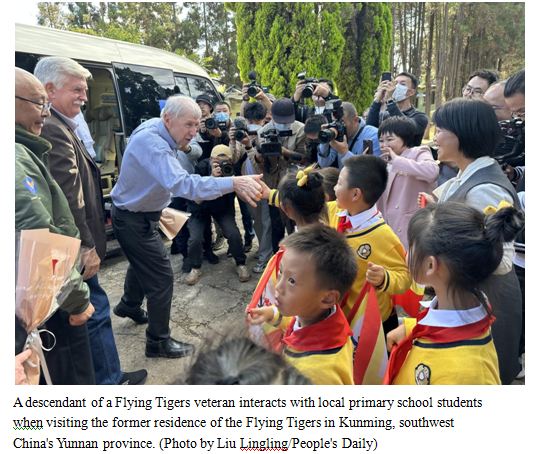
Accompanied by melodious accordion, a delegation of the U.S. Flying Tigers veterans and their descendants joined teachers and students from the Kunming Foreign Language School, a “Sino-U.S. Hump Airlift Memorial School”, in Kunming, southwest China’s Yunnan province, in singing the song “Auld Lang Syne”during a visit to the school.

The song reminded Flying Tigers veteran Harry Moyer of the days when the Flying Tigers fought alongside the Chinese people against Japanese aggression and forged a deep friendship.

Reliving that history and seeing the smiles on students, Moyer was moved to tears by the performance of the song in the auditorium of the Kunming Foreign Language School.

The friendship did not come easily, said Moyer.

Their visit to the Kunming Foreign Language School was part of a recent China tour organized by the Sino-American Aviation Heritage Foundation formembers of the American Volunteer Group of the Chinese Air Force, known as the “Flying Tigers,” and their descendants.

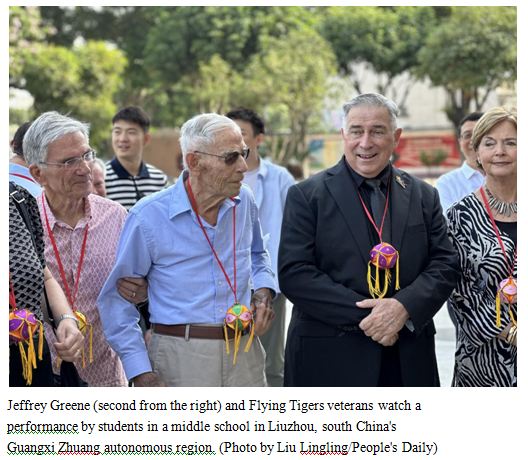
The delegation visited Chinese cities including Beijing, southwest China’s Chongqing municipality, Kunming, and Liuzhou city of south China’s Guangxi Zhuang autonomous region, renewing friendship between the Chinese and American people.

Moyer told People’s Daily that Kunming was the place he looked forward to visiting the most in this tour of China.

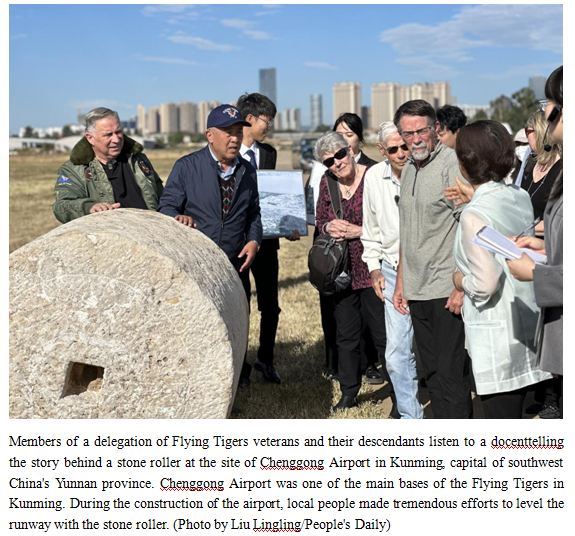
The city was where the Flying Tigers first took off to combat in China, and also the starting point and logistics hub of the famous “Hump” air route, a vital airlift route over the Himalayas and the primary way the Allies supplied China between 1942 and 1945 in World War II.

In 1942, after Japan occupied Myanmar and cut off China’s last international connection, the Flying Tigers blazed a new air route – the “Hump” route over the Himalayas. The route was extremely difficult to fly, but the fearless and selfless members of the Flying Tigers braved all challenges and built an “air bridge” over Kunming.

Back then, people in Yunnan also overcame tremendous difficulties to provide supplies for the Flying Tigers, and did their utmost to rescue downed members of the Flying Tigers, making the legendaryAmerican Volunteer Group a symbol of mutual assistance between the Chinese and American people.

During the visit to the Kunming Foreign Language School, members of the delegation watched the “Green Path and Rainbow: the Story of the Flying Tigers and the Hump”, which showed the Flying Tigers’ adventure to open the “Hump” air route. The was voluntarily created by locals of Kunming.

As actors playing locals gave a thumbs-up gesture and praised the bravery of members of the Flying Tigers as “ding hao” (“top-notch”)in local dialect, Moyer, sitting in the audience, also raised his hands and gave a thumbs-up to the actors on stage.

The American people speak a different language from the Chinese people, but the friendship and emotions between the two peoples are connected, said Moyer’s granddaughter Sarah Moyer.

Deeply touched by the performance, she said she will definitely pass on this sincere friendship.

At the Kunming Flying Tigers Museum, exhibits including pilot goggles, military oil stoves, and group photos of members of Flying Tigers andChinese soldiers and civilians evoked memories of the Flying Tigers.

Jane Bonner Scott, daughter ofFlying Tigers pilot Steve Bonner,couldn’t help but shed tears as she saw her father’s photos in the museum.

Her father loved China very much, according to Jane Bonner Scott, who recalled that her father, who passed away two years ago, often talked to her about China and the Chinese people.

Coming to China to visit the place where her fatherhad fought madeher think of him a lot, Jane Bonner Scott said.

The history and memories of the Flying Tigers belong not only to her and her family, but also to the people of both countries, noted Jane Bonner Scott, who added thatshe hopes more young people will learn about the Flying Tigers’ story and cherish peace and friendship.

The name “Flying Tigers” can be frequently seen along the streets of Kunming, where there are buildings, avenues, theme restaurants, among other facilities named after the Flying Tigers, which have become a vivid demonstrationof the profound friendship between the Flying Tigers and the Chinese people.

Nell Calloway, granddaughter of U.S. General Claire Lee Chennault, who led the wartime Flying Tigers pilots to fight Japanese invaders in China during World War II,has visited Kunming more than once.

All the members of the Flying Tigers she knows have told her that they received warm welcome and support from the Chinese people, said Calloway, who disclosed that she was present at the opening of the Kunming Flying Tigers Museum.

During her recent visit to Kunming, Calloway expressed her heartfelt wish for the deep friendship between the Flying Tigers and the Chinese people to continue to be passed down from generation to generation, and for a continuation of the beautiful story of friendship between the American and Chinese people.

Flying Tigers veterans relive friendship between Chinese and American people during China tour

To jointly build Asia-Pacific community with shared future

To jointly build Asia-Pacific community with shared future

By He Yin, People’s Daily

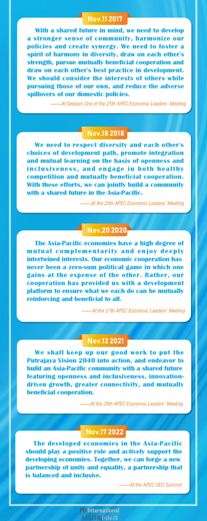
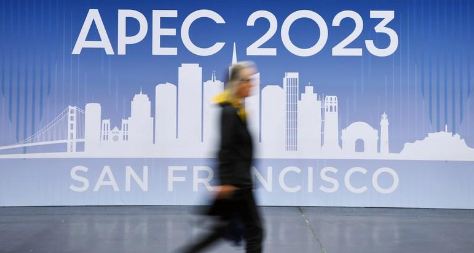
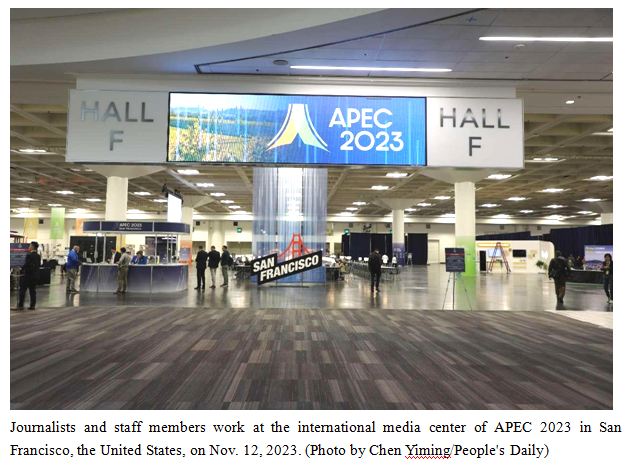
This year marks the 30th anniversary of the first Asia-Pacific Economic Cooperation (APEC) Economic Leaders’ Meeting. Chinese President Xi Jinping has been invited to attend the 30th APEC Economic Leaders’ Meeting, which fully showcases the great importance China attaches to Asia-Pacific economic cooperation.

China will continue to contribute wisdom and strength to deepen Asia-Pacific cooperation and promote the building of an Asia-Pacific community with a shared future.

The Asia-Pacific region accounts for one-third of the world’s population, over 60 percent of the world’s economic output, and nearly half of global trade. It is the most dynamic economic area of the world.

As an important economic cooperation platform in the Asia-Pacific region, APEC has made continuous progress in promoting regional trade and investment liberalization and facilitation and played a positive role in driving global and regional economic growth.

Currently, the Asia-Pacific region enjoys overall stability, and regional cooperation continues to make progress. Peaceful development and win-win cooperation remain the mainstream.

At the same time, the world enters a new period of turbulence and transformation, with geopolitical tensions and an evolving economic landscape impacting the development environment and cooperation framework in the Asia-Pacific region.

All parties expect the Asia-Pacific region to follow the path of peaceful, open, cooperative, win-win and inclusive development, respond to the challenges of the times, promote regional economic integration, explore new development prospects, and lead global economic growth.

China has been actively advocating for the building of an Asia-Pacific community with a shared future and firmly led the direction in promoting cooperation in the region.

Since 2013, Xi has attended or chaired APEC Economic Leaders’ Meetings and delivered important speeches.

China has promoted Asia-Pacific cooperation through its propositions, promoted the development of the region with its contributions, built consensus in the region with its wisdom, and promoted the joint construction of an Asia-Pacific community with a shared future featuring openness and inclusiveness, innovation-driven growth, greater connectivity, and mutually beneficial cooperation.

At the 30th APEC Economic Leaders’ Meeting, Xi will deliver an important speech to fully elaborate on China’s major propositions on deepening Asia-Pacific cooperation and driving regional and global growth.

China will steadfastly work with all parties to promote the prosperity and development of the Asia-Pacific region and create a better future for the region.

China, as a key player in the Asia-Pacific region, holds immense potential for economic growth and plays a significant role in driving regional economic development.

The Asian Development Bank’s Asia Economic Integration Report 2023 indicated that China contributed 64.2 percent to the region’s total economic growth, 37.6 percent of the growth in trade in goods, and 44.6 percent of the growth in trade in services.

The country is dedicated to deepening the Asia-Pacific partnership featuring mutual trust, inclusiveness and mutually beneficial cooperation. It aims to build an Asia-Pacific community with a shared future that is peaceful, stable, clean and beautiful, a region where all are ready to help each other and that brings prosperity for all.

The commitment will create new opportunities and inject fresh impetus into the development and prosperity of both the Asia-Pacific region and the world at large.

China’s development has benefited from the Asia-Pacific region, and China reciprocates by benefiting the region through its own progress.

China stays committed to opening up in a wider scope and broader areas and at a deeper level. It sticks to Chinese modernization and builds new systems for higher-level open economy. China will continue to share its development opportunities with the world, especially with the Asia-Pacific region.

It is widely recognized that a prosperous and strong China not only serves the fundamental interests of the Chinese people but also brings more benefits to the Asia-Pacific and the world.

The peace, stability, and prosperity of the Asia-Pacific region belong to all the people in the region, and the future of the Asia-Pacific relies on the joint efforts of the people.

All parties should stay true to their original aspirations, adopt a strategic and long-term perspective on regional cooperation, and uphold APEC’s role as the main channel in regional cooperation and keep Asia-Pacific cooperation in the right direction, so as to work together to build an Asia-Pacific community with a shared future.

To jointly build Asia-Pacific community with shared future

To strive for lasting peace, common prosperity in Asia-Pacific region

The 30th Asia-Pacific Economic Cooperation (APEC)

By Huan Yuping, People’s Daily

The 30th Asia-Pacific Economic Cooperation (APEC) Economic Leaders’ Meeting is scheduled for Nov. 15-17. Currently, the Asia-Pacific region enjoys overall stability, and regional cooperation continues to make progress. Peaceful development and win-win cooperation remain the mainstream.

At the same time, the world enters a new period of turbulence and transformation, with geopolitical tensions and an evolving economic landscape impacting the development environment and cooperation framework in the Asia-Pacific region.

Standing at a new crossroads, whether Asia-Pacific cooperation can stay true to its original aspiration, follow the correct direction, and steadfastly move towards the goal of building an Asia-Pacific community with a shared future, is crucial to world peace and development, and tests the wisdom and responsibility of all parties in the region.

The 21st century is the Asia-Pacific century. The establishment and development of APEC are in line with the historical trend of openness and integration, the strong aspiration for development in the Asia-Pacific region, and the common demand of people from various countries for jointly addressing challenges.

Over the past more than 30 years since its establishment, APEC has gradually grown into the highest-level and most influential mechanism for economic cooperation covering the broadest area in the Asia-Pacific region. It has witnessed the historical achievements of Asia-Pacific development and is an important propeller of the “Asia-Pacific miracle.”

According to the Regional Economic Outlook for Asia and Pacific recently released by the International Monetary Fund, the region is expected to grow by 4.6 percent this year, and economic activity in Asia and the Pacific remains on track to contribute about 2/3 of global growth in 2023. This once again highlighted the Asia-Pacific region as the most dynamic and promising economic area of the world, and a crucial engine for global economic growth.

The success story of APEC is a remarkable chapter in the construction of an open world economy. Guided by the Bogor Goals, APEC has continuously enhanced regional economic integration. It has advanced trade and investment liberalization and facilitation in tandem with economic and technical cooperation, with a view to realizing mutual complementarity and balanced development of the “two wheels” of APEC cooperation.

APEC, guided by open regionalism and the principles of diversity and non-discrimination, has become an architecture for inclusive and win-win regional cooperation. It has not only benefited the region, but also played a significant role in leading the evolution of the multilateral trading system.

Over the past decades, economies in the Asia-Pacific region have broken market barriers, strengthened economic ties, and actively embraced the world, creating vast opportunities for economic development.

In the 26 years since the implementation of the Bogor Goals, the region’s trade volume increased five times with an average annual growth rate of 6.7 percent, and two-way investment increased 12 times with an average annual growth rate of over 10 percent.

Currently, the international situation is complex and volatile. The Asia-Pacific region has seen practices that distorted international norms, impeded economic ties, and exacerbated regional tensions.

At this critical juncture, all parties in the region need to take a strategic and long-term perspective on Asia-Pacific cooperation. By upholding APEC’s role as the main channel in regional cooperation and keeping Asia-Pacific cooperation in the right direction, the region can effectively respond to the challenges of the times and jointly forge a new path for development.

To further strengthen APEC cooperation, it is important to adhere to the established goals. APEC members, based on the initial realization of the Bogor Goals, have launched the Putrajaya Vision 2040, aiming to build an open, dynamic, resilient and peaceful Asia-Pacific community, which offers important guidance for economic cooperation in the region in the near future.

With clear objectives in place, it is crucial to take action. APEC members should deepen cooperation within the APEC framework, advance the Free Trade Area of the Asia-Pacific, and implement the Putrajaya Vision 2040.

Deliberate attempts to dilute the concept of “Asia-Pacific” and replace the region’s well-established cooperation structure with a new one will only divert Asia-Pacific cooperation from the right track and hinder the development of the region.

To further strengthen cooperation within the APEC framework, it is necessary to build closer partnerships. APEC is a big family, and it is in the common interest of all members to build an open Asia-Pacific economy featuring innovative development, interconnected growth, and shared interests. The Asia-Pacific partnership featuring mutual trust, inclusiveness and mutually beneficial cooperation is the spiritual bond of the APEC family and an important guarantee for keeping APEC cooperation on the right track.

There are various national conditions in the Asia-Pacific region, thus there will be differences. The key is to adhere to the common goal of seeking development, promote the spirit of partnership, negotiate and address differences, and explore solutions to common challenges.

Only by adhering to the right direction can regional countries renew the “Asia-Pacific miracle” together. Each APEC member should uphold the purposes and principles of APEC, continuously deepen partnerships in the Asia-Pacific region, promote the spirit of the Asia-Pacific family, and work together in solidarity and with mutual assistance. Building an Asia-Pacific community with a shared future is the correct choice that conforms to the trend of history, regional consensus, and the will of the people.

To make greater contributions to Asia-Pacific’s stability, prosperity

To make greater contributions to Asia-Pacific's stability, prosperity

By Yu Yichun, Cao Shiyun, People’s Daily

This year marks the 30th anniversary of the first Asia-Pacific Economic Cooperation (APEC) Economic Leaders’ Meeting. Over the past 30 years, China’s deepening reforms and expanding opening up have gone hand in hand with the continuous expansion of Asia-Pacific economic cooperation.

Since 2013, Chinese President Xi Jinping has attended or chaired APEC Economic Leaders’ Meetings and delivered important speeches.

From “building an Asia-Pacific community with a shared future” to “creating and fulfilling an Asia-Pacific dream,” and from “forging an Asia-Pacific partnership” to “building a high-quality Asia-Pacific connectivity network,” Chinese ideas and proposals have sparked strong resonance in the Asia-Pacific region, making significant contributions to the stability and prosperity of the region.

China’s opening up and development are closely related to the Asia-Pacific region. China has always been a staunch supporter and active promoter of Asia-Pacific regional economic cooperation, integrating its own development with regional development and driving the opening up of the whole region through its own opening up.

In 2022, China’s trade volume with Asia-Pacific economies reached $3.1 trillion, a year-on-year increase of 19.2 percent, accounting for 36.8 percent of China’s total foreign trade.

During the same period, China’s high-quality implementation of the Regional Comprehensive Economic Partnership (RCEP) resulted in a total of 12.95 trillion yuan ($1.78 trillion) in imports and exports to other RCEP members, growing 7.5 percent from a year ago.

According to the Asian Economic Integration Report 2023 by the Asian Development Bank, Asia’s economic recovery is driven particularly by China, which accounted for 64.2 percent of total growth.

China has been making continuous and concrete efforts to deepen trade and investment cooperation with regional economies, contributing its part to building an open economy in the Asia-Pacific.

It pushed for the launch of the process to build a Free Trade Area of the Asia-Pacific at the 2014 APEC meeting in Beijing, and actively worked to join the Comprehensive and Progressive Agreement for Trans-Pacific Partnership and the Digital Economy Partnership Agreement. Furthermore, China has been actively promoting the China-ASEAN Free Trade Area 3.0 with ASEAN members.

The 30th APEC Economic Leaders’ Meeting, with the theme of “Creating a Resilient and Sustainable Future for All,” conveys the significance of green development and innovation for the Asia-Pacific region.

Under the active promotion by the Chinese government and the vigorous participation of Chinese enterprises, cooperation platforms such as the APEC Sustainable Energy Center and the China-Pacific Island Countries Climate Change Cooperation Center have gradually been established. Green development projects, including the Dzilam State Reserve located in Mexico’s Yucatan Peninsula, have commenced, contributing Chinese wisdom and solutions to building a clean and beautiful Asia-Pacific region.

APEC Secretariat Executive Director Rebecca Sta Maria noted that China has demonstrated its determination to achieve sustainable development through practical actions and has fulfilled its international commitments in the field of sustainable development.

Leveraging the digital twin technology, Chinese scientists are providing more solutions for the protection of marine biodiversity in Latin American countries. By introducing technologies such as 5G, cloud computing, and artificial intelligence, Chinese companies are helping Thai hospitals achieve comprehensive intelligent transformation in their services. With the assistance of the China-ASEAN Information Harbor, the level of cross-border trade and economic services between China and ASEAN countries continues to improve.

China not only leads the world in technological innovation and digital economic development, but also actively promotes digital transformation in the Asia-Pacific region and even the world at large.

Working with its partners to promote high-quality Belt and Road cooperation, China is improving the connectivity level in the Asia-Pacific region. It proposed to establish the Asian Infrastructure Investment Bank, aiming to provide financial support for regional infrastructure development.

China has hosted a series of international exhibitions such as the China Import and Export Fair, China International Fair for Trade in Services, and the China International Consumer Products Expo at high standards, collaborating with various parties to write stories of open cooperation and mutual benefit.

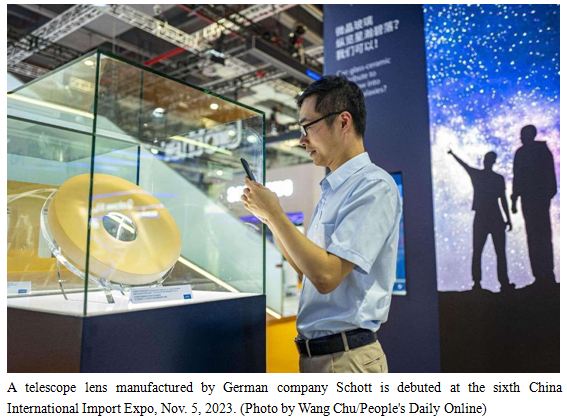
The just-concluded sixth China International Import Expo achieved fruitful results, with tentative deals reaching a new high of $78.41 billion, a 6.7 percent increase from the previous year.

China is committed to advancing high-level opening up, continuously providing new opportunities for the Asia-Pacific region and the world through its new development, and contributing Chinese strength to the construction of an open world economy.

Major countries should shoulder great responsibility. The United States is the host of the 30th APEC Economic Leaders’ Meeting. China and the United States are the world’s top two economies, accounting for over 1/3 of the global economic output, nearly 1/4 of the world’s population, and approximately 1/5 of global bilateral trade. They play a unique and important role in driving economic growth in the Asia-Pacific region and promoting regional cooperation.

The wide globe is fully capable for the two countries to develop themselves and prosper together. Stabilizing and improving China-U.S. relations not only serves the fundamental interests of both countries and their peoples, but also contributes to peace and prosperity in the Asia-Pacific region and even the world.

The world is once again at the crossroads of history. Under the new situation, Asia-Pacific economies need to learn from past experiences and lessons, respond to the challenges of the times and steadfastly advance Asia-Pacific regional economic integration, so as to jointly break new ground in development and build an Asia-Pacific community with a shared future. They will contribute wisdom and strength to world peace and development with the stability and prosperity of the Asia-Pacific region.

To make greater contributions to Asia-Pacific's stability, prosperity

To open new, splendid era of long-term peace, stability, high-quality development in Xizang

To open new, splendid era of long-term peace, stability, high-quality development in Xizang

By People’s Daily

The social and economic progress of Xizang epitomizes the nation’s outstanding achievements in development, created on the roof of the world through the Chinese path to modernization, says a white paper titled “Communist Party of China (CPC) Policies on the Governance of Xizang in the New Era: Approach and Achievements.”

The white paper was released by China’s State Council Information Office on Nov. 10. With detailed statistics and abundant facts, the document systematically summarizes the comprehensive progress and historic achievements in all undertakings related to the Xizang autonomous region under the CPC’s strategy in governing Xizang in the new era. It fully demonstrates China’s firm determination and strong confidence in ensuring good governance in Xizang and maintain long-term stability and high-quality development in the autonomous region.

To govern the country well, China must first govern the frontiers well, and to govern the frontiers well, the country must first ensure stability in Xizang.

Since the 18th National Congress of the CPC held in 2012, the CPC Central Committee with Comrade Xi Jinping at its core has deepened its understanding of the work related to Xizang through years of practice, summarized the successful experience of the CPC in leading the people to govern, stabilize, and develop Xizang, and has formulated the CPC policies on the governance of Xizang in the new era. This provides fundamental guidance for effectively carrying out work related to Xizang in the new era.

The CPC policies on the governance of Xizang in the new era, grounded on the practice of socialism with Chinese characteristics and the actual situation of Xizang, demonstrate a keen understanding of work related to Xizang. They encapsulate the CPC’s past successes in stabilizing Xizang and its plans for future development. Embodying Xi Jinping Thought on Socialism with Chinese Characteristics for a New Era, these guidelines provide answers to a series of questions on the future direction and strategy in governing Xizang.

The main driver of the CPC’s endeavors is the people’s aspirations for a better life. From eradicating absolute poverty to developing a system of public cultural services, from strengthening its work related to ethnic affairs and managing religious affairs in accordance with the law to constantly improving its working mechanisms and governance capacity, and from making efforts to become a national or even an international model in advancing eco-civilization to ensuring the right of all people of all ethnic groups to be masters of the region and the country, Xizang, following the CPC policies on the governance of Xizang in the new era, has made significant progress in stabilizing the social environment, achieving rapid economic progress, and strengthening the Party organization in Xizang, which has led to a better life to its people, amity among all ethnic groups and religions, cultural prosperity, sound ecological systems, and secured borders.

Together with the rest of the country, people in Xizang have witnessed the tremendous transformation of the Chinese nation from standing up and becoming prosperous to growing in strength.

Since the new era, Xizang has experienced a period of unprecedented development and huge change, bringing more tangible benefits to the people. It has achieved all-round progress and historic success in various undertakings. The fundamental reason for such huge progress is that the autonomous region follows the strong leadership of the CPC Central Committee with Comrade Xi Jinping at its core and follows the scientific guidance of Xi Jinping Thought on Socialism with Chinese Characteristics for a New Era.

The region’s achievements have proved that to ensure long-term stability and high-quality development in the region, the Party’s guidelines on the governance of Xizang in the new era must be fully and thoroughly implemented. The region’s development must serve to benefit ethnic unity and progress, to safeguard national unity and oppose separatism, and to improve people’s lives and build social consensus, so that people of all ethnic groups in Xizang will have a greater sense of gain, fulfillment and security. To ensure long-term stability, prosperity and high-quality development in Xizang, the four main tasks of ensuring stability, facilitating development, protecting the eco-environment, and strengthening the borders must be successfully and effectively fulfilled.

Since the 20th National Congress of the CPC held in 2022, people of all ethnic groups in China have embarked on a new journey of promoting comprehensive national development and achieving the great rejuvenation of the Chinese nation through the Chinese path to modernization.

Xi Jinping, general secretary of the CPC Central Committee stressed that no ethnic group shall be left behind in building a great modern socialist country in all respects.

He urged full realization of common prosperity and development of all ethnic groups, so as to ensure that people of all ethnic groups can share the glory of building China into a great country and advancing the rejuvenation of the Chinese nation..

Embarking on the new journey, China must align its thoughts and actions with the decisions and deployments of the CPC Central Committee. It must firmly forge a stronger sense of the Chinese nation as one single community, unswervingly follow a Chinese approach to ethnic issues, fully implement the Party’s policies on the governance of Xizang in the new era, apply the new development philosophy in full, to the letter and in all fields, and promote ethnic unity and progress on all fronts.

The country must focus on safeguarding national unification and strengthening ethnic unity, focus on improving people’s lives and strengthening unity in socio-economic development, consolidate its achievements in poverty reduction and comprehensively advance rural vitalization, build Xizang into a high ground of ecological progress, and pave a path of high-quality development that suits Xizang’s reality.

It has been proved that without the CPC, there would have been neither New China nor new Xizang, said Xi during an inspection tour in Xizang. The CPC Central Committee’s guidelines and policies concerning Xizang work are completely correct, he added.

Today, Xizang is embracing an unprecedented and extraordinary opportunity for development, as it takes flight towards a brighter future.

Under the strong leadership of the CPC Central Committee with Comrade Xi Jinping at its core, guided by the CPC policies on the governance of Xizang in the new era, and with the wholehearted support of the people across the nation, as well as the collective efforts of all ethnic groups in Xizang, the autonomous region will surely open a new and splendid era of long-term peace and stability and high-quality development.

To open new, splendid era of long-term peace, stability, high-quality development in Xizang

To pass down friendship between American, Chinese people from generation to generation

To pass down friendship between American, Chinese people from generation to generation

By Jeffrey Greene

Recently, I led a delegation of the Flying Tigers to China to attend an event to commemorate the 80th anniversary of the U.S. 14th Air Force’s participation in China’s war of resistance against Japanese aggression. We visited Beijing, Chongqing, Kunming, Liuzhou, and other cities.

Among the members of our delegation were Flying Tigers veterans Harry Moyer and Melvin McMullen, as well as relatives and descendants of Flying Tigers veterans. Together, we reviewed the history of the American and Chinese people fighting shoulder by shoulder during the war and encouraged the younger generation to inherit and carry forward the spirit of the Flying Tigers.

The spirit of the Flying Tigers is a shared legacy of the American and Chinese people, and we believe that this visit to China will promote greater understanding of the Flying Tigers story and better inheritance of their spirit among the people of both countries, particularly the younger generation, so that the friendship between the two nations will be passed down from generation to generation.

The story of the Flying Tigers is well-known in China. In 1941, General Claire Lee Chennault established the American Volunteer Group, also known as the Flying Tigers, to assist China in its fight against Japanese aggression. My first visit to China in 1995 was related to the Flying Tigers.

At that time, a group of Flying Tigers veterans were invited to China to participate in an activity commemorating the 50th anniversary of the victory of Chinese People’s War of Resistance Against Japanese Aggression and the World Anti-Fascist War. I was producing a documentary about the Flying Tigers and had the privilege of accompanying them.

During that time, we were considering how to ensure that more people would remember this history and promote the spirit of the Flying Tigers. Eventually, we decided to establish the Sino-American Aviation Heritage Foundation, with the aim of deepening Americans’ understanding of this history and encouraging more young people to carry on the spirit of the Flying Tigers.

Since its establishment in 1998, the Sino-American Aviation Heritage Foundation has financed nearly 500 Flying Tigers veterans and hundreds of their relatives to visit China. Over the years, the foundation and the Flying Tigers veterans have been telling the story of the Flying Tigers in the U.S. and China, promoting the understanding of the history and deepening friendship between the young generation of the two countries.

Last year, the Sino-American Aviation Heritage Foundation launched the Flying Tigers Friendship Schools and Youth Leadership Program, and facilitated the establishment of a “Flying Tigers Friendship School” relationship between Jack Lund Scofield Middle School in Nevada, U.S. and two middle schools in China. This has created a new platform for passing on the Flying Tigers spirit and enhancing friendship among young people from both countries.

The Flying Tigers symbolizes the mutual assistance between the people of the U.S. and China, and the spirit of the Flying Tigers represents friendship and cooperation. During their operations in China, over 2,000 Flying Tigers members sacrificed their lives, and thousands of Chinese people gave their precious lives when rescuing endangered Flying Tigers pilots. During this trip to China, we saw many monuments and museums in different cities that tell the stories of how our two countries’ military and civilians fought side by side. We were deeply moved.

As time goes by, there are now only around 20 surviving Flying Tigers veterans. Therefore, we have invited many veterans’ families and descendants to participate in our programs, allowing them to share the stories of the Flying Tigers and promote the Flying Tigers spirit with the younger generation. They will return to the U.S. with fascinating stories and share their experiences in China with their friends, ensuring the continuous inheritance of friendly exchanges.

Earlier this year, Moyer, McMullen and I wrote a letter to President Xi Jinping, introducing the efforts of the foundation and Flying Tigers veterans in helping promote U.S.-China friendly exchanges, and expressing our willingness to inherit and carry forward the precious spirit of U.S.-China cooperation. We were honored to receive a reply from President Xi Jinping. His reply conveyed to the American people and the people of the world at large that China will never forget old friends. In his reply, President Xi Jinping said that to grow China-U.S. relations, the hope and foundation lie in the people, and its future lies in the youths. I fully agree with this.

The youth are of utmost importance in cultural exchanges between the two countries and are the hope for the healthy and stable development of U.S.-China relations. By letting more young people understand the story of the Flying Tigers, the spirit of the Flying Tigers will be passed down, and the younger generations of the U.S. and China will become closer with each other and be envoys of friendship between the two countries.

The U.S.-China relationship holds significant importance for world peace, stability, and development. While facing some challenges at present, both countries can draw inspiration from history. Just as the Flying Tigers went all out to assist the Chinese people during World War II, and the Chinese people fearlessly rescued endangered Flying Tigers members, the American and Chinese people should join hands with mutual trust. We will work together with Flying Tigers veterans, their families, and like-minded partners to tell the story of the Flying Tigers to more young people in both the U.S. and China.

We will encourage them to become a new generation of Flying Tigers dedicated to fostering friendly relations between the two peoples, ensuring that the spirit of the Flying Tigers is passed down from generation to generation, and making contributions to the friendship between the two countries.

(Jeffrey Greene is the chairman of the Sino-American Aviation Heritage Foundation.)

To pass down friendship between American, Chinese people from generation to generation

Crested ibis see growth in population, habitat area

Crested ibis see growth in population, habitat area

By Gong Shijian, People’s Daily

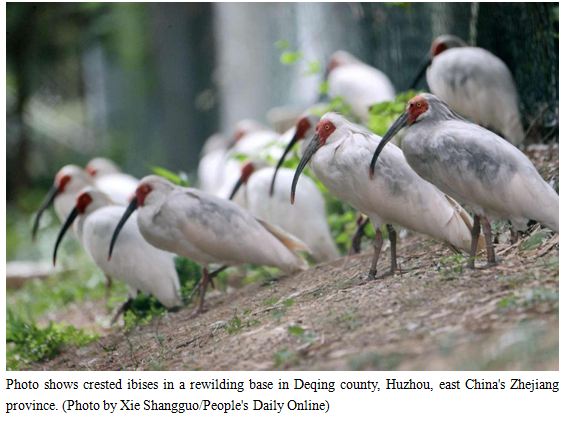
The global population of the crested ibis has reached 11,000, according to statistics released by China’s National Forestry and Grassland Administration. This has downgraded the conservation status of the species from critically endangered to endangered.

The habitat of these birds has gradually been restored from Yaojiagou, Yangxian County, northwest China’s Shaanxi province, where they were initially discovered, to their historical distribution area in East Asia.

The population growth and the expanding habitat of the species make a remarkable ecological miracle that astonishes the world.

The crested ibis is dubbed as the “oriental gem.” It was once widely distributed in China, Japan, the Korean Peninsula, and the Russian Far East. However, the global population of the species drastically declined in the 20th century due to environmental changes and human interference, and the birds were once thought to be extinct.

Fortunately, Chinese experts rediscovered seven wild crested ibises in Yangxian county in 1981. Over the past 42 years, continuous conservation efforts have led to a significant increase in the global population of the species, from the original seven to more than 10,000 today.

“In the decade or so after the rediscovery of crested ibises, our research personnel and volunteers have been monitoring and protecting every nest around the clock,” Zhang Yueming, senior engineer at the Shaanxi Hanzhong Crested Ibis National Nature Reserve, told People’s Daily.

“Nowadays, we have shifted from protecting individual birds through constant surveillance to protecting the entire ecosystem,” he added.

In addition to implementing in-situ conservation measures such as habitat restoration, population monitoring, and community co-management, conservation personnel have actively worked on artificial breeding techniques for crested ibis and explored the possibilities of reintroducing the birds into the wild.

The habitat area for wild crested ibises has expanded from less than 5 square kilometers when it was discovered to 16,000 square kilometers.

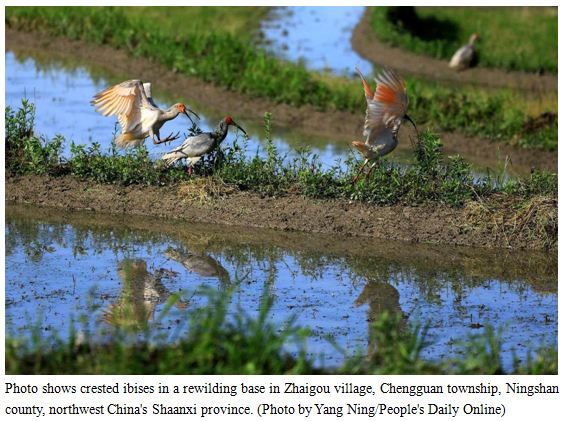
Through relentless efforts, Shaanxi province has successively fostered crested ibis populations that are able to support themselves after being reintroduced into the wild, and launched rewilding programs in Ningshan county of Ankang, Yaozhou district of Tongchuan, Qianyang county of Baoji, Zhouzhi county of Xi’an, Linwei district of Weinan and Lantian county of Xi’an.

As a result, crested ibises have crossed the Qinling Mountains and entered the Yellow River Basin from the Yangtze River Basin. Up to now, Shaanxi has reintroduced 560 crested ibises into the wild, increasing the population of wild crested ibises to over 6,600. The national population of crested ibises has reached over 9,800.

In recent years, Shaanxi province has exported a total of 158 crested ibises to other countries, and helped establish more than 20 artificial populations. Among them, 14 crested ibises have been sent to Japan, South Korea, and other countries for the establishment of translocated populations or collaborative research. This not only promotes the conservation of the species, but also builds a bridge of friendly exchanges with the world.

Crested ibis see growth in population, habitat area

Port of Piraeus witness to China-Greece mutual learning, win-win cooperation

Port of Piraeus witness to China-Greece mutual learning

By Deng Yu

“Dad, it’s the song you always hum!” As my child shouted excitedly, a familiar melody rang in my ears. On the TV screen, Greek singer Theodora Baka was singing the Greek folk song “The Children of Piraeus.”

“So much I’ve tried, I’ve never found a port to captivate my heart as Piraeus does,” sang Baka.

At that moment, I had a flashback to the memories of the Port of Piraeus.

The song “The Children of Piraeus” was written by Greek composer Manos Hatzidakis. It conveys the optimistic and open-minded attitude of the Greek people. In 1960, it gained worldwide acclaim when Greek actress Melina Mercouri performed it in the film “Never on Sunday,” and won the Academy Award for Best Original Song in the same year.

The first time I heard “The Children of Piraeus” was at a reception held by the Chinese Embassy in Greece in 2014. Its catchy and melodious chorus made me hum along. As a newcomer, I quickly memorized the melody.

Facing the Aegean Sea, Greece is the cradle of Western civilization. The ancient Greek culture, like a dazzling star, shines brightly in the long river of human history. Represented by epics, dramas, and philosophy, the classical culture of ancient Greece, nurtured and enriched by the Aegean Sea, has yielded fruitful intellectual achievements and become the source of Western civilization.

However, Greece in the early 21st century was plagued by various problems such as the debt crisis, a high unemployment rate, and a stagnant economy.

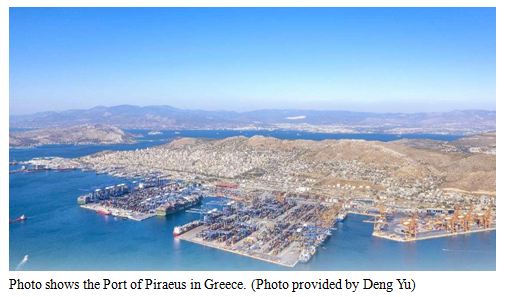
In 2010, China’s COSCO Shipping acquired and successfully operated the No.2 and No.3 container terminals of the Piraeus, bringing significant economic and social benefits. It was regarded by the locals as a business model.

In 2016, COSCO Shipping acquired a 67 percent stake in the port authority and officially took over in August.

I was also transferred to work at the Port of Piraeus, and got to see with my own eyes the picturesque scenes depicted in the song “The Children of Piraeus” with the sound of birds chirping and young people joyfully singing and dancing.

However, it was much more challenging to truly integrate into the Port of Piraeus than just learning a song. As a management executive, my first challenge was institutional reform and personnel adjustments.

In October 2016, I was responsible for selecting department leaders for the new structure. Among the interviewees was a woman surnamed Vassiliou, who was then the general manager of the labor department at the Port of Piraeus. She had extensive experience in human resources, and her confidence was evident on her face, making the atmosphere a bit tense at the beginning.

Suddenly, Vassiliou’s phone rang with the ringtone “The Children of Piraeus.” This little incident made her somewhat embarrassed. I smiled and said in English, ” ‘The Children of Piraeus’ is a great song, very touching.” She was surprised that I knew this song.

The song suddenly broke the ice between us, and the conversation flowed easily. Vassiliou said that this song was her favorite, just like the Port of Piraeus, where she had worked for most of her life. She also expressed some disappointment about the changes happening there.

In response to her honesty, I said, “You and my parents are close in age, and I am deeply honored and humbled to meet you. The Chinese company’s acquisition of the Port of Piraeus aims to collaborate with Greek colleagues for mutual benefit, improving the port’s facilities and services, and enhancing its competitiveness in the global market. The Port of Piraeus needs constant renewal, but it will always be the Port of Piraeus in your heart.”

The sincere beginning paves the way for a wonderful ending. After thorough communication, Vassiliou accepted the arrangement and became a department advisor as she wished. She left us with her affirmation and blessings, saying, “You are a management team worth expectation. I hope our cooperation will make the Port of Piraeus better and better.”

One year later, on her retirement day, she specifically came to bid me farewell, saying that she always remembered the little incident during the interview, our honest communication, and the constant renewal of the Port of Piraeus.

Under the management of COSCO Shipping, the container throughput of the Piraeus has increased from 880,000 twenty-foot equivalent units (TEUs) in 2010 to over 4 million TEUs in 2017, making it the fastest-growing port in container throughput worldwide. This remarkable growth led to a significant improvement in economic benefits and the Port of Piraeus has been highly praised by both the Chinese and Greek governments.

In the pleasant sunshine in June 2017, the Port of Piraeus and Shanghai Port signed a sister port agreement, further strengthening the connectivity between the Piraeus port and Chinese ports. Tassos Vamvakidis, a Greek employee, applauded the moment.

Vamvakidis has been working in shipping since 1973 and has witnessed the rise, fall, and revival of the Port of Piraeus. In an article titled “The Children of Piraeus,” he recounted his observations, feelings, and thoughts during the seven to eight years since he joined the container terminal of the Port of Piraeus managed by COSCO Shipping in 2009.

Vamvakidis once saw the predicament of the port in 2010. He could feel the fundamental change in local people’s attitude when Greeks often give a thumb-up to COSCO Shipping employees with oriental faces.

In his opinion, this change came from the Chinese company’s commitment to transformation while maintaining localization: only six or seven executives were sent from China, while the rest of the managers and employees were all Greeks. This decision quickly provided thousands of new direct job opportunities for the locals and indirectly employed tens of thousands of people.

Through sincere cooperation between employees from both countries, the Port of Piraeus has gradually become a modern, reliable, and highly productive port, gaining an increasingly higher reputation in the industry and effectively supporting the development of the local business community.

Vamvakidis, upon invitation, attended the inaugural Belt and Road Forum for International Cooperation and took the stage on China Central Television’s show “The Reader.” After reciting his story to the Chinese audience, Vamvakidis sincerely said to the camera, “I am proud to be a member of the COSCO Shipping family. As a ‘Child of Piraeus’ and a shining pearl in the Mediterranean Sea, the Port of Piraeus will continue to create new benefits and hopes for the Greek people, and renew the chapter of friendship, cooperation and development between Greece and China.”

In the summer of 2019, my family and I traveled to Switzerland. While staying at a local hotel, a familiar melody started playing. It was “The Children of Piraeus.”

I couldn’t help but hum along, and noticed the eager gaze of the hotel receptionist. After some talks, I learned that he was a native of Piraeus and had come to Switzerland for work due to employment difficulties back home.

“You’re from China, and do you know a Chinese company called COSCO Shipping? They’re doing great in the Port of Piraeus, and I have friends working there,” he asked me.

I replied that I was actually working for COSCO Shipping in Piraeus, making development plans for the port and promoting the cruise and other industries. I told him that in the future, surrounding tourism facilities such as hotels, duty-free shops, and malls would embrace significant development, and perhaps in a few years, he would return to his hometown and find a job of his choice.

In Greek, Piraeus means “the place over the passage,” and it once withstood frequent invasions from foreign naval forces. Today, the Port of Piraeus is opening its arms to welcome visitors and fully loaded container ships from all directions.

The song “The Children of Piraeus” and the China-Greece cooperation on the Port of Piraeus are reflections of the profound friendship between the two countries. Today, under the Belt and Road Initiative, Piraeus has once again become a shining pearl in the Mediterranean Sea.

“The Children of Piraeus” is a song that symbolizes the Port of Piraeus. Most importantly, it is a witness to the exchange, mutual learning, and win-win cooperation between China and Greece.

Port of Piraeus witness to China-Greece mutual learning, win-win cooperation

To let Internet better benefit people of all countries

To let Internet better benefit people of all countries

By Jin Xin, Gu Chun, Liu Junguo, People’s Daily

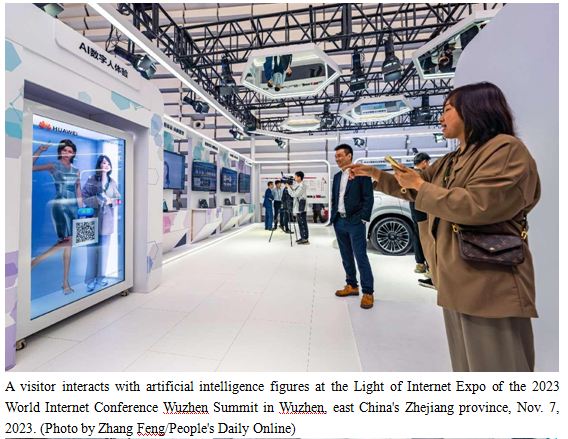
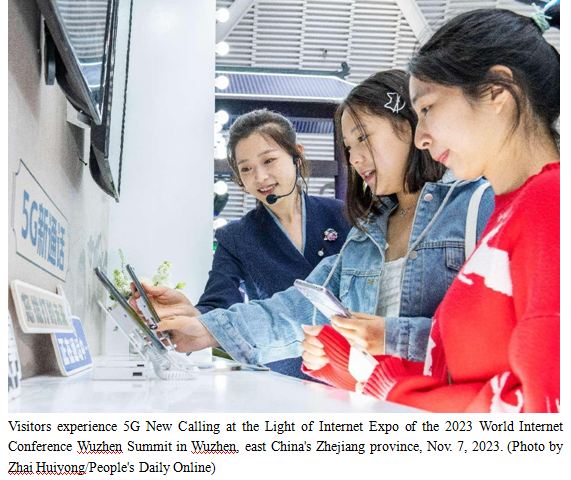
The 2023 World Internet Conference (WIC) Wuzhen Summit kicked off in Wuzhen, east China’s Zhejiang province on Nov. 8. The summit is the largest and highest-level Internet conference held in China, and also a highly anticipated global summit in the field of Internet.

The WIC has been held annually since 2014, bringing together political dignitaries and Internet elites from around the world at its permanent venue in Wuzhen to discuss collaboration and win-win cooperation in Internet development of the world.

Chinese President Xi Jinping addressed the 2023 WIC Wuzhen Summit via video. He said as the Internet becomes a new driving force of development, a new frontier of ensuring security, and a new platform for mutual learning between civilizations, the building of a community with a shared future in cyberspace is a natural choice in answering the call of the times and a common aspiration of the international community.

He stressed that the international community needs to deepen exchanges and practical cooperation to jointly advance the building of a community with a shared future in cyberspace to a new stage.

Currently, more than half of the countries and regions around the world are using China’s BeiDou Navigation Satellite System (BDS), and the system is making people’s lives safer, more convenient , and more efficient.

The BDS has been incorporated into the standard systems of international organizations in civil aviation, maritime affairs, and mobile communications, and is accelerating its integration into the international industrial system.

During the 2022 WIC Wuzhen Summit, an event was hosted to showcase the exemplary cases of  building a community with a shared future in cyberspace. Twelve cases were showcased, included one related to the BDS.

From conceptual documents to initiatives, and to cases, consensuses have gradually transformed into concrete actions. Leveraging the WIC Wuzhen Summit, countries are jointly planning for the global development of Internet and building a community with a shared future in cyberspace.

On July 12, 2022, Xi sent a congratulatory letter to the WIC for the inauguration of the WIC international organization. He said the establishment of the organization is an important move echoing the informatization trend of the times, and it will deepen international exchanges and cooperation in cyberspace.

This marked a qualitative leap of the WIC, from an annual international conference to an international organization with a permanent institution. Since its establishment, the WIC international organization has been joined by more than 120 members from countries such as the UK, France, Germany, the United States, Australia, South Korea, Japan, and India.

In recent years, an increasing number of international exchange activities have been held in China. Together with the WIC, they have built a collaborative platform for building a community with a shared future in cyberspace.

The China International Digital Products Expo, the China International Software Expo, the World Robot Conference and the World Artificial Intelligence Conference all presented opportunities for the international community to share the fruits of innovation in cyberspace.

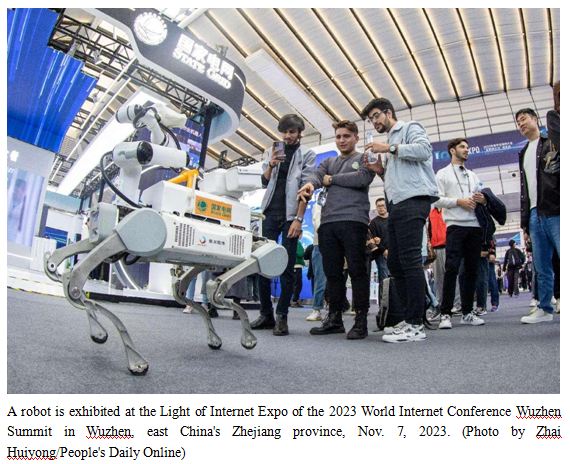
As a highlight of the WIC Wuzhen Summit, the Light of Internet Expo has become a leading indicator of global Internet technology development.

Since 2014, the WIC has been dedicated to promoting the integration of digital technology and real economy, and using new driving forces to propel new development.

Not only the Light of Internet Expo, but also other important events such as a release ceremony for world leading internet scientific and technological achievements and the Global Internet Competition of “Straight to Wuzhen,” have facilitated the integration of mobile Internet, cloud computing, big data, artificial intelligence, and various other industries. These efforts have provided new impetus for enhancing global economic development.

Taking the WIC as an opportunity, China, as a major player in the digital economy, actively promotes broader and deeper international cooperation in digital economy, ensuring that the achievements of Internet development benefit people worldwide.

In Southeast Asia, Chinese enterprises helped build the first 5G smart hospital in ASEAN countries, promoting the intelligent transformation of hospital services. In Latin America, China has partnered with Brazil and Ecuador to utilize digital technology for innovative cooperation, assisting in the protection of the Amazon rainforest ecosystem and marine ecological environment. In Africa, China has launched technology assistance and training programs with the International Telecommunication Union to support the construction of a digital Uganda.

From the construction of information infrastructure and social digital transformation to the application of new technologies such as 5G and the Internet of Things, China is committed to narrowing the global digital divide and sharing development opportunities with the world.

In the information age, the Internet carries human dreams and is closely related to the well-being of the people. Looking ahead, the WIC will always strive to build a global Internet platform for extensive consultation, joint contribution and shared benefits, actively create a new pattern of international cooperation in cyberspace, and continue to write new chapters in the global development and governance of the Internet.

To let Internet better benefit people of all countries

CIIE to provide new opportunities for world with China’s development

CIIE to provide new opportunities for world with China's development

By Luo Shanshan, Ge Mengchao, Yang Xun, People’s Daily

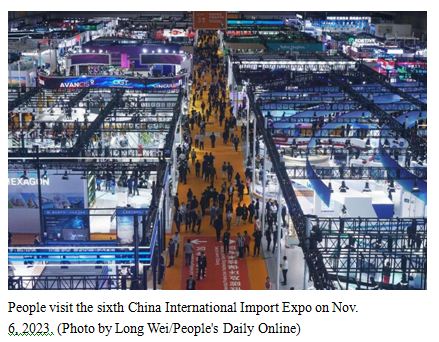
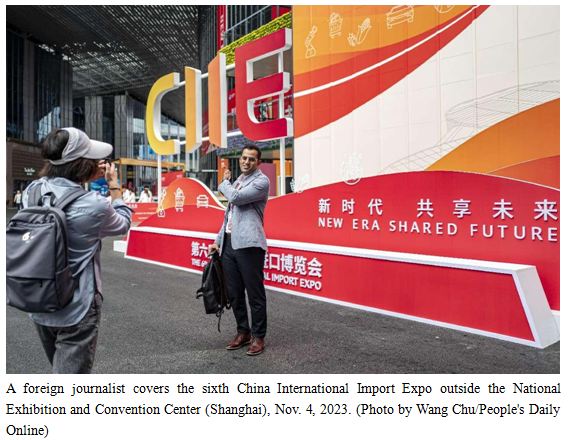
On Nov. 5, the first day of the sixth China International Import Expo (CIIE), the National Exhibition and Convention Center (Shanghai) was bustling with “old friends” and “new friends” who gathered to discuss cooperation.

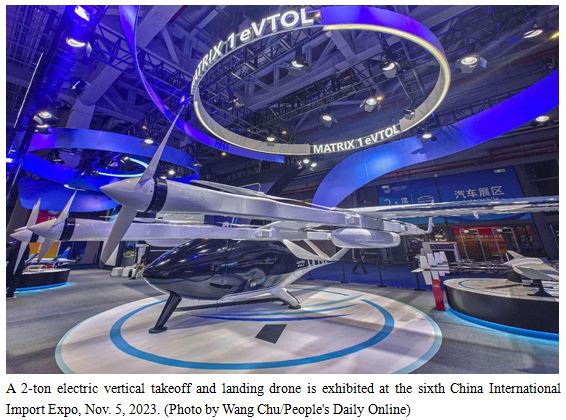
Walking through the exhibition areas, visitors were often overwhelmed by the vast array of exhibits on display. At this year’s CIIE, the Business Exhibition covered approximately 367,000 square meters, featuring six main exhibition areas and an innovation incubation zone.

In the Consumer Goods exhibition area, a 4.6-meter-tall Lego model was quite eye-catching. Heart shapes, smiley faces and wood ducks imbued with childlike wonder were dotted throughout the structure.

According to a staff member at the Lego booth, this large 3D model was specifically built for the CIIE, which took 18 builders 491 hours to put together.

At the previous five sessions of the CIIE, the Lego Group debuted many new products. This year, it once again launched its latest products at the event, hoping to bring more surprises to Chinese consumers.

The multinational medical device group Elekta brought its latest generation of the Gamma Knife stereotactic radiosurgery system. The group’s founder and boardchairman Laurent Leksell told People’s Daily that the CIIE is a platform for the company to showcase its latest innovative technologies and clinical applications, adding that the group looks forward to exchanging ideas and explore new opportunities with industry partners.

It is reported that at this year’s CIIE, exhibition areas for cutting-edge technologies like energy, low carbon, and AI, as well as lifestyle and consumer goods have grown 30 percent. More than 400 new products, technologies and services were exhibited.

Many agreements on practical cooperation were inked on the first day of the event.

One was signed by the multinational pharmaceutical company AstraZeneca and the Wuxi National High-tech District in east China’s Jiangsu province. According to the agreement, AstraZeneca will expand its production capacity of small molecule drugs in Wuxi.

The pharmaceutical company also inked an agreement on the phase-two project of an inhaler production supply base in Qingdao, east China’s Shandong province. It announced to launch a rare disease cooperation project in the Jinan Innovation Zone of Shandong, to develop more innovative medicines.

Wang Lei, global executive vice-president of UK company AstraZeneca and president of its China branch,, said this year marks the 30th year of AstraZeneca’s entry to the Chinese market, and China has become an important growth engine for the company in the global market.

“We are honored to be able to share the opportunities of the Chinese market through the CIIE,” he noted.

On Nov. 5, Sinochem Holdings held a special signing ceremony at the CIIE, at which it inked agreements with clients from the United States, Brazil, Chile, and other countries in multiple industries such as crude oil and refined oil, food and agricultural products, chemical products, chemical equipment, and service trade.

“Through the CIIE, a global exchange platform, Sinochem Holdings has strengthened cooperation with global energy, chemical, and agricultural companies, effectively expanding the channels for accessing upstream resources in related domestic industries, achieving diversification of import channels, and ensuring the stability of the industrial supply chain,” said Yang Shihao, vice president of Sinochem Holdings.

The CIIE has leveraged the strengths of China’s enormous market, fulfilled its platform function for international procurement, investment promotion, people-to-people exchanges and open cooperation, and made positive contributions to creating a new development pattern and promoting world economic development.

The “CIIE effect” continues to unfold, allowing China’s enormous marketto be shared by the world. This has strengthened the confidence of multinational companies in long-term investment and development in China.

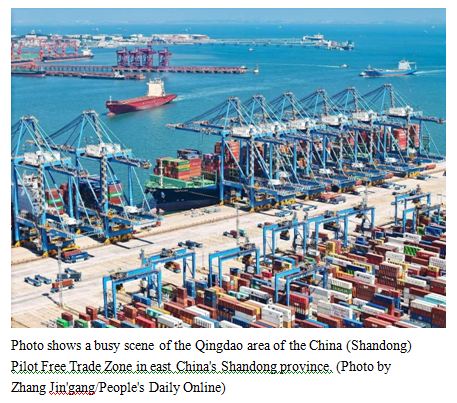
At this year’s CIIE, General Mills, an American food company, announced the full-channel entry of its pet food brand, Blue Buffalo, into the Chinese market. Blue Buffalo made its debut in China at the fourth CIIE and has since benefited from various preferential policies in pilot free trade zones, successfully entering the Chinese market through cross-border e-commerce platforms.

“Over the past two years, we have seen the vast prospects of the pet market in China, which has brought new growth to our business in the country,” said Su Qiang from General Mills.

“We hope to exchange with other players in the industry via the CIIE and build more partnerships,” Su added.

“Through our participation in the CIIE over the past few years, we have fully experienced the powerful spillover effect of this platform. Shiseido’s new skincare brands and products have garnered extensive attention and recognition from consumers after being exhibited at the CIIE,” said Toshinobu Umetsu, president and CEO of Japanese company Shiseido’s branch in China.

He said the CIIE is an epitome of China’s high-level opening up, providing foreign companies operating in China with more market opportunities, investment opportunities and growth opportunities, and allowing enterprises to share the dividends of China’s opening up.

CIIE to provide new opportunities for world with China's development

Stay Connected

64FansLike
60FollowersFollow

Latest Reviews

Exchange Rates

USD - United States Dollar
EUR
1.17
GBP
1.34
AUD
0.67
CAD
0.73