Home Blog Page 864

Australia announce 14-man squad for first Test against Pakistan

Australia announce 14-man squad for first Test against Pakistan

Australia on Sunday announced the 14-man squad for the first Test match of the three-match home series against Pakistan which will be led by World Cup 2023 winning skipper Pat Cummins. 

The first match of the series will take place on December 14 to 18 at the Perth Stadium. 

Australian opener David Warner, who said that he would bring down a curtain on his 12-year career in the longest format, is included in the squad for the first Test alongside Usman Khawaja.

Other players included in the team are Scott Boland, Alex Carey, Cameron Greene, Josh Hazlewood, Travis Head, Marnus Labuschagne, Nathan Lyon and Mitchell Marsh.

Lance Morris, Steve Smith and Mitchell Starc were also included in the 14-member squad for the first Test. 

Australian chief selector George Bailey said there were still opportunities for others to play themselves into contention for the Tests against Pakistan in Melbourne and Sydney, as well as the two-match series against West Indies that follows.

“We look forward to seeing the continued strong performances from players who have been performing domestically, many of whom will get a tremendous opportunity in the Prime Minister’s XI fixture against Pakistan later this week,” he said in a statement.

Pakistan, who have not won a match in Australia in nearly three decades,  are currently preparing for the series. 

Australia squad: David Warner, Usman Khawaja, Marnus Labuschagne, Steve Smith, Travis Head, Mitchell Marsh, Alex Carey, Pat Cummins (captain), Mitchell Starc, Nathan Lyon, Josh Hazlewood, Scott Boland, Cameron Green, Lance Morris

Pakistan squad: Shan Masood (captain), Aamir Jamal, Abdullah Shafique, Abrar Ahmed, Babar Azam, Faheem Ashraf, Hasan Ali, Imam-ul-Haq, Khurram Shahzad, Mir Hamza, Mohammad Rizwan (wk), Mohammad Wasim Jnr, Noman Ali, Saim Ayub, Salman Ali Agha, Sarfaraz Ahmed (wk), Saud Shakeel and Shaheen Shah Afridi

Australia tour schedule:

Four-day match: PM’s XI vs Pakistan – December 6-9: Manuka Oval, Canberra

1st Test – Australia vs Pakistan – December 14-18: Perth Stadium

2nd Test – Australia vs Pakistan – December 26-30: Melbourne Cricket Ground (MCG)

3rd Test – Australia vs Pakistan – January 3-7: Sydney Cricket Ground (SCG)

Chinese Foreign Policy towards India and Pakistan

Chinese Foreign Policy towards India and Pakistan

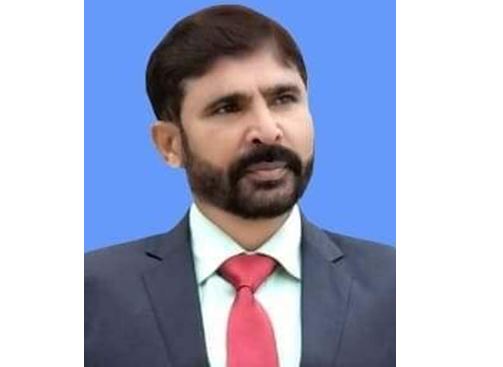
Dr. Muhammad AkramZaheer

Since the late 20th century, China has shifted her policy from isolation and separation from the international community and now is on the way to becoming the major economic power of the world. The Chinese leadership has formulated more attractive, pragmatic and flexible policies for global affairs and issues. With economic growth, China is widening and deepening its quest for energy resources and expanding its investment, market and political influence.  It is also projecting her soft power vigorously and peacefully by promoting culture, sports, education, tourism and other exchanges. The Chinese believe in the emergence of a peaceful great power as once. Professor of international relations Yan Xuetong said, China is the second most powerful state in the world.

A rapid change in the domestic situations of countries and in the international system has been followed by the change of their, perceptions, priorities, foreign policies and interests. That’s why the modern dynamics of foreign policies are extending their activities into many spheres of the international system to increase influence. The quest for the achievement of national interests allows countries to continue work effectively on their potential, inherent to make useful policy. In the past, Chinese diplomacy was often employed to pursue goals of unbalanced interests.  Now the world has dramatically changed since after the Cold war and China is in the position to play a constructive role in the international system. China was allied to the USSR and viewed the USA as its principal enemy during the 1950s. On the other hand, Washington sought an anti-communist alliance with Pakistan as well as close relations with India. After the 1965 Indo-Pak war, US and Indian relations became weaker due to Washington’s limited sale of weapons to India. In1970s. India moved closer to the USSR while China grew closer to Islamabad because India’s of complicated strategic position. Then China inclined towards the USA in quest of its export market and as a counterbalance to the USSR.

After the USSR’s collapse, a peaceful environment favored China and a shift came in her policy towards south Asia. Now, Beijing was seeking political and economic bilateral ties with the regional countries, particularly positive developments in the process of Sino-India rapprochement. This shift did not favor Pakistan and posed negative consequences on the traditional Pak-China relationship. The impact of the foreign policy shift gave this impression during the Pak-India crisis over Kashmir in 1989-90 when Beijing did not support a resolution on Kashmir in the United Nations. It remained neutral and calm, emphasizing on both parties to solve the issue by dialogue. Contrarily, the Cold-war Chinese policy towards Pakistan was supportive against India. During the 1990s, China has been advising both Pakistan and India to solve their problems through dialogue.  In 1996, President Jiang Zemin visited Pakistan and in his speech to the Senate, he urged Pakistan to develop cooperative relations with India and put thorny issues aside. Pakistan should make trade and economic relations to lessen the hostility. During the Kargil crisis China-India rapprochement had entered the mature phase. This time again, China adopted a neutral policy and emphasized holding talks and solving the issue through negotiations. Pakistan was seeking active support on the issues of Kashmir and Kargil, but the Chinese position was unchanged. During the visit of the Pakistani Foreign Minister to China in1999, Chinese Foreign Minister Tang  Jiaxuan said the international community has great concerns about the South Asian situation and Pakistan should remain cool and exercise self-control. It was a warning to Pakistan that China would not support it militarily, and Pakistan should get out from Kargil and settle the crisis by dialogue.

After the cold war, India abandoned the Soviet model and looked for economic reforms. Therefore, India remained no longer allied so closely to Moscow and became less of a danger to China. Now the need of Islamabad for Beijing was narrowed to counterbalance Delhi and Moscow, but was concerned at the Delhi-Washington closeness. China wants to prevent India joining the USA to counter her and the USA looks to India to counterbalance China. This situation is very difficult for China to sustain and maintain the balance and demonstrate her ability in the region of nuclear powers.The incident of 9/11 brought regional and international developments and new adjustments in foreign policy for China. This led to a diplomatic standoff between Pakistan and India. Almost for a year, the military forces of both sides stood eyeball to eyeball. The terrorist attack on Indian Parliament and the Srinagar incident inflamed insecurity and instability in the region. Beijing has concerns about Pak-India tension and it played a proactive role at the diplomatic level to diffuse tension. China also activated SCO and other forums to dissipate tension between Islamabad and New Delhi. Soon after 9/11, the USA declared a global war against terrorism and China was discomforted and had many internal and external concerns. It warned the USA that counter-terrorism should not be used to practise hegemony. Although the war was against the Taliban regime in Afghanistan, China also managed the worsened situation of her troubled province of Xinjiang, and was unsettled by the presence of US forces near her border. China believed that Washington would create instability in the region and might have new political designs. The region, particularly Central Asia, was more attractive to China due to its energy resources and Washington’s political and military involvement in the region worried China.

Washington was increasing pressure on Islamabad to get Pakistani support for the war on terror in Afghanistan after 9/11. On the other hand, China had concerns of the expanding Delhi-Washington strategic cooperation. India and the USA were considering China as a common rival of both and were thinking to limit the rise of China. Washington made efforts to diffuse the crisis between Pakistan and India by a balancing posture during this period. China also maintained a balanced position towards Pakistan and India post 9/11. Another worry for China was the Indian move towards Japan and Vietnam, with whom Chinese relations remained tense. The past cooperation in political, economics, security and diplomatic issues and bilateral ties produced Chinese $62 billion investment in Pakistan through CPEC. China has provided support to Pakistan in the UNSC regularly. China has assisted Pakistan to improve security and defence capability by the joint venture of the JF-17 Thunder in 2003. The deteriorating relationship of Islamabad and Washington provide China motivation and impetus to improve relations. On the other hand, China and India are two natural strategic rivals with large populations in the region. A sense of competition between the two is very high. China has engaged Nepal, Bhutan, Bangladesh, and Maldives, which was considered in the area of Indian influence. China tried to build a road in Bhutan in the Doklam area, which is a source of tension for India. It seemed that China was occupying the strategic territory, which was very necessary for Indian security. In addition, India thinks that Pakistan is serving Chinese interests by forcing her to fight wars, reducing the Indian ability to counter the Chinese rise.

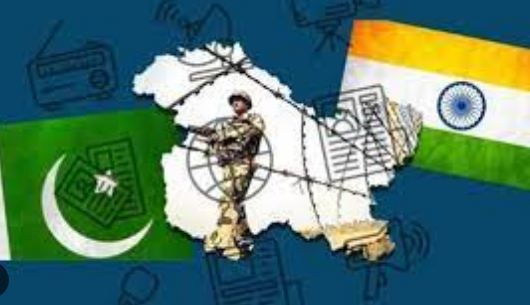
However, the leadership of both China and India has recognized the need of peace and cooperation to ease the tension. They met in the Wuhan summit in April 2018 and agreed to expand economic relations. China seems a major beneficiary of China-India economic relations. The importance of this partnership may not be worsening China-Pakistan relations. The example of the China and Pakistan cooperation is seen when Beijing put its weight behind Islamabad and forced a discussion in the UNSC on India’s latest reconfiguration of Kashmir. As its economic power grows, China has its own paradigm of development and new ways of interaction with regional and global powers on a win-win basis. Being the neighbour of China, Pakistan has the privilege to achieve investment and trade. The frequent exchange visits by the leadership of both have reinforced mutual trust and cooperation. On the other hand, China and India have agreed to expand their cooperation on multiple levels to ensure peace on their borders. However, India and Pakistan are challenging each other on the issue of Kashmir and both the countries had fought four wars in the past. On the issue of Kashmir, Chinese policy will have significant implications for the China-India-Pakistan relationship and will test China’s foreign policy towards Pakistan and India.

World Bank Vice President visits Tarbela 5th Extension, Dasu Hydropower Project

Dasu Hydropower Project

SAID ALAM KHAN

PESHAWAR: The World Bank Vice President Martin Raiser along with a 4-member delegation, visited Tarbela 5th Extension and Dasu Hydropower Project.  Chairman WAPDA Eng Lt Gen Sajjad Ghani (Retd) and World Bank Executive Director Syed Tauqir Hussain Shah also accompanied him. World Bank is providing financial support for construction of these projects.

In the first leg, the World Bank Vice President visited Tarbela 5th Extension Hydropower Project, being constructed on Tunnel No. 5 of Tarbela Dam. He witnessed construction activities on main components. The project management apprised him about progress on the power house, tail race culvert, canal and switch yard. Tarbela 5th Extension has an installed power generation capacity of 1530 MW. On its completion, power generation capacity at Tarbela Dam will increase from 4888 MW to 6418 MW. Tarbela 5th Extension Project will start electricity generation in 2025.

Later, the World Bank Vice President also visited 1410 MW-Tarbela 4th Extension Hydel Power Station, completed in 2018 with financial assistance of the World Bank. He was informed during the visit that Tarbela 4th Extension, since its completion, has provided 22.56 billion units to the National Grid.

In the second leg, the World Bank Vice President flew to under-construction Dasu Hydropower Project at River Indus upstream of Dasu town in Khyber Pakhtunkhwa. He visited the power house, transformers cavern and the project colony to review construction activities. Dasu project team, in a briefing, informed him about progress on main works of the project. It was briefed that the river diversion system has been functioning satisfactorily since its completion early this year. Flushing tunnel is also complete, while excavation of right bank bypass  tunnel has recently been completed. Excavation of right and left abutment of the main dam, intake, power house, tailrace tunnel, surge chamber and transformers cavern is in progress. The 4320 MW-Dasu Hydropower Project will be completed in two stages. At present, WAPDA is constructing Stage-I, with installed generation capacity of 2160 MW and annual energy generation of 12 billion units. Stage-I of the Project is likely to be commissioned in 2026. 

Anaylysis of Indian Kashmir Policy-Implications and Way Forward for Pakistan

Anaylysis of Indian Kashmir Policy-Implications and Way Forward for Pakistan

ISLAMABAD, Dec 02 (DNA): Special Assistant to the Prime Minister on
Human Rights and Women Empowerment, Mushaal Hussein Mullick called upon
the world powers and UN bodies to wake up of their sweet slumber to
circumvent the Indian initiative of implementing the Gaza model in
Indian Illegally Occupied Jammu and Kashmir (IIOJK).

Addressing a focused talk on “Anaylysis of Indian Kashmir
Policy-Implications and Way Forward for Pakistan” organized by Natoinal
Institute of Maritime Affairs (NIMA) as a Guest of Honor, Mushaal stated
that the fascist Indian government turned the scenic valley into a world
largest tortured cell and garrison city especially after revocation of
article 370 and 35-A of constitution on August 5, 2019.

Admiral (Retd) Muhammad Zakaullah NI(M) attended the focused talk as
Chief Guest. Other Participants included Ms. Sabien Hussein Mullick
(Focal Person to SAPM), Dr. Adam Saud (Dean H&SS BU), Mr. Syed Muhammad
Ali (Security Analyst), and Amb (Retd) Nadeem Riyaz (President IRS).

Mushaal Mullick noted that the brutal occupation forces unleashed a wave
of terrorism and barbarity to stifle the just dissenting voices in the
occupied valley, adding that supremacist Indian government fundamentally
altered the geopolitical and social fabric of the region, which remained
one of the most enduring and complex disputes in South Asia, causing a
constant threat for regional stability and international peace.

Mushaal feared that the Indian brutal forces were replicating the
Israeli model of genocide and ethnic cleansing to turn the Muslim
majority region into minority.

The SAPM on Human Rights and Women Empowerment highlighted that the
Narendra Modi-led fascist regime unleashed a reign of terror in the
IIOJK, as top Kashmir leadership including her husband Yasin Malik were
put in unlawful detentions in false, fabricated and politically
motivated cases.

Moreover, she said that the Indian troops were given license to kill and
torture Kashmir people with impunity, adding that women rape was used as
a weapon of war in the occupied valley to deter the freedom fighters in
order to defuse the just struggle.

Mushaal urged that the world powers, international community and UN
bodies should take prompt notice of world worst human rights abuses in
IIOJK and take practical measures to resolve the decades-old dispute as
per the aspirations of Kashmiri people and the UN agreed formula.

Saira Peter mesmerises the audience with her magical voice at PNCA

PNCA

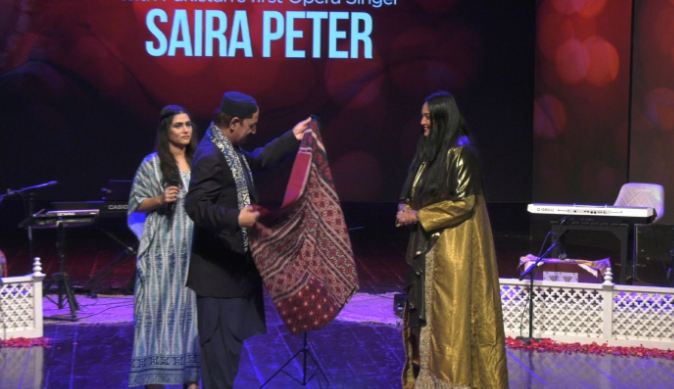
ISLAMABAD, Dec 2: Saira Peter, a British-Pakistani soprano recognised as the Pakistan’s first Sufi Opera singer mesmerised the audience with her magical voice at musical evening in Pakistan National Council of the Arts.

Federal Minister for National Heritage and Culture Jamal Shah was the chief guest on the occassion.Prominent government officials, Diplomats and large number of people were also attended the event.In his opening remarks, Director General PNCA Muhammad Ayuob Jamali welcomed the guests at PNCA Auditorium.On the occasion, Federal Minister for National Heritage and Culture Jamal Shah appreciated the performance of Saira Peter and said that the people here love music.He termed Saira Peter as highly accomplished singer.

Saira Peter and her husband a music director Stephen Smith started the performance with classical opera receiving high applause from the audience. From there, Saira went on to perform Sufi Kalam.

Saira Peter has also the distinction to be the world’s first Sufi opera singer.

Saira Peter has received an overwhelming response to his live performance in jam packed PNCA Auditorium.Saira presented opera and classical songs, Urdu, Pashtu, ‘thumri’, ‘ghazals’, film, Sindhi, Balochi and Punjabi songs.

She also sang a special Arabic song during her performance.

Saira Peter and her enthusiastic audience shared lively interaction throughout the concert.She conveyed her love for the music of her homeland and thanked PNCA for showing so much honour.

Passionate about bringing together people of all backgrounds, Saira Peter identified music as a historical means of promoting a positive message.Simultaneously in the midst of studying Western Classical voice, she envisioned using her music to take Sufi peace poetry to the world stage.

She is currently working with a team of British artists to develop the world’s first full-scale “Sufi Opera”, a musical stage drama based on the story of Umar Marvi, one of Latif’s “seven heroines” of Sindh.

Saira Peter has also pioneered a fusion style of the qawwali genre in which she incorporates both Western operatic and South Asian classical styles of singing.

PM encourages gates foundation to strengthen stem education, disaster management in Pakistan

PM encourages gates foundation to strengthen stem education, disaster management in Pakistan

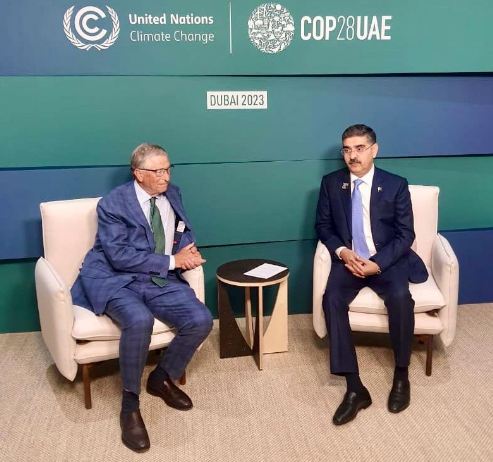
Dubai: Caretaker Prime Minister Anwaar-ul-Haq Kakar met Mr. Bill Gates, co-Chair, Bill & Melinda Gates Foundation (BMGF), on the sidelines of COP-28 in Dubai earlier today.

Prime Minister Kakar and Mr Gates discussed progress in Pakistan’s polio eradication efforts. The Prime Minister apprised Mr. Gates of the ongoing polio vaccination drive in Pakistan and said that Pakistan would spare no effort to eliminate poliovirus. The Prime Minister underlined the Government’s full commitment to maximizing outreach of vaccines to children all across Pakistan.

The Prime Minister and Mr. Gates also discussed cooperation extended by BMGF to Pakistan in financial inclusion, poverty alleviation and malnutrition. While lauding the support received from the Gates Foundation, the Prime Minister further encouraged the BMGF to work with Pakistan to enhance national capacities in STEM education, strengthen early warning and emergency operations for disaster management as well as to digitalize agricultural value chains.

BJP’s attempt to unite Hindu fragments likely to fail, predicts Director ISC

BJP's attempt to unite Hindu fragments likely to fail, predicts Director ISC

BJP’s attempt to unite Hindu fragments likely to fail, predicts Director ISC

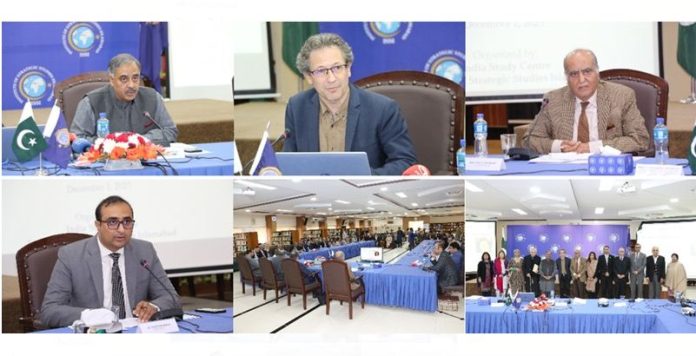
ISLAMABAD, DEC 2 /DNA/ – The India Study Centre (ISC) at the Institute of Strategic Studies Islamabad (ISSI) hosted renowned French scholar Christophe Jaffrelot, for a roundtable discussion on “The Plight of Indian Minorities under Modi’s India.” The event was attended by academics, practitioners, diplomats, students and representatives of the media.

Dr. Khurram Abbas, Director ISC, in his introductory remarks said that the BJP’s attempt to unite all Hindu fragments together into a single Hindu party will fail as sub-castes galore had begun to create small parties of their own in every state. Hindus alone had 1,600 jatis, with multiple caste-like divisions and holding them together for a long time was highly challenging.

According to the Election Commission of India, 38 new parties registered after 2014, the year when Mr. Modi was sworn in as Prime Minister. To keep these parties united, the BJP required ‘enemy’ within and outside of India.

DG ISSI Ambassador Sohail Mahmood welcomed the distinguished participants and emphasized the significance of the subject. He underlined that contemporary India was drifting towards deeper polarization, more religious intolerance, and increased violence. Rise in hate speech, mushrooming of vigilante groups, frequent mob lynchings, demolition of churches and mosques, schemes like ‘Love Jihad’ and ‘Ghar Wapsi’, and legislative measures like the National Register of Citizens and Citizens Amendment Act (CAA) were manifestations of the ‘Hindutva’ ideology, which had a deep impact on the minorities, especially Muslims.

He further pointed out the disturbing demographic change being effected in the Indian Illegally Occupied Jammu and Kashmir (IIOJK) by turning the local Muslim majority into a minority in its own land through the colonial settler project. India under the BJP was also witnessing unprecedented rise in Islamophobia. The DG ISSI pointed out that Prof.Dr. Jafferlot, a leading international scholar on South Asia and India, had meticulously mapped India’s transformation and shown how Muslims faced increased social marginalization, institutional exclusion and judicial obliteration.In his presentation, Professor Jaffrelot affirmed that it was necessary to mention vigilantism and hate speeches; and that there was a lot more to cover when Muslims’ marginalization in today’s India was contemplated. In this context, three facets — namely institutional representation, socio-economic condition, and educational status — of Indian Muslims were worth examining. Through thoroughly researched quantitative data, Prof. Jaffrelot pointed out as to how Muslims in India were facing a consistent decline in their condition since 1947. Besides Muslims’ significant proportion in India’s overall population, they were highly underrepresented in government offices, but over-represented in jails. He asserted that the most deplorable reality about Muslims under the BJP was that their representation in elected assemblies, either in the Lok Sabha or State Assemblies, was severely decreasing. From the 1980s to 2019, Muslims participation in the Lok Sabha had decreased from 9 percent to just 4.6 percent. In major Indian states like UP, Muslims had been facing political marginalization.Prof. Jaffrelot also highlighted the yawning socio-economic gaps between Muslims and Hindus. Muslims in India were more deprived institutionally than other backward communities like Scheduled Castes (SCs), Scheduled Tribes (STs) and Other Backward Classes (OBCs). Muslims’ share of wealth was just 9.5 percent compared to 36.1 percent of Hindu Upper castes and 33.3 percent of Hindu OBCs. Same was the case with education. There was a huge decline in Muslims going for higher education, and this gap had increased under the BJP government. In 2021-22, only 19.8 percent of the whole Muslim population entered higher education institutions. These factors had collectively caused Muslims’ deprivation under Modi’s India.During the interactive session, experts delved into the deepening marginalization of Muslims in socio-economic sectors, institutions, and education. Prof. Jaffrelot further illustrated the wealth gap, job losses, decreasing educational opportunities, and the threat to Urdu language in India. The discussion also touched upon the challenges faced by other minority communities, including Christians, and the role of the diaspora in spreading the ‘Hindutva’ ideology globally. The ongoing de-Kashmirization process, developments in South India, and the issue of Akhand Bharat were also discussed. The exchanges also covered the future trajectory of India, the potential for radicalization of Indian minorities due to their marginalization, and the geopolitical implications of the rise of the BJP-led ‘Hindutva’ ideology. Prof. Jaffrelot emphasized the importance of understanding the ground realities and the long-term impact of policies pursued by the incumbent Indian government.The Roundtable ended with concluding remarks by Ambassador Khalid Mahmood, Chairman BoG ISSI.

COAS commends troops’ high morale and operational preparedness at field exercise

COAS commends troops' high morale and operational preparedness at field exercise

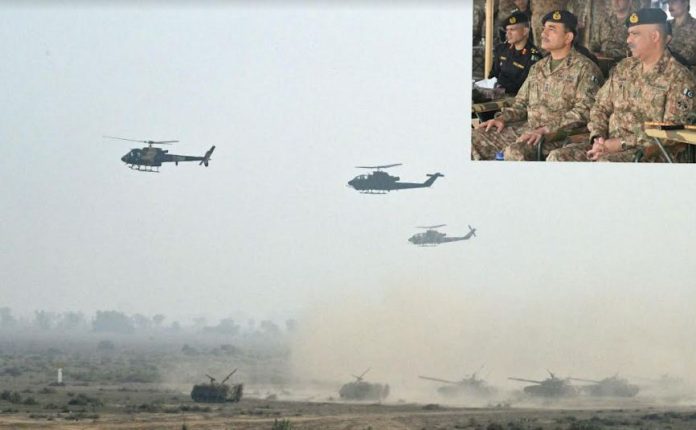
RAWALPINDI, DEC /DNA/ – General Syed Asim Munir, NI (M), Chief of Army Staff (COAS) visited troops at Khairpur Tamewali (KPT) to witness Field Exercise of Bahawalpur Corps.

COAS was briefed about Field Exercise, aimed at enhancing professional skills at various tiers and battlefield procedures required to meet future challenges in operational environment.

COAS witnessed integrated fire and battle maneuvers of various elements, including Armour, Mechanized Infantry, Artillery, Air Defense, Anti-Tank Guided Missiles (ATGMs) duly supported by Pakistan Air Force (PAF) and Combat Aviation.

Later, COAS interacted with troops participating in the exercise.

COAS appreciated the training standards, operational preparedness and high morale of officers and troops. COAS directed troops to keep serving the nation with traditional zeal and passion under all circumstances.

“We are cognizant of the challenges and with the support of the nation we are prepared to thwart any nefarious designs of the enemies of Pakistan”, COAS emphasized.

“Pakistan Army is fully prepared to defend territorial integrity and sovereignty of Pakistan against all odds. Pakistan Armed Forces are focused on defending the frontiers of motherland against full spectrum of threat and with the support of the nation, Armed Forces will defeat the enemies of Pakistan, InshaAllah, COAS concluded.

Earlier, on arrival, COAS was received by Commander Bahawalpur Corps.

Thai envoy calls for boosting bilateral trade, investments

Thai envoy calls for boosting bilateral trade

Ambassador of Thailand to Pakistan Chakkrid Krachaiwong says Thailand has worked closely with our ASEAN family in Islamabad to enhance cooperation with Pakistan

ANSAR M BHATTI

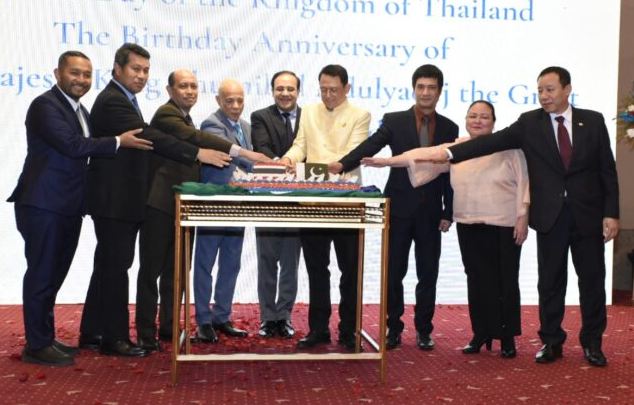
ISLAMABAD: Ambassador of Thailand to Pakistan Chakkrid Krachaiwong has said although Thailand and Pakistan have enjoyed diplomatic relations for 72 years, our bonds have been established for more than two thousand years/ through Gandhara route. And what we should be excited the most is the historical visit of Phra Anil Sakya because Phra Anil  was born in Sakaya family which is the same family of the Lord Buddha himself and he was here in Pakistan!
The Ambassador made these remarks on the occasion of the National Day of Thailand. Dr. Umar Saif, Minister for Information Technology and Telecommunication was the chief guest on the occasion. The Thai artists presented traditional cultural performance and received huge applause from the audience. Thai ambassador further said following the election in Thailand, the new government assumed its duty in September. This is a great opportunity to further deepen our cooperation.
‘Our total trade has reached 1.65 billion USD in 2022 but there is much more we can do to increase trade under Pakistan National Single Window and I hope to see measures to lower trade barriers and increase investment facilitation. I trust that Pakistan-Thailand FTA will be an extremely important vehicle in boosting our trade. Thailand strongly supports the conclusion of our FTA at the earliest opportunity’.He said The 5th of December is an auspicious occasion as we commemorate National Day of the Kingdom of Thailand, the Birthday Anniversary of the late King Bhumibol and Thailand’s Father’s Day. The 5th December is also recognized by the UN  as “World Soil Day” to acknowledge the late King’s contributions / in soil science for the improvement of livelihood of people.
He said, the year  2023 is an exciting year  for Thailand – Pakistan relations. Many historical moments have happened that reflect our strong ties/ and promising future.He said, while Thailand is always proud to host visitors from Pakistan for tourism purpose, he wished Pakistanis to consider Thailand’s world-class health care and wellness services and internationally recognized educational institutions.
‘We can also benefit from skillful IT experts from Pakistan /and Thailand’s advance IT infrastructures/ to create a powerful global IT powerhouse supporting world businesses.‘I am excited to meet a team of Thai cyclists who biked from Islamabad to Gilgit for 2 months. They came back with unforgettable memories of the locals/ they met along the way. With the shared values we have in living in peace and harmony, is the reason why we feel very connected/ and are able to create bonds with the Pakistanis in no time.He added, another historical event that happened this year is that, for the first time, Thailand, a country with no history in Cricket has set foot in Pakistan when Thailand Emerging Women Cricket Team came here to compete in T20/ with West Indies and Pakistan. Having the opportunity to compete in this tournament / not only help them gain more experiencesbut also help create bond and friendship among the players.
As an active member of ASEAN, Thailand has worked closely with our ASEAN family in Islamabad to enhance cooperation with Pakistan in3 pillars of ASEAN which are Political-Security, Economic, and Socio-Cultural.Pakistan has a lot to offer. Gandhara civilization is not only about Buddhism but also covers wide range of knowledge. Taxila is home to wisdom, philosophy, medical, and technologies. This is the treasure that belong to Pakistan, he added.

From Ashkhabad to Islamabad: Exhibition honors the significance of 31 years of diplomacy

From Ashkhabad to Islamabad: Exhibition honors the significance of 31 years of diplomacy

DNA

ASHKHABAD CITY, DEC 1: Many thanks indeed for all of you for being with us today to share the Photo Exhibition dedicated to 31st anniversary of establishment of diplomatic relations. The relevant protocol on it was signed in the Ashkhabad city, capital of Turkmenistan on May 10 1992. The copy of that doc is also displayed today in our Exhibition.

Let me first express my sincerest appreciation to Federal minister for National heritage and culture Mr. Syed Jamal Shah for his great support and guidness in arranging today`s event.

Special thanks indeed go to Mr. Muhammad Ayoub Jamali DG Pakistan National council of Arts and all his team for indispensible help and excellent cooperation in all arrangements of our Exhibition.

Together we are able to show to Pakistani public and Diplomatic corpse the retrospective and hystorical photos demonstrating the very active dynamic interaction of Uzbek and Pakistani leaders – Presidents, Prime Ministers and federal ministers.

Secretaries, additional secretaries, generals, DGs, ambassadors and  diplomats of our countries had made great input in cementing our ties through the 3 decades.

I`m glad to greet 2 of prominent heads of Pak missions who 24\7 tirelessly were serving for the active development of bilateral relations –my kind greetings are to Ambassadors – Mr Irfan Yusuf Shami and Mr. Riaz Ahmad Bukhari who are also graced the today`s occasion.

Please allow me express the very warm appreciation of course to prominent experts, researchers, experts, highly skilled journalists from our countries daily and immensely contributing for the strengthening for the re-connectivity of our countries and nations, Alhamdulillah.

Dear friends, ladies and gentleman,

After 3 decades of our active interaction let`s focus on the Connectivity strategy of our two regions South Asia and Central Asia – implementation of the projects for the boosting trade and economics,  transport linkages – cultural and people to people re-connectivity.

Alhamdullilah, this strategical approach is also is actively promoted by our country`s governments, experts`s community and most importantly supported by our young generation.

Our connectivity logically emanates from the closeness of cultures and religion traditions – carawan`s roads of the Central Asia with South Asia – Pakistan, China, Afghanistan, Sri Lanka, India, Nepal, Butan and Bangladesh.

The rich scientific and cultural legacy of such great Ulemas like Imam Al-Bukhari, Imam At –Termizi, Al-Motrudi and Marghinani   scholars as Abu Ali Ibn Sina, Al-Ferghany, Abu Raihan Al-Beruni and Zahiriddin Muhammad Babur, Alloma Muhammad Iqbal, Mirza Ghalib is considered as a richest and common heritage of our religion.

The brilliant works of Rahman Baba, Khushhal Khan Hattak, Alloma Iqbal, Jalaluddin Rumi, Makhtumquli Fraghi, Sadriddin Aini, Mirza Golib, Alisher Navoi are well known in the world`s history, science and culture.

The period of our interactions were brightly manifested during the era of Ghandhara, Harappa civilizations, with the civilizations Saikhun and Jaihun rivers, Moghulistan and Khorasan cities -Samarqand, Bukhara, Khwarazm, Termiz which are the well known centers of Islamic cultural enlightment and sciences.

I`m sure that all Pakistanies are well aware of the common great heritage of the such dynasties like Amir Taymur`s, Zakhiriddin Muhammad Babar`s. The great successors of Bukharys, Mughals, Barlas, Termizi, Mirsas in Pakistan are bright followers of our connectivity, promoting the mutual understanding among our nations.

My sincerest thanks goes to two highly skilled artists – photographers Mr Ramzan Mughal and Mr Fazan Rabi who during last several years made beautiful photos of our common national and cultural heritage – from Tashkent to Islamabad, from Samarqand to  Lahore, Bukhara-e Sharif, Mazar-e Sharif to Golra Sharif and Uch Sharif to be displayed today in our Exhibition.

Dear friends, Ladies and gentlemen,

In last years our brotherly cooperation has been elevated to a level of the strategical partnership due to confidant political dialogue, strengthening the trade and industrial, and cultural cooperation.

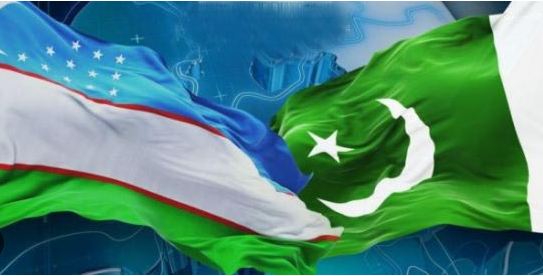
Last 3 years we together have increased bilateral trade via brotherly Afghanistan based on Transit and Preferential trade agreements. Every year the bilateral trade is dynamically growing on 40-50% ($317 mln in 10 months 2023) and no doubt that our teams along with our colleagues will reach very soon the goals of recently signed 1 bln trade record, Inshallah.

Let me express confidence that with valuable and tireless efforts of 2 sides we will be able to gain remarkable results – strengthening people to people contacts, business to business forums while developing region to region connectivity.

Hon Minister Syes Jamali Shah, dear friends, ladies and gentlemen!

Exceptional privilege for me and my Embassy is to be a humble servant of the re-connectivity between our two regions and nations.

In conclusion, I`m honored to convey best wishes to all of you and hopefully with such events our 2 countries will celebrate many good occasions and achievements in coming future. Inshallah.

Stay Connected

64FansLike
60FollowersFollow

Latest Reviews

Exchange Rates

USD - United States Dollar
EUR
1.17
GBP
1.35
AUD
0.67
CAD
0.72