Home Blog Page 849

CASS discusses Pakistan’s path to 2047, stressing reforms and citizen engagement

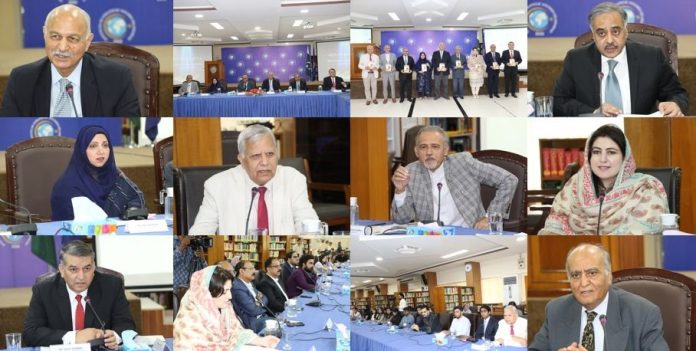
CASS discusses Pakistan’s path to 2047

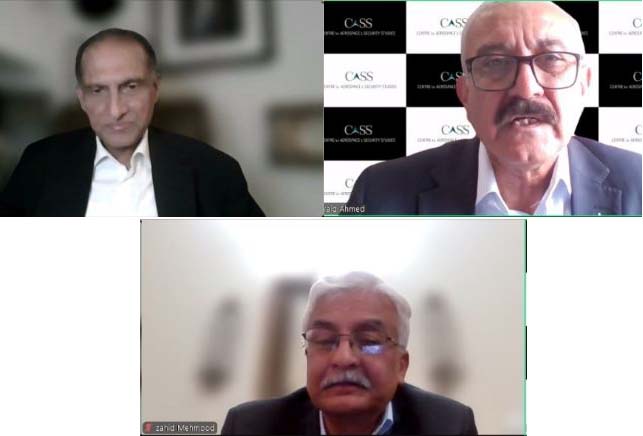
ISLAMABAD, AUG 20 /DNA/ – As Pakistan nears its centennial year of independence, engaging in thoughtful discussions to envision a prosperous future becomes imperative. This Catalyst Conversation, organised by the Centre for Aerospace & Security Studies (CASS), Islamabad, was designed to facilitate such discourse. The session was guided by insights and expertise of Ambassador Aizaz Ahmad Chaudhry, Chairman Sanober Institute and former Foreign Secretary of Pakistan.

Air Marshal Zahid Mehmood (Retd), moderator for the session and Director at CASS, initiated the discussion by reflecting on the creation of Pakistan — a saga marked by struggle and sacrifice under the guidance of visionary leaders. He stressed that as Pakistan approaches its centenary, it is crucial for all Pakistanis to learn from the past 77 years and chart a forward-looking course aligned with the original vision of its founders and the aspirations of its people. He also highlighted that the responsibility for Pakistan’s development extends beyond policymakers and national leaders to every citizen.

On the main subject ‘Pakistan of 2047,’ Distinguished Speaker, Ambassador Aizaz Ahmad Chaudhry (Retd), discussed the formidable challenges and potential strategies for envisioning a prosperous future for Pakistan. During his talk, he noted the difficulty in predicting the nation’s future given the current political and economic climate and regional conflicts.

Ambassador Chaudhry stressed the importance of having a clear vision and long-term socioeconomic development plans, similar to those implemented by nations like the United States, China, and Singapore. He outlined several critical challenges facing Pakistan today, including inadequate devolution of power; substantial portion of the population not contributing to the tax base; excessive reliance on donor aid to balance economic shortfalls; and lackluster export growth. Additional issues highlighted included weak economic growth; water and food insecurity; bureaucratic barriers for the private sector; non-competitive knowledge economy, and insufficient development of human resources.
Despite these challenges, Pakistan’s potential was underscored by its young population, rich natural resources, and strategic geographic location. Ambassador Chaudhry advocated for a citizen-centric approach, as originally championed by the country’s founder — Quaid-i-Azam.

Ambassador Chaudhry outlined several key reforms needed to transform Pakistan’s potential into reality, including stable political governance through decentralisation; economic self-reliance; living within means; continuity of economic policies; and ease-of-doing business to facilitate the private sector. He also called for streamlining regulations; enhancing tax compliance; non-partisan accountability; and significant investments in human development, particularly in education and skill development for youth in emerging technologies such as AI. The speaker concluded by stating that with these reforms, Pakistan could look forward to a peaceful and prosperous future by 2047, marking the centennial of its independence. Conversely, without such reforms, the future remains uncertain.

In his concluding remarks, Air Marshal Javaid Ahmed, President of CASS, Islamabad, pointed out dual nature of the challenges Pakistan faces, with both known and unknown elements. He stressed the immediate need for action and the pivotal role of think tanks in fostering foresight and developing a balanced perspective for the nation’s future. He remarked on critical imbalance in the national narrative, which often oscillates between two extremes, underscoring the importance of grooming current and future leadership to better address these difficulties.

In the question and answer session, participants and speakers agreed that understanding Pakistan’s challenges is essential for planning and executing future actions that will steer the country toward a prosperous and stable future, ensuring balanced development that includes contributions from all sectors of society.

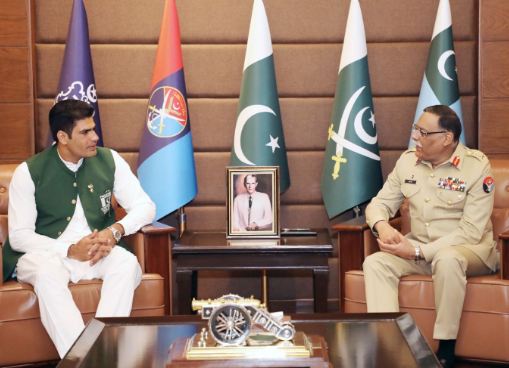
Olympian Arshad Nadeem meets Chairman JCSC

Olympian Arshad Nadeem meets Chairman JCSC

RAWALPINDI, AUG 20 /DNA/ – Arshad Nadeem, record-holder Olympian, called on General Sahir Shamshad Mirza, Chairman Joint Chiefs of Staff Committee, at Joint Staff Headquarters, Rawalpindi.


Chairman JCSC lauded Arshad Nadeem’s efforts for securing Pakistan’s first-ever Gold Medal in a singles’ event and setting up of a new Olympic record.


General Sahir Shamshad Mirza also appreciated the diligence and devotion of Arshad Nadeem in achieving a momentous milestone in Pakistan’s sport history and wished him the very best for his future endeavours.

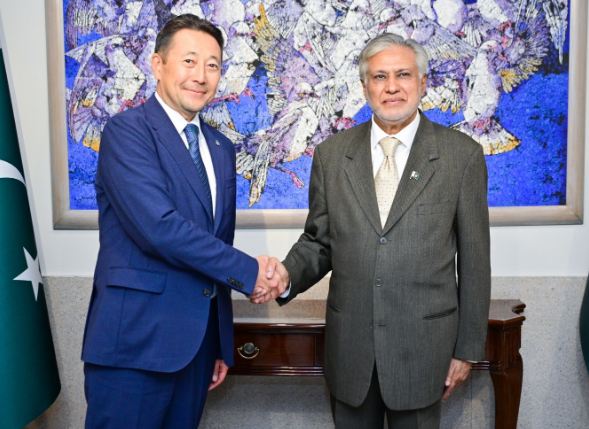
CICA Secy Gen. meets Deputy PM Ishaq Dar, discusses cooperation in Asia

CICA Secy Gen. meets Deputy PM Ishaq Dar

ISLAMABAD, AUG 20 /DNA/ – Secretary General of the Conference on Interaction and Confidence Building Measures in Asia (CICA), Ambassador Kairat Sarybay, who is currently on a visit to Pakistan, called on Deputy Prime Minister and Foreign Minister Senator Mohammad Ishaq Dar today.

The Deputy Prime Minister and Foreign Minister reaffirmed Pakistan’s commitment to CICA’s vision for a common, comprehensive, cooperative and sustainable security in Asia. He emphasized the need for conflict prevention; addressing the root causes of endemic disputes; and finding sustainable solutions for lasting peace and development in the CICA region. He also emphasized the significance of preventive diplomacy, multilateralism and regional collaboration in addressing emerging global challenges.

Secretary General Sarybay appreciated Pakistan’s active and constructive role in CICA and briefed the Deputy Prime Minister and Foreign Minister on the ongoing activities and the future outlook of CICA.

Taliban denounces Pakistan special envoy remarks, terming it provocative 

Pakistan: A Pivotal Bridge Aligning Economic Interests Between China and the Middle East

Shamim Shahid 

PESHAWAR, AUG 20 /DNA/ – Afghanistan’s ministry for foreign affairs in a statement has reacted strongly to the Asif Durrani’s recent remarks on the repeat of 9/11, as world turn back to Afghanistan, terming a move of provocation and jeopardising relations between the two countries neighbours to each others.

 Zia Ahamd Takal the Taliban deputy spokesman for foreign ministry in a statement issued at Kabul on Tuesday, said “Mr. Durrani should know that it is the responsibility of diplomats to ensure that provocative media statements do not jeopardize the relations of the two countries’.

The Taliban leaders governing Kabul, issued the strong worded reaction at the time when skirmishes, closure and exchange of hot words between security personnel of both the neighbouring countries at Torkham and other crossing points is the routine matter. Bilateral trade is on decline whereas Pakistan is accused Afghanistan of providing sanctuaries to militants who are carrying out deadly terror acts especially attacks against security forces.

 The statement said that the recent comments made by Pakistan’s Special Representative Asif Durrani, concerning Afghanistan’s security and economic situation are both provocative and misaligned with the ground realities, seemingly aimed at misleading the public perception regarding Afghanistan. “ In fact, the issues and concerns he attributed to Afghanistan are more likely to be present in Pakistan. 

Afghanistan is now a safe and stable country, focused on achieving economic self-sufficiency by utilising its own resources rather than being reliant on foreign loans and aid. The Afghan government has successfully neutralized the ISIS-KP, insurgent group, within Afghanistan”, the statement said “However, addressing ISIS-kp hideouts along the theoretical Durand Line could lead to the complete elimination of this threat. It’s worth noting that the Tehrik-i-Taliban Pakistan (TTP) issue is an internal matter of Pakistan, requiring a domestic solution”, the statement further said.  

The Afghan government has already shown its goodwill to by taking tangible actions to foster positive relations. Thereafter, Pakistan’s effective agencies should adopt rational and pragmatic approaches to address this issue. Mr. Durrani should know that it is the responsibility of diplomats to ensure that provocative media statements do not jeopardize the relations of the two countries.

 According to Pakistani media Asif Durrani the special envoy of Pakistan to Afghanistan in a meeting with former Pakistani ambassadors said on Sunday that after the Ukraine war and Palestinian genocide, the priorities of the international players changed. 

“In fact, Afghanistan is no more in the news. Forget about front or back pages, even in the inner pages Afghanistan is absent.” I think it can push back Afghanistan to pre-9/11 conditions and which in fact then give birth to 9/11,” Durrani warned.

Pakistan’s special envoy Asif Durrami in response to a media querry regarding  his assessment on the Taliban rule and their possible international acceptance, Durrani was of the view that they were moving in that direction. “We should not forget that they are faced with tremendous challenges. Number 1, they are not recognised by any country, secondly, when they came to power, their coffers were empty, thirdly, they were not expecting of a meltdown of Ashraf Ghani government.”. “On the balance, if you look at it during the past 3 years, I think the security situation in Afghanistan has improved, there is less corruption, which is internationally acknowledged,” he further said.

ISSI hosts launch of Naz Parveen’s book “Xinjiang ke Khushal Uyghur”

ISSI hosts launch of Naz Parveen’s book “Xinjiang ke Khushal Uyghur”

ISLAMABAD, AUG 20 /DNA/ – The China-Pakistan Study Centre (CPSC) at the Institute of Strategic Studies Islamabad (ISSI) organized a book launch for “Xinjiang ke Khushal Uyghur,” authored by renowned columnist and author Ms. Naz Parveen. The event was graced by Senator Mushahid Hussain Sayed as the chief guest. Distinguished speakers included Ambassador Sohail Mahmood, Director General ISSI; Prof. Zamir Ahmed Awan, founding chairperson of the Global Silk Route Research Alliance; Professor Dr. Azhar Ahmed, Independent Analyst; and Ms. Nabila Jaffer, Research Analyst and Lead of the China Program at the Institute of Regional Studies Islamabad.

In his welcome remarks, Ambassador Sohail Mahmood expressed gratitude to the guests for attending the book launch. He highlighted three key aspects: Firstly, the unique and cherished relationship between Pakistan and China — marked by strategic mutual trust and mutual support, nurtured by successive generations, and strengthened by transformational initiatives like CPEC. Secondly, Ms. Naz Parveen, the author and director of China Window, has made notable contributions through her writings and facilitated deeper understanding of China’s culture and traditions. Thirdly, this book contains her detailed account based on observations and experiences particularly in Kashgar and Urumqi, and debunks many of the motivated narratives emanating from the West regarding the treatment of Uyghurs in China’s Xingjian Region.

Prof. Zamir Ahmed Awan, emphasized the significance of cultural diplomacy in understanding China and lauded the author for her accessible and engaging writing style. He elaborated on the rich history and cultural heritage of China’s Xinjiang region, noting how the book captures the essence of this dynamic area and encourages greater appreciation of Chinese culture among readers in Pakistan.
Professor Dr. Azhar Ahmed commended the author for her achievement in publishing such a detailed and vivid travelogue. He praised the book’s ability to transport readers into the heart of Xinjiang, making them feel as though they were experiencing the journey alongside the author. He also stressed the importance of such works in dispelling negative perceptions and promoting a deeper understanding of China’s cultural landscape.

Ms. Nabila Jaffer expressed her admiration for the book’s imaginative and artistic narrative, which she found to be a refreshing departure from typical political discourses. She highlighted the book’s emphasis on personal experiences and cultural exchanges, which she believes are crucial for fostering stronger ties between Pakistan and China.

Ms. Naz Parveen, the author, shared her motivation for writing the book, which stemmed from her experiences at China Window in Peshawar and her desire to counter the negative narratives surrounding China’s treatment of Uyghur Muslims. She recounted her journey through Beijing, Chengdu, Kashgar, and Urumqi, where she was deeply moved by the warmth and hospitality of the Uyghur people and their socio-economic development, which starkly contrasted with the negative portrayals often carried by the Western media.

Senator Mushahid Hussain Sayed, the chief guest, congratulated Ms. Naz Parveen for her exceptional work and commended the book for its communicative style and insightful content. He reflected on the evolution of China, highlighting its revolutionary reforms and criticized the Western media’s attempts to demonize China. He stressed the importance of Pakistani voices in countering such propaganda and called for greater efforts to promote understanding between the two nations.

Earlier, in his introductory remarks, Dr. Talat Shabbir, Director of the China Pakistan Study Centre, introduced the book. He emphasized the importance of producing more literature on China-Pakistan cultural relations in Urdu to reach a broader audience. He commended the author’s literary skills and praised her work as a significant contribution to the literature on China’s culture.

In his vote of thanks, Ambassador Khalid Mahmood, Chairman of the ISSI Board of Governors, emphasized the profound connection between Pakistan and China, rooted in mutual trust and respect. He praised the book for its personal and thought-provoking insights into Chinese culture, which serve as a powerful rebuttal to negative narratives.

The book launch was well attended by academics, students, members of the diplomatic community, and civil society.

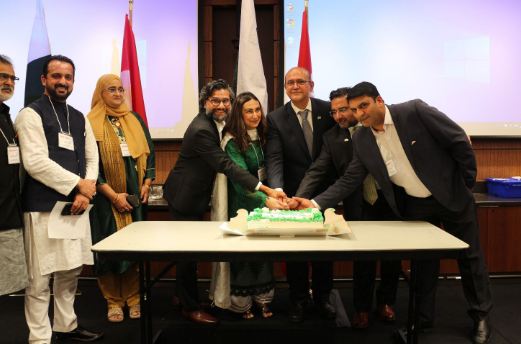
Pakistan High Commission, CPA host Independence Day event at Parliament Hill

Pakistan High Commission, CPA host Independence Day event at Parliament Hill

OTTAWA, AUG 20 : /DNA/ – The Pakistan High Commission, in collaboration with the Canada-Pakistan Association (CPA) and the Honorable Yasir Naqvi, Member of Parliament, proudly organized a “Pakistan Independence Day Celebration” at the iconic Parliament Hill in Ottawa on August 16, 2024. This event marked a significant moment as it brought together a large gathering of the Pakistani diaspora and Canadian nationals of Pakistani origin, united in their shared pride and joy for our homeland.

In his address, Acting High Commissioner Mr. Faisal Kakar extended heartfelt congratulations to the Pakistani community in Canada on the 78th Independence Day of Pakistan. He reflected on the monumental Pakistan Movement, led by the visionary Quaid-e-Azam Muhammad Ali Jinnah, which culminated in the creation of a sovereign nation where we could live with dignity, freedom, and equality.

Mr. Kakar lauded the Pakistani diaspora in Canada for their unwavering dedication and contributions, which have played a pivotal role in strengthening the bonds between Pakistan and Canada. He emphasized that the Pakistani community has not only fostered greater understanding and cooperation between the two nations but has also been instrumental in showcasing Pakistan’s positive image on the global stage.

He also took the opportunity to draw attention to the ongoing plight of our Kashmiri brethren in Indian Illegally Occupied Jammu and Kashmir (IIOJK). Mr. Kakar reiterated Pakistan’s commitment to stand in solidarity with the Kashmiri people in their just cause, urging the international community to fulfill the promises made to them and to uphold their right to self-determination.

This celebration was not just a commemoration of Pakistan independence but also a reaffirmation of the shared values, unity, and the enduring spirit of Pakistanis, both at home and abroad.

PM Bids Farewell to Palestinian Ambassador, Reiterates support for Palestine with pre-1967 borders

PM Bids Farewell to Palestinian Ambassador

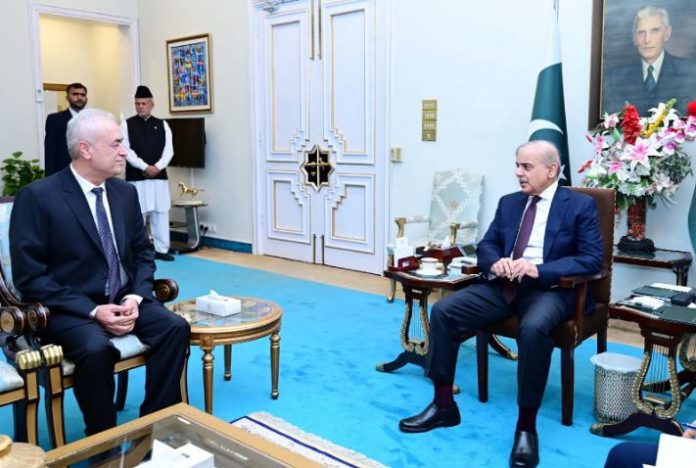
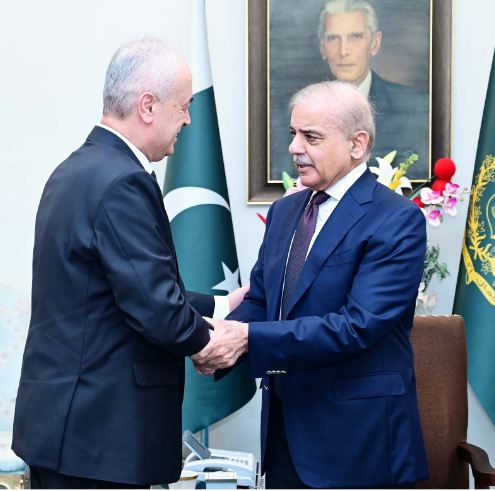
ISLAMABAD, AUG 20 /DNA/ – Prime Minister Muhammad Shehbaz Sharif met the outgoing Ambassador of Palestine, Amb. Ahmed Jawad A.A. Rabei at the Prime Minister House.

The Prime Minister reiterated Pakistan’s unwavering support for the Palestinian people and their right to self-determination. He strongly condemned Israel’s barbaric actions against innocent Palestinians in Gaza since October 7, 2023 that had led to the heart wrenching killing of over 40000 innocent Palestinians, including women and children, and more than 90000 injured.

The Prime Minister reaffirmed Pakistan’s strong commitment and support for efforts to find a just and lasting resolution of the Palestine issue through a two state solution with the creation of an independent state of Palestine with pre-1967 borders and Al Quds as its capital, in accordance with relevant UN resolutions.

Amb. Jawad thanked the Prime Minister for his support for the Palestinian cause as well as for the hospitality extended to him during his five years’ tenure. He lauded Pakistan’s historic and consistent stance on Palestine and its contribution to the international efforts for peace and stability in the region. The Ambassador thanked the Government of Pakistan for providing much needed humanitarian assistance and offering scholarships to Palestinian medical students to complete their studies in Pakistan.

In the end, the Prime Minister wished the Palestinian Ambassador success in his future endeavors.

Pak, Netherlands cement ties with focus on human trafficking

Pak

Ambassador de Vries congratulated Minister Naqvi on his nomination for the presidency of the Asian Cricket Council and underscored the importance of sports diplomacy

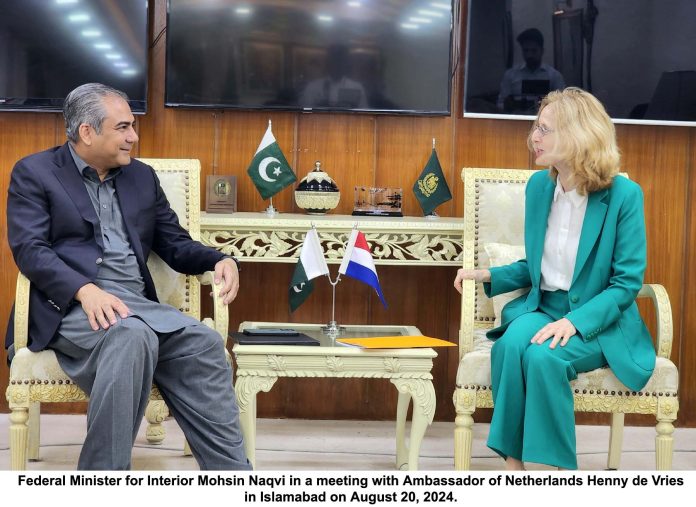
ISLAMABAD, Aug 20 (DNA): Federal Minister for Interior Mohsin Naqvi welcomed the Ambassador of the Netherlands, Henny de Vries, on Tuesday at the Ministry of Interior to discuss issues of mutual interest.

The meeting focused on enhancing bilateral cooperation across various sectors, with a special emphasis on combating human trafficking and strengthening cricket ties between the two nations.

Naqvi emphasized Pakistan’s commitment to deepening relations with the Netherlands, particularly in areas such as human trafficking prevention, where he highlighted the importance of collective international action.

“Human smugglers are a powerful mafia, and no country can tackle them alone,” Naqvi remarked.

The discussion also covered the upcoming visit of an Italian team to Pakistan, aimed at furthering these collaborative efforts.

Additionally, both sides agreed on the need to bolster support for Afghan refugees, with Pakistan reiterating its long-standing commitment to hosting displaced populations.

The conversation also extended to the realm of sports, where plans to promote cricket between the two countries were discussed.

Ambassador de Vries congratulated Minister Naqvi on his nomination for the presidency of the Asian Cricket Council and underscored the importance of sports diplomacy.

He expressed hope that closer cricket ties would provide the Netherlands team with valuable learning opportunities from Pakistan’s experience.

The meeting concluded on a positive note, with both sides agreeing to further enhance cooperation in various fields, reinforcing the strong and growing relationship between Pakistan and the Netherlands.

Federal Interior Secretary Khurram Ali Agha and Additional Home Secretary Rifat Mukhtar Raja were also present at the meeting.

Pakistan successfully conducts Shaheen-II ballistic missile launch

Pakistan successfully conducts Shaheen-II ballistic missile launch

ISLAMABAD, AUG 19: Pakistan on Tuesday successfully conducted a training launch of the Shaheen-II, a surface-to-surface ballistic missile.

The exercise was designed to train troops, validate various technical parameters, and evaluate the performance of enhanced sub-systems aimed at improving accuracy and survivability.

According to a statement issued by Inter-Services Public Relations, the training launch was attended by senior officers from the Strategic Plans Division, Army Strategic Forces Command, and leading scientists and engineers from strategic organizations. The event marked a significant milestone in Pakistan’s defense capabilities.

During the event, the director general of the Strategic Plans Division commended the technical expertise, dedication, and commitment of the scientists and engineers who played a crucial role in achieving this landmark success. He highlighted the importance of such exercises in maintaining and advancing Pakistan’s strategic defense objectives, stated the ISPR.

The successful launch drew praise from the highest levels of government. The president, prime minister, Chairman Joint Chiefs of Staff Committee, and services chiefs all extended their congratulations to the team of scientists and engineers for their outstanding achievement.

The Shaheen-II missile is known for its precision and advanced technological features, contributing significantly to Pakistan’s strategic deterrence capabilities. Today’s successful launch underscores Pakistan’s commitment to maintaining a credible and effective defense posture.

National Security in American Political Discourse

National Security in American Political Discourse

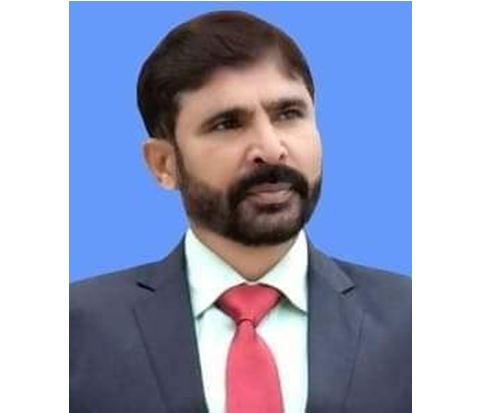
Dr. Muhammad Akram Zaheer

American political discourse has an issue of “national security” fundamentally amplifies its importance, often bringing it to the forefront of policy discussions and public concern. The term itself carries a weight that surpasses ordinary political or social issues, signaling a matter of utmost priority for the nation’s well-being. Within the specialized field of foreign policy analysis, national security concerns are typically classified under “high politics,” a category reserved for the most critical and existential threats to a nation. This includes matters such as the regulation and control of weapons of mass destruction, which are seen as pivotal to a country’s survival and sovereignty. Conversely, issues like human rights, although important, are often relegated to the realm of “low politics,” considered secondary in terms of immediate national survival.

However, the designation of what constitutes a national security issue is not universally agreed upon. The boundaries of national security are fluid and have shifted over time, reflecting changes in the geopolitical landscape, technological advancements and evolving perceptions of what threatens a nation. In the American context, the concept of national security has seen significant variation throughout history, influenced by both external threats and internal developments.Historically, American leaders have invoked the concept of national security without always providing a precise definition. During the Revolutionary era, figures like George Washington and Alexander Hamilton used the term, but its exact meaning remained ambiguous. The concept of national security as we understand it today began to take shape in the mid-20th century. The onset of the Cold War marked a significant expansion of the national security agenda. The passage of the National Security Act in 1947 was a pivotal moment, establishing the framework for America’s national security apparatus, including the creation of institutions like the National Security Council and the Central Intelligence Agency. Yet, even then, the act did not clearly define what national security entailed.

As the Cold War progressed, the scope of national security concerns fluctuated. During periods of intense tension with the Soviet Union, such as the early years of the Cold War, national security concerns were broad and all-encompassing. However, as détente—a relaxation of tensions between the U.S. and the Soviet Union set in during the late 1960s, the focus of national security began to narrow. This shift was temporary, as new challenges, such as the 1973oil embargo, soon emerged, once again broadening the scope of what was considered a national security issue, particularly with regard to energy security.The 1980s saw further expansion of the national security concept, reflecting the global strategic competition of the time. However, the end of the Cold War in 1991 brought about a period of relative ambiguity. With the collapse of the Soviet Union, the United States found itself without a clear, existential threat, leading to a period of debate and uncertainty among scholars and policymakers regarding the definition and scope of national security.This uncertainty persisted until the attacks of September 11, 2001. The events of 9/11 and the subsequent “war on terror” led to a dramatic and rapid expansion of the national security concept. In the post-9/11 world, a wide array of issues began to be framed as matters of national security. Today, national security encompasses not only traditional military and intelligence concerns but also a diverse range of issues such as climate change, cybersecurity threats like ransomware, the security of critical minerals, the development and deployment of artificial intelligence and even public health challenges like personal protective equipment during pandemics.In the contemporary American context, the term “national security” has become so expansive that it can be applied to almost any issue. This broadening reflects the complexity of the modern world, where threats are increasingly diverse and interconnected. Consequently, the line between “high politics” and “low politics” is increasingly blurred, as issues once considered peripheral are now recognized as central to the security and stability of the nation.

The ongoing process of economic globalization and the rapid pace of technological advancement have undeniably amplified the number of unconventional threats that the United States faces today. These new challenges arise from various sectors, including cybersecurity, global financial systems and emerging technologies like artificial intelligence. However, there is a noticeable trend within the U.S. foreign policy establishment: an accumulation of concerns that never seem to be fully addressed or resolved. Instead of removing old concerns from the national security agenda, new ones are added, creating a growing list of issues that demand attention.In the complex landscape of global politics, problems rarely disappear on their own. At best, they fade into the background but never truly go away. Even when crises seem to be under control, they often linger, only to reemerge later when left unattended. These issues, once considered peripheral, can quickly move to the forefront, demanding urgent attention. This dynamic creates a challenging environment where policymakers must constantly juggle a multitude of concerns, both new and old.Within this context, policy entrepreneursindividuals or groups who advocate for specific policy changes play a significant role. They come from various political backgrounds and push the administration, Congress and other key actors in U.S. foreign policy to prioritize their particular issues as matters of national security. Their goal is to secure greater focus and resources for these concerns, which they believe are critical to the nation’s safety.Among these voices, American populists and nationalists are particularly vocal. They tend to view a wide range of issues as threats to national security, often advocating for aggressive measures to address them. A notable example is the Heritage Foundation’s Project 2025, which outlines potential policies for a second Trump administration, should Donald Trump win the upcoming election. This project highlights concerns about both domestic big tech companies and foreign firms like TikTok, labeling them as potential national security threats that require regulation.

The influence of these political interests and the structural incentives within the foreign policy establishment lead to an ever-expanding list of national security issues. Rarely are concerns removed from this list, which results in a situation where almost anything can be framed as a national security threat. However, this broad and ever-growing definition of national security creates a significant risk. When too many issues are labeled as national security priorities, it becomes difficult to determine which threats truly deserve the most attention and resources.

Without a more focused and deliberate discussion among policymakers about what truly constitutes a national security issue, there is a real danger that Washington will spread its resources too thin. By attempting to address too many concerns simultaneously, the U.S. may end up effectively addressing none of them. This dilution of focus can lead to genuine threats being overlooked or inadequately addressed, ultimately compromising the nation’s safety and security.As the next president takes office in January, a critical task will be to reassess and redefine the fundamental principles that guide national security policy. This reassessment is essential to narrow the scope of national security concerns to those that genuinely pose the most significant risks. Without such a reevaluation, there is a considerable danger that the U.S. will continue to overextend itself, attempting to tackle too many issues at once and failing to adequately protect the nation from real and pressing threats.

The concept of national security in American political discourse has evolved significantly over time, expanding to encompass a wide array of issues beyond traditional military and intelligence concerns. This broadening reflects the complex and interconnected nature of modern threats, from cybersecurity to climate change. However, this expansion also poses challenges, as the growing list of concerns risks diluting focus and resources. It is crucial for policymakers to carefully assess and prioritize what truly constitutes a national security issue, ensuring that the most critical threats receive the attention they require to safeguard the nation’s well-being.

Stay Connected

64FansLike
60FollowersFollow

Latest Reviews

Exchange Rates

USD - United States Dollar
EUR
1.17
GBP
1.35
AUD
0.72
CAD
0.73