Home Blog Page 799

3 Islamabad bar associations reject constitutional changes

Pakistan hockey team not invited to Azlan Shah Cup 2025

Lawyers vow to stand firm against amendments, citing judicial independence concerns.

DNA

ISLAMABAD: Islamabad’s three major bar associations have rejected the recent constitutional amendments and announced their intent to resist them. The Islamabad High Court Bar Association, Islamabad District Bar Association, and the Islamabad Bar Council, in a joint press conference, declared that they will not only oppose the amendments but will actively work to prevent them from being implemented.

Addressing the press conference, Islamabad Bar Council’s Ali Imran Abbasi, along with other senior members, expressed concerns over the amendments, claiming they were designed to serve specific individuals and political parties.

He further added that the amendments would undermine the judiciary, reducing the Supreme Court’s powers to those of a session judge.

Abbasi pointed out that recent amendments aimed at curbing judicial independence by dismissing judges who opposed certain political agendas.

The bar associations also demanded the Supreme Court Bar Association withdraw its review petition of Article 63A, accusing the Chief Justice of playing a facilitator’s role in passing these amendments.

The lawyers claimed that a path was being paved for politically compliant judges, leaving no room for those with independent consciences.

The lawyers also announced an All Pakistan Lawyers Convention, scheduled for 7 October, to rally support against the amendments.

President of the Islamabad High Court Bar, Riasat Ali Azad, reaffirmed the lawyers’ commitment to resist any attempt to impose what he termed as “civil martial law” in the country.

He warned that any judge following in the footsteps of Justice Munir would be held accountable, vowing to stand like a wall against the constitutional package.

Malaysia welcomes Pak engagement with ASEAN

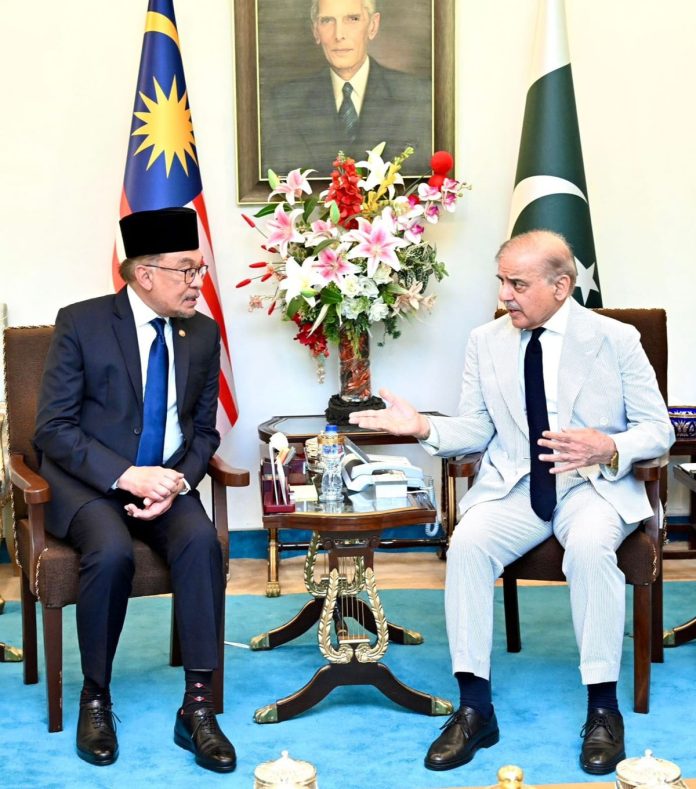
PM Shehbaz, Malaysian premier Dato’ Seri Anwar Ibrahim discuss mechanisms to achieve concrete results

Abid Raza

ISLAMABAD: Prime Minister Shehbaz Sharif and his Malaysian counterpart Dato’ Seri Anwar Ibrahim on Thursday reiterated their commitment to bolster mutually beneficial ties between the two countries.

Holding a one-on-one meeting in Islamabad, the two premiers underscored the rich history of close bilateral cooperation between the two countries, said the statement issued by the Prime Minister’s Office (PMO).

The development comes as PM Ibrahim, along with a high-level delegation, reached Islamabad on Wednesday on a three-day visit to the country.

During today’s meeting, the PMO statement added, the two sides discussed a wide range of bilateral, regional, and international issues of mutual interest including those being faced by the Muslim Ummah.

They also touched upon the mechanisms to enhance bilateral cooperation to achieve concrete results in these areas.

With PM Shehbaz congratulating his Malaysian counterpart on Malaysia’s upcoming Chairmanship of the Association of Southeast Asian Nations, (ASEAN )in 2025, the honourable visiting dignitary welcomed Pakistan’s continued engagement with ASEAN as a Sectoral Dialogue Partner and expressed support for further engagement between Pakistan and ASEAN as well as Pakistan’s larger role in ASEAN.

Setting the tone and future direction of bilateral relations between the two countries, the two leaders stressed the importance of dialogue and exchanges of visits at all levels and underlined the importance of the Joint Ministerial Commission (JMC), bilateral consultations and other mechanisms to enhance engagement at all levels.

Expanding on the Malaysian premier’s visit earlier this week, the Foreign Office said that the two sides will discuss a wide-ranging agenda to further strengthen Pakistan-Malaysia ties in diverse fields including trade, connectivity, energy, agriculture, halal industry, tourism, cultural exchanges and people-to-people contacts.

FO Spokesperson Mumtaz Zahra Baloch said both leaders will also discuss regional and global developments.

It is pertinent to mention here that Pakistan and Malaysia enjoy strong bilateral ties anchored in history, culture and faith. This visit provides an important opportunity to further strengthen Pakistan-Malaysia relations, added the FO spokesperson.

PM Shehbaz welcomes Malaysian PM to Pakistan on 3-day visit

PM Shehbaz welcomes Malaysian PM to Pakistan on 3-day visit

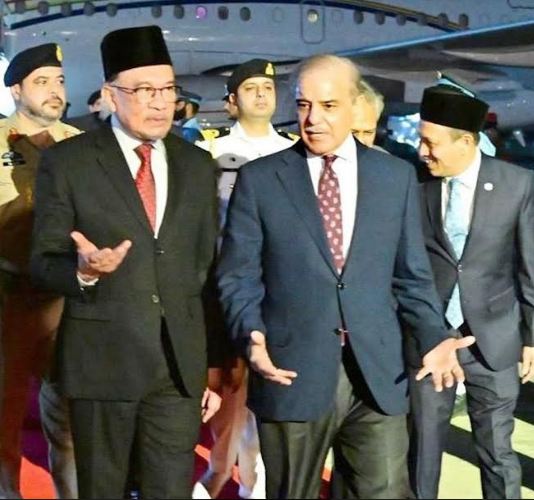
ISLAMABAD, OCT 2: Prime Minister Shehbaz Sharif on Wednesday welcomed Malaysia’s Prime Minister Anwar Ibrahim to Pakistan on a three-day official visit.

Upon his arrival at the Nur Khan Airbase, children clad in traditional attire presented bouquets to the Malaysian premier. He was also given a static guard of honour while 21 guns boomed in the background as a gesture of warm welcome.

Deputy Prime Minister and Foreign Minister Mohammad Ishaq Dar and members of the federal cabinet were also present to welcome the visiting dignitary. The Malaysian prime minister was accompanied by a high-level delegation.

Earlier today, Malaysia’s Foreign Minister Mohamad Hasan reached Islamabad airport, where he was received by Additional Foreign Secretary (Asia Pacific) Imran Ahmed Siddiqui, the Foreign Office said on X.

During his visit, PM Ibrahim will meet with his Pakistani counterpart Shehbaz Sharif, where they will discuss regional and global developments, according to a statement issued earlier by the Foreign Office.

They will also discuss a wide-ranging agenda to further strengthen Pakistan-Malaysia ties in diverse sectors such as trade, connectivity, energy, agriculture, halal industry, tourism, cultural exchanges and people-to-people contacts.

The Malaysian premier would be accompanied by a high-level delegation comprising ministers, deputy ministers and senior officials.

Noting that Pakistan and Malaysia enjoy strong bilateral ties anchored in history, culture and faith, the FO had termed the visit an “important opportunity” to further strengthen ties between the two Muslim nations.

Ahead of Ibrahim’s arrival in the country, Islamabad was adorned with Malaysian and Pakistani flags.

PM Shehbaz and Ibrahim had last met in April this year on the sidelines of a special World Economic Forum meeting in Saudi Arabia.

The prime minister had extended an invitation to his Malaysian counterpart to visit Pakistan when he was re-elected after the February 8 general elections this year.

Pakistan-Malaysia think-tank dialogue hosted by ISSI

Pakistan-Malaysia think-tank dialogue hosted by ISSI

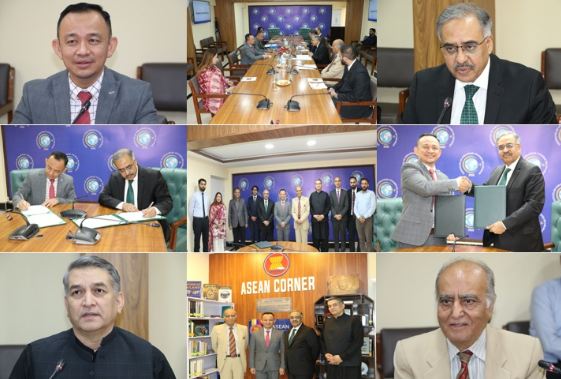
ISLAMABAD, OCT 2 /DNA/ – In the wake of Prime Minister Anwar Ibrahim’s bilateral visit to Pakistan, the Institute of Strategic Studies Islamabad (ISSI) hosted Pakistan-Malaysia think-tank dialogue with its Malaysian counter-part, the International Institute of Advanced Islamic Studies (IAIS). The IAIS delegation was led by H.E. Dr. Maszlee bin Malik, former Minister of Education and Chairman of IAIS.

The dialogue focused on Pakistan-Malaysia relations and Pakistan’s growing relations with ASEAN. The event culminated with the renewal of the Memorandum of Understanding (MoU) between ISSI and IAIS, marking steady progress in their partnership aimed at reinforcing different aspects of Pakistan-Malaysia relations and fostering closer collaboration between the two think-tanks.

DG ISSI Ambassador Sohail Mahmood extended a warm welcome to the distinguished delegation, noting that the dialogue marked a significant moment in the evolving relationship between ISSI and IAIS. He expressed appreciation for the first in-person visit, which coincided with the historic visit of Malaysian Prime Minister Anwar Ibrahim to Pakistan. He noted the exceptional cordiality of Pakistan-Malaysia relations and Malaysia’s steadfast support to the growth and expansion of Pakistan-ASEAN relationship.

Ambassador Sohail Mahmood also emphasized the importance of ISSI-IAIS institutional collaboration in reinforcing different aspects of Pakistan-Malaysia relations and broader policy objectives on both sides; deeper understanding of their respective regions’ dynamics through regular mutual dialogue; efforts to combat Islamophobia, and closer people-to-people exchanges.

Prof. Dr. Maszlee bin Malik reflected on the deep-rooted historical ties between Malaysia and Pakistan, particularly the strong people-to-people connections that predate the establishment of both countries. He emphasized the significance of cultural diplomacy and highlighted the importance of collaboration between think-tanks in addressing regional and global challenges, enhancing mutual understanding, and advancing Malaysia-Pakistan relations, particularly in the fields of education, IT, AI, and tourism. He expressed optimism for future cooperation, especially in ASEAN as Malaysia prepares to assume the chairmanship in 2025.

Dr. Talat Shabbir, Director of the China-Pakistan Study Centre (CPSC) at ISSI, highlighted the ISSI’s efforts in strengthening Pakistan’s ties with ASEAN, including through close collaboration with ACI (ASEAN Committee in Islamabad). He also noted the establishment of “ASEAN Corner” in ISSI Library last year to raise awareness and support for partnership with ASEAN.

Ambassador Khalid Mahmood, Chairman BoG, ISSI highlighted the importance of strengthening Pakistan-Malaysia bilateral relations and advancing collaboration in key areas such as trade, diplomacy and enhancing cooperation on multilateral forums.

The event concluded with the exchange of each other’s publications and Dr. Maszlee’s visit to the ASEAN Corner.

Dr. Zakir Naik meets Prime Minister Shehbaz Sharif in Islamabad

Dr. Zakir Naik meets Prime Minister Shehbaz Sharif in Islamabad

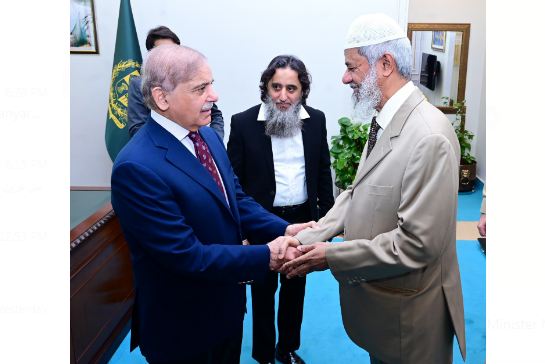
ISLAMABAD, OCT 2 /DNA/ – Renowned Islamic scholar, Dr. Zakir Naik, met with Prime Minister Muhammad Shehbaz Sharif in Islamabad on 2nd October 2024.

During the meeting, both leaders discussed various topics of mutual interest, focusing on the role of Islam in promoting global peace, unity, and tolerance.

Prime Minister Shehbaz Sharif praised Dr. Naik’s efforts in spreading Islamic knowledge and promoting interfaith dialogue worldwide.

The two leaders also exchanged views on how Pakistan can further benefit from Dr. Naik’s expertise in fostering religious harmony and education.

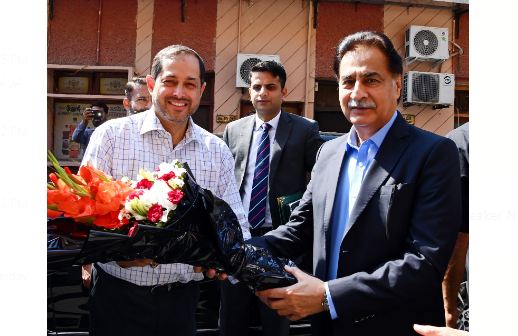
CEO Murree Brewery welcomes NA Speaker Ayaz Sadiq at Murree Brewery

CEO Murree Brewery welcomes NA Speaker Ayaz Sadiq at Murree Brewery

RAWALPINDI, OCT 2 /DNA/ – CEO of Murree Brewery, Isphanyar Bhandara, warmly welcomed Speaker of the National Assembly, Sardar Ayaz Sadiq, during his visit to the brewery. The meeting took place at the historic brewery, where both leaders engaged in discussions on various matters of mutual interest.

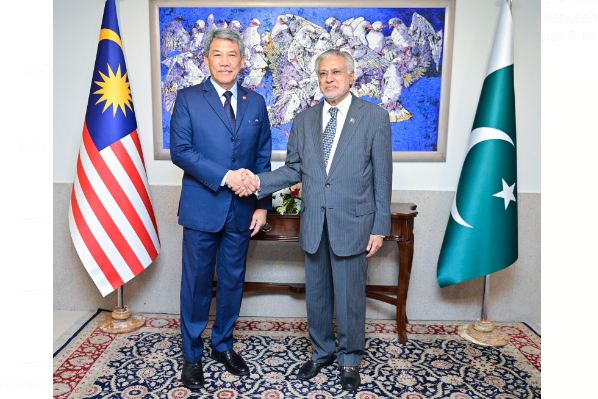
Pakistan, Malaysia Strengthen Ties: Ishaq Dar welcomes Malaysian FM

Pakistan, Malaysia Strengthen Ties: Ishaq Dar welcomes Malaysian FM

ISLAMABAD, OCT 2 /DNA/ – Deputy Prime Minister and Foreign Minister Senator Mohammad Ishaq Dar @MIshaqDar50 welcomes the Foreign Minister of Malaysia Dato Seri Utama Haji Mohamad Bin Haji Hasan @tokmatn9, on his arrival at the Ministry of Foreign Affairs. They discussed areas of bilateral cooperation between Pakistan and Malaysia and preparations for the visit of Malaysian Prime Minister to Pakistan.

Envoys of Tajikistan, Maldives Visit ICCI

Envoys of Tajikistan, Maldives Visit ICCI

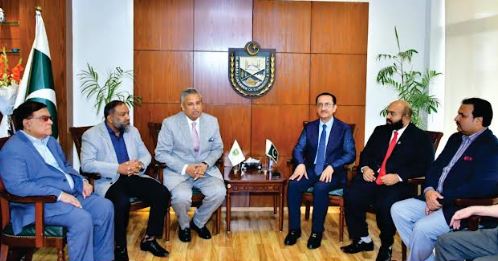
ISLAMABAD, OCT 2 /DNA/ – The Ambassador of Tajikistan, H.E. Yusuf Sharifzoda, and the High Commissioner of Maldives, Mohamed Thoha, visited the Islamabad Chamber of Commerce and Industry (ICCI) on Wednesday to extend their congratulations to the newly elected President, Senior Vice President, Vice President, and the executive committee.

During his address, Ambassador Sharifzoda emphasized the deep-rooted ties between Tajikistan and Pakistan, underscoring the extensive potential for trade and investment that exists between the two brotherly nations. He highlighted the mutual benefits that could be harnessed through enhanced cooperation, stating that both countries stand to gain significantly by leveraging these opportunities for the welfare of their people.

Drawing attention to the longstanding camaraderie, the Ambassador likened the two nations to “part of the same body and soul,” and remarked on the high demand for Pakistani products not only in Tajikistan but across Central Asia. He urged both nations to prioritize strengthening and expanding their existing relationship.

Ambassador Sharifzoda also provided an update on the ambitious CASA-1000 renewable energy infrastructure project, noting its expected completion in 2025, which will foster closer collaboration among the stakeholders. Additionally, he extended an invitation to the Pakistani business community, particularly ICCI members, to participate in the upcoming exhibition in Dushanbe on October 24.

High Commissioner Mohamed Thoha of Maldives, while expressing the close brotherly ties between Pakistan and the Maldives, emphasized the wealth of investment opportunities in his country despite its smaller size. He encouraged Pakistani entrepreneurs to explore these opportunities and to enhance trade relations for mutual benefit. Highlighting the potential for importing high-quality Maldivian tuna at competitive rates, he suggested Pakistani businesses could reciprocate by exporting vegetables and fruits to the Maldives, further enhancing trade between the two nations.

In his welcoming remarks, Nasir Mansoor Qureshi, President of ICCI, expressed his heartfelt gratitude to the distinguished guests for their visit and their good wishes for the newly elected leadership. Introducing his team, President Qureshi assured the envoys of ICCI’s commitment to further elevate trade relations with both nations to new heights, fostering economic growth on both sides. He also reaffirmed ICCI’s dedication to building bridges with chambers of commerce in friendly countries, facilitating ease of business.

Former President of FPCCI, Zubair Ahmed Malik, highlighted the immense investment potential on all fronts and stressed the need for its effective realization, while Zafar Bakhtawari, Secretary General of the United Business Group, emphasized the importance of enhancing air connectivity to strengthen bilateral ties. Bakhtawari noted that the strong bond between Pakistan, Tajikistan, and the Maldives is reflected in the shared sentiments and mutual goodwill among the three nations.

In his vote of thanks, Abdul Rehman Siddiqui, Senior Vice President of ICCI, reiterated that numerous opportunities exist to further enhance relations among the three countries.

The gathering was also attended by ICCI Vice President Nasir Mehmood Chaudhry, executive members Tahir Ayub, Ch. Irfan, Ch. Waseem, Malik Abdul Aziz, Fatima Azeem, Shumaila Siddiqui, Malik Mohsin Khalid, Malik Aqeel, Kaleemullah, Umer Hayat Abbasi, Ishaq Sial, Malik Najeehullah, along with Naeem Siddiqui, Khalid Chaudhry, and Abbas Hashmi.

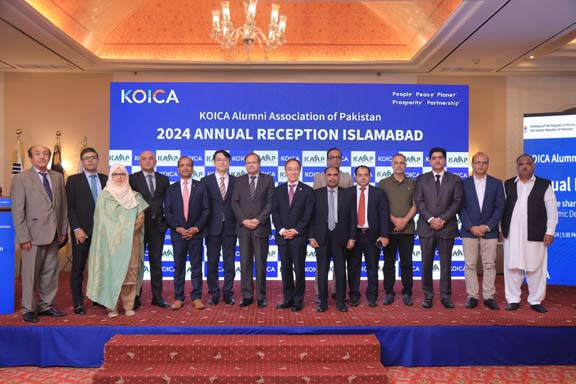
KOICA Alumni Association Pakistan successfully hosts 2024 annual reception

KOICA Alumni Association Pakistan successfully hosts 2024 annual reception

ISLAMABAD, OCT 2 /DNA/ – KOICA Pakistan Office and KOICA Alumni Association Pakistan (KAAP) successfully held its Annual Reception and Knowledge Sharing Seminar on October 1, 2024 in Islamabad. The event was organized to encourage knowledge sharing among alumni of KOICA trainees in Pakistan and to strengthen the development cooperation network between Korea and Pakistan.

The event was attended by H.E. Park Ki-jun, the Ambassador of the Republic of Korea and Mr. Yeon Je-ho, Country Director of KOICA Pakistan Office, Special Secretary of the Economic Affairs Division, Mr. Muhammad Humair Karim, and Joint Secretary of the Economic Affairs Division Mr. Sajid Manzoor. H.E. Park Ki-jun, the Ambassador of the Republic of Korea said “The development cooperation partnership between Korea and Pakistan will be further strengthened through the knowledge dissemination and exchange of KOICA trainees,”  ”We are very pleased to support Pakistan’s sustainable development through the exchange of knowledge and skills between our two countries and promote prosperity for future generations through human resource capacity building.”

The event featured two Training program alumni who shared their lessons learned from Korea. A trainee from Exploration of Good Research and Development Agricultural Productivity of Pakistan presented Agricultural Productivity: a pathway to Nutrition & Food Security in Pakistan, highlighting the impact of agricultural productivity in Pakistan on nutrition and food security, and emphasizing the important role of the agricultural sector in the country’s economic and social development. Another trainee from Capacity Building for Formulating and Evaluating Economic Development presented Economic Development Strategy and Policy in Pakistan, analyzing the country’s economic development strategy and policies and suggesting effective policies for economic development.

The KOICA Pakistan office reported on the main activities of KAAP in 2024. They shared the knowledge sharing events held this year in Quetta (June) and Peshawar (September), as well as the active participation of alumni members through the Earth Day plogging Campaign in May. “We are grateful for the active participation of many alumni in volunteer activities and look forward to continuing these activities,” said KOICA Pakistan.

The event also promoted the upcoming KOREA WEEK, which will be hosted by the Korean Embassy in Pakistan from October 22nd to 27th. The event aims to promote cooperation and cultural exchange between Pakistan and Korea, and many members were encouraged to attend and further strengthen the relationship between the two countries.

To date, a total of 1,834 alumni members  have been trained from KOICA’s training programs in Pakistan, and since the establishment of KAAP in 2010, various activities and seminars have been held every year through the Knowledge Sharing seminar. This year, 243 trainees attended the Knowledge Sharing seminar, and the KOICA Pakistan office said, “We expect that such knowledge sharing and cooperation will maintain the friendly relations between Pakistan and Korea and serve as a driving force for regional and national development.”

With this event, KOICA Pakistan and the alumni members pledged to continue their efforts in knowledge dissemination and human resource capacity building between Korea and Pakistan, and plan to maintain a mutually beneficial partnership.

PIDE celebrates five years of leadership and achievements under Nadeem ul Haque

PIDE celebrates five years of leadership and achievements under Nadeem ul Haque

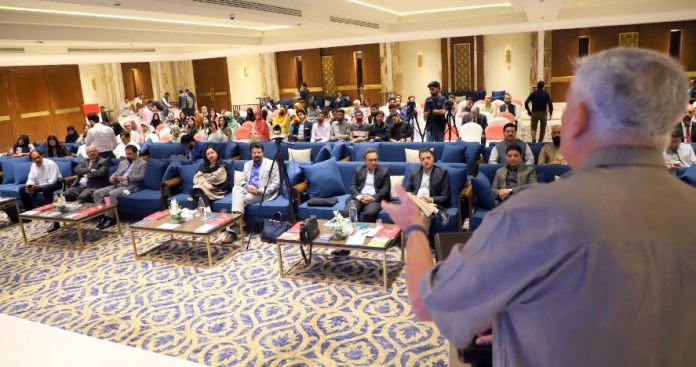
ISLAMABAD, OCT 2 /DNA/ – The Pakistan Institute of Development Economics (PIDE) proudly marks five transformative years under the leadership of Dr. Nadeem Ul Haque as Vice Chancellor. Since his appointment in October 2019, Dr. Haque has spearheaded innovative reforms in economic policy research and public policy discourse, positioning PIDE as a leading public sector think tank in Pakistan and globally.

Over the past five years, Dr. Haque’s leadership has revitalized PIDE, aligning its research with pressing macroeconomic and governance challenges. His dynamic approach reshaped the institute’s research agenda, focusing on crucial areas such as economic growth, urban development, regulatory reform, energy policy, education, healthcare, and public sector management. His groundbreaking work on the cost of bureaucracy and regulatory burdens has been widely recognized by policy circles and academics worldwide, fostering greater dialogue between policymakers, scholars, and international institutions. These contributions have played a pivotal role in shaping Pakistan’s policy landscape.

Under Dr. Haque’s stewardship, PIDE expanded its platforms for knowledge dissemination, including books, the renowned Pakistan Development Review journal, policy briefs, and academic conferences. Initiatives such as the EconFest and PIDE’s YouTube channel have extended the institute’s outreach, engaging a diverse audience beyond academia, including policymakers and the general public. Dr. Haque’s tenure also saw the launch of the Research for Social Transformation and Advancement (RASTA), the largest public policy research grant program in Pakistan. This initiative, aimed at fostering local research and solutions, has connected over 65 universities and 3,200 researchers, creating a robust knowledge network. This program is pivotal in generating high-quality, evidence-based research that informs policy decisions across the country.

With a vision for inclusive academic dialogue, Dr. Haque organized the prestigious Annual General Meeting and Conference of the Pakistan Society of Development Economists (PSDE) across multiple regions, including Peshawar, Quetta, and Multan. This outreach has strengthened ties between academia, policymakers, and development practitioners nationwide.

The Pakistan Institute of Development Economics (PIDE) proudly celebrates five years of driving reason, rigor, and research in shaping evidence-based policies. Reflecting on the institute’s journey, Dr. Nadeem Ul Haque, Vice Chancellor of PIDE, emphasized the pivotal role PIDE has played in addressing Pakistan’s socio-economic challenges through independent research. He reaffirmed the institute’s unwavering commitment to fostering data-driven solutions for national development.

“PIDE has always championed ideas that drive change and progress. Through relentless dedication and a focus on evidence-based research, the institute has contributed significantly to Pakistan’s policy-making process,” Dr. Haque stated. He further stressed the importance of embracing innovative ideas, encouraging a collective shift in mindset away from dependence on government alone, and towards individual responsibility and ownership for meaningful progress.

PIDE continues to cultivate a thriving network of knowledge, connecting researchers, policymakers, and practitioners to create sustainable growth. “Ideas survive through networks, and knowledge thrives through connections,” Dr. Haque remarked, acknowledging PIDE’s role in fostering these vital intellectual exchanges.

Dr. Durre Nayab, former Director of Research and Pro Vice-Chancellor of PIDE, presented a comprehensive research showcase, highlighting the institution’s achievements over the past five years.

She said that since 2019, PIDE has significantly diversified its research output, introducing a variety of publications including monographs, policy viewpoints, knowledge briefs, PIDE Analytics, and webinar briefs. The institute’s innovative approach has also led to the launch of discourse magazines, animated videos, and documentaries, making research more accessible and impactful for a wider audience.

PIDE’s research spans crucial areas of Pakistan’s socio-economic development, focusing on cities and urban development, public sector management, agriculture and real estate markets, power sector reform, fiscal policy, youth opportunities, housing, and foreign aid. By addressing these diverse themes, PIDE remains dedicated to generating evidence-based policy research that influences sustainable solutions to national and global challenges.

The institute’s digital presence has grown significantly, with over 540 webinars featuring 32 Nobel Laureates and international academicians. PIDE’s YouTube platform has produced 1,091 videos, attracting 2.2 million views and over 215,000 hours of watch time, cementing its role as a leader in digital engagement and knowledge dissemination.

The event also featured several panels on key topics, with active participation from leading experts:

The Macroeconomy panel, moderated by Mahmood Khalid, focused on concurrent issues and reforms needed to stabilize Pakistan’s economy. Speakers Hafsa Hina, Uzma Zia, and others, presented actionable insights on fiscal policy, inflation control, and economic growth.

The Regulatory Burden & Sludge panel, moderated by Ahmed Waqar Qasim, featured experts like Nasir Iqbal and Usman Qadir, who critically examined Pakistan’s regulatory environment and called for streamlined processes to reduce inefficiencies in governance.

The session on Opportunities and Digital Rights, moderated by Shahid Mehmood, brought attention to the increasing importance of digital transformation in Pakistan, with panelists like Fizzah Khalid Butt and Henna Ahsan advocating for inclusive digital policies.

The Cities as Engines of Growth session emphasized the role of urban centers in driving economic progress. Moderated by Muhammad Shaaf Najib, panelists such as Saba Anwar and Lubna Hassan discussed the need for sustainable urban planning and infrastructure development.

The final panel on Markets: Energy, Agriculture & Real Estate featured insightful discussions by experts like Afia Malik and Abedullah Anjum, who highlighted the critical challenges and opportunities in Pakistan’s key markets.

A key highlight of the day was the Grand Conversation with Nobel Laureate Michael Spence, moderated by Nadeem Ul Haque. Spence offered valuable insights on Development Strategies in a More Complex and Difficult Global Economy, emphasizing the importance of strategic reforms in emerging markets like Pakistan. His discussion provided global context to Pakistan’s challenges, offering a roadmap for navigating a complex global economic environment. Professor Spenser greatly appreciated the work PIDE has produced during Dr Nadeem’s tenure and wished that the successor would keep this momentum going for larger impact on policy decisions.


Stay Connected

64FansLike
60FollowersFollow

Latest Reviews

Exchange Rates

USD - United States Dollar
EUR
1.17
GBP
1.36
AUD
0.72
CAD
0.73