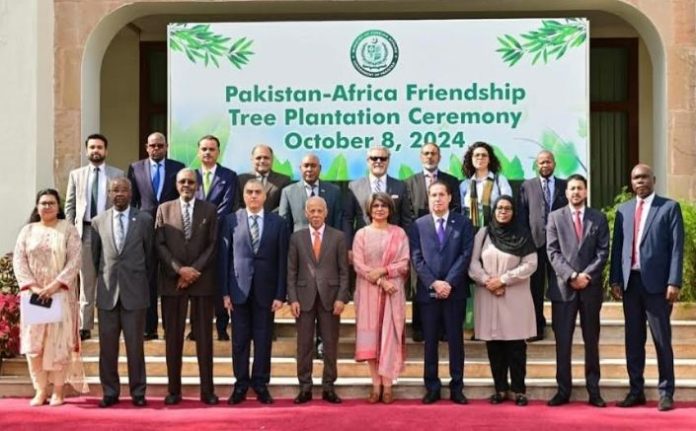
ISLAMABAD, OCT 8 /DNA/ – Ambassadors of the African group led by Mohamed Karmoune Ambassador of Morocco, who is also the Dean of the African Group, took part in tree plantation drive at the Ministry of Foreign Affairs. The Ambassadors are photographed with the Foreign Secretary Amina Baloch. DNA
A Year of Conflict: Palestinian diplomacy mobilizes global pressure against Israeli occupation

ISLAMABAD, OCT 8 /DNA/ – A year has passed since the war of extermination and displacement waged by the occupying state against our people and their just and legitimate national rights in general and in the Gaza Strip in particular, and it continues to commit more mass massacres and crimes of ethnic cleansing throughout the occupied Palestinian territory with the aim of liquidating the Palestinian cause, with the additional numbers of martyrs, wounded, injured and displaced people left behind by that war every day. A year has passed and the Ministry of Foreign Affairs and Expatriates and Palestinian diplomacy continues to make more efforts to mobilize the broadest international pressure front to stop the war of extermination, and moves in all international directions to expose the dimensions of the conspiracy and the violations, crimes and illegal unilateral steps that our people are exposed to as successive links in an expansionist and racist Israeli colonial project against our people.
The Ministry condemns in the strongest terms all forms of genocide and displacement committed by the occupation authorities, which have been ongoing for more than a year. It continues its political, diplomatic and international legal activity with the aim of translating the international consensus to stop the war into binding practical steps that force the occupying state to implement the relevant international legitimacy resolutions, precautionary orders and the advisory opinion issued by the International Court of Justice, which was adopted by a decision of the United Nations General Assembly.
The Ministry affirms that it is supervising the implementation of the full contents of the historic speech delivered by President Mahmoud Abbas before the last United Nations General Assembly, as it is the Palestinian vision for today and the day after the war, and is translating it into working concepts and diplomatic steps in its relations with countries at the bilateral level and the international community at the multilateral level so that it assumes its legal and moral responsibilities in respecting its decisions and imposing an immediate ceasefire and the war of genocide and displacement against our people. At the same time, the Ministry is keen and exerts more efforts to mature the international situation with the aim of implementing the United Nations General Assembly resolution and ending the occupation within 12 months in accordance with the text of the resolution.
In this context, the Ministry stresses that resolving the Palestinian issue is the correct approach to achieving security and stability in the region and the world, turning the page on the cycle of violence and wars, and achieving security, peace, stability, and prosperity for the peoples of the region.
ISSI launches book “Critical Issues Facing South Asia, Politics, Security, & Non-Traditional Challenges”
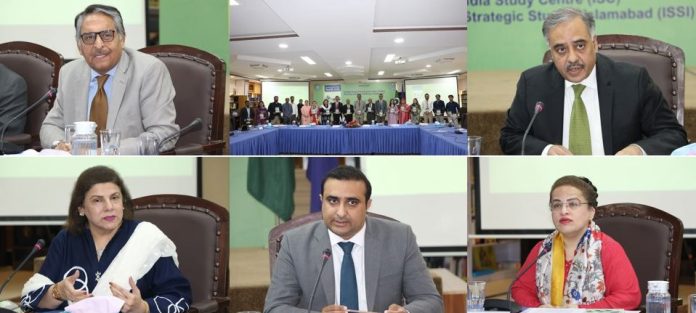
ISLAMABAD, OCT 8 /DNA/ – The India Study Centre (ISC) at the Institute of Strategic Studies Islamabad (ISSI) organized the launch of a new ISSI book, titled Critical Issues Facing South Asia: Politics, Security, and Non-Traditional Challenges. The book contains research articles by young researchers, prepared under the ISSI’s NextGen program. Ambassador Jalil Abbas Jilani, former Foreign Minister of Pakistan, graced the occasion as chief guest. Other speakers included Dr. Shabana Fayyaz, Chairperson, Department of Strategic Studies, QAU, Islamabad; and Dr. Asma Shakir Khawaja, Executive Director of CISS AJK.
In his special remarks on the occasion, Ambassador Jalil Abbas Jilani congratulated the ISSI on this initiative and appreciated the authors for producing excellent research work, full of innovative ideas. He noted that the subjects forming part of the book included myriad dimensions of Pakistan-India relations and a number of cross-cutting regional issues, which were very relevant and had currency in discussions among diplomatic as well as political circles. In the context of terrorism, for instance, he underlined that Pakistan was not alone in suffering from state-sponsored terrorism, other South Asian states including Sri Lanka, Bangladesh and Nepal were also victims of terrorism inflicted on their lands from the common neighbor. He also highlighted the salience of nuclear issues between Pakistan and India and, recalling the firing of a nuclear-capable missile from India in March 2022, stressed that it could have resulted in a larger conflagration if Pakistan had not reacted with tremendous restraint.
Ambassador Jilani underlined that for resolving Pakistan-India disputes, and for ensuring durable peace in the region, it was essential to revive the dialogue process, as disengagement could ignite serious conflict in a nuclearized South Asia. Specifically, Ambassador Jilani made six recommendations: (i) resumption of Pakistan-India dialogue; (ii) revival of discussions on all issues — from the core Jammu & Kashmir dispute to Siachen, Sir Creek and terrorism; (iii) revival of Kashmir-related CBMs; (iv) respect for and adherence to the Indus Water Treaty (IWT) in letter and spirit; (v) establishment of permanent mechanism to address nuclear-related issues; and (vi) revival of the SAARC process for regional cooperation.
In his remarks, DG ISSI Ambassador Sohail Mahmood stated that engagement with the NextGen scholars was part of the ISSI’s new vision. The Institute recognizes the youth as one of the key stakeholders and seeks to proactively draw the next generation of experts into the policy discourse with new ideas and fresh perspectives. This is important to help them develop a deeper and more nuanced understanding of the intricate issues at hand, enabling the next generation to make informed and insightful evaluations and suggest innovative approaches for addressing long-standing challenges in South Asia. In this context, he added, ISSI is happy to serve as a vital platform for fostering new ideas and amplifying the voices of young scholars, duly mentored by senior academics and seasoned practitioners. Ambassador Sohail Mahmood lauded the innovative methodologies, sharp analyses, and creative solutions offered by the young authors in their papers and thanked the ISC team for spearheading the project.
Dr. Shabana Fayyaz commended the research publication for it was solely an indigenized effort, offering local perspective based on local understanding of the context. She added that emerging technologies had been feeding insecurities of adversaries against one another and causing greater threat perceptions. The message one can draw from this book is that, amid increasingly complex regional scenarios, regional countries need to utilize their indigenized sources instead of looking up to extra-regional powers to bail them out. While praising ISSI for its NextGen initiative, she stressed that the youth in South Asia must be trained in forward-looking approaches and foresee the region beyond decades.
Dr. Asma Shakir Khwaja argued that the compilation is significant for its topic, freshness of the perspective it offers, and the actionable recommendations it brings forth. Innovative thoughts that young minds have produced on critical issues have the potential to turnaround geopolitical landscape of a most populous, yet least connected region like South Asia. Dr. Khwaja also presented an overview of the chapters while offering her insights on the subjects. She agreed that drone technology carried both benefits as well as threats in terms of security, and needed to be closely dealt with. Similarly, regulatory framework was required at regional level to prevent security threats stemming out of Artificial Intelligence.
The young authors thanked the ISSI for the opportunity provided to them for contributing to the book, which immensely helped their professional development and growth.
Earlier, Dr. Khurram Abbas, Director ISC, introduced the book. He commended the overwhelming response that the Institute received from young researchers, academicians and writers upon its call for chapters a year ago. He added that while this book launch was the final outcome of the NextGen program 2023-24, ISC plans to further enhance its engagement with young scholars through a number of similar initiatives that are to follow.
Hanif Abbasi visits ICCI: Says Country Makes Strides Towards Economic Stability
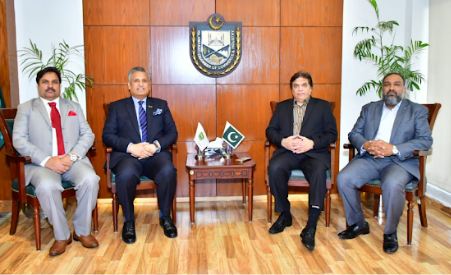
Islamabad, OCT 8 /DNA/ – Member National Assembly and senior member of Pakistan Muslim League (N) Mohammad Hanif Abbasi has emphasized the crucial role of political stability in achieving economic stability during his visit to the Islamabad Chamber of Commerce and Industry. He congratulated the newly elected president, Nasir Mansoor Qureshi, along with SVP Abdul Rehman Siddiqui, VP Nasir Mehmood Chaudrhy, and the executive body. Abbasi stressed that despite facing numerous challenges, Pakistan must focus on industrial development, fostering a tax culture, and promoting positivity by overlooking negativity targeting national institutions. He expressed optimism that continued progress on this path will ultimately lead to achieving the country’s development goals.
Abbasi expressed the hope that soon the Independent Power Producers (IPPs) issue will be resolved and bring much-needed relief to both the business community and the general public.
Nasir Mansoor Qureshi, President Islamabad Chamber of Commerce and Industry (ICCI), warmly welcomed the honorable guest and took the opportunity to introduce the newly elected Senior Vice President and Vice President. He reaffirmed ICCI’s dedication to addressing the concerns of the business community, crucial for the nation’s economic prosperity .
Qureshi highlighted the challenges faced by the community and emphasized the urgent need for resolving these issues to facilitate ease of doing business, ultimately boosting Pakistan’s exports.
Secretary General United Business Group Zafar Bakhtawari also commenced the services of MNA Mohammad Hanif Abbasi for the development of the twin city.
On this occasion, ICCI senior leaders Zahid Maqbool, Naeem Siddiqui, Khalid Chaudhry, Waseem Chaudhry, Rohail Anwar Butt, Raja Naveed Akhtar Satti and other were also present.
Bangladesh’s interim leader Yunus says no elections before reforms
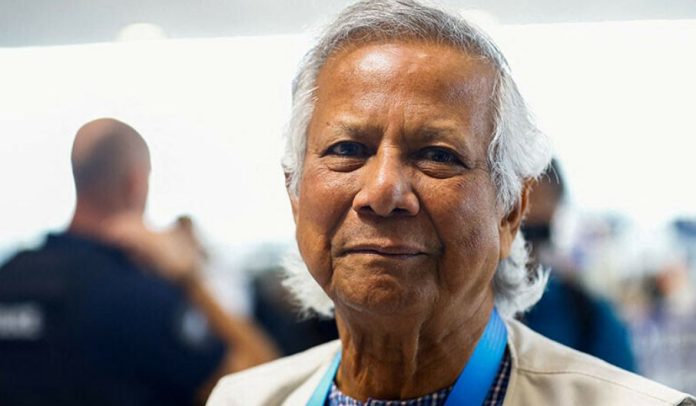
DHAKA, OCT 8: Bangladesh’s interim leader has refused to give a timeframe for elections following the ouster of his autocratic predecessor, saying in an interview published Tuesday that reforms are needed before polls.
Nobel Peace Prize winner Muhammad Yunus was appointed the country’s “chief advisor” after the student-led uprising that toppled ex-premier Sheikh Hasina in August.
The 84-year-old microfinance pioneer is helming a temporary administration, to tackle what he has called the “extremely tough” challenge of restoring democratic institutions.
“None of us are aiming at staying for a prolonged time,” Yunus said of his caretaker government, in an interview published by the Prothom Alo newspaper.
“Reforms are pivotal,” he added. “If you say, hold the election, we are ready to hold the election. But it would be wrong to hold the election first.”
Hasina’s 15-year rule saw widespread human rights abuses, including the mass detention and extrajudicial killings of her political opponents.
More than 600 people were killed in the weeks leading up to her ouster, according to a preliminary United Nations report which said the figure was likely an underestimate.
Her government was also accused of politicising courts and the civil service, as well as staging lopsided elections, to dismantle democratic checks on its power.
Yunus said he had inherited a “completely broken down” system of public administration that needed a comprehensive overhaul to prevent a future return to autocracy.
“Reforms mean we will not allow a repetition of what happened in the past”, he added.
‘Write as you please’
Yunus also batted away criticism at the numerous politicians, senior police officers and other Hasina loyalists arrested on murder charges after her government’s ouster.
The arrests have prompted accusations that Yunus’ caretaker government would hold politicised trials of senior figures from Hasina’s regime.
But Yunus said it was his intention that any criminal trials initiated against those arrested would remain free from government interference.
“Once the judicial system is reformed, then the issues will come forward, about who will be placed on trial, how justice will be carried out,” he said.
At least 25 journalists — considered by Hasina’s opponents to be partisans of her government — have been arrested for alleged violence against protesters since her downfall.
Press watchdog Reporters Without Borders has condemned those arrests as “systematic judicial harassment”.
But Yunus insisted he wanted media freedom.
“Write as you please,” he told the newspaper.
“Criticise. Unless you write, how will we know what is happening or not happening? “
How The Blue Economy Can Drive National Development

By: Muhammad Salman Ul Haq
The National Institute of Maritime Affairs (NIMA) is Pakistan’s leading maritime research Institute which is actively working with national and international partners to jump-start the Blue Economy of Pakistan. This year on 9th of October NIMA is holding its 4th International Maritime Symposium on the topic of “Realization of Blue Economy Through the Prism Sustainable Development Goals – Options For Developing Countries”. Such events can not only provide people the opportunity to engage with global maritime experts but also learn to contribute towards shaping a sustainable future.
The Blue Economy, which emphasizes the sustainable use of ocean resources to promote economic growth, enhance livelihoods and ensure the health of marine ecosystems, offers a transformative opportunity for Pakistan’s socio-economic uplift. By investing in and developing its Blue Economy, Pakistan can diversify its economic base while aligning with several Sustainable Development Goals (SDGs). Key goals such as SDG 1 (No Poverty), SDG 8 (Decent Work and Economic Growth), and SDG 14 (Life Below Water) are directly linked to the potential of the Blue Economy while all other goals are indirectly linked.
The major areas of Blue Economy consists of fisheries and aquaculture, marine tourism, marine renewable energy, maritime shipping and marine biotechnology. Countries like Bangladesh and Indonesia are good examples of how the Blue Economy can help drive economic growth and development, job creation and increase in the national income. Pakistanhas a vast coastline of 1001 kilometres, Exclusive Economic Zone and a vibrant fishery sector which can also benefit from Blue Economy.
However, Pakistan’s coastal region has numerous challenges that slow down the development of Blue Economy. The communities are mostly poor and cannot even access basic necessities such as education, health and clean water. The underdeveloped infrastructure in these communities thus does not allow the people to participate in any economic activity apart from fishing.
Deterioration of the coastal environment through factors such as overfishing adds on the challenges faced by these communities. Unsustainable fishing practices lead to the exhaustion of fish resources and this poses a major threat to fishermen who depend on fish as their source of income. Other problems include marine pollution, coastal erosion and various factors that make the fishing industries unsustainable in the long run.
In addition, majority of the coastal populations are not well endowed in terms of skills and capital to participate in higher value Blue Economy activities like marine tourism or production of marine renewable energy. The lack of government polices that seek to address the particularities make these communities economically neglected. The statistics are shocking to say the least. According to the United Nation Development Program’s Human Development Index report, HDI of 2022, Pakistan ranked 161 countries out of 192 countries. By 2023, Pakistan ranked 164th and has regressed three places due to continuous social, economic and political issues, and the floods of 2022. The country’s education standards are extremely dismal; only about 60.65% of the population is literate according to the 2023 census. This situation is more grim in the coastal rural areas of Sindh and Balochistan province where currently the literacy rate stands at 38.14% and 35.74% respectively, highlighting the wide disparity of growth between coastal and inland areas. The health indicators are also unfavourable, with high prevalence of malnutrition and high infant mortality rate in the coastal communities.
Pakistan has vast opportunities to elevate the living standards of its people especially those in coastal areas using the Blue Economy. Fisheries and aquaculture can be developed through the promotion of sustainable methods and incorporation of state-of-the-art technologies into fishing activities, which will improve yields and guarantee the sustainability of fish stocks. This comprises of offering relevant training and subsidies to enable a shift from conventional methods that are less efficient and environmentally friendly.
Additionally, developing marine tourismencompassing eco-friendly resorts, beach tourism and water sportscan significantly stimulate related industries like hospitality, transport and handicrafts. In the renewable energy sector, focusing on offshore wind and tidal energy can diversify energy sources and create job opportunities in coastal regions. Furthermore, involving coastal communities in marine biotechnology and conservation efforts, such as coral reef restoration and mangrove planting, will preserve marine biodiversity while providing alternative livelihoods, thus promoting both environmental sustainability and economic resilience.
For the blue economy to reach its full potential, the Pakistani government, together with relevant stakeholders, require a multi faceted approach. Educational and vocational training for the marginalized coastal communities will prepare them for an active participation in the maritime industries through construction of schools, health centres and clean water sources for a better and sustainable economic future. It is equally important to enforce environmental protection laws through policies that encourage sustainable fishing, protection of the exploited species and their habitats. These initiatives require the support of the government, the private sector and civil society, especially the public-private partnerships which also spearhead investment, technology and employment. Furthermore, collaboration with countries that have already implemented Blue Economy initiatives can give Pakistan the knowledge and capital required to harness the full potential of its maritime sector.
The Blue Economy presents a unique opportunity for Pakistan to address the socio-economic challenges faced by its coastal communities. Through sustainable fisheries, marine tourism, renewable energy and improved infrastructure, Pakistan can uplift these marginalized populations and build a stronger, more resilient Blue Economy. However, this potential can only be realized through careful planning, investmentand a commitment to sustainability. By recognizing and acting upon the value of its maritime resources, Pakistan can pave the way for a brighter future for its coastal communities, contributing to national prosperity in the process.
The National Institute of Maritime Affairs (NIMA) is Pakistan’s leading maritime research Institute which is actively working with national and international partners to jump-start the Blue Economy of Pakistan. This year on 9th of October NIMA is holding its 4th International Maritime Symposium on the topic of “Realization of Blue Economy Through the Prism Sustainable Development Goals – Options For Developing Countries”. Such events can not only provide people the opportunity to engage with global maritime experts but also learn to contribute towards shaping a sustainable future.
The author is a Research Associate at the National Institute of Maritime Affairs, Islamabad and can be reached at [email protected]
Who Benefits from Attacks on Chinese Nationals in Pakistan?
Muhammad Mohsin Iqbal
The targeting and killing of Chinese experts and residents working in Pakistan has raised concerns about both the safety of foreign nationals and the stability of long-term development projects, particularly those under the China-Pakistan Economic Corridor (CPEC). These attacks are not random acts of violence but are part of a broader, calculated strategy aimed at undermining Pakistan’s growth and the strengthening of Pakistan-China relations. Understanding the real reasons behind these targeted killings, identifying the beneficiaries, and addressing the internal and external forces orchestrating these incidents is essential for ensuring the future of joint ventures, including CPEC, and safeguarding Pakistan’s geopolitical and economic interests.
One of the primary reasons for these targeted attacks is to destabilize Pakistan’s economic progress. The China-Pakistan Economic Corridor, a multi-billion-dollar investment project, is the flagship of the Belt and Road Initiative (BRI). It represents a long-term partnership that promises significant economic benefits to Pakistan, including the development of infrastructure, energy projects, and industrial zones. This partnership has the potential to make Pakistan a regional economic hub, which does not sit well with those who want to see the country in a state of perpetual dependency and instability. By targeting Chinese nationals, these actors aim to scare away foreign investment and stall the progress of CPEC, thereby hindering Pakistan’s development.
External forces are believed to play a significant role in these attacks. Some regional and global powers are uncomfortable with China’s expanding influence in South Asia, especially through its deep-rooted partnership with Pakistan. CPEC, given its strategic importance in terms of trade routes and energy supplies, is viewed as a direct threat to the economic and geopolitical ambitions of rival powers. These powers may seek to disrupt this partnership by sponsoring or instigating militant groups to carry out attacks on Chinese personnel in Pakistan. The objective is clear: to create friction between Pakistan and China, drive away Chinese investments, and strain the Pakistan-China relationship. Such efforts, if successful, would benefit these external actors by diminishing China’s influence in the region and weakening Pakistan’s economy.
Internally, there are groups that are either ideologically opposed to Pakistan’s cooperation with China or have vested interests in keeping certain regions of the country unstable. Baloch separatist groups, for instance, have frequently claimed responsibility for attacks on Chinese workers. These groups see CPEC as a threat to their cause, believing that it marginalizes the local population while exploiting the province’s resources. While their grievances may have a local flavor, they have often been accused of receiving support from external powers that are interested in destabilizing the region. Other extremist factions operating within Pakistan may also carry out these attacks to undermine the state, create an environment of insecurity, and gain international attention for their causes.
The beneficiaries of these attacks are not difficult to identify. The development of CPEC is seen as enhancing Pakistan’s economic and strategic capabilities, which challenges India’s influence in the region. Thus, any setbacks to CPEC, such as a reduction in Chinese investment or delays in project completion, would serve India’s strategic interests. Additionally, some Western powers, wary of China’s global rise, may view the disruption of CPEC as part of a broader strategy to contain China’s influence in Asia and beyond.
The impact of these attacks on CPEC and other joint projects is considerable. Every time Chinese nationals are targeted, it sends a message of insecurity, not only to China but also to other potential investors and foreign workers. While China has shown remarkable resilience in continuing its investments in Pakistan, frequent attacks could lead to a reevaluation of risk. Chinese companies and workers may demand stronger security guarantees, increasing the cost of these projects. In the worst-case scenario, sustained violence could lead to a reduction in Chinese involvement, which would be a major setback for Pakistan’s economic future. Other countries may also hesitate to engage in joint ventures if they perceive Pakistan as unable to protect foreign nationals.
Pakistan must take immediate and concrete steps to address this issue. First, the government must significantly improve security measures for foreign workers, particularly those associated with CPEC. Additionally, intelligence sharing and coordination between Pakistan and China should be enhanced to preempt future attacks.
Second, Pakistan must address the internal grievances that are fueling some of these attacks. In regions like Balochistan, where CPEC is seen as a source of disenfranchisement rather than development, the government must engage in dialogue with local communities. Ensuring that the local population benefits from these projects, through employment opportunities and social development initiatives, could help mitigate the grievances that militant groups exploit. Economic development and political inclusion in these regions will reduce the appeal of militancy.
Finally, on the diplomatic front, Pakistan needs to take a firmer stance against external actors that are suspected of sponsoring or facilitating these attacks. Through effective diplomacy, Pakistan should present evidence to international forums and engage its allies to counter efforts aimed at destabilizing its relationship with China. Pakistan’s foreign policy should remain aligned with China while also seeking to resolve tensions with neighboring countries through dialogue.
In conclusion, the attacks on Chinese nationals in Pakistan are not isolated incidents but part of a larger strategy to disrupt Pakistan’s economic progress and weaken its partnership with China. Both internal and external forces are involved in this destabilization, and their aim is to undermine CPEC and other development projects that are critical to Pakistan’s future. To counter these challenges, Pakistan must take immediate action on multiple fronts: improving security, addressing internal grievances, and confronting external threats. Only by doing so can Pakistan safeguard its economic future and maintain the strong relationship it has with China.
UN slams terror attack near Karachi airport, killing two Chinese nationals
UNITED NATIONS, Oct 08 (DNA): The United Nations on Monday condemned the terrorist attack near Karachi’s Jinnah International Airport, which left two Chinese nationals dead, saying civilians should never be targeted.
Late on Sunday night, a massive explosion occurred on a road near the Airport, killing a total of three people and injuring at least 11 others, including a Chinese citizen.
“We condemn this act of terror that we saw in Pakistan,” the UN Secretary-General’s Spokesperson, Stephane Dujarric, said in response to a question at the regular noon briefing at UN Headquarters in New York.
“Civilians should never ever be the targets and we extend our condolences to the families of the victims and to the people and governments of both Pakistan and the People’s Republic of China,” Dujarric said on behalf of the UN chief.
Dr. Zakir criticises Pakistan for backlash
Comes down hard on PIA for not allowing his free baggage; says Indian would allow him hundreds of free baggage
DNA
Karachi: Prominent Islamic scholar Dr Zakir Naik has come under scrutiny after he abruptly left the stage during a recent charity event for orphans in Karachi.
The incident occurred when Dr Naik was invited to present awards at Pakistan Sweet Home, a foundation dedicated to helping orphaned children.
During the event, the chairman of Pakistan Sweet Home, Zamarud Khan, called girls to the stage to receive shields from Dr Naik.
However, the scholar declined to interact with them, stating that they were non-mahram and he could not present the awards. The moment was captured on video and subsequently went viral on social media, igniting a firestorm of reactions.
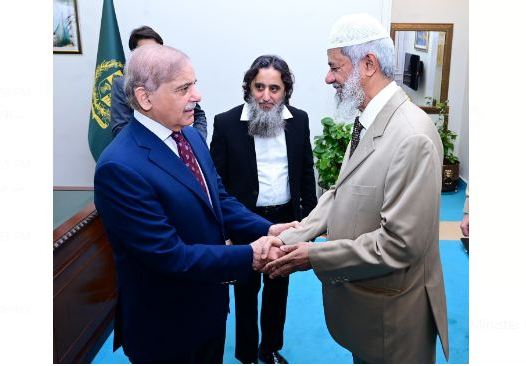
In response to the backlash, Dr Naik addressed the controversy during a public meeting at the Governor House in Sindh.
He explained that he had been invited to meet orphaned children but was taken aback by the focus on a photo session instead. “I agreed to attend despite my busy schedule, but the orphans were left behind while the focus shifted to photographs,” he said.
Dr Naik further elaborated that although the girls were termed as “daughters” by the orphanage owner, he maintained that it was inappropriate for him to touch non-mahram individuals, regardless of their age.
He expressed concern over the cultural perception in Pakistan, contrasting it with his experiences in India, where he claimed Hindu audiences respect boundaries regarding interactions with women.
“I was shocked to receive criticism for my actions. What has happened to this country?” Dr Naik remarked, urging the public to reconsider the values they uphold. He also emphasised the importance of maintaining religious boundaries, stating that while it is permissible to refer to girls as “daughters,” physical interaction is still prohibited under Islamic principles.
He also came very hard on PIA for not allowing his free baggage; saying Indian would allow him hundreds of free baggage. Speaking at a public gathering he narrated the story. He said he approached the PIA CEO to allow him free baggage which contained shooting equipment. He said he was surprised when the CEO said he will get 50 per cent discount. He told the CEO that instead of paying him 50 percent why not he should take with him six persons and thus the baggage will go free. He said while traveling in India nobody every asked him for any payment for his baggage. He said it was written on his passport that he was a state guest but even then he was not given any importance.
President condemns Karachi blast, killing Chinese nationals
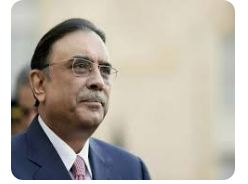
ISLAMABAD, OCT 07 (DNA) — President Asif Ali Zardari on Monday condemned the blast took that place near Karachi airport on Sunday night in which two Chinese nationals were killed. He expressed his deep grief over the killing of Chinese nationals and conveyed condolence to the bereaved families.
He said that the anti-state elements were poised to damage Pakistan’s progress and prosperity. Sympathising with the victim families, President Zardari emphasised the effective action against the perpetrators of the attack. —DNA