Home Blog Page 784

Pakistan strongly condemns terrorist attack in Istanbul

Pakistan strongly condemns terrorist attack in Istanbul

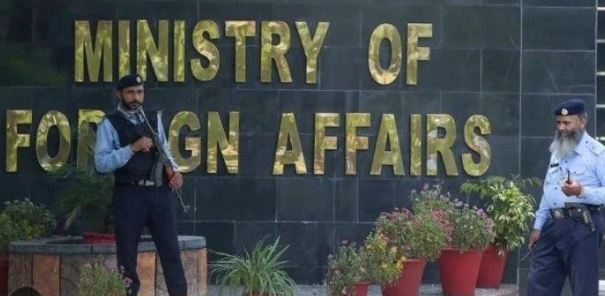
ISLAMABAD, FEB 6 (DNA) – Pakistan strongly condemns the terrorist attack targeting the Courthouse complex in Istanbul today. We extend our heartfelt condolences to the brotherly people and government of Turkiye and pray for the swift and complete recovery of those injured in this heinous attack. Our thoughts and prayers are with the bereaved families.

Pakistan reaffirms its resolute solidarity with Turkiye in its fight against scourge of terrorism.

Chairman JCSC engages in strategic talks with Saudi defense minister

Chairman JCSC engages in strategic talks with Saudi defense minister

RAWALPINDI, 6 Feb /DNA/ – Chairman Joint Chiefs of Staff Committee (Chairman JCSC) General Sahir Shamshad Mirza, while on official visit to KSA, in connection with 2nd World Defence Show called on His Royal Highness Prince Khalid Bin Salman Bin Abdulaziz Al-Saud, Minister of Defence, KSA and discussed strategic / security issues and opportunities to enhance defence cooperation between the two brotherly countries.

The Chairman JCSC also visited stalls of different organizations from Pakistan and inaugurated Al-Fatah-II Missile stall at World Defence Show.

The Chairman  also held meetings with His Excellency General Fayyadh bin Hamed Al-Ruwaili, Chief of General Staff KSA and Lieutenant General Fahad bin Abdullah AL-Muter, Chief of Royal Saudi Land Forces, KSA.

Govt hints at suspending internet services on Feb 8 polling day

Govt hints at suspending internet services on Feb 8 polling day

ISLAMABAD: Caretaker Interior Minister Dr Gohar Ejaz on Tuesday said that the government would consider suspending the internet services on February 8 only if it gets a request from a district or province in view of the security situation.

“So far, there has been no decision made regarding the suspension of internet services at any place,” said the minister during a presser in Islamabad alongside caretaker Information Minister Murtaza Solangi.

A day earlier, Solangi turned down the possibility of an internet shutdown on February 8, saying that local administrations have the authority to decide on an internet shutdown in light of the law and order situation, however, he stressed that no such situation has so far been reported.

On Sunday, caretaker Balochistan Information Minister Jan Achakzai announced that the internet service will remain temporarily restricted in the sensitive polling booths in the province on election day.

Ejaz, while talking about the law and order situation today, said that the government was making efforts to hold peaceful elections without any loss of lives.

“The election atmosphere in Sindh is full of excitement and it does not seem that any political party has enmity with another,” said Ejaz, adding that he did not see any tension between the candidates in Balochistan during his visit.

He said that we do not want to take the law into our hands in Sindh, “The parties contesting the polls in Sindh have known each other for years.”

The interior minister said that the government will provide security in three layers. “The commandos will be deployed in Balochistan to respond in the shortest possible time,” he said.

“Police, civil armed forces and army will give you protection. We will not let anyone raise an eyebrow against the integrity and independence of Pakistan,” he said.

Ejaz said that there are 90,777 polling stations across the country of which over 40,000 have been declared normal. Meanwhile, 20,985 polling stations have been declared sensitive and 16,766 have been declared most sensitive.

At least seven to eight law enforcement officials will be posted at every polling station across the country, he said, adding that over 137,000 law enforcement agencies have been deployed in the country.

“Pakistan Army troops will be deployed as quick reaction force (QRF),” said Ejaz.

The minister further said that people in Khyber Pakhtunkhwa — which suffers the most at the hands of terrorism — should come out and vote on February 8.

Ejaz said that it was government’s duty to protect the lives of all citizens.

SCULPTED WHISPERS: Echoes of a melting world exhibition 2024

SCULPTED WHISPERS: Echoes of a melting world exhibition 2024

DNA

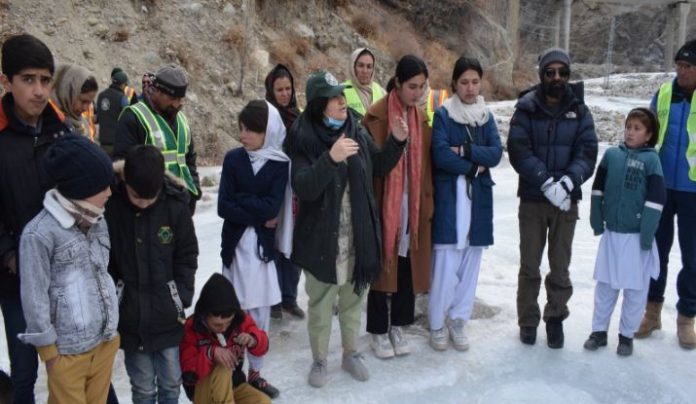
ISLAMABAD, FEB 6: The Aga Khan Agency for Habitat (AKAH) Pakistan, in partnership with the Government of Gilgit Baltistan, Tourism, Sports, Culture, Archaeology & Museums Department, and as well as local artists, arrangedanart and advocacy exhibition titled “Sculpted Whispers: Echoes of a Melting World”, as part of broader GB Winter Sports Festival, from 21 – 26 January. This was a public exhibition, held by the riverside in Shishkat, GulmitGojal, in Hunza district, engaging people from all walks of life including community members, policy makers, social activists, studentsand tourists.

“Sculpted Whispers” aimed to draw attention towards the urgent issue of melting glaciers, the need for climate action, and to foster a deeper understanding of the environmental challenges faced by the region. The exhibition themes included global warming, endangered species, the importance of trees, the role of individuals in society and protection of Mother Earth.

A team of five artists which included three men and two women, crafted eye-catching sculptures and calligraphy from ice, sand, river sediments and frozen stream, to illustrate the impact of human actions onClimate Change. AKAH’s Community Emergency Response Team (CERT) volunteers remained engaged in mobilizing community and increasing awareness and ensuring the personal safety of visitors at the event. Each sculpture went beyond artistic creativity, embodying the frozen wonders of our Earth, serving as poignant reminders of disappearing beauty due to global warming. Delegates including Secretary Finance-Gilgit Baltistan, Assistant Commissioner and District Commissioner for Hunza region also visited the art exhibition and appreciated the unique idea for raising awareness on such an important global issue.

During the exhibition, the AKAH Pakistan team also participated in a panel discussion arranged by the Government of Gilgit Baltistan at Khalti Lake on 24 January sharing a global perspective of Climate Change and its triggering factors, and its effects onGilgit-Baltistan and glaciers in North.

In a video message, Onno Ruhl, the General Manager- AKAH, said that “The Aga Khan Agency for Habitat is committed to working with frontline communities in high mountain areas like Gilgit-Baltistan and Chitral, Pakistan, impacted by climate change. AKAH’s goal is to help communities lead fulfilling lives amid escalating challenges, through blending local wisdom with scientific solutions.

Nusrat Nasab, Chief Executive Officer, AKAH Pakistan, while speaking at the press conference at the inception of art exhibition, said that ” We are committed to addressing the profound impacts of unprecedented climate change on vulnerable communities. Sculpted Whispers is an innovative exhibition that offers a visually striking portrayal of the beauty of ice, sand and stone art, while highlighting the imminent realities of climate change, urging the audience to reflect on the fragility of our planet and inspiring action towards sustainable solutions.As we witness  visible environmental transformations, AKAHreaffirms its unwavering commitment to tackling climate-induced challenges,  andvulnerability and foster the resilience of  communities in the face of adversity.”

The closing ceremony held at Khalti Lake, on the seventh day of the sports festivalwas attended by the Force Commander Northern Areas Major General Kashif Khalil as the chief guest, as well as representatives of government institutions, AKDN agencies, community, local and national tourists.

Art proved to be a powerful tool in communicating messages to people of all ages, cultures, and languages. Beyond the realm of art, “Sculpted Whispers” served as a powerful vehicle for environmental education, advocacy, and transformation. It provided a platform to spark conversations, inspire change, and leaves an indelible mark on the hearts and minds of all those who experienced it.

The Plight of Islamabad Zoo: A Call for Change and Responsibility

The Plight of Islamabad Zoo: A Call for Change and Responsibility

By: Hayah Bahroni

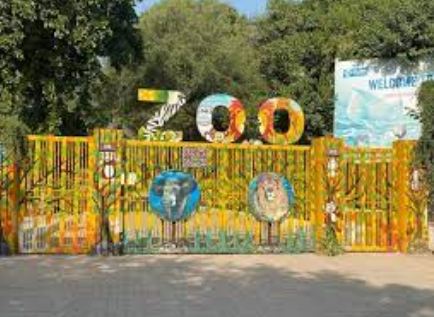
The closure of the zoo in Islamabad, once a beacon of wonder and joy for many, marks a heartbreaking chapter in the city’s history. What was once a place of fascination and education has descended into a state of neglect and tragedy, with animals suffering due to poor care and inadequate conditions. As someone who treasured this facility in my youth, the recent events surrounding the zoo’s mismanagement and exploitation by self-proclaimed saviors of animal rights are deeply troubling.

Growing up, the zoo held a special place in my heart. It was a sanctuary of discovery, where I could marvel at creatures from around the world and learn about the importance of wildlife conservation. However, recent reports of animals being poorly fed, neglected and even meeting tragic fates like the burning of a lion have shattered the image of this once-vibrant institution.

The transition from a well-maintained facility to a haven of neglect and exploitation was a result of the zoo falling into the hands of individuals who had ittle to no experience of handling the affairs but instead prioritize personal gain over the well-being of the creatures they are meant to protect. On the other hand, the so-called animal rights mafia had turned a blind eye to the suffering of the animals, perpetuating a cycle of cruelty and disregard for life. And now after the closure of this facility they have used the situation to suit their own vested interests and are now looking to expand the influence even on the hiking trails. Unfortunately these people are only concerned for their own fringe benefits and have no pain or empathy for the poor animals.

It is imperative that sanity prevails and responsible authorities step in to rectify the dire situation encircling the fiasco that led to the closure of the zoo. The Capital Development Authority must reclaim control of the zoo’s administration and institute sweeping reforms to ensure that the facility upholds the highest standards of animal welfare, hygiene and care. It is not only a matter of justice for the voiceless inhabitants of the zoo but also a moral obligation to provide them with the dignity and respect they deserve.

By restoring the zoo to its former glory, the Capital Development Authority can create a space that not only serves as a source of entertainment and education for the public but also as a testament to our commitment to the well-being of all living beings. A properly managed zoo can become a symbol of hope and conservation, inspiring future generations to appreciate and protect the diverse species that share our planet.

Reimagining the zoo as a modern, ethical institution will not only benefit the animals but also enrich the lives of visitors who seek to connect with nature in a meaningful way. It is a chance to bridge the gap between the digital world, where animals are often reduced to mere images on screens and the tangible reality of witnessing these majestic creatures up close.

The closure of the zoo in Islamabad due to the appalling conditions in which the animals were kept is a wake-up call for us all. It is a reminder of our responsibility to safeguard the welfare of all creatures and to ensure that places like zoos serve as centers of conservation and education. Let us hope that the Capital Development Authority heeds this call for change, turning the fate of the zoo around and creating a legacy that we can be proud to pass on to the next generation.

Commonwealth Observer Group meets PM Kakar ahead of general elections

Commonwealth Observer Group meets PM Kakar ahead of general elections

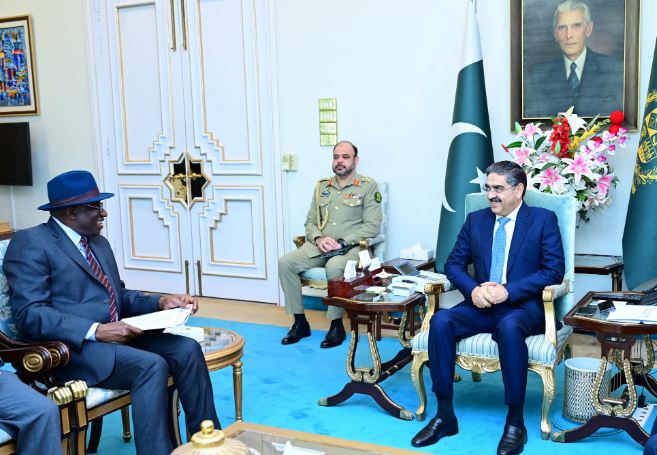
ISLAMABAD, /DNA/ – A delegation of the Commonwealth Observer Group (COG), led by former President of Nigeria, Mr. Goodluck Ebele Jonathan, called on Caretaker Prime Minister Anwaar-ul-Haq Kakar earlier today.

The meeting was part of the COG’s interaction with various stakeholders ahead of the upcoming general elections on 8 February, 2024.

The Caretaker Prime Minister welcomed the COG delegation and said that Pakistan was proud to honor its commitment as a Commonwealth member state by inviting independent international observers to witness the general elections. He said despite numerous challenges, the best possible arrangements had been made to ensure peaceful and seamless conduct of elections on polling day, across the country.

The Caretaker Prime Minister highlighted that the Caretaker Government had fulfilled its responsibilities to run the day-to-day affairs of the state and create a conducive environment ahead of the elections. Now it was the turn of the people of Pakistan to exercise their democratic right to vote.

Mr. Goodluck Ebele Jonathan thanked the caretaker Prime Minister and conveyed best wishes of the Secretary General of the Commonwealth, Ms. Patricia Scotland. He said the COG delegation would be visiting various polling sites throughout the country to observe the election process.

Pakistan High Commission Canada marks Kashmir Solidarity Day

Pakistan High Commission

DNA

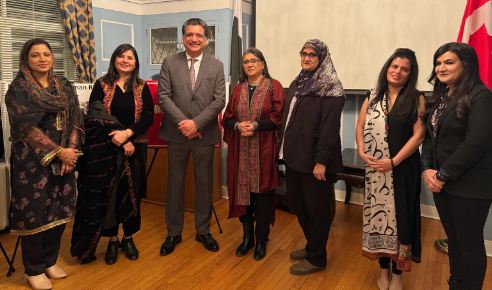
ISLAMABAD, FEB 6: Pakistan High Commission in Ottawa and its three Consulates in Toronto, Vancouver and Montreal arranged a series of programmes including pictorial exhibitions, seminars, documentary screening, demonstration and media interactions to highlight the human rights violations in the Indian Illegally Occupied Jammu & Kashmir and express solidarity with Kashmiris facing the worst kind of oppression under illegal Indian occupation.

The High Commissioner of Pakistan Mr. Zaheer A. Janjua inaugurated the photographic exhibition which was attended by a large number of Pakistani diaspora. Mr. Janjua highlighted the Indian brazenness and bravado subjecting the defenceless Kashmiris to endless atrocities. He underscored that the annulment of Articles 35(A) and 370 has added complexities to the Kashmir dispute, plunging the region into perpetual turmoil. This move has not only altered the independent status of Jammu and Kashmir but also exacerbated demographic disparities, particularly impacting the Muslim majority regions under Indian control. The relentless suppression of dissent and blatant disregard for human rights not only sow insecurity among Kashmiris but also contribute to a nefarious strategy aimed at achieving control and dominance, he added.      

In a video message, the High Commissioner also reiterated that the unanimous endorsement of the ultra-nationalist Modi government’s illegal measures, including abrogation of the Indian Constitution’s Article 370, have no legal or political impact on the disputed status of Jammu and Kashmir. Resolutions 91 and 122 of the UN Security Council explicitly declare that no unilateral step taken by any of the parties to the dispute would constitute a final disposition of the State of Jammu and Kashmir. Moreover, these actions of Modi government are ultra vires to their own constitution as consent of the Jammu and Kashmir Legislative Assembly is required, which currently stands dissolved. This is clear manifestation of the Indian judiciary’s surrender of its own legal and ethical standards to the demands of the Hindutva regime.As Jammu and Kashmir remains the most militarised region in the world,he called upon the international community to stop India of massive violations of human rights in Jammu and Kashmir, rescind the unilateral and illegal measures and implement the United Nations’ 13 Resolutions.

On this occasion, messages of the President and the Prime Minister of Pakistan were read out to the audience. Moreover, various documentaries and songs dedicated to Kashmiris’ struggle were screened and broadcast on the social and local electronic media. The day’s leading event was a seminar hosted by Consulate Vancouver.

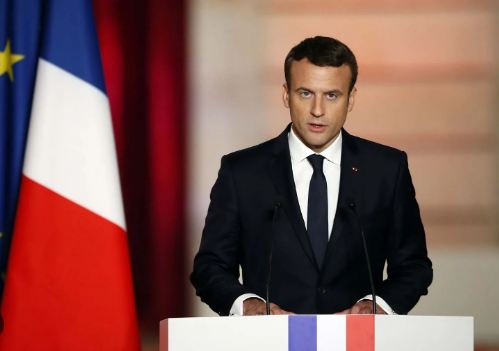
France urges bold action to counter Russian aggression in Ukraine

Russian aggression in Ukraine

STOCKHOLM, FEB 6: /DNA/ – Everything was said and perfectly by Your Majesty and Mister Prime Minister. So, I don’t want to repeat and I will try to get short and direct, perhaps much more on the situation in Ukraine.

And I suggest to answer your questions and to have more interactive session, afterwards. But very often, I repeated the necessity to have a more sovereign Europe.

And it was, for a lot of people, the sort of mystery of a paradox to speak about sovereignty referring to Europe. And indeed, I do insist on this notion. What does it mean? Having more autonomy and deciding the cooperation we want to build, but not depending on others for what is core for us.

This sovereignty is stronger now than it was a few years ago. And happily, the Russian aggression against Ukraine was part of the triggering point of more sovereignty in Europe. But we did improve the sovereignty and we are building it together. And I think our partnership with the Prime Minister – you perfectly referred to this document – and from our defense industry to our nuclear energy, our research and so on, we are building a stronger cooperation serving a stronger and more sovereign Europe. But very clearly, we have today a much more sovereign Europe.

We are ready to design and conduct operations together abroad. This is what we are doing in the Red Sea today, this is what we did together in Africa thanks to Takuba. We designed a much more European defense, the European Initiative for Intervention, creating more intimacy between our armies and you joined this initiative and this is around such a framework that we worked together in Africa. We built a European defense fund, we built, you referred to that European peace facility, which is a big success and was totally new in order to provide equipment and financing to a third party like Ukraine. We designed few weeks after the beginning of this war a common sovereign agenda.

We called it the Versailles agenda. We’re all together in order to reduce our strategic dependencies. But in technology, energy, defense, economic capacities, we decided precisely to work closely together to have more European answers. Clearly, we started to reverse decades of falling defense expenditures. We started after Crimea in 2014, and we accelerated during the past two years.

And altogether we are spending more and more money and building common capacities and common projects between Europeans. And your decision to join NATO is part of this strategic awakening. And I want to reiterate here our full support and to congratulate you about the fact that this decision is absolutely critical, having such an important member joining now our alliance.

On top of that, we reacted very rapidly right after the aggression. We put sanctions all together, we preserved our unity as Europeans and we managed to send support financing to Ukraine during the past two years. In parallel, we put our defense industry on a war footing, and we increased the churn rates, we reopened production lines, we placed new orders and reduced administrative constraints on our industry to produce much more and much more rapidly. And we were lucky to have a U.S. partner very much involved with all of us.

Here are just a few remarks to highlight how much stronger we were altogether and more sovereign we were altogether. And all these key decisions were not obvious for a lot of people two or 3 years ago. So clearly, the past two years were characterized after the aggression of Russia by this strategic move and all these reactions. Now, the war in Ukraine will be a longterm effort, and clearly, now, this is a testing moment and a decisive moment for all of us. Both of you mentioned the importance of the challenge, and I want to insist on the fact that, even if we can be very proud of these recent decisions and the moves we made, I strongly believe that we have to do much more.

First, we will have to be ready to act, defend, and support Ukraine whatever happens and whatever the U.S. decision will be. I think we are very lucky to have such a partner, to have such an ally. But very clearly, we have to be lucid on the fact that Ukraine is part of the European continent. And whatever the U.S. will decide, we have to take the right and bold decision to support Ukraine and the Ukrainian people.

And we have to follow the line in the current strategy, which is impossible for all of us to see Russia winning this war, because there is no more framework and architecture of security in our continent if this is a Russian victory. What is the future of our Eastern flank, what is the future of the whole Europe, what is the future of Caucasus, what is the future of Central Asia if the results of such an international involvement will be a victory for Russia? So the cost, the real cost on the short to long-run of a Russian victory is too high for all of us.

This is why the reasonable answer is to put ourselves in a situation to support Ukraine during this year and the years to come. Whatever it takes, whatever it costs, this support should be through weapons and ammunitions, training programs, and everything they will need in order to resist the Russian aggression and put themselves, meaning the Ukrainians, in a situation to negotiate a sustainable peace; meaning a peace decided by the Ukrainians, and a peace respecting international order and international rules.

This is why whatever we decided and we did, clearly, we will have, in the months to come, to accelerate and scale up our effort. In terms of production, let’s be clear, and perhaps in terms of nature, it will request a lot of national decisions.

It will request some clear European decision, and we will make the follow-up on Thursday with our dear colleagues in Brussels. It will request to have perhaps some innovative answer, and I want to praise our colleague Kaja KALLAS, and she proposed a very bold decision for our defense industry strategy in order to have a sort of grant approach in order to raise more money to finance this effort.

 I mean I’m ready to take all this adapted decision and build the consensus but very clearly, we will have to take additional decision and we will have to adapt ourselves as well to more production because let’s be clear, even if we made a lot of efforts in order to produce more and more rapidly, if we compare ourselves to the Russian effort today, it’s not at scale and it’s not right speed. They managed to completely re-adapt their system so we have to react and even overreact to be alongside with the Ukrainians.

In parallel, I think we have clearly to follow up strengthening this effort, strengthening production, be ready to take national and European decision and pre-empt any US decision not to be dependent on any change.

In parallel, I would like to insist on a few critical points for me for the future. It will guide us to a strengthening of European defense. I insisted several times on this issue. Europe of defence is not a substitute to NATO and it’s even more important for you today than it was for yesterday but clearly this is one critical pillar of NATO. This is our way to take our own fair share and this is a necessity because we speak about our own neighbourhood.

So on top of that let’s follow up the strengthening of this European defense meaning we need more innovation, more common programmes and more clear operational intimacy. What we started with the European initiative for intervention should be strengthened and deepened in the months and years to come in order to have a much more European operational approach and interoperability based on NATO experience is an asset. We have to do the same as well with common programmes. I think our common partnership will allow us to do much more together and with our defense industry we will have to follow up.

Third, we have to follow up and deliver our Versailles agenda meaning we need much more sovereignty and autonomy on our energy and our technologies and our capacity to produce. And I think one of the wake-up calls we should not forget is that during years and years we thought that making trade and exchanging energy with Russia was the best way to prevent a war.

It was a mistake. It was the best way to suffer from a war and suffer from a unilateral decision. So we should not replicate this approach. So let’s diversify our relation but let’s refuse to depend on anybody else. When we speak about our energy we have to produce our low carbon energy. More renewable, more nuclear, more efficiency. European solutions.

It’s part of our mid to long run security. When we speak about our technology, our artificial intelligence and so on it’s great to have a super partner but we want to choose and design our future. So let’s work hard in order to preserve European solutions and European innovations. When we speak about space, and both of us have this advantage to have the capacity to send satellites and launchers with our bases, let’s preserve European access to space.

This is the decision we took in Sevilla and Ariane 6 to come. But more than that, the full range of innovation, civilian and defense innovation are absolutely critical for this war and the years to come.

My last point is about how to deal with our neighbours and how to frame our own architecture. I think part of what’s happening in Ukraine is due to the fact that probably we were, as Europeans, in a situation of geopolitical minority. We were not and we didn’t put ourselves in a situation to decide for our own territory.

All the treaties were decided by former USSR and USA. Everything which covered our territory was decided by the big guys in the room, not by the Europeans themselves. And it seems that we were quite happy with such a situation. I think we have to be part of those to decide for ourselves when it is about EPF, when it is about deployments, when it is about arms control for today and tomorrow.

When it is about designing our architecture of security, we have to be the one to decide. And this is to be designed during this period of war. And this is why our involvement for the Ukrainians is not just for them to prevent any Russian victory, but it is for us to be around the table to decide for our future because Ukraine is part of our future, being part of our continent.

There is no future for ourselves and our children, if we are not in a situation to build the new architecture of security, of arms control and neighbouring of the whole region. But we have to be the one to decide it for ourselves and not to delegate it to big powers, even if they are very good allies, because they live on the other side of the ocean. It’s probably simpler.

And I think it’s very important in this moment to have in the back of our mind the fact that this is because of our current involvement, then we can put ourselves in the situation to prevent any Russian victory. But we will be legitimate as well to be part of those, to define and design this future architecture, which is absolutely critical. NATO will be part of it. But NATO should not have the exclusivity of this architecture. And as Europeans, we clearly have to be part of such a new architecture.

And I speak as a faithful partner, a robust expeditionary military power and a nuclear weapon state whose vital interests have a European dimension. And we offered a specific dialog on this. And for me it’s important to reiterate this point here in front of you.

 I want to thank you for the opportunity to share just these few remarks. But let me tell you how much we respect your country, your armed forces, your commitment and the friendship you had and the quality of cooperation we had during the past few years. And let me reiterate here our support for your current project, but as well your project in the future. And each time it will be difficult. Be sure that you can count on France.

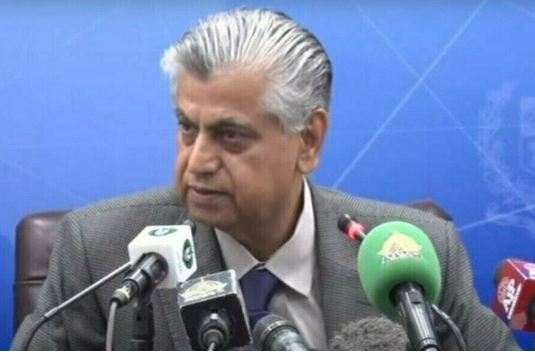
No guidelines to shut down internet on election day: Solangi

Murtaza Solangi

ISLAMABAD, Feb 05 (DNA): Caretaker Federal Minister for Information, Broadcasting and Parliamentary Affairs Murtaza Solangi on Monday said that the government had not issued any guideline to shut down internet and mobile signals on the day of general election.

Speaking in a private news channel programme, the minister said that the local administrations had the authority to decide about shutting down internet in a specific area if it faced any law and order issue.

He said there was no doubt that an extraordinary situation required extraordinary measures, however, so far no such a situation had been reported in any area.

Highlighting the government’s measures to curb fake news and propaganda on social media, the minister said the relevant institutions had been issuing clarification to rebut any such news circulating in different media.

“Security is a serious issue,” he said, while pointing out a steep rise in activities of different terrorist groups in the country, especially after the establishment an interim government in Kabul.

“Last year alone, around 1,500 incidents of terrorism were reported in the country,” Murtaza Solangi noted.

Police cops were martyred in a terrorist attack on a police station in the Dera Ismail Khan, he said, adding such acts had failed to affect the resolve of  law enforcement agencies fighting terrorism in the country.

He noted that recently, 24 terrorists were killed in Mach area of Balochistan.

The minister ruled out any delay in the elections which were scheduled for February 8. The history of Pakistan suggested that the elections were held in harsh and difficult conditions.

To a query, he said the Kashmir dispute was a long-standing issue on the agenda of the United Nations Security Council.

He recalled that some 75 years ago, the then Indian prime minister promised in the United Nations Security Council that the Kashmiri people would be given their right to self-determination so that they could decide their own destiny.

“On August 5, 2019, India changed the status of Kashmir by taking unilateral and illegal actions,” he said while regretting that the Indian government deprived the Kashmiris of their rights by abolishing Article 370 of the Indian Constitution.

He said the government and the people of Pakistan would continue to extend their moral, legal and diplomatic support to the people of Kashmir.

To another query, the minister clarified that the caretaker government had no favourites in the elections and the statement of the Pakistan Peoples Party chairman in that regard was “unfortunate”.

The minister reiterated that the caretaker government was ensuring a level-playing field for all the political parties and the state media was giving due coverage to all of them.

Solangi said all-out efforts were being made to ensure equal treatment to all the political parties, but ironically “complaining is part of Pakistan’s political culture”.

The Pakistan Muslim League-Nawaz (PML-N) had complaints of an uneven playing field in Sindh, while the PPP in Punjab and Maulana Fazlur Rehman in Khyber Pakhtunkhwa, he said, adding that the matter of level-playing field was being politicized for political gains.

He believed that the people of Pakistan would come out on the election day in a large number to elect the parties of their choice.

To another query, he said there had been a significant increase in the number of registered voters for the general elections 2024. The number of women voters alone was increased by 2 million, he added.

The proportion of the submission and acceptance of nomination papers for the elections 2024 was higher than the previous ones, he noted.

A helpline, he said, had been established for quick redressal of the complaints of local and foreign journalists and observers.

The minister urged the citizens to express their love for the country by exercising their right to vote on the election day.

“It is clearly written in the preamble of the Constitution that the country will be run by its elected representatives,” he said while regretting a persistent propaganda about the election delay.

India a terrorist state, committing worst atrocities against Kashmiris: Kakar

Anwaar-ul-Haq Kakar

MUZAFFARABAD, FEB 05 (DNA) — Caretaker Prime Minister Anwaar-ul-Haq Kakar on Monday said that India was a terrorist state, which had been committing the worst atrocities and brutalities against the innocent people of Indian Illegally Occupied Jammu & Kashmir for decades.

The world was, however, silently watching the Indian state terrorism against the Kashmiris, he regretted while addressing the Azad Jammu and Kashmir Legislative Assembly on the occasion of Kashmir Solidarity Day.

The prime minister said for last many years, India was presenting a false narrative and trying to weaken the indigenous movement of the Kashmiris for freedom by wrongly labeling them as terrorists.  There was a clear difference between terrorism and the people’s struggle for independence, he added.

PM Kakar said that the Indian leadership was also claiming that Gilgit-Baltistan and Azad Jammu & Kashmir were part of their country. “On this day, I make it clear that that India should not have any such illusions. We believe in peace and are showing maximum patience and tolerance, but any misadventure in this regard will be forcefully responded.”

He reaffirmed that Pakistan did not want any conflict in the region, however, it was fully capable of strongly retaliating any attack on its soil.  India, he said, had for many times tested Pakistan’s  capacity, and if still had any desire in that regard then “we are fully ready to show our might”.

He said if India was a true democracy then it should give the people of Kashmir their just right to self-determination, besides restoring all the basic human rights in the IIOJK.  PM Kakar said India must also stop the gross violations of human rights in the region along with releasing all the political prisoners.

 It should also abrogate all the strict emergency laws, besides removing its heavy military presence from the villages and towns of Kashmir.  It should allow the Kashmiris to hold peaceful gatherings, he added.

The prime minister said that India must allow unrestricted access to the observers of UN and Organization of Islamic Conference (OIC), international media and human rights organizations to IIOJK to get first-hand information about the situation there; and investigate and report human rights violations.

He said that India’s illegal and unilateral actions of August 5, 2019 usurping the special status of of the IIOJK were a blatant violation of international laws, including the UN Charter, 4th Geneva Convention and the relevant UN Security Council resolutions.

India had since been engaged in taking further measures to alter the demographic structure and political landscape of the held Valley, he added.  PM Kakar said that the ‘Kashmir Solidarity Day’ was annually observed on the 5th February across Pakistan to express its unwavering support for the Kashmiris’ just struggle for realization of their right to self-determination.

It was also an occasion to pay rich tribute to the sacrifices rendered by the Kashmiri brothers and sisters during the last 76 years, he added. The prime minister said that Pakistan had consistently maintained that a lasting solution of the Jammu and Kashmir dispute was possible only in accordance with the relevant UN Security Council resolutions and as per the wishes of Kashmiri people.

Pakistan would continue its moral, diplomatic and political support for the just cause, he vowed.  PM Kakar said that the relevant UN Security Council resolutions provided that the final disposition of the Jammu and Kashmir dispute would be made in accordance with the will of its people through the democratic method of a free and impartial plebiscite conducted under the auspices of the United Nations. 

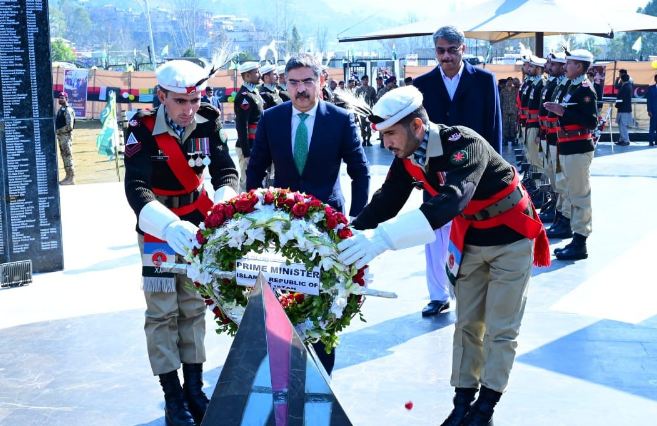
However, he added, India over the last 76 years had carried out a relentless campaign to intimidate and suppress the IIOJK people as evident from extrajudicial killings, arbitrary detentions and custodial torture. Earlier on his arrival at arrival at the AJK Legislative Assembly, the prime minister was presented a guard of honour. — DNA

Stay Connected

64FansLike
60FollowersFollow

Latest Reviews

Exchange Rates

USD - United States Dollar
EUR
1.17
GBP
1.34
AUD
0.67
CAD
0.73