Home Blog Page 783

Parliamentary committee picks Justice Yayha Afridi as next CJP amid PTI-SIC boycott

Parliamentary committee picks Justice Yayha Afridi as next CJP amid PTI-SIC boycott

ISLAMABAD: The Special Parliamentary Committee, constituted for the first time in the country’s history for the appointment of Chief Justice of Pakistan (CJP), has agreed on the name of Justice Yayha Afridi’s as the next chief top judge of the country, Planning Minister Ahsan Iqbal said.

Justice Afirdi, third on the seniority list, has been nominated by the committee members with two-thirds majority.

The development came after first round of in-camera meeting of the parliamentary panel comprising government and opposition members held in the afternoon at room no 5 of the Parliament House.

However, the members belonging to the opposition Pakistan Tehreek-e-Insaf (PTI)-backed Sunni Ittehad Council (SIC) skipped the meeting, prompting the committee members to meet again tonight.

Play Video
In a statement, the National Assembly Secretariat said that the SIC members have taken final decision not to attend the parliamentary panel’s meeting. “The committee has been apprised of the SIC’s decision.”

The secretariat noted that a sub-committee, comprising four members — Ahsan Iqbal, Rana Ansar, Raja Pervez Ashraf and Kamran Murtaza, was constituted to convince the SIC lawmakers to attend the meeting, “but to no avail.”

During their meeting with SIC members, the statement noted, Barrister Gohar Ali Khan said that they would not attend the parliamentary committee’s session in line with the PTI’s political committee decision.

Meanwhile, Ahsan Iqbal — while talking to journalists — regretted the SIC’s decision and said that they left no stone unturned in convincing the PTI-backed lawmakers to attend the meeting.

“The committee will decide on the CJP’s name today,” he said, adding that they have the required two-thirds majority for the decision.

He further said that the committee will forward the name to Ministry of Parliamentary Affairs today through NA Secretariat.

Subsequently, the remaining nine committee members reconvened the meeting to nominate the next chief justice.

Speaking to journalists after first round of meeting, Law Minister Azam Nazeer Tarar noted that nine members of the Special Parliamentary Committee attended the proceedings.

He added that the required number is present and the committee’s proceedings would not come to a halt. “However, we are democratic-minded people and the beauty of democracy is to unite everyone.”

The minister said that four committee members were requested to visit PTI-SIC lawmakers’ chambers and convince them to reconsider their decision and attend the meeting.

The government is racing against time to appoint the new top judge as the incumbent CJP Qazi Faez Isa is set to retire on October 25. Under the previous law, the incumbent CJP would have been automatically replaced by the senior puisne judge — Justice Mansoor Ali Shah.

However, the method has been changed following the enactment of the contentious 26th Constitutional Amendment Bill.

Under amendments to clause 3 of Article 175A, the top judge will now be “appointed on the recommendation of the Special Parliamentary Committee from amongst the three most senior judges of Supreme Court” with two-thirds majority.

After Justice Shah, the next two senior judges were Justice Munib Akhtar and Justice Yahya Afridi.

The committee consists of senators Azam Nazeer Tarar from the Pakistan Muslim League-Nawaz (PMLN), Farooq H Naek from Pakistan Peoples Party (PPP), Syed Ali Zafar from Pakistan Tehreek-e-Insaf (PTI), and Kamran Murtaza Jamiat Ulema-e-Islam-Fazl (JUI-F).

Meanwhile, members of the NA from PML-N include Khawaja Asif, Ahsan Iqbal and Shaista Parvez; Raana Ansar from Muttahida Qaumi Movement-Pakistan (MQM-P), Syed Naveed Qamar and Raja Pervez Ashraf from PPP, and Barrister Gohar Ali Khan and Sahibzada Hamid Raza from the Sunni Ittehad Council (SIC).

It may be pointed out that the process for appointment of the new chief justice is required to be completed in the next three days as incumbent CJP Isa is going to retire on October 25.

As per clause 3C of Article 175A, the committee by the majority of not less than two-thirds of its total membership, within 14 days prior to retirement of the CJP would send the nomination. However, the first nomination under clause 3 after commencement of the Constitution (Twenty-sixth) Act 2024 would be sent within three days prior to retirement of the chief justice.

However, the clause (3) of Article 175A also mentioned that if the nominee from amongst three senior most judges declines, the remaining judges from amongst three senior most judges would be considered for nomination.

Earlier, the former ruling party had announced that it would not participate in the Special Parliamentary Committee meeting.

The decision was announced by PTI Central Information Secretary Waqas Akram following the party’s political committee meeting.

Screenshot of PTI Central Information Secretary Waqas Akrams tweet. — X/@SheikhWaqqas
Screenshot of PTI Central Information Secretary Waqas Akram’s tweet. — X/@SheikhWaqqas
PM Shehbaz emphasises ‘quick justice’
After the successful legislation of the 26th Constitutional Amendment, Prime Minister Shehbaz Sharif has said the legal reforms will ensure quick redressal of people’s cases pending with the judiciary.

“With the 26th Constitutional Amendment, the people will get quick justice from the judicial system,” said the premier, while addressing a meeting of federal cabinet on Tuesday.

He added that the establishment of constitutional benches would offer convenience to the common man.

The prime minister’s remarks came after the ruling coalition succeeded in pushing the highly contentious judicial reforms through the parliament via a two-third majority with 225 and 65 votes in the lower and upper house, respectively.

Under the judicial reforms — opposed by the Pakistan Tehreek-e-Insaf (PTI) which boycotted the voting process — the chief justice of Pakistan will now be selected by a parliamentary committee and have a fixed term of three years.

HRCP concerned over impact of 26th Constitutional Amendment
Meanwhile, the Human Rights Commission of Pakistan (HRCP) expressed strong reservations over certain aspects of the Constitution (Twenty-Sixth Amendment) Act 2024.

Although the amendments are more tempered than those proposed in earlier drafts, the human rights watchdog expressed fear that the law will erode judicial independence has not been allayed, HRCP Chairman Ahsan Iqbal Butt said in a statement on Tuesday.

“First, the manner in which constitutional benches are to be established, as well as their composition, raise serious concerns that, in practice, the credibility of these benches may be compromised by direct political influence,” he added.

Second, the composition of the Special Parliamentary Committee that will nominate the chief justice of Pakistan (comprising members of the Senate and National Assembly according to their parties’ proportional representation) “gives the government of the day a dangerous advantage, potentially subjugating the judiciary in contravention of Pakistan’s obligations under Article 14 of the ICCPR”, it said.

It read that the HRCP does not object to the amendment to Article 184(3) under which constitutional benches cannot exercise suo moto jurisdiction.

The HRCP showed deep concerns about the opposition’s allegations of coercion with respect to supporting the passage of the Act.

“These are extremely serious and must weigh on the conscience of those who proposed the Act. Such allegations must not be dismissed out of hand,” Butt said.

The human rights watchdog reiterated that the absence of careful and sustained public debate on a single, official version of the bill — which any constitutional amendment warrants — also raised questions as to the legitimacy of its intent.

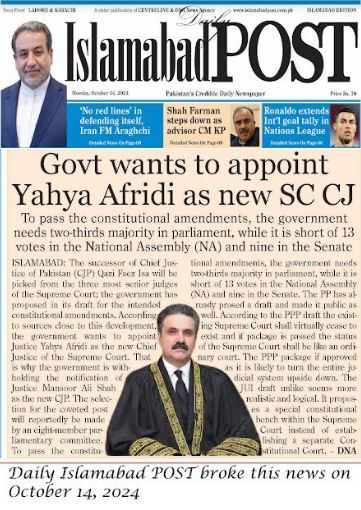
No 3 in seniority list: Justice Afridi to be the new Chief Justice

No 3 in seniority list: Justice Afridi to be the new Chief Justice

Daily Islamabad POST had broken the news of the appointment of Justice Afridi as the chief justice of Pakistan. Justice Yahya Afridi is considered as a ‘neutral’ and the man who always goes by the book

Ansar M Bhatti

ISLAMABAD: A meeting of Special Parliamentary Committee, constituted for the first time in the country’s history for the appointment of Chief Justice of Pakistan (CJP), recommended Justice Yahya Afridi as the new Chief Justice of Pakistan. Justice Yahya is No 3 in the seniority list.

Justice Mansoor Ali Shah and Justice Muneeb Akhtar stood at No 1 and 2 positions respectively in the seniority list. However, the committee, as it was expected, agreed on the name of Justice Yahya Afridi.

The PTI boycotted the process saying this since the committee came into being as a result of constitutional amendments passed in an ‘unlawful’ manner therefore they cannot be the members of the committee.

Government and the powerful circles did not want either Justice Mansoor or Justice Mubeen to become the chief justice of Pakistan because of their perceived anti-established and anti-government stance. There is also no dearth of people who believe that both these justices had a soft corner for the PTI, which, according to many jurists and legal experts, was an unfounded allegation. Both these judges, according to the legal experts, enjoy impeccable reputation and an elaborated professional career.

The first round of in-camera meeting of the parliamentary panel comprising government and opposition members held in the afternoon at room no 5 of the Parliament House. But the first session was called off because of non-participation of the PTI members.

Daily Islamabad POST had broken the news of the appointment of Justice Afridi as the chief justice of Pakistan. Justice Yahya Afridi is considered as a ‘neutral’ and the man who always goes by the book.

In a statement, the National Assembly Secretariat said that the SIC members have taken final decision not to attend the parliamentary panel’s meeting. “The committee has been apprised of the SIC’s decision.”

The secretariat noted that a sub-committee, comprising four members — Ahsan Iqbal, Rana Ansar, Raja Pervez Ashraf and Kamran Murtaza, was constituted to convince the SIC lawmakers to attend the meeting, “but to no avail.”

During their meeting with SIC members, the statement noted, Barrister Gohar Ali Khan said that they would not attend the parliamentary committee’s session in line with the PTI’s political committee decision.

Meanwhile, Ahsan Iqbal — while talking to journalists — regretted the SIC’s decision and said that they left no stone unturned in convincing the PTI-backed lawmakers to attend the meeting.

Alisher, Dr. Irfan news Uzbek and Turkiye ambassadors to Pakistan

Alisher, Dr. Irfan news Uzbek and Turkiye ambassadors to Pakistan

DNA

ISLAMABAD: Alisher Tukhtayev, who previously served as adviser to the foreign minister, has been appointed Uzbekistan’s new ambassador to Pakistan. Alisher Tukhtayev succeeded Oybek Arif Usmanov.
Ambassador Alisher Tukhtayev arrived in the capital of Pakistan Islamabad on 6 October, according to the official news agency of Uzbekistn.
Alisher Tukhtayev is a graduate of Tashkent State Institute of Law. He has held various senior positions at the Ministry of Foreign Affairs, Institute for Strategic and Interregional Studies under the President and the Presidential Administration.
He also previously worked at the Association of Cotton and Textile Clusters of Uzbekistan, first as an advisor and then as deputy chairman.
Meanwhile Dr Irfan Naziroglu has arrived in Islamabad to act as the Ambassador of Turkiye to Pakistan. Dr. Irfan has replaced Mehmet Pacaci, who has been assigned an important position at the OIC.

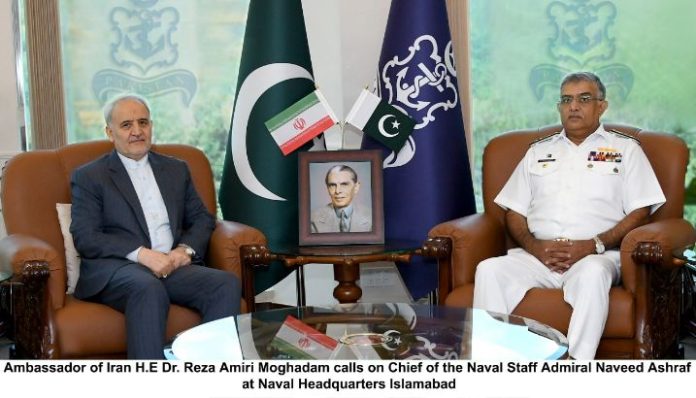
Ambassador of Iran meets Naval Chief

Ambassador of Iran

ISLAMABAD, OCT 22: /DNA/ – The Ambassador of Iran, Reza Amiri Moghadam, called on the Chief of the Naval Staff, Admiral Naveed Ashraf, at Naval Headquarters in Islamabad. During the meeting, avenues for bilateral collaboration and maritime potential were discussed.

Nasir Elected as Chairman of Hajj Association

ISLAMABAD, OCT 22 (DNA) — Nasir Khan has been elected as the new Chairman of the Hajj Association of Pakistan. The community and industry leaders congratulated him on assuming the responsibility and said that the new chairman would address the community issues.

Former Chairman of the Travel Agents Association of Pakistan, Rana Abdul Ghafoor, expressed confidence that under Nasir Khan’s leadership, long-standing issues related to Hajj arrangements will be addressed. He praised the newly elected chairman and his team for their commitment to solving challenges faced by the community.

Rana Shahid Rafiq, former Chairman of the Hajj Association, also congratulated Nasir Khan and emphasized that the election process was carried out in a peaceful and cooperative atmosphere. He added that the new leadership will continue to work for the welfare of the community while upholding the traditions of the association. —DNA

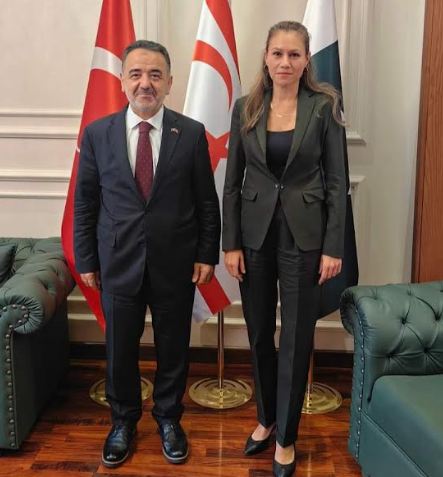
Newly-appointed Ambassador of Türkiye meets Chief of Mission of TRNC

Newly-appointed Ambassador of Türkiye meets Chief of Mission of TRNC

ISLAMABAD, OCT 22 /DNA/ – Ambassador Dr. İrfan Neziroğlu, newly-appointed Ambassador of Türkiye to Pakistan paid a courtesy visit to the Chief of Mission of TRNC Dilşad Şenol. Both sides discussed matters of mutual interest. DNA

Shah resumes as Acting Governor, summoned Assembly session on OCT 23

Shah resumes as Acting Governor

Nazir Siyal

KARACHI, OCT 22 /DNA/ – Acting Governor Sindh, Syed Awais Qadir Shah, has summoned a session of the Sindh Assembly on Wednesday evening 4:00pm.

Earlier, Speaker Sindh Assembly, Syed Awais Qadir Shah assumed the responsibilities as the Acting Governor of Sindh province.

While taking charge as the Acting Governor checked official routine matters of the Governor House.

On this occasion, Acting Governor  stated that he would make every effort to maintain the governance and management of the Governor House as Acting Governor Sindh.

Meanwhile, Sindh’s Minister for Home, Law, and Parliamentary Affairs, Zia-ul-Hassan Lanjar, met with Acting Governor Syed Awais Qadir Shah at the Governor House on Tuesday. During the meeting, matters of mutual interest were discussed. Additionally, the discussion between Home Minister Zia-ul-Hassan and Acting Governor Awais Qadir Shah also covered issues related to law and order in the province, among other issues also.

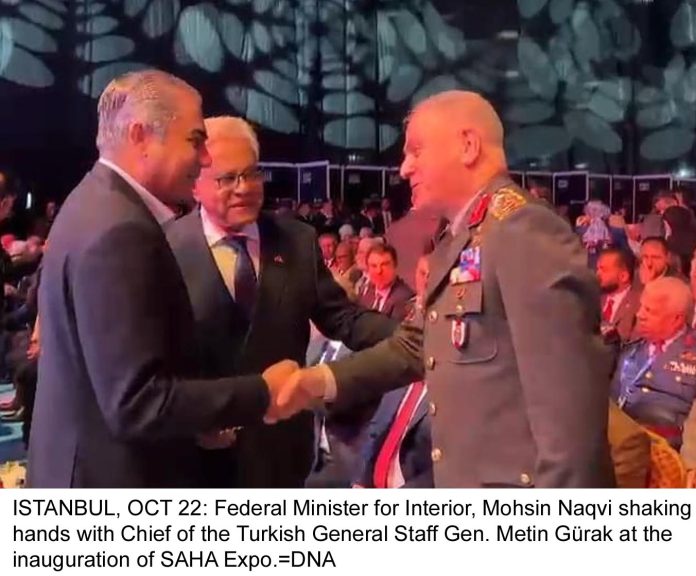
Federal Minister for Interior and Narcotics Control Mohsin Naqvi Visits SAHA Expo in Istanbul

Federal Minister for Interior and Narcotics Control Mohsin Naqvi Visits SAHA Expo in Istanbul
ISTANBUL, OCT 22: Federal Minister for Interior, Mohsin Naqvi shaking hands with Chief of the Turkish General Staff Gen. Metin Gürak at the inauguration of SAHA Expo.=DNA

Istanbul, Oct 22 /DNA/ – Federal Minister for Interior and Narcotics Control Mohsin Naqvi participated in the SAHA Expo in Istanbul today. Interior Minister along with representatives from other countries, inaugurated SAHA Expo-2024.

Upon arrival at the expo, Turkish officials warmly welcomed Mohsin Naqvi. Interior Minister met with Chief of the Turkish General Staff General Metin Gürak and congratulated him on the successful organization of the expo and extended his good wishes. General Metin Gürak thanked Mohsin Naqvi for Pakistan’s participation in the International Expo. Interior Minister along with representatives from other countries visited the expo. He also reviewed the Pakistani stalls and praised the equipment displayed over there.

The Interior Minister expressed deep interest in the modern machinery and equipment showcased at the expo, saying, “I am delighted to see the innovative technology displayed at the International Expo.” He added that International Expo-2024 will foster increased cooperation among friendly nations.

Earlier, upon arrival in Turkiye, Mohsin Naqvi was warmly received by Pakistan’s Ambassador to Turkiye Dr. Yusuf Junaid, Turkiye’s Ministry of Interior Director General Mehmet llidi, and high-ranking officials.

During his visit, Interior Minister will meet with Turkish cabinet ministers and central leadership. He stated that the trip aims to strengthen Pakistan-Turkiye relations and the discussions will revolve around enhancing bilateral cooperation, particularly border management, security, and combating human trafficking.

Mohsin Naqvi acknowledged Turkiye’s consistent support for Pakistan, highlighting excellent brotherly relations between the two countries. He emphasized that the primary objective of this visit is to further solidify Pakistan-Turkiye relations.

Empowering Rural Women: PODA’s 17th Annual Leadership Training Conference Kicks Off in Islamabad

PODA

1st Day of 3-Day Annual Rural Women Leadership Training Conference

ISLAMABAD, OCT 22 /DNA/ – On the first day of PODA’s 17th Annual Rural Women Leadership Training Conference, women from over 132 districts nationwide, including the four provinces and the regions of Gilgit-Baltistan and AJK, united to advocate for the recognition of women as “farmers.” The fundamental focus of Tuesday’s proceedings was to bring the issues facing rural women to the forefront, ensuring that they can benefit from government policies and services. Lok Virsa collaborated with PODA to organize the 3-day conference on its premises.

Prime Minister’s Coordinator for Climate Change and Environmental Coordination, Ms. Romina Khurshid Alam, called for the empowerment of women to address climate change challenges while praising their contributions in agriculture, the economy, and other fields. Ms. Alam urged all provincial governments to take steps toward empowering women and improving healthcare, particularly focusing on the rights of girls and women in rural areas. She commended the resilience of rural women in the face of challenges, emphasizing that their participation in decision-making processes and empowerment will positively impact the overall plight of women across the country.

Ms. Alam informed the women leaders that the federal government has launched a program in Balochistan titled “She Power,” in collaboration with the Chinese government, aimed at improving health and hygiene conditions for girls and women. She stated that women’s empowerment will have far-reaching impacts on the country’s economy, agriculture, and climate change issues.

While welcoming the women leaders, Ms. Sameena Nazir, Executive Director of PODA, informed them that women make up around 60 percent of the agricultural labor force in Pakistan. However, research indicates that if these women had equal access to productive resources as men, they could increase farm yields by 20 to 30 percent, leading to a rise in total agricultural output in the country by 2.5 to 4 percent. This improvement could help reduce hunger and poverty while enhancing the quality of life for women, who are the backbone of the agricultural sector, she said.

In a message, Prime Minister Muhammad Nawaz Sharif commended the women participants for highlighting the progress and development of rural women. He emphasized that rural women play a crucial role in ensuring food security, maintaining agricultural sustainability, protecting the environment, and significantly contributing to the health and education sectors. He also reiterated his government’s commitment to providing an enabling environment for all women and girls, particularly in rural areas, ensuring they have access to quality education, health services, vocational and professional training, and sustainable livelihoods.

Director General of Population Welfare, Punjab, Ms. Saman Rai, appreciated PODA for its efforts in organizing an impactful gathering where women could come together to share their experiences, strengthen their leadership skills, and advocate for their rights in the agricultural sector. “It’s a wonderful platform for imparting information, knowledge, and skills,” she added.

Ms. Rai also visited the stalls and praised PODA for providing training to women in olive production, thereby creating opportunities for their economic empowerment.

Other prominent speakers included: Ms. Rahila Hameed Durrani, Minister for Women Development, Balochistan;MPA Uzma Kardar, CM-Punjab’s Focal Person for Polio; MPA Advocate Kanwal Liaquat, Parliamentary Secretary for Environment Protection and Climate Change and Member of the Women Protection Authority, Punjab; Ms. Farah Naz Akber, Parliamentary Secretary, National Heritage and Culture Division; Dilshad Bano, Minister for Social Welfare and Women Development of Gilgit-Baltistan; Ms. Samina Fazil, President of the Islamabad Women’s Chamber of Commerce and Industry; and Akeela Naz, representing women farmers of South Punjab.

During the second session of the day on “Empowering Rural Women Through Sustainable Innovations, Digital Entrepreneurship, and Climate Action: Challenges and Opportunities,” children from Zameer Akhtar School in Rawalpindi delivered an engaging educational theater performance that depicted the practices contributing to the devastating impacts of climate change on people’s lives. They also emphasized the importance of saving the ozone layer and the Earth by adopting habits such as using cloth bags.

During the strategic session, the panelists discussed the pressing challenges of climate change and the significant vulnerabilities rural women in Pakistan face due to these challenges. The participants agreed that despite their crucial role in food production, they often lack access to essential resources, technical bio-sciences information, and decision-making opportunities. Rural women also experience gaps in digital literacy that limit their entrepreneurial potential. They were of the opinion that by integrating climate-resilient practices and empowering women through knowledge and technology, community resilience and confidence in women farmers can be fostered.

Women from all provinces showcased their folk songs and dances, highlighting the strength of diversity that is a hallmark of Pakistan as a federation.

Pakistan’s Digital Lag

Global Misperceptions

By: Bisma Rafique

Pakistan has established itself as a global leader in freelancing, ranking 4th in the world according to Payoneer’s Global Gig Economy Index. A youthful, tech-savvy population, with 64% of citizens under the age of 30, has fueled the rapid growth of the gig economy. This thriving sector is contributing significantly to Pakistan’s economy. In 2023 alone, freelancers generated over $500 million in export remittances, which serves as crucial support for the country, especially amid financial instability. However, despite these advancements, Pakistan faces significant digital challenges. Limited internet access, poor infrastructure, and low digital literacy have put Pakistan’s global competitiveness at serious risk.

As the world increasingly embraces digital solutions, Pakistan is struggling with an internet slowdown that is adversely affecting economic progress. Slow internet is more than just a daily inconvenience; it is a barrier to growth, particularly in key sectors like IT services, e-commerce, and remote work. Internet use in Pakistan has surged in recent years, but the country’s digital infrastructure has not kept pace.

Shaza Fatima Khawaja, the Minister of State for IT & Telecommunication, has acknowledged the problem. She pointed out that one of the major reasons for the internet slowdown is the widespread use of VPNs, which has further strained the system’s already limited capacity. While VPNs allow users to bypass government restrictions, their heavy use has placed additional pressure on Pakistan’s outdated network. With over a million Pakistanis employed in remote jobs and freelancing, these digital roadblocks are having widespread effects. The unreliable internet threatens their ability to perform. Arooj Fayyaz, who works remotely for the US-based IT education platform JOBSKILLSHARE, voiced her concerns: “Working on critical projects has become very difficult. I have missed deadlines due to internet issues, and during important meetings, it is tough to stay engaged with frequent connection drops. This is frustrating for me and my clients.”

The ongoing internet slowdown threatens this growing source of revenue. Reduced efficiency and project delays are leading to lost contracts, tarnishing Pakistan’s reputation as a reliable hub for outsourced talent. If these internet issues persist, Pakistan risks losing clients to countries with better digital infrastructure, leading to a loss of foreign earnings and thousands of jobs for skilled workers. E-commerce, another rising sector, could also face challenges as businesses struggle to maintain consistent online services. This could harm consumer trust and further slow economic growth.

To address these pressing challenges, Pakistan must invest in modernizing its digital infrastructure. This includes expanding internet access, improving bandwidth, and enhancing overall service quality. By prioritizing these improvements, Pakistan can create an enabling environment for its freelancers and businesses, allowing them to thrive in the global market. A robust IT infrastructure will not only enhance productivity but also attract foreign investment and foster economic growth. With the right strategies in place, Pakistan can harness its digital potential and secure its position in the rapidly evolving global economy. In a world increasingly driven by technology, ensuring a reliable internet connection is essential for Pakistan’s success and prosperity.

The writer is a freelance journalist. She tweets/posts @bismarafique and can be reached at: [email protected]

Stay Connected

64FansLike
60FollowersFollow

Latest Reviews

Exchange Rates

USD - United States Dollar
EUR
1.18
GBP
1.36
AUD
0.72
CAD
0.73