Home Blog Page 779

CAP-ICC convened to mull over pressing global challenges

CAP-ICC convened to mull over pressing global challenges

NA Speaker, Sardar Ayaz Sadiq said the responsibility of Parliamentarians was not restricted to mere legislation but rather to ensure rights and betterment of their constituents facing myriads of challenges

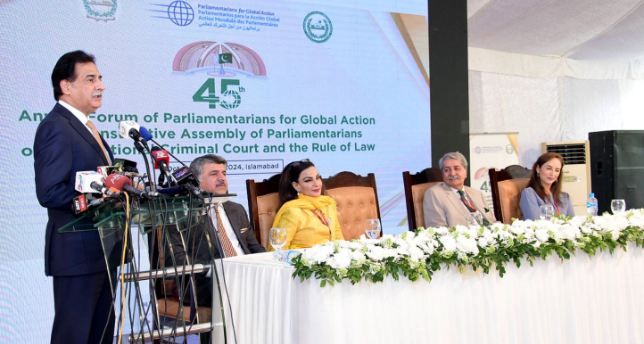
ISLAMABAD, Oct 28 (DNA): Speaker of National Assembly Sardar Ayaz Sadiq on Monday said the 13th Consultative Assembly of Parliamentarians on International Criminal Court and Rule of Law (CAP-ICC) had been convened under the patronage of Parliamentarians for Global Action (PGA) to mull over pressing global challenges amid piling up humanitarian and climate crisis jeopardizing human security on the planet.

He was addressing the 45th Annual Forum of Parliamentarians for Global Action 13th Consultative Assembly of Parliamentarians on International Criminal Court and Rule of Law hosted by the National Assembly of Pakistan.

NA Speaker, Sardar Ayaz Sadiq said the responsibility of Parliamentarians was not restricted to mere legislation but rather to ensure rights and betterment of their constituents facing myriads of challenges.

He informed that every parliamentarian in Pakistan had around one million constituents in their constituencies that were facing huge and tremendous issues of access to clean drinking water, sanitation, stunting and many more.

The main goal of the forum was to work out mechanisms to follow up the PGA members commitments at their native parliaments to ensure concerted efforts to bring relief for humanity in distress, he added.

Humanitarian issues were piling up amid no declining trend, whereas wars and violence were exacerbating human miseries, however all wars were only resolved on table, he added.

“It’s our collective responsibility and all members delegates to fully utilize this forum as opportunity to devise effective strategies,” he added.

“It’s our job to improve the lives of our constituents. It’s our responsibility to raise our voices against violence and bloodshed like one taking place in Gaza to stop it. Moreover, the unresolved issue of Kashmir where forced disappearances and mass graves are a serious issues amid blatant violations of UN resolutions,” the NA Speaker said.

Ayaz Sadiq also highlighted the country and region’s increasing vulnerability to climate change that resulted into unprecedented devastation post 2022 floods despite being one of the least contributors to global warming and climate change.

Secretary-General, Parliamentarians for Global Action (PGA), Mónica Adame in her welcome remarks gave a warm welcome to all delegates and congratulated the National Assembly for their impressive arrangements and warm hospitality.

She acknowledged the support of the NA Speaker, President PGA, Syed Naveed Qamar, Chairperson PGA National Chapter Sherry Rehman, parliamentarians and the delegates participating in the forum.

 Mónica Adame informed that the PGA was founded 45 years ago and was the largest non-governmental network of crossborder parliamentarians across the world.

The PGA mobilized legislators as champions of human rights, rule of law, democracy, human security, climate justice and gender equality, she added.

“We seek to reveal trust between Parliamentarians and relevant stakeholder. The role of parliamentarians in ensuring rights of their constituents is paramount and it is also important for them to ensuring bilateral dialogue at all levels and stop impunity to the violence and mass human rights violations world over,” she added.

“The CAP-ICC forum serves as a forum to exchange best practices, challenges, experiences and lessons learnt among the members whereas the international criminal court was the only established global court to listen to the cases pertaining to serious risk to humanity,” she said.

President, PGA Pakistan National Group, Senator, Sherry Rehman in her opening remarks welcomed the elected representatives and delegates participating in the PGA Conference from all over the world on their arrival in Pakistan to attend the CAP-ICC.

Senator Rehman emphasized on joint efforts that were necessary to promote world peace and rule of law.

“PGA’s efforts to promote global justice and peace are commendable. The member Parliamentarians have to adopt a common plan of action to end conflicts. Pakistan has always taken the lead in supporting world peace and human rights,” Senator Sherry Rehman said.

Pakistan was committed to promoting justice, human rights and rule of law, whereas the role of parliamentarians was very important for the promotion of global justice, she said.

President, Parliamentarians for Global Action, Member National Assembly (MNA), Syed Naveed Qamar in his special remarks underscored the importance of revitalizing Pakistan’s stature as a vibrant nation advocating global rights, democracy and justice.

The PGA forum, he said was for the activists and parliamentarians who care for human rights and democracy.

President Xi’s Shared Prosperity Model

Qamar Bashir

Qamar Bashir

President Xi Jinping, since assuming office, has been a driving force in elevating China to unprecedented heights, not only in the country’s own history but also in the global context. He possesses the qualities of a charismatic, pragmatic, and highly composed leader, rarely seen losing his temper, displaying worry, or revealing any personal anxiety. His humility and down-to-earth nature are evident in his respectful engagement with world leaders and citizens alike, garnering widespread recognition, respect, and admiration.

Unlike other global powers, President Xi Jinping’s approach emphasizes peaceful development and self-reliance, positioning China as a model of progress rooted in shared prosperity and stability. His primary focus, however, has been on his own people, who appear to be dearer to him than anything else.

Driven by an unwavering commitment and by his belief that a capable, educated, and skilled population is vital for national progress—President Xi Jinping lifted over 100 million citizens out of extreme poverty by 2021, nearly a decade ahead of the UN’s 2030 target through targeted financial aid, agricultural support, and the construction of 1.1 million kilometers of rural roads. He ensured access to education and healthcare, raised Literacy rates, and slowed school dropout rates with the introduction of nine-year compulsory education, laying a solid foundation for long-term economic independence.

Xi’s dedication to his people extended to redirecting state resources to improve public welfare, providing health insurance coverage for over 95% of the population and expanding pensions for rural and migrant workers. He also fostered economic independence by offering incentives to 20 million small and micro-businesses, enabling sustainable incomes and supporting local economies.

While his focus remained in improving the lives of its people simultaneously, he brought much needed economic growth by unleashing the entrepreneurship qualities of Chinese people and transforming companies and corporations to higher pedestal of growth and development. He transformed them from low-cost manufacturing to high-tech and consumer-driven organizations to meet the growing needs of the domestic population and to cater to the regional and international demands. Despite daunting global economic challenges, he steered the economy with his known grit and vision and made China the second-largest economy with a GDP exceeding $18 trillion by 2021 a feat which looked impossible only a few years ago. Now his vision “Made in China 2025” is all set to drive China to become a global leader in high-tech industries, including artificial intelligence (AI), robotics, semiconductors, and 5G and in no time, China is now one of the world’s leaders in AI research and development and a leader in 5G deployment and digital transformation, extending China’s influence in global telecom, enhancing connectivity nationwide.

It was only his vision and untiring effort coupled with political and administrative acumen that since he took over, in 2013, the country’s foreign exchange reserves touched an all time high to $3.238 trillion by the end of 2023. Per capita income nearly doubled from $6,283 in 2012 to around $12,605 by 2023. Trade volume expanded from $3.87 trillion in 2012 to $6.31 trillion by 2022 illustrating China’s progress toward a more robust, internally resilient economy.

President Xi’s vision extended beyond China’s domestic prosperity; after achieving substantial growth at home, he focused on enhancing regional trade and commerce, leveraging China’s resources to support the economic health of neighboring and global partners. His 2013 Belt and Road Initiative (BRI), initially seen as a highly ambitious project with its intricate network of land, sea, rail, and air links, has since evolved into one of the world’s largest infrastructure and investment programs. Spanning Asia, Africa, Europe, and Latin America. By 2024, the BRI had attracted around $1 trillion in total investment and connected over 140 countries. Trade volume among these nations reached approximately $9 trillion, highlighting the vast economic engagement driven by the BRI, which continues to stimulate regional integration and substantial trade flows, with the potential to transform economies through enhanced connectivity and mutual growth.

President Xi’s vision of shared prosperity, rooted in economic, investment, and infrastructure diplomacy with a “win-win” approach, did not go unnoticed by global powers. However, rather than appreciating these efforts or considering President Xi’s generous offer to partner in China’s pursuit of shared prosperity, the U.S. and its allies have often placed roadblocks in the path of China’s progress. The USA and its allies launched a Chinese containment policy without appreciating President Xi’s declared policy that this world is big enough for all of us to share its bounties and immense resources without undercutting each other.

The US and its allies launched a de-risking strategy aimed at reducing excessive reliance on China, particularly in supply chains and markets. On the military front, the US started bullying its partners and allies in the Asia Pacific and Indo pacific region to encircle China in the Asia Pacific region and beyond.

The USA used the existing groups like Quadrilateral Security Dialogue (QUAD) and Australia, the United Kingdom and the United State (AUSKUS), developed a new alliance with Japan and the Philippines, for joint maritime patrols with the Philippines in the South China Sea, and restructured the US military command in Japan — the biggest upgrade to defense cooperation since the 1960s — to make them more responsive against perceived threats from China.

The U.S. has spearheaded the “Five Eyes” alliance, comprising the United States, Canada, the United Kingdom, Australia, and New Zealand, focused on intelligence sharing and countering cyber threats and foreign interference, often accusing China of intellectual property theft and using artificial intelligence for hacking and espionage. Additionally, the U.S. forged a strategic partnership with India to counterbalance China’s influence in the Indian Ocean and the region. In recent years, the U.S. has also utilized credit rating agencies like Fitch and Moody’s, which have adjusted China’s credit ratings to negative, citing perceived risks to public finances.

President Xi, fully aware of the U.S.’s efforts to place roadblocks to slow and ultimately halt China’s vision of shared global prosperity, remained undeterred. Maintaining his composure, he continued to pursue peaceful diplomacy with all nations, including the U.S. and its allies, grounded in a firm belief that his sincere intentions and dedication to shared prosperity would ultimately prevail.

Without fanfare or lofty claims, President Xi not only ensured that China became an effective and active member of existing regional and international organizations but also initiated new ones to advance China’s vision of shared prosperity and growth.

Under President Xi’s leadership, China is an effective and productive member of over 100 international and regional organizations. China became a founding member of the Asian Infrastructure Investment Bank (AIIB) to create a viable alternative to Western-led financial institutions. He uplifted Shanghai Cooperation Organization (SCO) to foster regional connectivity in Central Asia and encouraged collaborations in infrastructure, IT, and agriculture. China is one of the largest shareholders of the International Monetary Fund (IMF) and World Bank and contributes to global financial stability. China actively participates in BRICS (Brazil, Russia, India, China, and South Africa) to promote economic, political, and cultural collaboration among emerging economies. China joined Regional Comprehensive Economic Partnership (RCEP) which includes 15 countries across the Asia-Pacific, enhancing trade relations within the region. China has expanded its naval capabilities, notably in the South China Sea, to ensure peace and stability in the region.

President Xi is pursuing a pragmatic policy toward the U.S. and its allies; rather than responding with antagonism, his philosophy emphasizes relationship-building with the U.S. and Europe. His approach is rooted in cooperation, mutual respect, and shared prosperity, underscoring non-conflict, respect for core interests, and win-win collaboration. Xi advocates for peaceful coexistence and views economic interdependence as a stabilizing force, positioning China as a committed partner on global issues like climate change, health, and trade.

Leveraging areas of mutual interest, his approach counters confrontational rhetoric with constructive engagement. Championing multilateralism through platforms like the UN and WTO, Xi promotes collective problem-solving over unilateral actions. His focus on soft power diplomacy, while avoiding hard power tactics, fosters ties that diffuse aggressive stances from the U.S. and its allies, presenting China as a peaceful, responsible global leader committed to stability through inclusive development and cooperation.

President Xi has aptly recognized that people worldwide, regardless of color, creed, or race, long for peace to fulfill their dreams, raise their children in safety, and provide them with quality education. He understands that they deserve equal opportunities for growth and development, along with relief from economic and financial hardships that hinder prosperity. Aware that the world is already burdened by prolonged conflicts, he believes that humanity—now in an era marked by rapid innovation, creativity, and knowledge—comprehends both the horrors of war and the dividends of peace. More than ever, the global community yearns to end warmongering, threats, and the destruction that has devastated societies for centuries. This growing movement against war is gaining momentum, as people and nations alike reject antagonism and embrace cooperative, peaceful partnerships. Ultimately, this shift aligns with President Xi’s philosophy of shared prosperity and win-win solutions, fostering a world where all can thrive together.

Qamar Bashir
Former Press Secretary to the President
Former Press Minister to the Embassy of Pakistan to France
Former MD, SRBC, CEO, ATV

Ex-CJP Isa likely to face PTI protest

Ex-CJP Isa likely to face PTI protest

Ex-chief justice becomes first Pakistani judge to get elected as bencher at prestigious legal institution

Foreign Desk

LONDON: Former chief justice of Pakistan (CJP) Qazi Faez Isa, the first Pakistani judge to be invited to a dinner by The Honourable Society of the Middle Temple on Tuesday, is likely to face protest by the Pakistan Tehreek-e-Insaf (PTI) UK chapter.

Jahanzeb Khan, former senior vice president of PTI UK, and Sahibzada Jahangir, party founder Imran Khan’s friend and former adviser confirmed that a demonstration has been called at the Middle Temple in Central London to protest ex-CJP Isa’s participation and condemn the society for inviting him and elevating him in the Temple.

Jahanzeb said that former minister ministers and advisers Zulfi Bukhari, Maleeka Bokhari and Shehryar Afridi will also attend the demonstration.

Meanwhile, the Middle Temple confirmed that it has invited former CJP Isa for the bench call where the ceremony is being held for the benchers and members of the Inn to call elected members to the Bench.

The Callees include Isa, Professor Adrian Briggs, Isabel Hitching KC and Nikki Singla KC. They will be called to the bench before dinner and asked to take their place at the high table.

Isa will give a short speech to the benchers and members, the Middle Temple confirmed.

The former chief justice became the first Pakistani judge to get elected as a bencher at the Middle Temple, a prestigious legal institution in the United Kingdom (UK).

Isa, who retired as the top judge of Pakistan on October 25, arrived in London to attend the ceremony in his honour.

He studied law at the Middle Temple and his father, Qazi Isa, was also a graduate of the Middle Temple.

He had written to the administration of the Middle Temple stating that he could only attend the event after his retirement on October 25, prompting the ceremony to be rescheduled for October 29.

The Middle Temple is one of four historic and esteemed legal institutions known as the Inns of Court in London. These institutions provide training to law students and grant licences for entry into the legal profession.

The other three Inns of Court are Gray’s Inn, Lincoln’s Inn and Inner Temple.

Founded in the 14th century, the Middle Temple has held a significant position at the heart of the British legal system for centuries.

The distinguished people, who later rose as global statesmen, premiers, presidents, chief justices, monarchs, chief ministers, governors and mayors and studied at the prestigious Middle Temple during the last few centuries are: former British premiers John Major, Boris Johnson and David Cameron; Hong Kong’s first chief justice of the Court of Final Appeal Andrew Li; Princess of Wales Lady Diana; Hong Kong’s Judge of Final Appeal Kemal Bokhary; Singapore’s founding father Lee Kuan Yew and his wife Kwa Choo; British Supreme Court judges Simon Brown, Anthony Clarke and Mark Saville; Irish High Court judge Sir Donnell Deeny; Thailand’s former premiers, Sanya Dharmasakti, Pote Sarasin, and Phraya Manopakorn; ex-chief justice Allahabad High Court, John Edge, King Edward VII, King Edward VIII, Indian Viceroy; and Rufus Daniel Isaacs among others.

Apart from the Middle Temple, the other three Inns of Court (Gray’s Inn, Lincoln’s Inn and Inner Temple) have also churned out some magnificent personalities like Quaid-i-Azam Muhammad Ali Jinnah, Allama Iqbal, former president Zulfikar Ali Bhutto, Indian premier Jawaharlal Nehru, former Pakistani president Wasim Sajjad, former British prime ministers Margaret Thatcher and Tony Blair; former Indian president Shankar Dayal Sharma, former Pakistani Supreme Court judge Dorab Patel, Ex-chief justice Lahore High Court and Allama Iqbal’s son Justice (retd) Javed Iqbal, former Indian Union Minister of Defence Krishna Menon and Bhimrao Ambedkar, the former Indian law minister and the man who headed the committee drafting the constitution of India.

President pays tribute to security forces for successful operations against terrorists

President pays tribute to security forces for successful operations against terrorists

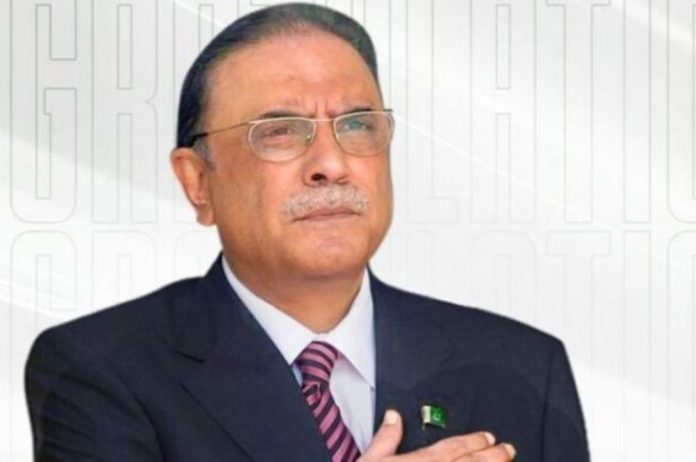
ISLAMABAD, Oct 27 (APP) President Asif Ali Zardari on Sunday paid tribute to security forces for launching two successful operations against terrorists in Khyber Pakhtunkhwa.

The president, in a statement, commended the bravery of security forces for conducting successful operations against Khawarij terrorists.

He expressed resolve to continue operations against terrorists until the complete elimination of Fitna al-Khawarij. “The entire nation stands with its security forces in the fight against terrorism”, the president said.

Pakistan-South Africa joint anti-terror exercise Iqbal-I concludes at Cherat

Pakistan-South Africa joint anti-terror exercise Iqbal-I concludes at Cherat

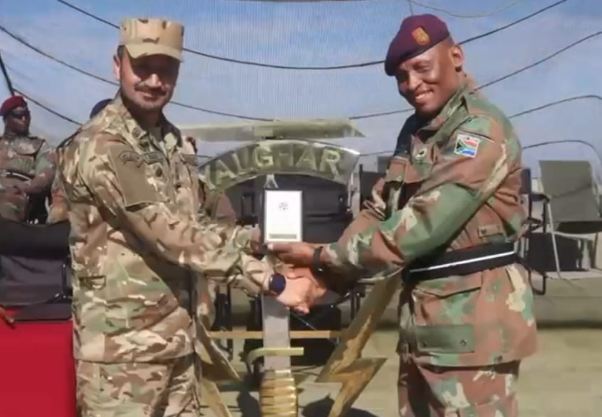
RAWALPINDI, OCT 27 /DNA/ – Closing ceremony of Pakistan – South Africa Joint Exercise Iqbal-I in Counter Terrorism domain was conducted between the Armies of Pakistan and Republic of South Africa at Cherat, Pakistan.

Two weeks long exercise commenced on 15 October 2024. 2 x Combat Teams from Special Services Group, Pakistan Army and Republic of South Africa Special Forces participated in the Exercise.

Commandant Special Operation School, attended the closing ceremony as Chief Guest. Colonel SS Lechoenyo, Chief of Staff Republic of South Africa Special Forces also witnessed the Closing Ceremony.

The troop displayed highest standards of professional excellence during the conduct.

The Exercise was aimed at refining the drills, procedures and techniques involved in CT operations through joint training, besides harnessing the historic military to military relations among the friendly countries.

Four militants eliminated in two security operations in KP: ISPR

Four militants eliminated in two security operations in KP: ISPR

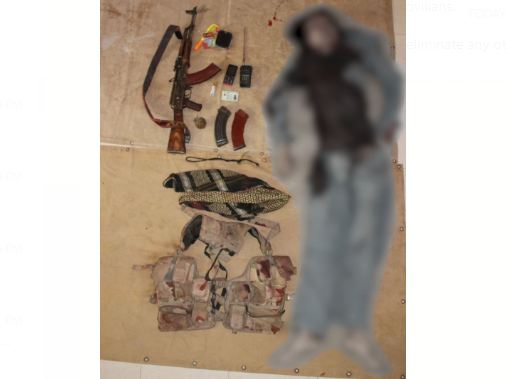
RAWALPINDI, OCT 27: /DNA/ – On 26/ 27 October 2024, four Khwarij were killed by the security forces in two separate operations in Khyber Pakhtunkhwa Province.

An intelligence based operation was conducted in North Waziristan District and after intense exchange of fire, two khwarij including Kharji Insaf Ullah were sent to hell.

In another encounter in Khyber District, own troops effectively engaged the khwarij location and resultantly two khwarij were killed, while three got injured.

Weapons and ammunition were also recovered from killed khwarij, who remained actively involved in numerous terrorist activities against the law enforcement agencies as well as the innocent civilians.

Sanitization of the area is being carried out to eliminate any other kharji found in the area as security forces of Pakistan are determined to wipe out the menace of terrorism from the country.

KC-EU holds protest in front of Indian Embassy in Brussels against occupation of Kashmir

KC-EU holds protest in front of Indian Embassy in Brussels against occupation of Kashmir

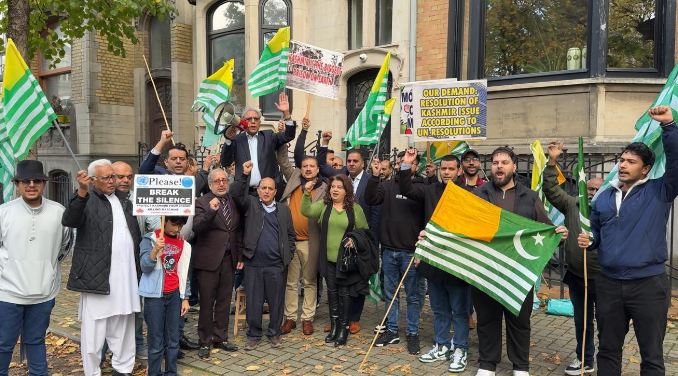
BRUSSELS, OCT 27 /DNA/ – KC-EU holds protest in front of Indian Embassy in Brussels against occupation of Kashmir A protest demonstration was arranged in front of Indian Embassy in Brussels by Kashmir Council Europe (KC-EU) today, the day of Indian Occupation of Jammu and Kashmir.

Kashmiris on both sides of the Line of Control and based in other parts of the world observe Black Day on 27th October every year to mark protest against the illegal occupation of Jammu and Kashmir by India.

A number of the Kashmiris based in Europe including Belgium and their sympathisers and representatives of the various non-governmental organizations participated in the demonstration. They were holding placards and banners having slogans against the Indian occupation of Kashmir and in favour of freedom struggle of Kashmiris.

On occasion of the protest in Brussels, Chairman Kashmir Council Europe (KC-EU) Ali Raza Syed made it clear that we demand New Delhi to free people of Kashmir by ending the occupation of Kashmir and give them right of self-determination.

Ali Raza Syed said, 27th October 1947 was the darkest day in history of Jammu and Kashmir when India in total violation of all international norms and human values illegally landed its troops in the state of Jammu and Kashmir against the will of the Kashmiri people.

Chairman KC-EU further said, by staging this protest, we intend to send a message to the Indian government that Kashmiris do not accept India’s illegal occupation. The Kashmiri people wish to decide their future in a free environment. It is sad to say that India claims to be the largest democracy in the world, but it suppresses the rights of Kashmiris and kills the innocent people in the occupied valley. People in the Occupied Kashmir are victims of Indian persecution for above seven and half decades. On a daily basis, Indian authorities are attempting to crush the Kashmiris. Indian police and security forces commit violence and create fear among the people of Kashmir.

He said, the international community should understand that peace in Kashmir is connected to the whole region. If Kashmir is witness of peace, the whole region would be witness of peace and prosperity.

Chairman Kashmir Council EU Ali Raza Syed asserted that Kashmiri nation is not ready to compromise on their right to self-determination.

He also urged the world’s major powers to help the people of Jammu and Kashmir, struggling for their right to self-determination. A peaceful resolution of issue of Kashmir, which is long lasting desire of the people of Jammu and Kashmir, should be achieved.

Other speakers of the protest also condemned the Indian atrocities in the occupied Kashmir and demanded the freedom of the Jammu and Kashmir from Indian occupation.

Chairman Bilawal calls on PM Shehbaz

Chairman Bilawal calls on PM Shehbaz
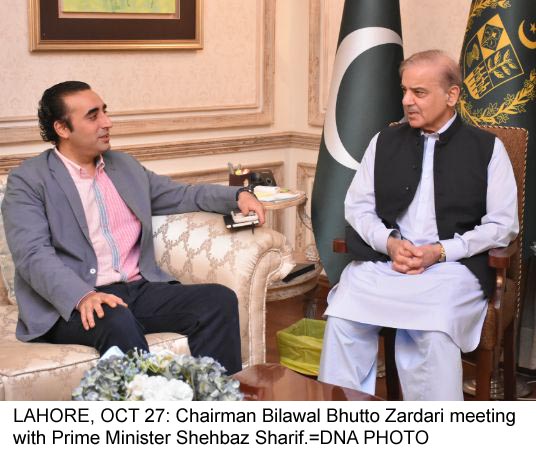
LAHORE, OCT 27: Chairman Bilawal Bhutto Zardari meeting with Prime Minister Shehbaz Sharif.=DNA PHOTO

Lahore, OCT 27 /DNA/ – A delegation of Pakistan People’s Party led by Chairman Bilawal Bhutto Zardari calls on Prime Minister Muhammad Shehbaz Sharif on 27 October 2024.

Fiery Trial in Hayatabad – A Tribute to Valor and Unity

Fiery Trial in Hayatabad - A Tribute to Valor and Unity

by: Izmi Herlani

The sun was shining bright over Hayatabad, casting a warm golden hue across the industrial state, when chaos erupted. A thick plume of smoke rose ominously into the sky, darkening the once-peaceful horizon. The acrid smell of burning materials filled the air and the sound of sirens pierced through the evening calm. A factory, which had once been a hub of productivity and promise, was engulfed in flames. I stood on the rooftop of my Uncle’s home, a mere witness to this heart-wrenching scene unfolding just beyond our doorstep.

As I watched, the brave firefighters from Rescue 1122 rushed to the scene, their faces grim yet determined. Their dedication was palpable, as they battled the inferno with everything they had. Yet, the fire was relentless; it roared and crackled, consuming everything in its path. The flames seemed to dance with a life of their own, taunting the efforts of the courageous men who stood before it. Despite their unwavering resolve, it became increasingly clear that this was no ordinary fire. The blaze grew larger, and the surrounding area was soon shrouded in a thick veil of smoke. It was a scene of desperation, as the firemen struggled against the overwhelming odds. It was at this moment, when hope seemed to flicker like a dying ember, that the call for assistance echoed throughout the air—help was needed, and who better to answer that call than the noble personnel of Pakistan Air Force?

In a matter of minutes PAF personnel, known for their bravery and swift response in times of calamity, arrived on the scene like Sentinels descending from the Sky. These brave heroes, trained to confront peril and adversity, descended upon the burning site with a sense of urgency and purpose. Watching them in action was nothing short of awe-inspiring.

As the PAF personnel coordinated with the civil firemen, a glimmer of hope emerged for all of us watching the entire scene from our houses amidst the chaos. They utilized their resources, deploying fire hydrants with precision and skill. I could see the determination etched on their faces, a fierce commitment to protect not only the property but also the lives of those who worked within the factory walls. It was a moment that reminded me of the indomitable spirit of our nation—When We Come Together, We Can Face Even the Fiercest of Storms.

The scene was both heart-wrenching and uplifting. The flames continued to rage, but with the combined efforts of Rescue 1122 and Pakistan Air Force, a sense of control began to take shape. I watched as the PAF firefighters, clad in their uniforms, worked tirelessly alongside their civilian counterparts. Each drop of water released from the fire hoses felt like a testament to their dedication and bravery. They were not just fighting a fire; they were fighting for their fellow citizens, for the lives, dreams and futures that were at stake.

As the hours passed, I was filled with a mixture of emotions—fear for the destruction, sorrow for the loss but also immense pride in the heroes who had come to our aid. Pakistan Air Force has always been at the forefront of responding to our nation’s call, whether in times of natural disasters or man-made calamities. Their swift action during this incident reaffirmed my belief in their unwavering commitment to the people of Pakistan.

Amidst the chaos, I reflected on the nature of courage. It is not the absence of fear but the determination to push through it. The firefighters, both from Rescue 1122 and PAF, exemplified this spirit. They stood tall against the fire, battling not just the flames but also the anxiety and despair that gripped our community. Their bravery ignited a spark of hope in our hearts, a reminder that we are never alone in our struggles.

As night fell and the flames were finally brought under control, I felt a profound sense of gratitude. The factory may have suffered significant damage, but the spirit of unity and resilience that emerged from this tragedy was unbreakable. We were reminded that in our darkest hours, we can rely on the courage and valor of those who serve selflessly.

To the brave men and women of Pakistan Air Force, thank you for being our guardians, our Sentinels in the Sky. Your bravery in the face of danger is an inspiration to us all. In moments like these, we are reminded of the strength that lies within our nation—Together We Rise, Together We Heal.

Iftikhar Gilani’s book launch sparks dialogue on India’s sociopolitical landscape and Muslims’ plight

Iftikhar Gilani's book launch sparks dialogue on India's sociopolitical landscape and Muslims' plight

The systematic study of India’s internal dynamics could enhance Pakistan’s advocacy for Kashmiris’ rights

Islamabad, OCT 27 /DNA/ – A deeper and more systematic understanding of India’s sociopolitical and cultural landscape, “Hindustan Sanashi“, is a prerequisite for shaping effective policies, as well as advocacy efforts for marginalized communities like Muslims in India and Indian Occupied Kashmir.

By broadening its scope to include serious academic study and curricular integration, and reaffirming the ideas surrounding Pakistan and Kashmir, a more comprehensive approach to regional issues can emerge. This expanded understanding should extend beyond media, entertainment, and major urban centers, offering hope and direction for future generations.

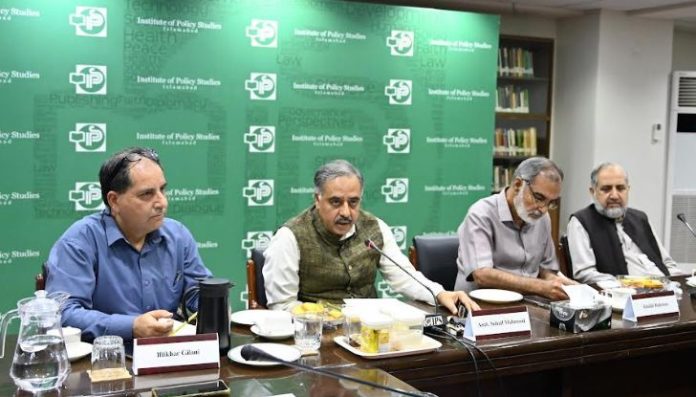
This was observed during the launching event of renowned journalist Iftikhar Gilani’s latest book ‘Ikkeeswi Sadi ka Bharat aur Musalman: Siyasat aur Samaaj kay Aeenay Mai’ (The 21st Century India and Muslims: Reflections in the Mirror of Politics and Society)” held by Institute of Policy Studies (IPS), Islamabad.

The book, published by IPS Press – the publishing arm of IPS, provides an in-depth exploration and record of the evolving dynamics between India’s Muslim minority and the state, and the impact of the Bharatiya Janata Party (BJP) and Rashtriya Swayamsevak Sangh (RSS) policies, which are reshaping India’s political and cultural identity with significant implications for Muslims and other minorities.

Chaired by Ambassador Sohail Mahmood, former foreign secretary and high commissioner to India, and director general, Institute of Strategic Studies, Islamabad (ISSI), the event featured remarks from Khalid Rahman, chairman IPS, and Ambassador (r) Syed Abrar Hussain, vice chairman IPS. The reviews of Prof Khurshid Ahmad, eminent scholar and patron-in-chief IPS, Raja Muhammad Zafar-ul-Haq, former senator and secretary-general Motamar Al-Alam Al-Islami, and Pakistan’s former high commissioner to India Ambassador (r) Abdul Basit were also presented on the occasion.

In his review, Prof Khurshid Ahmad emphasized the socio-political setbacks for Muslims and the decline of secular values in India, calling the book a crucial revelation of the harsh realities confronting the community.

Raja Zafar-ul-Haq emphasized the growing influence of Hindutva and the systemic marginalization of minorities, urging the need for Muslims to defend their identity and rights.

Ambassador Abdul Basit lauded the book’s thorough analysis of policy impacts over three decades, framing it as essential for understanding the ongoing struggle for Muslim rights in India.

Ambassador Sohail Mahmood emphasized that “Hindustan Shanasi” goes beyond academic curiosity; it is crucial for effective policymaking in Pakistan. He argued that a structured and deep study of India’s internal dynamics – addressing issues such as sectarianism, authoritarianism, and socioeconomic inequalities – can guide more informed decision-making. The speakers noted that understanding India’s sociopolitical landscape is vital for Pakistan, especially in advocating for the rights of Kashmiris and Muslims on international platforms.

The panel discussed the importance of reaffirming and promoting the “idea of Pakistan” alongside positioning Pakistan as a role model, championing the cause of Kashmir through a coherent narrative on Kashmir and Muslims and advocacy for Kashmir’s and Muslims rights at every international forum, based on a well-documented narrative of the region’s ideology, history, and struggles.

In this regard, documentation was considered a vital tool for strengthening the permanence and credibility of advocacy. The panel underscored the significance of compiling meaningful and contextual records of the challenges faced by Muslims in India, the struggle for Kashmir, and the evolution of Pakistan’s own identity is crucial for shaping policies and influencing international perspectives.

In his concluding remarks, Khalid Rahman said that ‘Ikkeeswi Sadi ka Bharat aur Musalman’ is not merely a compilation of articles but a meaningful documentation of the evolving relationship between the Indian state and the Muslim minority.

He further noted that much of the current discourse on India remains confined to media portrayals and major urban centers, failing to capture the complexities of India’s democracy, social structures, and shifting ideologies that, in turn, shape India’s governance, economic disparities, and the challenges faced by minority communities. 

Stay Connected

64FansLike
60FollowersFollow

Latest Reviews

Exchange Rates

USD - United States Dollar
EUR
1.17
GBP
1.36
AUD
0.72
CAD
0.73