Home Blog Page 767

CDA Chairman, Islamabad Chief Commissioner meet FIA to combat human trafficking

CDA

ISLAMABAD, NOV 6 /DNA/ – Chairman Capital Development Authority (CDA) and Chief Commissioner Islamabad, Muhammad Ali Randhawa, held a meeting with the FIA’s Director of the Anti-Human Smuggling Wing, Saqib Sultan Mehmood to address the issues related to Trafficking in Persons (TIP) while the officers from ICT departments also attended it. The meeting focused on a way forward outlining critical targets and areas of concern to combat trafficking in person within the Islamabad Capital Territory (ICT).

During the meeting, Chairman CDA and Chief Commissioner Islamabad, Muhammad Ali Randhawa was briefed on the findings and recommendations of the recent Trafficking in Persons (TIP) Report 2024 published by the U.S. Department of State. The FIA Director of Anti-Human Smuggling Wing underscored the importance of proactive, coordinated efforts at all levels to safeguard Pakistan’s standing on the international front. He apprised that the immediate steps are required to avoid placement Pakistan on the TIP Watch List.

Chairman CDA and Chief Commissioner Islamabad, Muhammad Ali Randhawa reiterated to address all forms of trafficking in persons including forced begging and bonded labor etc. He further directed the immediate convening of the District Vigilance Committee for ICT in order to implement the recommendations of TIP report. He further directed the relevant ICT departments to ensure that data and related information on TIP cases such as those related to sexual exploitation, forced and bonded labor, and forced begging etc are gathered and shared with Anti-Human Smuggling Wing of FIA.

The meeting emphasized the importance of TIP-related training and capacity building for the concerned departments and need for the awareness campaigns and outreach to better inform the public and the measures to combat it. It further highlighted that the collective efforts from all relevant stakeholders are required to ensure that trafficking cases are fully investigated, prosecuted, and lead to convictions. The data collection efforts must include detailed information on case registrations, prosecutions, and convictions, as well as updates on victims’ referrals to social services.

This meeting ends with the resolve to combat TIP cases with prime focus on prosecution, protection and prevention.

Expectations from Trump’s Return

Expectations from Trump’s Return

by Muhammad Mohsin Iqbal

As the world watches the return of President Donald Trump to office, a range of expectations and cautious optimism emerge on the international stage, especially from Pakistan and its regional neighbors in the Middle East. President Trump’s previous term showcased a distinctive approach to foreign policy—one marked by unpredictable decisions, a focus on “America First” policies, and a mixed legacy of both diplomatic breakthroughs and heightened tensions. In his new term, global actors anticipate that Trump will navigate regional challenges with renewed vigor, aiming to balance his national priorities with pressing international issues. Countries like Pakistan are especially interested in how his leadership might affect regional stability, security cooperation, and economic ties.

For Pakistan, a second Trump administration presents both opportunities and challenges. While Trump’s previous stance on Pakistan showed ambivalence, there remains hope that he might work toward a more constructive relationship this time around. In the past, Trump’s administration held a hardline position on Pakistan’s role in counterterrorism efforts, voicing concerns about security and support for regional stability. However, there were also positive signals, such as the 2020 United States-Taliban peace deal, which Pakistan facilitated, leading to the eventual U.S. withdrawal from Afghanistan. This role in fostering peace efforts could serve as a basis for improved diplomatic and security relations between Pakistan and the U.S., where mutual interests in counterterrorism and stability may once again come into focus.

Furthermore, economic cooperation is an area that Pakistan hopes to expand under Trump’s new term. Although Trump’s previous administration did not prioritize economic engagements with Pakistan, his policies often leaned toward bilateral deals that could offer opportunities for countries willing to engage. Pakistan may seek more favorable terms in trade and investment, especially in sectors such as agriculture, technology, and renewable energy. With Pakistan facing economic challenges, a focus on strengthening trade ties with the U.S. could be crucial. Additionally, Pakistan hopes that Trump’s administration will acknowledge Pakistan’s importance as a strategic partner in South Asia, a region becoming increasingly vital to global geopolitics.

The Middle East remains a region of particular interest to Trump and his foreign policy team. The previous Trump administration recognized Jerusalem as Israel’s capital, brokered the Abraham Accords, and imposed heavy sanctions on Iran, decisions that polarized opinion across the region. Expectations are high regarding how Trump will now approach key Middle Eastern issues, particularly the Palestinian cause, Lebanon’s stability, and Iran’s regional influence. For Palestinians, there remains hope that the U.S. will play a more balanced role in fostering peace with Israel. Trump’s earlier stance was clearly in favor of Israel, but his legacy includes the Abraham Accords, which, despite their controversies, showed that new forms of engagement were possible. Palestinians are hopeful that Trump might reconsider policies that previously appeared one-sided, encouraging a more just approach that acknowledges Palestinian sovereignty and rights.

In Lebanon, the hope is for greater American involvement in the country’s recovery from years of economic instability, political gridlock, and social upheaval. Trump’s administration previously placed pressure on Hezbollah and took a firm stance on limiting Iranian influence in Lebanon, moves that polarized local opinion. Moving forward, there is an expectation that the U.S. will offer more comprehensive support to help Lebanon stabilize without exacerbating sectarian tensions. By adopting a more balanced approach, Trump’s administration could help mitigate internal divisions within Lebanon, supporting a recovery that respects the country’s complex social fabric.

The re-election of Trump brings with it concerns in Iran, as Trump’s previous term saw the U.S. withdrawal from the Joint Comprehensive Plan of Action (JCPOA) and a series of escalating sanctions that crippled Iran’s economy. It remains uncertain whether Trump will pursue a renewed deal or maintain pressure on Tehran, a policy that often-strained relations across the region. Many hope that Trump will opt for dialogue over confrontation, potentially re-engaging Iran in discussions that prioritize regional stability over rivalry. Should Trump shift towards a more diplomatic approach, this could contribute significantly to easing tensions not only between the U.S. and Iran but also among other regional powers.

Perhaps one of the most pressing areas for Pakistan and South Asia is the long-standing issue of Kashmir. During his last administration, Trump offered to mediate between India and Pakistan, a move that drew both criticism and support. For Pakistan, there is hope that Trump will leverage his influence to promote a just and peaceful solution to the Kashmir conflict, which has been a major source of tension between the two nuclear-armed neighbors. The Trump administration previously aligned closely with India, viewing it as a strategic partner in countering Chinese influence in the region. However, if Trump seeks a more balanced approach, his administration could play a role in fostering dialogue on Kashmir, recognizing the aspirations of the Kashmiri people while encouraging diplomatic engagement between India and Pakistan. This would be a significant shift that could not only ease tensions in South Asia but also reinforce America’s role as a mediator in global conflict resolution.

Trump’s party, the Republican Party, has generally championed strong military alliances and economic self-interest. However, the party’s conservative principles also emphasize respect for national sovereignty and bilateral relations, two elements that may shape Trump’s foreign policy this term. By focusing on bilateral ties rather than extensive multilateral engagements, Trump might prioritize individual relationships, enabling Pakistan and other nations to negotiate on equal terms. This emphasis on direct engagements could allow countries like Pakistan to advocate for their unique strategic interests and seek a more balanced partnership with the U.S.

In sum, the world approaches Trump’s return with mixed expectations, hopeful yet cautious. For Pakistan, there is the potential for stronger economic and security ties, a more balanced approach to regional conflicts, and support for diplomatic solutions in South Asia. In the Middle East, hopes revolve around a fairer approach to the Palestinian issue, constructive involvement in Lebanon, and potentially renewed talks with Iran. If Trump’s administration takes a pragmatic approach, it could open new avenues for cooperation and understanding, fostering a legacy of stability and mutual respect that would benefit not only America but its global partners as well. As Trump prepares to navigate these complex issues, the world watches with anticipation, hoping his leadership will prioritize lasting peace and cooperation.

Trump Trumped Harris

Qamar Bashir

By: Qamar Bashir

The Working America organization deployed a force of 400 trained canvassers over a month, traveling in more than 60 vans with seven canvassers per vehicle, going door-to-door to campaign for Kamala Harris in the entire Michigan. Despite this substantial investment and effort, the results fell short of expectations, with Trump leading significantly in Michigan, capturing 51.9% of the vote compared to Harris’s 46.3%. The likely victory by Trump also contradicted many national surveys that had consistently projected Harris as the frontrunner.

This trend extended beyond Michigan, as Republicans were enjoying a comfortable lead across much of the country, leaving Democrats anxious as the midnight hour approached. The unexpected shift also sent shockwaves to Democratic supporters and international allies in Europe and beyond.

As of now, Harris has secured 194 electoral votes, trailing Trump’s 246, leaving him only 24 votes shy of the 270 needed to win the White House as the clock passes midnight in the U.S.

This created an atmosphere of global uncertainty and concern. While absentee and mail-in ballots are still being counted, a reversal appears almost impossible. Importantly, the election process has been deemed fair by 83% of surveyed voters, minimizing any doubts about potential manipulation.

Overall, Harris’s campaign appears to have underperformed across multiple states, highlighting the effects of a perceived lack of effective campaigning. Notably, her projected support among women and Black voters did not meet expectations, reflecting a broader struggle to resonate with key voter demographics.

Trump was successful in swaying male voters, securing 54% of their support by focusing on issues like abortion rights, economic challenges, inflation, and job losses. In contrast, Harris garnered 44% of the male vote. Among new and younger voters, many of whom recently entered the job market, discontent with the Democrats’ economic performance led to a shift toward Trump, with 55% favoring him compared to 44% for Harris.

White voters heavily supported Trump, with 72% aligning with him on issues related to immigration, white identity concerns, and opposition to legalized abortion. Although Harris won 66% of the female vote—driven by strong support for abortion rights—this was insufficient to swing the election in her favor.

There was a notable alignment among white men aiming to prevent a Black and South Asian woman from ascending to the presidency and becoming the commander-in-chief of the U.S. Armed Forces, one of the world’s most powerful positions.

Confidence in Trump’s crisis-management abilities was also higher, with 50% of voters believing he could handle crises better than Harris, who received 48% in this regard.

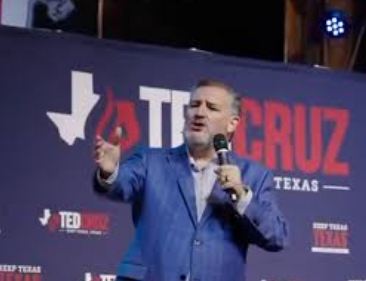
In Washington, D.C., a large crowd of Democratic supporters had gathered outside the party’s headquarters, hoping for a decisive win. However, as the night wore on, disappointment set in as they watched the election slip away. Meanwhile, a jubilant crowd at the Republican headquarters in New York celebrated noisily, ready to welcome Trump’s expected victory. Disappointed, Harris postponed her planned address to supporters. In contrast, Trump prepared to give a victory speech, laying out his vision for the next four years for one of the world’s most powerful nations.

Trump skillfully dismantled the Democrats’ election agenda, which had centered on promises to reduce food prices, support working families, provide $25,000 to first-time homebuyers, and cut tax rates for middle-class households. However, public sentiment leaned heavily toward skepticism. Many questioned how the Biden administration, with Kamala Harris as Vice President, could fulfill these promises now when they had struggled to deliver on similar commitments while in power. This perception further strengthened Trump’s position, as voters viewed the Democrats’ pledges as hollow, given their track record over the past term.

The post-midnight results stunned Democrats. In Arizona, Trump led Harris narrowly at 49.7% to 49.5%, with abortion rights proving pivotal. Harris won her home state of California with a strong 61.2%, securing 59 electoral votes. However, Trump claimed Florida with 56.2% over Harris’s 42.9% and took Georgia (50.7%) and Iowa (55.1%) due to strong rural support. In Idaho, Trump led with 59.1%, while North Carolina also went to him with 50.7% over Harris’s 47.8%. Harris won Oregon comfortably at 59.2%, yet underperformed in Pennsylvania, a critical swing state, where Trump led 50.8%. Trump also led in Wisconsin, 51% to 47.3%, cementing his edge in key battlegrounds.

Now it is not rocket science that Donald Trump has won the 2024 U.S. presidential election and the situation is not going to change even if all votes are counted, which might take a few more days.

With Trump the world is now unscrambling itself to face sweeping changes in the USA’s  approach to the Middle East, the Russia-Ukraine war, NATO, and China could significantly.

Trump has traditionally favored a “peace through strength” doctrine, potentially leading to an assertive stance in supporting Israel while promoting diplomatic engagements to avoid direct U.S. involvement in new conflicts.

Trump’s previous skepticism of NATO could resurface, with calls for greater burden-sharing among member countries, potentially affecting NATO’s united front against Russia. In the case of Russia-Ukraine, Trump has shown interest in swiftly negotiating an end to the conflict, which may lead to a pressured peace deal that could favor Russia or at least reduce U.S. military aid, drawing criticism domestically and internationally.

On the domestic front, Trump’s economic policies have historically included tax cuts, deregulation, and tariffs—especially against China, which he views as a critical economic rival. A more protectionist stance on China could lead to heightened trade tensions, potentially impacting global supply chains and increasing U.S. manufacturing costs, though it may boost certain U.S.-based industries.

Trump’s past emphasis on limiting immigration to protect American jobs could lead to stricter immigration policies, which may face opposition from businesses reliant on immigrant labor, particularly in tech and agriculture.

Economically, Trump is likely to prioritize policies aimed at GDP growth, possibly including tax cuts and reducing regulations on fossil fuels to spur energy independence. However, these moves could risk higher inflation if not carefully balanced with monetary policy.

The overall impact on inflation, jobs, and GDP growth would depend heavily on his administration’s ability to navigate international uncertainties while managing domestic economic pressures effectively.

By Qamar Bashir

Press Secretary to the President(Rtd)

Former Press Minister at Embassy of Pakistan to France

Former MD, SRBC

World leaders congratulate Trump following victory in US Election

World leaders congratulate Trump following victory in US Election

RABAT, NOV 6: In the wake of projected wins in crucial states, Republican candidate Donald Trump has declared victory in the US presidential election over Kamala Harris.

Although vote counting is not yet fully complete, Trump’s campaign claims an “unprecedented and powerful mandate,” marking a return to the White House for the controversial figure.

International leaders have responded swiftly to the election news, offering their congratulations and expressing hopes for strengthened diplomatic relations.

Hungarian Prime Minister Viktor Orban hailed Trump’s apparent win as “the biggest comeback in US political history” and called it a “much-needed victory for the world.”

Ireland’s Prime Minister, Simon Harris, highlighted the “historic and unbreakable bonds” between the United States and Ireland as he vowed to commit to reinforce those ties “in the years ahead.”

European Union leaders also joined the chorus of congratulations. EU Commission President Ursula von der Leyen extended her warm regards to Trump, noting the deep-rooted partnership that unites over 800 million citizens on both sides of the Atlantic. “So let’s work together on a strong transatlantic agenda that keeps delivering for them,” she said in a post on X, formerly known as Twitter.

Meanwhile, EU Council President Charles Michel expressed the EU’s anticipation of continuing “constructive cooperation” with the incoming Trump administration.

Spanish Prime Minister Pedro Sanchez echoed the sentiment, voicing a commitment to “strategic bilateral relations” and a “strong transatlantic partnership.” Romanian Prime Minister Marcel Ciolacu expressed optimism, hoping Trump’s renewed leadership would bring “peace and prosperity for all our citizens.”

Other European leaders, including the prime ministers of Sweden, Denmark, and Norway, issued statements celebrating Trump’s apparent success and expressed willingness to work with his administration.

Meanwhile, Turkish President Recep Tayyip Erdogan shared his hope that Trump’s presidency could help resolve global crises, with a particular focus on the Israeli-Palestinian and the Russian-Ukrainian wars. “I hope that the elections will be beneficial for our friendly and allied people in the United States and for all of humanity,” Erdogan remarked, suggesting he expects a more just global approach under Trump’s leadership.

In Ukraine, President Volodymyr Zelenskyy congratulated Trump on his “impressive victory” and expressed hope that the new administration might accelerate the path to a “just peace” for his country.

© Morocco World News. All Rights Reserved. This material may not be published, rewritten or redistributed without permission.

Support
Your support allows us to continue delivering quality journalism that is accessible to audiences across the globe. Every contribution, however big or small, is valuable for our mission and readers.

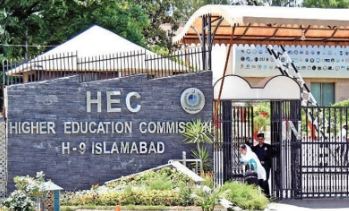
Senate body concerned over fraud cases in HEC

Senate body concerned over fraud cases in HEC

Faisal Sheikh

ISLAMABAD, NOV 6 /DNA/ – On Tuesday, while chairing the Senate Standing Committee on Federal Education and Professional Training, Senator Bushra Anjum Butt emphasized the need for timely allocations for the HEC’s International Research Support Initiative Program (IRSIP), noting that a final decision is anticipated by the end of December. Currently, 266 out of 515 candidate reviews have been completed, and the Chair stressed the importance of documenting this timeline to ensure results are released as scheduled.

During the meeting, Senator Syed Masroor Ahsan also highlighted the issue of retired college teachers from FUUAST University Karachi who are not receiving their due pensions and other allowances. It was directed that the matter be discussed in detail at the next meeting, and the Ministry will provide detailed information on the matter.

The issue of derogatory remarks about Pashtuns in an O-Level Urdu book, raised by Senator Bilal Ahmed Khan during the Senate sitting on October 18, 2024, was thoroughly discussed. It was reported that actions have been taken to ban the book, and the author has submitted a written apology. The Secretary of Education noted that while language is regulated, content varies by province.

Senator Bilal expressed frustration over the book’s continued availability. Chairperson Senator Bushra emphasized the federal government’s role in overseeing educational content and called for the publisher and author to attend the next meeting. She highlighted that such content promotes hate speech and negatively impacts children, recommending that the Ministry of Education issue a directive to all provinces to withdraw the book from circulation. This action, she stated, would serve as a warning to other writers and publishers against harmful content. She also recommended that the author must provide explanations, offer an apology, and be held accountable in the next meeting.

The HEC Chairman agreed, noting that insufficient funding for higher education has led to a reliance on private institutions and that poor governance has resulted in the appointment of Acting Vice-Chancellors. Senator Bushra called for a policy change to ensure that Acting Vice-Chancellors do not have the same privileges as permanent ones and urged for a permanent VC to be appointed within a specified timeframe, as universities suffer without stable leadership. She also noted multiple complaints regarding issues caused by Acting VCs when permanent VCs arrive.

Pakistan congratulates Donald Trump for assuming ‘second term’ as US president

Pakistan congratulates Donald Trump

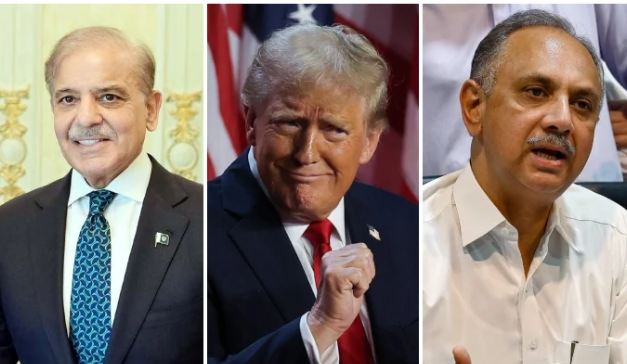
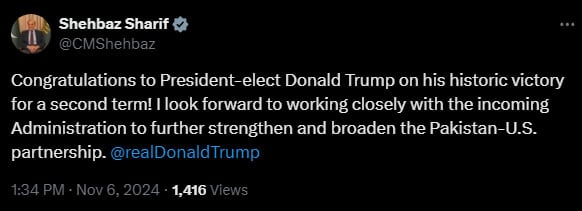
WASHINGTON, NOV 6: As Republican presidential candidate Donald Trump claimed “magnificent victory” in speech addressing supporters, Prime Minister Shehbaz Sharif Wednesday congratulated him on his return to the White House as the 47th president of the United States defeating Vice-President Kamala Harris.

In his congratulatory message posted on X, formerly Twitter, the premier mentioned Trump as president-elect extending congratulations on his “historic victory for a second term”.

“I look forward to working closely with the incoming Administration to further strengthen and broaden the Pakistan-U.S. partnership @realDonaldTrump,” wrote PM Shehbaz in his post.

Pakistan congratulates Donald Trump for assuming second term as US president

PM Shehbaz’s wish for Trump, who will return to assume the president’s office in Washington for the second time, came after his victory speech was broadcast live for viewers around the world.

While complete results of the US presidential polls are yet to be announced, Trump — based on several US media reports including those of Fox News — has claimed victory in the historic race that saw a Black-South Asian woman Harris compete against a former white president.

The Democratic candidate is way behind in the race with 226 and Trump leading with 277 votes, as per the aforementioned American media.

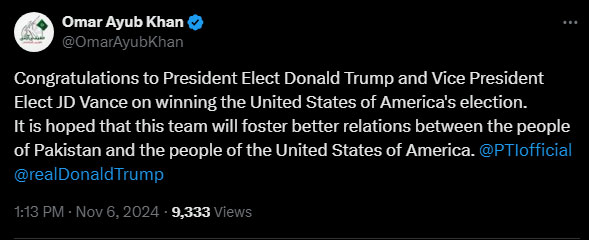
On the other hand, Omar Ayub Khan — the Leader of the Opposition in the National Assembly and Pakistan Tehreek-e-Insaf (PIT) lawmaker — also extended congratulations to Trump and his VP-elect JD Vance on winning the polls.

“It is hoped that this team will foster better relations between the people of Pakistan and the people of the United States of America,” he wrote in a post on X.

Pakistan congratulates Donald Trump for assuming second term as US president

The PTI also took to their official X handle to congratulate the Republican candidate and his VP-elect, stating that the people of the United States have spoken and their “mandate has been respected”.

It added that it is “a stark contrast to Pakistan, where the public mandate was blatantly stolen”.

The felicitations from the PTI and Ayub come at a time when the party’s founder Imran Khan remains imprisoned for over a year following convictions in multiple cases.

The wish for Trump is also crucial as the party has, according to claims made by Defence Minister Khawaja Asif, urged foreign powers to influence Pakistan for the release of their founder and ensure moving him abroad.

During his tenure as prime minister of Pakistan, Imran shared amicable ties with Trump administration — a reason why the PTI celebrates the US president-elect’s return to power as a potential advantage.

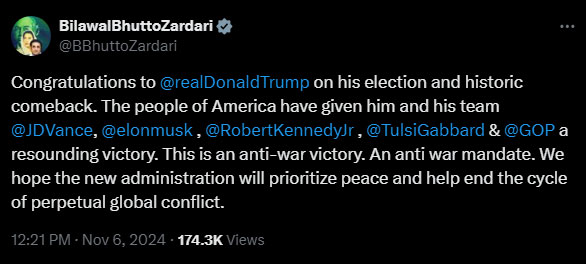
Meanwhile, Pakistan Peoples Party Chairperson Bilawal Bhutto-Zardari, in his message for Trump, congratulated him and his team on the “election and historic comeback” and “resounding victory”.

Pakistan congratulates Donald Trump for assuming second term as US president

Terming the Republican’s win and mandate “anti-war”, Bilawal wrote: “We hope the new administration will prioritize peace and help end the cycle of perpetual global conflict.”

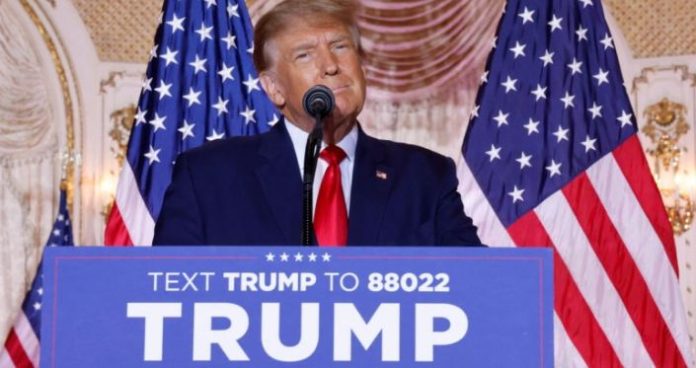
Donald Trump claims victory after American media projects him as 47th US president

Donald Trump

WASHINGTON, NOV 6: “This is a magnificent victory for the American people, I will fight for every citizen,” says Donald Trump after claiming victory.

Philippines says joint maritime exercises rein in China

Philippines

MANILA, NOV 6 (AFP/APP): Joint naval exercises held frequently by the Philippines, United States and other Western powers are helping rein in “aggressive” Chinese actions in the South China Sea, a Filipino military official said Wednesday.

Beijing has for years sought to expand its presence in the disputed waterway, brushing aside an international ruling that its claim to most of the sea has no legal basis.

In recent months, China has deployed navy, coast guard and so-called maritime militia forces — allegedly Chinese fishing vessels — in a bid to bar the Philippines from a trio of strategically important reefs and islands in the South China Sea.

But those efforts were absent during the 10 instances this year when the Philippines, United States and others were conducting joint patrols dubbed Multilateral Maritime Cooperative Activity (MMCA), the Philippine Navy said Wednesday.

“During the conduct of MMCAs, there have been no observed coercive and aggressive actions by the (People’s Liberation Army) Navy, Coast Guard or the maritime militia,” Rear Admiral Roy Vincent Trinidad, spokesman for South China Sea issues, told reporters on the sidelines of a Manila security forum.

The lull was observed for “a few days before and during, and a few days after” the exercises, he said, adding more joint naval drills could be expected in 2025.

Violent encounters with Chinese vessels typically occur during Philippine resupply missions to its remote garrisons in the area.

In Beijing, foreign ministry spokeswoman Mao Ning stressed “China has sovereignty over the South China Sea islands and their adjacent waters” and “we safeguard our sovereign rights and interests in accordance with domestic and international law”.

She added: “Making a show of force and provoking confrontation in the South China Sea will only escalate tensions and undermine regional stability.”

While Washington and its allies have avoided taking sides in the territorial dispute, they say Chinese actions threaten freedom of navigation essential for trade, with trillions of dollars passing through the waterway each year.

Multilateral and bilateral naval exercises help “buy time as we continue developing our capabilities”, Trinidad said Wednesday, noting it was a “great challenge” given the Philippine military’s limited equipment.

He also said that the Association of Southeast Asian Nations, which groups Manila and nine neighbours, was “not doing enough” to support the Philippines or international law.

Fellow ASEAN members Brunei, Indonesia, Malaysia and Vietnam also have claims overlapping Beijing’s in the South China Sea, but others in the bloc have closer ties with China.

Trinidad urged ASEAN countries not to “suffer in silence” in the face of Chinese actions.

Republicans gain majority in Senate for first time in four years

Republicans gain majority in Senate for first time in four years

News Desk/DNA

WASHINGTON: Meanwhile, Republicans gained control of the US Senate again on Tuesday night by sweeping up seats in West Virginia and Ohio with the help of an unexpected battleground win from Nebraska.

It is worth noting that it is the first time in four years for the Republican party to win a majority in the Senate.

Incumbent GOP Sen Deb Fischer brushed back a surprisingly strong challenge from independent newcomer Dan Osborn.

As tallies rolled in across a map that favoured Republicans, Democrats watched their efforts to salvage their slim majority slip out of reach.

In Ohio, multiple US media outlets projected that Republican Bernie Moreno would defeat incumbent Democrat Sherrod Brown. Those two victories ensured Republicans will hold at least a 51-49 majority in the Senate, with further gains possible as results in other competitive races come in.

Republicans also posted gains as they sought to retain control of the House, which they currently control by a narrow 220-212 majority.

They picked up three seats from Democrats in North Carolina, where they had redrawn district lines to bake in their advantage, while Democrats won control of a Republican-held seat in Alabama that had been redrawn to comply with a US Supreme Court order to create a Black majority district.

Democrats now need to flip at least six seats to take control of the 435-seat chamber.

As in the presidential election, the outcome will likely be determined by a small slice of voters. Fewer than 40 House races are seen as truly competitive.

Republicans stand a chance to widen their Senate majority further if they win in Montana, where Democrat Jon Tester faces a tough reelection battle, and prevail in several competitive Midwestern states. However, they are unlikely to end up with the 60-vote majority needed to advance most legislation in the chamber.

Pakistani food exporters depart for Malaysia to explore trade opportunities

Pakistani food exporters depart for Malaysia to explore trade opportunities

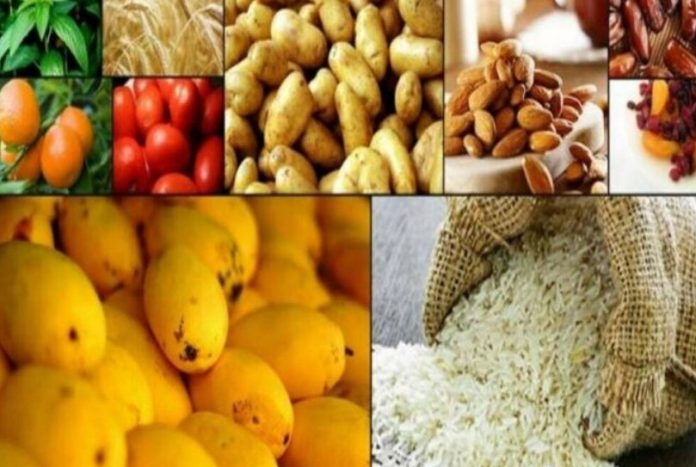
LAHORE, Nov 06 (APP):A delegation of Pakistani food and snacks exporters left for Malaysia on Wednesday for a two-week visit aimed to exploring export opportunities and strengthening trade relations between the two Muslim countries.

Prior to departure here, leader of the delegation Coordinator to Federal Tax Ombudsman Saif Ur Rehman told newsmen that the initiative reflects Pakistan’s commitment to expanding its footprint in the Southeast Asian market, particularly in the food and snack industry.

The delegation, comprising key exporters and industry representatives, would engage in various meetings with Malaysian importers, distributors, and government officials to showcase Pakistan’s diverse food products.

He further explained that current visit also aligns with Pakistan’s broader goal of increasing bilateral trade, tapping into Malaysia’s growing demand for quality halal food products.

By fostering stronger trade ties, Pakistan and Malaysia hope to promote mutual economic growth and create avenues for long-term collaboration.

The delegation’s visit underscores the potential for both countries to benefit from increased trade in sectors with shared cultural and economic interests, he added.

Stay Connected

64FansLike
60FollowersFollow

Latest Reviews

Exchange Rates

USD - United States Dollar
EUR
1.18
GBP
1.36
AUD
0.73
CAD
0.73