Home Blog Page 764

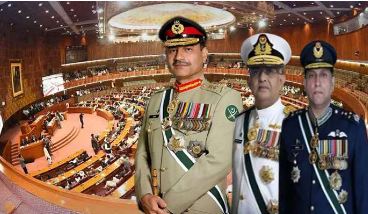
Extension of service chief’s tenure commendable act

Extension of service chief's tenure commendable act

Javeria bint Rabbani

The increase in the tenure of the army chief and the rest of the service chief is a good thing. Trafficking increased and in the recent past, after 9/11, US forces destroyed Afghanistan for 20 years. The Pakistan Army and other security agencies are helpless against them. Terrorism is increasing and our young men are martyring them selves while fighting this temptation of Khawarij. The series of terrorism is increasing and our men are martyred while fighting against this temptation. The extension of the service chief’s tenure is a commendable decision for the army Recent Amendment to Services Act by the Parliament has been well received by people from all walks of life especially members of the Armed Forces’ community.

With almost all having consensus on the fact that three years tenure for the Services Chiefs is too less to affect any long-term changes; enhancement of the same to five years will assist in addressing such obvious predicaments.

On the other hand, credible senior sources in the military have confided that another major shortcoming for a relatively limited tenure of three years was availability of more controls with political forces who had been maintaining intrusive influence over military i.e. politicization of the military.

When compared with other modern militaries of the world, this enhancement in service limit of the Services Chiefs is nothing new but in line with them. For example in US it is 4 years, UK 3-4 years, China 5 years, Germany 3-5 years & France 4 years.

Also, several researches in the world vividly enunciate that a relatively longer period of the Services Chiefs assists in making militaries independent and immune from interference from outside world. Thus, Chiefs are not only able to take decisions which benefit not only the militaries alone in mid to long term but also assist the countries as a whole.

Notwithstanding above, this enhanced tenure limit of the Services Chiefs will definitely accrue several other important advantages as well including continuation of policies, adequate time for implementation of perceived vision, greater stability and bridging trust deficit between the Government and the Services Chiefs which has been bitter at times in the past in Pakistan.

In sum, this enhancement in age limit of Service Chiefs will further add to the professionalism of the Armed Forces while making the institution immune to interference by the political parties while providing additional leverage to the Chiefs for maintaining intrusive influence over military affairs -a win-win situation both for the ArmedIt will be beneficial for both the armed forces and the country.
([email protected] )

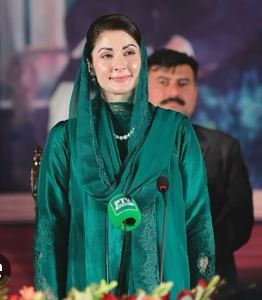
Message of CM Maryam Nawaz on Iqbal Day

PODA greets Maryam Nawaz on her groundbreaking role and commitment to women's rights

LAHORE, NOV 9 /DNA/ – “I will be the servant of him who loves the servants of God,” said Chief Minister Punjab Maryam Nawaz Sharif in her message on Iqbal Day. She added,”On Iqbal Day, we pay tribute to the thought and vision of the great thinker Allama Iqbal.”

Madam Chief Minister said, “The intellectual services of the poet of the East for the establishment of Pakistan can never be forgotten.” She added, “His message for the new generation is that of self-awareness.” She highlighted,”It is very important to enlighten the young generation with Iqbal’s thoughts.”

Chief Minister Maryam Nawaz Sharif said, “‘Shikwa’ and ‘Jawab-e-Shikwa’ are timeless creations of Allama Iqbal.” She added,”Allama Iqbal’s poetry both in Urdu and Persian languages is a great addition to the literature in these languages.” She underscored,”Kalam-e-Iqbal needs to be made a maximum part of the educational curriculum.”

Madam Chief Minister said, “On Iqbal Day, we pledge to adopt the thoughts of Poet of the East to elevate Pakistan.” She added,”Following the teachings and thoughts of Iqbal is the best way to be devoted to him.” She noted,”Allama Iqbal gave message of the Muslims of the sub-continent and raised the awareness of two nations.”

Chief Minister Maryam Nawaz Sharif said, “Allama Iqbal gave the youth of the subcontinent a high sense of character through his poetry.” She added,”His thoughtful poetry transformed the Muslims of the subcontinent into a dynamic and awakened nation.”

Madam Chief Minister said, “We are trying to lead the peasants of Punjab on the path of independence according to the thoughts and ideas of Poet of the East.” She added,”My favorite poetic verses include “May my work be supporting the poor, loving the sick and the weak.” She flagged,”My God save me from evil… Be a good guide, guide me on true path” is my prayer for children.”

Ready to sacrifice life for Imran Khan’s release, vows Gandapur at Swabi power show

Swabi power show

SWABI, NOV 9: Khyber Pakhtunkhwa (KP) Chief Minister Ali Amin Gandapur has vowed to secure release of PTI founder Imran Khan, saying that they are even ready to “sacrifice their lives” for this purpose.

“Even if our lives are lost, we will not rest until the release of PTI founder,” he roared at a public gathering organised by the PTI in Khyber Pakhtunkhwa’s Swabi for the independence of judiciary.

PM Shehbaz visits Police Service Center in Islamabad

Police Service Center

ISLAMABAD, NOV 9 /DNA/ – Prime Minister Muhammad Shehbaz Sharif visits the Police Service Center established for facilitation of diplomatic community in Islamabad.

This is the first time that such a comprehensive service centre has been established in the history of the Diplomatic Enclave, aligning with the government’s focus on enhancing the convenience and safety of diplomats and foreign residents.

Afghan women not barred from speaking to each other: morality ministry

Afghan women not barred from speaking to each other: morality ministry

KABUL, NOV 9: Women in Afghanistan are not forbidden from speaking to each other, the Taliban government’s morality ministry told AFP on Saturday, denying recent media reports of a ban.

Afghan media based outside the country and international outlets have in recent weeks reported a ban on women hearing other women’s voices, based on an audio recording of the head of the Ministry for the Propagation of Virtue and the Prevention of Vice (PVPV), Mohammad Khalid Hanafi, about rules of prayer. PVPV spokesperson Saiful Islam Khyber said the reports were “brainless” and “illogical”, in a voice recording confirmed by AFP.

“A woman can talk to another woman, women need to interact with one another in society, women do have their needs,” he said.

He added, however, that there were exceptions according to Islamic law, such as those described by Hanafi that women should use hand gestures instead of raising their voices to communicate with other women while praying.

Women in Afghanistan are barred from singing or reciting poetry aloud in public, according to a recent “vice and virtue” law detailing sweeping codes of behaviour, including that women’s voices should be “concealed” along with their bodies when outside their homes. Women’s voices have also been banned from television and radio broadcasts in some provinces.

The law codified many rules the Taliban government has imposed based on their strict interpretation of Islamic law since they came to power in 2021, with women bearing the brunt of restrictions the United Nations has called “gender apartheid”.

The Taliban authorities have banned education after secondary school for girls and women, also barring them from various jobs as well as parks and other public places.

The Taliban government has said all Afghan citizens’ rights are guaranteed under Islamic law.

Mushahid: Pakistan has new ‘Strategic Space’ in South Asia after Bangladesh shift

Mushahid Hussain

Mushahid calls for strategic ties with Bangladesh as now it’s ‘Muslim Bengal’ which rejects Indian hegemony, urges visa-free  & open trade

ISLAMABAD, NOV 9 /DNA/ – Speaking at Islamabad Literature Festival here today, Senator Mushahid Hussain Sayed said that the historic change in Bangladesh has changed the strategic landscape of South Asia, opening up historic opportunities for Pakistan. At a panel on ‘Pakistan-Bangladesh Relations’ which he shared with author Ikram Sehgal, Mushahid said Bangladesh’s  people call the Student Revolution against the pro-India Haseena Wajid regime as the ‘Second Liberation’, which,  he said, meant ‘liberation from Indian hegemony’.

Mushahid Hussain said the recent Revolution in Bangladesh has a three-fold historic significance for Pakistan. First, the Revolution provides a closure to the painful chapter of 1971, where the Indian narrative has now been finally buried. Second, a new Bangladesh identity has now emerged, an identity of ‘Muslim Bengal’, which is rooted in the 1947 common struggle for freedom based on the Two Nation Theory. Hence, it’s no accident that the death anniversary of Quaid e Azam Muhammad Ali Jinnah was commemorated recently in Dhaka for the first time since 1971.

Third, now is the ‘opportunity of a lifetime’ for restoration of brotherhood, camaraderie & Strategic Partnership between Pakistan and Bangladesh. He urged for opening up visa-free travel and open trade and investment between the two brotherly countries. He termed Pakistan and Bangladesh as being tied together with an ‘umbilical cord’. He called for exchange of youth and students between the two countries. Senator Mushahid Hussain said that India had an ideological animosity towards both Pakistan and Bangladesh, as its current ideology stemmed from ‘Akhand Bharat’ (Greater India).

He recalled that in December 1971, immediately after the breakup of Pakistan, then Indian Prime Minister Indira Gandhi proudly proclaimed: ‘we have taken revenge after 1000 years’, language that is now echoed by Prime Minister Modi and the RSS Hindutva crowd. Mushahid Hussain said, given this historic change, Pakistan now has Strategic Space to pursue a proactive foreign policy in South Asia, starting with restoring the strategic bond with Bangladesh as well as close ties with Nepal, Sri Lanka and the  Maldives, all of whom are wary of Indian hegemony.

Mushahid Hussain termed Bengalis as among the creators of Pakistan who always displayed a spirit of defiance and culture of resistance, especially praising the eminent Muslim Bengal leaders, Hussain Shaheed Suhrwardhy, Sher e Bengal Fazlul Haq and Maulana Bhashani, who were great leaders of the Pakistan Movement. An animated question-and-answer session followed the presentation.

Pakistan Navy assumes guard duties at mausoleum of Dr. Allama Iqbal

Pakistan Navy assumes guard duties at mausoleum of Dr. Allama Iqbal

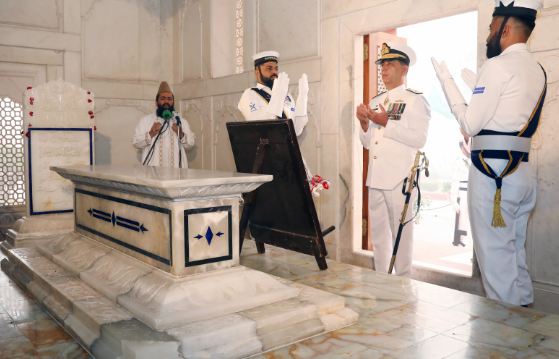
LAHORE, NOV 9 /DNA/ – An impressive Change of Guard Ceremony was held at the mausoleum of Dr. Allama Muhammad Iqbal as the nation celebrated the 147th birth anniversary of Mufakkir-e-Pakistan, the visionary behind the ideology of an independent Muslim state in the subcontinent.

A smartly attired contingent of the Pakistan Navy took over guard duties from the Pakistan Rangers (Punjab). Commander Central Punjab, Pakistan Navy, Rear Admiral Azhar Mahmood graced the occasion as the Chief Guest and paid homage to the National Poet.

Commander Central Punjab laid a floral wreath at the mausoleum on behalf of the Chief of the Naval Staff, Admiral Naveed Ashraf, as well as Officers, Sailors, and Navy Civilians of the Pakistan Navy, and offered Fateha. The Chief Guest also recorded his remarks in the visitor’s book, paying rich tribute to the great poet and philosopher.

The ceremony was attended by dignitaries, members of the media, and a large number of the general public.

SJC to ‘widen consultation’ on IHC judges letter accusing spy agencies of interference

SJC

CJP Afridi-led SJC takes decision “as the code applies to the heads of different institutions in addition to judges”

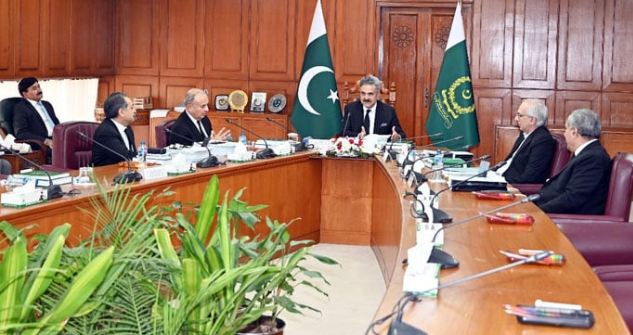
ISLAMABAD, NOV 8 /DNA/ – The Supreme Judicial Council (SJC) has decided to widen consultation on a letter written by six judges of Islamabad High Court (IHC), accusing the intelligence agencies of interference in judicial affairs.

The decision was taken during the meeting of top judicial body under the chairmanship of Chief Justice of Pakistan (CJP) Justice Yahya Afridi, said a press release issued by the Supreme Court.

The meeting was attended by Justice Mansoor Ali Shah, Justice Munib Akhtar, IHC Chief Justice Aamer Farooq and Balochistan High Court Chief Justice Muhammad Hashim Kakar.

According to the press release, the council discussed the agenda items regarding amendments to the code of conduct of judges under Article 209(8) of the Constitution and letter of six judges of Islamabad High Court.

“The Council considered different options and modalities in this regard and decided to widen the consultation on the subject as the code applies to the heads of different institutions in addition to judges and decided to take up the matter in the next meeting once again,” it stated.

On March 25, a letter of six judges of the IHC came to surface wherein they had demanded former Chief Justice of Pakistan (CJP) Justice Qazi Faez Isa to convene a Judicial Convention to consider the matter of interference in judicial functions, or intimidation of judges in a manner that undermines independence of the judiciary.

(Clockwise) IHCs Justices Mohsin Akhtar Kiani, Tariq Mahmood Jehangiri, Babar Sattar, Ijaz Ishaq Khan, Arbab Muhammad Tahir and Saman Riffat.— IHC website/file

(Clockwise) IHC’s Justices Mohsin Akhtar Kiani, Tariq Mahmood Jehangiri, Babar Sattar, Ijaz Ishaq Khan, Arbab Muhammad Tahir and Saman Riffat.— IHC website/file

The IHC judges — who wrote the letter to the SJC — include Justice Mohsin Akhtar Kiyani, Justice Tariq Mehmood Jahangiri, Justice Babar Sattar, Justice Sardar Ejaz Ishaq Khan, Justice Arbab Muhammad Tahir, and Justice Saman Fafat Imtiaz.

The letter emerged days after the Supreme Court declared the removal of former IHC Justice Shaukat Aziz Siddiqui illegal, directing that he may now be considered as a retired judge.

The verdict noted that the SJC proceeded against Justice Siddiqui on the “assumption that the truth or falseness of the allegations levelled” by the former judge was “irrelevant”.

On Nov 2, The News reported that the IHC judges held a meeting with CJP Afridi and expressed their reservations over the problems they face while discharging judicial functions.

Although, there was no official confirmation regarding the development, however, it was learnt that CJP Afridi, after taking oath of his office, had held a meeting with IHC Chief Justice Aamer Farooq, who is also the chairman of the high court’s administrative committee.

Meanwhile, the top judicial body — in today’s meeting — also examined ten complaints against the judges under Article 209 of the Constitution filed by different people and held that “no substantial evidence has been adduced by the complainants, therefore the Council has filed those complaints.” 

The Council also discussed in detail the issue of rule-making of the council and establishment of its secretariat.

It agreed to the proposal of registrar and decided that rule making process of the council should be undertaken and draft should be placed before the council in the next meeting.

The JCP authorised CJP Afridi to hire the services of a competent individual with proven ability to work as secretary of the council for a period of 3 months who would be tasked to assist the council in conducting its meetings, oversee rule making exercise, and firm up infrastructure and human resource requirements of the Council’s secretariat.

Furthermore, the SJC decided to hold regular meetings on monthly basis in future to clear the backlog on fast track.

JCP meeting

On the other hand, CJP Yahya Afridi also chaired the second meeting of the Judicial Commission of Pakistan constituted under the recently-enacted 26th Constitutional Amendment to consider a single point agenda of formation of a constitutional bench within the Sindh High Court. It was attended by Justice Syed Mansoor Ali Shah, Justice Munib Akhtar, Justice Ameen-ud-Din Khan and Justice Jamal Khan Mandokhail (via video link); Justice Muhammad Shafl Siddiqui, SHC Chief Justice, Law Minister Azam Nazeer Tarar, Attorney-General for Pakistan Mansoor Usman Awan, Senator Farooq H Naek; Senator Syed Shibli Faraz, MNA Sheikh Aftab Ahmad, Leader of Opposition in NA Omar Ayub, Roshan Khurshid Barucha, Sindh Law Minister Zia ul Hassan Lanjar, member of Sindh Bar Council.

Following an extensive and thoughtful exchange of views, the commission unanimously endorsed the proposal put forth by SHC CJ Muhammad Shafi Siddiqui that all the existing high court judges are nominated to be the judges of constitutional benches for expeditious disposal of the existing huge backing of cases.

NUML hosts seminar on “Paigham-E-Pakistan” emphasizing unity and national values

NUML hosts seminar on

DNA

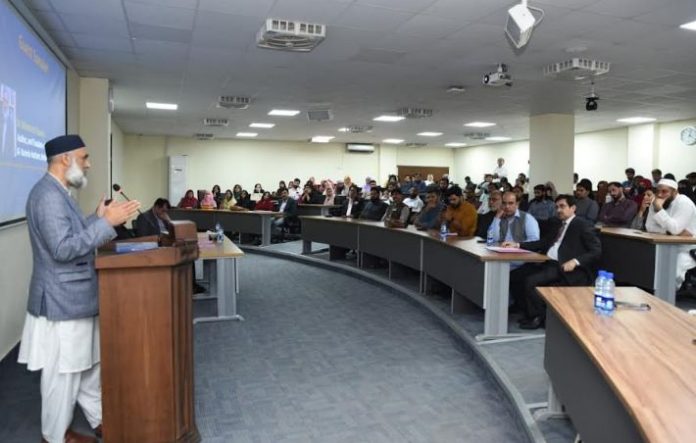
ISLAMABAD, Nov 8: The National University of Modern Languages held a seminar today titled “Paigham-e-Pakistan,” jointly organized by the Department of Islamic Thought and Culture and the Department of Pakistan Studies. The seminar highlighted the significance of unity, spiritual values, and dedication to Pakistan’s progress.

Renowned Qari Syed Sadaqat Ali and Dr. Musharraf Hussein, an author, translator of “The Majestic Quran,” and Director of the Al-Karimia Institute, Retford, UK, were the chief guests. Director General NUML, Brig. Shahzad Munir also graced the occasion.

The seminar began with a soulful recitation of Quranic verses and a Naat by Qari Syed Sadaqat Ali, captivating the audience with his melodious voice. Reflecting on Pakistan’s history, he reminded participants of the immense sacrifices made for the nation’s independence, emphasizing the role of the Armed Forces, civilians, Ulema, and students. He called upon the youth to cherish and uphold Pakistan’s legacy, stressing that the foundation of the country is built upon the blood of martyrs and that each generation bears the responsibility to safeguard and contribute to its development.

Dr. Musharraf Hussein delivered an insightful address on the “Paigham-e-Pakistan” narrative, underscoring Pakistan as a land of purity and goodness. He highlighted the importance of adhering to moral, spiritual, and social values, and shared that the teachings of the Quran offer guidance and solutions for humanity’s challenges. He urged the audience to recognize the timeless wisdom of the Quran as a source of strength and direction.

Director General NUML, Brig. Shahzad Munir, further underlined the importance of the “Paigham-e-Pakistan” message, stressing the need to fulfill the purpose of our creation by utilizing our potential for the betterment of the country. He emphasized that Allah has blessed humanity with knowledge and resources, and it is the responsibility of Pakistanis to care for these blessings. DG NUML reiterated that the Quran’s message is universal and everlasting, calling upon Pakistanis to understand and embody this message as stewards (Khalifa) of Allah on earth.

The seminar concluded with a presentation of tokens of appreciation to the distinguished guests, followed by a group photo.

Chairman PRCS meets British High Commissioner

PRCS

DNA

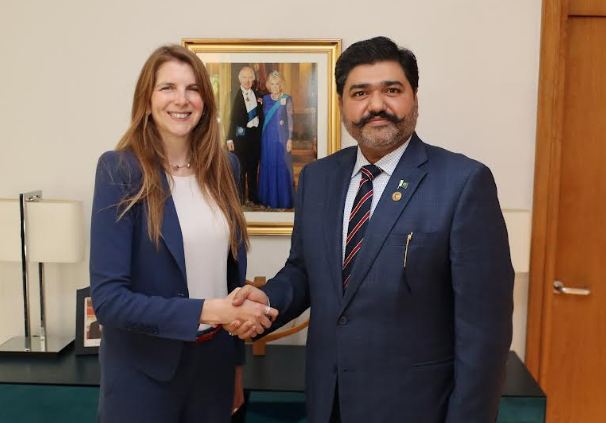
ISLAMABAD, NOV 8 – Chairman Pakistan Red Crescent Society (PRCS), Sardar Shahid Ahmed Laghari, held a pivotal meeting with Jane Marriott, British High Commissioner to Pakistan, at the United Kingdom Embassy in Islamabad today. The high-level discussion focused on enhancing humanitarian cooperation, with a special emphasis on addressing health and climate challenges impacting Pakistan. PRCS Secretary General and other senior officers were also present.

During the meeting, Chairman Laghari highlighted Pakistan’s critical climate vulnerability and outlined PRCS’s ongoing initiatives aimed at mitigating disaster impacts and building climate resilience. Acknowledging the vital support from the United Kingdom in times of national crises, he emphasized the shared commitment to long-term rehabilitation, livelihood restoration, and sustainable development for disaster-affected communities across Pakistan.

High Commissioner Ms. Jane Marriott praised the significant strides PRCS has made under Laghari’s leadership, particularly in modernizing the organization and expanding its impact. She noted Pakistan’s troubling position as the seventh most vulnerable country on the climate risk index and commended PRCS’s forward-thinking initiatives, including the establishment of a Climate Change Unit and the promotion of green office practices. Ms. Marriott encouraged further proactive measures, underscoring the urgency of collective action to address climate change.

The two leaders explored potential collaboration avenues between PRCS and the British Red Cross, focusing on areas such as Migration and Displacement, Cash and Voucher Assistance (CVA), Disaster Preparedness, and Risk Reduction. PRCS’s climate action efforts were also a highlight of the conversation, including projects such as CACRA (Climate Advocacy and Coordination for Resilient Action) and youth-led climate initiatives. Chairman Laghari shared PRCS’s vision for a climate research center and about reforestation and waste management projects.

Chairman Laghari extended invitation to High Commissioner Marriott to visit the PRCS National Headquarters, emphasizing the importance of ongoing dialogue and knowledge exchange in humanitarian work. In recognition of their shared commitment, he presented her with a commemorative shield and a special souvenir symbolizing PRCS’s mission. High Commissioner Marriott also received a magazine celebrating recent PRCS milestones and Sardar Shahid Ahmed Laghari’s book “Dastan-e-Azam”.

Stay Connected

64FansLike
60FollowersFollow

Latest Reviews

Exchange Rates

USD - United States Dollar
EUR
1.18
GBP
1.36
AUD
0.73
CAD
0.73