Home Blog Page 763

Actor Hania Aamir reveals her marriage plan

marriage

Toronto, NOV 10: Pakistani actor Hania Aamir, who is loved by people across the world, addressed her fans’ curiosity over her marriage plan. 

Hania is currently in Toronto, Canada, where she attended a meet and greet organised her fans during which they asked the starlet questions about her professional and personal life. 

During the event, her fans had the chance to ask Hania various questions.

Responding to a question related to her wedding, the actor said candidly: “I don’t have any plan to get married at the moment.”     

“I am a simple girl. Whenever I get married, I will announce it with a bang.”

To another query, the actor said that the boards at borders cannot separate people, adding, “no restriction can hold you back when you love someone from the bottom of your heart.”

The actor said that she used to visit abroad to meet her fans. “It brings me great joy,” she added.

After Quetta blast, Naqvi vows to strengthen Balochistan LEAs to combat terrorism

Quetta

QUETTA: A day after the devastating terrorist attack at Quetta railway station, Interior Minister Mohsin Naqvi vowed to upgrade the professional capabilities of Balochistan’s law enforcement agencies (LEAs) to combat the menace of terrorism effectively.

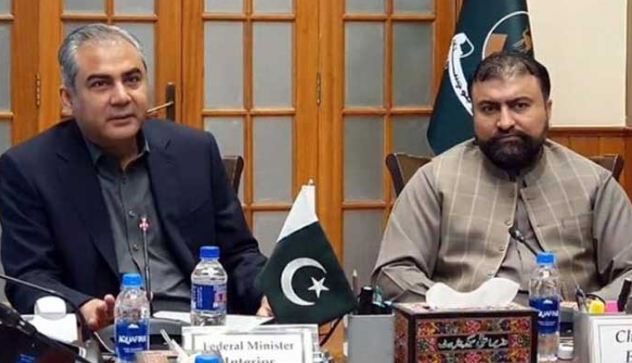
“The Centre will provide all-out support to the Balochistan government to maintain peace and eradicate terrorism from the province,” the security czar said in a meeting with Chief Minister Sarfraz Bugti in the provincial capital on Sunday.

A suicide bombing that ripped through Quetta Railway Station on Saturday morning claimed 27 lives, including security personnel and the suicide bomber, and left 62 others injured. The blast struck when a large number of passengers were on the platform to board the Jaffar Express.

According to the initial report by the Counter Terrorism Department (CTD), the suicide bomber detonated 8-10 kilograms of explosives on the platform crowded with passengers.

Police officers collect evidence amid the debris after a bomb blast at a railway station in Quetta, November 9, 2024. — Reuters
The deadly attack drew condemnations from Pakistani leadership and world leaders, including Russian President Vladimir Putin, the Malaysian premier, and UN Secretary-General Antonio Guterres.

The interior minister, in today’s meeting with CM Bugti, reviewed the post-blast situation and discussed the measures taken to maintain peace, public security, and the protection of property in Balochistan.

Both leaders paid homage to the martyrs and prayed for the elevation of their ranks.

Expressing complete solidarity with the families of the martyrs, they stated, “The war against terrorism is the war of every Pakistani, and the defeat of our enemies in this war is the first and last option.”

Speaking on the occasion, the chief minister said that further efforts were being made to ensure law and order and reiterated that a handful of elements are involved in terrorist activities in Balochistan, which would be rooted out in every way.

Interior Minister Mohsin Naqvi along with Balochistan Chief Minister Sarfraz Bugti inquiring health of injured person in railway station blast at Civil Hospital, Quetta, November 10, 2024. — PID
Later, CM Bugti and Naqvi chaired a high-level meeting on the law and order situation in Balochistan here at the Chief Minister’s Secretariat. The preliminary report of the suicide blast at Quetta railway station was also presented in the meeting.

The meeting decided to take decisive steps with “full force to crush the terrorists and expand intelligence-based operations to thwart the nefarious designs of anti-state elements.”

Addressing the meeting, Naqvi said that the federal government would provide all possible support to the Balochistan government to fight against terrorism. He also announced that provide resources to Balochistan on a priority basis.

He said that measures would be taken to provide training and strengthen the professional capabilities of police, counter-terrorism department (CTD), Levies and other forces of Balochistan.

He expressed the government’s resolve to defeat enemies who want to weaken Pakistan by furthering their nefarious designs.

Surge in terror attacks
As per a report issued by the Centre for Research and Security Studies (CRSS), the third quarter (July-September) of 2024 saw a sharp increase in fatalities due to terrorist violence and counter-terrorism campaigns, with a 90% surge in violence.

A total of 722 people were killed, including civilians, security personnel, and outlaws, while 615 others were wounded in as many as 328 incidents recorded during the period under review.

Nearly 97% of these fatalities occurred in KP and Balochistan, marking the highest percentage in a decade, and over 92% of these incidents of terror attacks and security forces’ operations were recorded in the same provinces.

The total fatalities from three quarters of this year have now surpassed the total fatalities recorded for the entire 2023; the number of fatalities rose to at least 1534 in the first three quarters compared to 1523 in 2023.

Four terrorists eliminated in separate operations in North Waziristan: ISPR

Security forces kill four terrorists in D.I.Khan

RAWALPINDI, NOV 10 /DNA/ – Four Khwarij were killed in two separate engagements in North Waziristan District. An intelligence based operation was conducted by the Security Forces in general area Spinwam, North Waziristan District. During the conduct of operation, own troops effectively engaged khwarij’s location and after intense fire exchange, two Khwarij were sent to hell.

In another incident, movement of a group of khwarij, who were trying to infiltrate through Pakistan-Afghanistan border, was picked up by the security forces in general area Spinwam, North Waziristan District. Own troops effectively engaged and thwarted their attempt to infiltrate. Resultantly, two khwarij were sent to hell, while two khwarij got injured.

Sanitization operations are being conducted to eliminate any other Kharji found in the area.

Security Forces of Pakistan are determined and remain committed to secure its borders and eliminate the menace of terrorism from the country.

From Page to Stage: 10th Islamabad Literature Festival Highlights Pakistan’s Literary Legacy and Future

10th Islamabad Literature Festival

ISLAMABAD, NOV 10 /DNA/ – The 10th Islamabad Literature Festival (ILF), ‘Words Change Mindsets,’ comprising fifty intellectually inspired sessions, including movie screening, dance recital, mushairas, theatre, and a memorable Sufi night, concluded with a fantastic closing ceremony at the Allama Iqbal Auditorium last evening. The event was graced by 100+ prominent voices in literature and art who spoke and reflected as keynotes and panelists in the festival, and esteemed guests.

Commenting on the transformative character of such events, renowned writer, and critic Muneeza Shamsie shared, “ILF has shown us the unifying power of words, fostering dialogue across divides and inspiring change.” Poet and writer Najeeba Arif echoed the sentiment, adding, “Literature shapes our perspectives and allows us to see the world through others’ eyes.”

The event also featured remarks by Mohammad Mikail Soomro, Head of Corporate Communications, Getz Pharma, who emphasized the value of supporting literary platforms, saying, “We are proud to be part of an initiative that encourages intellectual discourse and nurtures Pakistan’s vibrant literary culture.

Arshad Saeed Husain, Managing Director, Oxford University Press Pakistan, expressed his gratitude to attendees and contributors, stating, “Our passion and commitment is towards ensuring that Literature continues to drive the change towards a progressive and equitable society. We are blessed to have found an ever-expanding group of friends like you to empower our mission.”

Bringing up the last five of the total seventeen book launches; Day 3, continued with Akbar in Wonderland by Umber Khairi. In a lively conversation between the author and Aamir Ghauri, Khairi shared insights on her protagonist’s challenges of social and political ethos in the nineties.

In the Urdu fiction category, Najeeba Arif’s Mazahir o Mubahis was presented, in conversation with Abid Hussain Sial, who explored the themes of cultural identity and modernity. Shahid Siddiqui’s latest work, Toronto, Dubai, and Manchester, was discussed in a session with Asghar Nadeem Syed, highlighting Siddiqui’s narrative journey through the socio-political landscapes of three cities.

M. Athar Tahir’s Telling Twilight offered a poetic exploration of nature and nostalgia, with Tahir discussing his work with filmmaker Ammar Aziz. Similarly, Pani pe likhi kahani by Muhammad Asim Butt was launched in an engaging discussion with Qasim Yaqoob, delving into Butt’s reflections on time and memory.

A heartfelt session was held for My Friend Mairaj: An Intimate Biography by Shamim Ahmad, who, in conversation with Safiya Aftab, spoke on the legacy and personal memories of Mairaj Muhammad Khan. In a session filled with introspection and personal insights, Aankh se Aasman jata hai by Tariq Naeem, was launched, with Mehboob Zafar moderating a conversation on Naeem’s unique poetic vision.

The festival also celebrated English poetry with the launch of Poetry in English from Pakistan, edited by Ilona Yusuf and Shafiq Naz. A diverse panel of poets, including Naeem Pasha, Rayan Khan, Alamgir Hashmi, Harris Khalique, Waqas Naeem, Haseeb Sultan, Wajahat Malik, Athar Tahir, Mehvash Amin, Saad Ali, Zain Ul Abidin Khan Alizai, and Sophia Bano, presented their works, with Ammar Aziz moderating a discussion that highlighted the rich tapestry of Pakistan’s English-language poetry scene.

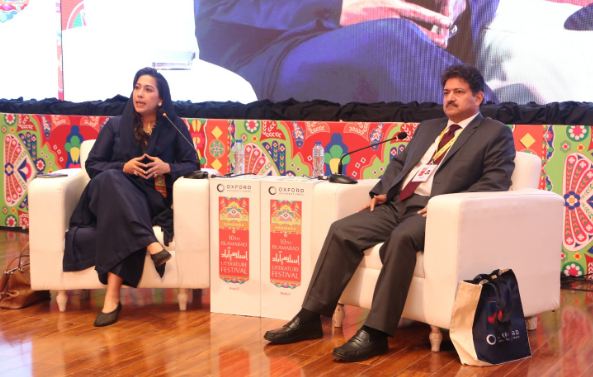
An engaging lineup of panel discussions and sessions sparked lively conversations on diverse topics relevant to Pakistan’s socio-cultural and literary landscape. Season 2 of Capital Talk featured a thought-provoking conversation between Hamid Mir and Meher Bukhari, touching on pressing issues in journalism and public discourse. In a timely discussion on social media: Free Speech vs. Censorship, panelists Farnood Alam, Husnain Jamal, and Munizae Jahangir, moderated by Khayyam Mushir, delved into the challenges of balancing freedom of expression with the need for responsible content regulation. Munizae spoke of the pains of fighting fake news but insisted that censorship must change its role towards protecting the rights of the minorities and not suppressing the voice of people.

 Visual Journey: Documenting The National Art Gallery of Pakistan; moderated by Hammad Husain, the session delved into insights regarding preserving Pakistan’s heritage. Naeem Pasha’s philosophy of humility and accessibility in designing his masterpiece won hearts. “Sango Khesht has to be subservient to Art and Culture.”

A literary discussion, Pakistani Urdu Adab ke Khud-o-Khaal, brought together esteemed voices like Zehra Nigah, Iftikhar Arif, Najeeba Arif, and Abid Hussain Sial, moderated by Shakeel Jazib, to explore the evolving identity of Urdu literature in Pakistan. On the question of geography of literature, Zehra Nigah commented, “Literary molds evolve with time to stay relevant – very much like the physical structures. Literature has never had boundaries, and it will stay connected to its historical legacy while reflecting present dynamics.” Arif Iftikhar expanded on how rich Pakistani literature has been with stalwarts like Ibne Insha. Yusufi, Rashid, Pitras, Faiz, and countless more, and how their works are gems of the glorious history and literary wonders of Urdu language.

The session Urban Dialogues: Decoding Islamabad’s Dynamics with Naeem Pasha, Fauzia Asad Khan, Sikander Ajam Khan, and Hammad Husain, moderated by Hamid M. Husain, examined Islamabad’s urban growth and social shifts. Theater group Swaang performed Daastan-e-Mizaah, adding a cultural touch to the festival through a comedic exploration of Pakistani society.

In Fostering a Global Mindset: Co-Existence of Local and International Exam Boards, panelists including Ghulam Ali Mallah, Amanda Ingram, Andrew Coombe, Arshad Saeed Husain, and Shahid Soroya, moderated by Faisal Bari, debated the merits of a diversified educational approach. Shahid spoke of the learning crises of fifty-four million children in school, while Coombe defined the essence of curiosity that must define pedagogical and assessment’s objective. Pakistani English Literature: Defining a Canon featured Muneeza Shamsie, Harris Khalique, and Ilona Yusuf, guided by Aroosa Kanwal, discussing the evolution of English literature from Pakistan and the challenges in forming a literary canon. Commenting on the nature of literary festivals, Harris Khalique said,” festivals may not contribute to the literary canon, but they definitely enable the shift in the mindset.”

Hameed Akhtar’s legacy was revisited in Hameed Akhtar ke Sawaal with Iftikhar Arif, Saba Hamid, Asghar Nadeem Syed, and Harris Khalique, led by Shahzad Sharjeel. Exploring the economic opportunities via strengthening the AI infrastructure became the main discussion point in How Pakistan can capture its share of the $2 Trillion AI Market. It saw insights from Faisal Aftab, Owais Barlas, Fizza Amjad and was moderated by Basit Riaz Shaikh. In Who Owns the English Language? Contemporary Pakistani Anglophone Fiction – Raazia Sajid, Umber Khairi, and Sonia Irum, shared their views on Pakistani writers’ contributions to Anglophone literature. The session was moderated by Aroosa Kanwal.

The constitutional discourse in We the People and our Constitution, featuring Hamid Khan, Ahmer Bilal Soofi, and Farhatullah Babar,  with Mujahid Barelvi as moderator, delved into citizens’ rights and constitutional awareness. Our Education System and the Future Workforce Needs, with experts A.H. Nayyar, Faisal Mushtaq, Shahid Siddiqui, and Shoaiba Mansoor, moderated by Faisal Bari, focused on aligning education with workforce demands. Shoaiba shared the update on vocational and technical integration in the federal schools, but all panelists agreed on the need for a paradigm shift with strong training, and evaluative framework for the teachers. 

A session on digital storytelling, Beyond the Hype: Content Creators Crafting Stories, included creators Huzaifa Nizam (Huztory by Huzaifa), Noman Jaffar (Islamabadwala), and Maryam Raja, moderated by Sonia Irum, exploring the influence of digital narratives. Concluding with Pindi Afsanay ka School, Hameed Shahid, Ravish Nadim, and Nilofar Iqbal, moderated by Khaleeq ur Rehman, reflected on the unique narrative style emerging from Pindi’s literary scene.

The ceremony concluded with a soulful Sufi night performance by Akbar Ali Khan, leaving the audience deeply moved and inspired. The festival’s closing celebrated literature’s unique ability to reshape perspectives, fostering greater understanding and empathy across society.

About Oxford University Press

Oxford University Press (OUP) is a branch of the University of Oxford, dedicated to global publishing for various audiences. They produce dictionaries, educational materials, children’s books, journals, and more. With roots dating back to 1478, OUP received printing rights in 1586, extended to cover all book types in 1636. The Press is overseen by Delegates from the university’s faculty who approve proposals and work closely with editors. The Chief Executive, also known as the Secretary to the Delegates, manages OUP’s operations. Presently, OUP operates in 50+ countries, publishing in 90+ languages, making it the largest university press globally.


Serena Polo Cup concludes with a thrilling finale

Polo Cup

ISLAMABAD, NOV 10 /DNA/ – Serena Hotels, under its Sports Diplomacy initiative and commitment to community engagement, organized the Serena Polo Cup 2024 on 10th November at Islamabad Club polo grounds. The event was attended by diplomats, members of the corporate sector, and polo enthusiasts, creating a vibrant atmosphere celebrating the spirit of the sport.

The final match of the Serena Polo Cup featured an exciting showdown between Team BN and Team Rizvi’s by U Bank. Both teams displayed exceptional skill and teamwork, captivating the audience with their skill of the game. Team Rizvi won the Serena Polo Cup with a score of 7, after an exciting tie across four chukkers that led to a decisive fifth chukker.

 Serena Hotels congratulates both the teams for their outstanding performance at the Serena Polo Cup 2024. Hosting these events brings communities together and promotes diverse sports across Pakistan. Through initiatives like the Polo Cup, Serena Hotels provides a platform to celebrate athleticism and raise positive community connections.

The Sports Diplomacy efforts extend beyond polo, extensive support for various sports, including squash, tennis, and women’s cricket. These initiatives promote youth engagement, gender equality, and national pride, encouraging positive relations within both local and international communities

Pakistan calls for immediate, unconditional ceasefire in Gaza at Arab-Islamic Summit

Arab-Islamic Summit

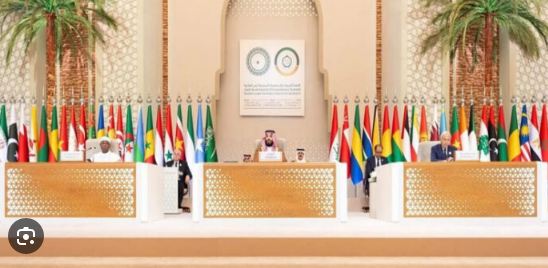
RIYADH, NOV 10 /DNA/ – Let me begin by extending my profound appreciation to the Custodian of the Two Holy Mosques, King Salman bin Abdul Aziz Al-Saud, His Royal Highness Crown Prince and Prime Minister of Saudi Arabia, Prince Mohammed bin Salman bin Abdul Aziz Al-Saud and His Highness Foreign Minister Prince Faisal bin Farhan Al Saud bin Abdullah for convening this crucial meeting for the preparation of the Summit tomorrow.

2.            I also commend the efforts of the Secretary General of the OIC and the Arab League for their unwavering dedication to the Palestinian cause.

Excellencies,     

3.            The first Joint Arab-Islamic Summit in Riyadh in November last year had adopted far-reaching decisions to end war in Gaza. Unfortunately, after more than a year, the situation in the Middle East has become worse. Israel has been contravening all international norms and laws with impunity. The Israeli occupying forces continue to commit war crimes and crimes against humanity against the innocent Palestinians.

4.            During the last one year:

i.              Brutalization of Palestinians by Israeli occupying forces has increased. Death toll of innocent Palestinians has crossed 44,000, while more than a hundred thousand have been injured and millions displaced;

ii.             Cities and towns continue to be destroyed. Civilian infrastructures – homes, schools, hospitals, and humanitarian shelters – have been willfully targeted and razed to the ground;

iii.            International humanitarian access to Palestinians has been further restricted. According to the Commissioner General of United Nations Relief and Works Agency for Palestine Refugees (UNRWA), “Gaza is the most dangerous place in the world for aid workers.” The demonization and delegitimization of the UNRWA by the Israeli Parliament not only risk the collapse of the already fragile aid distribution process in Gaza but also amounts to flagrant contraventions of the UN Charter, international law, provisional measures set by the ICJ, and the Court’s Advisory Opinion of July 2024.

iv.           The conflict has been expanded to Lebanon, Syria and Iran. The reckless pursuit of a so-called greater Israel by encroaching upon the sovereignty of states beyond Palestine, is fraught with serious implications for regional peace and stability. Pakistan strongly condemns Israel’s military strikes against these brotherly countries which are a blatant violation of the UN Charter and international law;

v.            The UN Security Council remained ineffective. The calls by UN General Assembly, the OIC, and International Court of Justice for a ceasefire, unimpeded humanitarian aid, and civilian protection were utterly disregarded;

vi.           The continuation of the conflict has further pushed away prospects of a political and durable solution in the near future.

Excellencies,

5.            Mere condemnation of Israeli actions will not be enough. We must act now to fulfil our moral and legal duty to stand with the people of Palestine for their rights and demand justice for them. The whole Muslim Ummah is looking at us today. We need to demonstrate unwavering political will and complete unity and take concrete steps to effectively address the situation at hand.

6.            We must:

•             Secure an immediate and unconditional ceasefire in Gaza and the region;

•             Ensure unfettered humanitarian assistance to the Palestinians;

•             Force Israel to stop demonization of UNRWA and urge the UNGA to ensure UNRWA continues its vital operations;

•             Pursue full implementation of the UNGA resolution ES-10/24;

•             Support Palestine’s admission as a full member of the UN;

•             Explore legal avenues to hold Israel accountable for war crimes;

•             Impose an immediate arms embargo on Israel;

•             Undertake a comprehensive review of Israel’s membership of the UN;

•             Nominate a Joint Arab-Islamic Special Envoy on Middle East as a focal point to coordinate progress on the implementation of the Resolutions adopted by the Joint-Arab-Islamic Summits.

Excellencies,

7.            Pakistan congratulates the Saudi initiative for holding the inaugural meeting of the “Global Alliance for Implementation of a Two State Solution” last month. The creation of the Alliance is a meaningful step that would lay the framework and advance an irreversible path towards the independence of the State of Palestine and realizing the two-state solution with a clear timeline, under international law and the relevant United Nations resolutions. The international community should be urged to actively participate in the process. I assure you of Pakistan’s abiding commitment to and engagement with the Alliance for the achievement of its objectives. Pakistan looks forward to actively contributing to the different thematic working groups of the Global Alliance.

8.            We also acknowledge and commend the sincere efforts by the Ministerial Committee constituted after the first Arab-Islamic Summit last November for the resolution of this intractable issue confronting the Muslim Ummah. 

Excellencies,

9.            Pakistan has always been a staunch supporter of the Palestinian cause. Since October last year, Pakistan has sent 12 consignments comprising humanitarian assistance for our Palestinian brethren. Besides, Palestinian students are being provided additional scholarships at various Pakistani educational facilities.  Pakistan is also taking Palestinian medical students to complete their education in Pakistan’s medical institutions.

10.          Pakistan will continue to champion the rights of its Palestinian brethren until the creation of a viable, contiguous, and sovereign state of Palestine based on the pre-June 1967 borders, with Al-Quds Al-Sharif as its capital.

11.          We hope that the new US administration following last week’s elections would lend its weight to reinvigorate efforts for peace in the Middle East in accordance with the UN resolutions and international law, as a priority.

12.          I sincerely hope that our discussions today will produce concrete and practical recommendations for our leaders’ meeting for the summit tomorrow.

President, PM congratulate Pak cricket team on ODI series win against Aussies

President

ISLAMABAD, Nov 10 (APP):President Asif Ali Zardari and Prime Minister Muhammad Shehbaz Sharif on Sunday felicitated Pakistan Cricket Team on winning the one-day international (ODI) series against Aussies eleven at their home ground in Australia.

The president lauded the national team for achieving the remarkable triumph in Australia after a gap of 22 years span, President Secretariat Press Wing said in a press release.

He further observed that Pakistan team performed well for which the entire team deserved accolades.
The president expressed the optimism that the national cricket team would continue its winning streak in future.
The prime minister termed it as the happiest occasion for the nation because the national team achieved victory in ODI series in Australia after a gap of 22 years, PM Office Media Wing said in a press release.

The bowlers and batters displayed an excellent performance against Australia, he said, adding the members of the team and management worked hard for which they deserved such victory.
Separately, on X account, the prime minister posted, “Big Day for Pakistani Cricket! Congratulations to the Pakistan cricket team on their historic ODI series victory against Australia. After 22 years, Pakistan as defeated Australia on their home ground, and that too, in a convincing manner.”

He further posted that this victory was the result of unity and teamwork of their brilliant players; as well as efforts of coaching staff and the PCB under the able leadership of Chairman Mohsin Naqvi.
“May this be the start of a great and glorious period for Pakistani Cricket Team”, he added.
The national team overwhelmed the last two games with ball and bat, completely outclassing the strong Aussies team.
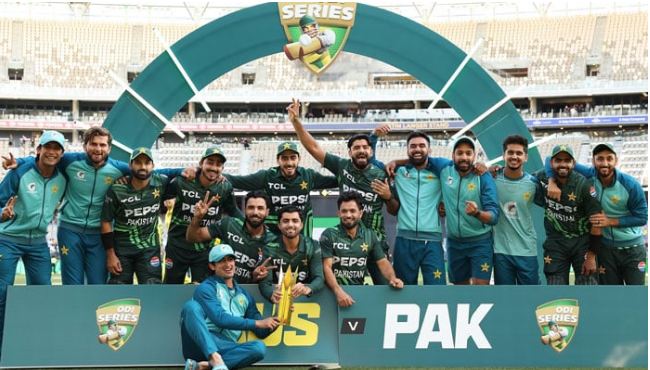
Pakistan cricket team defeated Australian team by 2-1 in ODI series and registered a historic and rare win since 2002.

UAE condemns terrorist attack at railway station in Quetta

UAE

ISLAMABAD, Nov 10 (APP):The United Arab Emirates (UAE) has strongly condemned the terrorist attack at a railway station in Quetta, which resulted in dozens of deaths and injuries to innocent civilians.

In a statement, the Ministry of Foreign Affairs affirmed that the UAE has expressed its strong condemnation of these criminal acts and its permanent rejection of all forms of violence and terrorism aimed at undermining security and stability in contravention of international law.

The Ministry expressed its sincere condolences and sympathy to the government and people of Pakistan, and to the families of the victims of this terrorist attack, as well as its wishes for a speedy recovery for all the injured.

The Consequences of Leaving Wounds Open

The Consequences of Leaving Wounds Open

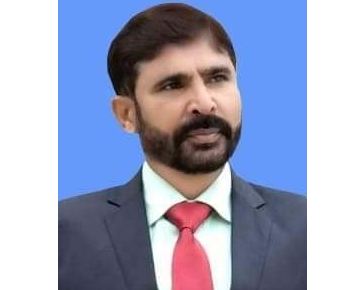
Dr. Muhammad Akram Zaheer

“If you must wound someone, it is better to kill him”The statement reflects a powerful notion regarding the nature of conflict, especially in its suggestion that merely wounding an enemy whether in or military contexts often fails to resolve tensions and may even escalate them. In this perspective, it implies that if one must strike, the strike should be decisive enough to prevent retaliation or a prolonged cycle of conflict. While the idea may sound ruthless, it offers insight into why conflicts, especially at national and global levels, often spiral when left unresolved, leading to deeper, more damaging confrontations.The principle discussed in the missive reveals a fundamental truth about cycles of revenge and violence, especially relevant to historical and modern warfare. In an historical example, Japan’s attack on Pearl Harbor was a significant strike, but not one that incapacitated the United States. Rather, it galvanized the U.S. response, ultimately leading to devastating attacks on Japan. Here, the “decisive strike” concept emerged: the U.S. did not aim to merely retaliate but to neutralize Japan’s ability to wage war. The use of atomic bombs, while morally contentious, exemplified this approach by compelling Japan’s surrender, a controversial move but one that ended years of bloody conflict and paved the way for Japan’s reconstruction as an ally. Though brutal, the tactic also reflects the argument that decisively ending conflict can spare prolonged suffering and loss on both sides, as compared to an ongoing cycle of lesser strikes.In this light, the statement seems to support the idea that decisive, if extreme, measures can bring an end to conflict in a way that prolonged, lesser actions cannot. This logic suggests that decisive actions may sometimes be employed to end a standoff and lay a foundation for future stability. A military or political conflict marked by an ongoing cycle of wounding but non-terminal blows can spiral out of control, causing even more suffering without resolution. The adversaries, rather than seeking peace, instead prepare for the next exchange, potentially becoming locked in a perpetual cycle of vengeance and escalation, each side motivated by a desire to right perceived wrongs.

This concept resonates starkly within modern conflicts such as the one between Hamas and Israel. The October 7 attack by Hamas against Israel, for example, inflicted damage and loss but was not a blow that disabled Israel’s capacity to respond. Israel, perceiving the strike as a critical threat, has since escalated its actions with a stated objective of dismantling Hamas’s ability to launch further attacks. From Israel’s perspective, leaving Hamas weakened but still capable could mean leaving an adversary who would likely retaliate. Thus, Israel’s strategy appears driven by a belief that completely neutralizing the threat is the only way to achieve lasting security a strategic, if morally ambiguous, pursuit of finality rather than a cycle of tit-for-tat aggression.However, while the principle can be seen as compelling in explaining these actions, it is morally fraught. The approach described in the missive risks endorsing an overly aggressive stance that might overlook the complex motivations of adversaries or the long-term impacts on civilians and regional stability. Many conflicts are not simply matters of neutralizing an enemy but involve complex political, historical, and cultural grievances. In a world interconnected by global relationships and bound by humanitarian norms, the idea of dealing a “final blow” can have broader repercussions, potentially breeding long-standing resentment, fostering more opposition, and causing immeasurable civilian suffering. Ending a conflict by attempting to eliminate a perceived threat might succeed in the short term, but it can also backfire, creating a new generation of adversaries motivated by the losses they endured.Furthermore, this approach does not consider scenarios where mutual respect and diplomacy might resolve underlying issues more effectively than violent measures. A purely militaristic view might dismiss the idea that former adversaries can become partners or that long-standing tensions can evolve into peaceful relationships. Decades after World War II, Japan became a close ally of the United States, a transformation not brought about solely by force but by subsequent efforts toward reconciliation, mutual respect, and economic partnerships. This perspective suggests that while decisive actions may conclude one phase of a conflict, they do not ensure sustainable peace; true peace often requires addressing the grievances, histories, and needs of those involved.

Reflecting on global dynamics today, it’s evident that many international strategies continue to be shaped by similar ideas of preemption and deterrence. States might choose decisive action over incremental wounding, fearing that a perceived “half-measure” would invite further escalation. This approach, however, remains ethically complex. While some leaders and strategists may find it pragmatic to seek finality, they must also weigh the humanitarian costs and moral considerations, particularly in an age where public opinion, international scrutiny, and diplomatic relationships profoundly affect long-term outcomes. Indeed, the principle that “killing the enemy is kinder than wounding them” assumes that wars and conflicts are inherently zero-sum games, disregarding alternatives that might foster reconciliation and avoid recurring violence.This concept is also mirrored in the responses of modern command centers worldwide, where military leaders are forced to consider not only their immediate objectives but also the potential consequences of wounding versus delivering decisive, crippling blows. In recent years, nations have escalated their approaches to warfare with advanced technology, cyber capabilities, and other means that allow them to inflict significant damage without deploying traditional military force. Such tools offer ways to strike at critical infrastructures, potentially debilitating an enemy’s ability to function without necessarily causing mass casualties. Yet, even these methods carry risks, as they might provoke further retaliation or lead to extended, disruptive conflicts without achieving conclusive peace.

Pakistan stun Australia to win first ODI series in Down Under in 22 years

Pakistan stun Australia to win first ODI series in Down Under in 22 years

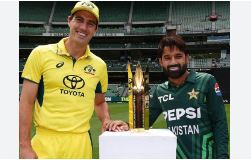
Pakistan on Sunday thumped Australia in the third and final ODI to win the three-match series — the first won by the Green Shirts on Australian soil in 22 years with the last 50-over series win coming back in 2002.

Chasing Australia’s modest 141-run target, the Men in Green eased past the victory line in 26.5 overs to bag an eight-wicket win in the series decider.

Securing their first ODI series victory in Australia in over a decade, an unchanged Pakistan restricted the hosts to 140 in 31.5 overs before mowing down the total by scoring 143-2.

Underscoring the diminished standing of the 50-over format, Australia chose to rest their red-ball players for the decider as preparations ramp up for a blockbuster five-test series against India beginning November 22.

During today’s match, Pakistani fast bowlers Shaheen Afridi and Naseem Shah led the way, picking up three wickets apiece during a showcase of swing and pace which accounted for Jake Fraser-McGurk (7) and Aaron Hardie (12) in the first powerplay.

Josh Inglis, in his captaincy debut, departed for seven after skying Naseem to keeper Mohammad Rizwan in the 11th over and opener Matt Short (22) soon followed, caught at square-leg attempting to pull in-form quick Haris Rauf (2-24).

It went from bad to worse for the hosts when a nasty blow from seamer Mohammad Hasnain to the left hand of Cooper Connolly forced the 21-year-old to retire hurt on seven and leave the venue for scans.

A jubilant Rauf found the edge of Glenn Maxwell on zero, leaving Australia reeling at 79-5.

No spin was used as the Pakistan seamers maintained the pressure and mopped up the tail. Sean Abbott top-scored with 30.

In reply, Saim Ayub (42) and Abdullah Shafique (37), fresh off half-centuries, played with fluency and controlled aggression during an 84-run opening stand.

Local speedster Lance Morris (2-24) sent both set batsmen packing in the 18th over to give the Perth crowd something to cheer about, leaving Rizwan (30) and Babar Azam (28) to seal the result.

Expressing his views on the historic win, Rizwan — who was leading the side in his first series as the team’s skipper — said: “This is a very special moment for me.”

“It is not easy to beat Australia in Australia,” remarked the captain.

Crediting the team’s fast bowlers for a remarkable performance, Rizwan also lauded openers Saim and Abdullah for giving the side a good start in both the second and third ODIs.

Meanwhile, Australian skipper Inglis lamented his team’s disappointing performance in the series.

“We have been completely outclassed in the series against Pakistan,” he said while adding that their batters failed to score runs in the second and third ODIs.

Rauf, apart from bagging the Player of the Match award for claiming three wickets today, was also awarded the Player of the Series award for dismissing 10 Australian batters in the series.

“Before the series, the bowlers had made a plan which they followed,” said the pacer.

Saim, on the other hand, emerged as the top run-scorer with 125 runs to his name.

The left-handed batter scored 82 and 42 runs in the second and third ODIs, respectively.

Stay Connected

64FansLike
60FollowersFollow

Latest Reviews

Exchange Rates

USD - United States Dollar
EUR
1.18
GBP
1.36
AUD
0.73
CAD
0.73