Home Blog Page 737

Pakistan activates crisis management unit to support citizens in Syria

Pakistan activates crisis management unit to support citizens in Syria

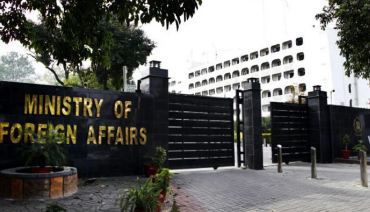
ISLAMABAD, DEC 7 /DNA/ – In view of the ongoing developments and evolving situation in Syria, the Ministry of Foreign Affairs has activated its Crisis Management Unit to facilitate Pakistanis in Syria.  

Pakistani nationals in Syria and their families are encouraged to contact the CMU at the following telephone/Email:

Phone No:
          051-9207887

Email: 
          [email protected]

Meanwhile the Pakistan Embassy in Damascus remains actively engaged to facilitate Pakistani nationals in Syria.

Contact details of the Embassy of Pakistan, Damascus

Cell/Whatsapp: 
         +963 987 127 822
         +963 990 138 972

Email: 
         [email protected]

A Nation Between the Mountain and the Sands

Qamar Bashir

By: Qamar Bashir

Macomb, Detroit, Michigan

During our youth in Quetta, we were a vibrant group of energetic souls who found solace and adventure in the embrace of the rugged mountains that surround the city. Every weekend, we set out to conquer a new peak, guided by our trainer, Ibrar Hussain Shah—a Hazara boxer of international acclaim. Before every climb, Ibrar would share invaluable lessons, instilling in us the wisdom necessary for survival and success in the unforgiving terrain.

I still remember one of his most profound teachings. He would say, “Never fight the mountain—it will kill you. Do not sprint on its slopes; it will drain your energy. Do not test your endurance against the mountain, for it will always outlast you. Respect the mountain’s mood. If it is angry, stay away. It will crush you by shifting the earth beneath your feet, unleash avalanches upon you, drown you in relentless rains, or disorient your mind to lead you to certain death.”

In this scenario, PTI is the mountain—steadfast, enduring, and rooted in public support, shaped by years of resilience and determination. In contrast, the opposing entities—political parties, the government, and the bureaucracy—are like shifting sands, transient and unstable. Their attempts to challenge the mountain may create temporary disruptions, but they lack the solidity to displace it. Like a passing sandstorm, their efforts may obscure the view for a moment, but the mountain remains unshaken, defining the landscape long after the winds die down.

At the start of my professional life, I developed a deep love for reading about some of the most phenomenal personalities in human history. Among them, none impacted mankind more profoundly than our beloved Prophet Muhammad (Peace Be Upon Him), who transformed the course of human history in a way unparalleled by anyone else. His entire life offers lessons for humanity, but one episode particularly resonates with Pakistan’s current scenario: the forced exile of the Prophet (PBUH) and his followers to Sha’ib Abi Talib. The demand was simple: cease preaching the message of one Allah and stop rejecting the idols. Despite the promise of luxurious lives, the Prophet and his followers stood firm in their faith, enduring untold hardships. Ultimately, the Meccans, exhausted and unable to break their resolve, lifted the embargo.

During this period, I also fell in love with reading autobiographies of individuals who significantly shaped human history. Among them, Nelson Mandela deeply inspired me. Mandela spent 27 years in prison, enduring immense suffering, yet he stood resolutely against the apartheid regime in South Africa. His steadfastness ultimately led to the collapse of the powerful white ruling elite, who crumbled before his courage like dry bread.

In Pakistan’s history, the example of Sheikh Mujibur Rahman stands out. Mujib championed the principles and rights dear to the people of East Pakistan (now Bangladesh). Despite facing military dictatorships armed with tanks, cannons, and an entire army of over 100,000 soldiers, Mujib and the unarmed civilians of East Pakistan demonstrated unmatched determination. Their courage ultimately led to one of the most humiliating defeats in military history for Pakistan during the 1971 war. The Hamoodur Rahman Commission Report on the East Pakistan debacle candidly stated that it would have been more honorable for the Pakistan Army to embrace martyrdom while fighting bravely rather than surrendering in cowardice to the “worshippers of idols.”

History offers various examples of heroic conduct even under incarceration. One notable example is Zulfiqar Ali Bhutto, who was executed by the regime of a ruthless military dictator, General Zia-ul-Haq, following a controversial and widely criticized judicial trial. Despite facing immense pressure and the looming threat of death, Bhutto did not plead for mercy, maintaining his dignity until the end.

On the other hand, we have examples of political figures like Nawaz Sharif, Shahbaz Sharif, Ishaq Dar, and Maryam Nawaz, who, while branding themselves as Pakistan’s ruling elite, have demonstrated a different kind of resilience. These businesspeople-turned-politicians, often styled themselves as a “ruling family,” have perfected the art of avoiding prolonged incarceration by abandoning their followers, compromising their positions, or seeking refuge in foreign lands when the political tides turn against them. They have transferred vast amounts of wealth—accumulated through both fair and questionable means—to foreign accounts and constructed luxurious sanctuaries abroad. From these comfortable abodes, they wait patiently for a favorable political climate, orchestrating deals, hatching conspiracies, and ensuring their return to power. Once the stage is set, they return, repeat the cycle of rule and accumulation, and retreat again when ousted.

Today, however, Pakistan finds itself witnessing an unprecedented scenario. For the first time in its history, the entirety of the political spectrum, civil and military bureaucracy, and state apparatus has united against a single individual, Prisoner 804. Despite the deployment of the state’s brutal machinery, funded by the hard-earned tax money of Pakistan’s people, this man remains unbroken. Instead, his resolve strengthens with every passing day, while the forces aligned against him appear to weaken, their unity unraveling as they struggle to maintain control.

This time is different, as though a political government exists, it has been reduced to a mere showpiece, with real authority lying elsewhere. Much like the situation in East Pakistan in 1971, the army has directly pitted itself against Prisoner 804 and his followers across the country. For the first time since that tragic chapter in Pakistan’s history, the army faces widespread resentment, not just from one province or group, but across the entire nation. From the Baloch to the Pashtuns, Punjabis, Swatis, Kashmiris, and even the residents of Islamabad, there is a growing sentiment of alienation and anger against the military establishment.

This situation is profoundly alarming for all patriotic Pakistanis. The defenders of the nation—who were nurtured and sustained by the sacrifices of citizens, who diverted their hard-earned incomes to support a military they believed would protect them from external threats—now view their own people as adversaries. The guns that were meant to guard against external enemies are now turned inward, threatening the very fabric of the nation.

This perilous path should prompt introspection. When the constitution is disregarded, lawmakers are treated as puppets, genuine representatives of the people are jailed, and the defenders of the nation turn their might against their own citizens, the result is the transformation of a once-formidable institution into shifting sand. Like the tragedy of East Pakistan, where the people’s will was ignored, and their demands for autonomy were suppressed with force, history risks repeating itself. Such actions create the illusion of strength, but as history has shown, a mountain cannot be toppled by shifting sand. Unless the lessons of the past are heeded, the nation may once again face a devastating outcome.

By: Qamar Bashir

Press Secretary to the President (Rtd)

Former Press Minister at Embassy of Pakistan to France

Former MD, SRBC

Macomb, Detroit, Michigan

‘Do your freaking job’: S. Korean protesters frustrated by failing impeachment vote

'Do your freaking job': S. Korean protesters frustrated by failing impeachment vote

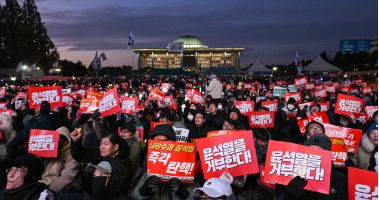
SEOUL, DEC 7 (AFP/APP/DNA): Gasps of frustration. Shouts of rage. Tears. Many of the tens of thousands of protesters outside South Korea’s parliament were overcome with emotion Saturday, as a presidential impeachment motion looked set to fail.

                  Nearly 150,000 people were estimated by police to have filled the streets around the National Assembly on Saturday, demanding that lawmakers impeach President Yoon Suk Yeol for his shocking imposition of martial law four days earlier, which plunged democratic South Korea into turmoil.

                  For hours, people poured into the area around parliament where on Tuesday night soldiers were helicoptered in as part of Yoon’s short-lived bid to subvert civilian rule.

                  Ahead of the vote on the opposition-led impeachment motion, giant screens to show parliament livefeeds were set up across the eight-lane road by the National Assembly, which had been closed off to serve as a rally site.

                  Many protesters held banners saying: “impeach Yoon” and “insurrection criminal” and sang songs with lyrics such as “South Korea is a democratic Republic”.

                  The atmosphere was festival-like, with some people bringing small children, or coming in large groups, with jaunty music punctuated by anti-Yoon chants.

                  But as MPs formally opened a session to determine Yoon’s fate, the vast crowd fell silent, fixated on every move of the lawmakers.

                  A gasp of disappointment rippled through the crowd when a special probe bill to investigate suspicions surrounding First Lady Kim Keon Hee was struck down.

                  Of the 300 MPs, 198 voted in favour of the probe — only two shy of the 200 needed.

                  Signs of frustration became more visible as ruling People Power Party MPs began leaving the main chamber to boycott the impeachment motion, which also required 200 votes to remove Yoon from office.

                  “I feel terrible that it has come to this today,” said An Jun-cheol, 24, at the rally.

                  “What the ruling party lawmakers did today — walking away from the vote — is nothing more than an attempt to cement their power and status, with no regard for the people.”

                  But An was resolute, saying he would keep attending the rallies until Yoon was impeached.

                  “I am sure more people will come here for the next vote,” he said.

                  Jo Ah-gyeong, a 30-year-old from Seoul, shared his determination.

                  “I’m neither discouraged nor disappointed,” she told AFP, despite the apparent failure to secure enough votes to impeach Yoon.

                  “Because we’ll get it eventually. I’ll keep coming here until we do.”

                  And she had a message for ruling party lawmakers: “Please do your freaking job.”

                  Four days after the martial law declaration, a sign of the event remains at the National Assembly. A white paper taped to one of its gates reads: “This is the gate which the Assembly Speaker climbed over to vote down the martial law.”

Italian Navy Ship Amerigo Vespucci visits Karachi

Italian Navy Ship Amerigo Vespucci visits Karachi

KARACHI, 7 DEC /DNA/ – Italian Navy’s sailing and training ship, ITS Amerigo Vespucci, arrived at Karachi Port for a three-day goodwill visit as part of its global voyage.

Upon arrival, the ship was warmly received by officials from Pakistan Navy, Italian Navy, and Italian Ambassador to Pakistan, H.E. MarilinaArmellin.

This inaugural visit of ITS Amerigo Vespucci to Pakistan, along with the third consecutive visit of Italian Navy ships to Karachi in the past two months, underscores the strengthening Pak-Italian relations in general and the growing bilateral cooperation between the two navies in particular.

Pakistan Navy remains committed to enhancing bilateral cooperation with regional and extra-regional navies, fostering global partnerships, and ensuring a lawful maritime order.

Hunza Serena Hotel: Luxury you Deserve

Hunza Serena Hotel: Luxury you Deserve

Munaza Kazmi

Only the frequent traveler would have heard Karimabad, but don’t worry today I will be your travel guide and telling my readers about Karimabad. Known as Baltit in ancient times, when it serves as the center point of Hunza Valley, positioned high above on a hill top overlooking the valley, with the majestic Baltit Fort seems like guarding the whole valley, which was formerly the palace of then Raja.

However, today Karimabad is like a small tributary in the channel of big waters,but the glam never lost. With the passage of time, it became a celebrated tourist attraction, from across the globe travelers started flying to witness the magic of snow-clad mountains, gorgeous views, and to hear the tales of Rajas and the Baltit Fort, then sooner the town got filled with trinket shops, pottery work, handicraft and some famous traditional cuisine, as well as luxury hotels.

Suppose you are in the stunning valley, hiking, boating and walking all day in the paradise, then off-course you should deserve a comfortable, noiseless good sleep, which I believe cannot be found in a road side motel. Hence, wherever I go, first I search for the best hotel there for a safe, comfortable and relaxing holiday.

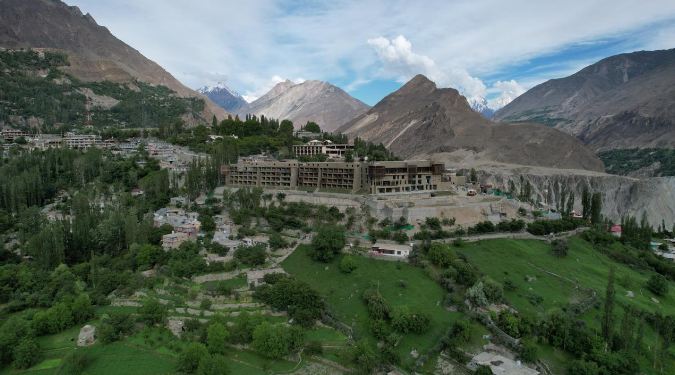
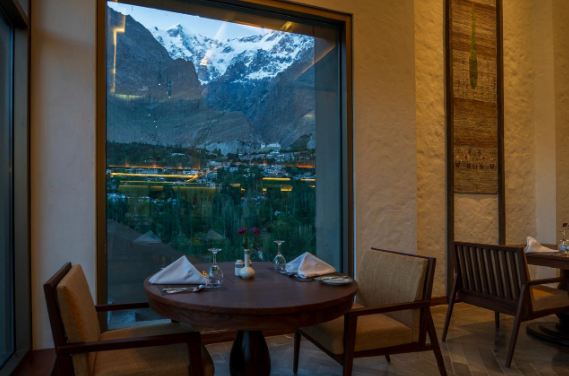
Nestled in the middle of Karimabad, Hunza, Pakistan, Hunza Serena Hotel a newly built hotel of Tourism Promotion Service, is a 5-star hotel towering against the majestic background of breathtaking peaks. Standing pompously on a hilltop, hence it can be seen from quiet a long distance, just at the base of mountain and a little above the valley, in between.

Further, the hotel is situated in the close proximity of the market and on a 20-15 minutes walking distance from the Baltit Fort which making is such a prize, since when I was staying there I took the liberty of going all the way to the fort by crossing the colorful bazaar which took me back to the tales of Rajas, the ancient shops, the old houses and the smell of freshly baked buns energizing the whole setting.

For reaching Hunza Serena Hotel, in case you have are coming of flight, it is approximately 2:3O hour drive from Gilgit Airport, but it’s my guarantee those 2 hours will fly, since you’ll all be occupied in witnessing the wonders of nature and the ancient works of man, don’t forget to stop by The Silk Road.

Arriving at the hotel, you can select from a range of accommodation, however it’s better to book in advance. But for your information, in total there are 82 Rooms, of which 76 are Deluxe Rooms, 4 Executive Suites, and 2 Heritage Suites. Deluxe Room features contemporary comfort with the mesmerizing views of the valley below. Executive Suiteprovide extra space with stunning views of peaks, while Heritage Suite blend traditional charm with modern amenities, reflecting the region’s cultural essence, on my stay I booked Executive Suite, from whose balcony it was the unhindered scene of Baltit Fort, among the gigantic show of snow laden peaks. Moreover, every room is equipped with Safe Locker, Mini Bar, Telephone, Internet, Television and all the modern-day facilities. Further, as a safety precaution, the fabric used for making curtains is made with such an advance engineering that it is Fire Resistant. Beside of every room the look is magnificent, ultimate luxury.

For Dining there comes 4 restaurants, MarakaResurant, Karighar Lounge, Chatak and Rakaposhi Café. MarakaResturant, is all day dining, serving a variety of delicacies from all across Pakistan along few traditional and international dishes. However, the restaurant took its name from the Burushaki language meaning “Gathering”. Karighar Lounge, if you are my loyal reader, you must have known about Karighar, since I penned a complete article on it, however for new comers Karighar is Serena Hotel’s project for empowering the communities, where Hotel aid, teaches and train local people in honey making practices and how to adore a fabric means embroidery and stitching. Hence, this lounge is dedicated to it, where you can sit in the comfort of locally made sofas while devouring on snacks and can buy a gift for your loved ones from the Karighar Gift Shop. Next comes,Chatak Caféwhich is snack bar with an exquisite covered sitting lounge and an open area, this cafe also derived its name from the Burushaki language meaning “Seating Place” and Rakaposhi Café,a standard restaurant, which you will find in all the Serena properties in Pakistan, serving A la Carte Menu. Beside you can avail the option of Room Service and enjoy food in the comfort of room.

Beside this there is a Banquet Hall, with the name of Dilshan, and Meeting Rooms for conferences and seminars, in addition to the Maisha Spa and Health Club, where you can do workout in a well-equipped Gym, Swim in the heat control pool surrounded by the lush valley and towering peaks, Spa, Sauna and Salon to unwind and pamper yourself.

Further, in the hotel there are Gardens, with fruit bearing trees of excellent quality, red apples were my favorite among them, in addition to palm size roses and jasmine scenting the air. I believe it is enough of the story telling, thank you me and pack your bag for Hunza Serena Hotel.

27th Convocation Ceremony of Bahria University held in Islamabad

27th Convocation Ceremony of Bahria University held in Islamabad

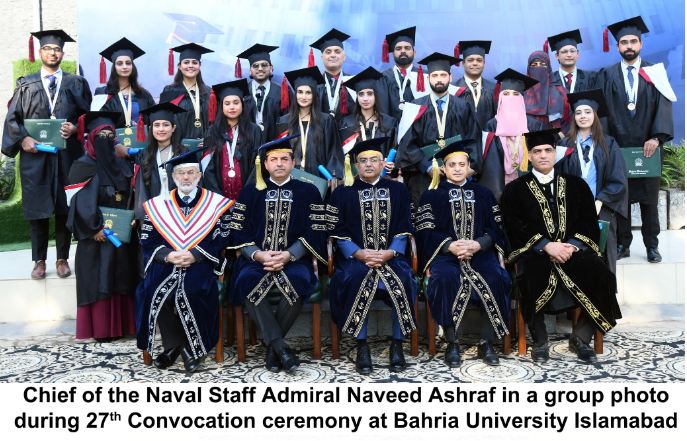
ISLAMABAD, DEC 7 /DNA/ – Bahria University Islamabad held its 27th Convocation Ceremony. Chief of the Naval Staff Admiral Naveed Ashraf, Pro-Chancellor Bahria University, graced the occasion as the Chief Guest and conferred degrees to the graduating students.

During the convocation over 1300 graduates were awarded degrees across various disciplines. A total of 103 graduates received gold and silver medals in recognition of their exceptional achievements.

While addressing the ceremony, Chief of the Naval Staff congratulated the graduates and their families on their well-deserved success. He urged the graduates to uphold values of discipline, ethics and service by contributing positively to society. He reaffirmed Bahria University’s commitment to achieve the pinnacle in academic excellence with proactive response to the competitive higher education landscape.

Earlier in welcome address, Rector Bahria University Vice Admiral Asif Khaliq (Retd) highlighted the academic achievements of the students and the importance of their future professional contributions.=DNA

=========

Six soldiers martyred, 22militants killed in IBO in tank district: ISPR

Six soldiers martyred, nine militants killed in IBO in tank district: ISPR

RAWALPINDI, DC 7 /DNA/ – On 6-7 December 2024, twenty two Khwarij were sent to hell in three separate engagements in Khyber Pakhtunkhwa Province.

An intelligence based operation was conducted by the Security Forces in general area Gul Imam, Tank District on reported presence of khwarij. During the conduct of operation, own troops effectively engaged the khwarij location and resultantly, nine Khwarij were sent to hell, while six got injured.

In another operation, conducted by the Security Forces in North Waziristan District, ten Khwarij were successfully neutralized.

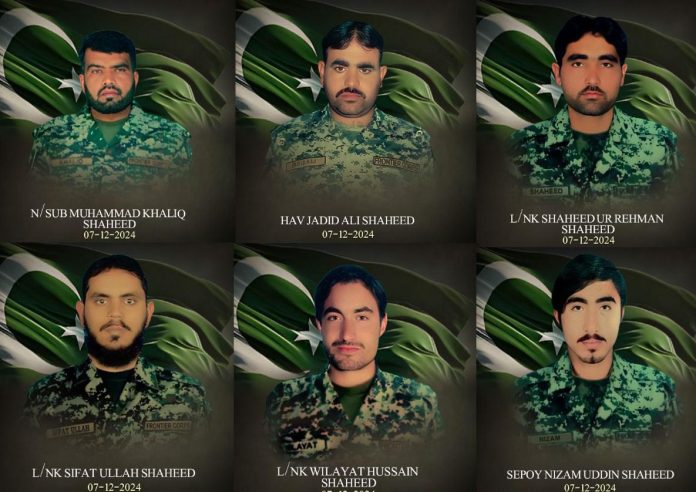
In a third encounter, security forces thwarted Khwarij attempt to attack a security forces’ post in Thall District and killed three khwarij, however, during the intense fire exchange, six brave sons of soil, having fought gallantly, paid the ultimate sacrifice and embraced Shahadat.

Sanitization operations are being conducted to eliminate any other Kharji found in the area as Security Forces of Pakistan are determined to wipe-out the menace of terrorism and such sacrifices of our brave soldiers further strengthen our resolve.=DNA

============

Embracing Enlightenment for Pakistan’s Future

Embracing Enlightenment for Pakistan’s Future

Muhammad Irfan

In modern world, European nations are the foundations of economic strength and intellectual advancement, having established societies that encourage scientific progress, critical thinking, and economic development. Despite its rich intellectual history, the Islamic world is behind in both economic and intellectual development. By examining the past, we can understand how nations flourished when they valued knowledge, innovation, and open discourse, while other nations struggled to do so when these values were disregarded. Revising these historical patterns can reveal the secrets of what is possible and what we should learn from this.Around75 thousands years ago, the development of language was a major and transformational milestone for Homo sapiens, marking a major leap in human evolution. Language enabled early humans to communicate complex ideas, share knowledge, and collaborate in ways that weren’t possible before. This capacity to share abstract concepts and coordinate efforts allowed humans to develop social structures and pass down cultural knowledge across generations. Once humans could communicate more effectively, they began forming larger, more complex social groups, leading to the emergence of early forms of community and society. With a shared language, they could now plan, divide tasks, and establish norms that strengthened their social bonds. These social developments set the stage for organized societies and civilizations.

Approximately 10,000 years ago, the Agricultural Revolution fundamentally transformed human societies, as humans Start domesticate plants and animals, they shifted from a nomadic lifestyle of hunting and gathering to settled communities centred around agriculture. This shift enabled them to produce surplus food, which allowed populations to grow and led to the establishment of the first permanent settlements and cities. The surplus created by agriculture gave rise to the first known civilizations, such as Mesopotamia in the Fertile Crescent, Egypt along the Nile, the Indus Valley Civilization, and ancient China along the Yellow River. These civilizations developed sophisticated social, political, and religious structures. Writing systems, such as cuneiform in Mesopotamia and hieroglyphics in Egypt, emerged as ways to document agricultural yields, manage trade, and maintain records further enhancing communication and organization within these societies.In essence, the invention of language, the agricultural revolution, and the development of early societies were key steps that laid the foundation for civilizations. Language sparked collaboration, agriculture allowed for settled societies, and these societies grew into civilizations characterized by complex systems of governance, trade, and culture. These developments not only shaped human history but also laid the groundwork for future intellectual revolutions, such as the Golden Age of Muslim society and the later Renaissance and Industrial Revolution in Europe.

The first era of human enlightenment began with the Agricultural Revolution, marking the start of Homo sapiens’ intellectual evolution and laying the foundation for early societies. This revolution led to organized communities, sparking growth in science and the arts. The second major era of enlightenment took off with Gutenberg’s invention of the printing press in 1440, which enabled the mass production of books. Knowledge and ideas could now spread widely, fuelling a cultural Renaissance in Europe centred on science, reason, and philosophy.This Renaissance birthed modern secular and democratic principles, grounding societies in ideas of individual freedom and rational governance. The emphasis on intellectual freedom led to ground breaking scientific discoveries and ultimately laid the foundation for the Industrial Revolution, giving Europe its global economic and technological power.The intellectual foundation for Europe`s transformation was laid by philosophers like Francis Bacon, John Locke, and Immanuel Kant. Voltaire and Rousseau established the foundation for secularism, liberal democracy, and intellectual freedom. The Enlightenment was a result of these ideas, which directly challenged the strict authority of religious authorities and advocated for the separation of church and state. Intellectual freedom during this period was encouraged, which led to new discoveries of science, philosophical developments and revolutions. Humanity’s understanding of the natural world underwent significant changes due to pioneering contributions from scientists such as Galileo Galili, Isaac Newton, and Copernicus. These changes reached a peak during the Industrial Revolution of the 18th and 19th centuries. The industrialization of Europe was driven by technological innovations such as the steam engine, the spinning jenny, and the mechanical loom, which resulted in a transition from an agrarian economy to a production-oriented, mechanized production environment. This industrial power enabled European nations to produce goods on a large scale, manufacture modern weapons, and develop transportation systems such as railroads and steamships.

            On the other hand, the decline of the Islamic Golden Age (later known as the “Golden Age”) from the 8th to 13th centuries was marked by a major shift in intellectualism and scientific endeavor in the Islamic world. This period was marked by the ground breaking contributions of scholars such as al-Khwarizmi, Avicenna (Ibn Sina), and Al-Farabi in mathematics, medicine, philosophy, and astronomy. Islam became a center of learning, inspiring intellectual curiosity and innovations that had an impact on both the East and the West. Intellectual stagnation and critical thinking persisted for centuries, despite the decline of the golden age of innovation in the 14th century. The rise of religious orthodoxy and the influence of scholars like Imam Al-Ghazali, who criticized certain elements of Greek philosophy and mathematics as not in line with Islamic teachings, were instrumental in this decline.Another significant factor was the rejection of technological innovations such as the printing press. While European societies embraced the press after Gutenberg’s invention in 1440, using it to disseminate knowledge widely and fuel the Renaissance, many Muslim societies viewed it with suspicion. The printing press was initially prohibited in several Muslim regions, as religious authorities were concerned it could spread ideas contrary to religious doctrine. This restriction stifled the spread of new ideas and knowledge within the Islamic world, whereas Europe was rapidly advancing through science and critical thinking.The arrival of colonial powers in the Muslim world in later centuries further deepened this intellectual and economic decline. European nations exploited the region’s resources, imposed foreign governance systems, and disrupted traditional social structures. The exploitation of resources, combined with economic dependency, left these societies economically weakened and politically fractured. The impact of these two paths was profound. Europe’s embrace of intellectual freedom, scientific exploration, and technological advancement propelled it to a dominant position in the world, shaping modern history. Meanwhile, Muslim societies, constrained by restrictions on knowledge and innovation, were left vulnerable to colonialism and unable to compete with Europe’s industrial and military prowess. This historical divergence highlights the importance of fostering an environment of open inquiry and innovation—lessons that remain relevant for societies today.For Pakistan, the lessons of history are clear, to build a strong and resilient nation, it must embrace critical thinking, intellectual growth, and rational thought. The decline of the Muslim Golden Age, marked by a shift away from scientific inquiry and intellectual openness.Investing in education, particularly in the fields of science, technology, engineering, and mathematics (STEM), is a vital starting point. Introducing critical thinking as a core component of the educational curriculum can empower students to question, innovate, and solve real-world problems. Pakistan must also work to promote freedom of thought, protect intellectuals, and create policies that support research and development.In the modern world, a nation’s strength lies not just in economic resources but in intellectual capital. Pakistan’s potential for growth is immense; however, only by embracing a new age of enlightenment based on rational thinking, tolerance, and innovation can it overcome its historical challenges and emerge as a powerful, self-reliant nation on the global stage.

Muhammad Irfan

[email protected]

JICA celebrates 70 years of official development assistance with Pakistan

JICA celebrates 70 years of official development assistance with Pakistan
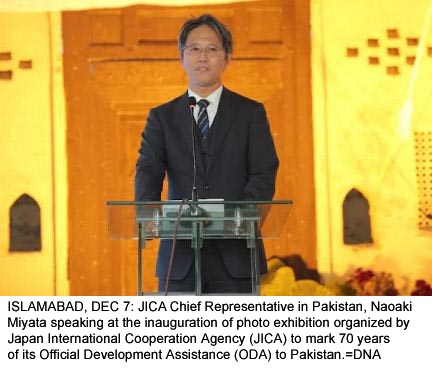
ISLAMABAD, DEC 7: JICA Chief Representative in Pakistan, Naoaki Miyata speaking at the inauguration of photo exhibition organized by Japan International Cooperation Agency (JICA) to mark 70 years of its Official Development Assistance (ODA) to Pakistan.=DNA

Mahnoor Ansar

ISLAMABAD, DEC 7 /DNA/ – The Japan International Cooperation Agency (JICA) proudly commemorated 70 years of its Official Development Assistance (ODA) to Pakistan, a milestone marked by a captivating photo exhibition showcasing the positive impact of various projects across the country. The exhibition, held in the heart of Islamabad, brings together prestigious guests, including government officials, development partners, and key stakeholders, to celebrate this significant achievement.

Since Japan initiated ODA in 1954 by receiving trainees from Pakistan, JICA has been committed to fostering sustainable development in Pakistan through diverse initiatives such as education, health, and disaster management, and infrastructure such as road and electricity network. The photo exhibition highlights the successful JICA’s projects, featuring compelling visuals that capture the dedication and joy of communities that have benefited from this long-standing partnership.

At the inauguration of the exhibition, JICA’s Chief Representative in Pakistan, Mr. Naoaki Miyata., addressed ” Building reciprocal relationships through continuous dialogues with partner countries to create solutions is a strong tradition of Japan’s cooperation.  By leveraging the tradition, JICA is ready to advance co-creation among stakeholders for a better future of Pakistan”.    

Also Chargé d’ Affaires of Embassy of Japan, Shuichi Takano stated “We would like to create our social values together, through dialogue and cooperation. Japan will continue to collaborate with Pakistan in realizing its vast potential.”.

The event showcases photographs from various successful projects. Each image tells a story of partnership, highlighting the shared commitment to improving the quality of life for millions of Pakistanis.

Distinguished guests at the exhibition included Secretary of Ministry of Economic Affairs, Dr. Kazim Niaz, who emphasized the importance of continued collaboration and innovation in tackling Pakistan’s development challenges. Their presence not only underscores the significance of JICA’s efforts but also reaffirms the enduring friendship between Japan and Pakistan.

The exhibition will remain open to the public until 8th of December 2024 from 10 am to 4 pm at white gallery in Lok Virsa, Islamabad, allowing visitors to immerse themselves in the rich history of JICA’s contributions to Pakistan and to inspire future generations to engage in development efforts.=DNA

The Militarization of the South China Sea

The Militarization of the South China Sea

Muhammad Wali Jan

The South China Sea is a vital region for international trade, maritime security and resource exploitation, yet it remains one of the most contentious geopolitical hotspots in the world. The competing territorial claims involving China, the Philippines, Vietnam, Malaysia, Brunei, and Taiwan have escalated tensions in recent decades, particularly due to China’s assertive policies. As a regional organization committed to maintaining peace and stability, the Association of Southeast Asian Nations (ASEAN) faces enormous challenges in dealing these disputes. The increasing militarization of the South China Sea, involving not only regional actors but also global powers, has further Hampered  ASEAN’s ability to act as a unified entity.The origins of the South China Sea Disputes are deeply rooted in historical claims and strategic interests. China’s assertion of its “Nine-Dash Line” overlaps with maritime zones claimed by ASEAN member states,leading to Rivalries involving sovereignty and and resource rights. Although an international tribunal ruled in favor of the Philippines in 2016, China has continued to militarize the region by constructing artificial islands equipped with military infrastructure. These actions have disturb the balance of power in Southeast Asia, Invoking reactions fromexternal actors like the United States, which seeks to challenge China’s dominance through Freedom of Navigation Operations.ASEANhas a central role in managing the South China Sea disputes but fraught with difficulties. The organization functions based on consensus and non-interference principles, which, while fostering inclusivity, also complicate decision-making on contentious issues. Member states have diverse standpoint on the South China Sea due to their unique geopolitical and economic interests. Claimant states such as Vietnam and the Philippines view China’s activities as  threat to their sovereignty and often seek external alliances to counterbalance China. Contrariwise, non-claimant states like Cambodia and Laos, which rely heavily on Chinese investments, seeks to align with Beijing, even at the expense of ASEAN’s collective position.The militarization of the South China Sea magnify these divisions. China’s deployment of military assets in the region highlight its dominance, while the United States’ strategic presence through naval operations and alliances with regional actors adds to the complexity. Other powers, including Japan, Australia, and India, Have become involvedin the fray, supporting maritime security initiatives that further militarize the region. This foreign involvement, while aimed at maintaining a rules-based order, often make deeper internal divisions within ASEAN, as member states are pressured to align with rival powers.The implications for ASEAN’s unity are Substantial. The inability to form a cohesive stance undermines the ASEAN’s credibility and Undermines its potentialin negotiations with China over a Code of Conduct for the South China Sea. Furthermore, the disintegration shifts ASEAN’s focus from economic and developmental priorities to managing external security pressures. Without a united front, ASEAN risks marginalization in shaping the region’s strategic landscape, potentially allowing foreign powers to dominate its regional affairs.To address these challenges, ASEAN must strengthen its internal integration and strategic autonomy. This requires focusing on collective diplomacy over bilateral negotiations that often undermine regional solidarity. Economic diversification is also significant to lower dependency on China, which exerts significant influence over certain member states. Increasing regional defense cooperation among ASEAN member states  can provide a balanced response to militarization without heavily relying on external powers. Furthermore, ASEAN should leverage international legal frameworks, such as the United Nations Convention on the Law of the Sea (UNCLOS), to advocate for peaceful conflict resolution and sustain the region’s stability.The militarization of the South China Sea presents a critical challenges for ASEAN’s unity and its role in regional diplomacy. The bloc must navigate complexity of  geopolitical dynamics with a focus on consensus and integrated action. By adopting a balanced approach that avoids involvement in great power rivalries, ASEAN can maintain its relevance and contribute to a stable and peaceful Southeast Asia.

Muhammad Wali Jan

Student of International Relations at NUML Islamabad

[email protected]

Stay Connected

64FansLike
60FollowersFollow

Latest Reviews

Exchange Rates

USD - United States Dollar
EUR
1.18
GBP
1.36
AUD
0.72
CAD
0.73