Home Blog Page 722

Diplomatic Football League Season 8 kicked off in Islamabad

Diplomatic Football League Season 8 kicked off in Islamabad

DNA

ISLAMABAD: The Season 8 of the Gerry’s Diplomatic Football League is marking a vibrant start with some thrilling matches. A total of 18 teams are competing in the league, divided into two groups, battling through the league stage to secure spots in the knockout rounds. In Group B, MOFA, Big Bird, and Central Asia United are leading the pack with six points each, showcasing strong early performances.

Meanwhile, in Group A, Trio Homes and Nigeria are setting the pace as group leaders. The league has attracted the diplomatic community in Islamabad where more than 25 different nationalities are participating, with approximately 280 players contributing to the international camaraderie and competitive spirit.

Matches are being hosted at Iqra University, the official venue partner for the tournament. The event will culminate in a grand finale at the end of February next year. The league is proudly title-sponsored by Gerry’s and powered by RBS, with additional sponsorship from Trio Homes, Jupi Media and Tours, Joma, and Alamco Duty-Free.

The event is organized by its founder, Mubasher Sanjrani, CEO of Sanjrani Oxen Enterprises, who is also participating in the league as a representative of Joma United.

The league continues to be a platform for fostering international relations, sportsmanship, and community engagement. The Diplomatic Football League has undoubtedly established itself as one of the most renowned and highly anticipated events among diplomats in Pakistan.

Its growing popularity not only highlights the enthusiasm for sports within the diplomatic community but also serves as a testament to the friendly and peaceful image of Pakistan.

The Diplomatic league fosters unity, mutual respect, and cultural exchange, showcasing Pakistan as a welcoming host and a hub for international camaraderie. Events like these underline the country’s commitment to diplomacy through sports and strengthen its position as a promoter of global peace and cooperation.

Khawarij-Afghan Taliban ‘joint infiltration attempt’ on border foiled

Khawarij-Afghan Taliban 'joint infiltration attempt' on border foiled

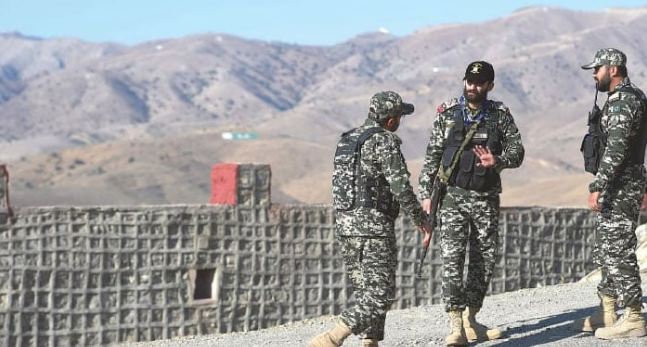
RAWALPINDI: Security forces successfully thwarted an attempted infiltration and retaliated decisively against a cross-border attack by militants in the Kurram and North Waziristan regions, security sources told Geo News on Saturday.

According to security sources, a group of 20 to 25 khawarij, in coordination with the Afghan Taliban, launched an unprovoked attack on Pakistani posts using heavy weaponry this morning.

In a swift and effective response, Pakistani forces not only neutralised the infiltration attempt but also delivered a strong counterattack.

Reports claim that over 15 militants, including Afghan Taliban members, were killed, with many others injured. The operation forced the Afghan Taliban to abandon six posts along the border, incurring heavy losses on their side.

Initial reports suggest significant damage on the Afghan side, with further casualties likely. Despite the intensity of the exchange, Pakistan’s security forces reported no fatalities and only three injuries.

The development comes against the backdrop of increased terrorist attacks inside Pakistan since the interim Afghan Taliban-led administration came to the helm in Kabul.

Terrorist attacks have been rampant in the provinces of KP and Balochistan — which abut Afghanistan — targeting especially the law enforcers and security forces.

Islamabad has time again urged Kabul to not allow its territory to be used by terrorist groups to carry out attacks against Pakistan.

“We desire good ties with them (Kabul) but TTP should be stopped from killing our innocent people [….] This is our red line,” Prime Minister Shehbaz Sharif said in a cabinet address on Friday.

The diplomatic effort is coupled with ongoing kinetic action against terrorists by security forces who eliminated 13 terrorists in three KP operations earlier this week.

A day before that, forces had gunned down 13 terrorists during an intelligence-based operation in South Waziristan.

The third quarter of 2024 (July-September) witnessed a sharp uptick in fatalities in terrorist violence and counter-terrorism campaigns with a 90% surge in violence, according to a report issued by the Centre for Research and Security Studies (CRSS).

A total of 722 people were killed, including civilians, security personnel, and outlaws, while 615 others were wounded in as many as 328 incidents recorded during the period under review.

Nearly 97% of these fatalities occurred in KP and Balochistan — marking the highest percentage in a decade, and over 92% of these incidents of terror attacks and security forces’ operations were recorded in the same provinces.

In 2024 alone, the military has reported 383 soldiers and 925 militants killed in various clashes.

Pak vs SA: Third day of Centurion Test delayed due to rain

Pak vs SA: Third day of Centurion Test delayed due to rain

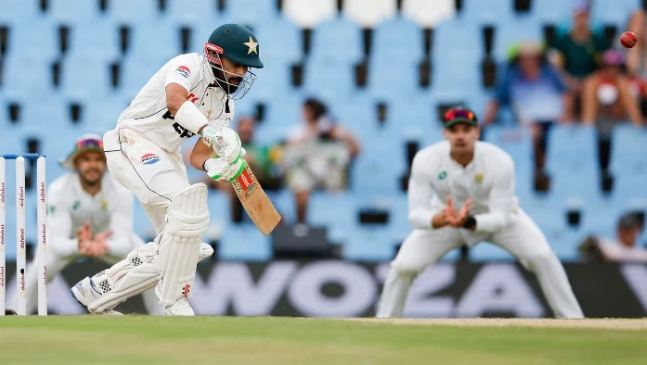
CENTURION: Rain played spoilsport on Saturday as the third day of the ongoing first Test between Pakistan and South Africa at the SuperSport Park has been delayed.

If the rain subsides, Pakistan will be resuming the third day on 88 for three, with star batters Babar Azam and Saud Shakeel at 16 and eight, respectively.

It is pertinent to mention that Pakistan is just two runs short of erasing South Africa’s first innings lead of 90 runs.

Notably, South Africa would qualify for next year’s World Test Championship final for the first time with a victory in either match of this two-Test series.

Earlier on the second day, Pakistan’s top-order struggled, losing three wickets early.

The left-handed batter Saim Ayub was sent back to the pavilion for 27 after a promising start, falling to Kagiso Rabada with the score of 49.

Followed by skipper Shan Masood, who scored 28 runs before Tristan Stubbs caught the catch when Marco Jansen delivered third ball of the 16th over.

Kamran Ghulam, who smashed 54 runs in the first innings, was dismissed for four runs in the second phase after Jansen struck again, leaving Pakistan tattering at 74/3.

Proteas capitalised in the first innings by posting 301 runs in response to Pakistan’s total of 211, securing a 90-run lead.

Reflecting on the conditions, Aiden Markram said it was a typical Centurion pitch, providing assistance for the fast bowlers.

“While I was batting it did feel that at any time the ball could nip past your edge,” he said.

Markram cautioned South Africa would need to bowl well to press home their advantage on Saturday.

Speakers call for reconnecting with Quaid-i-Azam’s vision

Speakers call for reconnecting with Quaid-i-Azam’s vision

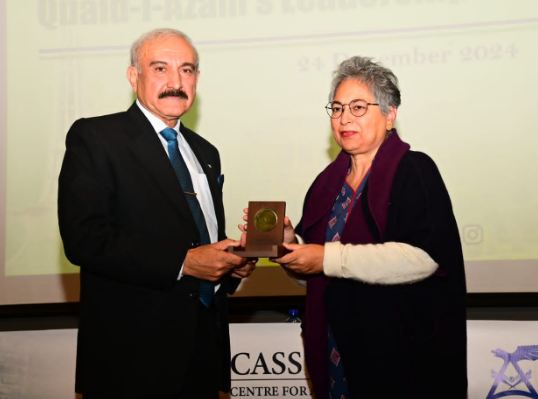
ISLAMABAD, DEC 28: /DNA/ – As Pakistan nears its centennial year of independence, engaging in thoughtful discussions to envision a prosperous future becomes imperative. In this regard the Centre for Aerospace & Security Studies (CASS), Islamabad in collaboration with Air University organized a guest lecture under its Catalyst Conversation Series on ‘Steering through Storms: Quaid-i-Azam’s Leadership in the Time of Crisis’, which aimed to facilitate such discourse. Moderated by CASS Research Assistant Shaheer Ahmad, the discussion explored Quaid-i-Azam Muhammad Ali Jinnah’s leadership style and decision-making during turbulent times, drawing lessons for modern governance. The keynote was guided by insights of Prof. Dr Dushka H. Saiyid, Editor Youlin Magazine & Former Chairperson, Department of History, Quaid-i-Azam University.

In her Keynote Address, Prof. Dr Dushka H. Saiyid discussed the enduring legacy of Quaid-i-Azam focusing on his leadership qualities and his advocacy for women’s empowerment. The speaker reflected on Jinnah’s visionary approach to governance and his unwavering commitment to constitutional principles. Highlighting Jinnah’s legislative achievements, the speaker noted his instrumental role in championing women’s rights, including his support for inheritance laws through the Shariat Bill of 1937, which secured fixed property shares for women. Jinnah’s leadership in mobilising women for political and social causes was underscored, as was his belief in the vital role of women in nation-building. Prof. Dr Dushka H. Saiyid’s address served as a powerful reminder of Jinnah’s foresight and inclusivity, urging today’s leaders to draw inspiration from his example in promoting equity and progressive governance.

In his Concluding Remarks, Air Marshal Farooq Habib (Retd), Senior Director at CASS, underscored the significance of Quaid-i-Azam’s vision in shaping Pakistan’s identity and future. He urged the young generation to honour Jinnah’s legacy as a guiding principle for progress and unity. ‘Without Quaid’s vision, the Muslims of the subcontinent would have had no identity. It is crucial for us to reconnect with this legacy to shape a prosperous future,’ said Air Marshal Habib. He emphasised Jinnah’s dream of an inclusive state with an impartial government, where all citizens could live freely and with dignity.

Delivering his Vote of Thanks, President of CASS, Islamabad, Air Marshal Javaid Ahmed (Retd), thanked Prof. Dr Dushka H. Saiyid for her thought-provoking address and expressed gratitude to the administration of Air University for their cooperation in organising the Catalyst Conversation at their institution. The lecture was followed by an interactive Question and Answer session with students and faculty of the university.

EU issues scam alert in Pakistan

EU

Criminal organisations spreading fake visa info via Google Maps, misleading Pakistanis about services, says EU Office

DNA

ISLAMABAD: The European Union (EU) Delegation to Pakistan has issued a public warning regarding a scam targeting Pakistani citizens about criminal organisations spreading misleading information about visa and consular appointments by creating fake embassy listings and phone numbers on Google Maps.

In a statement shared on X on Friday, the delegation confirmed that several fake entries for EU member state embassies had been observed in Islamabad. These listings, which include incorrect details about visa and consular services, also feature fraudulent phone numbers aimed at deceiving users.

“This is a serious scam by criminal organizations,” the EU office stressed, urging citizens to rely solely on official embassy websites for accurate contact information and service details.

The delegation clarified that only the official websites of EU member state embassies provide authentic details for visa and consular matters. It specifically cautioned against using entries on Google Maps or other embassy directories, which may contain inaccurate or deceptive information.

Furthermore, the EU noted that its own delegation in Pakistan does not handle the issuance of passports or visas. These are issued by the embassies and consulates of individual EU member states.

The EU urged Pakistani citizens to contact the relevant embassy or consulate directly to obtain the correct visa for their travel destinations in Europe.

Richard Grenell: Catalyst or Noise?

Qamar Bashir

By: Qamar Bashir

Macomb, Detroit, Michigan

The Establishment, after having consolidated control over all pillars of the state, the country’s polity, and the media, perhaps feels more powerful and in full control than at any time since the autocratic rule of General (R) Pervez Musharraf. Musharraf, who passed away as a fugitive in Dubai, faced an ignominious end after battling amyloidosis, a rare disease.

People, left with no effective means to express their sentiments against what they perceive as suppression, resorted to protests and agitations. These were met with brutal crackdowns, with reports of several protestors being killed at point-blank range. Amid this atmosphere of despair and helplessness, the latest interview of Richard Grenell, a former U.S. diplomat and close ally of Donald Trump, came as a breath of fresh air for Pakistanis both within the country and in the diaspora.

Grenell’s remarks resonated widely, as millions shared and retweeted his interview, pinning their hopes on his words and the potential return of a Trump administration to advocate for their lost freedoms of speech, assembly, and justice.

Naturally, Grenell’s statements provoked a strong reaction from Pakistan’s ruling elite, who responded with a mix of denial, deflection, and hostility. One of the most peculiar reactions came from PPP leader Sherry Rehman, who, despite being a prominent recipient of U.S. aid herself, questioned Richard Grenell’s position within the U.S. official hierarchy. She dismissed his comments as inconsequential, attempting to undermine their significance without addressing the substance of his critique.

Another controversial remark emerged from a senior Pakistani leader who suggested an improbable “swap” of Imran Khan with Aafia Siddiqui, a statement that was widely criticized for its absurdity and insensitivity.

However, the most bizarre and convoluted reaction came from Defense Minister Khawaja Asif, who introduced a baseless theory he termed “Operation Goldsmith.” He alleged that Grenell had been enlisted by external forces, particularly Jemima Goldsmith, to destabilize Pakistan—the world’s only Muslim-majority nuclear-armed nation.

This claim, entirely without evidence, drew widespread ridicule for its outlandishness. Jemima Goldsmith, visibly dismayed by the allegations, firmly denied any involvement in Pakistani politics. She stated unequivocally that she has never, and would never, finance or interfere in political affairs in Pakistan, either directly or indirectly.

Grenell, for his part, expressed shock and surprise at the incoherence of Khawaja Asif’s statements. Taking to social media, he criticized the Defense Minister’s baseless claims as reckless and called for accountability from Pakistan’s diplomatic mission in Washington, D.C. Tagging the Pakistan Embassy (@PakinUSA) and Ambassador Rizwan Sheikh, he demanded an explanation for the inflammatory rhetoric and the apparent indifference to death threats arising from such conspiracy theories. Grenell also suggested that the U.S. government review the aid it provides to Pakistan, questioning whether American taxpayer funds should continue to support a regime that tolerates such behavior from its senior officials.

Grenell’s critique, particularly his call for a reevaluation of U.S. aid, has added a new dimension to the ongoing discourse about governance and accountability in Pakistan. By drawing attention to the conduct of senior officials, his comments could intensify international scrutiny of Pakistan’s political landscape. While the establishment’s reactions were intended to discredit Grenell, they inadvertently highlighted the very issues he sought to expose, reinforcing the perception that Pakistan’s ruling elite is increasingly out of touch with reality.

The widespread sharing and discussion of Grenell’s interview reflect a growing frustration among Pakistanis, both at home and abroad. In an environment where traditional media is tightly controlled, social media has become a critical platform for voicing dissent. The international attention generated by Grenell’s comments provides a counter-narrative to the establishment’s control, energizing opposition movements and raising awareness about the country’s political challenges.

If Grenell’s views gain traction within U.S. policymaking circles, especially under a potential Trump administration, Pakistan’s ruling elite may face significant diplomatic pressure. The United States has historically used financial aid as leverage to influence Pakistan’s policies. A credible threat to reduce or reallocate aid could compel the establishment to soften its stance on political dissent and human rights. However, this depends on how unified and consistent U.S. foreign policy toward Pakistan remains.

Imran Khan’s incarceration and the suppression of his political movement have attracted international criticism. Grenell’s remarks amplify this scrutiny, potentially strengthening calls for Khan’s release. However, while international attention can embolden Khan’s supporters, his political fate remains tied to Pakistan’s internal dynamics, including public mobilization and potential fractures within the establishment. External voices like Grenell’s may act as a catalyst but cannot singularly change the situation.

If Grenell secures a formal role in a future U.S. administration, his statements could carry more weight and lead to increased international scrutiny of Pakistan’s governance. As a special envoy, he could advocate for human rights and political freedoms, challenging the ruling elite’s actions. However, his effectiveness would depend on whether the U.S. government adopts a coherent and sustained approach toward Pakistan, along with support from other international actors. For now, Grenell’s remarks serve as a symbolic yet powerful reminder of the need for accountability and reform.

The Richard Grenelles remarks is an addition to many voices which has been raised at various forums in the United State expressing deep concern over weakening of democracy and reduction of democratic instititons just rubber stamps. like Grenelle, the U.S. Congress, Biden administration, and civil society have increasingly voiced concerns over Pakistan’s political trajectory, focusing on human rights abuses and democratic backsliding.

A recent congressional resolution called for an investigation into alleged election irregularities, while over 60 lawmakers urged President Biden to push for the release of imprisoned former Prime Minister Imran Khan. The Biden administration has condemned the use of military courts to try civilians and raised alarms over restrictions on free speech, assembly, and due process. Meanwhile, international organizations and civil society groups have echoed calls for accountability and democratic reforms, emphasizing the need for transparency, fair elections, and the protection of fundamental rights in Pakistan.

These voices may collectively compel the upcoming U.S. administration to take decisive action against Pakistan’s ruling elite. If this pressure intensifies, even a slight adjustment in IMF policies could cripple the fragile economy of country, forcing it to confront its governance failures. Let us hope this prompts Pakistan’s leadership to learn a lesson and take swift, corrective action to avert the looming economic meltdown.

By: Qamar Bashir

Press Secretary to the President (Rtd)

Former Press Minister at Embassy of Pakistan to France

Former MD, SRBC

Iranian ambassador, PCP chairman join hands to combat fake news

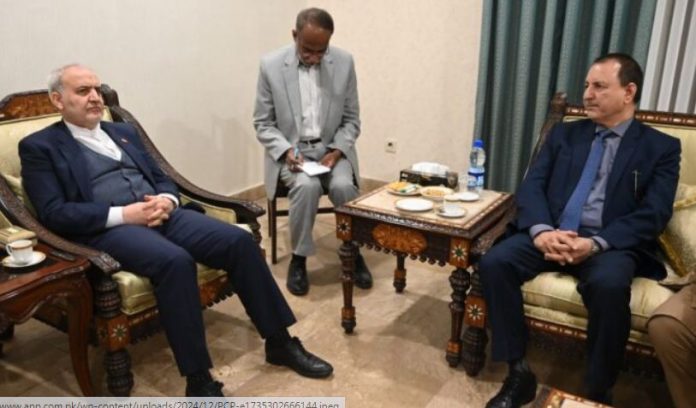
ISLAMABAD, DEC 27 (DNA): Iranian Ambassador to Pakistan, Reza Amiri Moghadam and Press Council of Pakistan (PCP) Chairman, Arshad Khan

ISLAMABAD, DEC 27 (DNA): Iranian Ambassador to Pakistan, Reza Amiri Moghadam and Press Council of Pakistan (PCP) Chairman, Arshad Khan Jadoon on Friday reaffirmed their commitment to enhancing media collaboration between Iran and Pakistan as part of a broader strategy to counter the growing menace of fake news.

During the meeting here at the Iranian Embassy, both dignitaries underscored the critical importance of tackling disinformation that threatens societal harmony. They agreed that fostering strong media ties between the two nations is essential to portraying a positive image of both countries on the global stage.

Ambassador Moghadam emphasized the need for cultural exchange through the sharing of dramas and movies between the two countries. “We must use media as a bridge to promote cultural cohesion and mutual understanding among our peoples,” he stated. He also assured full support from the Iranian side to further strengthen bilateral media cooperation.

Chairman Jadoon provided an overview of the PCP’s constitutional mandate, highlighting its role in addressing fake news and promoting ethical journalism. He outlined PCP’s efforts in monitoring media practices and ensuring adherence to the code of ethics to maintain journalistic integrity.

Chairman Jadoon emphasized that the agenda of Prime Minister Muhammad Shahbaz Sharif to combat fake news is a critical issue facing the entire world. He highlighted the importance of strengthening bilateral ties to address misinformation and to collaboratively work towards the development of journalists in both countries.

The meeting concluded with a shared resolve to foster meaningful media partnerships and adopt innovative measures to counter fake news, contributing to a more harmonious and informed society.

On this occasion, Chairman Jadoon graciously presented the traditional Sindhi Ajrak (shawl) and Topi (cap), along with a bouquet, as a gesture of hospitality and cultural significance.

Kremlin says no comment on Azerbaijani plane crash until probe completed

Moscow, Dec 27 (AFP/APP):The Kremlin said Friday that it would not comment on the deadly crash of an Azerbaijani passenger plane until an inquiry was completed, after reports the jet was targeted by a Russian air defence missile.
                  The Azerbaijan Airlines jet crashed near the Kazakh city of Aktau, an oil and gas hub, on Wednesday after going off course for undetermined reasons.
                  Thirty-eight of the 67 people on board died.
                  “An investigation is underway, and until the conclusions of the investigation, we do not consider we have the right to make any comments and we will not do so,” Kremlin spokesman Dmitry Peskov told reporters.

India announces state funeral for former PM Manmohan Singh

India announces state funeral for former PM Manmohan Singh

New Delhi, Dec 27 (AFP/APP): India announced seven days of state mourning on Friday after the death of former prime minister Manmohan Singh, one of the architects of the country’s economic liberalisation in the early 1990s.
                  Singh, who held office from 2004 to 2014, died at the age of 92 late on Thursday evening at a hospital in New Delhi. He will also be accorded a state funeral.
                  The Indian government said in a statement on Friday that seven days of state mourning will be observed throughout India ” as a mark of respect for the departed dignitary.” The mourning will run until January 1.
                  “It has also been decided that the state funeral will be accorded to late Dr. Manmohan Singh,” it said, with the national flag fluttering at half-mast on official buildings across the country.
                  India’s cricket team battling hosts Australia in the fourth Test took to the ground in Melbourne on Friday with black armbands to show respect for Singh.
                  The official date for the state funeral was not announced immediately but a senior member of the Congress party suggested it would be held on Saturday.
                  Prime Minister Narendra Modi said India “mourns the loss of one of its most distinguished leaders”, while newspapers hailed his legacy.
                  “Man who liberated India’s dreams,” The Times of India front page read.
                  “He opened India to the world,” The Indian Express headline ran.


                  – Understated technocrat –


                  The former premier was an understated technocrat who was hailed for overseeing an economic boom in Asia’s fourth-largest economy in his first term.
                  However, Singh’s second stint ended with a series of major corruption scandals, slowing growth, and high inflation.
                  Singh’s unpopularity in his second term, and lacklustre leadership by Nehru-Gandhi scion Rahul Gandhi, the current opposition leader in the lower house, led to Modi’s first landslide victory in 2014.
                  Born in 1932 in the mud-house village of Gah, in what is now Pakistan, Singh studied economics to find a way to eradicate poverty in the vast nation and never held an elected post before taking the nation’s highest office.
                  He won scholarships to attend both Cambridge, where he obtained a first in economics, and Oxford, where he completed his doctorate.
                  Singh worked in a string of senior civil service posts, served as a central bank governor and also held various jobs with global agencies such as the United Nations.
                  He was tapped in 1991 by then Congress prime minister P.V. Narasimha Rao to reel India back from the worst financial crisis in its modern history.
                  Singh steered the economy through a period of nine percent growth in his first term, lending India the international clout it had long sought.
                  He also sealed a landmark nuclear deal with the United States that he said would help India meet its growing energy needs.

Islands, sports and spotted dogs: Five facts about Croatia

Islands, sports and spotted dogs: Five facts about Croatia

Zagreb, Dec 27 (AFP/APP):Croatians will vote for a new president on Sunday, with many analysts saying incumbent left-wing populist Zoran Milanovic is a clear frontrunner.
                  Here are five facts about the former Yugoslav republic, independent since 1991:


                  – 1,000 islands –


                  Croatia is blessed with a stunning coastline along the Adriatic Sea dotted with more than 1,000 islands and islets attracting around 20 million tourists annually.
                  Tourism is the key pillar powering the country’s economy, accounting for a fifth of gross domestic product.
                  The sector has performed so well in recent years that Croatia has been dogged by several issues linked to the deluge of visitors, including overcrowding in the medieval walled city of Dubrovnik and a shortage of workers.
                  The “Pearl of the Adriatic” has seen a major increase in arrivals after scenes from the Game of Thrones TV series were filmed in Dubrovnik in 2011.
                  Apart from the coastline, other top tourist attractions include the Istria hinterland, known for its truffles, the Velebit mountain range, and the Krka and Plitvice national parks.
                  – Sports incubator –


                  Many consider Croatia’s sports stars as the country’s biggest success, as the small nation boasts an impressive number of athletes.
                  Its footballers made a historic run to the World Cup final in 2018 led by captain Luka Modric. They also reached the 2022 Qatar World Cup semi-finals.
                  The water polo squad and national handball team have both scooped up world championship titles and Olympic gold medals.
                  Tennis star Goran Ivanisevic, who won Wimbledon in 2001, and former world number three Marin Cilic, as well as high-jump champion Blanka Vlasic, have also become stars at home and abroad.
                  And although Croatia has practically no ski resorts, it boasts Alpine ski champions — sister and brother Janica and Ivica Kostelic.
                  – Dalmatians –


                  Originating from Dalmatia, a region on the Adriatic, the Dalmatian dog breed was first depicted in paintings and church chronicles dating from the 16th and 18th centuries.
                  Of Croatia’s seven native dog breeds, Dalmatians became the most universally known thanks to Walt Disney’s animated film “101 Dalmatians”, first released in 1961.
                  – Ties –


                  “At all events, people who deny the influence of Europe’s ‘smaller nations’ should remember that the Croats have the rest of us by the throat,” wrote Norman Davies in his book “Europe – A History”.
                  The British historian was referring to the tie or cravat — worn every day by millions of men worldwide — whose Croatian origin reaches far into the past and is linked to love and devotion.
                  According to Croatian tradition, women tied kerchiefs around their darlings’ necks as they set off for battle in foreign wars.
                  Notably, Croat mercenaries wore them as they fought on the side of King Louis XIV during the Thirty Years War in the 17th century.
                  The humble tie was soon accepted as a fashion accessory by the powerful French court, and later spread to Britain and throughout the world.
                  Its association with the Croat nation resulted in the word cravat.
                  Today, Croatians celebrate Cravat Day on October 18.
                  – Demographic drop –


                  Experts warn that the nation of 3.8 million people is facing a demographic crisis as it struggles with low birth rates, a steady exodus of residents abroad and an ageing population.
                  Since Croatia joined the European Union in 2013, around 400,000 people have left the country.
                  The lure of higher wages abroad along with frustration with widespread corruption and nepotism at home are cited as the main reasons for departure.
                  The exodus has also fuelled a chronic labour shortage, notably in the construction and tourism sectors.
                  In recent years it led to a sharp increase in workers from Asian countries posing a new challenge for one of Europe’s more homogeneous societies.
                  The United Nations projects that Croatia will have just 2.5 million people by the end of the century.

Stay Connected

64FansLike
60FollowersFollow

Latest Reviews

Exchange Rates

USD - United States Dollar
EUR
1.17
GBP
1.35
AUD
0.72
CAD
0.73