Home Blog Page 718

PM stresses hard work for prosperity, says ‘witchcraft’ won’t help

PM stresses hard work for prosperity, says 'witchcraft' won't help

ISLAMABAD, MAY 25: Stressing the need for hard work and austerity to steer the cash-strapped country out of the economic crises, Prime Minister Shehbaz Sharif on Saturday remarked that “witchcraft” won’t help the nation.

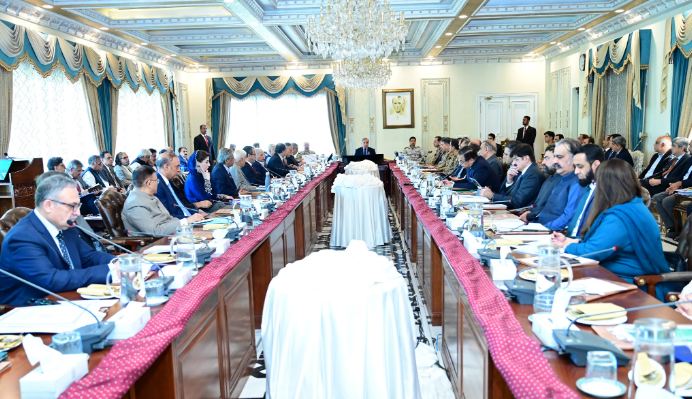
The country’s chief executive, who came into power in March this year, made the remarks while addressing the apex committee of the Special Investment and Facilitation Council’s (SIFC) 10th meeting at the Prime Minister’s Office.

Addressing the civil-military forum established to attract foreign investment, the premier said that joint efforts were being made to resolve the country’s issues.

Briefing the participants about his recent visits to Saudi Arabia and the UAE, PM Shehbaz said that during the meetings leaders and delegations of other countries expressed their satisfaction with the performance of SIFC.

Referring to the alleged criticism over the body, the premier said: “Concerns were expressed when the SIFC took legal form.”

Over time, the forum silenced its critics with its achievements, he said, adding: “SIFC playing a key role in the development of Pakistan.”

The premier said that all the provincial governments repose trust in the SIFC, adding that they would achieve their goals through the forum.

Moving on to economic reforms, PM Shehbaz told the participants that a foreign firm had been hired for the digitalisation of the Federal Board of Revenue (FBR).

The premier said that the UAE pledged to invest $10 billion in Pakistan.

Khyber Pakhtunkhwa Chief Minister Ali Amin Gandapur, Punjab’s Maryam Nawaz, Sindh’s Murad Ali Shah and Balochistan’s Sarfraz Bugti were among the attendees of the meeting.

According to a statement from the PM’s Office, the SIFC meeting met with PM Shehbaz in the chair to review various initiatives and projects that fall under the forum.

Chief of the Army Staff (COAS) General Syed Asim Munir, chief ministers from all four provinces, members of the federal cabinet, and high-level officials attended the meeting.

“The participants of the meeting reviewed progress on economic cooperation with friendly countries.”

Speaking on the occasion, COAS Gen Munir assured the government of the army’s cooperation in their steps for economic prosperity in the country.

He also assured the military’s cooperation on the government’s initiatives for socio-economic welfare.

The statement further said that the forum also reaffirmed its determination to improve the environment for investment.

Matters related to privatisation of loss-making state-owned enterprises were also discussed in the meeting.

The forum expressed satisfaction with the ongoing privatisation process and stressed the need to complete the process in collaboration with concerned stakeholders.

During his interaction with journalists following the meeting, firebrand CM Gandapur said that he attended the huddle to represent his province.

“[I] will not compromise on the share of the province.”

The CM said that he put forth the concerns of his province before the forum, adding that he would perform his role for the betterment of his province and the country.

“People gave us mandate to fight for their rights.”

During the meeting, the CM said that he opposed the proposal to impose tax on the merged districts. He was of the view that they could increase revenue by reforms in the mining sector.

“I will go to any extent to give relief to the people.”

Responding to a question, the chief minister said that presenting budget was their constitutional right.

A day earlier, taking lead over the federal government as well as other three provinces, CM Gandapur-led KP government unveiled its maiden over Rs1.75 trillion budget for the fiscal year 2024-25.

On the other hand, Information Minister Attaullah Tarar told the journalist that the SIFC’s 10th meeting was held in a pleasant atmosphere.

Talking to journalists, the minister said that the huddle conveyed a message that the federation and the provinces were on the same page on national issues.

CM Gandapur acknowledged the importance of SIFC, he said, adding:” Ali Amin Gandapur said that he is not out of SIFC.”

Matters related to $10 billion from UAE, economy’s positive indicators and other issues were discussed in the meeting, he added. The premier had already clarified that their focus would be on investment instead of aid, Tarar said.

To a question, the information minister termed UAE’s $10 billion investment pledge “big effort” of the army chief.


PTI calls May 25 darkest day in political history

PTI

State should shun oppression, release Khan before situation further escalates: PTI Spokesperson

ISLAMABAD, MAY 25 /DNA/ – Pakistan Tehreek-e-Insaf (PTI) declared May 25, 2022 as the darkest day in the political history of the country, because on this day, the state unleashed its full fury on peaceful marchers under leader of PTI Founding Chairman Imran Khan and subjected them to tear gas, rubber bullets and batons for hours in total disregard of the constitution and law.

PTI Spokesperson, in a statement, said that PTI Founding Chairman Imran Khan launched the movement of Haqeeqi Azadi two years ago and took out a historic peaceful Azad March to establish supremacy of constitution and rule of law in the country.

However, he stated that as the state’s fascism reached its peak, the peaceful participations of the Azad March were subjected to the worst state brutalities on May 25, 2022 and unleashed a reign of terror and cracked down on them in sheer violation of the constitution and law.

PTI Spokesperson recalled that on that day, human rights were trampled across the country and the sanctity of foul walls was desecrated, as on that night, houses were raided, women and children were harassed, and PTI leaders and workers were abducted.

He stated that during this state barbarism, two PTI workers were martyred, and dozens were injured, besides destroying properties and ransacking their homes.

PTI Spokesperson noted that the state machinery tried its best to push the country towards civil war; however it was Imran Khan who, despite facing and enduring all the worst state atrocities, held high the flag of peace and saved the country from internal turmoil and chaos.

He said that two years ago, the oppression and tyranny inflicted on the citizens marked the beginning of a shameful sequence of the state barbarity and fascism, adding that during these two years, Pakistan’s largest and only federal political party PTI, had been subjected to full-scale state brutality.

PTI Spokesperson lamented that under the pretext of a false flag operation on May 9, senior leaders, including women, and over 10,000 workers were rounded up and imprisoned. He went on to say that the state was still engaged in extrajudicial and illegal activities, while Imran Khan and PTI were continuously targeted with violence and revenge.

Pakistan needs stability, which can only be achieved by ensuring supremacy of constitution and law, he asserted.

PTI Spokesperson demanded an immediate end to the state oppression, release of Imran Khan to provide effective leadership to the country and nation before the crisis further aggravated and the situation reached to a point of no return.

PTI moves IHC to de-seal its central office in Islamabad

PTI

ISLAMABAD: Imran Khan-founded Pakistan Tehreek-e-Insaf (PTI) on Saturday moved the Islamabad High Court (IHC) seeking its order to de-seal its central secretariat in the federal capital.

The Capital Development Authority (CDA) had Thursday demolished a portion of the PTI Central Secretariat over a “violation of building rules”, drawing strong condemnation from the former ruling party.

The CDA said that its anti-encroachment team launched an operation to eliminate illegal construction and encroachment.

In response, the PTI voiced its concerns in the Senate and today, the party’s secretary general, Omar Ayub Khan, filed the petition and made secretary of interior, chief commissioner, CDA chairman, and IG Islamabad parties in the case.

In his petition, the PTI leader said: “Neither any order nor any notice was ever served upon the petitioner, hence, the impugned act of the respondents is due to malafide intention, blackmailing, without due process of law and violation of principle of natural justice and also contrary to Article 4 and 10-A of the Constitution.”

The petitioner argued that PTI, through its members Arshad Dad and Naseem ur Rehman, purchased commercial plot Number 1-A situated at Shopping Centre, Sector G-8/4-2 from Sartaj Ali in 2020.

It is pertinent to mention here that the CDA, following the operation, had said that encroachment by a “political party” was removed and added that the plot was allotted in the name of a person named Sartaj Ali.

The petitioner termed the CDA’s operation illegal unlawful and the result of malafide, political victimisation and violation of fundamental rights.

Govt censured for using force against PTI
A day earlier, Leader of Opposition in Senate Shibli Faraz Friday berated the government for using force against the PTI and arresting the party’s local chapter chief Aamir Mughal.

Addressing the Senate, Faraz said the treasury benches not only banned his party they also used all the tactics against it. It was not enough for them to snatch the party’s electoral symbol, he blasted.

Referring to the raid at the PTI office, the senior leader said his party’s central office was razed in Islamabad, Mughal was arrested and PTI workers were beaten by police with batons.

Faraz said the CDA demolished the building on the government’s desire. They had started using foul tactics after failure to compete with the PTI politically, he said. They were creating hatred for themselves through such actions, he said.

“You cannot (continue to) do politics through coercion. Whatever oppression you carry out, will be registered,” he said pointing towards the treasury benches.

The opposition leader had said the PTI central office was attacked and the party’s information secretary survived a lethal assault.

Govt’s stance
Backing the anti-encroachment operation, Law Minister Azam Nazeer Tarar, had informed the Senate that action had been taken in accordance with the law and for violating building bylaws.

He made the remarks while responding to a point of order raised by PTI Faraz in the Senate. The law minister further explained that the first notice was issued to the political party in 2020 for violating building bylaws.

“Notices were repeatedly issued from 2020 to 2024 at six-month intervals, with the final notice given on May 10 for ongoing violations.”

“In view of the last notice dated May 10, the action is in accordance with the law,” the minister added.

The minister elaborated that he had talked to the chairman of the CDA, who confirmed that the process had been ongoing for the past four years due to the violations. The final notice was issued to ensure compliance with CDA directions, he added.

The minister further explained that reminders were issued to the political party regarding two floors constructed without CDA approval and the misuse of a public place for parking containers. He said that the party had constructed illegal parking sheds.

He said that despite repeated requests, the party did not remove the illegal structures or vacate the public space, causing problems for the public.

Lithuania keen to expand, diversify ties with Pakistan

Lithuania keen to expand, diversify ties with Pakistan

The Vice Minister of Lithuania Egidijus Meilunas says they had very fruitful and friendly discussions at the Ministry of Foreign Affairs of Pakistan on political and economic developments in our countries, bilateral relations, relations between the European Union and Pakistan, situation in South Asia and Europe’

Ansar M Bhatti

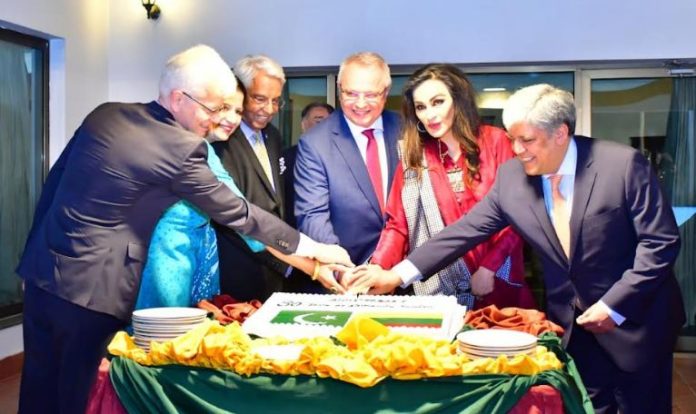
ISLAMABAD: The Vice Minister of Lithuania Egidijus Meilunas has said it was a great honour for him to be in Pakistan on occasion of the 30th anniversary of the diplomatic relations between the Republic of Lithuania and the Islamic Republic of Pakistan.

He said ‘these three decades were extremely dynamic for Lithuania. We established diplomatic relations between our two countries just in four years after Lithuania succeeded to restore its statehood after 50 years of Soviet occupation, and just in few months after withdrawal of Russian troops from the Lithuanian soil’.

This year Lithuania also marks the 20th anniversary of the European Union and NATO membership.

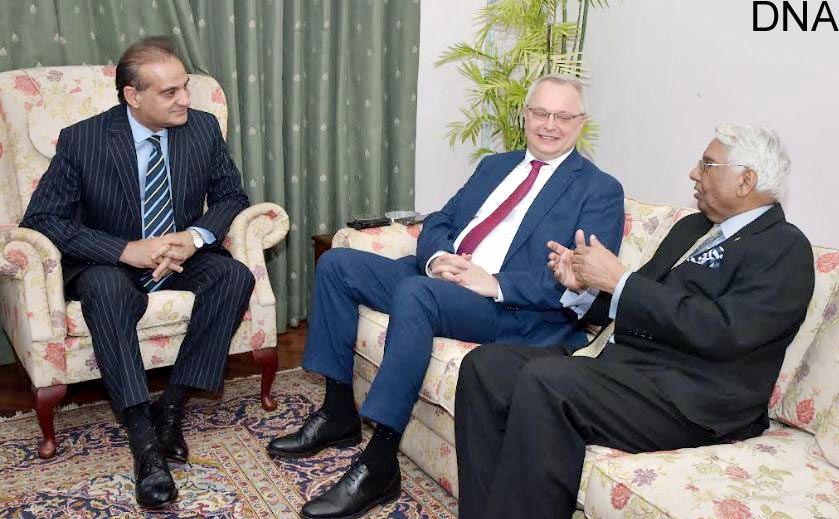
He expressed these views on the occasion of a reception. Seanor Sherry Rehman , Additional Secretary Ministry of Foreign Affairs, Lithuania Ambassador to Pakistan Ricardas Degutis (based in Ankara) and a  large number of guests attended the reception hosted by Masud Khan, Hon. Consul General of Lithuania in Pakistan.

Minister Meilunas further said, fast transformation period brought to Lithuania stability and security, contributed to firm establishment of the rule of law and respect to human rights, provided welfare, believe in the future of the sustainable development, and the most important – feeling of being integral part of the European and Euro-Atlantic family, where opinions are shared and heard, and culture of compromise and consensus in the politics is appreciated.

He added, ‘we had very fruitful and friendly discussions at the Ministry of Foreign Affairs of Pakistan on political and economic developments in our countries, bilateral relations, relations between the European Union and Pakistan, situation in South Asia and Europe’.

We also discussed other challenges for regional and global security. We live in very challenging and difficult times, so if we want to preserve our world order, based on rules and international law, we have to unite our efforts on protecting it, he added.

‘Our discussions reflected mutual interest in deeper understanding of our positions and concerns, as well as readiness to look at the opportunities to enhance bilateral links, especially in economic cooperation. Being strong in development of business service centers, startup ecosystem, fintech, software development, cyber security, life sciences, engineering and electronics Lithuania can be a very useful partner for Pakistani companies’.

He said he was very happy that my country is so well represented here by Mr Masud Khan, our Honorary Consul General in Pakistan.

He wished that the next 30 years of cooperation between Lithuania and Pakistan would be successful, productive, based on mutual respect and friendship.

Ambassador Khazar Farhadov says direct air links have further brought peoples of Pak, Azerbaijan closer

Ambassador Khazar Farhadov says direct air links have further brought peoples of Pak

Says Republic of Azerbaijan was chosen to next host COP29 in December 2023 with unanimous support from all countries, and it showcases the recognition of Azerbaijan`s leadership and efforts in addressing climate change at the national, regional, and global scales’

Ansar Mahmood Bhatti

ISLAMABAD: Ambassador of Azerbaijan to Pakistan Khazar Farhadov has said relations between Pakistan and Azerbaijan continue to grow on an upward trajectory in all fields.

Direct flights between Azerbaijan and Pakistan (from Islamabad, Karachi, and Lahore) which have been operated since 2022 by PIA, and 2023 by AZAL tremendously contribute to these relations. More than 50.000 Pakistani tourists visited Azerbaijan in 2023. I have to mention that Pakistan is one of the countries that is included in the online ASAN visa system of Azerbaijan.

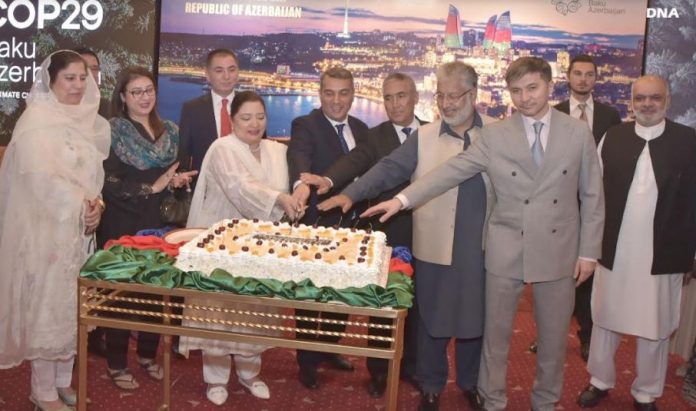
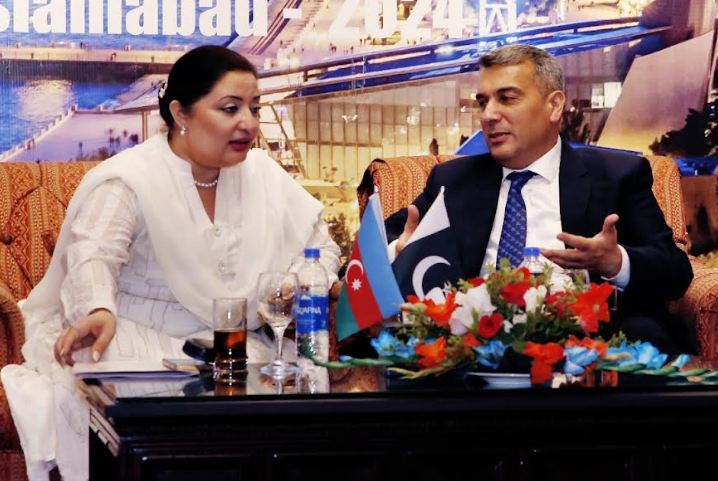
He expressed these views on the occasion of 106th anniversary of our independence. The Azerbaijan Democratic Republic was established on May 28, 1918, and that was the first democratic republic in the Muslim East. Prime Minister Coordinate on Climate Change Romina Khurshid was the chief guest. A large number of diplomats, members of the civil society and business fraternity attended the reception.

The Ambassador said the citizens of Pakistan can easily obtain a visa online within 3 hours and visit Azerbaijan. This direct connectivity brings people from all circles of the two countries closer.

In December 2022, the Government of Azerbaijan, taking into account the fraternal relations, exempted rice from the Islamic Republic of Pakistan with the same origin from import customs duty. It is not a coincidence that the trade turnover between the two brotherly countries reached up to 100 million dollars.

‘Within a remarkably brief span, Azerbaijan established its first parliament and government, defined its borders, instituted state attributes, and carried out crucial state-building measures. Important steps were taken in the field of state building, recognition of the Republic as a subject of international relations, and protection of its national interests’, he added.

Ambassador Khazar said, the Azerbaijan Democratic Republic, though it had an existence of only 23 months, played a pivotal role in the formation of democratic traditions and the history of national statehood, and laid a solid foundation for the future independence of the Republic by strengthening the sentiments of freedom and independence.

‘The legal successor of the Azerbaijan Democratic Republic, the independent Republic of Azerbaijan restored its independence in 1991 and managed to preserve its sovereignty thanks to the Great leader of Azerbaijan, Heydar Aliyev who has made an immense contribution to the people and the state of Azerbaijan. Azerbaijan has been implementing the policy of Heydar Aliyev, continuing and enriching it under the leadership of H.E. Mr. Ilham Aliyev, the President of the Republic of Azerbaijan’.

In 2020, under the leadership of the Supreme Commander-in-Chief of the Azerbaijani Armed Forces, President Ilham Aliyev, Azerbaijan liberated its internationally recognized territories from the almost 30-years occupation by Armenia, implementing UN Security Council 4 resolutions of 1993.

In this month, on May 1-3, 2024, the 6th World Forum on Intercultural Dialogue themed “Dialogue for Peace and Global Security: Cooperation and Interconnectivity” was held at the Baku Convention Center, he added.

‘It should be noted that the Republic of Azerbaijan was chosen to next host COP29 in December 2023 with unanimous support from all countries, and it showcases the recognition of Azerbaijan`s leadership and efforts in addressing climate change at the national, regional, and global scales’.

Ambassador said, Pakistan was one of the first countries that recognized the independence of the Republic of Azerbaijan on December 12, 1991. The diplomatic relations between the two countries were established on June 9, 1992, he concluded.

When there is no rule of law

Qamar Bashir

By: Qamar Bashir

Pakistan’s ranking on the World Justice Project’s Rule of Law Index was 129th out of 140 countries, placing it among nations like Myanmar and Sudan, where the rule of law is severely compromised​​. The absence of rule of law creates a society marked by instability, injustice, and suffering. It undermines social cohesion, economic development, and human rights, leading to a deteriorating quality of life and widespread despair. The rule of law is essential for creating a stable, just, and prosperous society where individuals can thrive and communities can develop harmoniously.

In a society where laws are trampled, selectively employed, and the government and its institutions become above the law, numerous adverse consequences arise, leading to instability and suffering. Without the rule of law, a society faces chaos as individuals and groups may resort to violence or take matters into their own hands to protect their interests. Crime rates tend to increase, and personal safety becomes a significant concern.

The absence of rule of law erodes trust in institutions and government. People lose faith in their leaders and the fairness of the system, which can lead to social unrest and political instability. Public cynicism and apathy towards civic engagement increase, weakening the social fabric.

Those in power can govern arbitrarily, making decisions based on personal whims rather than established legal principles. This leads to corruption, favoritism, and abuse of power, as leaders and officials are not held accountable for their actions. In a lawless society, justice is elusive. Victims of crimes and abuses have little hope for redress, and perpetrators often act with impunity. This perpetuates cycles of violence and injustice, as there are no mechanisms to hold wrongdoers accountable.

Countries lacking rule of law often face international isolation. Other nations may impose sanctions or restrict diplomatic and economic ties, viewing the state as unstable and unpredictable. This further exacerbates economic difficulties and hinders development. Sustainable development is severely hindered without the rule of law. Education, healthcare, infrastructure, and other critical sectors suffer from neglect and corruption, preventing long-term progress and improvement in quality of life for the population.

In a country where there is widespread perception powerful Supra Executive(SE)  in a country has co opted legislatures, intimidate the judiciary, use the civil bureaucracy as tool to perpetuate terror, and where free press is throttled,  the country faces  serious and far-reaching implications for the democratic fabric and institutional integrity of the country.

Intimidating the judiciary undermines the principle of judicial independence, a cornerstone of democracy. When judges feel threatened or coerced, they may not be able to make impartial decisions based on the law and constitution. This can lead to a lack of fair trials, miscarriages of justice, and an overall erosion of public trust in the legal system. It may also discourage qualified individuals from serving in the judiciary, further weakening the institution.

When a country’s legislature is co-opted, it effectively diminishes the checks and balances that are essential to a functioning democracy. Legislatures are meant to represent the will of the people and provide oversight of the executive. If they are co-opted, they may fail to hold the government accountable, pass legislation without proper scrutiny, and ignore the needs and rights of the populace. This can lead to the enactment of laws that benefit a select few rather than the public at large and erode democratic norms

A free and independent press is crucial for transparency and accountability in governance. When the government throttles the free press, it limits the flow of information, restricts public discourse, and hampers investigative journalism. This can prevent the exposure of corruption, abuses of power, and other governmental malfeasance. Without a free press, citizens are left in the dark about the actions of their leaders, undermining informed public participation and eroding trust in democratic institutions.

When there is widespread perception that the government itself is involved in breaking the rule of law, abducting its own people, destroying properties and businesses, attacking its citizens using proxies, torturing individuals, abducting political activists, and undermining political parties while promoting others, the implications for the country, society, and its people are severe and multifaceted.

Trust in leaders and institutions erodes, leading to a breakdown in the social contract and a climate of suspicion and fear. Social and political instability becomes rampant, with protests, strikes, and civil disobedience escalating into violence. Human rights abuses create widespread fear and repression, stifling free speech and democratic engagement. Economic decline follows as instability deters investment, increasing poverty and unemployment. International isolation through sanctions and trade restrictions cripples the economy further, while diplomatic relationships deteriorate. Public disillusionment grows, leading to emigration of skilled individuals and further weakening the country’s prospects for recovery. The legal system breaks down, losing credibility and the ability to enforce laws impartially, resulting in corruption and lawlessness. Long-term consequences include generations growing up in an environment where violence and injustice are normalized, making the rebuilding of trust and restoration of the rule of law a challenging and lengthy process.

On the other hand, In a society where the government, institutions, and individuals follow the rule of law, numerous positive outcomes emerge. Trust in institutions and government strengthens, fostering social and political stability. Citizens are confident that justice is served impartially, which enhances personal safety and reduces crime. Human rights are protected, allowing free expression and active civic participation. This stability attracts investment, spurring economic growth and raising living standards. Public engagement increases, with citizens actively participating in the political process and community development. Accountability is maintained through a free and independent judiciary, a free press, and transparent institutions, reducing corruption and ensuring efficient use of public resources. The legislature enacts laws that promote fairness and social welfare, addressing societal issues equitably. A free press keeps the public well-informed, enabling educated decision-making and holding leaders accountable. Social cohesion and equality are strengthened, as everyone is treated equally under the law, fostering a sense of belonging and unity. Ultimately, such a society thrives, achieving prosperity, equality, and cohesion, with trust in leadership and a shared commitment to justice and fairness. Choice is ours.

By: Qamar Bashir

Former Press Secretary to the President

Former Press Minister to the Embassy of Pakistan to France

Former MD, SRBC

Independence Day of Azerbaijan

Independence Day of Azerbaijan

DNA

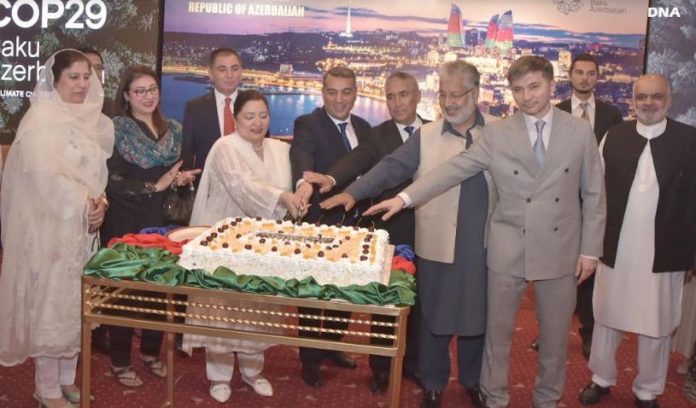
ISLAMABAD: Prime Minister’s Coordinator on Climate Change, Romina Khurshid Alam, Ambassador of Azerbaijan Khazar Farhadov and others cutting cake to celebrate the Independence Day of Azerbaijan.

IHC summons ISI, MI, IB officials on May 29

IHC

Court Reporter

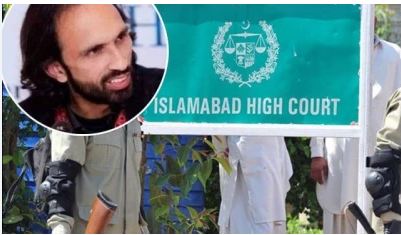
ISLAMABAD, MAY 24 /DNA/ – Islamabad High Court (IHC) senior puisne judge Justice Mohsin Akhtar Kayani on Friday summoned officials from the country’s intelligence agencies and the defence and interior ministries in a case about the recovery of missing Kashmiri poet Ahmed Farhad Shah.

The judge summoned the sector commanders of the Inter Services Intelligence (ISI) and Military Intelligence (MI), the director of the Intelligence Bureau (IB), Law Minister Azam Nazeer Tarar and the defence and interior secretaries in the next hearing on May 29.

The development came as Justice Kayani resumed hearing a petition seeking the recovery of the poet.

The Human Rights Commission of Pakistan had called for the immediate release of Shah, who had been allegedly abducted from his home on May 15.

A petition had been filed by Shah’s wife in the IHC the same day, requesting that he be found and produced before the court and to identify, investigate and prosecute those responsible for his disappearance.

On May 16, Justice Kayani had summoned a report from the defence secretary on the alleged role of intelligence agencies in the poet’s disappearance.

Earlier this week, the judge, expressing dissatisfaction with the “working” of the defence secretary, had called on intelligence agencies to shed the label of culpability in abductions.

Upon seeking an explanation from the defence secretary by 3pm the same day, the court had been informed that Shah was not in the custody of the Inter-Services Intelligence (ISI). Justice Kayani then summoned the defence and interior secretaries in person the next day.

However, on Tuesday, Attorney General of Pakistan (AGP) Mansoor Usman Awan had submitted the defence secretary’s report, stating that the official was sick. The judge again said that the secretary should appear before the court in the next hearing.

Justice Kayani then ordered the AGP to recover the missing poet within four days, which he took “full responsibility” of. Upon being asked about the ISI sector commander’s statement, Senior Superintendent of Police (SSP) Jameel Zafar told the court he could not do so due to the former’s absence.

During today’s hearing, AGP Awan and Islamabad Inspector General (IG) Ali Nasir Rizvi appeared before the court.

The court order, written in Urdu and available with Dawn.com, said: “The AGP was asked [whether] the law enforcement institutions, including ISI and MI, were performing their duties under any law to which the AGP said that the ISI is directly accountable to the prime minister of Pakistan while the MI is associated with the defence secretary and the armed forces of Pakistan.

“Looking at the explanation of this matter, the court considers it necessary that all the institutions should work within their constitutional limits, but in the present situation, we cannot do a comparative assessment of the administrative performance of the ISI with the police, FIA (Federal Investigation Agency) and CTD (Counter-Terrorism Department) until the court is briefed about official practices in institutions such as the ISI and MI, including the way to conduct investigation and inquiry.”

The order said the defence secretary was thus summoned in his personal capacity so he could submit a written explanation to the court on the above matters.

“This would allow the court to clarify the role of the agencies in the jurisdiction of police investigation in the future and lead them to be accountable in the jurisdiction of the court,” the order said.

At the outset of the hearing, AGP informed the court that a few call detail records (CDRs) were available that were being used to trace Shah.

At this, Justice Kayani asked him, “Are you saying that the state has failed?”

To the AGP’s reply in negative, the judge observed, “To recover [the missing person] is the state’s compulsion, otherwise it would be its failure.”

Justice Kayani then asked if the defence secretary was present, to which Awan said he was not as the court order had not mentioned so. “However, he will appear [if summoned],” the AGP assured the judge.

Justice Kayani then ordered: “The defence secretary should appear at the next hearing and explain to us the ISI’s workings.

“How many sector commanders and their sub-ordinates are in the ISI?” he asked, adding that intelligence agencies would no more remain “in hiding”.

The judge reiterated that not recovering Shah was the state’s failure, at which AGP Awan requested the court to not term it a failure: “If we are not able to present him [before the court], I’ll admit that the state has failed.”

At this point during the hearing, Justice Kayani, referring to the police officials present in the court, said they had appeared there as they were “answerable”.

“Transparency in the working is highly important,” the judge observed, noting that while performing their duties, policemen “get beaten and have their uniforms torn apart too”.

“If neither institutions are answerable nor can you make them answerable, what would happen? There must be a structure for agencies [where] someone is answerable to someone,” Justice Kayani noted.

The judge then remarked that at this point, Shah’s recovery was inconsequential compared to “a few things” that he said he would settle.

First batch of 720 Pakistani pilgrims arrives Jeddah

First batch of 720 Pakistani pilgrims arrives Jeddah

ISLAMABAD, MAY 24 (DNA) —Two planes of Saudi Airlines landed at the King Abdulaziz International Airport here on Friday morning carrying 720 intending Pakistani Hajj pilgrims from Karachi and Islamabad under the Road to Makkah Initiative, following the diversion of the pre-Hajj-flight operation from Madinah which concluded the other day.

As they stepped out of the planes, donning their Ihram and reciting the Talbiyah, their voices echoed with longing: “Labbaik Allahuma Labbaik (Here I am, O Allah, here I am!), Labbaik La Sharika Laka Labbaik (Here I am, no partner do You have, here I am), Inna Al-Hamda Wan-Ni’mata Laka Wal-Mulk (Indeed, all praise, grace, and sovereignty belong to You), La Sharika Lak! (No partner do You have).”

The first flight SV-3705, with 370 passengers on board, arrived by 5 a.m. (local time) and the second SV-3727 landed at 6:10 a.m. carrying 350 Hajj pilgrims. Director General Jeddah/Head of Pakistan Hajj Mission Abdul Wahab Soomro, Consul General Khalid Majeed, senior officials of the Consul and the Ministry of Religious Affairs, and representatives of the Saudi government welcomed guests of the Allah Almighty.

The guests of Allah Almighty were greeted with a warm welcome, showered with rose petals and presented bouquets, drinks, dry fruits and a variety of dates. The supporting staff of the Pakistan Hajj Mission was actively present at the airport to provide any kind of assistance to Pakistani Hajj pilgrims.

Under the Road to Makkah initiative, the passengers directly left their hotels avoiding long queues at the immigration counters, and their luggage was shifted automatically to their hotel residences.

In the first phase of the Hajj flight operation, a total of 34,316 Pakistanis reached Madinah by May 23 through 146 flights. From May 24 to June 09, as many as 114 flights will be operating to airlift 34,422 Pakistanis from their major cities to Jeddah. — DNA

Special Event at ISSI to celebrate “Africa Day 2024”

Special Event at ISSI to celebrate “Africa Day 2024”

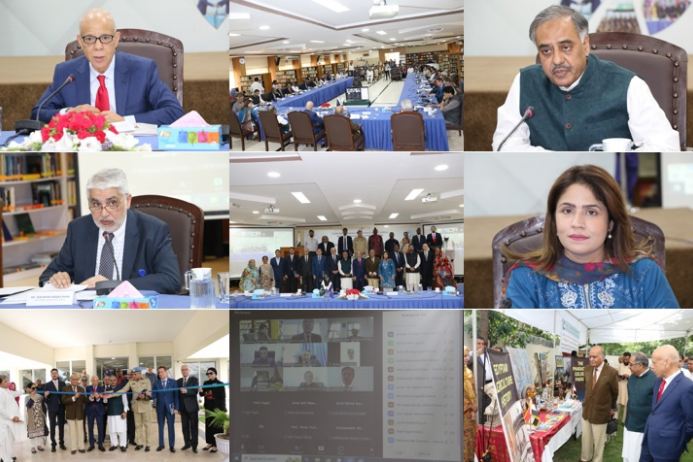
ISLAMABAD, MAY 24 /DNA/ – The Centre for Afghanistan, Middle East & Africa (CAMEA) at the Institute of Strategic Studies (ISSI) organized a special event to celebrate “Africa Day 2024.” The theme was “Pakistan’s Contribution to Peace, Security, and Prosperity in Africa.”

The Speakers included:  Director General ISSI Ambassador Sohail Mahmood; Dean of African Corps/Ambassador of Morocco, Mohammad Karmoune; Additional Secretary (Africa), Mr. Shehryar Akbar Khan; Sector Commander West MINUSCA, Central African Republic (CAR), Brig. Fahad Ayub; President Rawalpindi Chamber of Commerce and Industry (RCCI), Mr. Saqib Rafiq; Senior Research Fellow at Institute of Policy Studies (IPS), Dr. Tughral Yamin;  Senior Vice President Rawalpindi Chamber of Commerce and Industry (RCCI), Muhammad Hamza Sarosh, and Director CAMEA, Ms. Amina Khan.

The Heads of African Missions in Pakistan and Heads of Pakistan Missions in Africa also spoke on the occasion. Academics and members of the business community and students participated in the celebratory event. Stalls exhibiting African products and art work depicting African culture were also set up by African Missions in Islamabad.

During his welcome remarks, Director General Amb. Sohail Mahmood acknowledged contributions from partners including the Africa Division at the Ministry of Foreign Affairs, MO Directorate at GHQ, RCCI, African Missions in Islamabad, African students, and Pakistan’s Envoys in Africa. He highlighted Africa’s progress and the AfCFTA’s impact, reaffirmed Pakistan’s support for Africa’s development, and emphasized the role of Pakistani peacekeeping. Amb. Mahmood detailed Pakistan’s ‘Engage Africa’ policy, which helps strengthen and expand diplomatic and economic ties through new missions and joint initiatives. He stressed the strategic imperative of deepening Pakistan’s partnership with Africa and underscored the importance of a clear vision, consistent policy, and long-term strategy in this regard.   

Director CAMEA, Ms. Amina Khan highlighted the opening of new diplomatic missions in Rwanda, Djibouti, Ghana, Uganda, and Ivory Coast, and Ethiopia’s mission in Islamabad, signifying strengthened bilateral relations. Ms. Khan also commended Pakistan’s UN peacekeeping efforts and stressed the importance of cultural and educational exchanges for lasting partnerships and shared prosperity.

Ambassador Mohammed Karmoune discussed Morocco’s significant role in African peace and development, highlighting its contribution of personnel to UN peacekeeping and involvement in stabilizing regions like Somalia and the DRC. He also emphasized Morocco’s major investments in African infrastructure, banking, and telecommunications, including the Morocco-Nigeria Gas Pipeline, enhancing integration across 30 countries.

Mr. Shehryar Akbar Khan commended Africa’s advancements and Pakistan’s support, noting over 230,000 personnel deployed in UN peacekeeping over six decades, with 4,300 currently active. He highlighted the “Engage Africa” policy that fosters ties through training programs, reaffirming Pakistan’s dedication to Africa’s peace and development.

Brig. Fahad Ayub and Dr. Tughral Yamin praised the dedication and significant role of Pakistani peacekeepers in Africa. Brig. Ayub noted the deployment of 4,000 troops, efforts to increase female participation, and initiatives like agricultural support, highlighting their impartiality and trust earned. Dr. Yamin emphasized the peacekeepers’ professionalism and the challenging conditions they face, underlining the importance of continued support and recognition for their efforts.

Mr. Saqib Rafiq and Mr. Hamza Sarosh emphasized RCCI’s commitment to boosting Pakistan-Africa trade. Mr. Rafiq highlighted successful initiatives like the Pak-Africa Forum and a Cairo business event  that led to several MoUs, ongoing capacity-building efforts, and proposed a Trade Help Desk. Mr. Sarosh noted the nearly $4 billion in trade, potential for growth through the AfCFTA, and underscored Pakistan’s strengths in textiles and agriculture as crucial for entering African markets.

An interactive discussion followed, where representatives from the African Missions based in Pakistan shared their views. Representatives from the Pakistani Missions based in Africa also joined virtually and reiterated the importance of closer ties with Africa and offered their suggestions. At the end, the guests visited all the stalls established by African Missions in Islamabad, displaying African food and other products, which were introduced by the concerned Heads of Missions.

The event was attended by diplomats, practitioners, academics, students, and members of the business community, civil society, and the media.

Stay Connected

64FansLike
60FollowersFollow

Latest Reviews

Exchange Rates

USD - United States Dollar
EUR
1.17
GBP
1.35
AUD
0.67
CAD
0.72