Home Blog Page 703

From Bhutto to Imran Khan: A Chronicle of Judicial Convictions in Pakistan

From Bhutto to Imran Khan: A Chronicle of Judicial Convictions in Pakistan

by: Muhammad Mohsin Iqbal

Since Pakistan’s establishment in 1947, the office of the Prime Minister has been a focal point of judicial scrutiny. The judiciary has frequently intervened, resulting in the conviction and disqualification of several Prime Ministers—developments that have not only shaped their political destinies but also left an indelible mark on the nation’s democratic fabric.

The founder of the Pakistan People’s Party (PPP) and the country’s first democratically elected Prime Minister, Zulfiqar Ali Bhutto’s leadership ended with his overthrow in a military coup by General Zia-ul-Haq in 1977. Subsequently, Bhutto was arrested and trial for the murder of Nawab Mohammad Ahmed Khan Kasuri. The trial, widely criticized for its political undertones, culminated in his conviction and execution on April 4, 1979, a decision that remains one of the most contentious in Pakistan’s judicial history.
MohatramaBenazir Bhutto, Pakistan’s first female Prime Minister, faced judicial scrutiny during her tenure and beyond. Although her governments were dismissed twice on charges of corruption and mismanagement, it was during her years in opposition that the judiciary convicted her. In 1999, an accountability court convicted her in absentia on corruption charges, sentencing her to five years in prison and barring her from holding public office. However, this verdict was later overturned in 2001 due to insufficient evidence and procedural flaws.

Mian Muhammad Nawaz Sharif, another prominent figure, served as Prime Minister during three non-consecutive terms (1990–1993, 1997–1999, and 2013–2017). His political career was marred by multiple convictions. During his second term as Prime Minister, a military coup led to his ousting in October 12, 1999. He was later convicted by an anti-terrorism court for hijacking and terrorism, charges related to his attempt to deny landing rights to a plane carrying General Pervez Musharraf. This resulted in a life sentence, which was commuted following a deal leading to his exile. Sharif’s third tenure ended in 2017 when the Supreme Court disqualified him from office. This disqualification stemmed from corruption charges uncovered in the Panama Papers, leading to a verdict on July 28, 2017. Subsequently, an accountability court sentenced him to 10 years in prison in the Avenfield reference case.

Syed Yousaf Raza Gilani, who served as Prime Minister from 2008 to 2012, was disqualified by the Supreme Court on June 19, 2012. The disqualification resulted from his refusal to write a letter to Swiss authorities to reopen corruption cases against then-President Asif Ali Zardari. The court held Gilani in contempt, ending his tenure and setting a precedent for judicial oversight of executive compliance.

Raja Pervez Ashraf, Gilani’s successor, also faced legal challenges. Though he completed his term, he was implicated in the Rental Power Projects corruption case. While investigations and trials continue, his name remains associated with allegations of financial irregularities during his tenure as Prime Minister.

Imran Khan, the leader of Pakistan Tehreek-e-Insaf (PTI), served as Prime Minister from 2018 to 2022 and became yet another victim of Pakistan’s political-judicial entanglements. In 2023, he was convicted in the Toshakhana case, accused of concealing details of state gifts and selling them unlawfully. This conviction resulted in a three-year prison sentence and his disqualification from elections. Although the conviction was later suspended, Khan continues to face numerous legal challenges.

On January 17, 2025, the judiciary convicted former Prime Minister Imran Khan on charges of financial misconduct and abuse of power. This conviction, announced by a special accountability court, involved allegations of misusing public funds for personal gains during their tenure. The court sentenced the individual to 14 years in prison, along with a hefty fine and disqualification from holding public office. The verdict was seen as part of the judiciary’s ongoing efforts to ensure accountability among the country’s political elite, but it also sparked debates about the impartiality of the decision.

The overarching narrative of these convictions reveals a pattern in which judicial actions are often closely tied to political conflicts. While some leaders faced genuine charges of corruption or misconduct, others were seemingly targeted through politically motivated cases. The recurring legal battles of the country’s leaders reflect the fragile state of governance and accountability in Pakistan, raising questions about the impartiality of judicial processes and the overarching influence of political agendas.

The Quran and Hadith emphasize the principles of justice and impartiality in governance. Surah An-Nisa (4:135) commands believers to stand firm in justice, even against themselves or their kin. The Prophet Muhammad (peace be upon him) highlighted the perils of selective accountability, stating: “The people before you were destroyed because they inflicted legal punishments on the poor and forgave the rich” (Sahih Bukhari). These teachings underscore the need for equitable and unbiased justice, a standard against which judicial actions must be measured.

While the judiciary’s role in holding Prime Ministers accountable is vital for ensuring the rule of law, it has often been criticized for overreach and selective application of justice. Allegations of judicial activism, have at times undermined public confidence in its impartiality. Ensuring that judicial actions align with Quranic principles of justice and transparency is essential for strengthening democracy and fostering trust in state institutions.
Trump’s Strategy to Contain China (Part-1)

Qamar Bashir

Can Tariffs Push Back China?

By: Qamar Bashir

Macomb, Detroit, Michigan

It was an exhilarating experience to watch the live telecast of Scott Bessent’s over four-hour confirmation hearing for Treasury Secretary of the most powerful nation on Earth. This live broadcast reflected the highest standards of democratic values, making the public a part of vital decision-making, showcasing the performance of their elected representatives, and ensuring their accountability. This hearing also provided a rare opportunity for a writer like me to gain insight into the minds of U.S. decision-makers—how they think, deliberate on critical issues affecting both the United States and the world, strategize, and implement far-reaching, fate-changing decisions.

During the four-hour hearing, the members of the committee grilled Trump’s nominee on multiple issues confronting the U.S. and the world, including tariff policy, macroeconomic management, ensuring the dominance of the U.S. dollar as the world’s principal reserve currency, reducing inflation, creating jobs, fostering innovation, controlling the energy supply chain and trade routes, establishing a foolproof cybersecurity apparatus, securing and managing rare mineral resources, and maintaining military dominance.

Interestingly, China emerged as the primary focus of the discussion, consuming most of the hearing. No other country or world leader was deemed worthy of significant attention, reflecting the U.S. policymakers’ intense focus on China and its status as the foremost rival to American global influence across nearly all aspects of power dynamics and world dominance. Committee members repeatedly referred to China as “Communist China,” labeling it the nation’s biggest adversary and singling it out as the primary geopolitical and economic threat to the United States.

The senators from both parties expressed deep concerns over China’s alleged unfair trade practices, strategic global investments, and economic maneuvers aimed at undermining U.S. global leadership. The hearing systematically examined specific threats posed by China and explored counter-strategies to contain and counteract its growing influence.

The senators from both sides of the aisle used their oratory skills to elaborate on and condemn China’s alleged unfair trade practices, including currency manipulation, state subsidies, intellectual property theft, and forced technology transfers, which they argued create an uneven playing field for American businesses. They accused China of weaponizing trade partnerships and using economic coercion to pressure countries into political and military alignment by leveraging its massive trade network.

China’s growing influence in Latin America and Africa was highlighted as a significant concern, with senators observing that Chinese investments in energy, mining, and digital infrastructure in developing regions provide Beijing with long-term leverage over critical resources and political alliances. To counter China’s expanding geopolitical reach, senators proposed strengthening U.S. alliances in Asia and Latin America by deepening strategic partnerships with countries such as India, Japan, South Korea, Australia, and Latin American allies.

Senators emphasized that the massive trade deficit with China, which has surpassed $400 billion annually, has severely impacted American manufacturing, agriculture, and industrial sectors, leading to job losses and economic vulnerabilities.

Senator Bill Cassidy highlighted that China continues to flood global markets with artificially cheap goods, particularly in steel, semiconductors, and solar panels, driving American competitors out of business. Senator John Cornyn warned that China’s Belt and Road Initiative (BRI) strengthens its economic dominance by creating debt dependencies in developing nations, enabling Beijing to export its overcapacity while undermining U.S. trade influence. Senator Todd Young proposed using tariffs to pressure China into fulfilling its commitment to purchase $200 billion in additional U.S. agricultural products, which it has yet to fully meet.

Scott Bessent and Republican senators advocated for tariffs as the primary tool to correct trade imbalances and protect domestic industries from China’s state-backed economic aggression. Bessent outlined a tariff strategy that includes imposing selective tariffs on industries where China has gained an unfair advantage through government subsidies and forced technology transfers, using tariff revenues to fund American infrastructure and industrial revitalization, and leveraging tariffs as a negotiation tool to compel China to adhere to fair trade agreements and prevent further economic distortions.

The Committee members and Scott Bessent were unanimous in viewing tariffs as the primary weapon in the economic battle against China. However, they differed widely on how this weapon should be deployed. Some senators advocated for an aggressive tariff regime aimed at safeguarding U.S. manufacturers from China’s cost-effective yet high-quality products and services. However, this stance largely ignored the underlying inefficiencies within American manufacturing, the need for technological upgrades, and strategies to lower production costs. Others struck a middle ground, proposing a selective and strategic use of tariffs by targeting specific products and services where increased duties would not disrupt domestic manufacturing efficiency or unduly burden American consumers.

A recurring argument made by senators was that China engages in unfair trade practices by subsidizing its industries, allowing them to produce goods at lower costs, thereby outcompeting American businesses. However, this criticism overlooked a crucial aspect: the U.S. government itself employs similar mechanisms to support select industries through tax incentives, tax breaks, reduced levies, and regulatory advantages. These policies, while not explicitly labeled as subsidies, serve the same purpose—boosting domestic industries while limiting competition from foreign markets. Moreover, the senators failed to acknowledge that many Chinese industries, rather than being propped up by state subsidies, are highly profitable and contribute significant tax revenues. These revenues are then reinvested in struggling sectors, infrastructure, and research and development, reinforcing China’s economic growth and global competitiveness.

Rather than focusing solely on weakening China’s economic progress through tariffs, a more effective long-term strategy for the U.S. would be to strengthen its own industries through structural reforms. This would include improving manufacturing efficiency, reducing bureaucratic red tape, accelerating decision-making processes, and significantly increasing investment in research and development. Enhancing the productivity and competitiveness of American manufacturers would be a more sustainable solution than imposing reactionary tariffs.

“Ultimately, the best strategy for the U.S. is not to pull China down but to elevate itself through technological advancements, economic discipline, and sound policymaking. By fostering an environment that rewards innovation and competitiveness, the U.S. can position itself as a leader in global trade—not through protectionism, but through excellence and efficiency.

In Part II, we will explore Trump’s strategy to counter China’s Belt and Road Initiative (BRI) and its implications for global economic influence.

By: Qamar Bashir

Press Secretary to the President (Rtd)

Former Press Minister at Embassy of Pakistan to France

Former MD, SRBC

Motorbikes, three-wheelers sale increases

Motorbikes, three-wheelers sale increases

ISLAMABAD, JAN 17 (DNA) — The sale of motorbikes and three-wheelers in the country has witnessed an increase of 28.53 per cent during the first six months of the current fiscal year (2024-25) as compared to sales of the corresponding months of the last year.

During the months under review, as many as 696.455 motorbikes and three-wheelers were sold against the sale of 541,821 units in July-December (2023-24), according to the Pakistan Automobile Manufacturing Association (PAMA). The sale of Honda motorcycles surged by 24.92 per cent from 470,399 units to 587,669 units whereas the sale of Suzuki motorcycles also rose by 56.53 per cent from 7,386 units to 11,562 units during the months under review.

The sales of United Auto motorcycles increased to 68,103 units from 42,196 units during last year while the sale of Road Prince motorbikes increased by 26.88 percent to 10,255 units from 8,082 units. However, the sale of Yamaha motorbikes went down to 2,670 units from 4,583 units witnessing a decline of 41.74 per cent.

Meanwhile, the sale of Road Prince three-wheelers rose by 57.50 percent from 513 units to 808 units while the sale of Qingqi three-wheelers also surged to 5,123 units from 2,484 units. The sale of United Auto three-wheelers decreased by 59.07 percent from 1,097 units to 449 units, the data added. —DNA

Pakistan-China medical equipment B2B meeting yields $250 million in MoUs

Pakistan-China medical equipment B2B meeting yields $250 million in MoUs

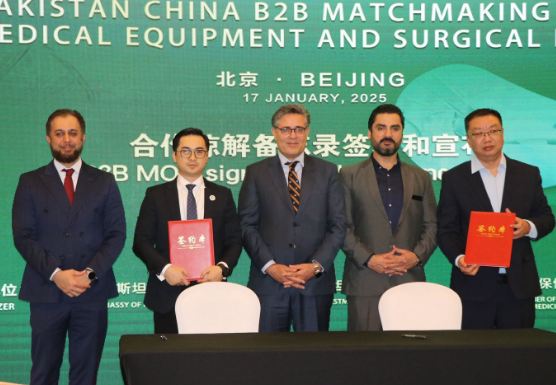
BEIJING, JAN 17 /DNA/ – The Embassy of Pakistan in Beijing, in collaboration with the Board of Investment (BOI), hosted the sixth in a series of sector-specific B2B matchmaking meetings focused on fostering joint ventures and investment partnerships between Pakistan and China in the medical and surgical equipment sector.

The meeting featured remarks by the Ambassador, senior leaders of Chinese medical and surgical industry associations, presentations by BOI and local enterprises, networking opportunities, and individual 200 B2B sessions. Over 80 Chinese companies and associations and more than 20 Pakistani companies participated both in person and online. Three Memorandum of Understandings (MOUs) worth $250 million were signed.

In his keynote speech, Ambassador of Pakistan to China H.E. Mr. Khalil Hashmi underscored the long standing experience and expertise gained by Pakistan in this important sector, the comparative advantage of competitive labour cost, geographical location, market access and investment facilitation measures offered by Pakistan in this sector. Ambassador Hashmi also highlighted the growing potential of this industry in Pakistan which was valued at over USD 600 million.

Highlighting the global reputation of Sialkot’s precision medical and surgical  instruments, Ambassador Hashmi encouraged Chinese companies to explore joint ventures with Pakistani counterparts and offered full support and facilitation by the Embassy.

Mr. Zhou Hui, President of the China Chamber of Commerce for Import & Export of Medicines & Health Products (CCCMHPIE), also spoke, noting the increasing trade in medical sector between the two countries. He underscored the complementary strengths of Pakistan’s labour force and raw materials and China’s supply chain expertise.

The meeting concluded with an announcement by Ambassador Hashmi that Pakistan will host the 4th Health, Engineering, and Minerals Show (HEMS) in Lahore from April 17-19, 2025, with a special focus on surgical and medical instruments. He invited Chinese companies to participate and explore new opportunities for growth and innovation.

The Ambassador also commended the leadership and team at Board of Investment (BoI) as well as Trade and Investment Wing of the Embassy for its meticulous planning and organization of this successful meeting, which marked the completion of first round of B2B investment promotion roadshows in seven priority sectors. Ambassador Hashmi noted the commencement of seven additional B2B Matchmaking Meetings in seven additional sectors of priority in the near future for which spadework was nearing finalization.

Security Forces eliminate five militants in Khyber’s Tirah Valley: ISPR

Security Forces eliminate five militants in Khyber's Tirah Valley: ISPR

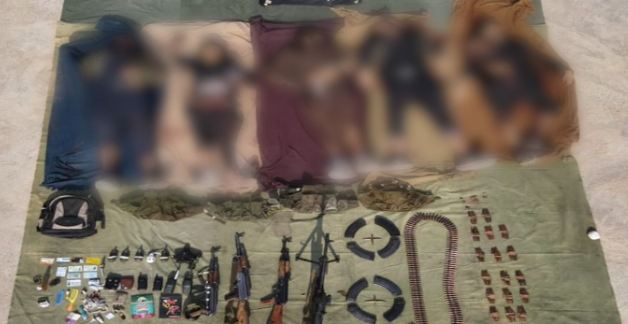
RAWALPINDI, JAN 17 /DNA/ – Security Forces conducted an intelligence based operation in general area Tirah, Khyber District on reported presence of khwarij.

During the conduct of operation, own troops effectively engaged khwarij location, as a result of which, five khwarij including Kharji ring leader Abidullah@ Turab, were sent to hell, while one kharji was apprehended.

Weapons and ammunition were also recovered from the khwarij, who remained actively involved in numerous terrorist activities in the area against the security forces as well as killing of innocent civilians.

Sanitization operation is being conducted to eliminate any other Kharji found in the area as the security forces of Pakistan are determined to wipe out the menace of terrorism from the country.

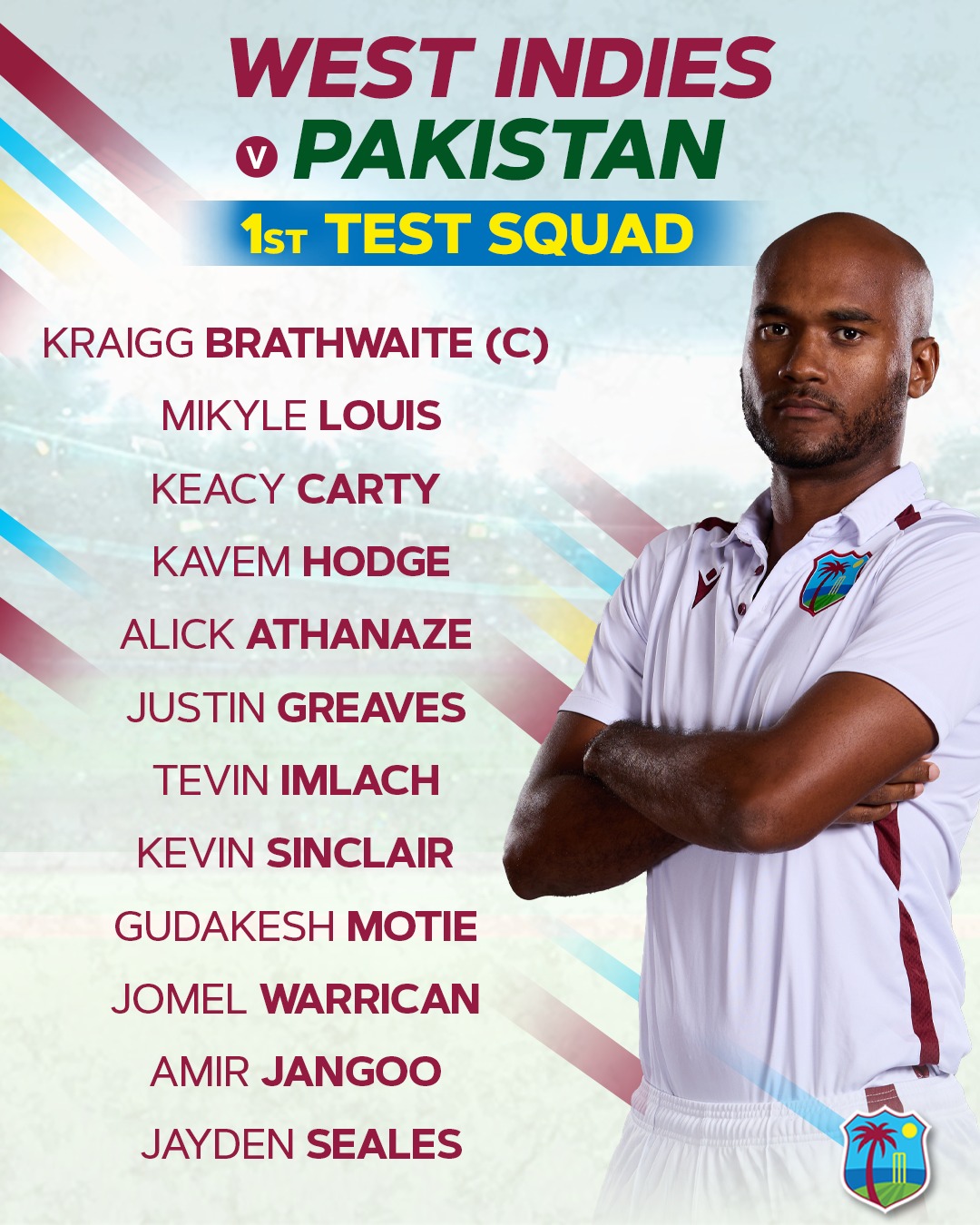
PAK vs WI: Play ends on day 1 after match stopped abruptly due to bad light

PAK vs WI: Play ends on day 1 after match stopped abruptly due to bad light

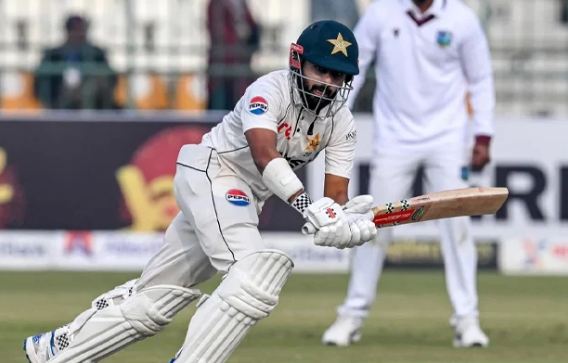
MULTAN: The play on the first day of the first Test between Pakistan and West Indies ended abruptly due to bad light as Mohammad Rizwan and Saud Shakeel continued batting after visiting side’s Jayden Seales dismissed three batters on Friday. 

Earlier, Pakistan had opted to bat first after winning the toss.

The toss, scheduled to take place at 9am, was delayed for hours because of dense fog in the city. It was finally staged at 1pm.

Play began and Jayden Seales struck thrice against Pakistan on a surface specifically made for spin but it was a pacer who send debutant Mohammad Hurraira, Kamran Ghulam and Babar Azam back for single figures putting Pakistan at 46-4 before Rizwan and Saud took control.

Rizwan and Saud batted steadily and ended the day’s play on scores of 51 and 56 respectively.

Play had to be stopped abruptly due to bad light and a few moments later, stumps was announced.

Pakistan will begin batting tomorrow as the scoreboard ticks on 143-4. 

Pakistan aim to finish the ICC World Test Championship 2023-25 on a winning note. The second Test will also be played at the same venue from January 25.

West Indies, who are playing a Test match in Pakistan for the first time since December 2006, are currently positioned at the bottom of the ICC World Test Championship table. In the last Test series between the two sides here, PCB Hall of Famer Inzamam-ul-Haq led the home side to a 2-0 win in three-match Test series.

Green Shirts and Men in Maroon last faced each other in the red-ball format in 2021 in West Indies, where the two-match series was levelled 1-1.

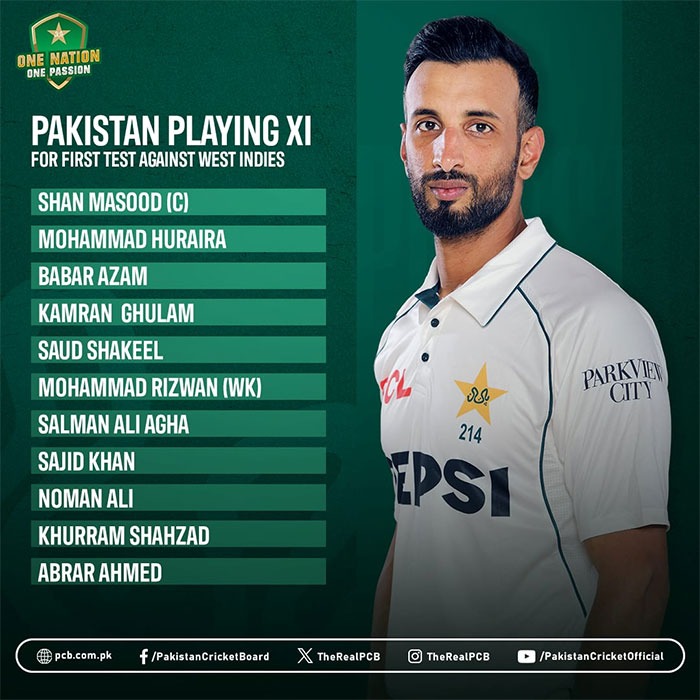
Pakistan under the leadership of Shan Masood are looking to win their second consecutive home series after they defeated England 2-1 in October 2024.

Men in Green’s 15-member squad has undergone three days of extensive training, while Kraigg Brathwaite-led side practiced for two days at the picturesque Multan Cricket Stadium. The touring side also featured in a three-day warm-up game against Pakistan Shaheens at the Islamabad Club in Islamabad last week.

The home side squad comprises of three uncapped players — Kashif Ali (right-arm fast bowler), Mohammad Huraira (right-handed batter) and Rohail Nazir (wicketkeeper-batter), while Abrar Ahmed, Imam-ul-Haq, Mohammad Ali and Sajid Khan have been recalled to the side.

Abrar and Sajid require 11 and six wickets, respectively to complete their 50 Test wickets each.

In his remarks, Shan said it was their last Test series of the current ICC World Test Championship cycle, and they would like to finish it on a winning note.

Every match in the format held great importance, and they were committed to giving it their all to end the campaign with a memorable series win, he added.

“West Indies are a decent side with a lot of talented players. They bring a unique style to the game, and we know they will push us hard. Test cricket is about adapting to challenges, and as a team, we are prepared to respond to whatever comes our way.

“The series win against England at home has given us a lot of confidence and momentum. We are fully focused on putting in strong performances and carrying forward that winning attitude.”

Whereas, Brathwaite, West Indies’ Test captain, said they were very excited to be here in Pakistan. He personally had never come to Pakistan before and probably majority of players were also touring for the first time and they were really looking forward to doing well in the series, he maintained. Pakistan were a strong side at home, so they looked forward to doing well in the conditions, he said.

“Our team’s performance will be quite crucial here, and obviously putting runs on the board is important but taking 20 wickets will be the key to win the Test match.

PAK vs WI: Play ends on day 1 after match stopped abruptly due to bad light

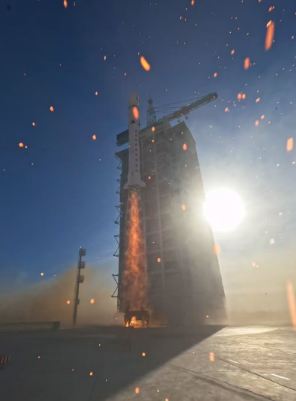
Pakistan Makes Space History: Indigenous EO-1 Satellite successfully launched

Pakistan Makes Space History: Indigenous EO-1 Satellite successfully launched

Rawalpindi, JAN 17 /DNA/ – Launch of Pakistan’s Indigenous Electro-Optical (EO-1) Satellite on 17 Jan 25 marks a momentous milestone in Pakistan’s space journey.

The EO-1 satellite offers substantial benefits across various sectors in Pakistan. In agriculture, it will enable precision farming by monitoring crops, assessing irrigation needs, predicting yields, and supporting food security initiatives. For urban development planning, the satellite will assist in tracking infrastructure growth and, managing urban sprawl.

In environmental monitoring and disaster management, it will provide timely updates on floods, landslides, earthquakes, deforestation, and land erosion. Additionally, it will support monitoring of minerals, oil and gas fields, glacier recession, and water resources.

This achievement is set to position advanced space technology capabilities at the forefront of national progress and development, aligning with the goals of National Space Policy.

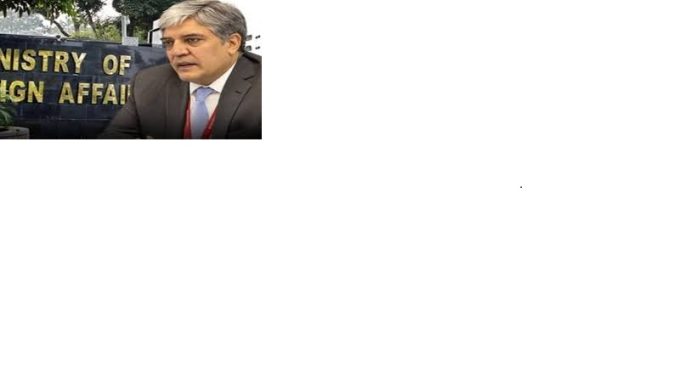
Wakhan Corridor part of Afghanistan; annexation reports “speculative and erroneous”: FO spox

ISLAMABAD, Pakistan on Thursday categorically rejected the reports of any annexation of Wakhan Corridor, calling it a part of neighboring Afghanistan; however, it reiterated the call for the Afghan government to act against the terrorist groups enjoying sanctuaries across the border.

“I have seen this endless speculation. Wakhan is part of Afghan territory. Afghanistan is a neighboring country. We recognize its sovereignty and territorial integrity. There is no question of Pakistan having designs on one of its neighbors. I deem it speculative and totally erroneous actually,” the newly appointed Foreign Office spokesperson Shafqat Ali Khan said in his maiden weekly press briefing.

He said that both Pakistan and Afghanistan understood the importance of relations and wanted to nurture good ties but the key problem was the terrorists’ sanctuaries on Afghan soil.

He said both countries were in contact on the matter through an ongoing multilayered engagement.

The spokesperson said that Pakistan welcomed the Gaza ceasefire, reached on Wednesday and called for its immediate and full implementation. It is hoped that the truce would lead to a permanent ceasefire and help in scaling up humanitarian assistance.

“Indiscriminate use of force by Israeli occupation forces has caused unprecedented loss of lives and property and displacements of hundreds of thousands of innocent civilian Palestinians. Israel’s expansionist designs have destabilised the entire region,” he remarked.

He also reiterated Pakistan’s support for a just, comprehensive, and durable solution to the Palestinian issue, leading to the establishment of a sovereign State of Palestine based on the pre-June 1967 borders, with Al-Quds Al-Sharif as its capital.

The spokesperson expressed deep concern over the increasingly racist and Islamophobic political and media commentary in the UK aimed at conflating the reprehensible actions of a few individuals with the entire 1.7 million British Pakistani diaspora.

Strongly rejecting the “baseless” accusations and “unfounded” assertions made by India’s Defence Minister and Chief of Army Staff on January 13 and 14, he said Jammu and Kashmir remained an internationally recognized disputed territory, whose final status was to be determined in accordance with relevant United Nations Security Council (UNSC) resolutions and the aspirations of the Kashmiri people.

“In this context, India has no legal or moral grounds to assert fictitious claims over the territories of Azad Jammu and Kashmir and Gilgit-Baltistan.”

The spokesperson referred to the hosting of the international conference on girls’ education in Islamabad last week attended by Prime Minister Shehbaz Sharif; Secretary General OIC Hissein Brahim Taha; Muslim World League Secretary General and Chairman of the Organization of Muslim Scholars Sheikh Dr. Mohammed bin Abdul Karim Al-Issa, besides high-level officials, ministers and dignitaries from a number of other Islamic countries.

He said that the Islamabad Declaration, adopted by the moot, “underscored girls’ education as a fundamental right protected by divine laws, Islamic teachings, and international charters and further emphasized aligning education with Islamic principles, national priorities, and global advancements, aiming to empower women and foster stable and peaceful communities.”

He told the media that at the Fourth Round of Pakistan-China Bilateral Political Consultations (BPC) and the Fifth meeting of the CPEC Joint Working Group on International Cooperation and Coordination (JWG-ICC) held in Beijing, the two sides noted with satisfaction the positive trajectory of Pakistan-China relations and reaffirmed the commitment to further deepen the All-Weather Strategic Cooperative Partnership.

They underscored the need to reinforce their mutual coordination at the multilateral forums, including at the United Nations Security Council, and exchanged views on a range of regional and international issues.

To a question, he said that Pakistan would work to send more humanitarian convoys to Gaza once the relief aid starts moving into the territory, following the ceasefire deal.

He told the media that Pakistan’s ambassador in Washington would attend the inauguration of US President-elect Donald Trump, and the reported invite to Pakistan Peoples of Party Chairman Bilawal Bhutto was not routed through the foreign ministry.

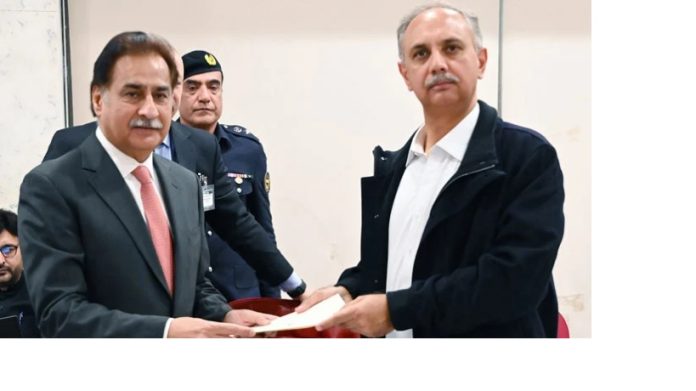
PTI demands CJP-led probe into May 9, Nov 26 events, political prisoners’ release

ISLAMABAD, JAN 16 (DNA): The Pakistan Tehreek-e-Insaf (PIT) on Thursday finally presented its demands in writing, seeking probes into the May 9, 2023, and November 26, 2024 events, as well as the release of “political prisoners”.

PTI’s ‘Charter of Demands’ says if The government fails to constitute two separate commissions on the violent events, the party will not continue the negotiations.

In the three-page document, the PTI mentioned that the party and its allies have travelled through “blood and gore” and their leader Khan and thousands of our supporters have faced “unjustified imprisonment”.

The document mentioned that the party entered into negotiations with the “government installed in Islamabad” in order to take the fight for the people’s rights onwards.

“The Charter of Demands is presented as a prerequisite to wider negotiations with respect to the restoration of the Constitution, the rule of law and respect for the people’s mandate, free and fair elections.”

In the previous two rounds, with the first taking place on December 27, 2024 followed by a second session on January 2, 2025, the party did not present its demands as they awaited Khan’s nod.

However, after much ado, the PTI negotiatiors were allowed to meet the PTI founder — behind bars at Rawalpindi’s Adiala jail — who gave them comprehensive instructions, based on which their demands were finalised.

Ahead of the meeting, spokesperson for the government committee, Irfan Siddiqui, said that all seven coalition partners will submit PTI’s demands to their party leaders.

What are PTI’s demands?

The party has demanded that the government form two commissions —which will comprise the Chief Justice of Pakistan or three serving judges of the Supreme Court of Pakistan, mutually nominated by the PTI and the government within seven days.

“The conduct of the proceedings of the two Commissions must be open to the general public as well as the media,” the party mentioned in the document.

First commission

As per the document, the first commission will be tasked to conduct an in-depth inquiry into the legality of the events that led to the arrest of Khan on May 9, 2023.

The commission will also investigate the legality of the manner of the arrest and those responsible for the break-in into the premises of the Islamabad High Court — from where Khan was arrested — by the Rangers and the police.

The events across the country after the arrest of Khan, in particular the circumstances in which groups of individuals were able to reach various high-security locations at which damage to property is said to have been caused, should also be investigated, the PTI said.

CCTV recordings at each location where damage is said to have been caused by protesters should be probed and if CCTV footage is not available, the causes of this lack of availability should be determined.

The manner in which those arrested in connection with the events of May 9 were apprehended and then kept in custody as well as the circumstances of their release should be inquired, the document said.

Did the authorities violate the human rights of these individuals, including through torture? How were the lists of those to be arrested compiled and determined?

It should also be inquired whether multiple FIRs were registered against the same individual with respect to May 9, 2023, and sequential arrests carried out in abuse of the process of the law.

The PTI demanded an inquiry into instances of media censorship, restrictions on reporting related to the incident, and the harassment of journalists.

“Examine the vires and legality of government’s imposition of internet shutdowns and its impact before, during and after the unrest and fix responsibility.”

Second commission

This second body should be tasked to carry out an in-depth inquiry into the events of November 24 to 27, 2024 in Islamabad — the days when the party, led by KP CM Gandapur and Khan’s wife Bushra Bibi, marched to Islamabad.

The PTI demaned that it should be inquired that was there firing of live ammunition and other forms of physical assault on the protestors in Islamabad.

“If so, who ordered the use of live ammunition and other violent actions against the protestors? To what extent was the use of force excessive? If so, who was responsible for the excessive use of force?”

The number of people killed and the injured and of the persons who went missing after the November protest should be brought to light, the PTI demanded.

The commission should also examine and ascertain the state of the CCTV recordings at the various hospitals and medical facilities in Islamabad with respect to the said period, the document mentioned.

Moreover, it should be probed whether the records of hospitals and other medical facilities tampered with, if so, under whose directions and command was this done? “Were the hospitals prevented from releasing information about the fatalities and the injuries?”

“Examine and ascertain the state of the CCTV footage recorded at the various premises from China Chowk to D Chowk in the Blue Area, Islamabad.”

The party also demanded that it should be inquired what difficulties were faced by those seeking to register FIRs and initiate other legal action with respect to the events of November 24 to 27.

The second commission should also review media censorship and restrictions on reporting related to the incident, including the harassment of journalists, it added.

“[It should also] examine the vires and legality of the government’s imposition of internet shutdowns and its impact before, during and after the unrest and fix responsibility.”

USA Boosts Military, Names China Top Adversary

Qamar Bashir

USA Boosts Military, Names China Top Adversary

Stay Connected

64FansLike
60FollowersFollow

Latest Reviews

Exchange Rates

USD - United States Dollar
EUR
1.17
GBP
1.35
AUD
0.72
CAD
0.73