Home Blog Page 688

Declining inflation: ECC urges measures for tangible relief to common man

Declining inflation: ECC urges measures for tangible relief to common man

ISLAMABAD, FEB 3 /DNA/ – The Economic Coordination Committee (ECC) of the Cabinet met today under the chairmanship of Federal Minister for Finance and Revenue, Senator Muhammad Aurangzeb. Besides the regular agenda, the meeting focused on reviewing the trends in inflation and the prices of essential commodities, as presented by the Economic Advisor’s Wing of the Finance Division.

At the outset, the ECC conducted a monthly review of inflation trends as per its earlier decision. The Cabinet body was informed that inflation during the first half of FY2025 (July-December) had decreased significantly to 7.2%, compared to 28.8% during the same period last year. Additionally, inflation for the month of December 2025 was recorded at 4.1%, a sharp reduction from 29.7% in December 2024. This marked the lowest inflation rate in 80 months, largely owing to exchange rate stability, prudent fiscal management, and improved supply arrangements of essential items across the country.

The ECC expressed satisfaction with the ongoing decline in the Sensitive Price Index (SPI) over the past few weeks. However, the chair emphasized that the reduction in core inflation, average inflation, and the downward price trends should translate into tangible relief for the common man.

Despite positive trends, the Committee expressed concern over the rising prices of sugar, vegetables, and edible oil, particularly in light of declining prices in the international market. To address this, the ECC directed the Ministry of Industries and Production and the Ministry of National Food Security & Research to collaborate with the National Price Monitoring Committee (NPMC) and report back to the ECC within two weeks with measures to ensure the maintenance of strategic reserves of wheat, sugar, and pulses, as well as to improve the supply chains of essential items ahead of the holy month of Ramadan.

Furthermore, the ECC called upon Provincial Price Control Committees to enforce strict compliance with the price control mechanism, curb cartelization, and prevent undue profiteering in order to protect consumers from unfair price hikes. The Chair reaffirmed the government’s resolve and commitment to ensuring the availability of essential commodities at affordable prices for the people of Pakistan.

Amongst the regular agenda, the ECC approved a summary submitted by the Revenue Division for introduction of necessary policy interventions in the Export Facilitation Scheme (EFS) 2021 with a view to plugging revenue leakages without disturbing the compliant exporters. The proposed changes in the EFS seek reduction in input utilization period, input authorization based on production capacity/input-output ratio, replacement of insurance guarantees with bank guarantees, vendor facilitation controls, drawal of samples to ensure the utilization of imported input in the exported goods, and withdrawal of EFS facility from importers of iron and steel scrap. 

The ECC also approved another proposal by the Revenue Division for release of a technical supplementary grant of Rs 2.79 billion for procurement of arms & ammunition component and engaging Nespak as design consultant for Digital Enforcement Stations (DES) and check posts.  

The ECC also considered and approved a proposal by the Ministry of Interior for release of a technical supplementary grant (TSG) of Rs. 494.56 million to Frontier Corps KP (North) for construction of barracks and check posts. Regarding another proposal by the Interior Division for release of a TSG of Rs 1.792 billion for smooth conduct of Reko Diq project activities as per MoU/agreement executed with the Reko-Diq Mining Company, the ECC directed the proposal be put up again in the next meeting with clear visibility of how the requisite grant was meant to be spent as regular funds were already allocated for the current expenditure.

The Cabinet body also considered and approved a summary by the Power Division seeking amendment to a 16th February 2024 mediation agreement pertaining to claims of KE for tariff differential subsidy and KWSB and payables of KE to different state-owned enterprises (CPPA/NTDC and SSGC), with the proviso that it would not lead to any increase in the tariff.

Finally, a proposal from the Intelligence Bureau Division for provision of a TSG of Rs 500 million was also considered and approved.
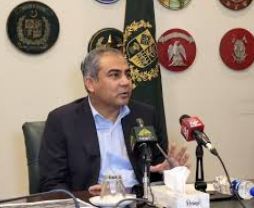
Rule of law and governance-driven approach termed vital for restructuring Pak-Afghan ties

Rule of law and governance-driven approach termed vital for restructuring Pak-Afghan ties

ISLAMABAD, FEB 3 /DNA/ – Restructuring Pakistan-Afghanistan relations requires a departure from short-term policy fixes toward a comprehensive, strategic, and governance-driven approach. Since the erosion of the rule of law and the spread of divisive rhetoric fuel mistrust and instability, this approach must prioritize mutual recognition of sovereignty, the rejection of polarizing narratives, the restoration of the rule of law, public ownership in law enforcement, and institutional integrity.

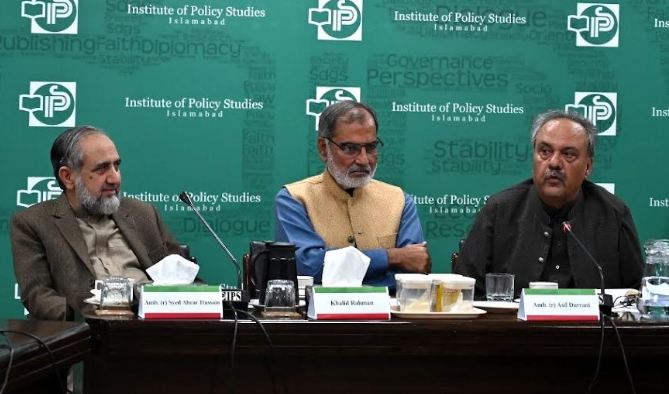
The views were reflected during a discussion followed by the keynote speech of Ambassador (r) Asif Durrani, Pakistan’s former special representative on Afghanistan, in a roundtable on “Geopolitical Imperatives: Redefining Pakistan-Afghanistan Relations in a Post-Taliban Era,” held at the Institute of Policy Studies (IPS), Islamabad.

The session was addressed by Khalid Rahman, chairman IPS, Brigadier (r) Said Nazir, defense analyst, Noor-ul-Ain Naseem, policy advisor, GIZ, Dr Farhat Taj, associate professor, University of Tromsø, Norway,  Ambassador (r) Syed Abrar Hussain, Ambassador (r) Ayaz Wazir, Dr Lutfur Rehman, an expert on FATA affairs, and other academics, former officials and policy experts.

Ambassador (r) Asif Durrani highlighted that geopolitical challenges in Pak-Afghan relations, such as the complex tribal dynamics, cross-border trade issues, and refugee management, cannot be managed through conventional diplomacy or a garrison approach. Instead, a governance-driven approach rooted in mutual recognition of sovereignty and an inclusive understanding of regional complexities is needed for lasting stability in all dimensions of this bilateral relationship.

He identified the erosion of the rule of law, amplified by the war economy of the 1990s that disrupted centuries-old trade and communal ties, as a key destabilizing factor in Pak-Afghan relations. He cautioned that governance failures, corruption, and mismanagement in areas like refugee policies, border security, and transit trade have further deepened lawlessness, making institutional restructuring imperative. To restore stability, he stressed the urgent need for institutional reforms, strengthening law enforcement through an empowered police force, and fostering public ownership of governance mechanisms.

Durrani also highlighted the detrimental impact of political narratives that fuel mistrust, with visible implications in people-to-people contact and economic cooperation. Given Afghanistan’s dependence on trade via Pakistan, he called for a pragmatic approach at both the leadership and public levels, which rejects divisive rhetoric and views bilateral relations as a strategic strength.

Endorsing this, the speakers noted that Pakistan-Afghanistan relations have long fluctuated between confrontation and appeasement, neither of which has delivered sustainable stability. For this, a more balanced strategy that integrates deterrence, development, and engagement is required. The panelists also underscored the importance of a regional approach, wherein Afghanistan’s neighboring states play a greater role in trade, border management, and people-to-people connectivity. This, they argued, would ensure that Afghanistan engages constructively with the broader region.

The speakers further identified the absence of structured public discourse on Pakistan-Afghanistan policy. They called for scholarly engagement and research-driven policymaking to develop informed, long-term strategies. They stressed that both sides must acknowledge historical complexities in any policy framework to ensure a people-centric approach that moves beyond reactive political maneuvering and fosters mutual trust.

In concluding remarks, Khalid Rahman emphasized that the blame game is counterproductive and does not resolve longstanding issues. He pointed out that poor governance lies at the heart of bilateral challenges, and without addressing this fundamental issue, policy measures will remain ineffective. He further noted that projecting a positive narrative focused on mutual strengths is critical. He stressed both countries must prioritize good governance, institutional stability, and a well-defined national narrative to foster regional stability and cooperation. 

Interior Minister Naqvi lauds ANF’s $10 billion drug seizures in 2023

Interior Minister Naqvi lauds ANF's $10 billion drug seizures in 2023

LAHORE, FEB 3: /DNA/ – Federal Interior Minister Mohsin Naqvi has commended the Anti-Narcotics Force (ANF) for its effective operations against the drug trafficking against drug mafia across Pakistan. He directed the ANF to continue its crackdown on elements involved in selling narcotics, especially “ice,” in schools and colleges.

The Interior Minister emphasized the need to enhance security checks at airports to prevent narcotics smuggling. He also called for indiscriminate action against elements using drones to smuggle narcotics in border areas.

The Interior Minister praised the ANF’s performance, despite limited resources, in seizing narcotics worth approximately $10 billion in 2,150 operations last year. He congratulated the ANF team, led by Director General Major General Abdul Mueed, on securing the release and return of a Pakistani family detained in Saudi Arabia.

Moreover, Interior and Narcotics Control Minister chaired a special meeting in which major decisions were taken to curb the sale and purchase of narcotics. The meeting was attended by Major General Abdul Mueed, Regional Director Brigadier Sikandar Hayat, and Director Enforcement Brigadier Imran.

Romanian Ambassador, Pakistan Business Council chart new course for bilateral growth

Romanian Ambassador, Pakistan Business Council chart new course for bilateral growth

KARACHI, FEB 3 /DNA/ – Romanian Ambassador Dan Stoenescu met with the board of Pakistan-Romania Business Council today in a significant step toward enhancing bilateral relations between the two nations.

The meeting focused on developing a comprehensive roadmap to strengthen business relationships and expand cooperation across multiple sectors.

Key areas of discussion included trade enhancement initiatives, cultural exchange programs, media collaboration, educational partnerships, and tourism development opportunities.

Ambassador Stoenescu engaged in detailed discussions with the board members to identify concrete steps for implementing various projects aimed at boosting economic and cultural ties between Pakistan and Romania.

The Pakistan-Romania Business Council serves as a vital platform for fostering business connections and promoting bilateral trade between the two countries.

Inflation falls sharply to 2.4% in January

Inflation falls sharply to 2.4% in January

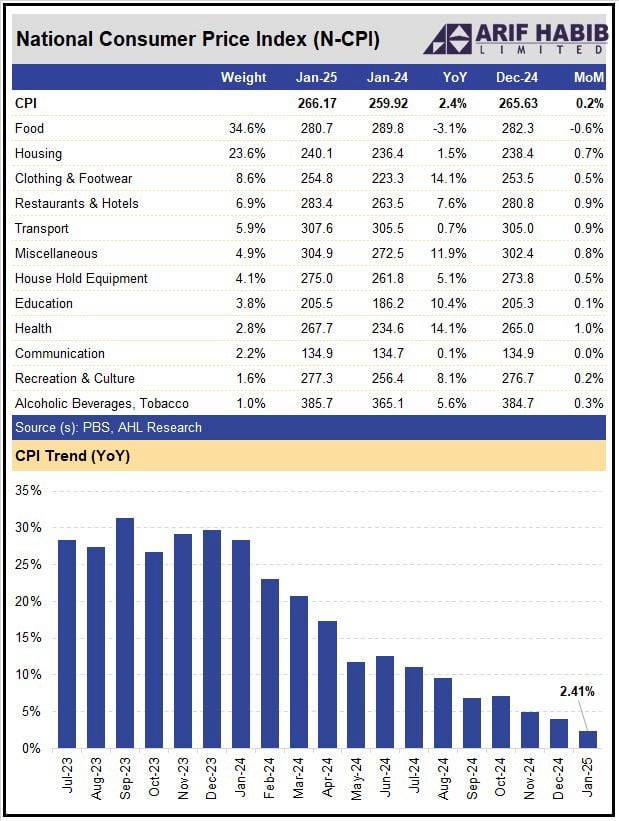
KARACHI: Consumer price index (CPI) inflation eased significantly to 2.4% year-on-year in January 2025, down from 4.1% in December and a staggering 28.3% recorded in January 2024, according to data released by the Pakistan Bureau of Statistics (PBS) on Monday.

This marks the lowest inflation in over two years, reflecting easing price pressures across both urban and rural areas. On a month-on-month basis, CPI inflation edged up slightly by 0.2% in January, compared to a 0.1% increase in the previous month and a 1.8% rise in January 2024.

According to brokerage firm Topline Securities, inflation during 7MFY25 has averaged 6.5% compared to 28.73% in 7MFY24.

PBS data shows that urban inflation declined to 2.7% year-on-year, compared to 4.4% in December and 30.2% a year earlier. On a monthly basis, urban inflation rose by 0.2%, reversing a 0.1% decline in December 2024.

Inflation falls sharply to 2.4% in January

Rural inflation followed a similar trend, falling to 1.9% year-on-year in January, down from 3.6% in December and 25.7% in January 2024. Month-on-month, rural inflation rose by 0.2%, slightly lower than the 0.3% increase recorded in the previous month.

The Sensitive Price Index (SPI), which tracks the prices of essential commodities, dropped sharply to 0.7% year-on-year in January, compared to 4.2% in December and 36.2% in January 2024.

On a monthly basis, SPI inflation fell by 1.4%, reversing a 0.8% increase the previous month.

Meanwhile, the Wholesale Price Index (WPI) inflation slowed to 0.6% year-on-year in January, down from 1.9% in December and 27.0% in the same month last year. On a monthly basis, WPI inflation inched up by 0.2%, following a 0.4% decline in December 2024.

Core inflation, measured by excluding food and energy prices, also showed a downward trend. In urban areas, core inflation fell to 7.8% year-on-year in January from 8.1% in December and 17.8% in January 2024. Month-on-month, it rose by 0.8%, compared to a 0.2% increase in December.

In rural areas, core inflation decreased to 10.4% year-on-year, down from 10.7% in the previous month and 24.6% a year earlier. On a monthly basis, it increased by 0.9%, slightly higher than the 0.6% rise recorded in December.

The 20% weighted trimmed mean core inflation — a measure that excludes extreme price changes — dropped to 5.4% year-on-year in both urban and rural areas. This is down from 6.2% (urban) and 6.5% (rural) in December, and significantly lower than the 22.1% and 25.8% recorded in January 2024.

On a month-on-month basis, trimmed mean core inflation rose by 0.6% in urban areas and 0.7% in rural areas, compared to 0.1% and 0.6% increases, respectively, in December.

PM strongly condemns attacks on polio vaccination teams in KP

PM strongly condemns attacks on polio vaccination teams in KP

ISLAMABAD, Feb 03 (APP/DNA): Prime Minister Muhammad Shehbaz Sharif on Monday strongly condemned two separate attacks on polio vaccination teams in Bakrabad and Jamrud areas of Khyber Pakhtunkhwa.

The prime minister expresses deep sorrow and grief over the martyrdom of police personnel assigned to protect the polio teams, PM Office Media Wing said in a press release.

The prime minister prayed for the departed souls and for grant of strength and patience for their families.

“The entire nation salutes the polio workers who risk their lives to be part of the campaign to eradicate polio from the country,” he added.

The prime minister said that the sacrifices of polio teams and the security personnel protecting them would not go in vain.

He further said the anti-polio campaign would continue with full determination despite all challenges, adding that they were committed to the complete eradication of polio from the country.

Belgium moves to the right as new PM De Wever sworn in

Belgium moves to the right as new PM De Wever sworn in

BRUSSELS, BELGIUM, FEB 3 (AFP/APP): Conservative Bart De Wever was sworn in Monday as Belgium’s new prime minister, after striking a hard-fought coalition deal that moves the country to the right.

                  Struck late Friday after seven months of tortuous negotiations, the agreement makes De Wever the first nationalist from Dutch-speaking Flanders to be named Belgian premier.

                  The 54-year-old — who in recent years has backed off on calls for Flanders to become an independent country — took the oath of office before King Philippe, in a ceremony at the royal palace in Brussels.

                  From there, he was expected to head straight to a gathering of EU leaders a few blocks away, for talks on defence and transatlantic relations.

                  Split between French- and Dutch-speaking communities and with a highly complex political system, Belgium has an unenviable record of painfully protracted coalition discussions — reaching 541 days back in 2010-2011.

                  This time around, five groups sought to forge a coalition after June elections that failed to produce a clear majority — with talks led by De Wever’s conservative N-VA which claimed the most seats.

                  – 60-hour marathon –

                  The new government brings together three parties from Dutch-speaking Flanders: De Wever’s N-VA, the centrist Christian-Democrats and the leftist Vooruit (Onward).

                  And it includes two from French-speaking Wallonia: the centrist Les Engages and the centre-right Reformist Movement.

                  Together, they hold an 81-seat majority in Belgium’s 150-seat parliament.

                  Coalition talks hit a wall during the summer over the issue of plugging the country’s budget deficit — 4.4 percent of gross domestic product in 2023.

                  Belgium is one of seven European Union countries facing disciplinary action for running a deficit above three percent of GDP, in violation of the bloc’s fiscal rules.

                  De Wever, the mayor of Antwerp since 2013, has pushed for cuts in social benefits and pension reforms that have already sparked opposition from labour unions.

                  He had threatened to throw in the towel if no coalition deal was reached Friday.

                  An agreement was struck with just hours to go after a 60-hour marathon session to iron out differences over an 800-page programme. 

                  De Wever’s N-VA was already part of a right-leaning ruling coalition between 2014 and 2018.

                  He takes over from outgoing prime minister Alexander De Croo, whose seven-party coalition took an arduous 493 days to emerge back in 2019-2020.

                  De Croo had stayed on as caretaker leader after the June elections.

Trump’s Adventures Imperil the U.S. and the World

Qamar Bashir

By: Qamar Bashir

Macomb, Detroit, Michigan

President Trump’s most important and election-winning promises was to reduce inflation, a concern that has been hitting American households hard, especially blue-collar working families. He outlined a two-pronged approach to achieving this: first, by expanding domestic oil drilling to lower energy costs and, second, by generating revenue through tariffs on imports. According to Trump, tapping into America’s vast oil reserves would bring down fuel prices, which in turn would help control inflation and stabilize the economy. However, instead of prioritizing the necessary investment, technological infrastructure, and workforce needed to ramp up domestic oil production, he implemented his vision in reverse.

Rather than first developing oil wells, refining capacity, and supply chain mechanisms to ensure a steady, affordable domestic energy supply, Trump swiftly imposed tariffs on imports from Canada, Mexico, China and many other countries.

The tariffs on Mexican, Canadian, and Chinese products cover several crucial imports essential to the U.S. economy. The tariffs on Mexican goods target vehicles valued at $115 billion, machinery worth $66 billion, and electrical machinery totaling $64 billion. Canadian imports hit by tariffs include mineral fuels (primarily crude oil) amounting to $120 billion, vehicles at $56 billion, and machinery valued at $45 billion. From China, the affected imports include electrical machinery worth $152 billion, machinery at $117 billion, and furniture and bedding totaling $35 billion. These imports play a critical role in manufacturing, energy, and consumer goods sectors across the U.S.

Meanwhile, counter-tariffs imposed by Mexico, Canada, and China impact $323.23 billion in U.S. exports to Mexico, $291 billion to Canada, and $148 billion to China. U.S. exports to Mexico include electrical and electronic equipment, machinery, nuclear reactors, mineral fuels and oils ($45.07 billion), vehicles ($28.36 billion), and plastics ($21.2 billion). Exports to Canada primarily consist of automobiles, energy products, machinery, and agricultural goods, while shipments to China are largely agriculture, semiconductors, and industrial machinery. These retaliatory tariffs threaten to reduce U.S. export competitiveness, further straining industries already impacted by rising costs.

The increased cost of all imports  will exacerbate the production costs for domestic manufacturers and retailers. Concurrently, the retaliatory tariffs will make American goods less competitive abroad, reducing demand and hurting industries like agriculture, automotive, and manufacturing.

Consequently, the Consumer Price Index (CPI), will rise pushing up the prices of fruits, vegetables, dairy, and meat, directly affecting household budgets. As inflation will rise, real wages will lose value, meaning that even if incomes remain the same, purchasing power will decrease, forcing American families to spend more on essential goods and services while cutting back on discretionary spending. This would create a ripple effect on the broader economy, reducing consumer demand and slowing business growth.

To counter inflation, the Federal Reserve is expected to raise interest rates triggering economic stagnation or even a recession. Higher interest rates will make business loans, mortgages, and personal credit more expensive, leading to reduced investments and spending leading to layoffs and reduced hiring across multiple sectors. Moreover, as borrowing costs will rise, homeownership and auto purchases could decline, further affecting real estate and consumer goods markets leading to prolonging economic distress, squeezing household budgets, and reducing overall economic growth.

Countries like Canada and Mexico are hurt not just by the imposition of tariffs but even more by what they perceive as a deep sense of betrayal by the United States. For decades, these nations have been reduced to near-vassal states, fully supporting U.S. policies and aligning themselves with American geopolitical adventures, even in conflicts where they had no direct role or stake.

Both Canada and Mexico stood by the U.S. in its wars and interventions, including the war against Russia, the invasions of Iraq and Libya, military actions in Yemen, Iran, and Afghanistan, and the broader War on Terror. They committed soldiers, resources, diplomatic backing, and moral support without questioning U.S. motives, often bearing the consequences of American foreign policy missteps.

Despite the risks and blowback, they remained steadfast allies, following Washington’s lead without hesitation. They were among the first to extend sincere aid during natural disasters, including the recent California wildfires, proving their loyalty and goodwill time and again. Yet, instead of appreciation, they now find themselves targeted by heavy tariffs, straining relations and leaving them feeling abandoned by the very country they stood by through thick and thin.

The unpredictability of President Trump is beginning to take its toll across the continent, creating a sense of uncertainty and unease. It seems as if the entire world has been caught in a whirlwind, with global powers struggling to anticipate his next move. Europe is growing increasingly nervous over Trump’s rhetoric about occupying Greenland and his potential withdrawal or reduction of U.S. commitments to NATO, which could jeopardize the security of the entire region.

In the Middle East, Trump’s controversial proposal to relocate the entire Palestinian population to Jordan and Egypt has ignited a geopolitical storm, further destabilizing an already volatile region. Meanwhile, his plans to assert U.S. control over the Panama Canal have sent shockwaves through Latin America, escalating tensions in an already turbulent political landscape. Additionally, his aggressive deportation of undocumented immigrants has triggered a human rights crisis, drawing widespread condemnation both domestically and internationally. Perhaps most alarming is his suggestion to annex Canada as the 51st state of the United States, a move that has sparked deep anxiety across the American continent and raised serious diplomatic concerns.

Historically, such expansionist ambitions have been associated with figures like Genghis Khan, the Crusaders, Nazi Germany, and the Soviet Union, where large-scale movements aimed to impose their will on the rest of the world. However, Trump’s success or failure will ultimately hinge on his domestic economic performance. If his adventurous foreign policies generate nationalistic support, they may boost his popularity among his base. However, if he fails to curb inflation and stabilize the U.S. economy in the short term, he may face an early downfall, with economic distress overshadowing his global ambitions.

By: Qamar Bashir

Press Secretary to the President (Rtd)

Former Press Minister at Embassy of Pakistan to France

Former MD, SRBC

Kashmir and Pakistan: A Union of Faith, History, and Destiny

Kashmir and Pakistan: A Union of Faith, History, and Destiny

by Muhammad Mohsin Iqbal

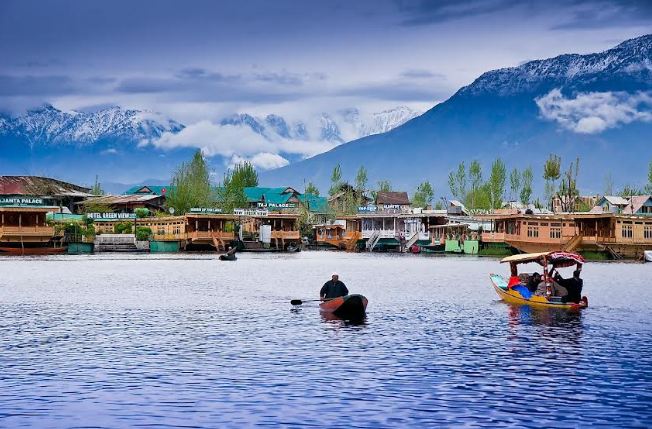
Kashmir has always held a central place in the heart of Pakistan, not merely as a geographical entity but as an inseparable part of its ideological and strategic framework. Its significance transcends political disputes and territorial claims, deeply intertwining with the spiritual, economic, and historical essence of Pakistan. It was this profound connection that led Quaid-e-Azam Muhammad Ali Jinnah to declare, “Kashmir is the jugular vein of Pakistan.” This statement was neither rhetorical nor confined to a mere strategic perspective; rather, it encapsulated the essence of Kashmir’s integral role in the very identity of Pakistan.

Kashmir and Pakistan: A Union of Faith, History, and Destiny

Religiously, Kashmir is an inseparable part of the Muslim world. Islam spread across the valley centuries ago, shaping its culture, traditions, and way of life. The region has produced renowned saints and scholars who played a vital role in spreading Islamic teachings across South Asia. The majority of Kashmir’s population, adhering to Islam, has historically maintained strong religious, cultural, and emotional ties with the Muslims of Pakistan. The Partition of 1947 was a manifestation of the Two-Nation Theory, based on the distinct religious and cultural identities of Muslims and Hindus. It was, therefore, only natural that Kashmir, with its overwhelming Muslim majority, would align with Pakistan. However, the unjust and forceful occupation of the region by India contradicted the very basis of this division, leading to an unresolved conflict that continues to weigh heavily on the collective conscience of the Muslim world.

The struggle of the Kashmiri people for self-determination is not just a political battle; it is a religious duty for Pakistan to support them. The oppression, persecution, and human rights violations inflicted upon the people of Kashmir are a grave concern for the Muslim Ummah. The desecration of mosques, restrictions on religious gatherings, and brutal crackdowns during Islamic observances underscore the systematic efforts to suppress their faith. The spirit of Muslim brotherhood and the obligation to stand against injustice make Kashmir a cause that resonates deeply with Pakistanis. It is not just a land dispute; it is a matter of faith, dignity, and moral responsibility.

Beyond its religious significance, Kashmir is crucial for Pakistan’s survival and prosperity. The valley is the origin of the major rivers that sustain Pakistan’s agriculture, the backbone of its economy. The Indus, Jhelum, and Chenab rivers flow from the Himalayas through Kashmir into Pakistan, providing water for irrigation, drinking, and hydroelectric power generation. India’s control over these water sources poses a perpetual threat to Pakistan’s food and energy security. The Indus Waters Treaty, though an international agreement, has been repeatedly challenged by Indian policies aimed at altering the natural flow of these rivers. The potential weaponization of water remains an alarming possibility that underscores why Kashmir is more than just a territorial concern—it is a lifeline for Pakistan’s agricultural and economic stability.

The geographical position of Kashmir further elevates its strategic importance. It serves as a natural gateway between South Asia and Central Asia, making it a crucial point for trade, security, and defense. The Line of Control (LoC) remains a volatile frontier where tensions frequently escalate, demanding continuous vigilance from Pakistan’s armed forces. The presence of Indian military installations in the region and its growing defense cooperation with external powers threaten Pakistan’s security. Control over Kashmir, or at the very least, ensuring that it does not become a hub of hostility against Pakistan, is essential for maintaining regional stability.

Quaid-e-Azam’s assertion that Kashmir is Pakistan’s jugular vein was not just a statement of political ambition; it was an acknowledgment of an existential truth. The oppression of the Kashmiri people, the economic implications of losing control over water resources, and the broader strategic vulnerabilities make Kashmir an inseparable part of Pakistan’s national interest. The ideological connection, rooted in the very foundation of Pakistan, further cements its place in the national consciousness.

Sir Owen Dixon, the former UN mediator on Kashmir, observed in his report to the United Nations in 1950, “The only just solution to the Kashmir dispute is a plebiscite under international supervision, allowing the people to determine their own future.” Yet, despite international recognition of Kashmir as a disputed territory, the voices of its people continue to be suppressed.

For over seven decades, Pakistan has stood by Kashmir, advocating its cause on diplomatic fronts, raising its voice in international forums, and extending moral and material support to its people. While global powers have often remained indifferent or complicit in India’s oppressive policies, the resilience of the Kashmiri people and Pakistan’s unwavering stance continue to keep the issue alive. The challenge remains formidable, but history has shown that no force can permanently suppress the will of the people.

The significance of Kashmir for Pakistan is not a matter of debate; it is a reality deeply embedded in its national, religious, and strategic fabric. The vision of Quaid-e-Azam, the sacrifices of the Kashmiri people, and the continued struggle for their rightful place in the world remain a collective responsibility of Pakistan. It is a cause that transcends political divides and resonates with every heart that believes in justice, freedom, and faith. Kashmir is not just an issue; it is an unfinished chapter of history that demands resolution in accordance with the aspirations of its people. Until that day comes, Pakistan will continue to stand firm, for Kashmir is not just a part of its geography—it is its soul, its faith, and its jugular vein.

Atheism and Faith in the Age of Science

Atheism and Faith in the Age of Science

Rai Muhammad Zaka Ullah Khan

Human history is a testament to our relentless pursuit of progress. Every major human innovation since the wheel was created until today’s internet demonstrates a consistent goal to improve people’s lives through speed and connectivity. We now have the ability to deliver messages globally in seconds while video calls connect different continents instantly. But every leap forward casts a shadow.  The technologies designed to connect us can also create divisions between people especially when these technologies are used to discuss religious faith and beliefs. Islamic civilization faces its greatest test at the intersection of scientific progress and atheistic thought. Atheism arises from skeptical thinking and rational investigation which utilizes scientific methods to challenge established religious beliefs. Atheism extends beyond not believing in God by establishing a worldview that values empirical proof above spiritual feeling. The scientific exploration of the universe from the Big Bang to the human genome leads many people to consider religion obsolete. This viewpoint fails to recognize how faith-based moral and spiritual teachings have historically molded Islamic civilization.

Atheism wasn’t always a significant concern. During Prophet Muhammad’s (PBUH) time, it was a marginal idea, hardly worth discussing. But as science advanced, particularly in the West, atheism gained ground. The 17th century was pivotal, with scientists like Isaac Newton and Galileo challenging established cosmic views. By the 19th century, Charles Darwin’s theory of evolution became a focal point for atheists, providing a natural explanation for life’s diversity that seemed to bypass divine intervention.In the 21st century, voices like Stephen Hawking have further pushed this narrative, arguing that the laws of physics make God unnecessary—a provocative claim that resonates with those who view science as the ultimate truth. For some, this shift has been liberating, but for many in Muslim societies, where faith is deeply woven into cultural identity, it’s unsettling.It’s easy to see science and religion as adversaries, but they address different aspects of human existence. Science explains the ‘how’ the mechanics of the physical world. Religion tackles the ‘why’ the purpose and meaning of life. These questions are not in competition but are complementary.Richard Feynman, a Nobel laureate in physics, once distinguished science as a “culture of doubt” and religion as a “culture of faith.” This distinction is vital. Science thrives on questioning, experimentation, and the revision of conclusions. Religion provides a foundation of certainty, a moral compass for human behaviour. The challenge now is to reconcile these approaches in an era where scientific discoveries can seem at odds with religious teachings.The rise of atheism isn’t merely a philosophical debate; it has real-world implications. In Muslim societies, atheistic ideas spread rapidly through social media and the internet. Platforms like YouTube and Twitter are rife with content questioning religious beliefs, often influencing young people who are still shaping their worldviews. For those with a tentative grasp on faith, this can be profoundly destabilizing.The allure of Western materialism adds to this complexity. Many Muslims, especially in urban settings, are drawn to modern conveniences and luxuries, which can disconnect them from their spiritual heritage. When material success becomes the primary goal, faith can easily become an afterthought.

Sectarianism within the Muslim world exacerbates the issue. Divisions, whether between Sunni and Shia or among various Islamic schools of thought, can lead to confusion and disillusionment. When young people witness these disputes, they might question the validity of faith itself, pushing some towards atheism in search of a more coherent, rational worldview.Addressing these challenges requires a multifaceted approach. Education is crucial; schools and universities must teach that science and Islam are not adversaries but allies. The Quran itself encourages the study of nature as a way to understand God’s creation. By emphasizing this connection, educators can help young people integrate faith and reason.Religious leaders play an essential role too. Instead of dismissing atheism as a moral failure, they should engage with its arguments thoughtfully and respectfully. This involves tackling tough questions directly, from the origins of life to the problem of evil, providing clear, evidence-based answers to strengthen believers’ faith.Governments also have a role. While freedom of expression is vital, there’s a need to moderate content that spreads misinformation or undermines religious values. This isn’t about censorship but about safeguarding the social fabric from divisive elements. Finally, unity within the Muslim community is essential. Sectarian divisions only weaken us, making it easier for external ideologies to gain traction. By focusing on our shared beliefs, values, and traditions, we can build a stronger, more resilient society.The emergence of atheism in conjunction with scientific development creates a difficult problem yet remains something humans can overcome. Muslim societies can overcome these obstacles by adopting education practices and unity alongside dialogue to protect their spiritual essence. Religion and science can work together to expand human understanding of existence by enhancing one another. The ultimate goal is not to oppose progress but to direct it toward serving humanity in a manner that respects both our intellectual development and spiritual values. The way forward merges respect for history with acceptance of new times.

Stay Connected

64FansLike
60FollowersFollow

Latest Reviews

Exchange Rates

USD - United States Dollar
EUR
1.17
GBP
1.35
AUD
0.72
CAD
0.73