Home Blog Page 685

Iranian envoy for strengthening Iran-Pak ties

Iranian Envoy recalls high-level diplomatic exchanges between Tehran and Islamabad

Saifullah Ansar

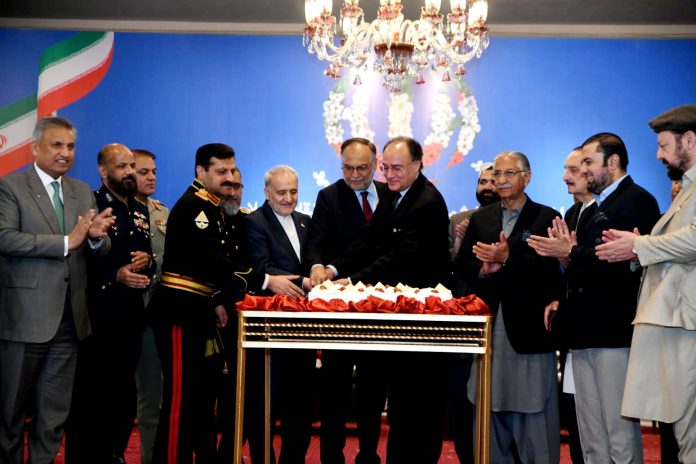
Islamabad: Iran’s Ambassador to Pakistan, Reza Amiri Moghaddam, reaffirmed Tehran’s commitment to strengthening relations with Pakistan during a ceremony marking the 46th anniversary of the victory of the Islamic Revolution. The event, arranged by the Iranian Embassy in Islamabad, was attended by distinguished guests, including Pakistan’s Finance Minister Muhammad Aurangzeb, who graced the occasion as Chief Guest.

In his address, Ambassador Moghaddam highlighted the profound impact of the 1979 Islamic Revolution, describing it as one of the most defining events of the 20th century. “The revolution introduced a new political discourse based on the principles of independence, freedom, and the Islamic Republic,” he noted, adding that it fostered self-reliance and sovereignty in Iran, leading to significant advancements in various fields despite external pressures and sanctions.

The Ambassador emphasized Iran’s longstanding policy of fostering strong ties with neighboring countries, particularly Pakistan. “Our brotherly bond with Pakistan holds a special place and has been consistently emphasized by the Supreme Leader,” he said.

He highlighted key initiatives undertaken to bolster economic and political collaboration, including the opening of border crossings and trade markets. “These steps have significantly contributed to the economic prosperity of both nations and the wider region,” he added.

Ambassador Moghaddam pointed to the numerous high-level visits exchanged between the two countries in the past year as evidence of deepening ties. He recalled the visit of the late Iranian President Ebrahim Raisi to Pakistan, as well as the visits by Pakistani leaders, including former Prime Minister Muhammad Shehbaz Sharif and Deputy Prime Minister Ishaq Dar, to Iran. Other significant visits by senior Iranian officials further underscored the growing diplomatic engagement between the two nations.

Discussing economic collaboration, the Ambassador highlighted the complementary nature of Iran and Pakistan’s economies. “Iran, with the world’s largest oil and gas reserves, and Pakistan, with its rich agricultural and livestock resources, are natural partners,” he said, stressing the potential for increased economic integration.

Iran has always supported efforts to enhance regional connectivity, particularly through transportation networks like the ITI rail route. The Ambassador underscored the importance of expanding port and infrastructure cooperation, which he said would foster prosperity, stability, and sustainable development for both nations.

“The Iran-Pakistan relationship, rooted in geographical ties, shared interests, and mutual respect, continues to move towards a brighter future,” he remarked, urging both nations to maximize their potential for regional development and economic growth.

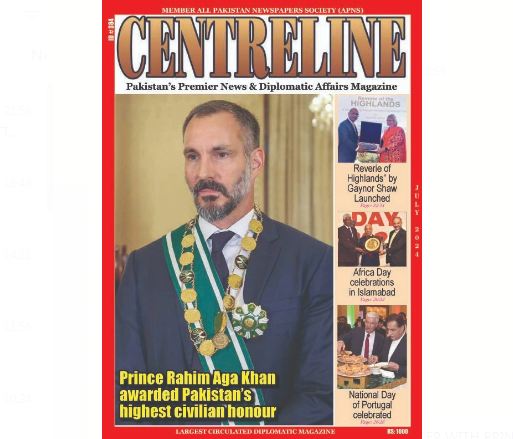
Prince Rahim Aga Khan V named 50th hereditary imam of the Shia Ismaili Muslims

hereditary

LISBON, PORTUGAL, 5 FEB /DNA/ – Prince Rahim Al-Hussaini Aga Khan V was today named the 50th hereditary Imam (spiritual leader) of the Shia Ismaili Muslims, following the unsealing of the Will of his late father, Prince Karim Al-Hussaini Aga Khan IV, who died in Lisbon, Portugal yesterday, aged 88.

Prince Rahim Aga Khan V is a direct descendant of the Prophet Muhammad (peace be upon him and his progeny) through his daughter, Hazrat Bibi Fatima, and the Prophet’s cousin and son-in-law, Hazrat Ali, the fourth Rightly Guided Caliph of Islam and the first Shia Imam.

Throughout their 1,400 year history, the Ismailis have been led by a living, hereditary Imam. The Ismailis live in over 35 countries and number approximately 12 to 15 million.

Prince Rahim Aga Khan V is the 50th hereditary Imam of the Shia Ismaili Muslims, as designated by his late father, Prince Karim Aga Khan IV, in accordance with historical Shia Imami Ismaili tradition.

Born on 12 October 1971, Prince Rahim is the eldest son of the late Prince Karim Aga Khan and his first wife, Princess Salimah. Prince Rahim was educated at Phillips Academy Andover and graduated in 1995 from Brown University with a Bachelor of Arts in Comparative Literature.

Prince Rahim has two sons from his former wife, Princess Salwa: Prince Irfan (b. 2015) and Prince Sinan (b. 2017).

He serves on the boards of many agencies of the Aga Khan Development Network, and has closely followed the work of The Institute of Ismaili Studies and the Ismaili community’s social governance institutions.

Prince Rahim has been particularly concerned with the AKDN’s drive to protect the environment and mitigate the effects of climate change, serving as Chairman of its Environment and Climate Committee. He has also given sustained attention to the work of AKDN and the Ismaili community institutions in addressing the needs of those living in the greatest poverty and supporting the improvement of their livelihoods through education, training and enterprise.

Prince Rahim meets regularly with leaders of government, international organisations, and civil society to strengthen their relations with the Ismaili Imamat and to advance the AKDN’s efforts to improve the lives of marginalised and vulnerable communities.

Letter to COAS a proof of Imran’s frustration: Siddiqui

COAS

PML-N senator calls letter “charge sheet” against jailed PTI founder

Mehtab Pirzada

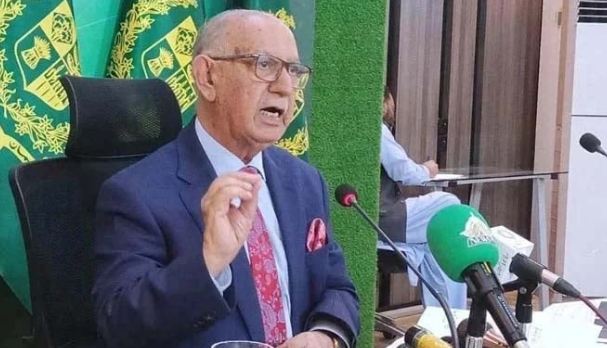
ISLAMABAD: Pakistan Muslim League-Nawaz (PML-N) Senator Irfan Siddiqui has asserted that jailed PTI founder Imran Khan’s letter to Chief of Army Staff (COAS) Gen Asim Munir was proof of the former’s “despair and frustration”.

In a statement on Wednesday, the senator termed Imran’s letter to the army chief a “charge sheet,” saying that the former prime minister had also sent a letter to COAS via former president Arif Alvi in 2023.

“They [PTI] did not receive a receipt or a reply to the previous letter, and will not receive this time as well,” Siddiqui added.

Two days earlier, PTI Chairman Barrister Gohar Ali Khan and lawyer Faisal Chaudhry confirmed that Imran, who is incarcerated in Adiala jail, penned a six-point letter to the army chief urging for review of policies while explaining the reasons for what he called the widening gulf between public and the army.

He clarified that writing a letter by the party founder to the army chief was not a policy shift and that the jailed party founder wrote the letter as a former prime minister.

The 71-year-old cricketer-turned-politician has been behind bars since August last year after he was booked in multiple cases ranging from corruption to terrorism since his ouster from power via opposition’s no-trust motion in April 2022.

However, security sources, a day earlier, claimed that no letter from the incarcerated former premier was received by COAS Munir. Sources added that the news about Khan’s letter came to the military brass via the media.

The letter comes weeks after PTI leaders — Khyber Pakhtunkhwa Chief Minister Ali Amin Gandapur and PTI Chairman Barrister Gohar Ali Khan — met the army chief, with the party’s chairman saying that they discussed the overall security situation.

It also holds importance as the former ruling party ended its negotiations with the PML-N-led coalition government last month, in which the PTI had demanded two things — the formation of judicial commissions on events that transpired on May 9, 2023, and November 24-27 as well as the release of “all political prisoners”, including Khan.

Kashmir solidarity day commemorated in Ankara

Kashmir

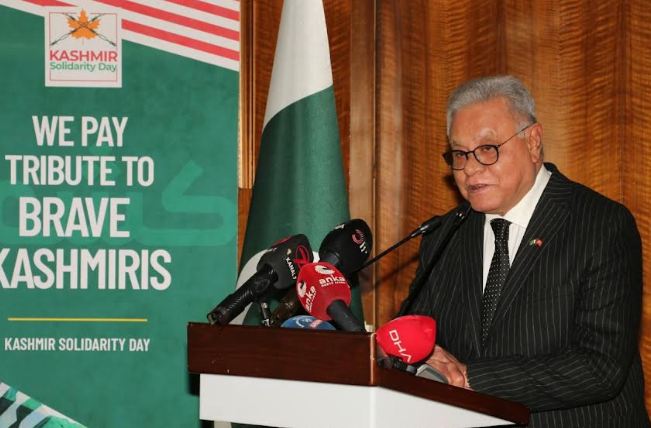
ANKARA, FEB 5: /DNA/ – The Embassy of Pakistan in Ankara observed Kashmir Solidarity Day (05 February) to reaffirm support to the legitimate Kashmiri struggle for realization of their right to self-determination.

Former Turkish deputy Prime Minister Recep Akdag, former Turkish Minister for Agriculture Mehmet Mehdi Eker, former Turkish Minister of Family and Social Services, currently DG SESRIC Ms. Zehra Zumrut, Member Parliament Burhan Kayaturk, Member Parliament Mustafa Kaya, Vice Mayor Ankara Municipality Mr. Faruk Koyluoglu, President Geostrategic Foresight Institute Gen. (R) Guray Alpar, Vice President Institute of Strategic Thinking Mr. Alpar Tan, Ambassador (R) Numan Hazar,  representatives of media, think tanks and civil society attended the event.

While reiterating Turkish support for Kashmiri legitimate cause of self-determination, Former Turkish deputy Prime Minister Recep Akdag stated that Turkiye has always supported peaceful resolution of Kashmir dispute as per the desire of the Kashmiri people and will continue to do so. He emphasized that international community needs to play its due role in putting an end to human rights atrocities in IIOJK.

Former Turkish Minister for Agriculture Mehmet Mehdi Eker, stated that Kashmir dispute is the issue of everyone with conscience, an issue of human rights and justice and the resolution of Kashmir dispute is vital for the peace and stability in South Asia.

          Turkish Member Parliament Burhan Kayaturk stated that the right to self-determination was promised to the Kashmiri people by the United Nations and the Indian leadership itself, but still after seven decades the promise remained unfulfilled.  In the just cause of freedom, Turkish nation would always keep standing shoulder to shoulder with their Kashmiri brethren, he added.

Turkish Member Parliament Mustafa Kaya stated that international community needs to play its due role in putting an end to human rights atrocities in IIOJK and implementation of relevant UN resolutions to ensure peace and stability in the region.

Former Turkish Minister of Family and Social Services, currently DG SESRIC Ms. Zehra Zumrut stated that Kashmir issue should be resolved within the framework of UN resolutions and aspirations of the Kashmiri people.

Vice Mayor Ankara Municipality Mr. Faruk Koyluoglu highlighted that Pakistani and Turkish peoples have been in solidarity throughout history and this unity would continue forever. He reiterated Turkish support to Kashmiri struggle for the legitimate right of self-determination.

President Geostrategic Foresight Institute, Gen. (R) Guray Alpar stated that the indifference of international community to Kashmir and Palestine is surprising; Kashmiris deserve the basic human right of self-determination, as promised to them by the United Nations

Vice President Institute of Strategic Thinking (SDE) Mr. Alpar Tan stated that in current era of disinformation, it is important that the actual situation and status of disputed territories is reflected objectively in media.

While underscoring the importance of international peace Ambassador(R) Numan Hazar stated that resolution of Kashmir dispute is vital for the establishment of regional and global peace.

In his concluding remarks, Ambassador Dr. Yousaf Junaid thanked the audience and stated that the cross-sectional representation consisting of former ministers, present parliamentarians, representatives of political parties, Ankara Mayor office, academia and media clearly demonstrated Turkiye’s unflinching support to Kashmir’s just struggle for the right of self-determination. Ambassador Junaid explained the genesis of the Kashmir dispute, current status and alluded to atrocities and genocidal actions committed by India in Indian Illegally Occupied Jammu and Kashmir, which had stepped up ever since 05 August 2019 illegal act of the Indian government.

Ambassador Junaid further stated that the Kashmir dispute was far more than a regional conflict—it was a litmus test for the international community’s commitment to justice and human rights. He called upon global leaders and institutions to take decisive action: hold India accountable for its systematic human rights abuses in IIOJK, reverse the illegal actions of 5th August, 2019, and ensure the Kashmiris exercise their inalienable right to self-determination.

Zardari, Xi meet in Beijing to bolster bilateral cooperation

Zardari

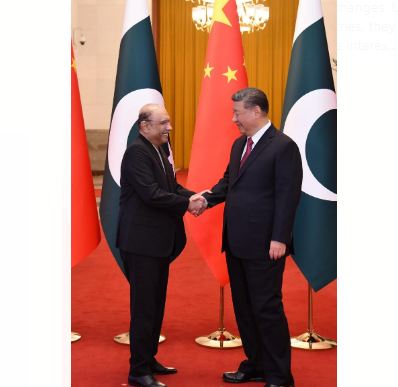
ISLAMABAD, FEB 5: /DNA/ – President Asif Ali Zardari met his Chinese counterpart, President Xi Jinping, at the Great Hall of the People in Beijing on Wednesday.

The two leaders discussed strengthening bilateral ties, accelerating China-Pakistan Economic Corridor (CPEC) projects, and security measures for Chinese nationals in Pakistan.

The high-level meeting was attended by Interior Minister Mohsin Naqvi, Sindh Chief Minister Murad Ali Shah, and other officials from Pakistan’s delegation.

President Zardari also met with Chairman of the Standing Committee of the National People’s Congress Zhao Leji, where they underscored the enduring and all-weather China-Pakistan friendship, which has deepened over the decades.

The two sides also discussed the high-quality development of CPEC 2.0, with a particular emphasis on promoting cooperation in science and technology, renewable energy, infrastructure and agriculture sectors.

They described CPEC as a shining example of people-centric development, with its focus on win-win cooperation, shared benefits and common prosperity.

The two sides discussed the opportunities to strengthen institutional linkages, including through parliamentary exchanges and participation in the CPEC Political Parties Joint Consultative Mechanism, to further solidify the bilateral cooperation.

President Zardari arrived in Beijing on Tuesday for a five-day state visit at the invitation of President Xi Jinping. He is accompanied by Deputy Prime Minister and Foreign Minister Ishaq Dar, and Interior Minister Naqvi, among other officials.

During his visit, Zardari is set to hold meetings with top Chinese political leaders to discuss trade, investment, regional security, and economic cooperation.

Over the past several decades, China has emerged as Pakistan’s largest trading partner and a major investor, particularly in infrastructure and energy projects.

Youth-led narrative building and digital advocacy critical to keeping the Kashmir cause alive

Youth-led narrative building and digital advocacy critical to keeping the Kashmir cause alive

ISLAMABAD, FEB 5: /DNA/ – The resilience of Kashmiris proves their struggle is far from over, and it is the responsibility of young advocates to ensure their voices are heard. This requires more than just solidarity; it demands action. The youth must spearhead digital advocacy, counter India’s disinformation narratives, mobilize the public, and build a compelling, fact-based discourse that keeps the Kashmir cause alive and firmly in focus.

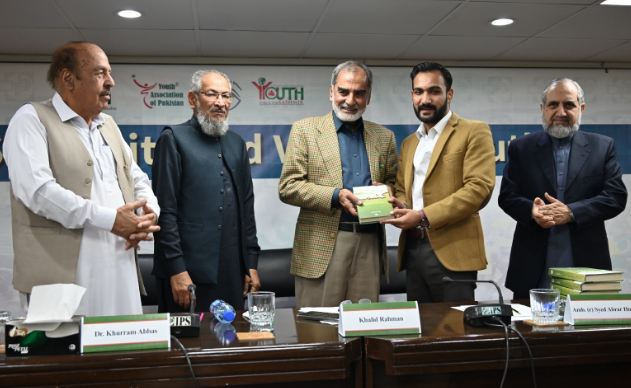
This was discussed during a session on “Kashmir Solidarity and Voices of Youth,” held at the Institute of Policy Studies (IPS), Islamabad, in collaboration with Youth Forum for Kashmir (YFK), Youth Association of Pakistan (YAP), and Youth Diplomacy Forum (YDF).

The session was addressed by Khalid Rahman, chairman, IPS, Ambassador (r) Syed Abrar Hussain, vice chairman, IPS, Abdul Qadir, chairman, YAP, and a panel of youth speakers including Alina Zafar, research officer, YFK, Musawar Tanoli, YDF, Basim Raza, research assistant, The Millennium Universal College (TMUC), Shaheer Ahmad, research assistant, Centre for Aerospace And Security Studies (CASS), Abdul Basit, research officer, Center for International Strategic Studies (CISS) AJK, Tayyaba Khurshid, research officer, CISS AJK, and Hafsa Masoodi, PhD scholar, The Centre for International Peace & Stability (CIPS), National University of Science and Technology (NUST).

The youth panel underscored the ongoing human rights violations in Indian Illegally Occupied Jammu and Kashmir (IIOJK), highlighting the decades-long repression, enforced detainments and disappearances, digital apartheid, unauthorized surveillance, restrictions on religious, political, and social freedoms, and the disruption of lives due to Indian military occupation. These violations are enabled by Indian draconian laws, which are evident to all, they stressed.

The gathering emphasized the role of digital advocacy for the Kashmir cause. They highlighted diverse ideas where youth can utilize social media platforms, develop AI-driven tools, and create independent digital spaces to counter disinformation and amplify the voices of Kashmiris. The importance of decentralized journalism and artistic expression was also highlighted as a means to circumvent censorship and project the ground realities in Kashmir.

Sharing their thoughts on international responses, the speakers observed that global responses remain largely muted despite the obvious realities. They stressed that since states operate in their geopolitical interests and strategic alignments, global public sentiment can be a powerful force for change instead.

In this regard, they called for the mobilization of global youth, engagement with international human rights organizations, and building international solidarity to counter India’s falsely projective narrative of normalcy. Moreover, the Kashmiri diaspora, particularly those hailing from IIOJK, must take an active part in this mobilization movement.

The speakers also pointed out gaps in Pakistan’s approach. They urged a revitalized strategy, including amplifying the voices of AJK youth and prioritizing the socio-economic development of AJK to strengthen the case for Kashmir’s right to self-determination. They noted that advocacy efforts should extend beyond traditional diplomatic channels to grassroots movements and international public discourse.

Earlier, Ambassador (r) Abrar Hussain provided a historical perspective on the Kashmir issue, emphasizing that both history and international law align with the Kashmiri cause. He highlighted that the struggle for self-determination is not only rooted in historical justice but also reinforced by international legal principles, which recognize the Kashmiri people’s right to decide their future through a plebiscite.

In concluding remarks, Khalid Rahman emphasized the need to challenge the growing misperceptions. He pointed out that the continued huge Indian military presence itself is evidence that Kashmiris have not surrendered, and their resilience should reinforce, not weaken, global support for their struggle.

He urged the youth to adopt a mindset of proactive engagement, asking themselves what role they can play in individual as well as collective capacity in sustaining the cause. He further stressed that long-term and synergic commitment is essential to keeping the Kashmir issue at the forefront of global discourse and ensuring meaningful advocacy for their right to self-determination.

Kashmir will remain corner stone of Pakistan’s foreign policy, PM  assures Hurriyat leaders

PM 

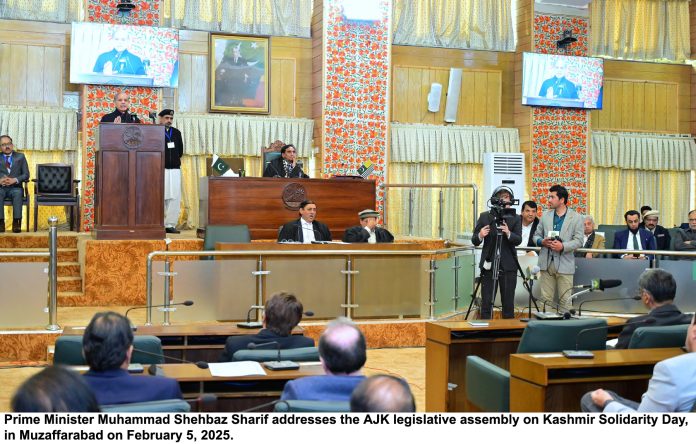
                MUZAFFARABAD, Feb 05 (APP/DNA): Prime Minister Shehbaz Sharif has assured that issue of Jammu and Kashmir was a cornerstone of the country’s foreign policy and will continue to be so till its resolution.

Talking to a delegation of All Parties Hurriyat Conference here on Wednesday the Prime Minister reaffirmed Pakistan’s moral, diplomatic, and political support for the struggle of Kashmiri brothers and sisters.

“The sacrifices of Kashmiris who have laid down their lives in the struggle for the right to self-determination will not go in vain,” the Prime Minister said.

He emphasized the urgent need for the international community to take action against Indian aggression and human rights violations in Kashmir.

The Prime Minister reiterated that Pakistan will maintain its unwavering moral, diplomatic, and political support for the Kashmiri people until they achieve their right to self-determination, in accordance with the relevant United Nations Security Council resolutions.

He also directed Federal Ministers Ahsan Iqbal and Engineer Amir Muqam to formulate a strategy to address the concerns and issues faced by refugees in Azad Jammu and Kashmir.

The leaders of the All Parties Hurriyat Conference (APHC) expressed their appreciation to the Prime Minister and the Government of Pakistan for their continued solidarity with the Kashmiri people. They also praised Pakistan’s unwavering support for the Kashmir freedom movement.

The Hurriyat leaders commended the Prime Minister for highlighting the Kashmir issue before the international community through the United Nations platform.

The meeting was attended by Prime Minister of Azad Jammu and Kashmir Chaudhry Anwar-ul-Haq, Speaker of the Azad Jammu and Kashmir Assembly Chaudhry Latif Akbar, Federal Ministers Ahsan Iqbal, Rana Tanveer Hussain, Engineer Amir Muqam, and Attaullah Tarar, among with Kashmiri leaders Ghulam Muhammad Safi, Advocate Parvez, Ijaz Rahmani, Syed Gulshan, Muhammad Ashraf Dar, Shaheen Iqbal, Mushtaq Ahmed, Khurshid Ahmed Khan, and Raja Khadim Hussain Shaheen.

BIOGRAPHY OF HIS HIGHNESS THE AGA KHAN IV

Karzai

The Aga Khan IV was born on 13 December 1936, in Geneva, son of the late Prince Aly Khan and his first wife, the late Princess Tajuddawlah, née Joan Yarde-Buller. He spent his early childhood in Nairobi, Kenya.

On 11 July 1957, at the age of 20, he succeeded his grandfather, Sir Sultan Mahomed Shah Aga Khan III as the 49th Imam, spiritual leader of the Ismaili Muslim community. He has led the Ismaili community for 67 years, a period of enormous change.

In the context of his role as Imam, His Highness the Aga Khan IV’s concern has been to interpret the faith for the Ismaili Muslim community and to take a lead in improving their quality of life as well as improving the quality of life of the people amongst whom his community live.

To this end, and guided by the ethical principles of Islam, he established the Aga Khan Development Network (AKDN) a group of private, international, non-denominational agencies, working to improve living conditions and opportunities for people in some of the poorest most vulnerable parts of the developing world.

The title “His Highness” was granted by Her Majesty Queen Elizabeth II in 1957 following the practice of earlier British monarchs who had accorded the same title to Aga Khans I, II and III.

The hereditary title “Aga Khan” (meaning “Commanding Chief”) is an honorific title given by the 19th century Persian, Qajar monarch, Fath Ali Shah (r.1797-1834) to the 46th hereditary Imam of the Shia Ismaili Muslims, Hasan Ali Shah Aga Khan I (r.1817-1881).

His Highness the Aga Khan IV graduated from Harvard University in 1959 with a BA Honors Degree in Islamic history.

He is survived by his four children: Princess Zahra, Prince Rahim, Prince Hussain (from his first marriage to Princess Salimah, née Sarah Frances Croker Poole) and Prince Aly Muhammad (from his second marriage to Princess Inaara, née Gabriele Renate Thyssen); his brother Prince Amyn Muhammad and their half sister Princess Yasmin; as well as four grandchildren.

He is a citizen of Britain and Portugal.

Personal interests:

An accomplished competitive skier, His Highness the Aga Khan IV skied in the Olympics for Iran in 1964.

Continuing a family tradition, he is owner and operator of one of the world’s most successful horse racing and breeding operations. His race wins include five Derby winners; four winners of the Prix de l’Arc de Triomphe, and a record seven winners of the Prix de Diane.

A lifelong passion for yachting and one of the founders of the Yacht Club Costa Smeralda, a non profit sporting association at the forefront of ocean conservation and marine preservation in response to the effects of pollution.

Achievements:

The AKDN is a contemporary endeavour of the IsmailiImamat, whose mandate it is to improve the quality of life of all peoples, irrespective of their faith, race, ethnicity or gender (for more information, please see www.akdn.org).

AKDN agencies:

  • Employ approximately 96,000 people.
  • Are active in 30 countries.
  • Are in the fields of education, healthcare, rural development, and culture in the not-for-profit sector, as well as in financial services, infrastructure, telecommunications, industry, and tourism.

AKDN includes:

  • Two universities – the Aga Khan University and the University of Central Asia
  • 200+ schools
  • 700+ health facilities

AKDN’s impact is wide. Annually it:

  • Generates electricity for 10 million people.
  • Provides healthcare to 5 million people.
  • Educates 2 million students.
  • Hosts 5 million visitors at its parks and gardens.

Through the work of the Aga Khan Trust for Culture, His Highness the Aga Khan IV has established a museum dedicated to muslimcivilisations, the Aga Khan Museum, Toronto, and founded one of the largest architectural prizes, the Aga Khan Award for Architecture, now in its 15th cycle, distributing prizes totalling USD $1 million, triennially.

The IsmailiImamat’s collaboration with national governments, international public agencies and non-governmental organisations stems from a common purpose and shared values and objectives to improve the quality of life of those most in need. The IsmailiImamat has diplomatic relations with various countries and partnerships with many international and national organisations.

In recognition of his exceptional efforts and contributions to human development and improving the social condition of societies globally, His Highness the Aga Khan IV has received numerous decorations, honorary degrees, and awards from institutions and nations across the world.

At the invitation of the Government of Portugal, His Highness the Aga Khan IV established the Diwan of the IsmailiImamat (global headquarters) in Lisbon in 2018.

The Ismaili Community:

The Shia ImamiIsmaili Muslims, commonly known as the Ismailis, belong to the Shia branch of Islam. The Shia form one of the two major interpretations of Islam, the Sunni being the other.

The Ismailis live in over 35 different countries, mainly in Central, East and South Asia, Africa, the Middle East, Europe, North America and Australia, and number approximately 12 to 15 million.

Throughout their 1,400 year history, the Ismailis have been led by a living, hereditary Imam from the time of the first Imam Ali, the cousin and son-in-law of Prophet Muhammad (may peace be upon him).

Ismailis are responsible citizens of the countries where they live, embracing pluralism by building bridges of peace and understanding; and generously sharing their time, talents, and material resources to improve the quality of life of society and the communities amongst whom they live.

The Ismailis have evolved a well-defined institutional framework through which they have, under the leadership and guidance of the Imam, established schools, hospitals, health centres, housing societies and a variety of social and economic development institutions for the common good of all citizens regardless of their race or religion.

The Ismailis respectfully and affectionately refer to His Highness the Aga Khan by the title “MawlanaHazar Imam”.

Read more about the Ismaili community here

Zardari, Zhao Leji emphasize strategic trust in bilateral relations

Zardari, Zhao Leji emphasize strategic trust in bilateral relations

BEIJING, FEB 5: /DNA/ –  President Asif Ali Zardari met with the Chairman of the Standing Committee of the National People’s Congress of the People’s Republic of China, Zhao Leji, in Beijing today.

President Asif Ali Zardari and Chairman Zhao underscored the time-tested and all-weather friendship between the two countries, which has continued to grow in depth and scope over the decades. They also underlined strategic mutual trust as the cornerstone of the China-Pakistan relationship and emphasized the importance of continued high-level exchanges to further deepen the ongoing practical cooperation.

The two sides also discussed the high-quality development of CPEC 2.0, with a particular emphasis on promoting cooperation in science & technology, renewable energy, infrastructure and agriculture sectors. They described CPEC as a shining example of people-centric development, with its focus on win-win cooperation, shared benefits and common prosperity.

The two sides discussed the opportunities to strengthen institutional linkages, including through parliamentary exchanges and participation in the CPEC Political Parties Joint Consultative Mechanism, to further solidify the bilateral cooperation.

PNCA exhibition explores libraries as cultural sanctuaries through art

PNCA exhibition explores libraries as cultural sanctuaries through art

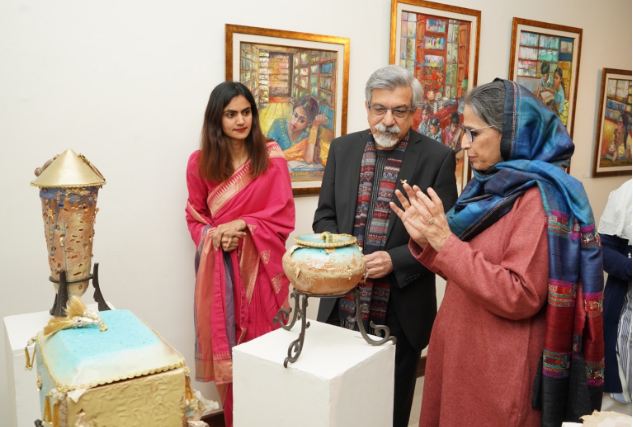
ISLAMABAD, FEB 5 /DNA/ – Pakistan National Council of the Arts and OffGrid Studios proudly present Rebinding the Library: An Artistic Intervention, on the 4th of February, 2025 at the Pakistan National Council of the Arts (PNCA) National Art Gallery, Gallery #5 Islamabad.

This compelling exhibition featuring the perspectives of 19 talented artists exploring the theme of libraries and the pursuit of knowledge. Inaugurated by esteemed artist and curator Dr. Arjumand Faisal, alongside DG PNCA, Mr. Ayoub Jamali, the exhibition marks the culmination of a three-week art residency held in October 2024, a collaborative effort between PNCA and the independent art platform OffGrid.

Showcasing a diverse mix of paintings, sculptures, ceramics, collages, and video installations, the exhibition encourages viewers to reflect on the evolving role of libraries as cultural sanctuaries, spaces for learning, and symbols of intellectual heritage. The participating artists, ranging from emerging to established names, offer unique interpretations of libraries, highlighting their significance and the urgent need for their preservation.

The exhibition features Akhter Iqbal’s series inspired by Allama Iqbal’s poetry, Khurram Babary’s exploration of nature’s complexity, and Faiza Gondal’s evocative paintings of libraries as spaces of personal growth. Jacob Joseph’s detailed paintings pay homage to historic libraries and literary figures, resonating deeply with visitors. Lubna Jehangir presents an artistic interpretation of poet Fahmida Riaz’s defiant verse, blending literature and visual art into functional, thought-provoking pieces. Tanzeel Babary merges painting with textile design, while Nuzhat Khawar’s collages celebrate the beauty of nature. Sidra Ashraf’s illumination patterns serve as metaphors for untouched books, and Zain Shakeel’s video installation captures the multifaceted nature of written knowledge.

Exploring diverse themes, Zarar Babary’s work highlights the hidden treasures of libraries, Nadia Raza’s paintings reflect spontaneous thoughts, and Tayyaba Aziz emphasizes the power of education for girls through bold, confident strokes. Shahzeb Ahmed’s Braille art offers an interactive experience, challenging societal norms and celebrating resilience. Honoring sacred texts, Kabeer Hussain Shah’s calligraphic pieces reflect the artist’s deep spiritual journey. Ahsan’s cubist-inspired ceramic sculptures explore nature’s forms, while Geytee Ara’s expressionist ceramic works address the alarming neglect of libraries.

The exhibition also highlights fresh voices in contemporary art. Young artist Khushal Khan presents philosophical explorations, while Areeba Imran revives the legacy of the Library of Alexandria and Queen Cleopatra, emphasizing the importance of cultural preservation.

Rebinding the Library is more than an art exhibition—it is a call to action. It urges visitors to reconsider the role of libraries in today’s society and to advocate for their preservation. Through compelling visual narratives, the artists underscore the transformative power of knowledge and the responsibility to safeguard it for future generations.

The Pakistan National Council of the Arts (PNCA), known for its dedication to preserving and promoting Pakistan’s rich artistic heritage, remains committed to nurturing artistic brilliance and fostering cross-cultural understanding. Serving as a thriving center for creativity and innovation in the country, PNCA continues to push the boundaries of artistic expression and collaboration.

The exhibition will be open to the public at the National Art Gallery, PNCA, from 04th -11th February, 2025, Daily timings 10 am-4 pm. Art lovers, book enthusiasts, and advocates for cultural heritage are encouraged to visit and engage with these thought-provoking works.

Stay Connected

64FansLike
60FollowersFollow

Latest Reviews

Exchange Rates

USD - United States Dollar
EUR
1.17
GBP
1.35
AUD
0.72
CAD
0.73