Home Blog Page 667

Forms of Expression of the Plurality of English Borrowings in the Urdu Language

Forms of Expression of the Plurality of English Borrowings in the Urdu Language

Zakirova Umida Ismatovna

Abstract

This article explores the phenomenon of English borrowings in the Urdu language, analyzing their historical development, linguistic adaptation, and the impact of English on Urdu’s grammatical and phonetic structure. The study focuses on the processes of assimilation, examining phonological, orthographic, and semantic changes that borrowed words undergo. Special attention is given to pluralization patterns, highlighting instances where English borrowings retain their original plural forms rather than conforming to Urdu grammatical rules. The research also discusses perspectives from linguists on language contact and borrowing theories, including classifications of loanwords and their levels of integration. The paper provides examples of English borrowings that maintain distinct pluralization structures, particularly in institutional and technical terminology. The widespread presence of these elements in contemporary Urdu, especially in media and academia, suggests an ongoing transformation in the language. The study concludes that the continuous influence of English contributes to the enrichment and dynamic evolution of Urdu while also challenging its traditional grammatical framework.

Keywords: loanword assimilation, borrowed words, phonetic and grammatical system, assimilation, exoticism, grammatical markers.

Introduction

The enrichment of a particular language’s vocabulary and its historical development and transformation are influenced by the phenomenon of word borrowing.

The process of word borrowing occurs as a result of language contact, where words, phrases, morphemes, and phonemes from one language are transferred to another. This usually happens through the adoption of words or syntactic expressions from another language. Sounds and word-forming elements assimilate within borrowed words, and as the number of such words increases, they become an integral part of the language.

Borrowed words undergo phonetic and grammatical assimilation according to the system of the receiving language. As a result, they leave a noticeable trace in the language, undergo significant changes, and lose their original characteristics.

The process of word borrowing occurs gradually: it passes through several stages, including words that are completely foreign to the target language, partially and significantly assimilated words that still retain certain characteristics of foreign words, and fully assimilated words, whose foreign origin can only be identified through etymological analysis.

The theoretical foundations of the problem of language interaction were first developed by I. A. Baudouin de Courtenay in 1875 [7, 50]. Later, in the late 19th and early 20th centuries, G. Schuchardt introduced the terms language blending and language intersection, the latter borrowed from the field of biology. During this period, the issue of lexical borrowing from one language to another became a central focus of linguistic research. As a result, scholars of the late 19th and early 20th centuries devoted significant attention to defining and refining the terminology used to describe this linguistic phenomenon.

In linguistic studies of this period, the process of lexical borrowing was considered in terms of both calquing and the direct transfer of words, as well as individual morphemes and phonetic elements, from one language to another. As a result, the term lexical borrowing process became widely used in scholarly works as a key descriptor of this phenomenon [11, 89]. Additionally, in the 20th century, linguists proposed the broader term language interaction to describe the various ways in which languages influence each other, encompassing not only lexical borrowing but also phonetic, morphological, and syntactic adaptations [19, 235].Thus, the term lexical borrowing process can be considered ambiguous. On the one hand, it has been understood as the transfer of words from one language to another, occurring in close connection with social life and various cultural phenomena [14, 73]. At the same time, some linguists distinguish lexical borrowing from calquing, treating them as entirely separate processes [10, 178].

On the other hand, the term lexical borrowing process is also used to refer not only to the transfer of a foreign word but to its full integration into the recipient language [2, 7]. As Yu. S. Sorokin noted, “the process of integrating foreign words is a bidirectional process. It is not merely the direct transfer of pre-existing linguistic elements from one language to another, but also their adaptation within the structural and semantic system of the recipient language, their incorporation into its grammatical rules, and their transformation within a new linguistic framework. If we are specifically discussing the lexical borrowing process, then it must be noted that, rather than a mechanical transfer of foreign words into another linguistic system, it is a process of assimilation and adaptation. This process is inherently creative and dynamic, reflecting a high degree of linguistic flexibility and the advanced development of the borrowing language” [14, 202].L. P. Krysin defines the process of lexical borrowing as “the transfer of various linguistic elements from one language to another.” The compilers of the Linguistic Encyclopedic Dictionary adhere to the same perspective [13, 355]. By “various elements,” they refer to units of different linguistic levels, including phonology, morphology, syntax, lexicon, and semantics. Krysin differentiates the borrowing of phonemes, morphemes, lexemes, and other linguistic components [11, 92].

E. Haugen classifies lexical borrowing based on structural characteristics. His classification of borrowed word formation is grounded in the varying degrees of morphological adaptation within the recipient language. He distinguishes true borrowings, where both meaning and phonetic form are adopted from the source language, from hybrid borrowings, which contain both foreign and native linguistic elements. Depending on which component is borrowed, hybrid borrowings are further divided into core borrowings (where the primary component is foreign) and peripheral or marginal borrowings. Moreover, Haugen argues that hybrid borrowings should be regarded as words derived from borrowings rather than borrowings themselves, thus excluding them from the lexical borrowing process proper [17, 344-382].

K. L. Yegorova, refining Haugen’s classification, expands the typology of lexical borrowings by considering their structural properties, semantic features, and the degree of divergence from their foreign prototypes [9, 139]. L. M. Bash’s concept represents both a continuation and an evolution of Haugen’s ideas. According to this framework, the term lexical borrowing process encompasses multiple linguistic phenomena and is therefore divided into direct lexical borrowing and quasi-borrowing (from Latin quasi, meaning “as if” or “seemingly”).

In linguistics, foreign words are traditionally classified into three groups: (1) loanwords, (2) exoticisms, and (3) elements of a foreign language that have entered another language. Loanwords, in turn, are further subdivided into the following categories:

a) Words that structurally correspond to their foreign prototypes, meaning they have been adapted to the phonemic system of the recipient language and may have undergone orthographic changes but do not include any additional structural modifications.

b) Words that have been morphologically adapted using the recipient language’s own morphological mechanisms, meaning that they have undergone structural transformation in accordance with the morphological rules of the recipient language.

c) Words that have undergone partial morphological modification, preserving certain foreign structural elements while integrating into the grammatical system of the recipient language [11, 95].

Thus, loanwords represent a complex and structurally diverse category. However, despite their internal diversity, the words within this group share specific linguistic characteristics that distinguish them from the native lexicon of the recipient language, highlighting the dynamic nature of lexical borrowing and adaptation.

The colonization of India by the British brought significant changes to the lives of its people. In 1835, English began to spread as the official language across the entire country. It became not only the language of education but also that of the press, science and technology, administration, and the judicial system. English became so deeply ingrained in India’s social fabric that even after the country gained independence, it retained its status. Notably, over time, as the negative socio-linguistic perception of English as the language of the colonizers diminished, its influence grew even stronger. Indians increasingly incorporated English loanwords into their everyday speech, and in some cases, entire English phrases became widely usedmany of which have since become integral elements of the modern Hindi lexicon [8; 53].

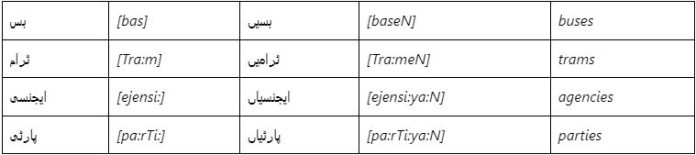
English borrowings in the Urdu language conform to its morphological rules. Although they can be fully integrated into the grammatical structure of Urdu, in some cases, English words retain their original morphological features. For instance, depending on the final letter of borrowed words, they can take plural markers in Urdu. For example, feminine nouns ending in “i” or a consonant in the nominative case receive the suffixes “ya:N” and “eN”:

بس[bas]بسیں[baseN]buses
ٹرام[Tra:m]ٹرامیں[Tra:meN]trams
ایجنسی[ejensi:]ایجنسیاں[ejensi:ya:N]agencies
پارٹی[pa:rTi:]پارٹیاں[pa:rTi:ya:N]parties

This table shows how English loanwords in Urdu follow the language’s morphological rules for pluralization, often adding eNor ya:Nas suffixes.

Some phrases have been borrowed from English as whole units, preserving the English plural form. This primarily applies to nomenclature terms, such as the names of organizations, institutions, companies, movements, and similar entities. For example:

یونائیٹڈ نیشنز[neishnz]United Nations
ہیومن رائٹس[ra:iTs]HumanRights
پریس کلبز[klabz]PressClubs
آرمڈ فورسز  [forsiz]ArmedForces

These phrases retain the English plural form in Urdu despite the language’s own grammatical rules.

سیکیوریٹی فورسز[forsiz]Security forces
 آل انڈیاانسٹیٹیوٹ آف میڈیکل ساینسز[sa:ynsiz]All India Institute of Medical Sciences
 فیڈریشن آف انڈیا چیمبرز آف کامرس اینڈ انڈسٹریز[inDasTri:z]Federation of Indian Chambers of Commerce and Industry

The plural forms of the words highlighted above indicate that they are purely English phrases since they are not structured according to Urdu grammar.

However, scientific research shows that nouns borrowed into modern Urdu often retain the English plural suffix “-s,” for example:

شفا خانہ نے کلینیکل اینیلایزرس درآمد کئے ہیں[enela:yzers]The hospital purchased clinical analyzers
کانفرینس میں دوسری پارٹیوں کے لیڈرز بھی شامل تھے[li:Derz]Leaders of other parties also participated in the conference
نئے دو تین ہیلتھ سینٹرز قائم ہوئے[senTrz]A few new health centers were established.

In the words we provided above, there was no necessity to explicitly indicate the plural form, as the plurality is already evident from the verb form. In all three examples, the verb is used in the masculine plural form. In the first sentence, the English word functions as an object, while in the second and third examples, it serves as the subject.

According to the rules of the Urdu language, nouns in oblique cases (except for the direct case) take the plural suffixes “oN” or “yoN” before postpositions. English loanwordsalsofollowtheserules. For example:

کمپنیوں کے مقابلے میںComparedto companies

In this example, the noun کمپنیappears in the plural form, marked by the suffix وں, in accordance with the postpositional phrase کے مقابلے demonstrating the application of plural morphology in oblique case constructions within Urdu grammar.

کسٹم نے دو سو بنڈلوں کو روک لیاThe customs officers stopped 200 bundles.

The sentence کسٹم نے دو سو بنڈلوں کو روک لیاillustrates the use of the plural marker -وں in the oblique case for the noun بنڈل (bundle), appearing before the postposition کو. ThisfollowsthestandardUrdurulewherenounsintheobliquecasetakethe -وںsuffixbeforepostpositions.

ان پارٹیوں نے بھی مخالفت کیThesepartiesalsoopposed.

Since the transitive verbمخالفت کرنا(to oppose) is used in the past perfect tense, the subject پارٹیوں نے (the parties) is in the ergative case and marked for plurality, following the standard ergative alignment rule in Urdu.

However, the given examples suggest that this rule is occasionally “disregarded,” as English loanwords in such instances retain their plural suffix “-s.” For example:

ٹیلیفون کالز پر رعایتDiscountontelephonecalls
پیداواری یونٹس کو فروغ دینا چاہیےProduction units should be developed
جناح ہسپتال میں ڈاکٹرز کی ہڑتالDoctors’ strike at Jinnah Hospital

As a result of scientific research, the following conclusions were reached:

Although English loanwords conform to the morphological rules of Urdu,they sometimes retain their original morphological features within the Urdu language.

In contemporary Urdu, the plural forms of widely used English loanwords indicate that they are originally English expressions. These words are not structured according to Urdu grammar, and in many cases, borrowed nouns retain the English plural marker “-s.”

The frequent occurrence of the English plural suffix in the examples above deviates from standard Urdu grammar. However, its widespread use indicates a gradual process of linguistic integration, where such forms are becoming increasingly naturalized in the language.

In conclusion, English has exerted a considerable influence on Urdu, a phenomenon clearly observable in Urdu print media, where linguistic changes are often first documented. These borrowings not only enrich the lexical repertoire of the language but also play a crucial role in shaping its ongoing evolution.

References

  1. Andronov M. S. English in India: Trends and Development Perspectives – Current Problems of South Asian Language Studies, Moscow, 1987.
  2. Aristova V. M. On Lexical Borrowings from English into Russian in the 17th–18th Centuries. Moscow, 1978.
  3. Barannikov P. A. The Linguistic Situation in the Hindi-Speaking Area, Leningrad, 1984.
  4. Bash L. M. Differentiation of the Term “Borrowing”: Chronological and Etymological Aspects // Bulletin of Moscow University. Ser. 9. Philology. 1989.
  5. Begizova Kh. B. On the Correlation of English Borrowings and Their Equivalents in Hindi – Current Problems of South Asian Language Studies, Moscow, 1987.
  6. Begizova Kh. B. On English Borrowings in Hindi – Linguistic Issues, Moscow, 1976.
  7. Baudouin de Courtenay I. A. Selected Works on General Linguistics. Vol. 1, 2. Moscow, 1963.
  8. Grishina A. “On the Question of Anglicisms in Hindi: Pronunciation of Anglicisms.” Moscow, 2002.
  9. Egorova K. L. Types of Linguistic Borrowings (Based on English and Anglo-Americanisms in Modern Russian). DissertationAbstract. Moscow, 1971.
  10. Efremov L. P. The Nature of Lexical Borrowing and the Main Signs of Borrowed Word Assimilation. DissertationAbstract. Alma-Ata, 1959.
  11. Krysin L. P. Foreign Words in Modern Russian. Moscow, 1968.
  12. Larionova E. V. Latest Anglicisms in Modern Russian. DissertationAbstract. Moscow, 1994.
  13. LinguisticEncyclopedicDictionary. Moscow, 1990.
  14. Lotte D.S. Issues of Borrowing and Systematization of Foreign Terms and Term Elements. Moscow, 1982.
  15. Sorokin Yu. S. The Development of the Russian Language’s Lexical Composition. Moscow, 1965.
  16. Khalmurzaev T.K. The Status of Urdu in Modern India and Trends in Its Development, Tashkent, 1979.
  17. Haugen E. The Process of Borrowing. In: New in Linguistics. Moscow, 1972. Issue No. 6.
  18. Shamatov A. N. Essays on the Historical Lexicology of Hindi and Urdu (15th–18th Century). Tashkent, 1990.
  19. Shcherba L. V. On the Concept of Language Mixing. In: Selected Works on Linguistics and Phonetics. Vol. 1. Leningrad, 1958.
  20. “QaomiAvaz” Delhi, India.
  21. “AxbareUrdu,” Islamabad, Pakistan.

Forms of Expression of the Plurality of English Borrowings in the Urdu Language

Zakirova Umida Ismatovna

Senior teacher at the High School of South Asian Languages and Literature

Tashkent State University of Oriental Studies

[email protected] phone: +998909906305
Welfare, development & festivities return to Punjab (PART-II)

Welfare, development & festivities return to Punjab (PART-II)

Abdul Rashid Shakir

Old maxim, “healthy mind lies in a healthy body,” aptly underscores the importance of engaging in healthy sports and physical activities for making a significant contribution in life, failing which reminds of another proverb, “an idle mind is devil’sworkshop.”

Greater the population, especially youth, the more prone it is to become a debilitating liability for the Government if not engaged properly in sports, debates, fine arts, social work or politics. Punjab is blessed with a sizeable population of around 128 million, more than 65% of which is below the age of 30 (7th Population & Housing Census-2023, Pakistan Bureau of Statistics). Mindful of the need of providing ample opportunities to ensure constructive engagement of its youth bulge, Punjab Government under the inspiring leadership of Chief Minister Madam Maryam Nawaz Sharif is focused on reviving sports in the province by rehabilitating deserted playgrounds and sports arenas. It is committed to nurturing talent, and developing sports infrastructure in the province to ensure better engagement of youth Multipurpose sports grounds are also being constructed across 91 constituencies, bringing sports facilities closer to communities to foster grassroot-level participation of youth in sports.

Immediately after assuming office on 26 February 2024, Madam Chief Minister inaugurated on 02 May the 1st edition of female-exclusive Chief Minister Punjab Pink Games 2024, in order to promote sportsin women of the province. Players from 19 universities across Punjab. participated in sports like Athletics, Archery, Badminton, Basketball, Cricket (T20), Hockey and Table Tennis. These games not only redefined sporting landscape of the province, but also promoted gender-balanced participation in sports by showcasing talent of female athletes like never before. Madam Chief Minister also inaugurated another premier sports event ‘Khelta Punjab Games 2025’ on 30 January 2025 with an aim to hunt young sporting talent across Punjab by organising multi-tiered sports competitions from grassroots to provincial levels. 15,000 sports clubs and a record number of 120,000 athletes across Punjab registered for the games, showcasing massive potential and deep interest of Punjab’s youth in healthy physical activities. These games not only fostered a spirit of sportsmanship and unity among players but also promoted healthy sporting activities in the province by offering them liberal financial awards. 2200 players excelling in the divisional-level competitions of ‘Khelta Punjab Games’ 2025 were awarded free e-bikes, 30,000 young athletes have been awarded merit-based sports scholarships, and Rs.60,000/- monthly stipend is being given to the intern athletes.A Talent Hunt Program was launched in the province to identify and nurture hidden talent, especially in basketball, in a bid to diversify sporting opportunities in the province. The Government also has plans to launch a ‘School Hockey League’ and ‘Punjab Olympics’ to further promote sporting culture in the province.

A revitalized Punjab Sports Board, comprising the renowned athletes like Arshad Nadeem (Olympic javelin thrower) and Aisam-ul-Haq (tennis star),has been established with an aim to enhance sports infrastructure, and promote excellence in sports in the province. A Sports Advisory Council featuringformer players and students has also been established to ensure inclusive governance and effective decision-making of sports in the province.

Madam Chief Minister has also stressed on the need to hire international coaches to bring Punjab’s athletes at par with the international standards, preparing them to compete internationally, and win laurels for the country. The Chief Minister has shown strong support for the national sport, hockey, by awarding them a financial grant, reflecting her commitment to preserving Pakistan’s sporting heritage. Punjab Government is focused on producing world-class athletes, and makng Punjab a hub of sporting talent. Its various initiatives, coupled with the Government’s financial commitment,are aimed at creating a sustainable ecosystem for the development of sports, ensuring long-term benefits for the youth and the province.

The revival of National Horse & Cattle Show on 09 February 2025, after a hiatus of more than three decaes, is another step in the right direction to afford young athletes, players, artists, craftsmen, agriculturalists and cattle-breeders with plenty of opportunities to showcase their talent, and engage them  in a positive and constructive way. Chief Minister Maryam Nawaz Sharif is also committed to promote tourism, especially religious tourism in the province by celebrating on official level various rituals of the minority communities like Besakhi, Easter, Christmas and Diwali. Development of world-class hotels and communication infrastructure is being planned to create an enabling ecosystem for the Sikh, Budh and Hindu pilgrims from across the globe to visit Pakistan and participate in their religious festivities. GurdwaraDera Sahib in Lahore, GurdwaraJanamAsthan also known as GurdwaraNankana Sahib some 75 kilometres southwest of Lahore, and GurdwaraDarbar Sahib in Kartarpur are some of the highly revered gurdwarasfor Sikh community; while Katasraj Temple Complex in Chakwal and JagannathMandir in Sialkot are some of the holy temples of Hindu community where members of Sikh and Hindu communities from around the globe flock each year to perform pilgrimage. This would not only provide youth better social engagement, but would also generate countless employment opportunities for them. Upkeep of communication infrastructure like roads and bridges is imperative to achieve this end. For this purpose, the Communication & Works Department of the Government of Punjab is committed to construct, repair and rehabilitate 590 arterialand connector roads, measuring 11,496 kilometers, across Punjab under SarkeinBahaal… Punjab Khushhal (Roads Restored… Punjab Prosperous) Programme. It would not only boost tourism by presenting to the world better infrastructure of the province, but would also attract investment to promote economic activities, ensuring better socio-economic conditions for the people.

However, it goes without saying that political stability and continuity of economic policies are needed for a lasting and discernable change that may offer people rich dividends forbringing about positive change in their lives.

Continued…

Abdul Rashid Shakir

[email protected]

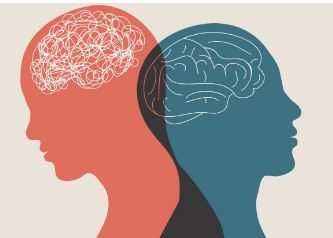
Mental well-being of Pakistani people

Mental well-being of Pakistani people

Naira Eshaal

Pakistani society faces many psychological issues due to cultural norms, political instability, and misinformation that has been spread around for ages in the name of religion and values. A lot of people tend to believe that the concept of mental health is just a myth and we often hear people associating serious mental illnesses or disorders with not having a close enough relationship with God. Psychological issues affect people across all demographics, yet stigma and lack of resources prevent many from seeking professional help.

People often struggle with constant stress and anxiety. Many factors can make a person feel anxious or burdened most of the time. Pakistan’s economic instability has led to many companies being shut down, leaving people unemployed. The country also faces issues regarding inflation, and without jobs and a stable income, it is hard for people to provide for their families and raise their kids. Men are usually the breadwinners and the sole providers of the house which puts constant pressure on them to fulfill their family’s needs.

Depression remains one of the most common but least acknowledged psychological disorders in Pakistan. Due to the stigma surrounding mental health, a huge percentage of people hesitate to seek professional help, often dismissing their symptoms as temporary sadness. A lot of the time, in extreme cases, untreated depression can lead to suicidal thoughts, a growing concern in recent years. Students face immense academic pressure to excel in competitive fields and are constantly being compared to other family members or friends of their age. We often see cases of suicide daily and a lot of those are solely because of too much academic pressure. Parents in their time had the same amount of academic pressure imposed on them and this generational trauma carries down for centuries. Generational trauma stems from deeply ingrained psychological wounds passed down through families due to historical, social, and personal experiences of extreme stress or suffering. It affects individuals and entire communities, shaping their behaviors, emotions, and coping mechanisms. Some key sources of generational trauma are war and conflict, Domestic Violence and Abuse, Poverty and Financial Struggles, Parenting Styles Shaped by Trauma, and Cultural Expectations and Repression. Generational trauma and Post-Traumatic Stress Disorder (PTSD) are deeply connected because unresolved trauma from one generation can create PTSD-like symptoms in the next, even if they didn’t directly experience the original traumatic event. People who experience severe trauma develop PTSD later in life which in turn alters their behavior and emotional regulation. It is often left untreated and then unconsciously passed down to the next generation. Children often exhibit PTSD-like emotions without even direct exposure to the trauma. Many studies suggest that severe trauma can alter genes affecting stress responses in later generations.

Naira Eshaal | The Writer is doing bachelor’s in Psychology and can be reached at [email protected]

Electric buses in Lahore: Free tickets for students, senior citizens and disabled persons

Electric buses

LAHORE, FEB 23: The electric bus project is progressing successfully in Lahore, with passengers calling it the most comfortable and affordable mode of transport.

According to Transport Minister Bilal Akbar Khan, electric buses are currently operating between Green Town and the Railway Station, allowing passengers to charge their mobile phones and laptops for free during travel.

The minister further stated that over 500 additional electric buses will be introduced in Lahore and other major cities in the coming months to enhance public transportation.

He emphasized that the fare has been kept extremely low, noting that even a rickshaw ride costs more than 20 rupees, yet this modern and convenient bus service is being provided at the same rate for the public’s benefit.

Bilal Akbar Khan also announced that students, senior citizens, and people with special needs will be provided free travel facilities through the Green Electro Card. The government remains committed to expanding this project to modernize and promote eco-friendly public transport across the country.

PTCL brings Africa-1 submarine cable to Pakistan, boosting country’s digital future

PTCL

DNA

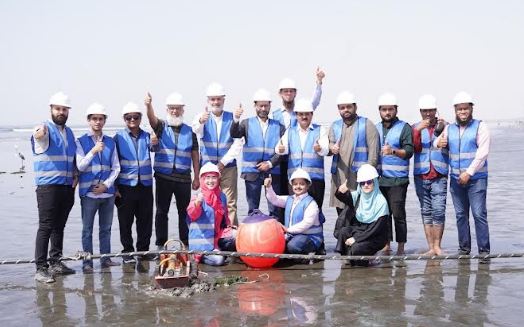
KARACHI, FEB 23: The ultra-high capacity, Africa-1 submarine cable has successfully made its landfall at Pakistan Telecommunication Company Limited’s (PTCL) landing site at Sea View Beach, Karachi. It marks a transformative step in enhancing Pakistan’s digital connectivity. This milestone follows Pakistan Telecommunication Company Limited’s (PTCL) official agreement to join the Africa-1 cable system consortium, highlighting its mission to integrate Pakistan with key global digital hubs, and reinforce the national telecommunication infrastructure.

This groundbreaking achievement reaffirms the vision of leveraging cutting-edge technologies to foster progress and connectivity across the regions served by the Africa-1 system.

The Africa-1 consortium comprises of leading telecommunications companies including Mobily (Saudi Arabia), e& (UAE), G42 (UAE), Telecom Egypt, Zain Oman International (ZOI), Algérie Télécom, TeleYemen and other global service providers. The cable system spans 10,000 kilometres and employ state-of-the-art advanced technologies. The system will link Pakistan with strategic locations, including Saudi Arabia, UAE, Egypt, Sudan, Algeria, France, Kenya, and Djibouti. The cable will be terminated at Africa-1 Cable station in PTCL Exchange Misrishah, Phase-VI, DHA Karachi, further positioning Pakistan as a vital hub in the global digital network.

Sharing his thoughts, Syed Muhammad Shoaib, Group VP International Business at PTCL highlighted the strategic significance of this collaboration: “PTCL is proud to be a part of the Africa-1 cable system consortium. This partnership aligns seamlessly with Pakistan’s Digital Vision 2030 and our commitment to empowering the communities by bridging the digital divide. By establishing strong, reliable connections to key international hubs, PTCL aims to provide faster, world-class internet services enabling innovation across sectors and strengthening Pakistan’s position in the global economy.”

The Africa-1 cable system is slated for completion in the beginning of 2026. Once operational, it will bolster PTCL’s capacity to deliver high-quality, reliable internet services that meet international standards, solidifying the company’s position as a preferred telecom operator in Pakistan and beyond.

Champions Trophy: Openers Babar, Imam fall cheaply as Indian bowlers strike in high-stakes clash

Champions Trophy: Openers Babar, Imam fall cheaply as Indian bowlers strike in high-stakes clash

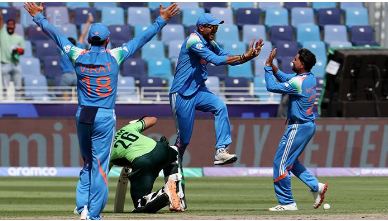
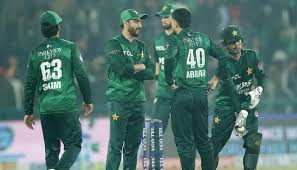
DUBAI: Cricket fever spikes as hosts Pakistan are batting first against their arch-rivals, India, after winning the toss in the high-stakes Champions Trophy showdown at the Dubai Cricket Stadium.

After Pakistan lost their openers, Babar Azam and Imam-ul-Haq, Pakistani skipper Mohammad Rizwan has joined Saud Shakeel at the crease, with the score at 59-2 in 13 overs.

Indian bowlers Hardik Pandya and Kuldeep Yadav struck to make a breakthrough for India just when the Men in Green looked to have gained a bit of stability.

Speaking at the toss, Pakistan skipper Mohammad Rizwan expressed confidence in his team’s performance.

Noting that the players were familiar with the conditions in Dubai, Rizwan said that the team would put up a good total on the scoreboard and added that the pitch might be slow in today’s fixture with dew expected to come into play in the evening.

The skipper further confirmed the inclusion of Imam-ul-Haq in the team who has replaced injured Fakhar Zaman.

Meanwhile, Indian captain Rohit Sharma said that he would’ve also opted to bowl first.

Commenting on the conditions, Sharma pointed out that today’s pitch was similar to the previous match.

Confirming that India had made no changes to their playing XI, he said that all players need to perform well in today’s match.

Pakistan enter the match in a do-or-die situation after suffering a crushing 60-run defeat to New Zealand in their tournament opener. Their title defence is already in jeopardy, and skipper Mohammad Rizwan’s men need a dramatic turnaround to keep their campaign alive.

Adding to their woes, opener Fakhar Zaman has been ruled out due to injury, while batting mainstay Babar Azam has faced criticism for his lack of intent despite scoring a fifty in the last match.


To counter India’s strong batting unit, Pakistan will likely rely on their rich legacy of fast bowling. The pace trio of Shaheen Shah Afridi, Haris Rauf, and Naseem Shah will be key in their bid to restrict a formidable Indian lineup featuring Virat Kohli, Rohit Sharma, Shubman Gill, and KL Rahul.

India, who refused to travel to Pakistan for the Champions Trophy citing government advice, are playing all their matches in Dubai. They kicked off their Group A campaign with a commanding six-wicket victory over Bangladesh. Even without pace spearhead Jasprit Bumrah, the Men in Blue looked dominant, with Mohammed Shami leading the bowling attack by claiming five wickets.

The Indian batting unit, spearheaded by the in-form Shubman Gill, who scored a brilliant 101 against Bangladesh, appears well-equipped to handle the Pakistani challenge. India has also dominated the rivalry in recent years, winning seven of the last eight completed ODIs against Pakistan.

Champions Trophy: Openers Babar, Imam fall cheaply as Indian bowlers strike in high-stakes clash
Their dominance is well-documented, but Pakistan’s unpredictability in major tournaments cannot be overlooked.

With emotions running high and a packed stadium expected, the clash promises to be nothing short of electrifying. Despite all the pressure, Pakistan’s nation remains hopeful for a striking performance from their team to turn the tables on India.

Pakistan Cricket Board (PCB) Chairman Mohsin Naqvi, while speaking to the media in Dubai, expressed confidence in the team ahead of the high-stakes encounter. He assured fans that the squad was fully prepared and predicted an exciting contest. Acknowledging the ups and downs of the game, Naqvi remained optimistic, stating, “InshaAllah, Pakistan will emerge victorious.”

He further emphasised that a win for the national team would be a significant achievement for the country. Naqvi also sent a strong message of support to the players, assuring them that, win or lose, the entire nation stands behind them.

Squads
Pakistan: Imam-ul-Haq, Babar Azam, Saud Shakeel, Mohammad Rizwan (C/WK), Salman Ali Agha, Tayyab tahir, Khushdil Shah, Shaheen Shah Afridi, Naseem Shah, Haris Rauf and Abrar Ahmed

India: Rohit Sharma (C), Shubhman Gill, Virat Kohli, Shreyas Iyer, Axar Patel, KL Rahul (WK), Hardik Pandya, Pavindra Jadeja, Harshit Rana, Mohammad Shami, Kuldeep Yadav.

Champions Trophy: Ben Duckett’s heroics propel England to 351 against Australia

Champions Trophy: Ben Duckett's heroics propel England to 351 against Australia

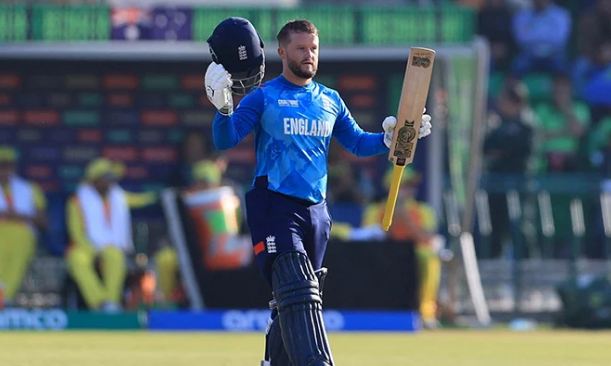
LAHORE, FEB 22 /DNA/ – England set a massive 352-run target against Australia courtesy of Ben Duckett’s explosive innings of 165 runs and Joe Root’s fifty despite a shaky start in the fourth group-stage clash of the ICC Champions Trophy 2025 being played at Lahore’s Gaddafi Stadium on Saturday.

Put into bat first, England registered 351/8 on the board in their allotted 50 overs, courtesy of a marathon third-wicket partnership between Duckett and Joe Root.

The 2019 World Cup winners, however, had a contrasting start to their innings as Ben Dwarshuis struck twice in his first three overs, dismissing opener Phil Salt (10) and returning Jamie Smith (15).

His twin strikes had reduced England to 43/2 in 5.2 overs but Duckett and Root partnered strongly to put England in control.

The duo dominated the inexperienced Australian bowling attack to add 158 runs to the total until Adam Zampa got rid of Root, who scored 68 off 78 deliveries with the help of four boundaries.

The leg-spinner soon struck again to dismiss Harry Brook (three), reducing England 219/4 in 34.1 overs.

Ben Duckett, on the other hand, stood his ground firm and recorded crucial partnerships with skipper Jos Buttler (23), Liam Livingstone (14) and Brydon Carse (eight) before finally falling victim to Marnus Labuschagne in the 48th over.

He remained the top-scorer for England with an enterprising 165 off 143 deliveries, studded with 17 fours and three sixes.

Dwarshuis was the standout bowler for Australia, picking up three wickets for 66 runs in his 10 overs, while Zampa and Labuschagne bagged two each. Glenn Maxwell chipped in with one scalp.

Playing XIs:
Australia: Steve Smith (captain), Travis Head, Matthew Short, Marnus Labuschagne, Josh Inglis, Alex Carey, Glenn Maxwell, Ben Dwarshuis, Nathan Ellis, Adam Zampa and Spencer Johnson.

England: Jos Buttler (captain), Ben Duckett, Phil Salt, Jamie Smith, Joe Root, Harry Brook, Liam Livingstone, Brydon Carse, Adil Rashid, Jofra Archer and Mark Wood.

Serena Hotels hosts invitational golf tournament 2025 to promote sports diplomacy

tournament

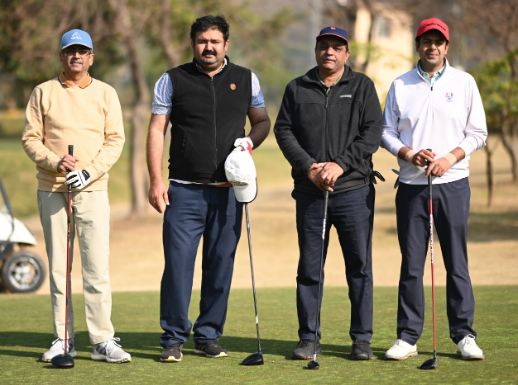
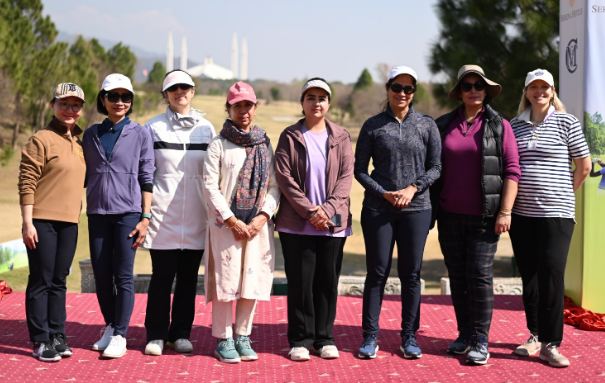
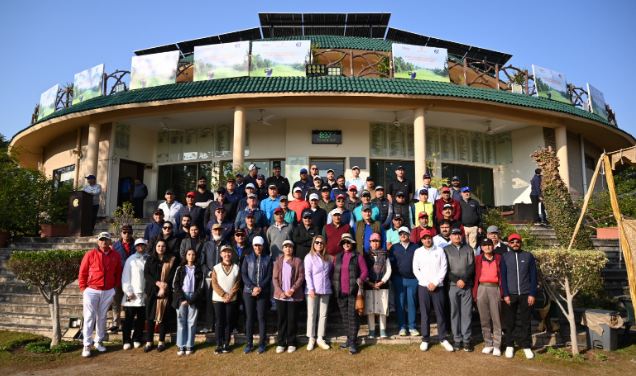
ISLAMABAD, FEB 22 /DNA/ – Serena Hotels Invitational Golf Tournament 2025 under its sports diplomacy initiative held at Margalla Green Golf Club. Scores of participants and spectators turned up to enjoy the great game of golf and admired Serena Hotel’s efforts to promote healthy sports activities and the spirit of community engagement. The event brought together golf enthusiasts from various backgrounds, showcasing Serena Hotels’ dedication to using sports as a platform to connect people and celebrate athletic excellence.

The tournament featured four categories: Diplomats, Government & Armed Forces, Corporate, and Women, with players demonstrating remarkable skill and technique throughout the competition.

The tournament was graced by Chief of the Naval Staff Admiral Naveed Ashraf NI(M) T Bt as the Chief Guest, who highly praised Serena Hotels for its dedication and commitment to promote sports in Pakistan through their platform.

Following an exciting day of competition, the Chief Guest distributed prizes amongst the winners in all categories, recognizing their outstanding performances and encouraging continued participation in sports.

Mr. Aziz Boolani, CEO of Serena Hotels, reaffirmed Serena Hotels’ commitment to sports diplomacy, saying:

“At Serena Hotels, we firmly believe in the power of sports to unite communities and inspire excellence. Through our Sports Diplomacy Initiative, we continue to support and promote various sporting events, promoting an environment of inclusion, engagement, opportunity and competitive spirit.”

Serena Hotels’ Sports Diplomacy Initiative remains dedicated to encouraging young players to pursue their ambitions by providing them a platform regardless of their background and promoting active lifestyles through diverse sporting events. The Annual Invitational Golf Tournament continues to be a significant milestone in this journey, bringing together players from different sectors in the true spirit of sportsmanship.

PM Shehbaz Sharif to visit Azerbaijan for two-day state visit on Feb 24

PM Shehbaz Sharif to visit Azerbaijan for two-day state visit on Feb 24

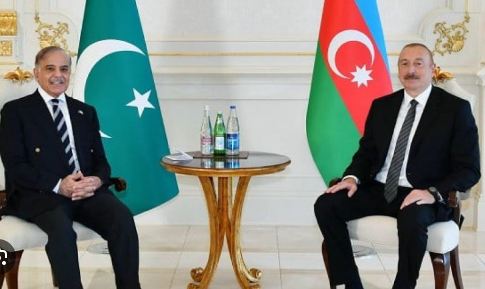
ISLAMABAD, Feb 22 (DNA): At the invitation of President of Azerbaijan, Ilham Aliyev, Prime Minister Muhammad Shehbaz Sharif will pay a two-day state visit to the Republic of Azerbaijan from 24-25 February 2025.

This marks Prime Minister Muhammad Shehbaz Sharif’s second visit to Azerbaijan since assuming office in March 2024. He will be accompanied by a high-level delegation including Deputy Prime Minister/ Foreign Minister Senator Mohammad Ishaq Dar and other key members of the Cabinet, reflecting Pakistan’s strong commitment to deepening its engagement with Azerbaijan.

During the visit, the two sides will engage in wide-ranging discussions on areas of mutual interest in order to further strengthen bilateral cooperation particularly in energy, trade, defence, education and climate sectors. Several MoUs/Agreements in multiple areas of cooperation are expected to be signed between the two sides during the visit.

Pakistan and Azerbaijan share a deep-rooted brotherly relationship built on mutual trust, understanding and a longstanding mutually beneficial cooperation. Azerbaijan remains one of Pakistan’s key economic and strategic partners, with strong collaboration across multiple sectors.

The Prime Minister is also expected to deliver a keynote speech during a Business Forum organized in collaboration with the Export and Investment Promotion Agency of the Republic of Azerbaijan (AZPROMO). During the visit, the Prime Minister, along with the President of Azerbaijan, will also visit to Fuzuli (Karabagh) as part of a special visit to the liberated territories of Karabakh.

The Prime Minister’s visit underscores Pakistan’s steadfast commitment to further strengthening its ties with Azerbaijan, fostering greater economic collaboration and exploring new avenues of partnership for shared development.

The U.S. and Europe: Parting Ways

Qamar Bashir

By: Qamar Bashir

Vice President J.D. Vance’s unwarranted, harsh, and undiplomatic remarks to European leaders deeply wounded the longstanding alliance between the U.S. and Europe. His speech was not just a critique—it was an outright attack on European traditions, governance, and society. He accused European nations of curbing illegal migration, suppressing democracy, restricting freedom of speech, and running inefficient institutions comparable to third-world countries. Furthermore, he charged Europe with exploiting U.S. taxpayers by using American funds to bolster European infrastructure, stockpile foreign exchange reserves, and strengthen military capabilities—all at the cost of making America economically weaker.

Vance’s delivery was laced with arrogance and disregard for diplomacy. His speech, fully endorsed by President Trump and the Secretary of State, signaled a clear policy shift, underscoring a new era in transatlantic relations—one marked by divergence rather than unity. The European Union interpreted Vance’s words as a direct insult. At the 61st Munich Security Conference (MSC), Christoph Heusgen, its chairman since 2022, gave a highly emotional response, warning that the common ground between the U.S. and Europe was eroding. He vowed that Europe would defend its liberal values and egalitarian traditions, even if it meant standing apart from its longtime ally.

Germany’s Defense Minister Boris Pistorius dismissed Vance’s speech as a gross distortion of reality, emphasizing Europe’s unwavering commitment to democracy and institutional integrity. Kaja Kallas, the European Union’s chief diplomat, interpreted the remarks as an intentional attempt by the U.S. to provoke conflict with Europe. Former Swedish Prime Minister Carl Bildt echoed these concerns, describing the speech as “significantly worse than expected.”

The once-unshakable transatlantic alliance is now unraveling at an alarming pace. For decades, the U.S., the United Kingdom, and France wielded significant power within the international governance system, using their collective veto at the United Nations as a formidable force. However, with the U.S. adopting an increasingly confrontational stance, it risks isolating itself, pushing the world toward a new multipolar order. Power centers are shifting, with Europe, China, and Russia emerging as independent forces, while India continues to rise as an economic and geopolitical player.

One of the most significant implications of this rift is that Europe will no longer feel obligated to align with the U.S. in future conflicts. Unlike in the past—when Europe was pressured into supporting wars in Iraq, Libya, Afghanistan, and the intimidation of Iran—European nations are now reconsidering their blind allegiance to American foreign policy. Historically, U.S. legitimacy in global conflicts depended heavily on European backing. But as trust wanes, European leaders are unwilling to continue sacrificing their national interests for policies they no longer see as justified.

This unprecedented divide did not emerge overnight. Trump’s disdain for Europe laid the groundwork for the current crisis. He persistently accused European nations of freeloading off American financial contributions for defense, arguing that the U.S. had no real stake in Europe’s security. He further criticized European leaders for allowing demographic shifts due to pro-immigration policies, fueling nationalist rhetoric on both sides of the Atlantic. His threat to occupy Greenland was yet another display of disregard for European sovereignty. Now, with J.D. Vance’s antagonistic remarks adding fuel to the fire, Europe’s patience has worn thin.

For the first time in modern history, the U.S. is actively alienating its closest allies, triggering an identity crisis within the Western alliance. Europe, which once relied on American leadership and protection, is beginning to reassess its position in the global order. This shift carries two major consequences.

First, the U.S. may gradually forfeit its status as the world’s preeminent superpower. Trump’s policies suggest that America no longer has the appetite—or financial capability—to maintain global dominance. The cost of sustaining this position is proving unsustainable, and rather than reinforcing its alliances, the U.S. appears willing to relinquish them. For Europe, this could be an opportunity rather than a setback. Unlike developing nations, European countries are wealthy and resourceful enough to sustain their own defense and shape independent foreign policies without U.S. intervention. Over time, they may move away from American influence, assert their collective strength on the global stage, and address international crises on their own terms.

This would also free Europe from the obligation to align with the U.S. on controversial geopolitical issues. Without the constraints of transatlantic loyalty, European nations might adopt more pragmatic stances—cooperating with China and Russia when necessary, rather than being bound by U.S.-driven narratives. This realignment could significantly weaken American influence within international institutions, eroding its ability to unilaterally dictate global policies.

However, history suggests that any vacuum left by a declining superpower is inevitably filled by another rising force. If the U.S. continues its path of isolationism and confrontational diplomacy, China is the only country with the economic strength and strategic resources to assume that role. Whether the U.S. is truly prepared to cede its global supremacy to China remains uncertain. Yet, if its current policies persist, this transition may occur sooner rather than later.

Ultimately, international relations are dictated not by sentiment but by shifting interests. The U.S.-Europe alliance, which has endured for two centuries, is now showing signs of natural decay. The once-strong commonality of purpose and shared values is giving way to nationalist and protectionist agendas. What were once minor disagreements have now escalated into full-blown political conflicts, revealing deep-seated fractures within the Western bloc.

The U.S., once the undisputed leader of the free world, now appears intent on relinquishing its leadership. By pushing its allies away, it is voluntarily dismantling the very system that secured its dominance for decades. The ultimate question remains: is America prepared for the consequences of this seismic shift? If it continues on this trajectory, the world order as we know it may be on the verge of an irreversible transformation—one in which the U.S. is no longer the central pillar of global governance.

By: Qamar Bashir

 Press Secretary to the President (Rtd)

 Former Press Minister at the Embassy of Pakistan to France

 Former MD, SRBC

 Macomb, Detroit, Michigan

Stay Connected

64FansLike
60FollowersFollow

Latest Reviews

Exchange Rates

USD - United States Dollar
EUR
1.17
GBP
1.35
AUD
0.72
CAD
0.73