Home Blog Page 648

Foreign diplomats, leaders unite against terrorism at Lahore iftar gathering

Foreign diplomats, leaders unite against terrorism at Lahore iftar gathering

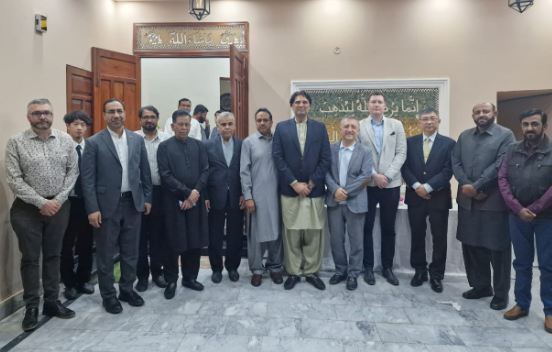
LAHORE, MAR 16 /DNA/ – In a significant development, the  foreign diplomats, politicians , renowned scholars have unanimously set the tone for one voice against all faces of terrorism sabotaging Pakistan’s security and sovereignty and resolved to stay united with all pillars of state as well as people to help Pakistan eradiate the menace once for all. 

Talha Barki new member of the federal cabinet,Consul General of Turkey Durmas Bastag, Consul General of Iran Mehr Mowahid Far, Acting Consul General of China Mr. Cao, Political Officer of China Mr. Fan, Political Officer of Japan Mochi Zuki, DG Khana Farhang of Iran Masoudi, Cultural Counselor of France Mr. Fabrice, Head of Punjab Affairs of the Btitish High Commission Mr. Ben Warrington, Vice Chairman LDA Mian Marghoob Ahmed, Malik Riaz Member of Punjab Assembly, Dr. Amjad Magsi President Professors and Lecturers Association of Punjab University etc. attended the iftar on behalf of Muhammad Mehdi foreign affairs expert on his residence .On this occasion, the participants raised their voices of unity and solidarity against terrorism in Pakistan.

The participants have said in clear words that they stand by Pakistan in the war against extremism and terrorism. On this occasion, the participants appreciated the efforts of the Pakistani army, parliamentarians and civil society in the efforts to eradicate terrorism and said that the international community will provide all possible support to Pakistan at this critical stage.

The host of the event, Foreign Affairs Expert Muhammad Mehdi, said that to win the war against terrorism, it is necessary to have mental harmony, unity and clarity of purpose among all institutions and people.He said that mutual consultation of all political forces strengthens unity and this unity destroys the ambitions of terrorists.He further said that all stakeholders should rise above their personal interests and unite against terrorism so that we can pass on peace and stability to our future generations.

Russian Navy Flotilla arrives in Karachi for goodwill visit

Russian Navy Flotilla arrives in Karachi for goodwill visit

KARACHI, MAR 16: /DNA/ – A Russian Navy Flotilla, comprising frigates RFS REZKIY and RFS ALDAR TSYDENZHAPOV, along with medium sea tanker RFS PECHENGA, arrived in Karachi for a goodwill visit from 15 to 18 March 2025.

Upon arrival, the Russian warships were accorded a warm welcome by officials of the Pakistan Navy, along with the Russian Consul General and Defence Attaché.

During the port call, the crew of the visiting ships will engage in professional discussions with Pakistan Navy personnel and participate in bilateral ship visits. Furthermore, Russian and Pakistani naval ships will conduct joint exercises aimed at enhancing interoperability and maritime cooperation.

Regular port visits and joint exercises between Pakistan Navy and Russian Navy continue to strengthen bilateral ties, deepen naval collaboration, and foster mutual trust.

The visit of Russian Flotilla marks a significant milestone in maritime diplomacy, reinforcing security and defence cooperation between the two nations.

Nushki Attack: Security Forces, Civilians martyred in cowardly bombing

Nushki Attack: Security Forces, Civilians martyred in cowardly bombing

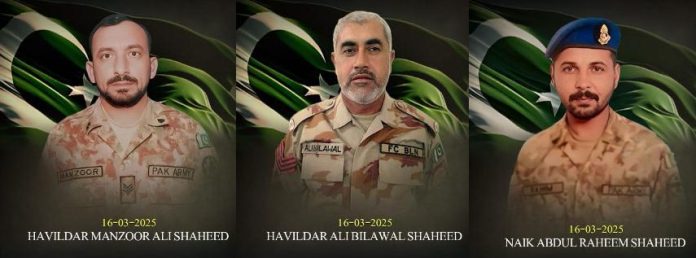
RAWALPINDI, MAR 16 /DNA/ – A vehicle borne suicide bomber exploded himself on a security forces convoy in Nushki District. Resultantly, five brave sons of soil embraced shahadat; three security forces personnel and two innocent civilians.

Shuhada include Havildar Manzoor Ali (Age: 38 years, resident of District Nawab Shah), Havildar Ali Bilawal (Age: 39 years, resident of District Naseer Abad), Naik Abdul Raheem (Age: 34 years, resident of District Badin), Civilian Driver Jalal ud Din (resident of District Quetta) and Civilian Driver Muhammad Naeem (resident of District Kharan).

In the ensuing sanitization operation, the terrorists were pursued and after intense fire exchange, three terrorists were effectively neutralized by the security forces.

Sanitization operations in the area would continue and perpetrators of this henious and cowardly act will be brought to justice.

Security forces of Pakistan, in step with the nation, remain determined to thwart attempts at sabotaging peace, stability and progress of Balochistan and such sacrifices of our brave soldiers and valiant civilians further strengthen our resolve.

Uzbekistan business delegation visits RCCI

Uzbekistan business delegation visits RCCI

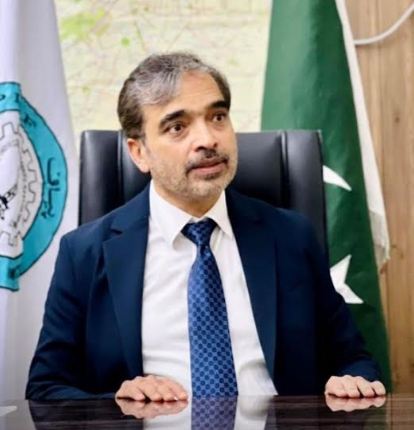
RAWALPINDI, MAR 16 /DNA/ – A high-level business delegation from Uzbekistan’s food industry visited the Rawalpindi Chamber of Commerce and Industry (RCCI). The 15-member delegation was led by Mr. Bakhrom Yusupov, Trade and Economic Counsellor at the Embassy of Uzbekistan.

 RCCI President Usman Shaukat, in his welcome remarks, provided an overview of RCCI’s initiatives and its role in fostering trade relations and regional connectivity. He highlighted the immense potential for trade expansion in Central Asia and emphasized the importance of strengthening economic ties between Pakistan and Uzbekistan.

 Group Leader Sohail Altaf, Senior Vice President Khalid Farooq Qazi and Vice President Fahad Barlas in their remarks extended a warm welcome to the delegation. The visit was focused on exploring trade opportunities, fostering B2B matchmaking, and enhancing bilateral cooperation in the food industry.

 The delegation engaged in discussions with local counterparts to identify avenues for collaboration and mutual growth. The visit reflects the growing economic ties between Pakistan and Uzbekistan, paving the way for increased trade and investment opportunities.

JUI-F to decide on possible anti-govt PTI alliance after Eid, says Maulana Fazl

JUI-F to decide on possible anti-govt PTI alliance after Eid, says Maulana Fazl

ISLAMABAD, MAR 16: Jamiat Ulema-e-Islam-Fazl (JUI-F) will decide on the possible coalition with the Pakistan Tehreek-e-Insaf (PTI) after Eid, party’s chief Maulana Fazlur Rehman said as the alliances brew among the opposition parties. 

Speaking to journalists in Islamabad on Saturday, he said that the JUI-F convened a consultative council meeting to discuss launching an anti-government movement with the PTI. The meeting will also decide on a possible alliance with the former ruling party, he added. 

The seasoned politician leader said that the PTI’s real leadership remains in jail, while those outside lack unity, referring to former ruling party’s founding chairman Imran Khan and Vice Chairman Shah Mahmood Qureshi. 

He went on to say that tensions with the PTI have reduced, and verbal statements would not harm any potential alliance. He added that if someone speaks against him, the PTI should take notice.

The JUI-F chief warned that if unilateral decisions continue, political tensions in the country would escalate. He said that the three-time former prime minister and Pakistan Muslim League-Nawaz (PML-N) President Nawaz Sharif can play an important role in the current political situation.

He also stressed the need for dialogue on Balochistan, saying if the state requests, the JUI-F may consider playing a role in Afghanistan-related matters.

It may be noted that the PTI and JUI-F have been holding consultations in recent months to possibly forge an alliance against the government, in the wake of incarcerated former prime minister Imran Khan’s call to his party to strengthen contacts with opposition parties. 

The Khan-founded party has expedited efforts to form a grand opposition alliance to launch an anti-government movement after Eid ul Fitr following his directives. In January, a PTI delegation met Fazl and invited him formally to join the opposition alliance, namely the Tehreek Tahafuz Ayeen-e-Pakistan (TTAP).

More recently, a two-member committee, consisting of former National Assembly speaker Asad Qaiser and JUI-F Senator Kamran Murtaza, was formed to pave the way for moving forward.

However, any significant progress in a working relationship remains elusive. 

The JUI-F had conveyed its conditions and reservations to the PTI about joining the opposition’s grand alliance, The News reported on March 8, citing sources. 

Here’s the full list of nations on Trump’s travel-ban chopping block

Here's the full list of nations on Trump's travel-ban chopping block

WASHINGTON, MAR 16: The Trump administration is considering issuing sweeping travel restrictions for the citizens of dozens of countries as part of a new ban, according to sources familiar with the matter and an internal memo seen by Reuters.

A US official speaking on the condition of anonymity cautioned there could be changes on the list and that it was yet to be approved by the administration, including US Secretary of State Marco Rubio.

The memo lists a total of 41 countries divided into three separate groups.

Full visa suspension

  • Cuba
  • Iran
  • Libya
  • North Korea
  • Somalia
  • Sudan
  • Syria
  • Venezuela
  • Yemen

Partial visa suspension (tourist, student and some other visas affected)

  • Eritrea
  • Haiti
  • Laos
  • Myanmar
  • South Sudan

Countries recommended for a partial suspension if they do not address deficiencies

  • Angola
  • Antigua and Barbuda
  • Belarus
  • Benin
  • Bhutan
  • Burkina Faso
  • Cabo Verde
  • Cambodia
  • Cameroon
  • Chad
  • Democratic Republic of the Congo
  • Dominica
  • Equatorial Guinea
  • Gambia
  • Liberia
  • Malawi
  • Mauritania
  • Pakistan
  • Republic of the Congo
  • Saint Kitts and Nevis
  • Saint Lucia
  • Sao Tome and Principe
  • Sierra Leone
  • East Timor
  • Turkmenistan
  • Vanuatu

Business community stands with armed forces amidst rising terror attacks

Business community stands with armed forces amidst rising terror attacks

PIAF leadership condemns train attack, hails army’s swift response

ISLAMABAD, MAR 16: /DNA/ – The Pakistan Industrial and Traders Associations Front (PIAF) Chairman Fahimur Rehman Saigol has strongly condemned the heinous terrorist attack on the Jaffar Express in Balochistan and praised the security forces for their effective and timely response in rescuing the passengers.

In a ceremony held here to honour those who lost their lives to fight against terrorists, PIAF Chairman Fahimur Rehman Saigol, Senior Vice chairman Nasrullah Mughal and Vice chairman Tahirm Manzoor Chaudhry expressed deep concern over the tragic incident. They commended the bravery and dedication of the security personnel, stating that their courageous efforts ensured the safety of innocent passengers.

The PIAF leaders denounced the attack as a cowardly and inhuman act, emphasizing that such elements are enemies of Pakistan’s peace, progress, and development. They stressed that those responsible deserve no leniency.

They also extended heartfelt prayers for the swift recovery of those injured in the attack. Despite the challenging terrain, they acknowledged the unwavering morale of the security forces, who effectively countered the terrorists through their prompt action.

The PIAF leaders affirmed that any conspiracy aimed at destabilizing the country would be thwarted, emphasizing that the entire nation stands united in solidarity with its security forces to ensure peace and stability.

The leadership lauded the valour of security forces for rescuing the passengers of Jaffar Express and said that attacks on innocent civilians and passengers were inhuman and condemnable acts. They said neither any religion nor a society allowed such repugnant acts.

The Baloch nation strongly opposed those elements who had taken unarmed passengers, elders and children as hostage. They said that security forces officers and personnel were eliminating terrorists bravely during the ongoing response.

“Despite a difficult terrain, the morale of the security forces is high and they are pushing back the coward terrorists with their timely action,” Shehbaz said. They expressed the hope that the security operation would soon meet with success and the terrorists would be eliminated.

Faheem Saigol said that inhuman terrorists, who launched the cowardly assault on Jaffar Express at Dhadhar-Bolan Pass did not deserve any concession. “Terrorists are the enemies of progress and development of Balochistan province,” he said.

“Targeting of innocent passengers in the holy and blessed month of Ramazanul Mubarak proves it clearly that terrorists have no relation with Islam, Pakistan and Balochistan,” he added. He vowed the fight against terrorism would continue till complete eradication of this spectre from the country.

Any conspiracy to spread chaos and lawlessness in the country would be foiled, he continued, stressing that the government would never allow enemies of the nation to succeed in their nefarious designs. “In this fight against terrorism, the entire nation stands shoulder to shoulder with the security forces.”

Without complete peace, the dream of development and prosperity is elusive. The valiant personnel of police, armed forces and Rangers are rendering ultimate sacrifices and the nation will have to remember it, he said.

The heinous plans of anti-national and anti-social elements will never be allowed to be allowed,” he said. The businessmen stand with the Balochistan government. He hoped police and other LEAs will bring this situation under control.

“Terrorists cannot shake the national resolve with such cowardly acts. The nation is united and the evil intentions of the enemies will be crushed,” he added.

He reaffirmed his full support for the security forces, and called for effective measures to eliminate elements seeking to destabilise the country. “The nation stands in solidarity with the families of the passengers during this difficult time,” he added.

President condemns Naushki blast

President condemns Naushki blast

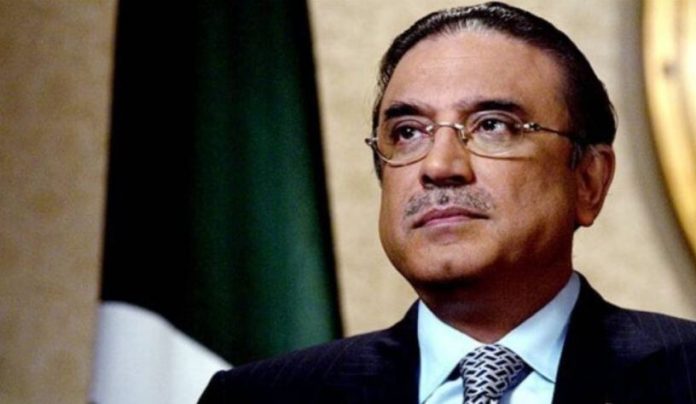
ISLAMABAD, MAR 16 (APP/DNA): President Asif Ali Zardari on Sunday condemned a blast in Naushki, Balochistan and expressed his deep grief and sorrow over loss of lives.

The president prayed for the high ranks of the departed souls and for the bereaved families to bear the losses with fortitude, President Secretariat Press Wing said in a press release.

He also prayed for the early recovery of those injured in the incident.

Blast near passenger bus on Nushki-Dalbandin highway kills 7, injures 35

Blast near passenger bus on Nushki-Dalbandin highway kills 7, injures 35

NUSHKI: At least seven people were killed and 35 injured in a blast near a passenger bus on Nushki-Dalbandin highway as violence-hit Balochistan records another tragic incident today (Sunday).

However, authorities have not yet confirmed the nature of the blast or its cause.

Noting that the injured were immediately shifted to Nushki Hospital soon after the explosion, the police have said that several of the wounded were in critical condition.

According to the hospital administration, an emergency has been declared at Mir Gul Khan Naseer Teaching Hospital to handle the situation. Security forces have cordoned off the area, and investigations are underway.

Play Video
Furthermore, as per the police, the injured were being shifted to Quetta via helicopter.

Reacting to the incident, Interior Minister Mohsin Naqvi expressed sorrow while condemning the targeting of innocent people — terming it as extreme brutality.

The security czar also wished for speedy recovery of the injured.

Meanwhile, Balochistan Chief Minister Sarfraz Bugti expressed deep sorrow and regret over the loss of precious lives while condemning the blast.

Reaffirming the government’s resolve to establish peace in Balochistan at all costs, Bugti said that every possible step would be taken to bring the enemies of peace to justice.

The incident comes days after a major terrorist attack in the Mushqaf area of the Bolan district in Balochistan, along with Khybe Pakhtunkhwa, faced the brunt of terrorist attacks — with both provinces accounting for over 96% of terrorist attacks and deaths in Pakistan in 2024 as per a Global Terrorism Index 2025 report.

Dozens of militants, affiliated with the Balochistan Liberation Army (BLA), blew up a railway track and assaulted Jaffar Express on Tuesday, carrying more than 440 passengers — who were taken hostage.

The security forces, after a complex clearance operation, neutralised 33 attackers and rescued the hostage passengers.

Apart from five operation casualties, as many as 26 passengers were martyred by the terrorists of which 18 were security personnel belonging to the Pakistan Army and the Frontier Corps (FC), three were officials from Pakistan Railways and other departments and five were civilians.

Also, three FC personnel were martyred in the militants’ attack targeting a picket before the train ambush.

Furthermore, the terrorist attack, as per Director General of Inter-Services Public Relations (DG ISPR) Lieutenant General Ahmed Sharif Chaudhry, was marred by malicious propaganda on social media platforms.

“The Indian media spread propaganda by using fake videos to exaggerate the situation,” he said while terming New Delhi as the main sponsor of the attack.

Meanwhile, the government has announced a compensation package of Rs5.2 million and jobs in the Ministry of Railways to the families of the victims.

Backsliding of Liberal Institutions in America

Backsliding of Liberal Institutions in America

Dr. Muhammad Akram Zaheer

Democracies rarely collapse through abrupt coups or military interventions in the contemporary world. Instead, the decline of democratic governance is often a gradual process marked by the weakening of democratic institutions, the erosion of civil liberties and the rise of hybrid regimes that blend democratic and authoritarian elements. In such cases, democratic structures remain formally intact, yet elections lose their credibility, opposition parties face systemic disadvantages and the rule of law becomes compromised. Scholars have warned that the United States, long considered a bastion of democracy, has exhibited symptoms of democratic backsliding in recent years, following trends observed in other nations that have experienced democratic decay. This essay examines the structural conditions that have facilitated democratic backsliding in the U.S., the role of political polarization, the impact of institutional weaknesses and the potential pathways for restoring democratic integrity.

The erosion of democratic norms in the United States did not begin with the rise of former President Donald Trump, although his tenure accelerated existing trends. Political conflict has been intensifying since the late 20th century, as partisan divisions have deepened and governing institutions have become increasingly gridlocked. The shift from consensus-driven policymaking to zero-sum political competition can be traced to the 1980s, when party leaders prioritized ideological purity over legislative compromise. The Republican Party’s takeover of Congress in 1994, fueled by a strategy of obstruction and confrontation, marked a turning point in partisan escalation.By the early 2000s, ideological polarization had become more entrenched, with the Republican Party, in particular, rewarding candidates who embraced extremist positions. The rise of the Tea Party movement further exacerbated this trend, as grassroots activists mobilized around anti-government sentiment, economic nationalism and cultural conservatism. Wealthy donors and interest groups, such as the Koch network, played a significant role in reshaping the Republican Party by supporting candidates who prioritized deregulation, tax cuts and a rollback of social protections.The convergence of these forces created an environment in which political competition was no longer about governance but about ideological dominance and partisan survival.A certain degree of polarization is natural in democratic societies, as it allows voters to choose between distinct policy agendas. However, excessive polarization can be detrimental when it leads political factions to view their opponents as existential threats rather than legitimate competitors. Comparative political scholars have identified a dangerous threshold at which polarization transforms into a form of democratic erosion, often aligning with deeper societal cleavages such as race, religion and economic inequality. In the U.S., the historical legacy of racial exclusion has exacerbated partisan divisions, with political competition increasingly revolving around identity-based conflicts. Over the past few decades, partisan identities have hardened, making bipartisan cooperation nearly impossible. Political psychologists have observed that individuals who strongly identify with either party are more likely to view their opponents as morally corrupt and untrustworthy. This form of social polarization generates heightened emotional responses, such as fear, anger and resentment, which further radicalize political discourse. The consequences of this dynamic became evident in the lead-up to the 2020 election, as disinformation campaigns, conspiracy theories and allegations of electoral fraud fueled public distrust in democratic processes.

Democratic backsliding is not always accompanied by the outright dismantling of institutions; instead, it often involves their subtle manipulation. In the U.S., the Republican Party has engaged in tactics that undermine democratic principles while maintaining a façade of constitutional legitimacy. These include gerrymandering, voter suppression and judicial appointments designed to entrench partisan advantages. For instance, the refusal to consider President Obama’s Supreme Court nominee in 2016, followed by the rushed confirmation of a conservative justice in 2020, highlighted the extent to which institutional norms had been subordinated to partisan interests.One of the most alarming aspects of recent democratic decline in the U.S. is the growing acceptance of political violence. Surveys conducted in early 2020 revealed that a majority of Republican voters believed that the “traditional American way of life” was under existential threat, with a significant portion expressing support for extralegal measures to preserve it. This rhetoric culminated in the January 6th, 2021, attack on the U.S. Capitol, an event that starkly illustrated the fragility of American democracy. Rather than unequivocally condemning the insurrection, numerous Republican lawmakers downplayed its significance, reinforcing narratives of electoral fraud and illegitimacy.Despite these challenges, certain aspects of the American political system have demonstrated resilience in the face of democratic erosion. The decentralized nature of election administration, for example, has served as a safeguard against large-scale electoral manipulation. State and local officials, irrespective of partisan affiliation, played a crucial role in ensuring the integrity of the 2020 election. Moreover, the judiciary, while increasingly politicized, has not entirely abandoned its role as a check on executive overreach. Courts at various levels dismissed numerous baseless lawsuits seeking to overturn election results, reaffirming the rule of law.Another underappreciated component of democratic resilience is the administrative state. Bureaucratic institutions, often maligned as inefficient or unaccountable, provide stability and continuity, even amid political turmoil. The public service sector has functioned as a bulwark against authoritarian tendencies by maintaining essential governance functions and resisting efforts to politicize its operations. However, public confidence in government institutions remains low, a vulnerability that can be exploited by populist leaders seeking to delegitimize democratic norms.Restoring democratic integrity in the U.S. will require systemic reforms and a renewed commitment to democratic principles by political elites and civil society. Some proposed reforms include abolishing the Electoral College, restructuring congressional representation and instituting campaign finance reforms to limit the influence of wealthy donors. While these structural changes face significant obstacles, more immediate steps can be taken to protect democratic institutions. These include strengthening voting rights protections, enhancing transparency in electoral processes and fostering bipartisan initiatives aimed at depolarizing political discourse. Ultimately, the survival of democracy depends not only on institutional reforms but also on the political culture that sustains it. Efforts to rebuild trust in democratic institutions must address the underlying social and economic grievances that fuel polarization. Civic education, media literacy programs and initiatives promoting cross-party dialogue can play a vital role in mitigating extremist tendencies and fostering a more constructive political environment. The United States is at a critical juncture, where the future of its democratic system hangs in the balance.

The historical precedents suggest that democratic institutions can withstand periods of political turmoil, the current trajectory of polarization and institutional manipulation poses significant risks. Recognizing the warning signs of democratic backsliding is the first step toward addressing the challenges ahead. Through institutional reforms, civic engagement and a commitment to democratic principles, the U.S. can reverse its course and reaffirm its status as a functioning democracy. The stakes are high and the coming years will determine whether the nation can withstand the forces that threaten to undermine its democratic foundation.

Stay Connected

64FansLike
60FollowersFollow

Latest Reviews

Exchange Rates

USD - United States Dollar
EUR
1.17
GBP
1.35
AUD
0.72
CAD
0.73