Home Blog Page 620

Time to rethink the relevance of the OIC

Time to rethink the relevance of the OIC

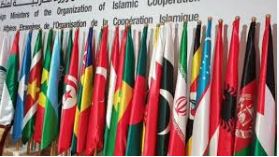
The Organisation of Islamic Cooperation (OIC), founded in 1969 in the aftermath of the arson attack on Al-Aqsa Mosque in Jerusalem, was meant to serve as the collective voice of the Muslim world. With 57 member states, it is the second-largest intergovernmental organization after the United Nations. Yet, more than five decades later, the OIC remains a symbol of unfulfilled promises, hollow statements, and political paralysis.

From Gaza to Kashmir, from Rohingya Muslims in Myanmar to the Uighurs in China, and from repeated episodes of Islamophobic attacks in the West to the publication of blasphemous cartoons—whenever the Muslim world has cried out for justice and solidarity, the OIC has responded with little more than verbal condemnations and watered-down resolutions. On Gaza in particular, while children are being massacred and entire neighborhoods are reduced to rubble, the OIC’s actions have remained timid, divided, and largely symbolic. Instead of leading a unified diplomatic offensive or initiating humanitarian interventions, it has issued apologetic statements, seemingly more worried about offending Western sensibilities than defending Muslim lives.

This is not what the founders of the OIC envisioned. It was supposed to be a platform to protect Muslim sanctities, defend Muslim nations under occupation or oppression, and promote political and economic cooperation among Islamic countries. Sadly, it has become a forum for photo-ops, empty rhetoric, and bureaucratic formalities.

The inability of the OIC to act decisively is not due to a lack of capacity, but a lack of will. Member states are deeply divided—politically, ideologically, and economically. Many are more interested in pleasing their Western patrons than in supporting their fellow Muslim nations. The OIC’s headquarters in Jeddah may still hold symbolic value, but it has lost moral authority in the eyes of the Muslim youth, activists, and even ordinary citizens across the world who see the suffering of their brothers and sisters go unanswered.

If the OIC cannot fulfill its mandate, it is time to seriously consider whether it should continue to exist in its current form. A bold alternative must be explored. A new bloc—comprising sincere, independent, and capable Muslim countries like Pakistan, Turkey, Indonesia, Malaysia, Iran, and even Afghanistan—could be formed. This new organization should not be bogged down by bureaucracy but must be built on a clear charter of action, unity, and resistance against oppression.

Such a grouping could speak with one voice on international platforms, create joint economic projects, pool defense resources, and coordinate responses to global Islamophobia. Most importantly, it would restore a sense of dignity and strength to a fragmented Muslim world desperately in need of leadership.

Muslims around the world are watching, and they are losing faith—not just in their leaders, but in institutions like the OIC that were supposed to protect their interests. It is time to either activate the OIC into a true force of unity and action, or accept its irrelevance and build something new. The suffering of the Ummah demands no less.
Gaza is not a war — it is a genocide

Pakistan condemns Israel’s military aggression against Rafah City in Gaza

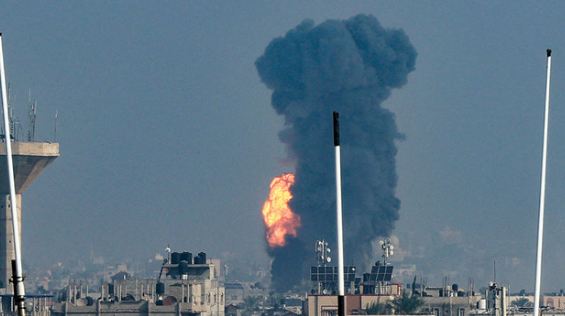
For months, the world has watched in horror as Gaza is relentlessly bombarded, its people displaced, starved, and killed. Yet, much of the international media and political discourse continues to call it a “war.” This is not just inaccurate—it is dangerously misleading. What is unfolding in Gaza is not a war. It is a genocide.

A war implies a conflict between two sides of relatively equal power, each capable of inflicting damage, defending itself, and making strategic choices. Gaza, blockaded and impoverished for over 15 years, has no army, no air force, no navy. Its people are trapped in one of the most densely populated regions on Earth, with no safe zones, no bomb shelters, and no means to escape. To describe what’s happening there as a “war” is to deny the fundamental imbalance of power—and the immense suffering of a civilian population.

What we are witnessing is the systematic destruction of a people. Entire families have been wiped out in airstrikes. Hospitals, schools, refugee camps, and UN facilities have been targeted. International humanitarian organizations have repeatedly warned of mass starvation and disease, yet the siege continues. This is not collateral damage. It is policy—one designed to make life in Gaza unlivable.

In this context,  U.S. President Donald Trump’s recent remarks during his Gulf tour—that Gaza “needs help”—ring hollow unless they are followed by concrete action. Trump made these statements while visiting the Gulf, where leaders are more sensitive to the Palestinian cause. Was it a moment of empathy or a calculated move to appease his hosts? The real test will come when he returns to the United States or travels to Europe or Israel. Will he have the courage to repeat such statements there? Will he call for a ceasefire, demand accountability, or support humanitarian aid? Or will his concern for Gaza conveniently fade away when he’s no longer speaking to an Arab audience?

Words without action are meaningless. If Trump—or any global leader—is truly concerned about the plight of Gazans, they must push for practical measures: immediate ceasefire, unimpeded humanitarian access, rebuilding efforts, and most importantly, a path toward justice and accountability. The International Criminal Court, human rights organizations, and independent observers must be allowed to investigate potential war crimes. Anything less would be complicity.

The world must stop calling this a “war.” It is not. It is a one-sided massacre, enabled by global silence, shielded by distorted language, and prolonged by political cowardice. Refusing to name it for what it is—genocide—only emboldens the aggressors and deepens the suffering of the victims.

History will judge the world not only by what it did during this tragedy, but by what it failed to say. Let us speak the truth: Gaza is not at war. Gaza is being exterminated. And silence, in the face of genocide, is unforgivable.

Hungary and Pakistan: a growing friendship (P-II)

Hungary and Pakistan: a growing friendship (P-II)

An Interview with H.E. Béla Fazekas, Ambassador of Hungary to Pakistan

EXCLUSIVE

Ansar Mahmood Bhatti

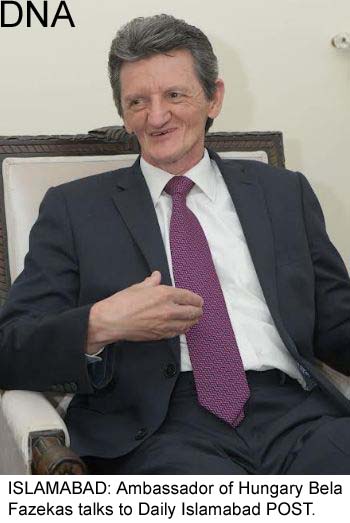
ISLAMABAD: As his tenure in Pakistan comes to a close, the Hungarian Ambassador to Pakistan, H.E. Béla Fazekas, reflects on the evolving bilateral relationship between Hungary and Pakistan. In a candid and thoughtful interview, Ambassador Fazekas offers insight into the diplomatic, economic, and cultural ties that have developed over the years—and outlines opportunities for a brighter, more connected future between the two nations. First of this interview was published in this newspaper on May 12, 2025.

When asked to assess the current state of political, economic, and cultural relations between Hungary and Pakistan, Ambassador Fazekas described the relationship as being “more than friendly and less than strategic.” However, he emphasized that the two nations are just a “stone’s throw away” from forging a truly strategic partnership.

“Over the past five years, we’ve covered significant ground,” he noted, underscoring the importance of consistent diplomatic engagement. “Economic and trade relations, however, tell a different story.”

The ambassador highlighted one of the most remarkable economic success stories: the long-standing presence of Hungarian oil and gas giant MOL in Pakistan. Since 1999, MOL has been active in the country’s energy sector, investing over USD 3 billion and contributing immensely to Pakistan’s energy security—particularly in the Khyber Pakhtunkhwa province.

Despite security challenges in that region, MOL has remained committed, even as many other Western companies exited. “This unwavering engagement speaks volumes about MOL’s confidence in Pakistan and its people,” said Fazekas.

On the flip side, the broader picture of bilateral trade leaves room for improvement. Though the trade volume has doubled in five years—from USD 50 million to USD 100 million—Ambassador Fazekas pointed out that this still does not reflect the true potential of the relationship.

Referencing the past “Nokia era,” when Hungarian-made cellphones were ubiquitous in Pakistani households, he said, “Those days might not return, but we must find a substitute—another flagship product to revive the vibrancy of our trade relations.”

Ambassador Fazekas is particularly proud of Hungary’s contributions to education in Pakistan. Despite being a relatively small nation in terms of geopolitical power, Hungary boasts one of the highest numbers of Nobel Prize winners per capita—a feat he attributes to its world-class higher education system.

In the last decade, Hungary has steadily increased the number of government-funded scholarships for Pakistani students, beginning with 80 and now offering 400 scholarships annually. The demand is overwhelming, with 15,000 to 18,000 applicants every year, demonstrating the high regard in which Hungarian education is held among Pakistani youth.

Additionally, hundreds of Pakistani students pursue self-funded studies in Hungary, making them one of the largest Pakistani student diasporas in Europe—and the largest under any single government’s scholarship program.

“These young people are ambassadors of Pakistan in Hungary,” said Fazekas, emphasizing the role of education in building long-lasting people-to-people connections.

On how Pakistan can enhance its presence in Hungary, Ambassador Fazekas offered pragmatic advice. “Establish a commercial counselor’s post at the embassy—or better yet, open a dedicated trade office in Budapest,” he recommended.

He also emphasized the need to leverage the presence of Pakistani students to deepen cultural understanding. “They can organize cultural events, culinary festivals, even introduce cricket to Hungarian youth. They are energetic, smart, and full of potential. Let them establish Pakistan as a beloved brand in Hungary.”

When asked if he would consider returning to Pakistan in the future, Ambassador Fazekas responded with warmth and realism. “Yes, I would. But being closer to 70 than 60, I don’t think Pakistan will be high on my bucket list. Still, I look forward to watching Pakistan become one of the success stories of the 21st century—something I believe will happen sooner or later.”

“A young country with ancient civilization,” Fazekas said without hesitation—capturing the essence of Pakistan’s identity in a single, powerful sentence.

In his parting words, the ambassador expressed deep gratitude:

“I just want to thank my Pakistani friends for treating me like one of their own. I apologize if at times I was too honest—perhaps even too blunt—but it was never against them, always for them.”

Ambassador Béla Fazekas leaves Pakistan with admiration and hope. His tenure has been marked by mutual respect, shared values, and a vision for even closer ties between Hungary and Pakistan. As both nations look to the future, it is evident that education, trade, and cultural exchange will form the bedrock of a truly strategic partnership.=DNA

PSL X: Warner, Vince steer Karachi to 237/4 against Peshawar

PSL X: Warner, Vince steer Karachi to 237/4 against Peshawar

RAWALPINDI, MAY 17: After being invited to bat first, Karachi Kings set a 238-run target against Peshawar Zalmi in the 27th match of the Pakistan Super League (PSL) Season 10 being played at the Rawalpindi Cricket Stadium on Saturday.

The Kings registered a formidable total of 237/4 in their allotted 20 overs, courtesy of a marathon second-wicket partnership between Warner and Vince.

The Kings, however, had a contrasting start to their innings as Luke Wood cleaned up debutant Ben McDermott on the first delivery of the innings.

Following the early stutter, Vince joined Warner in the middle, and together they launched an astounding recovery by putting together 162 runs for the second wicket until Ali Raza dismissed the former in the 15th over.

Vince smashed 11 fours and a six on his way to a 42-ball 72.

The Kings then lost another wicket in the next over when Wood dismissed in-form Muhammad Irfan Khan for two.

Arif Yaqoob gave Zalmi another massive breakthrough in the 17th over when he got Warner caught at deep mid-wicket.

The left-handed opener remained the top-scorer for the Kings with 86 off 50 deliveries, studded with 11 fours and two sixes.

The back-to-back wickets, however, did not dent the Kings’ march towards a big total as all-rounders Khushdil Shah and Mohammad Nabi added valuable runs at a brisk rate as they knitted an unbeaten 70-run partnership.

Khushdil was the core aggressor of the stand with a blistering 43 not out from 15 deliveries, while Nabi made an unbeaten 26 off 10 balls.

Wood was the standout bowler for Zalmi with two wickets for just 19 runs in his four overs, while Arif and Ali chipped in with one scalp apiece.

Playing XIs

Peshawar Zalmi: Mohammad Haris, Saim Ayub, Babar Azam (c), Tom Kohler-Cadmore, Hussain Talat, Max Bryant, Maaz Sadaqat, Luke Wood, Ahmed Daniyal, Arif Yaqoob and Ali Raza.

Karachi Kings: David Warner (c), Ben McDermott, James Vince, Saad Baig, Khushdil Shah, Muhammad Irfan Khan, Mohammad Nabi, Aamir Jamal, Abbas Afridi, Hasan Ali and Mir Hamza.

DG ISPR hails Iran’s efforts to de-escalate tensions in South Asia

DG ISPR hails Iran's efforts to de-escalate tensions in South Asia

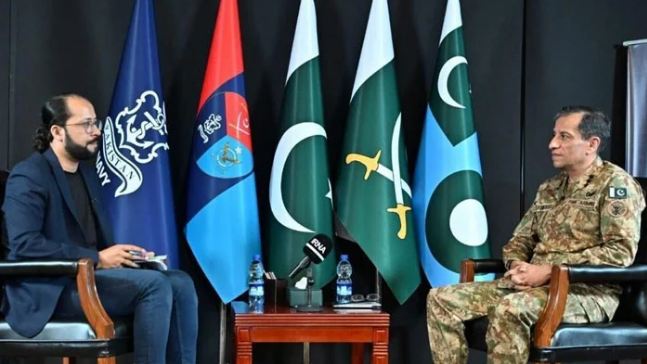
RAWALPINDI, MAY 17: Inter-Services Public Relations (ISPR) Director General (DG) Lieutenant General Ahmed Sharif Chaudhry has appreciated Iran’s efforts and support for de-escalating tensions in South Asia.

The latest escalation in the decades-old Pakistan-India rivalry began on May 7 when at least 31 civilians were martyred in an unprovoked Indian attack. In retaliation, Pakistan downed six IAF fighter jets, including three Rafale, and dozens of drones.

During an exclusive interview with IRNA, the DG ISPR said “We are pleased with all the efforts of the international community and brotherly countries, especially Iran, which played a role in reducing tensions.”

Without naming any outlawed group operating in the border areas of Pakistan and Iran, the military spokesperson continued, “We should be aware that there are forces in the region who, with the help of external factors, are seeking to create misunderstanding and confusion among brotherly countries in the region and want to create a rift between friends and brothers.”

He emphasised that Iran and Pakistan enjoy historical and brotherly relations and always stand by each other in all challenges and trials.

The DG IPR further said that Pakistan and Iran are two neighbouring and friendly countries that are in contact with each other on many issues and fields. 

“Pakistan is eager and pursues that the borders of the two countries are the borders of peace and friendship and we look forward to it,” he added. 

Referring to the important position of the two countries in the region, the military’s spokesperson said that Islamabad and Tehran were cooperating with each other for lasting peace and stability in the region.

Zardari, COAS Munir pay tribute to Marqa-e-Haq heroes

Zardari, COAS Munir pay tribute to Marqa-e-Haq heroes

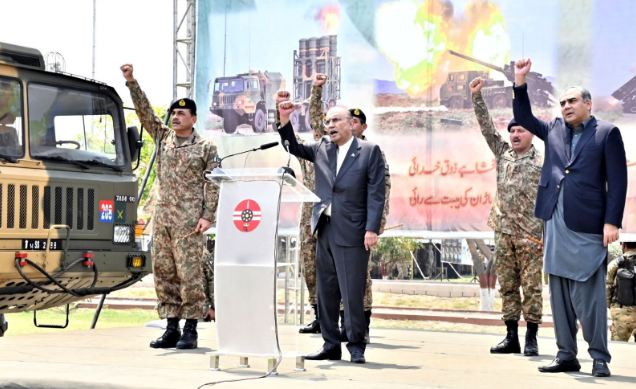
RAWALPINDI, MAY 17 /DNA/ – President of the Islamic Republic of Pakistan, Asif Ali Zardari visited Gujranwala Cantonment today. He was accompanied by Federal Interior Minister Mr Syed Mohsin Raza Naqvi. Upon arrival, the President was received by the Chief of Army Staff General Syed Asim Munir, NI (M). Commanders of Mangla and Gujranwala Corps were also present at the occasion.

The President lauded the exemplary conduct and professional excellence of the Pakistan Armed Forces in the successful execution of Marqa-e-Haq, acknowledging their resolute determination and unshakable courage in the face of unprovoked aggression. He paid solemn tribute to the military and civilian martyrs who laid down their lives in defence of the motherland, affirming that their sacrifice remains a sacred trust and a source of enduring national pride. He underscored that the sons of the soil, fortified by the enduring spirit of the nation, stood with unwavering resolve to defend the motherland and thwarted hostile designs with exceptional valour and operational acumen.

Zardari, COAS Munir pay tribute to Marqa-e-Haq heroes

He further remarked that history would bear witness to how, within a matter of hours, the Pakistan Armed Forces repelled aggression with unmatched precision and resolve, sending an unequivocal message of Pakistan’s strength, resilience, and national unity.

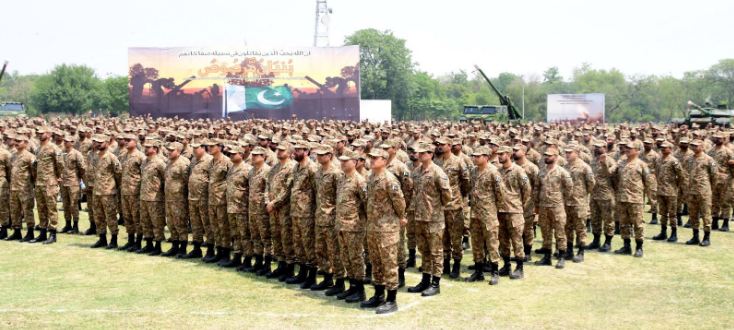
During his interaction with officers and troops, the President commended their exemplary morale, combat readiness, and devotion to duty. He extended heartfelt congratulations on the successful culmination of Operation Bunyan-um-Marsoos, and expressed profound pride in the defenders of the nation, affirming that the people of Pakistan hold their brave soldiers in the highest esteem as the true custodians of national honour and sovereignty.

Drowning Humanity: Another Chapter in Modi Government’s Brutality

Drowning Humanity: Another Chapter in Modi Government’s Brutality

by Muhammad Mohsin Iqbal

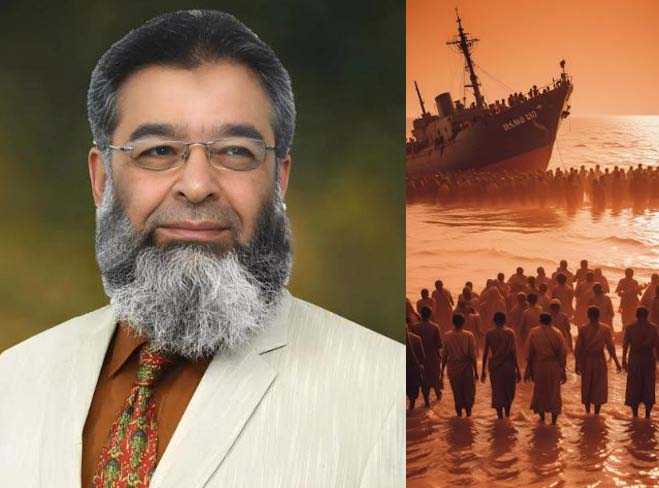
Another story of the Modi government’s brutality and inhumanity has come to light on the part of India, which makes one bow their heads in shame, but the Modi government is not ashamed. This time, the horrifying tale involves Rohingya refugees—already among the world’s most persecuted minorities—who have now become victims of an act so barbaric that it has alarmed the international conscience. Credible reports have surfaced indicating that dozens of Rohingya refugees were forced off Indian naval vessels into the Andaman Sea and made to swim toward Myanmar, a country from which they had fled to escape genocide and systemic oppression.

Drowning Humanity: Another Chapter in Modi Government’s Brutality

The incident is not only deeply disturbing but also a grave violation of international humanitarian norms. Tom Andrews, the UN Special Rapporteur on the situation of human rights in Myanmar, has rightly termed it an “unconscionable, unacceptable act.” The very idea that refugees—already bearing the trauma of statelessness and persecution—could be blindfolded, forcibly transported, and thrown into open sea, speaks volumes about the moral degradation of those in power. These actions represent a blatant breach of the international principle of non-refoulment, which forbids returning individuals to territories where they are at risk of persecution or death.

The details are chilling. Dozens of Rohingya refugees, reportedly holding identification documents, were rounded up from Delhi and Assam. Around 40 of them were blindfolded and flown to the Andaman and Nicobar Islands, only to be loaded onto an Indian naval vessel. In an act reminiscent of medieval cruelty, they were later handed life jackets and ordered into the sea—forced to swim toward a Myanmar island. Though they reportedly survived the perilous journey, their fate remains unknown. Another group of about 100 Rohingya refugees has also gone missing after being removed from a detention center in Assam and relocated to a border area with Bangladesh. Their condition and whereabouts are equally unclear.

The Modi government’s silence and refusal to acknowledge, let alone apologize for, these acts, reflects not just policy failure but a complete erosion of ethical governance. The image of Indian naval ships—symbols of national strength—being used to commit such cruelty against helpless refugees is a grotesque distortion of national power. What makes it worse is that these acts are not isolated. They are consistent with a growing pattern of hostility, discrimination, and abuse against minorities, especially Muslims, under the current regime.

On March 3, 2025, Special Rapporteur Andrews had already communicated with the Indian government, raising concerns over arbitrary and indefinite detention of Rohingya refugees and asylum seekers. He had warned against the dangers of refoulement and emphasized the need for access to places of detention and fair treatment of refugees. Yet, the response from the Indian authorities has been not just dismissive but defiant—escalating their inhumane tactics instead of correcting them.

India, which once proudly opened its borders to refugees—from Tibet, Bangladesh, Afghanistan, and Sri Lanka—now stands accused of pushing stateless Rohingya into the sea. Instead of honoring its civilizational heritage of hospitality and compassion, it is now following a path marred by hatred and exclusion. The Modi government’s repeated targeting of the Rohingya community—detaining them, denying them basic rights, and now reportedly casting them into the ocean—reflects not just xenophobia but a dangerous, calculated strategy to appease a hyper-nationalist, anti-Muslim constituency.

The international community, particularly human rights organizations and the United Nations, must act with urgency. It is no longer sufficient to express concern or issue condemnations. Concrete diplomatic, legal, and economic measures are required to hold the Modi government accountable. The United Nations must press India to explain these incidents, grant access to the victims, and prosecute those responsible for these grave human rights violations. Refugee protection is a global responsibility, but when a country as large and influential as India shirks this duty with such cruelty, it sets a dangerous precedent for others to follow.

Mr. Andrews’ efforts deserve support and reinforcement. As a representative of the UN Human Rights Council, though he serves in a personal and unpaid capacity, his voice carries the weight of the international community’s moral authority. His inquiry must be allowed to proceed unhindered, and his recommendations must be taken seriously—not just by India but by all member states committed to upholding human rights and international law.

This episode, if verified, is not just a humanitarian disaster; it is a political and moral catastrophe. It strips away the veneer of democracy and secularism that India still claims to possess and exposes the rotten core of a regime that sees compassion as weakness and cruelty as strength. The Rohingya, who escaped death in Myanmar only to be thrown into the sea by India, symbolize a global failure of conscience—but above all, they are evidence of the Modi government’s disdain for human dignity.

To feel shame is a sign of humanity. Yet, the Modi government seems incapable of it. The world must ensure that while the victims may be voiceless, their suffering does not go unheard. Their story—of survival, displacement, and betrayal—must remain a constant reminder of the cost of indifference, the horror of inhumanity, and the urgent need to reclaim our shared humanity from the clutches of state-sponsored brutality.

COAS Asim Munir praises media’s role in countering Indian propaganda

COAS Asim Munir praises media’s role in countering Indian propaganda

RAWALPINDI, MAY 17: Chief of Army Staff (COAS) Gen Syed Asim Munir has praised the role of Pakistani media, stating that it has responded courageously and wisely to Indian propaganda.

In an informal conversation with journalists, Gen Munir said, “We have concealed nothing; everything has been presented to the nation in a clear and transparent manner. The Pakistani media has demonstrated a strong sense of responsibility and effectively countered Indian propaganda in a commendable way.”

He stated that the media had played a vital role in promoting national unity, showcasing to the world that Pakistan is a vibrant and vigilant nation.

Gen Munir said, “The way our media confronted Indian narratives—with both courage and strategic insight—was truly remarkable. We are proud of our journalists and media institutions.”

Pakistan, UK strengthen cooperation under UPSCALE crime program

Pakistan, UK strengthen cooperation under UPSCALE crime program

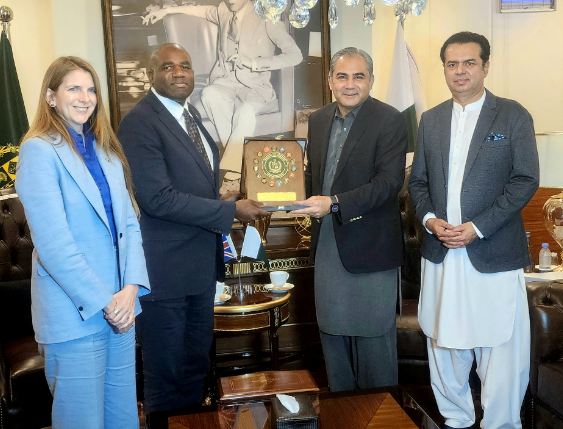
ISLAMABAD, MAY 17: /DNA/ – Interior Minister Mohsin Naqvi held an important meeting with Foreign Secretary of the United Kingdom Rt. Hon. David Lammy. Upon his arrival at the Ministry of Interior, Minister Naqvi warmly welcomed the British Foreign Secretary.

During the meeting, both sides discussed Pakistan-UK relations, bilateral cooperation, and developmental partnerships. Mohsin Naqvi stated that Pakistan stands as a strong wall in the fight against terrorism. He expressed the desire to further strengthen relations and mutual cooperation with the United Kingdom.

Appreciating the UK’s support under the UPSCALE Programme, the Interior Minister said the initiative is playing a key role in curbing organized crime. He added that under the programme, both countries are working jointly in the areas of illegal immigration, online child harassment, mutual legal assistance and extradition, criminal record exchange, sex offender management, illicit financing, and counter-narcotics.

Interior Minister highlighted that the cooperation under the UPSCALE Programme is yielding positive results in preventing serious and organized crimes. He said that with the support of the UK’s National Crime Agency (NCA), the Anti-Narcotics Force (ANF) seized 4.3 tons of opium, valued at £22 million.

The British Foreign Secretary thanked Pakistan for facilitating the relocation of Afghan refugees to the UK. He also expressed satisfaction over the successful progress of the UPSCALE Programme.

Minister of State for Interior Tallal Chaudhry, British High Commissioner Jane Marriott, Federal Interior Secretary, DG FIA, and senior UK officials were also present on the occasion.

An Analysis of Indus Water Treaty

An Analysis of Indus Water Treaty

Fiza Shaheen

The Indus Waters Treaty is a landmark water-sharing agreement between India and Pakistan, brokered by the World Bank. It was formulated to resolve disputes over the utilization of the Indus River system, which is vital for the agriculture, energy, and livelihoods of both nations. The river system comprises six major rivers: the Indus, Jhelum, Chenab, Ravi, Beas, and Sutlej. Under the treaty, the three western rivers—Indus, Jhelum, and Chenab were allocated to Pakistan, while the three eastern rivers—Ravi, Beas, and Sutlej were allocated to India. Given that India was already utilizing the eastern rivers and Pakistan heavily depends on the western rivers for its water needs, this division aimed to provide a fair and practical solution. India was permitted to use the western rivers for limited non-consumptive purposes such as irrigation, transport, and hydropower generation, provided these uses did not interfere with the water flow to Pakistan. Despite several armed conflicts between the two countries, the treaty has endured and is often regarded as a successful model of conflict resolution. A Permanent Indus Commission, consisting of representatives from both countries, was established to facilitate data exchange and resolve water-related issues. However, the treaty now faces mounting challenges. Climate change, glacial retreat, and increasing water demand due to population growth are placing significant strain on the river system. Pakistan frequently raises concerns about Indian dam projects on the western rivers, fearing they could provide India with strategic leverage or reduce water flow. India, on the other hand, asserts that these projects comply with the treaty’s provisions and that Pakistan’s objections are unfounded. Furthermore, the treaty has not been updated to address modern environmental and technical challenges such as groundwater depletion, pollution, and global warming. Although dialogue has been pursued, entrenched mistrust continues to hinder effective cooperation.

The Indus River system, comprising six principal rivers Indus, Jhelum, Chenab, Ravi, Beas, and Sutlej became a contentious issue following the 1947 partition of British India. The creation of India and Pakistan introduced new political boundaries, making the distribution of water resources a critical concern. A formal agreement became essential to prevent future disputes and ensure stable water sharing between the two nations.

The treaty, signed in 1960, outlines the following arrangements:

  • Eastern Rivers: India received exclusive rights over the Beas, Ravi, and Sutlej rivers. It is permitted full use of these rivers for domestic, agricultural, and industrial purposes. Pakistan, while not allowed to obstruct India’s use, is permitted limited use for irrigation.
  • Western Rivers: The Indus, Jhelum, and Chenab rivers were allocated to Pakistan. These rivers are crucial for Pakistan’s agriculture and economy. India is allowed non-consumptive uses such as limited irrigation and hydropower generation, provided these activities do not reduce the quantity or alter the timing of water flows into Pakistan.

The treaty has played a crucial role in ensuring relatively stable water relations between India and Pakistan. It has enabled the development of water management infrastructure and supported agricultural productivity in both countries. Nonetheless, several pressing issues now confront the treaty’s continued effectiveness:

  • Water Scarcity: Rapid population growth in both nations has significantly increased the demand for freshwater. Climate change is impacting rainfall patterns and accelerating the melting of Himalayan glaciers. Inefficient irrigation systems, pollution, and limited storage capacity further exacerbate water stress.
  • Political Tensions: Although the treaty is often considered a symbol of cooperation, it becomes contentious during periods of heightened political tensions. India has occasionally expressed interest in revisiting the treaty due to broader geopolitical disputes. Pakistan routinely protests against Indian hydroelectric projects on the western rivers, fearing a negative impact on water flows.
  • Environmental Concerns: Infrastructure projects permitted under the treaty, such as dams and barrages, can disrupt ecosystems, displace communities, and degrade wetlands and fisheries. Changes in river flow can affect biodiversity and reduce the ecosystem’s ability to adapt to climate change.

These developments underscore the urgent need to modernize the treaty to address evolving environmental, technical, and geopolitical realities. Reaffirmed in October 2023, the Indus Waters Treaty remains a cornerstone for the management of the Indus River system. While it has withstood decades of political and military strain, it now confronts more complex and urgent challenges:

  • Water Shortages: Rising populations and unpredictable water availability due to climate change have heightened water stress. Poor water management practices, including inefficient irrigation and widespread pollution, further strain the system.
  • Geopolitical Tensions: Despite the treaty’s relative detachment from broader conflicts, periods of increased hostility have led to calls within India to reassess the agreement. Pakistan has objected to Indian projects such as the Kishanganga and Ratle dams, fearing detrimental effects on downstream water availability. India maintains these projects are in compliance with treaty stipulations.
  • Environmental Degradation: Construction of dams and canals may alter sediment flow, disrupt aquatic ecosystems, and reduce biodiversity. Downstream communities in Pakistan often face water scarcity and declining agricultural yields.

Despite these difficulties, opportunities for cooperation remain. Modernizing the treaty could involve incorporating environmental safeguards, improving transparency in data sharing and project planning, and possibly engaging third-party mediators like the World Bank to restore trust and facilitate dialogue. The Indus Waters Treaty has served as a durable framework for water-sharing between India and Pakistan, even during times of significant political turmoil. However, new and persistent challenges necessitate renewed focus and collaboration. Urbanization, population growth, and unsustainable water practices are intensifying water scarcity. Climate change compounds these problems by altering precipitation patterns and accelerating glacial melt. Political disagreements over Indian infrastructure projects on the western rivers have deepened mutual distrust. Although dispute resolution mechanisms exist, mutual confidence remains fragile. Environmental concerns are increasingly salient, as large-scale infrastructure and altered hydrological flows threaten ecosystems and downstream communities. To ensure the continued relevance and effectiveness of the treaty, both nations must commit to its modernization, enhance communication, and pursue sustainable water management strategies. Only through genuine cooperation can they secure shared water resources for future generations.

Fiza Shaheen

[email protected]

DPT University of Okara

Stay Connected

64FansLike
60FollowersFollow

Latest Reviews

Exchange Rates

USD - United States Dollar
EUR
1.17
GBP
1.35
AUD
0.72
CAD
0.73