Home Blog Page 619

Netherlands Ambassador calls on Minister for Finance and Revenue

Netherlands Ambassador calls on Minister for Finance and Revenue

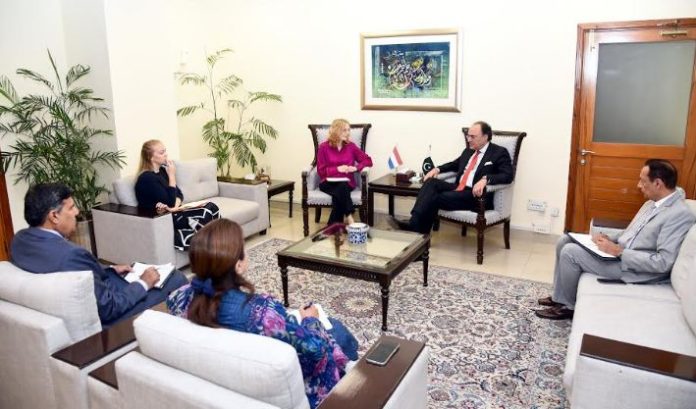
ISLAMABAD, MAY 21 /DNA/ – Federal Minister for Finance and Revenue, Senator Muhammad Aurangzeb, held a meeting today with Henny de Vries, Ambassador of the Kingdom of the Netherlands to Pakistan, at the Finance Division, Islamabad.

During the meeting, both sides discussed matters of mutual interest and avenues for further strengthening bilateral economic cooperation. The Finance Minister briefed the Ambassador on Pakistan’s current macroeconomic outlook and the government’s reform agenda, with particular focus on key sectors of the economy.

He emphasized the government’s commitment to achieving sustainable, productivity-driven, and export-led growth, highlighting the critical role of the private sector as the real engine of economic development. The Minister also acknowledged and appreciated the technical and financial support provided by the Netherlands to Pakistan in various areas, including development and capacity-building initiatives.

Senator Aurangzeb further welcomed the continued interest and investment by Dutch companies in Pakistan and reaffirmed the government’s commitment to facilitating foreign investment and fostering a conducive business environment.

H.E. Mrs. Henny de Vries expressed appreciation for the government’s macroeconomic reforms and its focus on export-oriented policies. She reiterated the Netherlands’ support for Pakistan’s economic development and affirmed her country’s interest in deepening economic ties and cooperation across diverse sectors.

The meeting concluded with both sides expressing confidence in the strengthening of Pakistan-Netherlands bilateral relations and continued collaboration in areas of shared interest.

Four Day Military Confrontation: Understanding Pak-India Conflict Metamorphosis

Four Day Military Confrontation: Understanding Pak-India Conflict Metamorphosis

Sohail A. Azmie

Following the Pehlgam terror incident, India launched a military strike on alleged terror hideouts in Pakistan on 7 May, a reckless action lacking strategic acumen and verifiable evidence, despite ongoing investigations, as noted by India’s MEA spokesperson Jaiswal on 12 May. While air domain and LOC saw intense combat in the Four Day Military Confrontation, 7-10 May 2025, with standoff weapons, the navies of both India and Pakistan remained disengaged, raising questions about the strategic value of naval warfare in this context. With a long land border between the two nuclear-armed neighbours, and each other’s military bases well within combat ranges of each other’s weapons, the question then naturally comes: given the Pak-India context, what it means to fight at sea, and to achieve what objectives? How does a short and intense air combat relate to the war at sea?

These questions necessitate strategic contextualization. American maritime strategist Mahan in 1890 posited that decisive fleet engagements were necessary for ‘command of the sea’ facilitating control of trade routes and projecting power ashore. British maritime historian, Julian Corbett in 1910 argued that a navy’s primary job was to influence events on land rather than looking for decisive battles at sea. When it comes to air warfare, the Italian airpower theorist Douhet in 1921 and American Billy Mitchell in 1925, argued for ‘command of the air’ to be a precondition for a decisive victory. On the contrary, Britain’s first air chief Trenchard in 1920s and American airpower theorist Warden in 1988 noted that airpower could be effective in specific, short combat contexts helping a nation to cause paralysis and swift degradation. However, for longer versions of war, airpower alone was not enough to ensure victory.

In past Pak-India wars (1948, 1965, 1971), land was the decisive domain, as hostilities began and ended with territorial gains or losses. Analysts have long viewed air and sea operations as tools to influence land warfare, not as decisive in themselves. However, the 2019 and 2025 conflicts suggest a shift. In 2019, Pakistan’s downing of an Indian MiG-21 and capture of its pilot, and in 2025, air strikes on S-400 systems and shooting of Indian jets, forced India to halt operations rather than escalate, aligning with Trenchard and Warden’s views on airpower’s role in short conflicts. C. Christine Fair, in an interview with Karan Thapar, and PravinSawhney of FORCE magazine, partially support Pakistan’s claims while questioning India’s reported outcomes, highlighting air warfare’s growing significance in narrow operational windows. Here it could potentially mean the one shooting first could dominate the operational space as well media alike.

India often follows, what could be termed as ‘terror turning strategy,’ i.e., using terrorism as a pretext to militarily engage Pakistan. Since Uri attack 2016, India’s terror-response algorithm, particularly under BJP, has been: Terror incident occurs, India blames Pakistan within hours of the incident, state-influenced Indian media begins a relentless war-mongering forcing the Indian government for a revenge, India conducts military action, claims victory, awards military personnel, BJP wins elections. This cyclic pattern repeats within 3-5 years, usually coinciding with the Indian general or major state election schedules. Post-Pehlgam, Indian declared political objective was ‘to strike terror sanctuaries that helped plan and orchestrate Pehlgam incident.’ Pakistan sought ‘to reestablish deterrence to preserve its sovereignty and territorial integrity.’ Though in both of these modern events airpower played a dominant role, yet nuclear deterrence coupled with India’s limited objectives disincentivised it against expanding and prolonging military action. This could probably have inhibited India from embarking on a military course at or from the sea. Will this remain the case in a future Pak-India confrontation? Will Indian navy threaten Southern Pakistan with long range strike from the sea in sync with IAF? These aren’t simple questions that can be answered in simple yes or no.

Technological advancements, in both air and maritime power domains, coupled with artificial intelligence, social media and strategic communication, combat dominance with ability to inflict reckonable destruction through air and sea combatants could compel the opposing side to (re)think of starting or terminating a war. This does not mean totally negating the other domains of warfare, but requires a balanced approach through an integrated battle-space that coherently combines the combat effects of operations in the multiple domains. With long range strike capabilities, Indian navy could possibly be deployed for combat as a response to Pakistan’s counteraction against India’s initial strike. India’s 2025 strikes across the international border, violating Article 51 of the UN Charter and the 1837 Caroline Doctrine’s necessity and proportionality criteria, suggest a potential shift from its traditional terror-response algorithm. In the future, India may increasingly opt for preemptive strikes inside Pakistan, justifying them by claiming that purported terror hideouts posed imminent threats requiring immediate action. This demands understanding the conflict metamorphosis that continues to evolve in Pak-India context. Under this theorem of kinetic necessity, the role of the Indian navy may figure out prominently should India choose to maintain ‘calm’ in air and land, while imposing a response dilemma upon Pakistan.

Extensive use of inexpensive/ expendable drones by both sides ultimately means, the long-held concepts of sovereignty and territorial integrity could be debated, and probably redefined. Grounding of container ship Antonio on 10 May 2025 due to GPS jamming in Eliza shoals near Saudi Coast heralds a new threat to maritime assets. Israel’s pager attacks and use of unmanned systems in almost all domains by several nations around the world signify burdens of ‘being ready at all times’ against India’s capability and willingness to go for these kind of operations without warning. A future war at sea will most probably be the exact transposition of what happened over land in the Four Day Military Confrontation, i.e., drones, electronic warfare and long range weapons. Deployment of drones from surface ships, and even submarines, could be a possibility. Consequently, this shift toward autonomous, low-cost warfare coupled with traditional strikes challenges contemporary military paradigms, compelling opposing sides to adapt to a new era where rapid, unannounced strikes blur the lines between deterrence and provocation, potentially destabilizing regional security.

The writer is an Islamabad-based researcher; his areas of interest include: maritime security, climate change and astropolitics. He can be reached at [email protected]

Corruption threatens TAPI’s Future

Corruption threatens TAPI’s Future

The Turkmenistan-Afghanistan-Pakistan-India (TAPI) gas pipeline project was once hailed as a game-changer for regional energy cooperation and economic integration. Designed to transport natural gas from Turkmenistan’s massive Galkynysh field to energy-hungry markets in South Asia, TAPI promised to reduce regional energy deficits and promote cross-border collaboration. But over a decade later, TAPI remains a vision on paper—mired in delay, dysfunction, and deepening distrust.

At the heart of the project’s stagnation lies a fatal flaw: widespread corruption in Turkmenistan. The opaque governance structure and lack of transparency in Turkmenistan’s energy sector have made international stakeholders uneasy. Key decisions are often made behind closed doors, without third-party scrutiny or accountability. Western investors and financial institutions have steered clear of Turkmenistan due to governance concerns, further stalling project financing. With no real reform or will to combat corruption, Turkmenistan has failed to build trust with its partners.

Pakistan, once a strong supporter of TAPI, is increasingly disillusioned—not just due to Turkmenistan’s internal dysfunction, but also because of its insistence on keeping India in the project. While the idea of regional connectivity sounds appealing on paper, the current geopolitical climate renders cooperation with India extremely difficult. Tensions between Islamabad and New Delhi have escalated in recent years, and strategic mistrust runs deep. Pakistan views Turkmenistan’s unwillingness to reconfigure the pipeline’s framework—either by excluding India or pursuing bilateral alternatives—as a lack of understanding of regional sensitivities.

From Pakistan’s perspective, any economic or energy collaboration that includes India without addressing core bilateral disputes, particularly Kashmir, is unacceptable. On the other hand, Turkmenistan, desperate for a reliable and economically lucrative export destination, sees India as a vital end-market for its gas. This divergence in strategic priorities is a major obstacle, and neither side appears willing to compromise.

Afghanistan, meanwhile, remains the weakest link. With security and political stability still fragile despite changing regimes, building and maintaining a critical piece of energy infrastructure across Afghan territory is a monumental risk. Investors are wary, insurance is nearly impossible, and logistical hurdles abound.

In reality, the TAPI project is a victim of overambition, poor planning, and political contradictions. A multibillion-dollar pipeline cannot be built on hopes alone—it needs a foundation of mutual trust, robust governance, and geopolitical alignment. As long as Turkmenistan refuses to clean up its energy sector and accommodate regional concerns, particularly Pakistan’s, the project is unlikely to move beyond paper.

Instead of clinging to a failing four-party framework, perhaps it is time for Pakistan to explore alternative energy partnerships. Bilateral gas pipelines, LNG imports, and domestic renewable investments might prove more feasible and politically sustainable.

TAPI was a bold dream. But without reform in Ashgabat and a serious reevaluation of strategic alignments, it is a dream that may never materialize. Regional energy cooperation is vital—but it must be rooted in realism, not rhetoric.

Banning X is not the solution

Banning X is not the solution

Rumors are once again swirling that the social media platform X (formerly Twitter) may be banned in Pakistan, allegedly due to a surge in negative commentary regarding the recent war with India and critical remarks about the elevation of the Army Chief to Field Marshal. Such a move, if implemented, would be a step in the wrong direction.

While it is true that social media often provides a platform for irresponsible behavior, disinformation, and even national security risks, banning a global communication platform like X is not a sustainable or effective solution. This is not the first time such an approach has been taken, and every time it happens, it disrupts public access to information, curtails freedom of expression, and damages Pakistan’s image as a democratic country.

In the digital age, platforms like X serve as crucial tools for information dissemination, citizen journalism, public awareness, and even government communication. Many ministries and official departments use X to broadcast updates. Silencing this medium over a few objectionable posts or misinterpretations amounts to punishing the majority for the actions of a few.

The specific concerns this time reportedly stem from misinterpretations of Indian Foreign Minister Jaishankar’s statement about pre-warning Pakistan of the recent attack—claims that some say have been twisted on X. Others have pointed to disrespectful comments against the military establishment, particularly in light of Field Marshal Asim Munir’s promotion. While such content is certainly inappropriate and must be addressed, banning the entire platform is like demolishing a house to fix a leaking pipe.

The solution lies not in blanket bans but in better regulation and smarter governance. The government should work with X’s management to report, flag, and remove harmful content that violates national security or legal standards. Cybercrime laws already exist in Pakistan, and those who spread hate speech or misinformation can be prosecuted under existing legal frameworks. Rather than depriving citizens of a vital communication tool, efforts should be made to enhance digital literacy, promote responsible online behavior, and strengthen counter-disinformation capabilities.

Banning X also creates a vacuum that is quickly filled by proxy servers and VPNs, making the ban ineffective and encouraging tech-savvy users to bypass restrictions—often exposing themselves to even greater risks online. Moreover, such actions alienate the youth and tech communities who rely on X for everything from education and employment to activism and entertainment.

As a responsible state, Pakistan must find a balance between maintaining national security and upholding constitutional freedoms. In a region where information warfare is real, the answer is more informed engagement, not digital blackout.

Therefore, instead of banning X again, the government should adopt a proactive strategy: invest in digital monitoring, enforce accountability for violators, and encourage constructive online dialogue. Silencing voices, no matter how uncomfortable they may be, is not the hallmark of a confident and strong nation.

Pakistan deserves an open internet—responsible, regulated, and free.

Amb. Dan visits Gujranwala: Romanian, Pakistan have huge business potential

Pakistan

ISLAMABAD, MAY 21 (DNA): Romanian Ambassador Dr. Dan Stoenescu, met with Rana Mohammad Sadique, President of the Gujranwala Chamber of Commerce and Industry (GCCI), to discuss ways to enhance bilateral trade and economic cooperation between Romania and Pakistan.

The meeting focused on exploring opportunities for trade and investment, particularly in the SME sector, and strengthening economic ties between the two countries. The Ambassador and the President GCCI exchanged views on how to promote business-to-business interactions and joint ventures between Romanian and Pakistani companies.

Sohail Shamim Firpo, Chairman Pakistan-Romania Business Council (PRBC), was also present in the meeting.

Atif Farooqi, Advisor & COO PRBC, said, “This meeting is a significant step towards strengthening economic ties between Romania and Pakistan. We’re excited to explore new opportunities for trade and investment.”

He also met with Gujranwala Division Commissioner Syed Naveed Haider Shirazi to discuss bilateral trade opportunities.

The meeting, attended by key members of the Pakistan-Romania Business Council (PRBC), focused on strengthening economic ties between the two countries.

The Ambassador highlighted the potential for cooperation between Romanian and Pakistani businesses, particularly in the SME sector, given Gujranwala’s status as a hub for small and medium-sized enterprises.=DNA

PM Shehbaz Praises Navy’s Role in Operation Bunyanum Marsoos

PM Shehbaz Praises Navy’s Role in Operation Bunyanum Marsoos

Rawalpindi, 19 May 2025: /DNA/ – Prime Minister of the Islamic Republic of Pakistan, Mr Muhammad Shehbaz Sharif, visited Pakistan Navy Dockyard today to pay tribute to the Pakistan Navy for its pivotal role in Operation Bunyanum Marsoos.

Upon arrival, the Prime Minister was received by Chief of the Naval Staff Admiral Naveed Ashraf. Chief of Army Staff General Syed Asim Munir and Chief of the Air Staff Air Chief Marshal Zaheer Ahmad Baber Sidhu were also present.

During the visit, the Prime Minister boarded the Type-054A Class Destroyer PNS TAIMUR, where he was briefed by Commander Pakistan Fleet on the Pakistan Navy’s strategic orientation, operational undertakings, and noteworthy contributions during the ongoing operation.

The Prime Minister interacted with officers and sailors of the Pakistan Navy, lauding their exemplary professionalism, combat readiness, and steadfast commitment to national defence. He conveyed the nation’s deep appreciation and reaffirmed unwavering confidence in the capabilities of Pakistan’s Armed Forces.

Addressing the gathering, the Prime Minister commended the Pakistan Navy for its resolute posture, operational dexterity, and effective deterrent response in countering adversarial maritime threats. He particularly praised the Navy’s critical role in safeguarding sea lines of communication and ensuring the uninterrupted flow of maritime trade, while maintaining absolute maritime sovereignty through a layered and assured seaward defence.

Recalling the Navy’s proud legacy of decisive operations, the Prime Minister underscored that Pakistan Navy remains fully capable of executing high-intensity operations akin to the historic Operation Dwarka, whenever and wherever required.

The Prime Minister was accompanied by Minister for Defence Khawaja Muhammad Asif, Minister for Planning, Development and Special Initiatives Mr Ahsan Iqbal Chaudhary, Minister for Information and Broadcasting Mr Attaulah Tarar, and Federal Minister for Education and Professional Training Dr Khalid Maqbool Siddiquie.

Upon arrival, the Prime Minister was received by Chief of the Naval Staff Admiral Naveed Ashraf. Chief of Army Staff General Syed Asim Munir and Chief of the Air Staff Air Chief Marshal Zaheer Ahmad Baber Sidhu were also present.

During the visit, the Prime Minister boarded the Type-054A Class Destroyer PNS TAIMUR, where he was briefed by Commander Pakistan Fleet on the Pakistan Navy’s strategic orientation, operational undertakings, and noteworthy contributions during the ongoing operation.

The Prime Minister interacted with officers and sailors of the Pakistan Navy, lauding their exemplary professionalism, combat readiness, and steadfast commitment to national defence. He conveyed the nation’s deep appreciation and reaffirmed unwavering confidence in the capabilities of Pakistan’s Armed Forces.

Addressing the gathering, the Prime Minister commended the Pakistan Navy for its resolute posture, operational dexterity, and effective deterrent response in countering adversarial maritime threats. He particularly praised the Navy’s critical role in safeguarding sea lines of communication and ensuring the uninterrupted flow of maritime trade, while maintaining absolute maritime sovereignty through a layered and assured seaward defence.

Recalling the Navy’s proud legacy of decisive operations, the Prime Minister underscored that Pakistan Navy remains fully capable of executing high-intensity operations akin to the historic Operation Dwarka, whenever and wherever required.

The Prime Minister was accompanied by Minister for Defence Khawaja Muhammad Asif, Minister for Planning, Development and Special Initiatives Mr Ahsan Iqbal Chaudhary, Minister for Information and Broadcasting Mr Attaulah Tarar, and Federal Minister for Education and Professional Training Dr Khalid Maqbool Siddiquie.

Operation Bunyanun Marsoos: Pakistan rejects baseless Indian claims regarding use of Shaheen missile

Operation Bunyanun Marsoos: Pakistan rejects baseless Indian claims regarding use of Shaheen missile

These misleading claims were triggered by a now-deleted video shared via the Indian Army’s official Twitter handle, which purportedly depicted the use of Pakistan’s Shaheen missile. Upon realizing that the content was factually incorrect and unverified, the Indian Army swiftly removed the video from its official platform

Ansar M Bhatti

ISLAMABAD: The Ministry of Foreign Affairs categorically rejects the unfounded and baseless allegations propagated by certain segments of the Indian media suggesting that Pakistan employed a Shaheen missile during Operation Bunyanun Marsoos (BM).

These misleading claims were triggered by a now-deleted video shared via the Indian Army’s official Twitter handle, which purportedly depicted the use of Pakistan’s Shaheen missile. Upon realizing that the content was factually incorrect and unverified, the Indian Army swiftly removed the video from its official platform. However, by that point, several Indian media outlets had already disseminated the false narrative without any due diligence or verification. Unfortunately, some media channels in India continue to propagate this misinformation.

It is particularly concerning that the Indian Army has not issued any clarification or retraction regarding the misleading post from its official handle, raising questions about the intent and professionalism behind such disinformation.

Independent analysts have noted that this misinformation campaign appears to be a deliberate attempt to divert attention from India’s military setbacks during Operation Sindoor, where Pakistan’s superior conventional capabilities played a decisive role. These fabricated stories also coincide with New Delhi’s broader effort to push a false narrative surrounding the ceasefire and unfounded allegations of so-called “nuclear blackmail” by Pakistan.

The Ministry directs attention to the Inter-Services Public Relations (ISPR) press release dated 12 May 2025, which clearly outlines the weapons systems deployed by the Pakistan Armed Forces during Operation Bunyanun Marsoos. These included:

Precision-guided, long-range Fatah-series missiles (F1 and F2)

Advanced loitering munitions (killer drones)

Precision long-range artillery systems

The military targets struck inside India and Indian Illegally Occupied Jammu & Kashmir (IIOJ&K) are also detailed in the aforementioned ISPR press release.

The Ministry of Foreign Affairs emphasizes that dissemination of unverified and inflammatory content by official or semi-official Indian platforms is irresponsible and detrimental to regional peace and stability. Such actions further erode the credibility of institutions involved in their propagation.

Pakistan remains committed to maintaining peace and stability in the region and urges responsible behavior, particularly from official entities that are expected to adhere to principles of professionalism and factual accuracy.

Heart health to glowing skin: Why mangoes are a must-have this summer

Heart health to glowing skin: Why mangoes are a must-have this summer

With the arrival of summer, the anticipation for one fruit in particular reaches its peak — the king of fruits, the mango. Whether enjoyed on their own, blended into a refreshing shake, or tossed into salads and desserts, mangoes are more than just delicious — they are packed with health-boosting nutrients.

While some people shy away from mangoes due to their natural sweetness, wondering if daily consumption is wise, nutrition experts agree: eating one mango a day is perfectly safe and incredibly beneficial for your overall health.

Naturally radiant skin
Rich in vitamin C, beta-carotene, and antioxidants, mangoes help fight oxidative stress and rejuvenate the skin. Regular consumption can contribute to a natural glow and youthful appearance.

Heart-friendly nutrients
Loaded with potassium and magnesium, mangoes help regulate blood pressure and maintain a steady heartbeat, making them a heart-healthy addition to your summer diet.

Aiding in weight management
Contrary to popular belief, mangoes don’t necessarily lead to weight gain. When eaten in moderation, a mango can actually curb hunger and improve metabolism, supporting weight loss goals.

Blood sugar control
Despite their sweetness, mangoes contain natural fiber, which prevents rapid spikes in blood sugar — especially when eaten with a balanced meal.

Easy ways to add mangoes to your daily routine
Blend into smoothies or shakes
Add chunks to yoghurt or oatmeal
Toss into summer salads
Make mango-based desserts like cheesecake or ice cream
Include in a breakfast fruit bowl
While mangoes are a delightful mix of flavour and nutrition, moderation remains key. A single mango a day can offer a world of benefits — without the guilt.

Deputy PM Dar set to visit China tomorrow amid Pakistan-India tensions

Deputy PM Dar set to visit China tomorrow amid Pakistan-India tensions

ISLAMABAD, MAY 18: Deputy Prime Minister and Foreign Minister Ishaq Dar will undertake an official visit to China tomorrow (Monday) amid “evolving regional situation in South Asia” in the aftermath of Pakistan-India military clashes.

According to a statement issued by the Foreign Office on Sunday, the deputy premier would undertake a two-day visit to Beijing from May 19 to May 21 on the invitation of the Chinse Foreign Minister Wang Yi.

“During the visit, Dar will hold in-depth discussions with Wang Yi on the evolving regional situation in South Asia and its implications for peace and stability,” an FO spokesperson said.

The two sides will also review the entire spectrum of Pakistan-China bilateral relations and exchange views on regional and global developments of mutual interest.

“The visit forms part of the ongoing high-level exchanges between Pakistan and China. It also underscores the two countries’ shared commitment to further strengthen the all-weather strategic cooperative partnership,” it was further added.

Meanwhile, Afghanistan’s Acting Foreign Minister Amir Khan Muttaqi is set to arrive in China on May 20 to join the trilateral meeting.

During the recent escalation with India, China voiced its support for Pakistan with Chinese ambassador reaffirming the “enduring and time-tested friendship between China and Pakistan”, describing the relationship as one of “ironclad brothers” who have always supported each other in challenging times.

Pakistan armed forces launched a large-scale retaliatory military action, named “Operation Bunyan-um-Marsoos”, and targeted several Indian military targets across multiple regions.

The strikes, described by officials as “precise and proportionate”, were carried out in response to India’s continued aggression across the Line of Control (LoC) and within Pakistan’s territory, which New Delhi claimed were aimed at “terrorist targets”.

Pakistan downed six Indian fighter jets, including three Rafale, and dozens of drones. After at least 87 hours, the war, provoked by India, ended on May 10 with a ceasefire agreement brokered by the United States.

According to ISPR, a total of 53 individuals, including 13 personnel of the armed forces and 40 civilians, were martyred in Indian strikes during the recent military confrontation.

The military confrontation between the two countries was triggered by last month’s attack in Indian Illegally Occupied Jammu and Kashmir (IIOJK) that left 26 tourists dead, with India blaming Pakistan for the attack without offering any evidence.

Trump Resets U.S.-Pakistan Relations After India Conflict

Qamar Bashir

By Qamar Bashir

President Donald Trump, while addressing American troops in Qatar, noted that Pakistan’s use of “a different kind of missile” had forced India to request a ceasefire. He added that the United States would deepen trade ties with Pakistan and urged American institutions to accelerate commercial engagement. In a rare moment of unqualified praise, Trump described Pakistanis as “brilliant people” who invent and produce cutting-edge technology—a clear nod to Pakistan’s domestic defense industry and scientific acumen.

After years of strategic neglect, Pakistan has reemerged in U.S. foreign policy considerations. The war with India in May 2025 served as a turning point, forcing a global reassessment of South Asia’s power dynamics. Trump’s repeated positive mentions of Pakistan reflect a recalibrated U.S. outlook, acknowledging Pakistan’s growing relevance in regional and international affairs.

The four-day war not only redrew the strategic map of South Asia but also laid bare two starkly contrasting global narratives. India—long portraying itself as a rising superpower—found its arrogance, militarism, and misinformation unraveling before the world. Pakistan, in contrast, emerged as a composed, competent actor, commanding military respect and diplomatic credibility.

India entered the conflict with misplaced confidence, believing its large defense budget, international lobbying, and media dominance would shield it from scrutiny. But its assumptions quickly crumbled. Since the revocation of Articles 370 and 35A of the Indian Constitution—unilaterally and in defiance of UN resolutions—India had adopted a tone of supreme arrogance. That arrogance culminated in the May 2025 aggression, when India, without presenting irrefutable evidence, blamed Pakistan for the Pahalgam attack and launched missile strikes on Pakistani territory.

India’s gambit backfired. For the first time in decades, the world refused to parrot India’s “terrorist state” label for Pakistan. Instead, New Delhi’s actions were seen as a unilateral, unprovoked act of war. The Kashmir issue, long buried under media blackouts and military occupation, reemerged on the global agenda. Trump himself declared that resolving the Kashmir dispute was essential for sustainable peace in the region.

India’s efforts to diplomatically isolate Pakistan not only failed but boomeranged. Major global powers—excluding perhaps Israel—remained neutral or subtly critical of India’s conduct. Russia, the United States, and European nations refrained from backing New Delhi. Even traditional allies in the Gulf and the broader Muslim world declined to endorse India’s narrative. International media questioned India’s disinformation, timing, and lack of credible evidence. Even strategic allies like the U.S. and Russia withheld support during India’s military debacle.

Politically, the impact was severe. Prime Minister Narendra Modi’s once mythic stature among Hindu nationalists eroded rapidly. Calls for his resignation grew louder, and the opposition, civil society, and independent media demanded accountability. Globally, Modi’s image suffered irreparable damage, with analysts condemning his militarized policies, suppression of minorities, and use of conflict for electoral gains.

In contrast, Pakistan earned global admiration for its restraint, precision, and strategic maturity. Its missiles hit key Indian military targets while sparing civilian areas—a combination of tactical brilliance and moral responsibility. Pakistan’s electronic warfare systems also rendered India’s expensive defense hardware ineffective, showcasing its technological edge.

Diplomatically, Pakistan performed with poise. China and Turkey openly supported it, while countries from Africa to Southeast Asia celebrated its victory. The United States and Western allies, though silent, acknowledged Pakistan’s competence by their inaction in support of India. Pakistani officials, from the Prime Minister to military spokespeople, engaged transparently with the media, offering facts and fielding difficult questions—in sharp contrast to India’s evasive and scripted responses.

International media recognized this openness and began to shift their tone. Pakistan, once portrayed as unstable and aggressive, was now seen as principled, disciplined, and transparent. Its moral standing improved as it framed its response within the bounds of international law and emphasized civilian protection.

Domestically, Pakistan witnessed a rare moment of unity. Citizens of all ethnic, religious, and political backgrounds rallied behind their armed forces. The war became a catalyst for national pride, reinforcing belief in self-reliance, technological capability, and institutional strength. Even opposition parties praised the government and military for their coordinated and effective response.

Crucially, Pakistan used this momentum to reignite global focus on Kashmir. With Trump endorsing mediation, Pakistan gained diplomatic traction. Its dignified wartime conduct and consistent call for peace lent it moral and political capital it had long sought.

This war did not last long, but its consequences will resonate for decades. India’s image as a stable democracy and rising power has been seriously undermined. The myth of Pakistan as a rogue state has been debunked. What remains is a clearer understanding: arrogance is not strategy, propaganda is not policy, and suppression is not victory.

As one oversees patriotic Pakistani Mr. Mubeen Ahmed Qureshi put it, this strategic space, created by the collective national resolve that defeated a far larger and better-equipped adversary, gives every reason for Pakistan to celebrate. But more importantly, Pakistan must seize this moment—not just to revel in triumph but to take a step back, identify its political, economic, financial, trade, and investment roadblocks, and with the same spirit it fought the war, begin to put its house in order. Only then can Pakistan reemerge as a significant regional and global player—not only militarily, but across all elements of national power.

The war has redrawn South Asia’s narrative landscape. The world must now reckon with a new geopolitical truth: Pakistan is no longer the problem—it is part of the solution. Meanwhile, unless India reforms its policies, rhetoric, and regional behavior, it risks becoming its own worst enemy.

By Qamar Bashir

 Press Secretary to the President (Rtd)

 Former Press Minister at the Embassy of Pakistan to France

 Former MD, SRBC

 Macomb, Michigan, USA

Stay Connected

64FansLike
60FollowersFollow

Latest Reviews

Exchange Rates

USD - United States Dollar
EUR
1.17
GBP
1.35
AUD
0.72
CAD
0.73