RAMALLAH, JUN 2 /DNA/ – Prime Minister’s Office – Prime Minister Dr. Mohammad Mustafa discussed on Monday with the Prime Minister of Luxembourg, Luc Frieden, recent developments and the need to advance efforts to mobilize a serious and effective international call for a ceasefire and an end to the Israeli aggression against the Palestinian people. The discussion emphasized the urgent necessity of delivering humanitarian aid to the Gaza Strip amid the famine being weaponized by Israel, as well as the ongoing Israeli aggression in the West Bank, including Jerusalem.
During a phone call, Mustafa renewed his call for Luxembourg to recognize the State of Palestine, following the example of countries that have already taken this step—especially in the lead-up to the upcoming international peace conference in New York.
He stressed the importance of Luxembourg’s support in ensuring the success of the conference through practical measures to advance the implementation of the two-State solution.
The Prime Minister also briefed Prime Minister Frieden on the Government’s ongoing efforts, including its emergency response and early recovery plan, paving the way for reconstruction immediately once the israeli aggression against the Strip is brought to an end as a roadmap toward stability, security, prosperity, and lasting peace in the region.
Mustafa praised Luxembourg’s principled positions, including its joint statement with European nations calling for effective European action to end the aggression against the Palestinian people. He expressed gratitude for Luxembourg’s support—whether through the European Union, bilateral channels, or contributions to UNRWA—and its consistent voting record in favour of Palestine in international forums, as well as its role within the EU amidst the continued Israeli aggression.
For his part, Prime Minister Frieden reaffirmed that the two-State solution is the only viable path forward and underscored the need for collective action to implement and safeguard it. He expressed his strong support for the Palestinian people and their inalienable rights.
ISLAMABAD, JUN 2 /DNA/ – The 1st edition of the Emerging Pakistan National Ranking Tennis Championships has entered its final stages after a week of high-energy, competitive matches at the PTF-SDA Tennis Complex, Islamabad.
In a dramatic Men’s Singles quarterfinal, Muzammil Murtaza overcame Islamabad’s rising star Ahmad Nael Qureshi in a marathon three-set thriller. Both players delivered outstanding baseline tennis in the opening set, with neither conceding serve. The set went into a tense tiebreak, where Muzammil’s power play saw him edge ahead to win 7-6(4).
The momentum shifted in the second set as the young Qureshi bounced back impressively, matching the No. 2 seed shot for shot. He eventually captured the set in another close tiebreak, 7-6(6), leveling the match.
In the decisive third set, Murtaza drew on his experience, displaying clinical precision and strong court coverage. He controlled the pace, denied Qureshi any opportunity to regroup, and secured the set 6-2 to advance to the semi-finals.
In the Ladies Singles semi-finals, top seed Ushna Suhail extended her winning streak with a commanding 6-2, 6-2 victory over 3rd seed Mehaq Khokar. Meanwhile, 4th seed Zunaisha Noor stunned 2nd seed Mahrukh Sajid with a dominant 6-1, 6-4 win to secure her place in the final.
In the Men’s Doubles event, the experienced pair of Aisam-ul-Haq Qureshi and Aqeel Khan showcased their dominance, defeating Hamza Roman and Saqib Hayat with ease in the second quarterfinal. The seasoned duo sealed the match in straight sets, 6-1, 6-2.
Meanwhile, top seeds Yousaf Khalil and Barkatullah were pushed to their limits in a sizzling, three-set battle against Mudassar Murtaza and the talented Sami Zeb Khan. After dropping the first set 3-6, the top seeds bounced back to claim the second set 6-2. They then powered through the match tiebreak, winning it 10-1 to secure their place in the semi-finals.
The championship continues to showcase the depth of talent emerging in Pakistan’s tennis scene, promising an exciting conclusion in the days to come.
Men’s Doubles (Quarter Finals) Yousaf Khalil & Barkatullah beat Mudassar Murtaza & Sami Zeb Khan 3-6 6-3 10-1, Aisam-ul-Haq Qureshi & Aqeel Khan beat Hamza Roman & Saqib Hayat 6-1 6-2, Abu Bakar Talha & Ahmad Nael Qureshi beat Ahmed Chaudhary & M.Abid 7-5 6-1, Abdullah Adnan & Muzammil Murtaza beat Faizan Fayyaz & Asad Zaman 6-1 6-0,
Junior 18 & Under Singles (Pre-Quarter Finals) Abubakar Talha beat Ahmed Hussain 6-0 6-0, Zohaib Afzal Malik beat Abdul Basir 1-6 6-4 7-5, Hamza Roman beat Muhammad Ali 6-4 7-6(4), Nabeel Ali Qayyum beat M.Junaid 6-4 6-1, M.Yahya beat M.Hassan Usmani 2-6 6-4 6-3, Muhammad Salar beat M.Uzair 6-0 6-0, M.Haziq Aasim beat Inam Qadir 6-2 6-3, Asad Zaman beat Moazzam Babar 6-0 6-2.
Junior 18 & Under Singles (Quarter Finals) Hamza Roman beat Nabeel Ali Qayyum 6-1 6-2, Muhammad Salar beat M.Yahya 5-7 6-2 6-1, Asad Zaman beat M.Hazaiq Aasim 1-6 6-1 6-1. AbuBakar Talha beat Zohaib Afzal Malik 6-0 6-3.
Boys 14 & Under Singles Quarter Finals Muhammad Junaid beat Muhammad Aayan 4-1 5-3, Razik Sultan w/o Behroze Mamoon, Muhammad Umer beat Mahd Mahmood 5-3 4-2, Muhammad Muaz beat Ohad-e Mustafa 4-0 4-2
Boys 14 & Under Singles Semi-Finals Muhammad Muaz beat Muhammad Umer 7-5 6-2,
Boys 12 & Under Singles Quarter Finals Muhammad Muaz beat M.Hamza 4-0 4-1, M.Faizan beat Mustafa Uzair 4-0 4-0, Muhammad Danyal beat Ashtar Alam 4-5 (5) 5-4(5) 4-1, Muhammad Aayan beat M.Turad 4-1 4-1.
Boys 12 & Under Singles Semi Finals Muhammad Aayan beat Muhammad Danyal 4-0 4-0, Muhammad Muaz beat M. Faizan 4-1 4-1.
ISLAMABAD, JUN 2: The federal government has officially announced the Eidul Adha holidays across the country, granting a four-day break for public celebrations.
According to a notification issued on Monday, all government offices and institutions will remain closed from Friday, June 6 to Monday, June 9, 2025, in observance of Eidul Adha.
Private offices and businesses are also expected to follow suit, although final decisions will vary by employer.
The notification states that the holidays have been declared in continuation of the Cabinet Division’s circular dated December 23, 2024, regarding public and optional holidays. The order applies to offices observing both five- and six-day workweeks.
Meanwhile, the Met Department has issued an advisory urging tourists and travellers to exercise caution due to the possibility of strong winds and rainfall during the Eid holidays. The weather system may pose risks to weak infrastructure, particularly in northern and mountainous regions.
According to the Met Office, rain is expected in various areas, including Dir, Swat, Chitral, and Kohistan, during the festive days. From June 3 to 5, there is a forecast of rain accompanied by strong winds in parts of Islamabad, Murree, Kashmir, Gilgit-Baltistan, Chitral, Dir, and Swat. Some locations may also experience hailstorms.
Islamabad and parts of upper and central Punjab, along with regions of Khyber Pakhtunkhwa, are likely to receive rain with gusty winds on June 3 and 4.
ISLAMABAD, JUN 2: Minister for Planning and Development Ahsan Iqbal on Monday said that over 118 different projects worth Rs1,000bn were scrapped due to limited resources.
During his interaction with the media following the Annual Plan Coordination Committee (APCC) meeting in Islamabad, Iqbal said: “Today, [we] have to make difficult decisions about limiting the ongoing projects.”
He said it was difficult to accommodate projects from all ministries within a limited budget of Rs1,000 billion.
“Now, we have to make decisions in the national interest,” Iqbal added.
Only key projects can be prioritised due to limited funds, the planning minister said, adding that the provincial-level projects should now be completed by the provinces themselves.
“Provinces have far more resources than the federation,” he added. The minister said that everyone must play their part in national development.
Shedding light on the upcoming budget, the minister said that the economic size target for next year had been set at Rs129 trillion.
The minister added that Rs150bn had been allocated for the social sector and Rs70bn for KP’s merged districts in the next budget.
“GDP growth target for the next fiscal year was set at 4.2%,” Iqbal said, adding that the target for exports was set at $35bn.
Earlier, giving a blueprint of the annual PSDP for the next fiscal year at the APCC meeting, he said that fiscal space will be provided in the next PSDP for the projects of strategic importance envisioned under Uraan Pakistan.
He mentioned that these projects include the Diamer Bhasha Dam, Sukkur Hyderabad motorway project, N-25 in Balochistan and Karakoram highway phase two.
The minister emphasised the need for greater synergy between the development projects of the Centre and the provinces for the early completion of national priority projects.
Iqbal said that projects with a foreign component and those nearing completion have also been prioritised in the PSDP.
The minister elaborated that the said allocations for special regions such as AJK, Gilgit-Baltistan and the tribal districts have also been prioritised.
The minister further said that an effort has been made to align the development budget with national priorities while staying within limited resources.
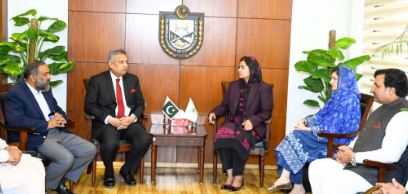
ISLAMABAD, JUN 2 /DNA/ – In a significant move to curb the spread of dengue fever in the federal capital, the Islamabad Chamber of Commerce and Industry (ICCI) and the Islamabad Capital Territory (ICT) Administration have pledged close collaboration in prevention efforts.
This development was made during the visit of Additional Deputy Commissioner (ADC) East, Ms. Mehreen Baloch, along with District Health Officer Dr. Syeda Rashida Batool and Dengue Focal Persons Dr. Mazhar and Dr. Sultan, to the ICCI. They held a detailed meeting with ICCI President Nasir Mansoor Qureshi to outline a coordinated strategy against the dengue threat.
Senior Vice President Abdul Rehman Siddiqui, Vice President Nasir Mehmood Chaudhry, Executive Member Waseem Chaudhry, and ICCI President’s Advisor Naeem Siddiqui were also present during the meeting.
The session focused on strengthening coordination for preventive actions, including awareness campaigns and anti-dengue spraying operations in major business areas. It was mutually agreed that no raids would be conducted at business premises until a designated cut-off date, promoting a cooperative approach over punitive measures.
The ADC lauded the business community’s contribution to national development and commended the ICCI’s pivotal role in bridging the public-private sector gap. She emphasized that the Chamber’s active engagement would significantly support efforts to prevent the outbreak of dengue in the capital.
The ICCI President Nasir Mansoor Qureshi, in his welcome remarks, reaffirmed the business community’s commitment to the nation despite numerous challenges. He shared the Chamber’s initiatives aimed at promoting entrepreneurship, improving the investment climate, and facilitating business operations. He stressed the need for preventive and corrective approaches rather than punitive actions, and announced that volunteers from various market associations would support the awareness efforts.
The meeting concluded with shared insights from other participants, including Senior Vice President Abdul Rehman Siddiqui, Dr. Rashida, Dr. Mazhar, and Dr. Sultan, reaffirming the collective resolve to eliminate the threat of dengue through collaborative and sustained action.
ISLAMABAD, JUN 2 /DNA/ – Muslim youth need to navigate a path toward the collective well-being of humanity by reconnecting to their roots and exploring their rich intellectual and spiritual legacy. Only a generation driven by a sense of purpose, commitment, and responsibility can help introduce an alternative framework to salvage humanity.
This was the underlying message delivered by renowned scholar, social scientist, and Vice Chancellor of Riphah International University, Prof. Dr. Anis Ahmad, during a lecture at the Institute of Policy Studies (IPS), Islamabad.
The event was held in collaboration with the Markfield Institute of Higher Education, UK, and the International Institute of Muslim Unity at the International Islamic University, Malaysia (IIUM). Titled “What Ails Human Civilization Today?” the lecture was the second in the ongoing series “The World Today and the Future of Humanity.” The session was moderated by Prof. Dr. Mustafeez Ahmad Alvi, while Prof. Dr. Hazizan Md. Noon from IIUM participated as a discussant. A number of scholars and students from various parts of the world joined the hybrid session.
The lecture explored the deep-rooted malaise afflicting human civilization, issues that, according to Dr. Anis Ahmad, cannot be properly understood without a critical examination of the trajectory of Western modernity that has shaped the dominant global paradigm over the past few centuries.
Dr. Anis noted that the dualistic approach, which evolved from the European experience with the Church, altered the entire concept of what it means to be human. The mechanized life stripped individuals and society of the higher objectives of life, while self-centered individualism distorted the natural social fabric by damaging family structures.
Modern civilization, he said, is plagued by moral decay, excessive individualism, and a loss of direction, all symptoms of a deeper spiritual and societal crisis. “The rise of mechanical living and artificial constructs of identity reflects a troubling departure from natural and divine principles,” he observed.
Dr. Anis emphasized that Islam, as a complete and timeless way of life, offers a comprehensive framework through the Qur’an and Sunnah to confront these challenges. Islam offers not only doctrinal beliefs but comprehensive solutions rooted in ethical principles and the higher objectives of Islamic law. Muslims must reclaim intellectual and moral leadership through self-reform, diligent effort, and the practical application of divine guidance. He called on youth to move beyond dependency and passive consumption and, instead, embrace faith-guided purposeful engagement in all spheres of life.
However, transformation does not come overnight. Nations have to work consistently for decades, even centuries, to bring about a transformation in their societies. To develop a generation capable of inspiring people towards a fair and just world, Muslims have to inculcate strong ethical values through an institutional approach so that they can exert intellectual and moral influence on human thought at a global scale. The focus, he stressed, should shift from the quantity of knowledge to its quality and purpose.
Dr. Hazizan Noon echoed these concerns about the erosion of moral values and the need for a spiritually anchored worldview. He particularly urged for subjecting artificial intelligence to human intellect and ethical vision. “Development of ethical frameworks to guide the use of AI, rooted in Islamic thought, is both necessary and urgent,” he said.
Dr. Mustafeez Alvi concluded the session by reiterating the urgent need for purposeful, values-driven leadership. He urged Muslims to build upon the legacy of Muslim scholars and develop a comprehensive Islamic alternative to harmonize ethics, intellect, and purpose.
The IPS lecture series continues to serve as a vital platform for critically examining the global moral and intellectual challenges of the contemporary period and for exploring Islam’s role in shaping a more humane, ethical, and spiritually grounded future.
ISLAMABAD, JUN 2 /DNA/ – Al-Shifa Trust, a leading eye care organization in Pakistan, has called for mandatory eye screenings in schools, stressing that early detection and treatment of vision problems can significantly reduce the risk of childhood blindness.
Speaking to the media, Maj. Gen. (Retd) Rehmat Khan, president of Al-Shifa Trust, said that while some eye health initiatives exist, they are not mandated by national policy and mainly depend on periodic campaigns or voluntary participation. This, he emphasized, is not enough to address the growing burden of childhood vision issues.
He announced that a formal letter would soon be sent to provincial and federal governments, urging the implementation of a coordinated national eye screening program in all schools and madrassas.
Apart from developed world, some countries in Latin America and South East Asia have successfully reduced childhood blindness through compulsory school eye examinations. Pakistan still lacks such a national program, he said.
Al-Shifa Trust has already taken significant steps in this direction, screening over 175,000 schoolchildren in the past year through more than 550 free eye camps in underserved communities. The trust aims to reach over 2 million patients and perform more than 120,000 eye surgeries in the coming year, he informed.
On one hand, many patients cannot afford treatment, and on the other, there are people with the resources to help. Now is the time for those who can to come forward, said Maj. Gen. Khan.
He also highlighted the trust’s expansion plans, which include new hospitals in Lahore, Haveli Lakha, and Gilgit, as well as a dedicated Eye Cancer Centre in Lahore.
Prof. Dr. Wajid Ali Khan, Chief of Medical Services at Al-Shifa Trust Eye Hospital, underscored the scale of the challenge. With over 250 million people in Pakistan, more than half of whom are children and adolescents, no single organization can handle the country’s entire eye care burden.
He proposed a collaborative national strategy, suggesting that every medical college adopt a district and take responsibility for eye screening programs among vulnerable populations.
Al-Shifa’s screening data revealed that 10 percent of children had convergence insufficiency, congenital cataracts and myopia, a common condition in which light is not properly focused on the retina.
Dr. Wajid said that an effective school-based eye health program should include trained health workers in every school or provide basic training to teachers to identify vision issues and refer children for specialized care if needed. Early intervention, he stressed, can prevent permanent vision loss and significantly improve educational outcomes.
With public support and government commitment, Pakistan can move toward eliminating avoidable childhood blindness, securing a healthier future for the next generation.
Nearly 80 percent of patients across trust’s facilities in Rawalpindi, Chakwal, Kohat, Sukkur, Muzaffarabad, and Gilgit receive free treatment.
India, the world’s largest democracy, has held regular elections since gaining independence on 15 August 1947. With over 900 million eligible voters today, Indian elections are often hailed as monumental democratic exercises. However, a critical examination of India’s electoral history reveals a disturbing pattern; the deliberate creation of external threats—primarily through engineered tensions with Pakistan—to secure emotional, nationalistic votes. This electoral strategy has consistently influenced Indian political outcomes and destabilized peace in the region.
India held its first general election between 25 October 1951 and 21 February 1952, under the leadership of Prime Minister Jawaharlal Nehru. This was a remarkable democratic feat in a newly decolonized and largely illiterate country. While the Indian National Congress dominated the early decades, the seeds of political opportunism were planted early. As internal challenges grew, so did the temptation to invoke external threats—especially from Pakistan—to consolidate electoral gains.
The first major instance was the India-Pakistan war of 1965, which broke out on 6 September 1965 and ended with a ceasefire on 23 September 1965. Prime Minister Lal Bahadur Shastri emerged from the war as a national hero with his slogan “Jai Jawan Jai Kisan.” Though he died mysteriously in Tashkent on 11 January 1966, soon after signing a peace agreement, the Congress party used the post-war nationalistic wave in its favor during the 1967 general elections.
The 1971 India-Pakistan war, which began on 3 December 1971 and ended with Pakistan’s surrender in Dhaka on 16 December 1971, was another key milestone. Prime Minister Indira Gandhi leveraged India’s military victory to gain immense popularity. The war led to the creation of Bangladesh and was used effectively to project her as the “Iron Lady” of India. In the 1972 state elections and 1977 emergency-driven polls, war heroism was invoked repeatedly, even as authoritarian tendencies crept in.
With the rise of the Bharatiya Janata Party (BJP) in the 1990s, anti-Pakistan rhetoric became a central electoral theme. The Kargil War of 3 May to 26 July 1999, occurring under the BJP-led government of Atal Bihari Vajpayee, came just a year after India’s nuclear tests on 11 and 13 May 1998 and the Lahore Declaration signed on 21 February 1999. Despite intelligence lapses, the BJP won the 1999 general elections, capitalizing on nationalistic fervor.
A deeply tragic and politicized moment came with the Mumbai attacks of 26 November 2008, when some armed persons carried out designed assaults at multiple locations, including the iconic Taj Mahal Hotel, killing over 100 people. Although Pakistan-based groups were swiftly blamed, the timing and handling of the attacks cast a long shadow over the Indian political landscape. As the 2009 elections approached, the Congress-led UPA government hardened its posture, leveraged public anger, and turned the tragedy into a call for stronger security measures. The emotional charge of the attacks, along with media-fueled nationalism, helped deflect attention from internal security failures and re-elect the ruling alliance.
Perhaps the most glaring example came inFebruary 2019, when a suicide attack on Indian paramilitary forces in Pulwama, Jammu & Kashmir, on 14 February 2019 killed 40 soldiers. India launched the Balakot airstrikes on 26 February 2019, and Pakistan responded with its own strikes on 27 February 2019, downing an Indian jet and capturing its pilot. The incident was highly politicized. Prime Minister Narendra Modi’s campaign for the 2019 general elections, held in April–May 2019, was centered almost entirely on national security. The BJP won with a resounding majority.
The latest and perhaps most dangerous escalation occurred on 7 May 2025, when a sudden and intense one-day war erupted between India and Pakistan. Tensions had been brewing for weeks, with provocative statements and military posturing from the Indian side. On the morning of 7 May, Indian jets crossed the Line of Control, prompting retaliatory strikes from Pakistan. The conflict lasted less than 24 hours but claimed dozens of lives and pushed both nuclear-armed neighbors to the brink.
Crucially, this war coincided with India’s general election phase scheduled between 19 April and 7 May 2025. The timing strongly suggests that the ruling party, facing growing criticism over economic stagnation, rising inflation, social unrest, and farmer suicides, resorted to a familiar tactic—manufacturing a military confrontation with Pakistan to divert public attention and invoke emotional nationalism.
The pattern is clear and disturbing. Whenever domestic governance fails to inspire voter confidence, Pakistan is invoked as a threat to national security. The media, often compliant or state-influenced, whips up hysteria, while emotional narratives eclipse economic realities. This short-term political gain comes at the cost of long-term peace, regional cooperation, and the democratic ethos that India claims to uphold.
Since 14 August 1947, when Pakistan formally became independent a day after India, the Sub Continent has seen three full-scale wars (1948, 1965, 1971), one limited war (1999), multiple standoffs, and countless border skirmishes. Each has left scars, consumed resources, and reinforced mistrust. But when conflict is reduced to an electoral strategy, the threat to regional stability becomes existential. The 7 May 2025 one-day war marks the most cynical use of this playbook to date.
India’s electoral history thus reflects not just the growth of democratic institutions but also how electoral politics can be manipulated through war-mongering. It is a warning to all democracies; when nationalism replaces governance, and emotional manipulation takes precedence over policy, elections cease to be instruments of progress and become tools of perpetual conflict.
Therefore, while Indian elections are often celebrated for their scale, they must also be examined for the disturbing trend of militarized nationalism. From the 1971 war to the 2008 Mumbai attacks, from Balakot in 2019 to the one-day war on 7 May 2025, there is a consistent theme: invoking Pakistan as a threat to distract, manipulate, and win votes. The result is a democracy that thrives not on performance or progress but on polarization and paranoia. South Asia deserves better. It is time to break the cycle—and let votes be cast for hope, not hostility.
ISLAMABAD, JUN 2 /DNA/ – A cohort of 15 Sri Lankan students has successfully completed their studies under the esteemed Allama Muhammad Iqbal Scholarship Programme for Sri Lankan Students, administered by Higher Education Commission (HEC), Pakistan.
The graduating students received their degrees during their convocation held by their host institute, i.e., Pak-Austria Fachhochschule Institute of Applied Sciences and Technology. Among the graduates, Mr. Shamikh ul Haq earned special distinction by receiving a gold medal in B.E. Chemical Engineering – an accomplishment that highlights the academic excellence encouraged by this initiative. His father travelled from Sri Lanka to share in this proud moment.
During their study stay in Pakistan, these students not only excelled academically but also contributed to strengthening the bonds of friendship and cultural exchange between Sri Lanka and Pakistan. As they return home, they carry with them treasured memories, a strong academic foundation, and a spirit of goodwill. They have served as true ambassadors of Sri Lanka, enriching the academic and cultural life of the institutions they were part of.
The Allama Muhammad Iqbal Scholarship Programme continues to serve as a vital platform for fostering regional collaboration and cultivating future leaders from partner nations.
As Pakistan braces for the upcoming federal budget, one of the more progressive proposals under consideration is a plan to encourage digital transactions as a preferred mode of payment. In a rapidly digitizing global economy, where cash is increasingly becoming obsolete and digital payments through debit and credit cards are the norm, this is a commendable and much-needed move by the government.
Across the developed and developing world, digital payments offer transparency, convenience, and accountability. Whether through cards, mobile wallets, or online platforms, these transactions help reduce cash circulation, which is often linked with undocumented financial activity and tax evasion. By promoting card-based transactions, the government aims not only to modernize the economy but also to channelize financial flows, enabling a better system of checks and balances on spending patterns—both for individuals and businesses.
However, for this initiative to bear fruit, the government must ensure that digital payment facilities are accessible to all segments of society—not just the privileged few. In Pakistan, credit cards remain largely restricted to the upper-middle and elite classes, with banks maintaining stringent eligibility requirements, including high minimum income thresholds and complex documentation procedures. This exclusionary framework has kept a majority of the working population, especially those in the lower-income and informal sectors, outside the digital economy.
In contrast, many countries around the world actively promote financial inclusion. Banks in such economies are incentivized to issue debit and credit cards to a broader base of customers, including students, low-income workers, and small business owners. Pakistan must follow suit. The State Bank of Pakistan, in collaboration with commercial banks, needs to develop simplified criteria for issuing credit and debit cards, supported by strong consumer protection and awareness campaigns about responsible card use.
Furthermore, the government must expand digital infrastructure—particularly in rural and underdeveloped areas—to ensure that digital payment systems are not confined to urban centers alone. Encouraging merchants to adopt card payment terminals, offering tax incentives to businesses that go cashless, and subsidizing mobile point-of-sale (mPOS) systems can help widen the digital net.
Encouragingly, the upcoming budget is also expected to provide relief to the salaried class, which has been under significant financial pressure due to rising inflation and stagnant wages. Tax cuts or increased exemptions for this segment would be a welcome move and would further support the adoption of formal financial tools like credit cards. Salaried individuals are typically stable and low-risk customers, making them ideal candidates for card-based financial products.
The push for digital transactions in the upcoming federal budget is a step toward a more transparent, efficient, and inclusive economy. But for the initiative to truly succeed, the government must address the structural and regulatory barriers that limit access to digital financial tools. A budget that not only promotes digital payments but also ensures equitable access to them will mark real progress on the road to financial modernization and inclusion.