Home Blog Page 604

Sana murder suspect Umar sent to jail

Sana murder suspect Umar sent to jail

Duty Judicial Magistrate Ahmed Shehzad approves IO’s request for suspect Umar Hayat’s identity parade

Abid Raza

ISLAMABAD: An Islamabad district and sessions court on Wednesday sent Umar Hayat, the suspected murderer of TikToker Sana Yousaf, to jail on a 14-day judicial remand.

The suspect, who was arrested yesterday from Faisalabad, was produced before Duty Judicial Magistrate Ahmed Shehzad after a case was registered against him at Sumbal Police Station under Section 302 of the Pakistan Penal Code. He faces allegations of murdering Yousaf at her residence in Islamabad.

The 17-year-old social media influencer — with more than a million followers across various platforms — was shot twice inside her home in Sector G-13/1 on Monday evening.

Islamabad Police acted swiftly and apprehended the suspect just 20 hours after the crime with the help of CCTV footage and mobile data analysis.

Hayat (22), also known by his nickname “Kaka”, is a TikToker himself and has confessed to the murder. He claimed to be the victim’s friend.

At the time of murder, victim’s father — a government officer —was out for work, while her mother had gone to the market. Yousaf’s 15-year-old brother is currently visiting their hometown of Chitral after completing his school exams.

The family lived in the upper portion of the house where the murder took place.

Yousaf’s aunt, who was reportedly present at the residence when the incident took place, revealed that the suspect had come to meet the girl and the two had a brief exchange of words before the shooting.

Tarar says India has institutionalized terrorism

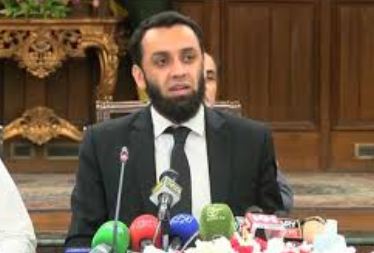
Federal Minister for Information and Broadcasting Attaullah Tarar

DNA

ISLAMABAD: Minister for Information and Broadcasting, Attaullah Tarar, has stated that India has institutionalized terrorism as a tool of foreign policy.

Speaking at a news conference in Islamabad on Wednesday, he said India has engaged in state-sponsored terrorism not only in Pakistan but has also targeted minorities, especially Sikhs, across the globe.

The Minister further said Indian proxies were responsible for the killing of Sikh leader Hardeep Singh Nijjar in Canada and that India had attempted to target Sikh activists in Australia and the United States. He said India is involved in state-sponsored terrorism and transnational aggression worldwide.

The Minister asserted that India has a history of fueling terrorism in Pakistan, referencing its support for the Mukti Bahini in the former East Pakistan in 1971. He said India continues to foment and facilitate terrorism through its proxies, such as Finta al-Hindustan, in Balochistan. He highlighted the arrest of Commander Kulbhushan Jadhav, a serving officer of the Indian Navy, in Balochistan, stating that Jadhav had confessed to carrying out terrorist activities in the province.

Attaullah Tarar reiterated that Balochistan is Pakistan’s lifeline and assured that the state will safeguard peace, development, and prosperity in the province by defeating Indian-backed proxies. He said Pakistan has defeated India both in conventional warfare and on diplomatic and narrative fronts.

The Minister also commended Pakistani media for upholding responsible journalism and successfully countering Indian disinformation campaign. He praised the Pakistani media for effectively challenging false narratives propagated by Indian outlets and presenting the truth to the world.

We Remember the Ram, But Not the Conversation

Muhammad Mohsin Iqbal

by Muhammad Mohsin Iqbal

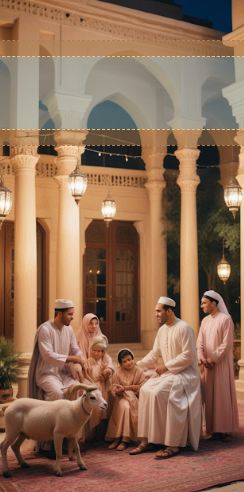
The true essence of sacrifice, as exemplified in the story of Hazrat Ibrahim (AS) and his son Hazrat Ismail (AS), lies not merely in the physical act of slaughtering an animal but in the profound spiritual submission, moral courage, and unwavering obedience to the will of Allah. It is the conversation between a father and his son that encapsulates the real philosophy of sacrifice. The Qur’an beautifully records this sacred dialogue in Surah As-Saffat:

Muhammad Mohsin Iqbal

“And when he (Ismail) was old enough to accompany him, he (Ibrahim) said, ‘O my son, indeed I have seen in a dream that I must sacrifice you, so see what you think.’ He said, ‘O my father, do as you are commanded. You will find me, if Allah wills, of the steadfast.'” (Surah As-Saffat 37:102)

This extraordinary exchange is not just a tale from the past; it is a timeless parable of submission, discipline, and the triumph of faith over worldly attachments. The sacrificial ram, which was later provided by Allah as redemption, became a symbol, but what we often forget is the essence — the conversation. The willingness of Hazrat Ibrahim (AS) to let go of what he loved most and Hazrat Ismail’s (AS) submission to Allah’s command teaches us that real sacrifice is about surrendering our will to the will of the Almighty. We remembered the ram, the physical sacrifice, but we forgot the conversation, the spiritual submission that it represented.

Today, as the Islamic Ummah and especially Pakistan face complex crises — political instability, economic downturns, moral decay, and a fractured society — it is high time we revive the real philosophy of sacrifice in our personal and collective lives. Our nation is burdened by corruption, social injustice, intolerance, and greed. The lesson from Ibrahim’s (AS) story is not merely about commemorating Eid-ul-Adha by slaughtering animals; it is a call to slaughter our egos, our illegal desires, and our lust for wealth and power.

The Quran commands: “Indeed, Allah does not change the condition of a people until they change what is in themselves.” (Surah Ar-Ra’d 13:11)

This verse resonates profoundly with our current state. If Pakistan is to rise and reclaim its dignity and honor, it must undergo internal purification. Our leaders must sacrifice their self-interested ambitions for the collective good. Our citizens must relinquish dishonesty, bribery, tax evasion, and misuse of public resources. Every individual must reflect on what they are willing to give up for the sake of the greater good. The spirit of sacrifice should translate into ethical governance, social justice, and national solidarity.

Hazrat Ibrahim (AS) was not commanded to sacrifice his son to cause pain, but to demonstrate complete submission to divine will. The command was a test, and the response was the highest form of spiritual maturity. Pakistan, too, is going through trials. We must ask ourselves — what are we willing to sacrifice to earn Allah’s pleasure and to restore our nation to the path of righteousness? Can we sacrifice our sectarian divides for the sake of unity? Can we give up hate speech and extremism for peace? Can we abandon illegal gains to promote fair economic practices?

Prophet Muhammad (ﷺ) said, “There is a piece of flesh in the body, and if it is sound, the whole body is sound. And if it is corrupt, the whole body is corrupt. That piece is the heart.” (Sahih Bukhari & Sahih Muslim)

The reformation of the heart is essential. The spiritual disease that afflicts the heart — greed, envy, pride — must be uprooted. Our political culture must be cured of hypocrisy and self-interest. Our economy must be purified of usury and exploitation. And our education must inculcate values that teach responsibility, truthfulness, and service to humanity.

If we reflect on the act of Hazrat Ibrahim (AS), we will see it was not a blind sacrifice. It was preceded by a divine vision, deliberate reflection, consultation with his son, and then full obedience. Similarly, Pakistan must not take any steps without a clear vision. National policies should be inspired by consultation, long-term foresight, and ethical foundations. Our sacrifices must have a purpose — a higher cause that aligns with Islamic principles and national interest.

The Quran states: “Their meat will not reach Allah, nor will their blood, but what reaches Him is piety from you.” (Surah Al-Hajj 22:37)

This verse demolishes the notion that sacrifice is about the animal alone. The real sacrifice is Taqwa — God-consciousness. Pakistan needs this consciousness in all segments of its society. Civil servants must act with integrity. Businessmen must uphold fair practices. Religious scholars must guide with sincerity and unity. The media must abandon sensationalism for truth. And youth must sacrifice temporary temptations for long-term contribution to national development.

The conversation between Hazrat Ibrahim (AS) and Hazrat Ismail (AS) also teaches us the value of intergenerational trust and cooperation. A father consults his son. A son agrees to the hardest of trials. In today’s world, where generational gaps are widening, and family structures are weakening, this story reminds us of the strength that lies in spiritual upbringing and mutual respect. Pakistani society must rebuild family institutions on the values of faith, communication, and responsibility.

In whatever capacity we are performing our duties— each segment of society must internalize the lesson of sacrifice. Without it, we remain fragmented. With it, we become a resilient nation. Sacrifice in its true sense means giving up our lower selves for a higher goal. The problem is not that we lack talent or resources, but that we are unwilling to give up comfort, luxury, shortcuts, and selfishness.

On this Eid, as the Ummah remembers the legacy of Hazrat Ibrahim (AS), let Pakistan lead by example. Let us revive the spirit of the conversation — the moment of truth, faith, and resolve. Let us bring the ethos of sacrifice into our homes, offices, streets, and government.

Let us no longer remember the ram only, but the willingness behind it. Let our sacrifices this year be internal as well — sacrifice of arrogance for humility, of fraud for honesty, of division for unity, of despair for hope.

Apparel exporters warn against EFS distortion as it’s lifeline for SMEs

Pakistan removes harsh clauses from anti-Israel UN Resolution

DNA

Lahore: The value-added textile sector has once again raised a unified voice to safeguard the backbone of Pakistan’s export economy—the small and medium enterprises (SMEs) of the apparel industry.

In a joint press conference held at PHMA Lahore office on Tuesday, the Pakistan Hosiery Manufacturers and Exporters Association (PHMA) and the Pakistan Readymade Garments Manufacturers and Exporters Association (PRGMEA) demanded urgent action to restore the Export Facilitation Scheme (EFS) in its original spirit.

https://googleads.g.doubleclick.net/pagead/ads?gdpr=1&us_privacy=1—&gdpr_consent=CQRqI0AQRqI0AEsACBENBrFoAP_gAEPgAB5QINJD7C7FbSFCyD5zaLsAMAhHRsAAQoQAAASBAmABQAKQIAQCgkAYFASgBAACAAAAICRBIQIECAAAAUAAQAAAAAAEAAAAAAAIIAAAgAEAAAAIAAACAIAAEAAIAAAAEAAAmAgAAIIACAAAgAAAAAAAAAAAAAAAAACAAAAAAAAAAAAAAAAAAQNVSD2F2K2kKFkHCmwXYAYBCujYAAhQgAAAkCBMACgAUgQAgFJIAgCIFAAAAAAAAAQEiCQAAQABAAAIACgAAAAAAIAAAAAAAQQAABAAIAAAAAAAAEAQAAIAAQAAAAIAABEhAAAQQAEAAAAAAAQAAA&addtl_consent=2~70.89.93.108.122.149.184.196.236.259.311.313.314.323.358.415.442.486.494.495.540.574.609.864.981.1029.1048.1051.1095.1097.1126.1205.1276.1301.1365.1415.1449.1514.1570.1577.1598.1651.1716.1735.1753.1765.1870.1878.1889.1958.1960.2072.2253.2299.2373.2415.2506.2526.2531.2568.2571.2575.2624.2677.2778~dv.&gpp_sid=-1&client=ca-pub-7078513716629609&output=html&h=60&slotname=6594497772&adk=261330499&adf=3173205331&pi=t.ma~as.6594497772&w=468&abgtt=7&lmt=1749034774&format=468×60&url=https%3A%2F%2Fislamabadpost.com.pk%2Fapparel-exporters-warn-against-efs-distortion-as-its-lifeline-for-smes%2F&host=ca-host-pub-2644536267352236&wgl=1&uach=WyJXaW5kb3dzIiwiMC4xLjAiLCJ4ODYiLCIiLCIxMDkuMC41NDE0LjEyMCIsbnVsbCwwLG51bGwsIjY0IixbWyJOb3RfQSBCcmFuZCIsIjk5LjAuMC4wIl0sWyJHb29nbGUgQ2hyb21lIiwiMTA5LjAuNTQxNC4xMjAiXSxbIkNocm9taXVtIiwiMTA5LjAuNTQxNC4xMjAiXV0sMF0.&dt=1749034774905&bpp=4&bdt=18514&idt=4&shv=r20250602&mjsv=m202505290101&ptt=9&saldr=aa&abxe=1&cookie=ID%3D4817580cfe5a6df5%3AT%3D1730361320%3ART%3D1749034764%3AS%3DALNI_MZ0MjDeDKclHgu94Q40rGMTctsnrw&gpic=UID%3D00000f6354975a0c%3AT%3D1730361320%3ART%3D1749034764%3AS%3DALNI_MZh0_kYNe2pOtmDmibRF5EpiekiFg&eo_id_str=ID%3Deedc58a7458319f6%3AT%3D1745920198%3ART%3D1749034764%3AS%3DAA-AfjbjN71dJ3nRHs749NMV56Po&prev_fmts=0x0%2C1200x280%2C324x250%2C324x250%2C324x250%2C728x90%2C468x60&nras=5&correlator=7619481989629&frm=20&pv=1&u_tz=300&u_his=1&u_h=768&u_w=1366&u_ah=728&u_aw=1366&u_cd=24&u_sd=0.9&dmc=4&adx=329&ady=1839&biw=1498&bih=694&scr_x=0&scr_y=556&eid=95353387%2C95360969%2C95362169&oid=2&pvsid=5147006326467119&tmod=295399225&uas=3&nvt=1&fc=1920&brdim=0%2C0%2C0%2C0%2C1366%2C0%2C1366%2C728%2C1517%2C694&vis=1&rsz=%7C%7CoEebr%7C&abl=CS&pfx=0&fu=0&bc=31&bz=0.9&psd=W251bGwsbnVsbCxudWxsLDNd&pgls=CAEaBTYuOC4x~CAEQBBoHMS4xNTQuMA..&ifi=9&uci=a!9&btvi=5&fsb=1&dtd=18

The leadership jointly called on Prime Minister Shehbaz Sharif to intervene and halt policy shifts that threaten to dismantle the EFS. They warned that ongoing bureaucratic distortions—compounded by lobbying from the spinning sector for new tariffs—are pushing the SME-based apparel export industry toward serious crisis.

PHMA Zonal Chairman Abdul Hameed and PRGMEA Regional Chairman Dr. Ayyazuddin said the EFS was introduced to allow duty-free import of raw materials for exporters, giving Pakistan’s apparel sector a competitive edge. “Instead of simplifying exports, EFS has become bogged down by manual procedures and is now under threat from proposed tariff changes,” said Abdul Hameed.

Dr. Ayyazuddin stressed that SMEs, which form the bulk of the value-added industry, cannot survive under such conditions. “We operate on thin margins and short timelines. EFS was a breakthrough for us—but now it’s being reshaped to serve upstream interests. These tariffs, reportedly pushed by the spinners’ lobby, protect a narrow segment at the cost of Pakistan’s largest job-creating export base.”

Leaders expressed concern over reports of potential duties on raw materials like synthetic yarns, man-made fibers, technical fabrics, and accessories—none produced locally. “Any tariff on items under HS Chapters 54, 55, and 96 is unacceptable,” said Abdul Hameed. “These are essential production inputs. Taxing them means taxing exports at the start.”

Speaking virtually, PRGMEA former Chairman Ijaz Khokhar—widely regarded for championing exporter causes—said the entire value chain had welcomed EFS as a much-needed correction in policy. “But distortions are creeping in. The original vision of a seamless, transparent system is being hijacked,” he said.

Exporters from Sialkot and Faisalabad criticized the EFS manual verification system, which they said causes delays, miscommunication, and uncertainty. “There’s no clear standard on application processing. The ‘automated’ system still relies on human intervention, creating bottlenecks,” said one Sialkot-based exporter.

Former PRGMEA chairmen Sohail A. Sheikh and Sajid Minhas pointed out that Pakistan’s export stagnation is tied to its limited product and input range. “Global markets are led by non-cotton apparel, yet we’re stuck in cotton because we lack duty-free access to diversified inputs. Imposing tariffs would push us further behind,” said Minhas.

They also warned against discouraging the use of stockists, who support the fast-fashion supply model. “SMEs can’t afford bulk imports or delays. They depend on stockists who import in volume and supply on demand. That system must be supported, not penalized,” said Sheikh.

Former PHMA Chairman Shehzad Azam added that any disruption in EFS erodes global buyer trust. “When you can’t commit delivery or product range, buyers walk away. We’ve already lost ground to Bangladesh and Vietnam—this policy uncertainty will only accelerate the decline.”

Ijaz Khokhar emphasized that the current tariff structure is outdated. “Protective duties on inputs not produced locally hurt value addition and damage exports. We need a progressive, not protectionist, approach.”

The leadership also opposed the shift from the simplified fixed tax regime (FTR) to a complex normal tax model. “The fixed tax regime gave predictability and ease of compliance to SMEs. Moving to normal taxation will only increase harassment, confusion, and cost,” they said, urging the government to maintain the existing framework.

PHMA and PRGMEA made it clear that any tariff imposition under EFS would defeat the scheme’s core purpose. “This scheme was created to facilitate exporters, not entangle them in red tape or price hikes. Any change influenced by upstream sectors must be withdrawn,” Abdul Hameed stated.

As the two associations continue talks with FBR, they underscored the need for political oversight. “We value FBR’s engagement, but top-level leadership must take charge. We call on Prime Minister Shehbaz Sharif to act now and prevent irreversible damage to Pakistan’s apparel export sector,” they concluded.

Ceasefire holding, but India’s political rhetoric persists amid, says Dar

Ceasefire

DPM Dar reiterated that Pakistan was open to dialogue — especially on counter-terrorism, but criticized India’s rigid stance, particularly Indian Foreign Minister Jaishankar’s claim that India would only engage in discussions centered on terrorism

Mahnoor Ansar

ISLAMABAD, JUN 4 /DNA/ – Deputy Prime Minister and Foreign Minister, Mohammad Ishaq Dar on Wednesday said that while military-to-military understanding between India and Pakistan remains intact and the ceasefire is holding, political rhetoric from the Indian leadership continues to stir tensions, potentially due to domestic considerations, including upcoming elections in Bihar.

“Another round of conflict seems remote, but we must remain vigilant,” the deputy prime minister said while speaking at a press conference here.

He emphasized that the “timeline goalposts” agreed upon between the two sides had been implemented that showed the sincerity of the purpose or seriousness. However, he warned that “political rhetoric was still on,” and could have internal reasons, pointing to Indian Prime Minister Narendra Modi’s and Defence Minister’s recent statements, including one referring to recent hostilities as “just a trailer.”

“I wish sense prevails. we have told the world that we are peace lovers and focused on economic revival,” the deputy PM stressed. But he said, “Dignity, sovereignty, and territorial integrity come first — and any conflict can escalate unpredictably.”

DPM Dar reiterated that Pakistan was open to dialogue — especially on counter-terrorism, but criticized India’s rigid stance, particularly Indian Foreign Minister Jaishankar’s claim that India would only engage in discussions centered on terrorism. “We have already exposed Indian agencies’ involvement in our territory,” Dar said, adding that the independent movements within its borders were not under the Pakistan’s control.

Highlighting his recent diplomatic engagements, particularly the informal bilateral visit to China on May 19, which included discussions around a trilateral meeting involving Afghanistan.

He also noted a broader regional outreach, citing engagements with Turkiye, Iran, Azerbaijan, and Tajikistan. “Our visit to Iran was especially positive,” Dar said, adding that both countries agreed to boost bilateral trade to $10 billion and maintain peace in the region. The Pakistani delegation also met with Iran’s Supreme Leader Ayatollah Ali Khamenei, who expressed support for Pakistan’s regional stability and Kashmir resolution efforts.

Dar revealed that Azerbaijan had reiterated its stance on undertaking a $2 billion investment in Pakistan, while discussions on multilateral cooperation, territorial integrity, and regional connectivity projects, including the Trans-Afghan railway and Peshawar-Kabul highway, are progressing.

To a question, the deputy PM criticized India’s stance on the Indus Waters Treaty, calling New Delhi’s push to renegotiate the agreement a violation of international law.

He said Pakistan and India were corresponding for last three years, that this treaty needed review and re-negotiation. “We received the last letter from India on April 8, and the reply was due on May 8 which we gave on time despite escalation of tension between the two countries.”

The treaty cannot be unilaterally suspended, he said adding that any such act would be treated as an act of war.

To another question, he said Saudi Arabia and the UAE played “active roles” in de-escalating recent tensions.

Dar emphasized that Pakistan’s diplomatic efforts had been recognized internationally. “From April 23 to May 11, we explained our position to the world. Our narrative prevailed. Indian claims — including about shooting down of  F-16 — were exposed.”

He confirmed that Pakistan would assume the presidency of the UN Security Council in July, with “promoting international peace and security through multilateralism and peaceful settlement of disputes” as its central theme.

The deputy PM stated that Pakistan had no intention of initiating conflict but would respond robustly if provoked. “We never initiated war, but we gave a befitting response,” he said. He also confirmed the downing of six Indian aircraft during recent hostilities, including three to four Rafale, one  SU-30, and a UAV.

Zardari greets new Korean president

Zardari greets new Korean president

DNA

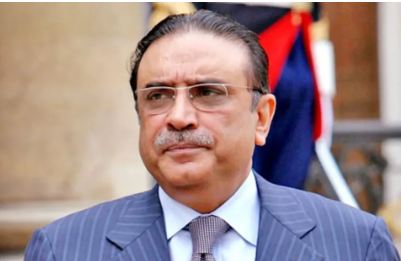
ISLAMABAD, JUN 4: President Asif Ali Zardari has extended his heartiest congratulations to H.E. Mr. Lee Jae-myung on his election as President of the Republic of Korea. He said that Pakistan remained committed to deepening its partnership with the Republic of Korea to achieve our mutual objectives for regional and global peace, as well as prosperity of the two nations.

Post-war diplomacy: India, Pakistan seek global support

Opinion

Ansar M Bhatti

In the aftermath of a brief but tense military escalation between India and Pakistan, both nations have launched diplomatic offensives aimed at garnering international support. While the dust of confrontation has barely settled, emissaries from New Delhi and Islamabad have been dispatched to various world capitals, each side presenting its narrative and seeking allies in a volatile regional and global climate.

India’s diplomatic effort is being spearheaded by seasoned diplomat and politician Shashi Tharoor, known for his articulate and persuasive style. Tharoor has led delegations to Western and Asian capitals, where the focus appears to be on framing Pakistan as an aggressor and warning of the risks posed by what India perceives as Pakistan’s use of proxies and cross-border adventurism. Indian officials have hinted at the possibility of further preemptive action, creating unease in diplomatic circles.

In contrast, Pakistan has opted for a multi-pronged diplomatic approach. Several teams have been formed, with the primary group led by former Foreign Minister Bilawal Bhutto Zardari. Pakistan’s outreach focuses on explaining the circumstances under which it responded to Indian aggression. Pakistani representatives have emphasized that their military response was reactive, not provocative, and highlighted the potential dangers of unchecked escalation between two nuclear-armed states.

While both sides have been active, international observers suggest that Pakistan may have had more success in presenting its narrative. Islamabad’s emphasis on restraint, self-defense, and adherence to international norms has resonated with several countries and international organizations. Pakistan’s diplomats have also focused on the human rights situation in Kashmir and the risks posed by India’s increasingly unilateral policies in the region.

Despite the diplomatic hustle, security officials in Pakistan remain on high alert. Intelligence assessments indicate the possibility of another Indian military strike, though the mode and scale remain uncertain. Speculation is rife that India may explore a naval route, possibly targeting Pakistan’s maritime assets or coastal infrastructure.

In anticipation of such a scenario, the Pakistan Navy has heightened its readiness levels. Naval units have been deployed to key positions, and joint exercises have been accelerated. According to senior defense sources, Pakistan is prepared to meet any aggression with a “full spectrum response,” signaling that any attempt to destabilize the region could have grave consequences.

Another flashpoint in the India-Pakistan standoff is the future of the Indus Waters Treaty (IWT), signed in 1960 with World Bank mediation. The treaty has survived multiple wars and political upheavals, serving as a rare example of cooperation between the two rivals. However, India has recently indicated that it may withdraw from or unilaterally modify the treaty, an action widely considered illegal under international law.

So far, India has not followed through with concrete steps to halt the flow of river waters into Pakistan. However, experts warn that any such move would significantly heighten tensions and possibly trigger a broader conflict. Water is a critical resource for Pakistan, and any disruption in its availability could endanger agriculture, livelihoods, and economic stability.

Pakistan has raised the issue at international forums, warning that tampering with the treaty could set a dangerous precedent. Islamabad views India’s threats as part of a broader strategy to exert pressure and escalate tensions without direct confrontation.

Both India and Pakistan possess nuclear weapons, a factor that makes any military conflict between them exponentially more dangerous. Pakistan’s officials have repeatedly warned that a full-scale war would be catastrophic for both nations and could destabilize the broader South Asian region.

Despite these warnings, Indian rhetoric has remained aggressive. Some Indian leaders have hinted that the time has come to “settle scores,” reflecting a hardline nationalist sentiment. Such posturing may play well domestically, but it fuels anxiety in diplomatic circles about the potential for miscalculation.

What makes the current situation even more tragic is that both India and Pakistan are grappling with profound internal challenges. Poverty, inflation, unemployment, and social unrest plague both nations. Resources that should be directed toward education, healthcare, and economic development are instead being funneled into military preparedness.

This shared vulnerability underscores the need for dialogue and de-escalation. While governments may be locked in conflict, the people of both nations face similar struggles. Analysts argue that true security will only come when the two countries prioritize human development over militarization.

At the heart of the India-Pakistan conflict lies the Kashmir dispute—a territorial conflict that has festered since the partition in 1947. Both nations claim the region in full but control different parts. The revocation of Article 370 by India in 2019, which granted special status to Jammu and Kashmir, has further strained ties. Pakistan sees the move as an illegal annexation, while India considers it a sovereign matter.

Resolving the Kashmir issue is critical to achieving lasting peace. However, meaningful dialogue has been absent for years. Pakistan insists that any talks must include the Kashmiri people and be based on United Nations resolutions, while India maintains that Kashmir is an internal affair.

The international community, particularly major powers like the United States and China, has a significant role to play. Both countries enjoy strategic partnerships with India and Pakistan, respectively. They must use their influence to encourage restraint and mediate a peaceful resolution. Instead of taking sides, global actors should act as facilitators of dialogue.

The United Nations, too, must move beyond issuing statements and take concrete steps to prevent further escalation. Confidence-building measures, backchannel diplomacy, and third-party mediation could all contribute to reducing tensions.

The current post-war scenario offers both danger and opportunity. The danger lies in missteps, miscalculations, or deliberate provocations that could lead to another war—potentially one with nuclear consequences. The opportunity lies in choosing dialogue over destruction.

For that to happen, leaders on both sides must rise above populism and nationalism. They must act not just as politicians, but as statesmen—guided by the long-term welfare of their people, not short-term political gain.

The world cannot afford a war between two nuclear powers. And India and Pakistan, with their shared history, culture, and aspirations, owe it to their citizens to choose peace over conflict, dialogue over war, and cooperation over confrontation.

Pak desires to strengthen partnership with Belarus

Shehbaz Sharif

The delegation included Belarusian Ambassador to Pakistan Andrei Metelitsa, Commander of the Belarusian Air Force and Air Defense Major General Andrei Yulianovich Lukyanovich and officials from the Belarusian defense ministry

Mahnoor Ansar

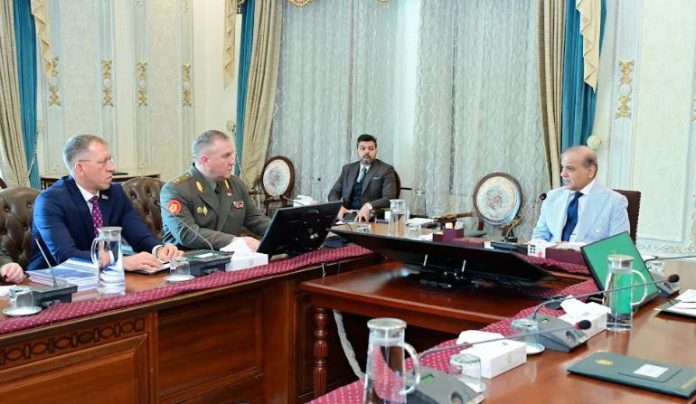
ISLAMABAD, Prime Minister Shehbaz Sharif on Wednesday said that Pakistan desired to strengthen economic partnership with Belarus and benefit from the country’s expertise in agricultural machinery manufacturing.

The prime minister, in a meeting with a seven-member delegation led by Belarusian Defense Minister Lieutenant General Victor Khrenin, which called on him here, said that Pakistan and Belarus enjoyed excellent bilateral ties which were strengthening over time.

The delegation included Belarusian Ambassador to Pakistan Andrei Metelitsa, Commander of the Belarusian Air Force and Air Defense Major General Andrei Yulianovich Lukyanovich and officials from the Belarusian defense ministry.

The prime minister said that cooperation with Belarus in information technology and defense sectors would be further strengthened.

He recalled that during his visit to Belarus this year, several memorandums of understanding and agreements were signed, which would contribute to further expand bilateral relations.

He also expressed good wishes for Belarusian President Aleksandr Lukashenko.

Apprising the delegation of Pakistan’s stance regarding the recent tension in South Asia, he said that Pakistan offered India an impartial investigation into the Pehelgam incident, but instead of responding positively, India demonstrated aggression by attacking Pakistan and targeting civilian populations, resulting in the martyrdom of innocent civilians.

The prime minister said that on

May 10, Pakistan responded befittingly to Indian aggression in self-defense.

Conveying President Lukashenko’s good wishes to the prime minister, the Belarusian defense minister said that they

desired peace and stability in South Asia.

He said that the delegation’s visit was aimed at further advancing the progress on MoUs and agreements between the two countries.

The minister appreciated Prime Minister Shehbaz’s personal interest in strengthening bilateral relations and also thanked him for the warm welcome and hospitality.

The meeting was attended by Deputy Prime Minister and Foreign Minister Ishaq Dar, Defense Minister Khawaja Muhammad Asif, Federal Minister for Defense Production Reza Hayat Haraj, and relevant senior government officials.

Reviving sports glory is top priority: DG PSB

Reviving sports glory is top priority: DG PSB

By Ansar Bhatti

ISLAMABAD — Director General of the Pakistan Sports Board (PSB), Yasir Pirzada, has unveiled an ambitious and comprehensive roadmap aimed at revitalizing the national sports landscape through infrastructure enhancement, advanced athlete training, and long-term strategic planning. The initiative reflects Pakistan’s strong resolve to reestablish its prominence in regional and international sports.

With Pakistan slated to host the South Asian Games in January 2026, preparations are entering a decisive phase. In a detailed briefing to a delegation of the Rawalpindi-Islamabad Sports Journalists Association (RISJA), led by President Abubakar Bin Tallat, DG Pirzada shared an insightful overview of ongoing developments. He affirmed the government’s unwavering support in ensuring that the upcoming Games are not only successful but also leave a lasting legacy.

“Hosting the South Asian Games is a matter of national prestige, and we are committed to achieving international benchmarks in infrastructure, athlete preparation, and organizational excellence,” Pirzada stated.

He highlighted the large-scale renovation and development efforts underway at the Pakistan Sports Complex, describing them as transformative. The goal, he said, is to upgrade the facility to a world-class standard, capable of hosting high-profile international competitions.

Under the leadership of Prime Minister Shehbaz Sharif, Federal Minister for Inter-Provincial Coordination Rana Sanaullah, and Federal Secretary IPC Mohyuddin Wani, the government is prioritizing the revival and institutional support for sports across Pakistan. DG Pirzada noted that this unified vision is already driving tangible progress.

He emphasized the significance of specialized athlete training camps, which now incorporate advanced coaching techniques, nutritional planning, and mental wellness support to better equip national athletes for competitive excellence.

Looking beyond the South Asian Games, Pirzada outlined the PSB’s long-term sports development initiatives, which include:

Grassroots talent identification programs

Revival of school and college-level competitions

Strengthened public-private partnerships

Capacity building for coaches and officials

He stressed that community engagement and youth development remain central pillars of the PSB’s agenda, ensuring that future generations are actively involved in sports from an early age.

The session concluded with a candid and constructive exchange of ideas, as journalists offered suggestions for improving media coverage and transparency in sports administration. DG Pirzada reiterated the PSB’s commitment to collaboration with the media, recognizing its crucial role in shaping public opinion and supporting national sports development.

The RISJA delegation included Abdul Mohi Shah, Shakeel Awan, Zulfiqar Baig, Nasir Naqvi, Shakir Abbasi, Afzal Javed, Shahryar Khan, Arfa Feroze Zaki, Awais Abbasi, and Kiran Khan.

This engagement marked a significant step forward in uniting all stakeholders around a common goal: the sustainable revival of sports in Pakistan, with the 2026 South Asian Games serving as both a challenge and an opportunity.

Bulgaria-Pakistan diplomatic ties celebrated with cultural exhibition in Islamabad

Ansar M Bhatti

Islamabad, June 4: The Embassy of Bulgaria in Islamabad hosted a vibrant reception titled “The Ancient Treasures of Bulgaria” to mark the Day of the Bulgarian Alphabet and Culture, as well as the 60th anniversary of Bulgaria-Pakistan diplomatic relations. The event brought together diplomats, officials, scholars, and cultural enthusiasts for an evening of celebration and cultural exchange.

Ambassador of Bulgaria, H.E. Irena Gancheva, welcomed the guests and highlighted the strong and friendly ties between Bulgaria and Pakistan, forged over six decades of cooperation and mutual respect. She emphasized the importance of cultural diplomacy in deepening people-to-people connections and enhancing bilateral relations.

The chief guest, Additional Foreign Secretary for Europe, Mohammad Ayub, congratulated Bulgaria on its national cultural day and appreciated the embassy’s efforts to promote cultural understanding. He noted the historical depth of both nations and expressed hope for continued collaboration in education, culture, and trade.

A key highlight of the evening was a special exhibition, “The Ancient Treasures of Bulgaria,” showcasing Bulgaria’s rich archaeological and cultural heritage. The exhibition was introduced by a visiting Bulgarian assistant professor, who offered insightful commentary on the artifacts and historical narratives. She noted the striking similarities between Bulgarian and Pakistani heritage — particularly in traditional crafts, folk music, and community values.

Ambassador Gancheva proudly emphasized Bulgaria’s role as the birthplace of the Cyrillic script, one of the world’s most influential writing systems, used by millions across Eastern Europe and Central Asia. “The Cyrillic alphabet is one of our major contributions to the European Union,” she noted. “It would not be an exaggeration to say that Bulgaria is perhaps the only country in the world, or among the very few, that celebrates its alphabet and culture in such a dedicated manner.”

For Bulgaria, the alphabet is more than just a system of writing—it is a core component of national identity. Ambassador Gancheva explained that the Bulgarian script has been instrumental in preserving the nation’s literature, history, and cultural legacy throughout the centuries. “The Bulgarian alphabet is the main factor for the preservation of our identity,” she said. “It has protected our cultural spirit and literary tradition across generations.”

The occasion was made even more meaningful as it coincided with the 60th anniversary of the establishment of diplomatic relations between Bulgaria and Pakistan. Ambassador Gancheva reflected on the strong bonds of traditional friendship and mutual understanding that have developed over the decades. While the diplomatic relationship was officially established 60 years ago, she highlighted that the two countries have been connected for over six decades through shared values and cooperation.

Looking to the future, the ambassador expressed Bulgaria’s continued commitment to strengthening bilateral ties with Pakistan. “We remain committed to further developing political dialogue, people-to-people contacts, trade and economic cooperation, as well as fostering partnerships in science, education, and culture,” she said. She expressed hope that with joint efforts, both nations will continue to see positive developments in their relations, to the benefit of their peoples.

Ambassador underscored the symbolic and practical importance of celebrating these two occasions—a national cultural day and an anniversary of diplomatic friendship—with a cultural event. Culture, she noted, is a powerful diplomatic tool, capable of bridging gaps and building empathy among people from different backgrounds. “It is not by chance that we decided to celebrate with a cultural event,” she explained. “Culture has an important role to play in connecting people, fostering understanding, and conveying messages of unity, especially in today’s world.”

In an era marked by global crises and complex challenges, the ambassador highlighted that the role of culture in diplomacy is more important than ever. Culture allows people to identify shared values and challenges, helping to build bridges between continents, countries, and communities. “Culture creates a spirit of togetherness despite our differences,” she said. “It speaks the universal language of humanity.”

Before concluding her remarks, Ambassador Gancheva expressed heartfelt gratitude to all those who contributed to the success of the event. Though she chose not to name individuals, she acknowledged their hard work and dedication in organizing cultural events not only in Islamabad but also in Lahore. She extended her thanks to the audience for their presence and engagement.

Stay Connected

64FansLike
60FollowersFollow

Latest Reviews

Exchange Rates

USD - United States Dollar
EUR
1.17
GBP
1.35
AUD
0.72
CAD
0.73