Home Blog Page 603

The Indo-Pacific’s Strategic Transition

The Indo-Pacific’s Strategic Transition

Dr. Muhammad Akram Zaheer

The strategic convergence emerging in the Indo-Pacific signifies a notable transformation in the regional security architecture, reflecting both a response to the shifting geopolitical balance and a reassessment of existing alliance structures. However, this convergence represents a transitional phase rather than a conclusive or optimal configuration. The prevailing security arrangements among the United States and its Indo-Pacific allies remain incomplete and fragmented. Unlike the North Atlantic Treaty Organization (NATO), which institutionalizes mutual defense commitments and centralized military coordination, the Indo-Pacific lacks binding defense obligations among regional partners and a central command structure for multilateral operations. Coordination exists, but it remains sporadic and lacks the regularized planning processes essential for rapid and cohesive responses to regional threats. The absence of mutual defense obligations among U.S. allies in the region such as Australia, Japan and the Philippines undermines the potential for a unified and effective deterrence posture. While each state maintains bilateral agreements with the United States, the failure to establish inter-allied obligations results in a fragmented network lacking urgency and strategic depth. In this context, the establishment of a collective defense pact focused on these three strategically aligned states offers a pragmatic path forward. Rather than replicating NATO’s expansive structure, a smaller and more focused alliance could enhance operational readiness and strategic cohesion.

Such a pact could, over time, incorporate additional members, subject to political will and strategic necessity. South Korea, due to its economic and military capabilities and geographical proximity, presents a natural candidate. However, its inclusion would necessitate a recalibration of its strategic priorities, particularly in terms of enhancing cooperation with Japan and reorienting its military focus toward a broader regional mandate. New Zealand, a member of the Five Eyes intelligence network, has shown increasing willingness to align with U.S. positions on China, though it may not yet be prepared for formal defense commitments. Meanwhile, key regional actors such as India and Singapore are unlikely to join in the initial stages but may engage through observer roles or limited operational cooperation. The inclusion of Taiwan remains untenable due to prevailing U.S. policy constraints and the geopolitical sensitivities of other potential pact members. Similarly, the incorporation of European allies appears premature, given their current military posture and regional priorities. Nonetheless, a future in which European militaries, supported by increased defense spending and enhanced capabilities, contribute to Indo-Pacific stability remains within the realm of possibility.

The urgency of countering China’s growing assertiveness necessitates immediate preparatory efforts. A foundational step involves transforming existing bilateral relationships among Australia, Japan and the Philippines into a web of mutual obligations. While this would require considerable diplomatic engagement, the strategic payoff in terms of enhanced deterrence would justify the complexity of negotiations. For Australia and Japan in particular, whose military ties with the United States are already deep, the transition from current defense partnerships to mutual defense obligations would entail only incremental changes. Operationally, a Pacific Defense Pact could build upon ongoing cooperative initiatives, including intelligence sharing, joint military exercises and coordination mechanisms. Notable among these are the U.S.-Japan Bilateral Intelligence Analysis Cell at Yokota Air Base, focused on Chinese movements in the East China Sea and the U.S.-Philippines Combined Coordination Center near Manila. These institutions could be expanded to incorporate Australia and the Philippines, fostering a more integrated regional intelligence and command structure. Existing basing agreements and troop rotations provide a logistical foundation upon which multilateral coordination could be built, contingent on the establishment of reciprocal access agreements among allies.

The proposed pact should also envision the development of shared military infrastructure, pre-positioning of munitions and the establishment of a unified headquarters. Japan emerges as a potential site for such a command center, especially in light of the United States’ intention to upgrade its regional command in Japan. However, alternative locations, including Australia and the U.S. Indo-Pacific Command in Hawaii, could also be considered. A formalized structure would necessitate the creation of working groups comprising defense and foreign ministry officials tasked with negotiating governance frameworks, legal protocols and decision-making mechanisms. These institutional mechanisms would form the backbone of a robust, day-to-day alliance management system. Moreover, the realignment of existing U.S. bilateral treaties in the region is necessary to reflect contemporary realities. These treaties, designed during an era of uncontested American primacy, reflect asymmetrical commitments that are increasingly misaligned with the capabilities and responsibilities of modern U.S. allies. For decades, U.S. protection was exchanged for military access and economic cooperation, without reciprocal commitments to support U.S. operations beyond the allies’ territories. Today, the People’s Liberation Army (PLA) of China presents credible threats not only to U.S. forces in the region but also to the U.S. mainland and American allies now possess the economic and technological wherewithal to shoulder a greater share of the defense burden.

Reciprocity is becoming both a strategic necessity and a domestic political imperative in the United States. Growing bipartisan sentiment in the U.S. underscores the demand for allies to contribute more substantively to collective security. Former President Donald Trump, among others, has criticized allied free-riding and emphasized equitable burden-sharing. Although increased defense spending is part of this equation, genuine reciprocity must also encompass greater mutual obligations. The U.S.-Japan Security Treaty, for instance, limits Japan’s commitment to its own territory, producing a strategic imbalance at high-level summits where U.S. leaders pledge defense commitments while Japanese counterparts remain silent on reciprocal obligations. Realignment would enable more integrated military planning, shared procurement of complementary capabilities and coordinated training exercises tailored to regional contingencies. Clarity on access, basing and overflight rights is vital for enabling rapid U.S. military responses and forward deployments. Infrastructure development and strategic mobility would be enhanced through such access agreements, reinforcing deterrence and facilitating sustained military operations during crises. These changes would inevitably raise complex sovereignty and legal issues, but such matters can be addressed through careful diplomacy and phased implementation.

Tensions in economic and diplomatic domains particularly if exacerbated by protectionist U.S. policies could complicate security cooperation. Nonetheless, security establishments in the United States and its allies should seek to compartmentalize defense collaboration from broader political disagreements. The strategic stakes involved necessitate continuity in security planning irrespective of domestic or bilateral disruptions. Despite the challenges, recent trends demonstrate growing resilience in U.S. alliances in the Indo-Pacific. The deteriorating security environment, driven by China’s revisionist posture and assertive actions in the East and South China Seas, has prompted an increased appetite for security cooperation among U.S. allies. Even if the current U.S. administration lacks the coherence to execute this vision fully, the groundwork can be laid for a future administration to finalize the pact.

Crucially, regional allies must secure domestic political support for deeper integration. Strategic arguments alone may not suffice; highlighting tangible benefits such as technology transfers, disaster resilience and infrastructure development may enhance public acceptance. In the United States, the proposed pact would not impose new obligations beyond existing ones but would reinforce homeland security and the safety of forward-deployed troops. The United States must also engage the broader Indo-Pacific region diplomatically to assuage concerns and avoid the perception of exclusive bloc formation. A prospective defense pact should be framed as one pillar within a broader strategy encompassing multilateral frameworks such as the Quad, ASEAN and trilateral partnerships. Its stated objective ensuring a free and open Indo-Pacific aligns with widely shared regional values and objectives. Importantly, the proposed alliance should limit its scope to defense, refraining from overlapping with economic and diplomatic institutions. Its success will be augmented by parallel initiatives in trade, diplomacy and development assistance. Predictably, China will condemn the formation of any new security coalition as evidence of “Cold War thinking” and “bloc politics.” Chinese military officials have already described efforts to consolidate American-led alliances in Asia as binding the region to the U.S. “war chariot.” Such rhetoric underscores Beijing’s apprehension about the formation of an effective counter-coalition.

Trilateral Talks: Pakistan, Afghanistan, China agree on anti-terror cooperation

Trilateral Talks: Pakistan, Afghanistan, China agree on anti-terror cooperation

ISLAMABAD, JUN 6 /DNA/ – The presence of various militant groups on Afghan soil poses a significant challenge to regional security, according to veteran journalist and former Associated Press correspondent Kathy Gannon. She added that while Afghanistan might not want all the militant groups on its territory nor did Kabul invite them all, but they were still there. She was speaking at an event titled “Geopolitical Shifts and Security Challenges: Pakistan, Afghanistan, and the Regional Power Play” organized by the Institute of Regional Studies (IRS). 

While appreciating recent positive developments in relations between Pakistan and Afghanistan, Gannon emphasized the importance of restoring trust between Pakistan and Afghanistan. She was of the view that Pakistan could better influence the Afghan government by treating it as an equal and a partner in pursuing its regional objectives. She also urged Islamabad to take steps against all terrorist groups through a concerted long-term strategy to address its internal security challenges. Gannon maintained that Afghanistan was still relevant for the US policymakers because of the increasing Chinese influence in the country as well as its mineral wealth.

Ambassador Asif Durrani, Pakistan’s former Special Representative for Afghanistan, referred to Pakistan and Afghanistan as twin brothers who had come to each other’s help whenever needed notwithstanding the state of their relationship at the time. He hailed the upgradation of diplomatic relations between Pakistan and Afghanistan and the inclusion of Afghanistan in the China-Pakistan Economic Corridor (CPEC) as positive developments. He added that in the recent high-level trilateral meeting between Pakistan, Afghanistan, and China, the three countries had agreed to oppose terrorism, carry out law enforcement and security cooperation, remain vigilant against external interference in the internal affairs of regional countries, and safeguard regional peace and security. Ambassador Durrani was of the view that there had been a decline in terrorist attacks in Pakistan since the positive development in diplomatic relations between Pakistan and Afghanistan.

President IRS Ambassador Jauhar Saleem said that despite challenges, regional geopolitics and mutual interests had continually pushed both countries to engage and re-engage across various levels. He added that recent developments pointed toward a more constructive phase in bilateral engagement and expressed his hope that the trilateral dialogue among Pakistan, Afghanistan, and China most recently held in Beijing would strengthen regional cooperation on counterterrorism, stability, and economic integration.

Aarish Khan, the Head of the Afghanistan Program at IRS, maintained that while the Taliban had not acceded to the demands of the international community on political inclusion, women education, and individual freedoms, they were still making good progress in improving diplomatic relations not only with important capitals like Beijing, Moscow, and Islamabad but also with the UN as was demonstrated by the Doha III talks las year. He added that the Afghan interim government had taken concrete steps against the TTP in the recent past.

Ambassador Abrar Hussain, Pakistan’s former Ambassador to Afghanistan, also argued that Islamabad’s top priority in Afghanistan was to promote peace and stability notwithstanding whichever government was in power in the country.

THE REPUTATION IMPERATIVE: why corporate survival hinges on trust

THE REPUTATION IMPERATIVE: why corporate survival hinges on trust

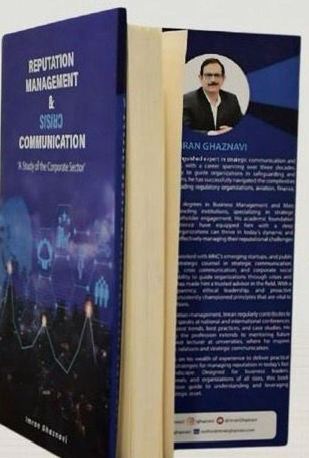
Title:                                   Reputation Management and Crisis Communication

Author Name:                    Imran Ghaznavi

Price:                                   Rs:  

Reviewed by: Ansar Mahmood Bhatti

ISLAMABAD, JUN 6 /DNA/ – The boardroom was silent when the call came in. A whistleblower had leaked internal documents to the press. The CEO’s face turned ashen. Shares plummeted 30% in pre-market trading. By noon, regulators were circling. Within a week, a 50-year-old brand was fighting for its life. 

This wasn’t just a crisis—it was a reputation assassination. And according to Imran Ghaznavi’s groundbreaking book, “Reputation Management and Crisis Communication: A Study of Corporate Sector”, it was entirely preventable. 

The Silent Killer in Corporate Risk Reports: Ghaznavi’s investigation reveals a chilling reality: 83% of Fortune 500 companies lack formal reputation risk oversight at the board level—despite reputation failures causing 65% of market value collapses since 2010 (per Harvard Business Review data). 

“Reputation risk isn’t a footnote—it’s the black box of corporate survival,” Ghaznavi told this reporter during a tense interview. “Yet most risk committees treat it like a PR problem, not a governance time bomb.” 

His findings expose that the Governance Gap: Only 12% of S&P 500 boards have a dedicated reputation risk committee.  The Speed Trap: In the digital age, crises go global in under 19 minutes—but the average corporate response takes 47 hours. The Trust Tax: Companies with weak reputation systems pay 7.5% more for capital (MIT Sloan data). 

The Ghaznavi Doctrine: A SEAL Reputation Team Six for Corporate

Drawing over 30 years of frontline experience—including advising multinationals, public sector institutions during the 2008 financial crisis and the COVID-19 pandemic—Ghaznavi prescribes wartime-style preparedness: 

1. The Boardroom Battlefield:  Mandate “monthly reputation risk briefings” alongside financial reports.  Tie “30% of C-suite compensation” to reputation KPIs (employee trust scores, social media sentiment) 

2. The 60-Minute Response Rule: Pre-drafted crisis playbooks for “17 worst-case scenarios” (CEO scandal, cyberattack, activist attack). “Dark site” media portals ready to launch in 15 minutes 

3. The Truth Dividend:  When a Ghaznavi-advised the chairman of a national airline (PIA -2006) during initial days of ban its on flights in Europe, to have patience handling main stream media. The silent fight between the CEO of a national newspaper and the airline made it worse to handle public image of the airline which ultimately resulted in serious financial and reputational loss.

Why Regulators Are Taking Notes: Globally the Federal Reserve stress tests now include “reputation contagion scenarios”. The SEC is debating on mandatory reputation risk disclosures. 

“Ghaznavi’s work proves reputation isn’t soft science—it’s the new systemic risk,” says the regulatory expert.

The Bottom Line: A Corporate Survival Kit for, CEOs: Your next crisis isn’t coming—it’s already here, investors: Demand reputation audits like you scrutinize balance sheets. Business executives: This is your anti-Black Swan playbook.

As Ghaznavi warns: “The companies that survive this decade won’t be the biggest or the richest—they’ll be the most trusted.”

Russia celebrates Russian language day to Honor Cultural Heritage and Literary Excellence

Russian language day

DNA

MOSCOW, JUN 6: Russia proudly observes Russian Language Day, a national celebration dedicated to honoring the richness, heritage, and global significance of the Russian language.

The date marks the birth anniversary of Alexander Sergeyevich Pushkin (1799–1837), the legendary Russian poet, writer, playwright, and the founder of modern Russian literary language. His works have inspired generations and played a pivotal role in shaping the Russian language as we know it today.

Russian Language Day was officially established by a Presidential Decree on June 6, 2011, with the goal of “preserving, supporting, and developing the Russian language as a national treasure of the peoples of the Russian Federation, a tool of international communication, and an integral part of the cultural and spiritual heritage of world civilization.”

Today, Russian is not only the state language of the Russian Federation but also one of the six official languages of the United Nations, and is spoken by over 250 million people worldwide. It remains a vital tool of diplomacy, science, education, and literature across continents.

Celebrations across Russia and in Russian cultural centers around the world include literary readings, cultural festivals, educational activities, and tributes to the life and legacy of Pushkin. Schools, universities, libraries, and media platforms are marking the day with special programs to highlight the evolution, richness, and continued relevance of the Russian language.

“Russian is more than just a language; it is a vessel of our shared memory, values, and identity. On this day, we pay homage to the words that have defined our literature, shaped our history, and continue to unite millions across the world,” said a spokesperson from the Ministry of Culture.

Russian Language Day serves as a reminder of the country’s vast literary tradition, from Pushkin and Tolstoy to Dostoevsky and Chekhov, and reaffirms Russia’s commitment to nurturing its linguistic and cultural legacy for future generations.

US envoy for strong ties with Pakistan

Pakistan

Centreline Report

ISLAMABAD, JUN 4 /DNA/ – The U.S. Embassy in Islamabad held a vibrant celebration to mark the 249th anniversary of American independence, with Chargé d’Affaires Natalie Baker delivering a heartfelt address that underscored the enduring friendship and growing partnership between the United States and Pakistan.

The event was graced by the presence of Prime Minister Shehbaz Sharif, Deputy Prime Minister Ishaq Dar, federal ministers, members of the diplomatic corps, senior military officials, prominent media personalities, and a wide array of guests from diverse sectors including business, fashion, sports, and civil society.

In her remarks, Natalie Baker warmly welcomed guests in both English and Urdu, emphasizing the strong historical and cultural bonds between the two countries. “The United States and Pakistan have stood together through good times and bad, from development to defense, from health to education,” she said.

Reflecting on her second diplomatic posting in Islamabad, Baker praised Pakistan’s rich culture, resilience, and the warmth of its people. She noted that the bilateral relationship had grown significantly in scope and depth over the years, and highlighted the shared values of liberty, equality, and opportunity that unite the two nations.

Baker paid tribute to the U.S. Agency for International Development (USAID) and its long-standing work in Pakistan, praising its life-changing contributions in health, education, food security, and economic empowerment. “The legacy of USAID’s work in Pakistan will continue to benefit communities for generations to come,” she stated.

On security cooperation, Baker acknowledged the long-standing defense ties between the two countries, particularly lauding the Pakistani security forces for their recent successes in counterterrorism operations. She mentioned Pakistan’s pivotal role in the capture and extradition of the ISIS-K terrorist responsible for the Abbey Gate attack in Afghanistan, terming it a major milestone in bilateral counterterrorism efforts.

Economically, she highlighted the recent Pakistan Critical Minerals Investment Forum and growing cooperation in technology, digital markets, and innovation. She also praised Pakistan’s leadership in promoting industrial and digital growth.

In a notable diplomatic nod, Baker acknowledged U.S.-Pakistan collaboration in helping de-escalate tensions between Pakistan and India, reinforcing the U.S. commitment to regional peace and stability.

Adding a touch of Americana to the evening, the celebration featured classic American food, live music by the U.S. Air Force band, and décor reflecting traditional Independence Day themes. Baker commended the sponsors and organizing team for curating a memorable event that celebrated not just American independence, but also the vibrant spirit of U.S.-Pakistan friendship.

She closed her speech by quoting former President Trump, calling the U.S.-Pakistan relationship “great” and adding, “the best is yet to come.”

The evening served as a reaffirmation of mutual goodwill and shared aspirations for peace, prosperity, and partnership in the years ahead.=DNA

============

India’s approach can damage its relations with China: Mushahid Hussain

India's approach can damage its relations with China: Mushahid Hussain

ISLAMABAD, JUN 4: Senior politician Senator Mushahid Hussain said on Wednesday that India’s approach could also damage its relations with China.

According to details, experts on international affairs and diplomats participated in a seminar held in Islamabad to discuss the implications of India’s actions on regional stability. On this occasion, Hussain said: “India’s use of water as a strategic weapon constitutes a crime against humanity.”

He was of the view that India’s global reputation has been adversely affected due to its unilateral actions.

“Tensions in the region have escalated as a result of India’s one-sided measures, he maintained.

Pakistan Navy leads fight against plastic pollution on World Environment Day

World Environment Day

KARACHI, JUN 4: /DNA/ – World Environment Day is observed on 5th of June every year to encourage awareness and spur action for the protection of environment. It is a global call to confront the escalating environmental crises under United Nations Environmental Programme. This year’s focus, ‘Ending Plastic Pollution’, emphasizes a profound threat to our planet, particularly our precious maritime domain.

The scourge of plastic pollution respects no borders, relentlessly invading our lakes, rivers, and seas. Beyond disfiguring our natural landscapes, it degrades habitats, cripples eco-systems, and endangers countless species. This insidious threat directly undermines livelihoods, food security, and the well-being of coastal populations worldwide. This is not a distant threat; it is a clear and present danger.

For Pakistan, with its extensive coastline supporting millions and harbouring a rich marine biodiversity, the stakes are exceptionally high. Our seas face relentless pressure from human activity, with marine pollution, driven significantly by plastic, posing an existential risk to this invaluable national asset.

Pakistan, with a thriving maritime economy, is deeply impacted by the state of our seas. Karachi harbour, a critical maritime hub and ecological zone, continues to suffer from the indiscriminate disposal of solid waste, hazardous industrial discharge, untreated sewage and plastic debris. These pollutants not only degrade the marine environment but also hurt marine life, threaten biodiversity and endanger human health.

Pakistan Navy in concert with maritime stakeholders is playing a proactive role in improving environmental conditions of Karachi harbour by taking various initiatives. However, the extent of pollutants being discharged and dumped into the sea is way beyond the scale of our efforts. There is a need to adopt a two-pronged strategy; first to stem the waste disposal i.e. industrial effluents, oil spills and solid waste, plastics being non-destructive and most detrimental that find their way into the sea, invariably accentuated by rains, and the second, to collect waste that has already reached our ports and anchorage by investing and committing more resources to clean harbours and make them safer for our shipping and aquatic activities.

Recognizing the increasing threat from plastic and marine pollution, Pakistan Navy renews its commitment to curb the menace of pollution by launching awareness drives and forging crucial partnerships. To mark the occasion, National Institute of Maritime Affairs (NIMA) has organized one day international seminar to create awareness about the issue and highlight ways and means to protect our marine ecosystem from plastic pollution.

I call upon all stakeholders to join hands with Pakistan Navy for nature based solutions Iike mangroves plantation, reducing pollution at the source, ban on plastic bags, beach cleaning activities, deploying additional waste collection assets, installation of trash barriers and raising en-mass awareness on this exacerbating crises, for a healthy and secure future for our next generations.

Rizwan likely to be removed as Pakistan’s ODI captain

Rizwan

ISLAMABAD, JUL 4: Pakistan wicketkeeper-batter Mohammad Rizwan is expected to be removed as the ODI captain. According to sources, a final decision regarding the change in captaincy will be made in the coming days. Head coach Mike Hesson has already begun consultations over the potential leadership shift.

Current T20I captain Salman Ali Agha is considered a strong contender to lead the ODI side.

In addition to appointing a new captain, Hesson is also expected to name a vice-captain.

Pakistan to launch own shipping line, save PKR 728 billion annually

Pakistan to launch own shipping line

KARACHI, JUN 4: /DNA/ – Atif Ikram Sheikh, President FPCCI, has apprised that Mr. Junaid Anwar Chaudhry, Federal Minister for Maritime Affairs, has in principle agreed to FPCCI’s demand that there should be a strong Shipping Lines of Pakistan’s own as the country’s traders pay PKR. 728 billion to foreign shipping lines annually – and, that too, in foreign exchange.

It is pertinent to note that Mr. Junaid Anwar Chaudhry, Federal Minister for Maritime Affairs, visited FPCCI Head Office at Federation House, Karachi, for a detailed, interactive and consultative session with the representatives of business, trade and industry – whereas, major stakeholders from terminal operators, shipping lines, customs agents and media outlets were also present on the occasion.

In a number of milestone developments, the minister not only announced the establishment of country’s own shipping lines along with the purchase of new ships to expand national fleet; but, also announced an open-door policy for the immediate resolution of issues, apprehensions and complaints of the trading community.

Mr. Junaid Anwar Chaudhry informed the gathering that Karachi Port Trust (KPT) has successfully freed lands worth PKR. 100 billion from the encroachers – and, invited the business community to invest with KPT in establishing business facilities through joint ventures.

Mr. Atif Ikram Sheikh extended his full support to the ministry for the consultative process in establishing the aforementioned shipping lines – and, demanded that FPCCI representatives should be included from the very beginning to align the process with ground realities and needs.

Mr. Saquib Fayyaz Magoon, SVP FPCCI, reiterated FPCCI’s view that the infrastructure cess of 1.8% that the Sindh Government collects from importers should be utilized for infrastructure development of the networks attached to the ports; industrial areas, commercial centers and the city of Karachi in general.

SVP FPCCI added that the collection of infrastructure cess amounts to PKR. 300 billion – and, entire infrastructure of Karachi and Sindh Province can be redeveloped, enhanced and internationally-aligned through these funds. The minister replied that he is ready to talk to the Sindh Government in this regard collectively with the business community in the national interest and interest of the economy.

Mr. Saquib Fayyaz Magoon pointed out that Netty Jetty interchange is the only route to country’s largest and the busiest port, i.e. Karachi Port – and, in case of any eventuality or crisis, country’s trade will be on a standstill. Therefore, there is a glaring need to build an alternative route to divide the traffic to Karachi port.

Mr. Asif Sakhi, VP FPCCI, stressed upon the need to have a collective and synchronized approach of KPT, SBP, Customs, the ministry, the business community and customs agents to fully facilitate the traders through removal of any ambiguities or anomalies. While, custom officers are exercising their authorities in this regard; but, they should be enabled to fully facilitate the traders through removal of any bottlenecks, he added.

Mr. Aman Paracha, VP FPCCI, demanded that the ports and terminal charges should be rationalized and made regionally-competitive. Business community is already under tremendous pressure due to the exorbitant and unbearable cost of doing business in the country and looking towards the maritime ministry for facilitation, he added.

IPL 2025: Seven killed in stampede during RCB victory parade

IPL 2025: Seven killed in stampede during RCB victory parade

New Delhi, JUN 4: Seven people, including women and children, were killed and several injured in a stampede during the Royal Challengers Bengaluru’s (RCB) victory parade on Wednesday.

According to Indian media reports, the tragic incident occurred as large crowds gathered to celebrate RCB’s maiden Indian Premier League (IPL) title win.

More than 10 people were injured in a stampede at the gates of Chinnaswamy Stadium in Bengaluru. Fans had gathered there to catch a glimpse of the RCB players.

It is worth noting that the Virat Kohli-inspired RCB had defeated Punjab Kings to secure their first IPL championship since the tournament’s inception in 2008.

Stay Connected

64FansLike
60FollowersFollow

Latest Reviews

Exchange Rates

USD - United States Dollar
EUR
1.17
GBP
1.35
AUD
0.72
CAD
0.73