Home Blog Page 585

Pakistan, Azerbaijan sign $2 billion economic investment pact

Pakistan

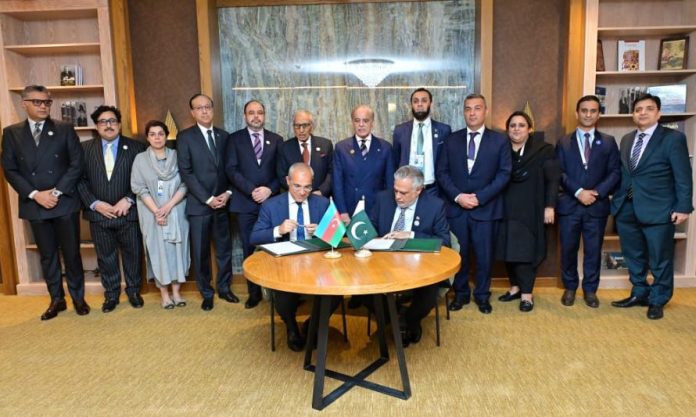
SHUSHA, JUL 4 /DNA/ – Prime Minister Muhammad Shehbaz Sharif witnessed the signing of a landmark agreement between Pakistan and Azerbaijan today, marking a significant step in bilateral economic cooperation. Under the agreement, Azerbaijan will invest USD 2 billion in Pakistan’s economic sector, bolstering trade and development ties between the two nations.

The ceremony took place in Shusha, Azerbaijan, in the presence of high-level officials from both countries. The investment is expected to enhance key sectors of Pakistan’s economy, including energy, infrastructure, and technology, further strengthening the strategic partnership between Islamabad and Baku.

Prime Minister Shehbaz Sharif hailed the agreement as a “transformative milestone” in Pakistan-Azerbaijan relations, emphasizing the shared commitment to mutual prosperity. Azerbaijani representatives expressed confidence that the investment would unlock new opportunities for economic growth in both nations.

This agreement underscores deepening bilateral ties and reflects Azerbaijan’s confidence in Pakistan’s economic potential.

Rwanda National Liberation Day celebrated

Rwanda National Liberation Day celebrated

ISLAMABAD, JUL 4 /DNA/ – A grand ceremony was held at Islamabad Serena Hotel to mark Rwanda’s National Liberation Day, with Chief Guest Senator Mushahid Hussain Syed, Sindh Governor Kamran Tesori, and Rwandan High Commissioner Harerimana Fatou leading the celebrations.

The event featured a cake-cutting ceremony, symbolizing the strong bilateral ties between Pakistan and Rwanda. Dignitaries, diplomats, and officials attended the function, highlighting mutual cooperation and shared values.

Khankendi Summit: Mirziyoyev, PM Sharif review bilateral roadmap progress

Khankendi Summit

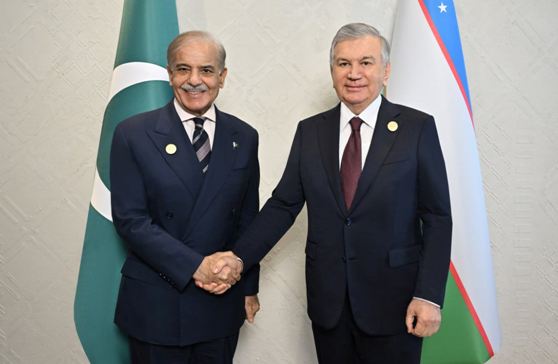
KHANKENDI, JUL 4 /DNA/ – On the margins of Economic Cooperation Organization summit in the city of Khankendi, a meeting took place between the President of the Republic of Uzbekistan Shavkat Mirziyoyev and Prime Minister of Islamic Republic of Pakistan Shehbaz Sharif.

Topical issues of further expanding and strengthening of Uzbek-Pakistani relations of strategic partnership based on the adopted “road map”.

The active contacts at various levels have been noted with satisfaction. The volumes of trade turnover, number of joint enterprises and direct flight are increasing. Trade houses are created in Karachi and Lahore.

Special attention has been paid to the acceleration of cooperation projects and programs in trade and economic, investment, transport and communication spheres, including promotion of Trans-Afghan railroad construction.

The importance of productive organization of the planned meeting of the Intergovernmental commission and business-forum this year, was noted.

The Leaders of Uzbekistan and Pakistan also exchanged views on international and regional agenda.

India’s white-ball tour of ‘postponed’

India's white-ball tour of ‘postponed’

NEW DELHI, JUL 04 (DNA) —   The Indian cricket team’s upcoming tour of Bangladesh, which was set to feature three ODIs and three T20Is from August 17 to 31, has reportedly been postponed indefinitely, Indian media reported on Friday. According to the reports, the delay follows a directive from the Indian government to the Board of Control for Cricket in India (BCCI), citing heightened political tensions between the two countries as the reason.

Neither the BCCI nor the Bangladesh Cricket Board (BCB) has officially confirmed the postponement. The Bangladesh Cricket Board had already begun preparations for the series, including the sale of media rights, which have now been put on hold. Broadcasters were also informed that the series will not proceed as originally planned.

Despite the developments, both cricket boards have remained tight-lipped. A BCB official, speaking to Indian media on condition of anonymity, stated: “The date for the India series hasn’t been fixed yet. They (the BCCI) said it’s difficult for them to come in August. This is part of the Future Tours Programme (FTP).”

On the Indian side, officials have been similarly non-committal. A BCCI source told the media that a final decision is expected within a week and hinted that a joint statement from both boards could be issued soon regarding the tour’s status. Bangladesh set to play 49 home internationals in the cycle concluding in May 2027, including eight Tests, two each against Ireland, Pakistan, West Indies and England, 20 ODIs and 21 T20s. — DNA

President, PM laud security forces

President

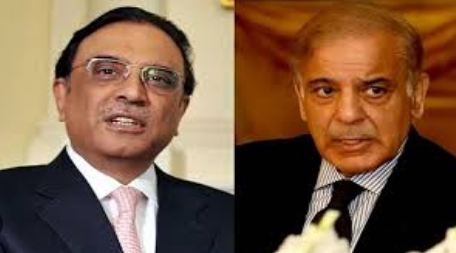
ISLAMABAD, JUL 04 (DNA) — President Asif Ali Zardari and Prime Minister Shehbaz Sharif on Friday paid tribute to the security forces for eliminating 30 Indian-backed Khawarij terrorists while attempting to infiltrate through the Pak-Afghan border in Hassan Khel area of North Waziristan.

The president and prime minister, in their separately issued statements, commended the bravery of security forces for carrying out the successful intelligence-based operations.

“Security forces’ operations will continue until the complete elimination of terrorists. It is commendable that Pakistan’s security forces are successfully conducting operations to eliminate Indian-backed terrorists,” the president said.

He also reaffirmed the nation’s unwavering resolve to eliminate terrorist elements and defend the nation. Prime Minister Shehbaz, who is currently on a two-day visit to Azerbaijan, said that Pakistan’s courageous security forces served as an unyielding shield to protect the nation.

“The entire nation salutes the security forces. We are determined to eliminate all forms of terrorism from the country completely,” the prime minister reiterated. — DNA

PM Shehbaz urges ECO states to strengthen cooperation on climate, regional issues

PM Shehbaz

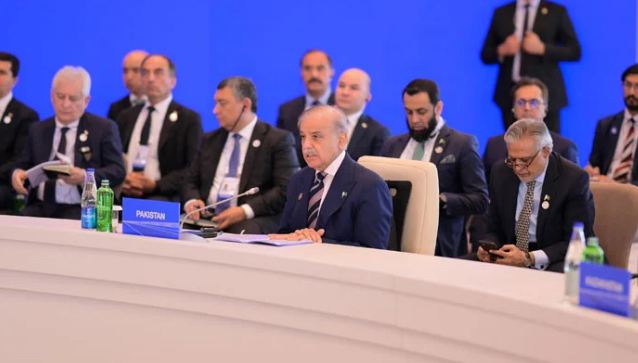
KHANKENDI, JUL 4: Prime Minister Shehbaz Sharif on Friday called on member states of the Economic Cooperation Organisation (ECO) to strengthen regional cooperation amid growing global and regional challenges, particularly climate change and geopolitical instability.

Addressing the 17th ECO Summit in Khankendi, Azerbaijan, PM Shehbaz highlighted the urgent need for coordinated action, stating that ECO countries are already experiencing the severe effects of environmental degradation.

He pointed to a range of climate-related challenges affecting the region, including melting glaciers, desertification, extreme weather events, and reduced agricultural productivity.

“Deeper collaboration among ECO members is essential to build resilience and ensure sustainable development amid increasing environmental and political uncertainty,” he said.

“Pakistan remains among the top 10 countries most vulnerable to climate change,” the prime minister said, recalling the catastrophic 2022 floods that displaced over 33 million people in Pakistan.

He also called for the creation of low-emission corridors and the establishment of a regional carbon market to enhance climate finance cooperation among ECO member states.

The prime minister thanked ECO member states for designating Lahore as the ECO Tourism Capital for 2027, inviting all delegates to experience Pakistan’s rich cultural heritage.

“Lahore, the cultural heart of Pakistan, will enthrall all who visit us. We extend a warm invitation to all member states,” he added.

Israel’s attacks ‘unlawful’
Condemning Israel’s recent strike on Iran, the prime minister termed it “unlawful, unjustified and uncalled for,” and expressed deep condolences to the Iranian people.

“Pakistan strongly condemns this act of Israeli aggression… We pray for a speedy recovery of our injured brothers and sisters in Iran,” he added.

Furthermore, he said the unprovoked and reckless Indian hostility directed towards Pakistan after the Pahalgam incident was yet another attempt to destabilise regional peace.

He also appreciated the support and solidarity extended to Pakistan by the brotherly ECO member states in the aftermath of Indian aggression earlier this year.

PM Shehbaz also strongly condemned Israel’s barbarism in Gaza saying: “Pakistan stands firmly against those who perpetrated barbaric acts against innocent people anywhere in the world whether in Gaza or IIOJK or Iran”.

The prime minister also drew attention to the weaponisation of water by India, referencing New Delhi’s violations of the Indus Waters Treaty (IWT) and the recent ruling by the Permanent Court of Arbitration.

“This violation is completely unacceptable. The Indus waters are a lifeline for Pakistan’s 240 million people. India’s actions amount to aggression,” he added.

Earlier in the day, Prime Minister Shehbaz Sharif met Turkish President Erdogan on the sidelines of the 17th ECO Summit in Khankendi, Azerbaijan.

Both leaders held a comprehensive review of bilateral relations and exchanged views on key regional developments.

The two leaders reiterated the resolve for meaningful progress in bilateral relations between the two countries in all major sectors.

He also held a meeting with Iran’s President Masoud Pezeshkian and reaffirmed Pakistan’s strong commitment to continue working closely with Iran for peace in the region through dialogue and diplomacy.

During the meeting, both leaders reviewed the ongoing bilateral cooperation across all areas and expressed satisfaction over the progress made on the decisions taken during their last meeting for further strengthening of Pakistan-Iran relations.

The two leaders also discussed the evolving regional situation in the wake of Israel’s illegitimate aggression against Iran.

PM also met President of Azerbaijan Ilham Aliyev to enhance their cooperation in the fields of trade and investment while expressing satisfaction over the progress made regarding the investment prospects.

Both leaders reiterated their resolve to strengthen the economic partnership, especially Azerbaijan’s investment in Pakistan, said a statement issued by the state-news agency.

Moreover, PM Shehbaz held a meeting with Uzbek President Shavkat Mirziyoyev.

During the meeting, both leaders agreed to enhance collaboration in diverse fields including trade and investment, connectivity, energy, regional security, culture, and people-to-people exchanges.

Special Task Force meets on PM’s directive to address Iran-Iraq pilgrims’ issues

Special Task Force meets on PM’s directive to address Iran-Iraq pilgrims’ issues

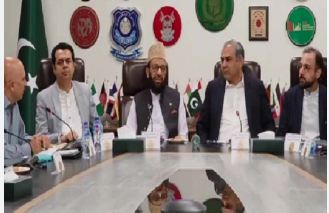
ISLAMABAD, JUL 4 /DNA/ – On the directions of the Prime Minister, a key meeting of the Special Task Force established to resolve the issues of pilgrims traveling to Iran and Iraq was held at the Ministry of Interior. Chairperson of the Task Force and Federal Minister for Interior Mohsin Naqvi, Federal Minister for Religious Affairs Sardar Muhammad Yousaf, Federal Minister for Overseas Pakistanis Chaudhry Salik Hussain, and Minister of State for Interior Talal Chaudhry attended the meeting.

During the meeting, important decisions were made regarding the facilitation and security of pilgrims. Civil Aviation briefed the meeting that the number of weekly flights to Iran has been increased from 6 to 15, while for Arbaeen, 107 special flights to Iraq have been arranged. It was further informed that further increase in the number of flights for Zaireen traveling to Iran and Iraq is under also consideration. Moreover, a ferry service is also being launched to provide better travel facilities to pilgrims in the future.

It was agreed that after Ashura, the security situation will be be assessed again and the decision regarding land travel for pilgrims will be made accordingly. Interior Minister Mohsin Naqvi emphasized that, in light of the current situation, protecting Zaireen from any kind of trouble or difficulty is the top priority. “The safety of pilgrims is most dear to us,” he stated.

During the meeting, it was also decided that from January 1, 2025, a new system of Zaireen Group Organizers will be implemented, and the Salar System will be completely abolished. From January 1, 2026, pilgrims will only be allowed to travel under the system of Zaireen Group Organizers.

Interior Minister Mohsin Naqvi directed FIA and relevant institutions to ensure all possible measures to stop illegal individuals from entering Iraq under the guise of pilgrimage. It was further apprised that so far, 1,413 applications have been received for the registration of Zaireen Group Organizers, and the scrutiny process of these applications is currently underway.

The meeting was also attended by the Secretary Interior, Secretary Religious Affairs, and representatives from the Ministry of Information and the Ministry of Foreign Affairs. DG FIA, DG Civil Aviation Authority, Additional Chief Secretary Balochistan, IG Balochistan, Commissioner Quetta, and officers from other relevant departments also participated in the meeting via Zoom.

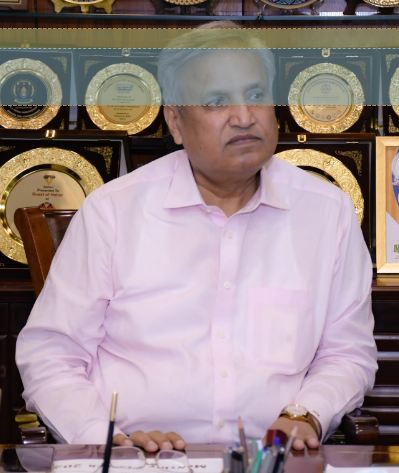
Nasir Mansoor Qureshi: ICCI to Continue Push for Business Reforms, SME Growth

Nasir Mansoor Qureshi

ISLAMABAD, JUL 4 /DNA/ – The Islamabad Chamber of Commerce and Industry (ICCI) will continue its robust policy engagements with the government to address key challenges facing the business community, including high taxation, rising energy costs, regulatory bottlenecks, and the urgent need for structural reforms to support local industries and  SMEs.

This was stated by Nasir Mansoor Qureshi, President of ICCI, during his interactions with various business delegations at the Chamber House  here on Friday.

He emphasized that ICCI remains steadfast in its role as a vital link between the private sector and the government, advocating for a business-friendly environment conducive to sustainable economic development in Pakistan. Nasir Mansoor Qureshi reiterated the Chamber’s commitment to amplifying the voice of traders, entrepreneurs and industrialists, ensuring that their concerns are addressed at the highest policy-making forums. He stressed that improving the ease of doing business is essential for attracting investment, promoting innovation, and accelerating economic growth in the country.

He noted that small and medium enterprises (SMEs) form the backbone of Pakistan’s economy and must be prioritized through targeted policy support, access to finance, simplified regulations, and skill development initiatives. He called for inclusive dialogue between public and private stakeholders to create an ecosystem that nurtures entrepreneurship and industrial growth.

The ICCI President also urged the government to stabilise economic policies, curb inflationary pressures, and reduce the cost of doing business to revive investor confidence. He said that with coordinated efforts and practical reforms, Pakistan has the potential to overcome current economic challenges and unlock new avenues for sustainable growth and prosperity.

Reassessing epistemology through Islamic thought: Dr. Anis Ahmad

Reassessing epistemology through Islamic thought: Dr. Anis Ahmad

ISLAMABAD, JUL 4 /DNA/ – Growing concerns over the ethical vacuum and fragmented understanding fostered by dominant Western knowledge systems have underscored the urgent need to reassess contemporary epistemologies through the lens of Islamic tradition. The Islamic concept of knowledge fosters the holistic development of the human personality and builds information, knowledge, and skill upon moral and spiritual foundations. A system of thought and education grounded in social realities and religious principles can serve as an effective means to address global crises and promote human dignity.

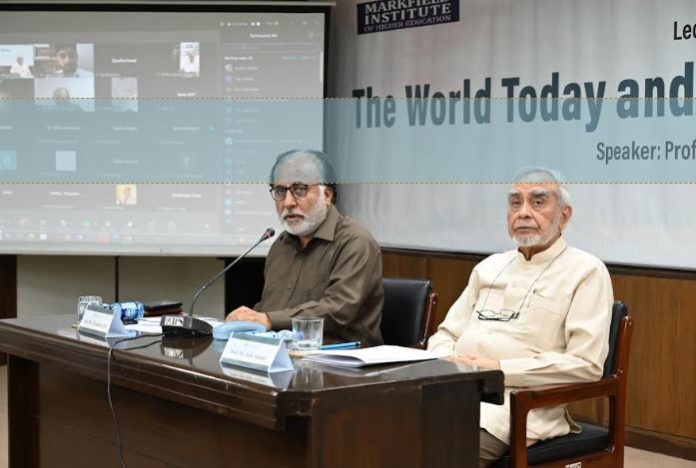
This was observed by Prof. Dr. Anis Ahmad, renowned scholar and vice chancellor of Riphah International University, while delivering a seminal lecture titled “Revisiting the Concept of Knowledge,” at the Institute of Policy Studies (IPS), Islamabad, as part of its lecture series “The World Today and the Future of Humanity.”

The event was organized in collaboration with the Markfield Institute of Higher Education (MIHE), UK, International Institute of Muslim Unity, Malaysia, and Islamic Studies Department at Bahauddin Zakria University (BZU), Multan. Head of Research at MIHE, Dr. Haroon Bashir, and Dr. Abdul Quddoos Sohaib from BZU also spoke on the occasion. The event was moderated by Prof. Dr. Mustafeez Ahmad Alvi.

In his address, Dr. Anis Ahmad critiqued the prevailing Western paradigms of knowledge, which he said have contributed to global ethical disorientation, deepening inequalities, and environmental degradation. He emphasized that the modern commodification of knowledge has reduced it to an economic and bureaucratic tool, severed from its spiritual, moral, and holistic dimensions.

He argued for a revival of the Islamic concept of knowledge, which rests on Tawheed (divine unity) and Wahi (revelation) as foundational sources. Prof. Ahmad underscored that in Islam, knowledge is not merely an intellectual exercise but a moral and transformative endeavor that connects human beings to their Creator and one another through justice, ethical responsibility, and the pursuit of the common good.

Citing examples from classical Islamic thinkers such as Ibn Sina and Ibn Arabi, he highlighted their efforts to integrate reason, revelation, and spiritual insight. He pointed to the Qur’anic emphasis on concepts like tafaqquh (deep understanding), ta’aqqul (rational reflection), and tadhakkur (moral remembrance), stressing the need to reconstruct educational and epistemic frameworks grounded in these principles.

The lecture concluded with a call for intellectual decolonization and a rejuvenation of Muslim educational institutions that not only produce functional knowledge but also cultivate wisdom (hikmah), ethical behavior, and holistic human development.

Dr. Haroon Bashir identified that Eurocentric approaches were implanted in Muslim and other non-Western societies through colonization and sustained through neo-colonial strategies.

Dr. Abdul Quddoos said that the thoughts generated from the scholarly discussion marked a meaningful contribution towards building an Islamic epistemic paradigm rooted in transcendence, ethics, and human dignity.

The event was attended by a large number of scholars, educators, students, and researchers from different universities, regions, and countries, in-person and online.

India decide against travelling to Bangladesh for white-ball series

India

New Delhi, JUL 4: The Board of Control for Cricket in India (BCCI) has decided against travelling to Bangladesh, citing political instability and security concerns.

According to the Indian media reports, the BCCI has decided to postpone the Bangladesh tour due to the political tension.

The Indian team had scheduled three ODIs and three T20Is in Bangladesh for next month.

Both the boards would announce the postponement of the series soon, said the Indian media.

Stay Connected

64FansLike
60FollowersFollow

Latest Reviews

Exchange Rates

USD - United States Dollar
EUR
1.17
GBP
1.35
AUD
0.72
CAD
0.73