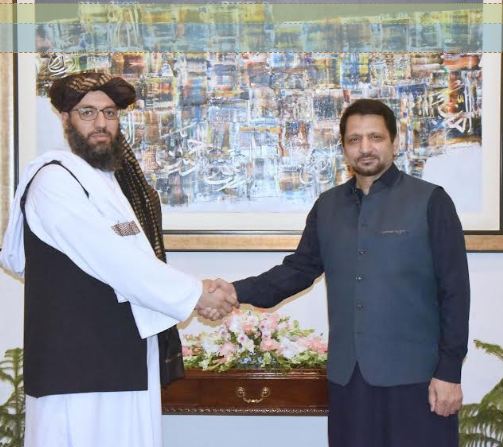
ISLAMABAD, JUL 7 /DNA/ – The inaugural round of the Additional Secretary-Level Mechanism between the Foreign Ministries of Pakistan and Afghanistan was held today in Islamabad pursuant to decisions reached during the visit of the Deputy Prime Minister/Foreign Minister of Pakistan to Kabul, Afghanistan, on 19 April 2025.
Pakistan side was led by Additional Secretary (Afghanistan & West Asia), Ambassador Syed Ali Asad Gillani, while the Afghan side was led by Director General, First Political Division at the Ministry of Foreign Affairs of Afghanistan, Mufti Noor Ahmad Noor.
Discussions covered key areas of bilateral interest, including trade and transit cooperation, security, and connectivity.
Both sides recognized terrorism as a serious threat to regional peace and security. The Pakistani side emphasized the need for concrete actions against terrorist groups operating on Afghan soil, noting that such groups undermine Pakistan’s security and hinder regional development.
The two sides exchanged views on deepening trade and transit cooperation. They reviewed the implementation status of measures announced during the visit of Deputy Prime Minister/Foreign Minister of Pakistan to Kabul for facilitating Afghan transit trade, including the removal of a 10% processing fee, provision of an insurance guarantee, reduction in scanning and examination, and operationalisation of the track and trace system.
They underlined the importance of enhanced regional connectivity as a catalyst for sustainable growth and shared prosperity. Noting the strategic significance of the Uzbekistan-Afghanistan-Pakistan Railway in that regard, they agreed to make concerted efforts towards the early finalisation of the Framework Agreement.
The two sides also discussed matters related to the repatriation of Afghan nationals. Pakistan side shared an overview of its efforts to facilitate documented travel from Afghanistan, notably through the issuance of over 500,000 visas since January 2024 to date across a range of categories such as medical, tourist, business, and study. Both sides agreed to work together to further strengthen the legal movement of individuals across borders.
Both sides reaffirmed their support for sustained engagement to address mutual challenges. They recognised lasting security as a cornerstone, for both the region’s optimal development as well as for further advancement of bilateral relations.
They decided to convene the next round of the Additional-Secretary talks at mutually convenient dates.
Pakistan Hosts Inaugural Round of Additional-Secretary Talks Between Pakistan and Afghanistan
Karachi Tragedy—a reflection of national apathy
Opinion
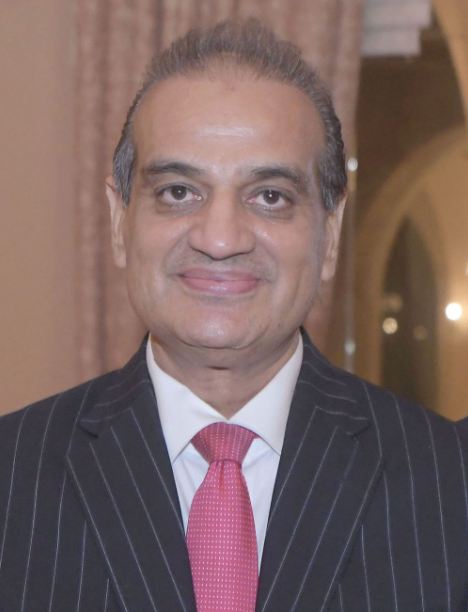
Ansar Mahmood Bhatti
On July 4, 2025, another tragedy has Karachi—a city that never sleeps, yet never seems to awaken from the nightmare of misgovernance and human suffering. People were yet trying to recover from the Swat River tragedy that also took many precious lives, the news came that a five-storey residential building collapsed like a house of cards, reducing concrete and steel to dust, and with it, burying precious human lives under the rubble. Mothers, children, elderly residents—people with dreams, memories, and hopes—were mercilessly crushed. And once again, all we are left with are rescue sirens, news flashes, hollow statements of sorrow, and the same old promise of “strict action” against those responsible.
This isn’t just the story of a building collapse; it’s the story of a system collapse. A collapse of values, governance, justice, and above all—humanity. This heart-wrenching incident speaks volumes for the sheer apathy of the concerned quarters. It screams of the poverty that shackles millions of Pakistanis, forcing them to live in crumbling, unlivable structures because they simply do not have a choice.
The truth is bitter and painful: People don’t live in such dangerous buildings by choice—they do so because poverty has left them with no options. They cannot afford repairs, renovations, or even relocation. Their rooms, their so-called homes, are more like ticking time bombs. And yet, nobody cares. There are no jobs. No opportunities. The wealth of this country remains concentrated in the hands of a select few, while the rest are left to struggle, to suffer, and to perish.
The Sindh government, as usual, remains absent when needed most. Corruption continues to rot the roots of every institution in the province. Reports abound of public funds being misused, siphoned off into the pockets of the powerful, leaving behind a trail of broken roads, overflowing gutters, and unsafe buildings. Accountability is a joke. Inspections are either never done, or signed off without a second glance. Everything is available for a price—even human life, it seems.
But let us not limit this tragedy to Sindh alone. This is the state of governance across the country. Pakistan as a whole is grappling with a systemic collapse. There is no mechanism in place to protect the common citizen. No one to listen to the cries of the poor. No government department that takes its duty as sacred. The entire structure of the state has been hijacked by individuals who are more interested in filling their own coffers than serving the people who elected them.
This country was meant to be a welfare state. An Islamic Republic, where the principles of justice, equality, and compassion were supposed to guide every policy and law. But look around—where is that vision? Where is the care for the weak, the protection for the vulnerable, the support for the broken?
In Pakistan today, the poor have no right to live, let alone dream. Their lives are expendable, their deaths mere statistics. If you are not part of the elite, the powerful, or the connected, then this country is not meant for you. It suits only the bigwigs—the untouchables who roam freely in their bulletproof vehicles, while the common man lies buried under concrete slabs.
We hear stories every day—of parents committing suicide after killing their own children because they can no longer feed them. Is this the land our founding fathers envisioned? Is this the state that was supposed to uphold the values of Islam, where helping the oppressed is a divine duty, and serving the people is an act of worship?
And yet, nobody fears God anymore. Nobody fears accountability—not in this life, nor the hereafter. Especially those in power. They act with impunity, as if they will live forever, as if there is no Day of Judgment. But there will be a day. A Day of Reckoning where each misdeed, each stolen rupee, each ignored cry for help will be brought to account. But for now, they continue to live in denial, mocking not just the people, but the very God they claim to serve.
For how long will this continue? For how long will the poor continue to suffer in silence? For how long will the corrupt thrive, while the helpless are buried under the weight of injustice? For how long will injustice be the rule and not the exception?
This tragedy in Karachi is not an isolated incident—it is a symptom of a much deeper disease. It reflects the moral decay of a nation that has forgotten its soul. A nation where human life has no value, and where suffering is just another news headline.
What we need is not just mourning and condemnation. We need a revolution of conscience. We need the rulers to remember their purpose—not to rule, but to serve. We need institutions that value human life. We need a media that doesn’t move on to the next story, but keeps asking the hard questions. And above all, we need citizens who hold the powerful accountable, who remember that silence in the face of injustice is complicity.
To the families who lost their loved ones in this tragedy, no words can ease your pain. But let this not be just another forgotten incident. Let this be a wake-up call. Let this be the moment where we as a nation say: Enough is enough.
Because if we continue to let the poor die like this—unnoticed, unprotected, uncared for—then we are all complicit in the crime. And we too, will have to answer one day—not just to history, but to God.
May God have mercy on the souls we lost. And may He awaken the dead conscience of those who still rule over the living.
PM directs NDMA, rescue teams to stay high alert
Saifullah Ansar
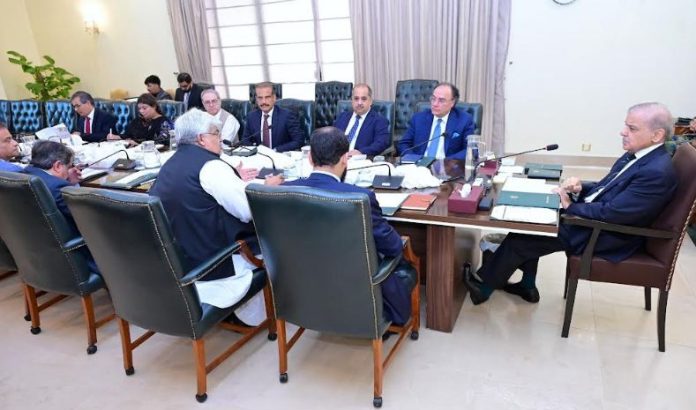
ISLAMABAD, Prime Minister Muhammad Shehbaz Sharif on Monday directed the National Disaster Management Authority (NDMA), rescue agencies, and administrative authorities to remain on high alert during the recent heavy rains and any potential emergency situations.
In anticipation of possible flooding in areas along the Indus River and other rivers, the prime minister has instructed the NDMA, rescue agencies, and administrative bodies to immediately implement safety measures and precautionary actions.
The prime minister directed the NDMA to strengthen coordination with the Provincial Disaster Management Authorities (PDMAs) for effectively dealing with the flood situation.
The NDMA has also been instructed to strengthen close coordination with provincial governments and other relevant institutions, a press statement issued by the PM Office said..
The prime minister directed the Pakistan Telecommunication Authority (PTA) to keep the public informed using all available means, providing accurate and real-time information.
He expressed concern that the operation of the Tarbela Dam spillways may increase flooding in the lower districts along the Indus River.
All provincial administrations have been directed to continue effective public awareness campaigns in view of the potential flood situation.
The National Emergency Operations Center (NEOC) has also been instructed to identify and clarify through the media, the areas that are vulnerable or less protected, where there is a risk of high, medium, or low-level flooding, so that the public can be warned in a timely manner.
The prime minister further directed that provincial administrations must be fully prepared in advance for any situation, and that the NDMA should ensure this preparedness.
Islamabad, Baghdad set to become sister cities as Iraq envoy meets CDA chairman
ISLAMABAD, Jul 07 (DNA): The Republic of Iraq and Pakistan are moving to formalize a sister city relationship between Baghdad and Islamabad in a step toward strengthening bilateral ties and fostering urban cooperation.
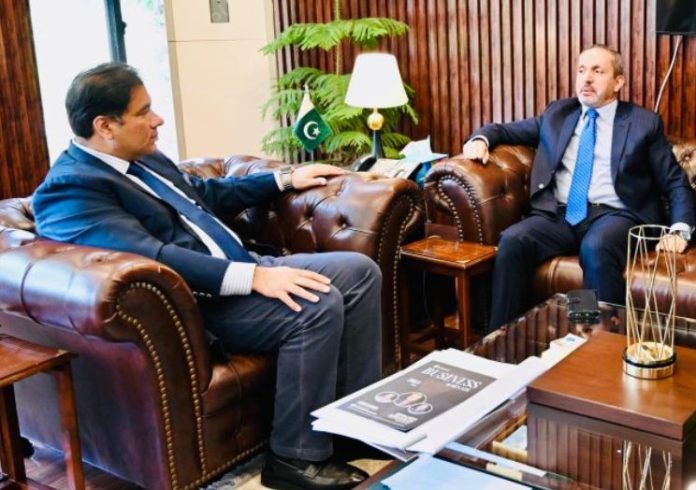
The announcement came during a meeting between Abdul Qadir Suleiman Al-Himeiri, Head of Mission at the Iraqi Embassy, and Muhammad Ali Randhawa, Chairman of the Capital Development Authority (CDA), and Chief Commissioner Islamabad on Monday.
Held at the CDA Headquarters, the meeting centered on enhancing collaboration in urban development, cultural exchange, and sustainable city planning.
The two sides agreed to sign a Memorandum of Understanding (MoU) to establish Baghdad and Islamabad as sister cities, paving the way for long-term cooperation in municipal management, infrastructure development, heritage conservation, and beautification of public spaces.
“This twinning arrangement is a significant step to deepen our cultural and urban linkages,” said Abdul Qadir Suleiman Al-Himeiri. “We are eager to share knowledge and explore joint initiatives that can strengthen economic, cultural, and tourism connections between Iraq and Pakistan.”
Chairman CDA Muhammad Ali Randhawa briefed the Iraqi envoy on Islamabad’s recent development initiatives, particularly the upgradation of the Diplomatic Enclave. “On the directions of Federal Interior Minister Mohsin Naqvi, we are working to modernize the enclave to meet international standards, transforming it into a secure and vibrant diplomatic hub,” Randhawa stated.
He added that renowned architects and landscaping professionals are being brought in to ensure the area reflects global standards of design and functionality.
The Iraqi ambassador commended these efforts and expressed his appreciation for the CDA’s commitment to enhancing the capital’s urban landscape.
The meeting, described as cordial and forward-looking, concluded with both sides reaffirming their intent to deepen institutional ties.
Randhawa presented a commemorative souvenir to Ambassador Al-Himeiri as a token of friendship, symbolizing the shared ambition of building a lasting partnership between the two nations.
“This initiative reflects Pakistan’s commitment to international cooperation rooted in mutual respect and shared goals,” Randhawa said, expressing optimism about the future of Islamabad-Baghdad collaboration.
Uzbekistan, Azerbaijan submit joint bid to host the FIFA U-20 World Cup

Uzbekistan and Azerbaijan have jointly submitted a bid to host the 2027 FIFA U-20 World Cup.
Tashkent, JUL 7 /DNA/ – According to the Uzbekistan Football Association, FIFA has officially begun reviewing bids for the hosting rights of the FIFA U-20 World Cup 2027. Taking into account the recent football reforms, infrastructure development, and growing international reputation of Turkic-speaking nations, the football associations of Uzbekistan and Azerbaijan have submitted a joint candidacy, expressing strong confidence in their ability to stage the tournament at the highest level.
Today, alongside Azerbaijan, Uzbekistan is fully prepared to host this prestigious tournament. In recent years, stadiums across the country have been upgraded to meet international standards. Additionally, the experience gained from hosting the AFC U-20 and U-23 tournaments, as well as the first-ever Futsal World Cup held in Central Asia, has laid a solid foundation. This futsal tournament was recognized by FIFA President Gianni Infantino as one of the best editions in the competition’s history.
As always, our nation stands ready to capture the world’s attention through its renowned hospitality, professional organization, deep passion for football, and, of course, the unwavering support of our dedicated.
COAS Munir dismisses India’s claim of Chinese war involvement
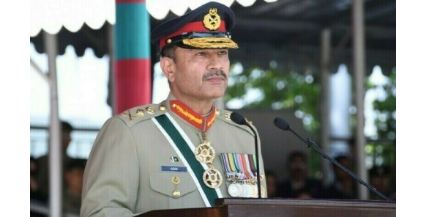
RAWALPINDI, JUL 7 /DNA/ – Chief of Army Staff (COAS) Field Marshal Asim Munir has dismissed India’s claim of Chinese assistance to Pakistan during the recent armed conflict between Islamabad and New Delhi as a “shoddy attempt at playing camp politics”.
“Naming other states as participants in the purely bilateral military conflagration is also a shoddy attempt at playing camp politics and desperately trying that India remains the beneficiary of larger geopolitical contestation as the so-called net security provider in a region,” COAS Munir said while addressing the graduating officers of the National Security and War Course at the National Defence University (NDU).
The army chief’s remark refers to claims made by the deputy chief of India’s army, who said that Beijing gave Islamabad “live inputs” on key Indian positions during the deadly conflict between two nuclear-armed neighbours in May.
India fought two adversaries during the conflict, with Pakistan being the “front face” while China provided “all possible support”, Lieutenant General Rahul Singh claimed at a defence industry event in New Delhi.
“When the DGMO (director general of military operations) level talks were going on, Pakistan … said that we know that your such and such important vector is primed and it is ready for action […] he was getting live inputs from China,” he claimed.
Regarding the possibility of China providing satellite imagery or other real-time intelligence, India’s chief of defence staff had said such imagery was commercially available and could have been procured from China or elsewhere.
Pakistani officials have previously dismissed allegations of receiving active support from China in the conflict.
His statement referred to the conflict that saw both countries using missiles, drones, and artillery fire during the four-day fighting —their worst in decades — triggered by an attack in April on Hindu tourists in Indian Illegally Occupied Jammu and Kashmir (IIOJK) that New Delhi blamed on Islamabad, before agreeing to a ceasefire. Pakistan has denied involvement in the attack.
Meanwhile in his address today, the field marshal noted that India’s inability to achieve its stated military objectives during Operation Sindoor — and the subsequent attempt to rationalize this shortfall through convoluted logic — speaks volumes about its lack of operational readiness and strategic foresight”.
“Insinuations regarding external support in Pakistan’s successful Operation Bunyan-um-Marsoos are irresponsible and factually incorrect and reflect a chronic reluctance to acknowledge indigenous capability and institutional resilience developed over decades of strategic prudence,” he added.
Highlighting India’s strategic behaviour resting on parochial self-alignment, the COAS stressed that Pakistan has forged lasting partnerships based on principled diplomacy, anchored in mutual respect and peace, establishing itself to be a stabilizer in the region.
He also retierated Islamabad’s “principled stance that any misadventure or attempts to undermine Pakistan’s sovereignty or violation of territorial integrity will continue to be reflexively met with a swift, and resolute response without any constraints or inhibitions”.
“Any attempt to target our population centres, military bases, economic hubs and ports will instantly invoke a ‘deeply hurting and more than reciprocal response,’ the army chief warned, adding: “The onus of escalation will squarely lie on the strategically blind arrogant aggressor who fails to see the grave repercussions of such provocative actions against a sovereign nuclear state”.
The army chief further remarked that wars are not won through media rhetoric, imported fancy hardware, or political sloganeering, but through faith, professional competence, operational clarity, institutional strength and national resolve.
Furthermore, highlighting the evolving character of warfare, he underscored the centrality of mental preparedness, operational clarity, and institutional professionalism in navigating complex strategic issues and lauded lauded the role of premier institutions like NDU in enhancing civil-military synergy and nurturing future leadership capable of mitigating hybrid, conventional, and sub-conventional threats with poise and resolve.
Urging the graduating officers to remain steadfast in the values of integrity, selfless service, and unwavering commitment to the nation, Field Marshal Munir expressed full confidence in the professionalism, morale, and readiness of the country’s battle hardened armed forces.
‘Rs40bn corruption’ revealed at NICVD

Two-member committee formed to probe audit report within 15 days
Monitoring Desk
KARACHI: A major financial irregularity worth Rs40 billion has been unearthed at the National Institute of Cardiovascular Diseases (NICVD) Karachi, according to the audit report of the Sindh Directorate General of Audit for the fiscal year 2023–24.
The report revealed alleged corruption at the prominent cardiac institute, prompting Sindh Health Minister Dr Azra Pechuho to take immediate notice, .
In response, she has ordered a formal inquiry and constituted a two-member committee to investigate the matter.
According to the official notification, the inquiry committee includes the Additional Secretary and Deputy Secretary of Health. The committee is tasked with submitting its findings within 15 days.
Meanwhile, the NICVD spokesperson has downplayed the development, saying that audit paras are a routine part of review processes for all government institutions.
“Observational reports from the Auditor General are standard and meant to improve financial transparency,” the spokesperson said.
Declaring these observations as conclusive evidence of corruption is premature, misleading, and contrary to facts, the spokesperson said, adding that presenting audit points without investigation or due process as financial misconduct is irresponsible.
The spokesperson further clarified that many of the audit observations in the 2023–24 report pertain to appointments and other issues from the years 2017 to 2018 — well before the current Executive Director assumed office in November 2023.
How Muslims Can Dismantle Israel’s War Machine
By Qamar Bashir
The Israel-Iran conflict has revealed a truth the Muslim world can no longer afford to ignore: Israel is not invincible. Without the shield of the United States, it is not the iron fortress it pretends to be—it is fragile, overstretched, and deeply dependent. But once wrapped in the diplomatic, military, and political embrace of Washington, Israel becomes a force few dare to challenge. It is not superior military strategy or moral high ground that sustains Israeli power—it is American sponsorship, bought and secured through decades of strategic manipulation.
No amount of resistance in Gaza, no fiery speech at the United Nations, no emotional outcry from the Muslim world will dismantle Israel’s machinery of oppression. Because that machine doesn’t run on Israeli fuel—it runs on Washington’s power grid: congressional endorsements, media narratives, think tanks, and corporate lobbying.
And Israel’s greatest tool to harness that power is AIPAC, the American Israel Public Affairs Committee—a political juggernaut that does not merely influence U.S. policy, it engineers it. With over $100 million spent in the 2024 elections alone, AIPAC and its Super PACs didn’t just promote pro-Israel candidates—they systematically crushed dissent, targeting Muslims, progressives, and even Jewish critics of Israeli apartheid. Through campaign donations, policy drafting, media alignment, and think tank funding, AIPAC ensures that support for Israel is not just bipartisan—it’s mandatory.
The irony is staggering. The U.S. sends Israel $3.8 billion in military aid annually. Israel uses that money to fund lobbying infrastructure that then cycles back into American politics, shaping public opinion and buying silence. This is not foreign policy—it is political laundering.
And yet, there is an even darker undercurrent to this influence—one rooted not just in money, but blackmail and coercion. That shadowy underside came dangerously close to exposure with the saga of Jeffrey Epstein.
Though widely branded as a disgraced financier and sex offender, Epstein’s real role was far more sinister. Backed by vast, unexplained wealth and cloaked in luxury, Epstein constructed an elite trap—an opulent web of yachts, villas, and underage girls designed not for personal pleasure alone, but for surveillance and leverage. Powerful politicians, industrialists, scientists, and media figures were lured in, indulged, and secretly recorded. His guest list included former presidents, royalty, billionaires, and lawmakers—many now suspiciously silent.
According to multiple intelligence reports and leaked sources, Epstein was an operative tied to Mossad, Israel’s elite spy agency. The data gathered—videos, images, confidential conversations—formed a cache of blackmail so extensive and so damning that it could paralyze the upper echelons of American power. Epstein’s mysterious death in custody—whether suicide or assassination—is widely believed to have been an effort to prevent those secrets from ever seeing daylight. What remains is a chilling reality: those files still exist—and they’re being weaponized by Mossad to control, blackmail, and compromise the very people entrusted with U.S. policymaking.
This is why every resolution at the UN demanding accountability for Israel is vetoed. Why every bomb dropped on a school in Gaza is whitewashed. Why every massacre is met with the same script: “Israel has a right to defend itself,” “Hamas uses human shields,” “It’s complicated.” These aren’t diplomatic statements—they are the product of manipulated consensus created by fear, funding, and in some cases, deep compromise.
The Muslim world’s response to this has been, at best, symbolic. Protests erupt. Speeches are delivered. Hashtags trend. But the facts on the ground remain unchanged. Gaza still burns. Settlements still grow. Aid convoys are still bombed into oblivion. Because the real battlefield is not Gaza—it’s Washington, D.C. And unless Muslims engage there—with the same precision, professionalism, and persistence as Israel—nothing will change.
This is not a call for violence. This is a call for strategy.
Muslims have failed to build a lobbying apparatus to challenge AIPAC’s grip on American power. Yet the resources are not lacking. The Gulf States alone manage over $2 trillion in sovereign wealth. Even a fraction—just $1 billion annually—could fund an American-staffed, data-driven, secular Muslim PAC, built not on sermons, but on strategy. Former lawmakers, PR experts, constitutional lawyers, media consultants, and think tanks could be mobilized to reshape the American narrative from within.
This would not be “interference.” It would be participation in democracy—the very kind Israel has perfected. It would fund candidates who support justice, oppose apartheid, and understand that human rights cannot be selective. It would challenge biased media through ownership and oversight. It would publish studies, mobilize communities, organize town halls, and train the next generation of Muslim American leaders to speak in the language Washington understands—policy and power.
Some will recoil at the idea of using money and lobbying to influence governance. But this is how the American system works. Corporate America lobbies. The gun industry lobbies. Big Pharma lobbies. Christians, Jews, Armenians, Cubans, Taiwanese—all have professional lobbying infrastructure. The only group that continues to shout from the outside is Muslims—and that isolation is costing innocent lives.
Now, cracks are forming in Israel’s carefully choreographed illusion. Western academics like Judith Butler and Pankaj Mishra are labeling Israeli policies as genocidal. Editorials in CNN, BBC, and even the New York Times have begun questioning Israel’s brutality. European parliaments are debating sanctions. Youth protests across American campuses are echoing the cries of “Free Palestine.” Even Jewish activists are joining the calls. And yet, despite all this growing unrest, nothing changes—because Israel still owns the power centers of the United States.
More disturbingly, Israeli thinkers now justify conquest with colonial analogies—likening the ethnic cleansing of Palestinians to the U.S. treatment of Native Americans or the British colonization of Africa. This isn’t just immoral—it’s legally and philosophically bankrupt. If colonial conquest is acceptable, so too is resistance—as enshrined in international law, the UN Charter, and the Geneva Conventions.
Palestinians, like Afghans before them, have the right to resist occupation. But until the machine enabling that occupation is dismantled, resistance alone will not prevail.
That machine is AIPAC. It is Epstein’s tapes. It is Mossad’s silent hand. And it is America’s refusal to confront its own corruption.
So here lies the choice for the Muslim world: keep protesting, or start investing. Stop reacting—and start shaping. Replace symbolic outrage with strategic influence. Build a Muslim AIPAC. Fund campaigns. Draft bills. Support honest media. Train candidates. Influence education. Enter the boardroom. Make standing for Palestine profitable and political suicide to oppose it.
Only when the cost of supporting Israel outweighs the benefits will the tide turn. And only then will the Palestinians find what they’ve long deserved—not pity, but power. Not charity, but justice. Not slogans, but sovereignty.
Because the war for Palestine will never be won with rockets from Rafah—but with policies from Capitol Hill. And the blueprint for victory does not lie in ancient grievances—it lies in Washington, D.C.
By Qamar Bashir
Press Secretary to the President (Rtd)
Former Press Minister, Embassy of Pakistan to France
Former MD, SRBC | Macomb, Michigan, USA
The Sound of Silence

Amina A Ghafoor
I recently attended a professional development event that brought together a diverse group of attendeesmen and women from various industries and backgrounds. At first glance, the gathering appeared to reflect progress: inclusion, diversity, and collaboration. However, what unfolded during the session left me disheartened and frustrated. It served as a reminder that while there is a visible respect for women in professional spaces, true inclusivity especially in practice still has a long way to go.
Unfortunately, the session was poorly planned. Although women were present in the audience, every activity, example, and interaction seemed designed exclusively with men in mind. From the outset, it was clear that no consideration had been given to creating an inclusive environment. As a woman in attendance, I felt not only excluded but deeply uncomfortable. The discomfort did not stem from being in the minority a familiar experience for many women in male-dominated fields like engineering but from the blatant disregard for gender sensitivity.
Throughout the session, patriarchal jokes were made, often at the expense of women. These were neither harmless nor humorous; they were offensive, tone-deaf, and entirely inappropriate for a professional setting. Even more disturbing was the casual manner in which they were delivered—and the laughter that followed from most of the male participants. The few women present—accomplished, experienced professionalswere visibly uneasy, their confidence evidently shaken. Some made efforts to engage, but gradually withdrew as the environment failed to foster equal participation. A handful of men noticed the imbalance and attempted to advocate for fairness and respect, but the dominant group, which appeared unwilling to examine its own behavior, quickly dismissed them directly or indirectly.
This experience was a powerful and painful reminder of why gender equity remains such a critical and urgent issue in our society, particularly in professional environments. In sectors like engineering and technology, where women remain significantly underrepresented, such experiences can be especially disheartening. They echo the early challenges many women face in their careers: often being the only woman in the room, constantly needing to prove their capabilities, working twice as hard for recognition, and confronting biases rooted not in merit, but in gender.
There is often hope that things are moving in the right direction that professional spaces are becoming more inclusive and equitable. Many individuals do actively foster such environments by mentoring young women, advocating for diversity, and ensuring all voices are heard and respected, regardless of gender. Yet, experiences like this serve as sobering reminders that progress is not as widespread as it may appear. The attitudes encountered are not isolated; they remain deeply embedded in professional culture.
What is most disheartening is realizing that many young women entering the workforce today continue to face the same challenges that previous generations encountered. Despite some areas of progress, the underlying structures of bias and inequality remain largely intact. This persistent reality is not only disappointing it is deeply discouraging.
We must understand that the gender gap cannot be closed through token gestures or one-time diversity initiatives. It requires sustained, systemic change. The first step toward that change is acknowledging the problem. Too often, concerns about gender bias are dismissed as exaggerated or irrelevant. But those of us who experience it know the reality all too well.
In societies like ours, where patriarchal norms are deeply entrenched, the burden of change cannot fall solely on women’s shoulders. Men especially those in leadership positions must become active participants in the movement toward gender equity. They must be willing to listen, to learn, and to challenge the behaviors and mindsets that perpetuate inequality.
Achieving gender equity is not just a matter of social justice it is an economic imperative. In a country grappling with economic instability, the exclusion of women from key industries and leadership roles is not only unjust but also inefficient. We cannot afford to overlook the contributions of half our population. When women are empowered to participate fully in the economy, societies thrive. Yet with the current slow pace of gender awareness and inclusivity, we are hindering our own development.
It is time to move beyond surface-level solutions and commit to deep, meaningful change. Gender awareness and sensitivity must be integrated across all sectors especially education, industry, and policy. Gender studies should be made a compulsory subject from school through university, just like religious studies. Early education plays a crucial role in shaping mindsets. Teaching children to value all genders equally helps lay the foundation for a society that not only upholds equality in principle but actively practices inclusivity and equity in everyday and professional life.
Beyond awareness, professional environments must turn intention into action by creating spaces where women are not only present but are genuinely included and supported. In fields like engineering and IT where gender disparities remain stark proactive measures are essential. Creating safe, inclusive, and equitable work environments, where all voices are heard and respected, should not be a mere policy statement it must become a cultural standard embedded in daily practice.
Of course, it is important to recognize that progress is being made. There are individuals and organizations actively working to close the gender gap, sometimes at great personal and professional cost. These trailblazers both women and men are our hope. Their efforts, though they may seem small in the grand scheme, matter. They create ripples that can eventually lead to waves of transformative change.And so, while this recent experience was disappointing, it also strengthened my resolve. I am reminded of why we must continue to speak up, even when it is uncomfortable. Why we must challenge the status quo, even when it resists. And why we must support one anotherespecially women just beginning their professional journeys.
One can hope for a future where no woman walks into a room and feels invisible, unheard, or out of place. A future where no young professional is made to question her abilities, diminish her presence, or conform to a space never designed to include her. A future where workplaces are not only diverse in numbers but inclusive in culture where leadership reflects the richness of different perspectives, and where policies are not performative but truly transformative. A future where respect, opportunity, and equity are not demands, but values inherently upheld.Those days are coming but only if we continue working toward them. Change doesn’t just happen. We build it together.
Amina A Ghafoor
Manager Sales Technical & Commercial-BEE, MSPM
IPS, ICRC host workshop on humanitarian journalism in Islamabad

ISLAMABAD, JUL 7 /DNA/ – Journalists play a critical role during emergencies, serving as both the eyes and ears of the public and the government. In times of natural disasters or violent conflicts, the dissemination of accurate and timely information can be life-saving. Journalists help guide humanitarian efforts, identify urgent needs, and monitor irregularities. To avoid misinformation during periods of chaos and uncertainty, it is essential for reporters and analysts to have a deep understanding of emergency dynamics.
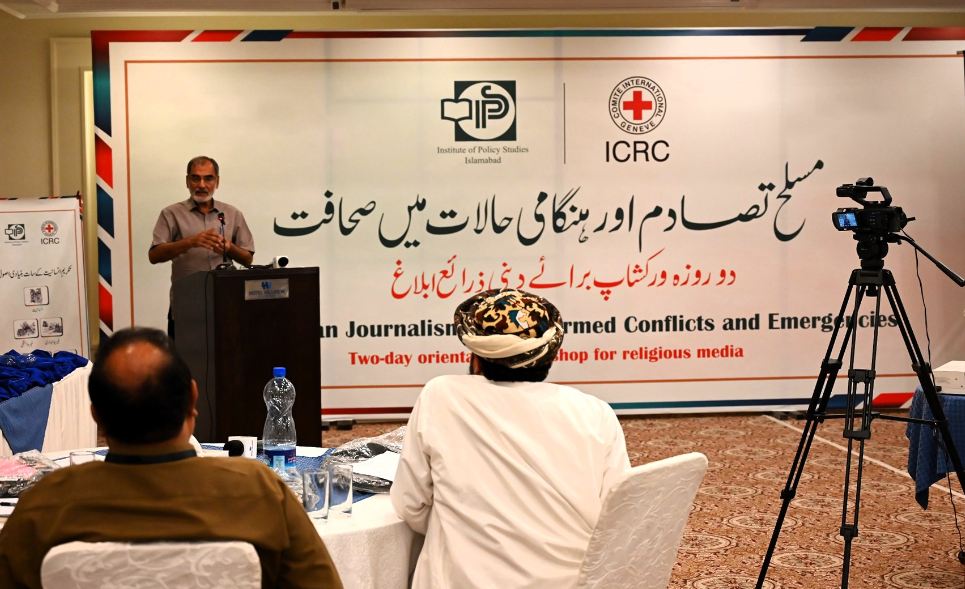
These points were emphasized during a two-day regional workshop for editors of religious journals and digital content creators. This media workshop was jointly organized by the Institute of Policy Studies (IPS), Islamabad, and the International Committee of the Red Cross (ICRC). The workshop aimed to equip participants with the knowledge and tools needed for effective reporting and analysis in the context of armed conflicts and humanitarian emergencies.
The sessions were led by Syed Nadeem Farhat, IPS research fellow, Dr. Ziaullah Rahmani, ICRC regional adviser, Dr. Yasir Riaz, a humanitarian officer at the United Nations, Muhammad Waqar Bhatti, senior health journalist, and Dr. Saqib Jawad, legal expert. The workshop concluded with remarks from ICRC Head of Delegation Christoph Sutter and IPS Chairman Khalid Rahman.
On the first day, the workshop focused on building the capacities of journalists and editors by introducing them to key aspects of humanitarian work. Topics included the evolving nature of human tragedies in the context of climate change and technological progress, the role of philanthropy and humanitarian organizations, relevant international laws, information-gathering strategies, and various types of crises. Drawing from personal field experiences, speakers stressed the importance of caution and empathy when reporting on human suffering and humanitarian emergencies.
The second day explored the core principles guiding humanitarian organizations – humanity, impartiality, neutrality, independence, volunteerism, universality, and unity. Through interactive sessions, including study circles and scenario-based role-playing exercises, participants received practical training on how to responsibly engage with humanitarian issues and play a constructive role in times of crisis.
In his closing remarks, Khalid Rahman highlighted the significant contributions of religiously motivated humanitarian workers during times of crisis. He noted, however, that a deeper understanding of the global humanitarian framework is essential for them to operate effectively within broader systems of aid and support.
Christoph Sutter emphasized the ICRC’s commitment to continue assisting the government and people of Pakistan in times of humanitarian crises and emergencies by equipping relevant stakeholders.