Home Blog Page 580

Qatar says ‘we will need time’ for Gaza accord

Qatar

Israel opposes an independent Palestinian state

Centreline Report

WASHINGTON:: Qatar has called for more time to finalize a Gaza ceasefire deal, urging all parties to show restraint and patience as negotiations enter a critical phase. A senior Qatari official, speaking to international media, said, “We are working tirelessly with all stakeholders. A sustainable ceasefire cannot be rushed—it must be just and lasting.”

Meanwhile, U.S. President Donald Trump has reportedly re-engaged with Middle East diplomacy, holding back-channel talks with regional figures to push for an immediate ceasefire. “We cannot allow more innocent lives to be lost,” Trump said in a brief statement.

At the same time, Israeli Prime Minister Benjamin Netanyahu has arrived in Washington for high-level talks with the Biden administration. The visit is seen as crucial amid growing international pressure on Israel to halt its ongoing military operations in Gaza, which have drawn condemnation for their humanitarian toll.

While some progress has been made, diplomats caution that key differences remain—particularly over prisoner exchanges and guarantees for long-term security.

As global calls for peace intensify, all eyes are now on Washington, Doha, and Tel Aviv in hopes that a breakthrough can be achieved in the coming days.

Meanwhile, Israel and Hamas did not achieve a breakthrough in their latest round of indirect talks on Tuesday in Doha for a Gaza ceasefire, a Palestinian official said.

“No breakthrough has been achieved so far, and the negotiations are ongoing,” the source close to the negotiations told AFP on the third day of talks aiming to bring an end to more than 21 months of war in the Palestinian territory.

Islamabad court orders to block 27 prominent YouTube channels over ‘anti-state content’

Islamabad court

YouTube channels allegedly involved in spreading material in violation of Peca and other relevant laws

ISLAMABAD, JUL 8: A local court in the federal capital on Tuesday ordered the blocking of 27 prominent YouTube channels for allegedly sharing content deemed anti-state.

The order was issued by Islamabad’s Judicial Magistrate Abbas Shah on the request of the Federal Investigation Agency (FIA).

According to the court order, the FIA’s Cyber Crime Wing initiated an inquiry into the matter on June 2, 2025.

During the course of the investigation, the agency identified multiple YouTube channels allegedly involved in uploading and spreading material in violation of the Prevention of Electronic Crimes Act (Peca) and other relevant laws.

The court noted: “In the light of facts explained and evidence presented by the enquiry officer, this court is convinced that the subject matter constitutes offences punishable under the Prevention of Electronic Crimes Act and Penal Laws of Pakistan.”

The court said it was satisfied with the evidence submitted by the FIA and permitted legal action in accordance with the law.

As per the written order, the head or officer in-charge of the security department or custodian of records of Google LLC (YouTube) has been directed to block or remove access to the 27 identified YouTube channels.

The directive was issued on FIA’s plea filed under Section 94 of the Criminal Procedure Code.

It may be noted that the contentious Prevention of Electronic Crimes (Peca) (Amendment) Bill 2025 was signed into a law in January, with new definitions, the establishment of regulatory and investigative bodies, and stricter penalties for disseminating “false” information.

According to the Peca 2025, any person “aggrieved by fake and false information” can approach the authority for removal or blocking access to such information and the authority would issue orders no later than 24 hours on the request.

The legislation was met with strong opposition from the rival parties of the ruling coalition as well as journalists and media bodies under the umbrella of the Joint Action Committee (JAC).

A report released by the Human Rights Commission of Pakistan (HRCP) also underscored serious flaws in the Peca (Amendment) Act 2025 and called for the law to be repealed entirely without accepting any coercive application of the law’s previous iterations from 2016 and 2023.

Two journalists, Farhan Mallick and Waheed Murad, were also arrested under the newly adopted law earlier this year.

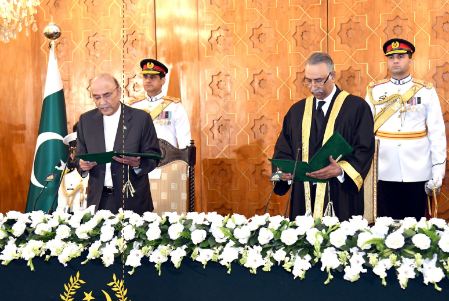
President Zardari to shortly administer oath to Justice Sardar Sarfraz Dogar

President

ISLAMABAD, JUL 8 /DNA/ – President Asif Ali Zardari will shortly administer the oath of office to Mr. Justice Sardar Muhammad Sarfraz Dogar as the Chief Justice of Islamabad High Court. PTV will telecast the proceedings live. All media outlets are requested to air the ceremony live.


Akhtar Munir: President Asif Ali Zardari administering the oath of office to Mr. Justice Sardar Muhammad Sarfraz Dogar as the Chief Justice of Islamabad High Court,at Awan-e-Sadr, on 8th July, 2025.

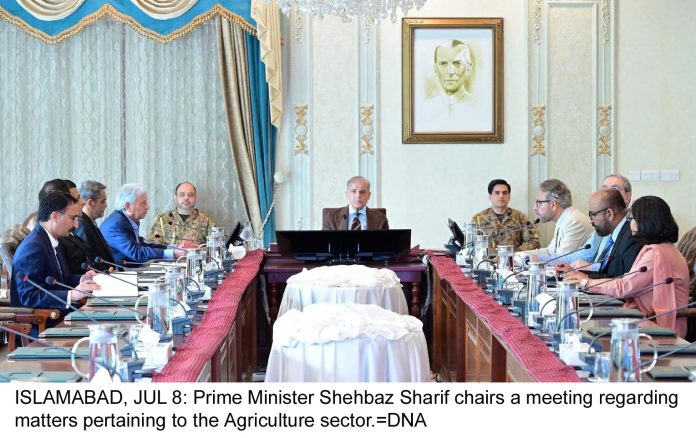
PM calls of comprehensive action plan to boost agri production

PM calls of comprehensive action plan to boost agri production
ISLAMABAD, JUL 8: Prime Minister Shehbaz Sharif chairs a meeting regarding matters pertaining to the Agriculture sector.=DNA

ISLAMABAD, JUL 8 (DNA): Prime Minister Shehbaz Sharif on Tuesday asked the relevant authorities to present a comprehensive action plan to boost agricultural production and introduce agriculture reforms in the country.

He was chairing a review meeting on the performance of the agriculture sector and ongoing reforms.

“Improving agricultural productivity, value addition, and increasing exports of agricultural products are top priorities of the government,” the prime minister said.

He directed that a comprehensive short- and long-term action plan be presented for modern agricultural machinery, quality seeds, geographical planning of crops, and provision of easy loans to farmers.

To enhance per-acre crop yield, the prime minister directed that agricultural research centers be made more effective.

He further directed that modern research be ensured through public-private partnerships in agricultural research centers.

The prime minister emphasized that the government should benefit from internationally renowned experts for the effective use of artificial intelligence and modern technology in agriculture.

He also instructed that an action plan be presented for the development of small and medium-sized agro-industries to enable the value addition of agricultural commodities and enhance export-ready products.

To promote cultivation of profitable crops and make Pakistan self-sufficient in food security, the prime minister directed that all necessary guidance and support be provided to farmers.

He stressed the importance of consultation with farmers and other stakeholders for policy recommendations.

The prime minister emphasized the need to strengthen coordination and cooperation with provincial governments for agricultural development.

To mitigate the adverse effects of climate change, he directed assistance for farmers in adopting climate-resistant seeds and modern farming methods.

Keeping in view changing rainfall patterns and other climatic shifts, the prime minister directed that after detailed consultation with provincial governments, especially in Sindh and Balochistan, a comprehensive plan for cotton cultivation in new suitable areas be prepared.

He also called for research and planning to incorporate biofuels into the country’s energy mix.

During the briefing, the meeting was told about the production of major and Kharif crops from the previous year, challenges faced by farmers, the proposed future roadmap, and suggestions for improvements.

The meeting was also briefed about the progress on the implementation of government reforms, and the impact of climate change on agriculture.

The prime minister directed that a comprehensive action plan for further agricultural reforms be presented soon.

Federal Minister for National Food Security Rana Tanveer, agricultural experts, and senior relevant officials attended the meeting.=DNA

The United Nations: a toothless tiger

The United Nations: a toothless tiger

The United Nations (UN) was founded in 1945 with the noble aim of maintaining international peace and security. Yet, nearly eight decades later, the organization stands as a shadow of its original vision—paralyzed by geopolitical rivalries, held hostage by veto-wielding powers, and rendered increasingly irrelevant in resolving the world’s most pressing conflicts. From the Israel-Iran tensions to the Gaza crisis, the Kashmir dispute, and the endless infighting in Africa, the UN has failed to act as an effective mediator. The Secretary-General, instead of being a moral authority, has been reduced to a helpless figurehead whose pleas for peace are ignored by warring nations and powerful Security Council members alike. If the UN can no longer fulfill its primary mandate, then it is time to ask: What is its purpose?

The fundamental problem with the UN lies in its structure. The Security Council’s five permanent members (P5)—the United States, Russia, China, France, and the United Kingdom—hold veto power, allowing any one of them to block resolutions that threaten their interests. This has turned the UN into a battleground for great power politics rather than a platform for conflict resolution.

The ongoing humanitarian catastrophe in Gaza is a glaring example of the UN’s impotence. Despite overwhelming global condemnation of Israel’s military actions, the US has repeatedly vetoed ceasefire resolutions, shielding its ally from accountability. The Secretary-General’s appeals for restraint are dismissed, and UN agencies like UNRWA are defunded and demonized. If the UN cannot even enforce its own humanitarian principles when a nuclear-armed state flouts international law, then what good is it?

The recent exchange of missile strikes between Israel and Iran further exposed the UN’s irrelevance. Rather than mediating de-escalation, the Security Council remained deadlocked, with Western powers backing Israel and Russia and China refusing to take a strong stance. The Secretary-General’s calls for restraint were ignored, proving that the UN has no real authority when major powers are involved.

The Kashmir dispute between India and Pakistan has been on the UN agenda since 1948, yet no meaningful progress has been made. India dismisses UN resolutions as outdated, while Pakistan uses them for rhetorical leverage. The UN’s failure to enforce its own mandates has left Kashmiris trapped in a cycle of violence and repression. If the organization cannot even facilitate dialogue after 75 years, why does it still pretend to care?

From Sudan to the Democratic Republic of Congo, Somalia to the Sahel, Africa remains a hotbed of conflict. The UN’s peacekeeping missions (MONUSCO, MINUSMA, etc.) have been criticized for inefficiency, corruption, and even complicity in abuses. The Security Council pays lip service to African crises but refuses to authorize robust interventions when they do not align with Western or Russian interests.

The current Secretary-General, António Guterres, has become a symbol of the UN’s impotence. His statements on Gaza, Ukraine, and other conflicts are met with indifference. When he invoked Article 99 of the UN Charter to force attention on Gaza, the Security Council barely reacted. If the UN’s top diplomat cannot influence world events, why does the position still exist?

Guterres should have resigned long ago—not out of cowardice, but as a moral statement. By staying, he legitimizes a broken system. A resignation would force the world to confront the UN’s failures. But like the organization he leads, he seems content with symbolic gestures rather than real change.

The harsh truth is that the UN is no longer a neutral arbiter—it is a tool of the P5, especially the US. Washington uses the UN to sanction its enemies (Iran, North Korea, Venezuela) while shielding its allies (Israel, Saudi Arabia). Russia and China do the same, vetoing resolutions on Syria and Myanmar. The General Assembly’s votes are non-binding, and the International Court of Justice’s rulings are ignored when inconvenient (e.g., US sanctions on Nicaragua, Israel’s occupation of Palestine).

For smaller nations, the UN provides a platform to voice grievances, but that is all. For the powerful, it is a stage to perform diplomacy while acting unilaterally behind the scenes. The UN’s agencies (WHO, UNICEF, UNHCR) still do vital humanitarian work, but its political role is fading.

The UN has two options: radical reform or dignified dissolution.

Abolish the Veto: The P5’s veto power is the root of the UN’s paralysis. Either remove it or expand permanent membership to include Africa, Latin America, and more Asian representation.

Empower the General Assembly: Make its resolutions binding, at least on non-security issues.

Strengthen the Secretary-General’s Role: Give the office real enforcement powers, not just moral pleas.

Alternative Alliances: If reform is impossible, nations should consider regional blocs (AU, ASEAN, OIC) as alternative peacekeeping bodies.

If none of this happens, the UN will continue its slow decline into irrelevance—a talking shop for diplomats while bombs fall on Gaza, Kashmir, and Sudan. The Secretary-General should either demand real change or step aside. The world no longer has time for empty gestures.

The choice is clear: The UN must reclaim its purpose or admit it has none.

Bulgaria to adopt euro in 2026

Bulgaria to adopt euro in 2026

Brussels, Belgium, July 8 (AFP/APP/DNA):EU ministers are set to give the final green light on Tuesday for Bulgaria to adopt the euro on January 1, 2026, when the country would become the single currency area’s 21st member.

                  The European Commission last month said the EU’s poorest country had fulfilled the strict conditions to adopt the euro, while the European Central Bank (ECB) also gave a positive opinion.

                  Bulgaria’s switch from the lev to the euro next year will come 19 years after the country of 6.4 million people joined the European Union.

                  “Today is truly an important day for Bulgaria. We are on the verge of achieving a strategic goal for our country,” Finance Minister Temenuzhka Petkova said before her EU counterparts met in Brussels.

                  Bulgaria’s journey to joining the eurozone has had a stormy political backdrop with seven elections in three years — the last in October 2024.

                  Its bid will be formally approved by EU finance ministers once they adopt the legal texts necessary for the historic move.

                  “(This) is obviously a historical day for Bulgaria, so congratulations,” EU economy commissioner Valdis Dombrovskis told reporters in Brussels.

                  “It’s also a good day, I would say, for Eurogroup and eurozone as a whole, as that strengthens and enlarges the eurozone,” he added.

                  But recent polls show Bulgarian society remains divided on the euro, with experts attributing the scepticism largely to fears of rising prices and declining purchasing power.

                  President Rumen Radev shocked many when he proposed holding a referendum on the matter but that was given short shrift by the Bulgarian parliament.

                  Since June, protesters have gathered in Sofia to call for “keeping the Bulgarian lev”. A symbolic protest camp with several tents has been set up near the presidency and the Bulgarian National Bank in the capital.

                  Far-right opposition parties have used the issue to promote anti-EU narratives.

                  Proponents in Bulgaria, however, insist the move will help improve the country’s economy, and reinforce its ties to the West and protect against Russia’s influence.

                  “The political benefits are becoming increasingly significant, as the protests against the euro seem to bear the mark of the Kremlin,” 43-year-old musician Veselin Dimitrov told AFP in Sofia.

ASEAN envoys meet DPM Dar ahead of ARF ministerial meeting

ASEAN envoys meet DPM Dar ahead of ARF ministerial meeting

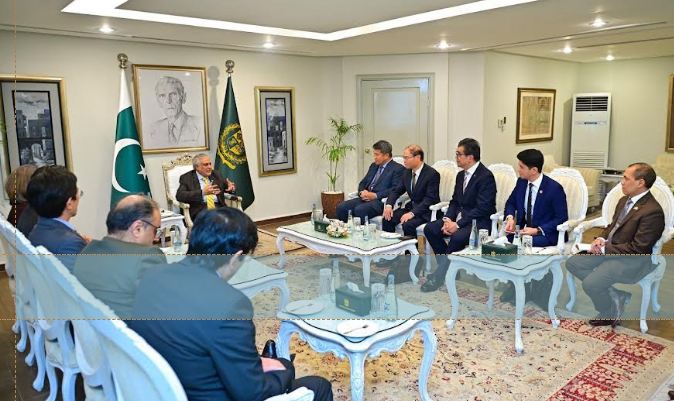
ISLAMABAD, JUL 8 /DNA/ – ASEAN Heads of Missions in Pakistan including Myanmar, Brunei Darussalam, Vietnam, Thailand, Philippines, Malaysia, and Indonesia called on the Deputy Prime Minister/Foreign Minister, Senator Mohammad Ishaq Dar @MIshaqDar50 ahead of his participation in the 32nd ARF Ministerial Meeting later this week.

They reaffirmed the importance of Pakistan’s partnership with ASEAN and its member states.

Acknowledging strong Pak-ASEAN cooperation, the DPM/FM underscored the potential to further deepen ties across diverse areas including trade, tourism, connectivity, IT, and education.

Crackdown against Hawala, counterfeit medicine ordered

Crackdown against Hawala

The Interior Minister stressed that counterfeit medicine trade is completely unacceptable and that those involved must be dealt with iron hands, as their rightful place is jail

DNA

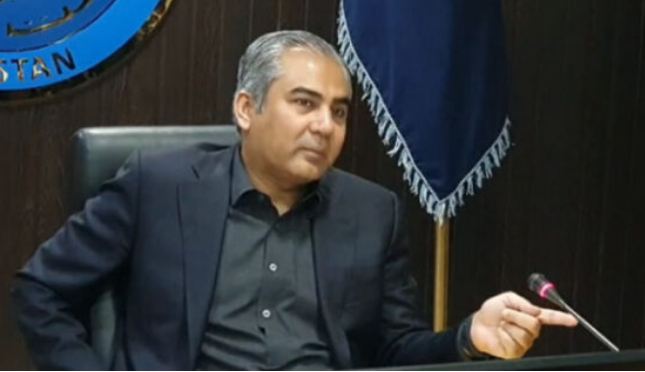
ISLAMABAD, JUL 8: Federal Interior Minister Mohsin Naqvi visited FIA Karachi Zone and chaired a high-level meeting. He ordered an effective crackdown against the Hawala-Hundi mafia and emphasized action against major hands involved in it, without yielding to any pressure.

Interior Minister also directed action against agents sending beggars abroad, stating that the beggar mafia is tarnishing Pakistan’s image and indiscriminate  action against them is necessary. He instructed the arrest of absconding agents with the help of other provinces and to ensure the arrest of deported beggars.

The Interior Minister stressed that counterfeit medicine trade is completely unacceptable and that those involved must be dealt with iron hands, as their rightful place is jail.

Mohsin Naqvi also ordered strong action against non-custom products and directed strict legal action against passengers attempting to take more than 5,000 dollars abroad.

Director Karachi Zone Nauman Siddiq briefed Interior Minister Mohsin Naqvi on the FIA Karachi Zone’s performance and ongoing issues. The meeting was attended by Additional DG FIA South Mujahid Akbar Khan, Director FIA Karachi Zone Nauman Siddiq, Deputy Director Anti-Money Laundering, Deputy Director Immigration, Deputy Director Anti-Corruption, all Assistant Directors, and officials from FIA South.

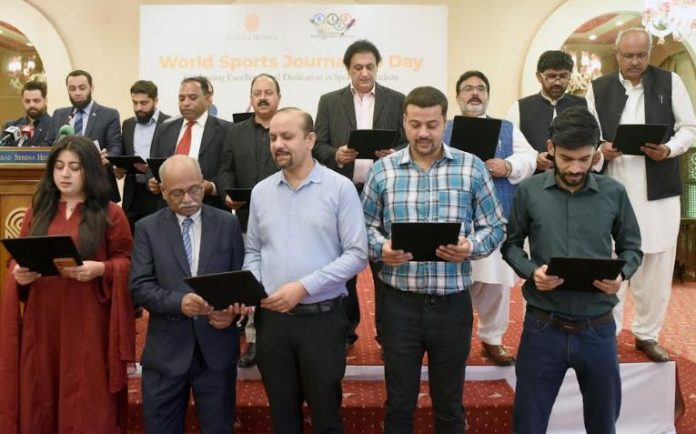
Tarar praises sports journalists as pillars of sporting spirit

Tarar praises sports journalists as pillars of sporting spirit

The minister made these remarks while addressing a ceremony held in connection with World Sports Journalists Day and the Oath-Taking Ceremony of the Rawalpindi-Islamabad Sports Journalists Association (RISJA).

ANSAR BHATTI

ISLAMABAD, JUL 8 /DNA/ – Federal Minister for Information and Broadcasting, Attaullah Tarar, has lauded the role of sports journalists as the backbone of Pakistan’s sporting culture, calling them true ambassadors of the nation on the global stage. He praised their tireless efforts in promoting sports and assured that the government will extend its full support to amplify their work and visibility.

The minister made these remarks while addressing a ceremony held in connection with World Sports Journalists Day and the Oath-Taking Ceremony of the Rawalpindi-Islamabad Sports Journalists Association (RISJA). The event, organized with the support of Serena Hotels, was attended by an esteemed lineup of guests including CEO Serena Hotels Aziz Boolani, Olympian Shahbaz Senior, Olympian Sadaf Siddiqui, boxer Usman Wazeer, PFUJ President Afzal Butt, National Press Club Secretary Nayyar Ali, Finance Secretary Waqar Abbasi, senior journalist Aliya Rasheed, and office-bearers from various sports bodies, associations and media organizations.

Tarar highlighted that sports journalists have been a source of hope and recognition for countless athletes, helping them rise to national and international prominence. “Without sports journalists, the public’s interest in competitions would have diminished. Their contribution to promoting sports is truly commendable,” he said. He further acknowledged their role in showcasing talent, fostering sportsmanship, and energizing the spirit of healthy competition across the country.

“I salute the sports journalists of Pakistan,” he added. “Our international sporting achievements owe much to their dedication. Whatever support is required—from coverage to promotion—the government will provide it. We are committed to going the extra mile to stand with them.”

Thanking Serena Hotels for hosting the event, the minister appreciated its ongoing contribution to sports through the Sports Diplomacy initiative. He emphasized that such public-private collaborations are vital for strengthening Pakistan’s sports infrastructure and global visibility.

Speaking on the occasion, Aziz Boolani, CEO of Serena Hotels, underlined the importance of nurturing sports and youth talent in Pakistan. “Our athletes are immensely gifted, and they deserve our full backing to raise Pakistan’s flag high globally,” he said.

Reiterating Serena’s long-term commitment to sports, Boolani added, “Through our Sports Diplomacy initiative, we will continue to support all forms of sports by providing platforms for both athletes and journalists.”

During the ceremony, Minister Attaullah Tarar also administered the oath to RISJA’s newly elected office-bearers. PFUJ President Afzal Butt, NPC Secretary Nayyar Ali, RISJA President Abu Bakar bin Talat, Patron Abdul Mohi Shah, and Chairman Shakeel Awan also addressed the gathering, highlighting the vital role of sports journalism in promoting a positive image of Pakistan.=DNA

‘TTP a global threat’: Pakistan warns UN of Afghanistan becoming breeding ground for terror

TTP

ISLAMABAD, JUL 8: In light of recent attacks by Afghanistan-based terrorists, Pakistan has urged the United Nations to prevent the war-torn country from becoming a hub for terror, while terming the Tehreek-e-Taliban Pakistan (TTP) a global and regional threat.

“We must ensure that Afghanistan does not become a breeding ground for terrorists that threatens not only its neighbours, but the region and beyond,” Pakistan’s Permanent Ambassador to the UN Asim Iftikhar Ahmad said while addressing a UN General Assembly’s plenary session on the situation in Afghanistan.

The ambassador’s remarks echo Pakistan’s repeated stance against the use of Afghan soil by terror outfits to carry out attacks.

Last week, the security forces eliminated at least 30 Indian-backed terrorists trying to infiltrate through the Pakistan-Afghanistan border in Khyber-Pakhtunkhwa’s North Waziristan district.

Pakistan has witnessed a surge in cross-border terror incidents since Taliban rulers returned to Afghanistan in 2021, particularly in the bordering provinces of Khyber Pakhtunkhwa and Balochistan.

The country saw a slight uptick in militant attacks in May 2025, even as heightened military tensions with neighbouring India failed to trigger a significant escalation in violence from extremist groups.

A day earlier, the two countries held the inaugural round of the additional secretary-level mechanism between the foreign ministries in Islamabad, with the two sides covering key areas of bilateral interest, including trade and transit cooperation, security, and connectivity. Both sides recognised terrorism as a serious threat to regional peace and security.

During the huddle, the Pakistani side emphasised the need for concrete actions against terrorist groups operating on Afghan soil, noting that such groups undermine Pakistan’s security and hinder regional development.

Expanding on the terror threat posed by groups from Afghanistan, Ambassador Iftikhar said that terrorism emanating from Afghanistan was a serious threat to the neighbouring countries, particularly Pakistan.

“Daesh continues to target the de facto authorities while other terrorist entities including Al-Qaeda, the TTP, and the Baloch militant groups, continue to operate from ungoverned spaces in Afghanistan.”

“Afghanistan must not become a safe haven for terrorism against any other country,” the envoy remarked while further highlighting that TTP, with around 6,000 fighters, remained the largest UN-designated terrorist group operating from Afghan soil.

“With cross-recruitment between various terrorist groups, including the TTP and Daesh, the TTP poses a threat not only to our national security but the region and the world,” the diplomat warned.

While lamenting continued attempts to transgress Pak-Afghan borders, the ambassador further accentuated the use of modern weapons, ammunition and sophisticated equipment by terrorists “to launch increasingly sophisticated attacks against Pakistan, including in the last two weeks”.

“These incidents underscore the scale and seriousness of the threat we face. Pakistan will continue to take all possible action to ensure the safety and security of its people.

“We also have credible evidence of collaboration between the TTP and other groups, such as the Balochistan Liberation Army (BLA) and Majeed Brigade, aimed at disrupting strategic infrastructure and economic development projects in Pakistan,” he said.

“Regrettably, Afghan soil also continues to be used by terrorists, often proxies, against other countries, particularly Pakistan,” the envoy added.

‘Afghanistan’s problems directly impact us’
Highlighting that Afghanistan’s problems directly impacted Pakistan, the ambassador said that the country hosted millions of Afghans for decades and continued to protect vulnerable Afghans despite its limitations.

“Since August 2021, an additional one million undocumented individuals crossed into Pakistan, creating among other issues, law-and-order concerns. The international community in our view must share this burden more equitably,” he noted while stressed the need for the revival of Afghan economy economy and banking system, including unfreezing of financial assets, and to enable trade and investment.

“Pakistan is committed to expanding trade and pursuing regional connectivity initiatives such as TAPI, CASA-1000, Uzbekistan-Afghanistan-Pakistan railway and extension of the CPEC to Afghanistan, that can contribute immensely to development and peace in Afghanistan and the region.

“For the first time in more than four decades, we have seen an end to fighting in Afghanistan. It has been nearly four years since the Taliban takeover. There is renewed hope for a better future for an Afghanistan at peace with itself, its neighbours and the international community.

“An Afghanistan which respects and nurtures all Afghans, regardless of considerations of gender, ethnicity, political affiliation or religion and a prosperous Afghanistan free from terrorism; fully integrated into the international community,” he concluded while stressing that Afghanistan must not be abandoned and that practical and pragmatic engagement through dialogue and diplomacy was the only way forward.

Stay Connected

64FansLike
60FollowersFollow

Latest Reviews

Exchange Rates

USD - United States Dollar
EUR
1.17
GBP
1.35
AUD
0.72
CAD
0.73