Home Blog Page 569

Tarar requests IHC to restore SRBC for employees sake

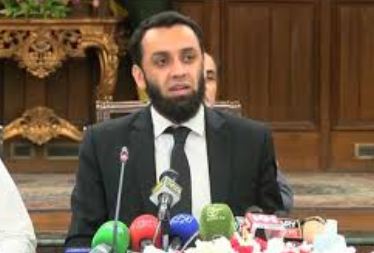
Federal Minister for Information and Broadcasting Attaullah Tarar

Attaullah Tarar said a previous government caused billions of rupees of losses to Pakistan International Airlines by making irresponsible statements

ISLAMABAD, Jul 18 (DNA): Federal  Minister for Information and Broadcasting Attaullah Tarar said on Friday that he had requested the Islamabad High Court (IHC) to restore Shalimar Recording and Broadcasting Company.

Talking to the media outside the Islamabad High Court, he said that he had presented his position in the court.

He said the process of SRBC liquidation had started much before he assumed office as Minister for Information and Broadcasting.

“The company has more than 300 employees, it is necessary to restore the company to protect their jobs,” Attaullah Tarar remarked.

The court has issued orders to submit a business plan, Tarar said, adding it has also directed the liquidator to pay the salaries of the SRBC employees.

Attaullah Tarar said a previous government caused billions of rupees of losses to Pakistan International Airlines by making irresponsible statements.

He said by the grace of God that PIA flights to Europe and the UK have been restored due to the efforts of the present government.

He said that Pakistani airlines’ flights to Europe were being restored in the Pakistan Muslim League-Nawaz era.

To a question, he replied that incompetence was at its peak in Khyber Pakhtunkhwa.

“Corruption, mismanagement are on the rise in the Khyber Pakhtunkhwa government,” Attaullah opined.

The minister said the PTI government in Khyber Pakhtunkhwa could not save the tourists stranded in the Swat River due to rampant corruption and inefficiency.

America’s Sanctions Spiral

Qamar Bashir

By Qamar Bashir

In a world already teetering on the edge of conflict, the United States’ expanding use of sanctions has taken a dangerous and unprecedented turn. What began as a tool to deter rogue actors has now become a blunt instrument of coercion—wielded not only against adversarial governments and corporations, but shockingly, against international institutions and even human rights defenders. This shift signals a collapse of diplomatic norms and a troubling rise in unilateral aggression cloaked under the guise of legality.

The recent imposition of U.S. sanctions on Francesca Albanese, the United Nations Special Rapporteur on Human Rights in the Occupied Palestinian Territories, illustrates the depth of this crisis. Her sole offense was the publication of meticulously documented reports that highlighted Israeli war crimes in Gaza and the West Bank. Her findings contributed to the International Criminal Court’s issuance of arrest warrants against Israeli Prime Minister Benjamin Netanyahu and Defense Minister Yoav Gallant for crimes against humanity and ethnic cleansing. Rather than supporting these legal processes, the United States retaliated—not against the alleged perpetrators, but against those seeking justice.

Albanese’s case, though emblematic, is not isolated. The U.S. has gone further to impose sanctions on the very judges and prosecutors of the ICC—targeting those who dared to uphold international law. These punitive actions are not based on evidence of wrongdoing but on the political inconvenience such accountability brings to America’s closest allies.

This pattern reveals a deeper flaw in American foreign policy. Sanctions are no longer tools of last resort; they have become the default mechanism when diplomacy, negotiation, and international consensus fail to align with Washington’s interests. What’s more disturbing is the arbitrary and often whimsical application of these measures, guided not by global justice but by strategic alignment—especially with Israel.

The history is long and revealing. Russian President Vladimir Putin has faced personal sanctions since 2014, intensified after the invasion of Ukraine. Venezuelan President Nicolás Maduro, accused of corruption and democratic erosion, has been subjected to sweeping sanctions. Former Iraqi President Saddam Hussein and Libyan leader Muammar Gaddafi were first sanctioned, then militarily removed. Iran’s leaders, Syria’s officials, North Korean diplomats, and even Afghan institutions have all found themselves targeted by America’s economic arsenal.

But the reach doesn’t stop with political figures. Business tycoons like Russian oil magnate Gennady Timchenko, Zimbabwe’s Kudakwashe Tagwirei, and Iranian frontmen like Elyas Nirumand Tumaj have been blacklisted. Global firms—Chinese tech giant Huawei, Iranian and Venezuelan oil companies, and even Swiss-based intermediaries—have seen their operations strangled under U.S. directives. Sanctions have cut off access to financial systems, disrupted supply chains, and destroyed livelihoods across continents.

Even entire nations reel under U.S. economic siege. Iran, Venezuela, Syria, North Korea, Russia, and Afghanistan face restrictions that devastate their economies and isolate their populations. China, while not under full-spectrum sanctions, endures targeted restrictions on its semiconductor, telecom, and defense sectors. Sectoral bans and export controls are calibrated not for security but to contain rivals and maintain technological dominance.

The hypocrisy is staggering. The U.S.—self-proclaimed guardian of democracy—has sanctioned a UN official for defending human rights, judges for enforcing international law, and students for exercising free speech. During Congressional hearings, Senator Marco Rubio chillingly defended the arrests of university students protesting Israeli actions in Gaza. He declared bluntly that “whoever opposes Israel or demonstrates against it will be dealt with.” Protesters have been arrested by masked agents. Faculty members supporting them have been fired. Even academic institutions are facing punitive funding cuts—transforming universities into battlegrounds for political conformity.

This crackdown directly contradicts the First Amendment of the U.S. Constitution, which guarantees freedom of speech, expression, and peaceful assembly. By criminalizing dissent, particularly when it challenges Israeli policies, the United States reveals the depth of its subservience to foreign agendas. It is no longer just international justice that is under assault—it is the American soul itself.

This obsessive alignment with Israel, particularly under Netanyahu’s leadership, is the common thread linking many of these punitive actions. Whether in Libya, Iraq, Syria, or Iran, nearly every military or economic intervention by the U.S. over the past two decades has mirrored the strategic calculus of Tel Aviv. Any regime perceived as hostile to Israeli dominance is painted as an existential threat—and then systematically undermined through sanctions, subversion, or war.

Netanyahu has made no effort to hide his ambitions. By turning Gaza into a killing field and ignoring every international plea, Israel has openly defied the United Nations, the Muslim world, and even U.S. public opinion. His administration’s policies, grounded in racial supremacy and territorial expansion, have reduced Palestinian territories to rubble, desecrated the very notion of international law, and created a humanitarian catastrophe that history will not forget.

And yet, rather than restraining these excesses, the U.S. has become their chief enabler. From military aid packages to diplomatic cover at the UN, Washington has placed Israel above reproach. But the tide is beginning to turn. Western nations—once unwavering allies—are now imposing sanctions on Israel. Major global corporations are severing ties with Israeli firms. Public opinion across Europe and America is shifting rapidly, with campus protests and media commentary reflecting growing outrage.

This backlash is not just a reaction to Israeli actions—it’s a response to America’s complicity. Weaponizing sanctions to silence critics, intimidate allies, and crush dissent is no longer a sustainable policy. The credibility of U.S. leadership is eroding, and its moral standing is collapsing under the weight of its double standards.

It is time for urgent recalibration. The United States must de-link its foreign policy from Netanyahu’s destructive vision and return to principles rooted in international law, justice, and diplomacy. Sanctions should be tied to human rights violations—not wielded as tools to shield those committing them. Engagement, not economic strangulation, should define America’s approach to the world.

A nation that once inspired the world through its Constitution, civil liberties, and democratic ideals must not descend into a caricature of repression and hypocrisy. To restore its standing, the U.S. must recommit to its founding principles—liberty, justice, and respect for the rule of law. Otherwise, it risks becoming not a leader of the free world, but a hostage to the whims of one regime, isolated and feared for all the wrong reasons.

 By Qamar Bashir
 Press Secretary to the President (Rtd)
 Former Press Minister, Embassy of Pakistan to France
 Former MD, SRBC | Macomb, Michigan, USA

Certainly, Mr. Qamar Bashir. Below is a revised, polished version of your 1100-word article titled “America’s Sanctions Spiral”, with repetition removed, analytical depth strengthened, and new narrative points about student arrests, university crackdowns, and First Amendment violations effectively integrated. The focus remains on the U.S. weaponization of sanctions, not just against individuals like Francesca Albanese, but as a global hegemonic tool serving narrow strategic interests.

Global Kashmir Conference in UK condemns India’s aggression, war crimes

Global Kashmir Conference in UK condemns India’s aggression, war crimes

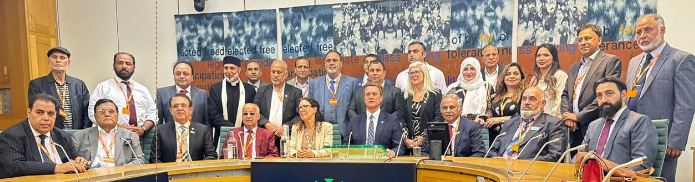
LONDON, JUL 16 /DNA/ – Under the patronage of Raja Najabat Hussain, Sitara-e-Pakistan, a historic All Parties Kashmir Parliamentary Conference was held in London, UK. The conference raised grave concerns over India’s escalating belligerence and nuclear brinkmanship, which, in the aftermath of the Pahalgam tragedy—where 26 innocent lives were lost—has pushed the region dangerously close to full-scale war. The declaration of the conference strongly urged the United Nations to conduct an impartial investigation into the incident and determine its real perpetrators.

Held at the British Parliament, the event saw the participation of a large number of MPs and dignitaries, including:

Barrister Imran Hussain, Chair of APPG on Kashmir

Tahir Ali, Senior Vice Chair

Debbie Abrahams, former Chair

MPs Dr Afzal Khan, Richard Burgon, David Williams, Dr Alison Clarkson, Connor Rand, Kate Dearden

Dr Zubair Ahmed, Barrister Mohammad Ayub, Mohammad Yasin, UK Head of Trade for Pakistan

Senator Dr Humayun Mohammad, Lt Gen (R) Abdul Qayyum, Chair Ex-Pakistan Army

Onaza Ehsan Butt, former MNA

Zafar Bakhtawari, Secretary General UBG and leading businessman

Mohammad Suleman, Assistant Director PIPS

Kashmiri community leaders and diaspora figures such as Prof. Shahid Iqbal, Muzzammil Ayub Thakur, Rehana Ali Advocate, Nadia Jafri (Chairperson, JK Right to Self-Determination Movement UK), Zeeshan Arif (Youth Wing Head), Barrister Shehzada Hayat, and many others also participated.

Speakers condemned Indian PM Narendra Modi’s ideology-driven Hindutva extremism and systematic human rights violations against minorities in India. They accused the BJP-RSS regime of pursuing the fascist goal of Akhand Bharat while spreading state terrorism, including cross-border attacks on Kashmiri and Sikh activists through RAW operatives.

India’s unilateral suspension of the Indus Waters Treaty was described as water terrorism. The speakers also highlighted the rise of over 19 separatist movements within India—across Jammu & Kashmir, Punjab, Manipur, Nagaland, Assam, and the South—indicating internal instability.

Particular outrage was expressed over the use of rape as a weapon of war by Indian forces in occupied Kashmir, calling it a gross violation of international law. Reference was made to US travel advisories warning about risks to women in India.

Participants demanded the immediate release of Kashmiri freedom leaders including Yasin Malik, Dr Qasim Faktoo, Shabir Shah, Khurram Parvez, Asif Sultan, Sajad Gul, Asiya Andrabi, Altaf Shah, and Musarat Alam Bhat.

It was emphasized that:

The Simla Agreement of 1972 is void, as the people of Jammu & Kashmir were not a party to it.

India is violating international laws, including UN Resolutions 47, 51, and 91, the Universal Declaration of Human Rights, and the 1949 Geneva Conventions.

Raja Najabat Hussain, Chairman of JK Self-Determination International UK, urged House of Lords members to raise the Kashmir conflict, Indo-Pak nuclear threat, and India’s treaty violations in today’s debate (July 17), especially in light of extremist Hindutva policies.

The conference concluded with a 6-point declaration, calling for:
A UN-supervised plebiscite in Jammu & Kashm A ban on extremist organizations and actions

Immediate action against uranium smugglingAccountability of India for war crimes

Global support for imprisoned Kashmiri leadersh. International action against India’s water aggression

The participants demanded global sanctions on India for:

Weaponizing sexual violence

Extrajudicial killings and disappearances

Harassment of journalists

Defying UN resolutions

Irresponsible nuclear behavior

The conference closed with a united pledge that Jammu & Kashmir will achieve freedom—no matter what.

The event was hosted by British MP James Frith.

Major Syed Rabnawaz martyred in Awaran Anti-Terror Operation: ISPR

Major Syed Rabnawaz martyred in Awaran Anti-Terror Operation: ISPR

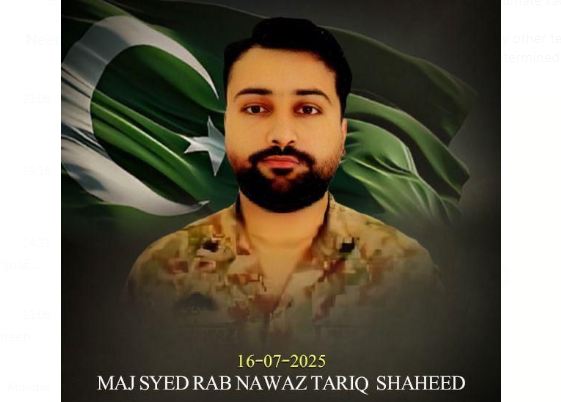
RAWALPINDI, JUL 16 /DNA/ – Security Forces conducted an intelligence based operation in Awaran District, on reported presence of terrorists belonging to Indian Proxy, Fitna al Hindustan.

During the conduct of operation, own troops effectively engaged the terrorist location and resultantly, three Indian sponsored terrorists were sent to hell.

However, during the intense fire exchange, Major Syed Rabnawaz Tariq (age: 34 years, resident of District Muzafarabad), a brave officer who was leading his troops from the front, fought gallantly and paid the ultimate sacrifice.

Sanitization operation is being conducted to eliminate any other terrorist found in the area, as the security forces of Pakistan are determined to wipe out the menace of Indian Sponsored Terrorism from the country, and such sacrifices of our brave men further strengthen our resolve.

24th Int’l Arab Tourism Hajj and Umrah Exhibition

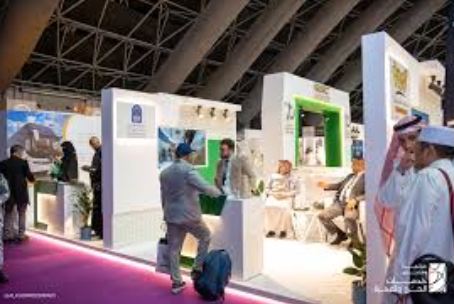
ISLAMABAD, JUL 16 /DNA/ – Governor Punjab  Sardar Saleem Haider and Allama Tahir Mahmood Ashrafi inaugurates 24th International Arab Tourism, Hajj and Umrah Exhibition Under the International Forum for Religious Tourism

The International Arab Tourism and Hajj and Umrah Exhibition will promote religious tourism in Pakistan: Governor Punjab Sardar Saleem Haider

Governor Punjab Sardar Saleem Haider and Chairman Pakistan Ulema Council Allama Tahir Mahmood Ashrafi inaugurated the 24th International Arab Tourism and Hajj and Umrah Exhibition Under the auspices of the International Forum for Religious Tourism.

On this occasion,  leaders of the International Forum for Religious Tourism including  Aminullah, Abdul Karim Hasni and representatives of global tourism from various Islamic countries were also present.

 Addressing the inaugural ceremony, Punjab Governor Sardar Saleem Haider said that the International Arab Tourism and Hajj and Umrah Exhibition will promote religious tourism  from Pakistan, adding that the Pakistan’s soft image will be taken to worldwide and the negative propaganda spread by enemy forces regarding Pakistan will be ended through this forum.

 He said that he invites pilgrims from all over the world in general and from Arab and Islamic countries in particular to come to Pakistan, Pakistan is a peaceful country and its people are peace loving and hospitable.

Governor Punjab also noted that the credit for bringing tourism companies from all over the world, especially from Islamic countries, through this exhibition goes to Hafiz Muhammad Tahir Mahmood Ashrafi, who has always served for the glory and dignity of Pakistan.

He also added that the disappearance of pilgrims in Iran and Iraq has brought disrepute to the country, and to avoid this disrepute, we have to improve our system.

 Governor Punjab said that  same procedure adopted for Hajj and Umrah should also be adopted for pilgrims going to Iran and Iraq so that no one going for pilgrimages can go missing.

On this occasion, Chairman Pakistan Ulema Council Hafiz Tahir Mahmood Ashrafi said that the promotion of religious tourism is the need of the hour.

He pointed that various countries are improving their systems for Umrah and Hajj pilgrimages adding that  we will have to make changes in our system accordingly.

Hafiz Tahir Mahmood Ashrafi noted that it cannot be that Saudi Arabia, Iran, Iraq, Egypt or Jordan create one system for the rest of the world and another for us. These countries may support us in brotherhood, but their systems will be the same for the entire world.

 He said that in the ‘Moharka-Haq’ the victory  that Allah has bestowed upon us enhanced the prestige of Pakistan in the Islamic world.

 We have to take advantage of this situation and promote religious tourism.

 Every year, millions of Muslims from Pakistan go to Saudi Arabia for Hajj and Umrah and millions of people go to Iraq and Iran for pilgrimages, and there are holy sites of many religions in Pakistan, for which tourists from all over the world want to come to Pakistan.

If we promote religious tourism, it will not only raise Pakistan’s prestige worldwide but also improve the country’s economy.

Aminullah Tahir, leader of the International Religious Tourism Council, said that the International Religious Tourism Council will organize such exhibitions throughout Pakistan and the relations between Pakistan and various tourism companies and ministries of the Islamic and Arab worlds will be further strengthened and enhanced, and practical steps will be taken in this regard.

Pakistan thump Indonesia to reach Asian U16 Volleyball championship semis

Pakistan thump Indonesia to reach Asian U16 Volleyball championship semis

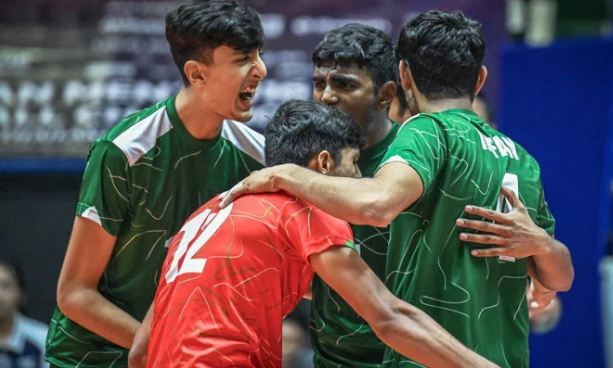
KARACHI: Pakistan advanced to the semifinals of the Asian U16 Volleyball Championship and qualified for next year’s U17 World Cup after a straight-set victory with scores of 25-23, 25-20, 25-20 over Indonesia in the crossover round on Wednesday.

The win extended Pakistan’s unbeaten streak to four matches in the tournament, all achieved without dropping a single set. Pakistan had previously topped its preliminary group stage with three consecutive wins before entering the crossover round, carrying forward the points against Korea, where it faced Indonesia in the first game.

Despite trailing 3-12 early in the first set, Pakistan staged a remarkable comeback to clinch the set 25-23 and maintained control throughout the match.

The team dominated in attack and block points, scoring 37 attack points to Indonesia’s 34 and securing 14 block points compared to Indonesia’s 3. However, Indonesia edged Pakistan in service points, 8-2.

Key performances came from Muhammad Junaid, who led Pakistan with 15 points, including 10 attack points, and Faizanullah, who contributed 11 points. Saran Baig and Talha Mehar also played pivotal roles in the victory.

With this result, Pakistan and Iran — both undefeated in Group F of the crossover round — have secured semifinal berths. Pakistan will face Iran in its final crossover match on Thursday, with the semifinal opponent to be determined afterwards.

CDA’s plot auction successfully continues into second day

CDA’s plot auction successfully continues into second day

DNA

Islamabad – The Capital Development Authority’s (CDA) open auction of commercial plots in Islamabad entered its second day with remarkable investor participation and enthusiasm. Chairman CDA and Chief Commissioner Islamabad, Muhammad Ali Randhawa, is personally overseeing the auction process to ensure transparency and efficiency.

So far, eight commercial plots have been successfully auctioned, fetching a total of Rs. 19.03 billion.

On the second day of the auction:

·         Plot No. 20, a petrol pump site located in Sector I-14 Markaz, was auctioned for Rs. 1.64 billion.

·         Plot No. 1-E, located in F-11/1, fetched Rs. 251.3 million.

On the first day:

·         In Blue Area (8-G):

o    Plot No. 13 was auctioned for Rs. 7.24 billion.

o    Plot No. 14 for Rs. 4.16 billion.

o    Plot No. 12 for Rs. 3.60 billion.

·         In I-14 Markaz:

o    Plot No. 3-A fetched Rs. 749.32 million.

o    Plot No. 3-B went for Rs. 709.32 million.

o    Plot No. 10-A was sold for Rs. 669.32 million.

The three-day auction event, which includes commercial plots and shops in Blue Area’s parking plaza, will continue until Thursday, July 17.

The enthusiastic participation of investors is a strong vote of confidence in CDA’s transparent and investor-friendly approach. A total of 46 plots and shops are being offered through open auction during the event.

Under the supervision of Chairman Randhawa, senior officials including Member Estate Talat Mehmood, Member Finance Tahir Naeem, Member Engineering Syed Nifasat Raza, and Member Planning Dr. Khalid Hafeez are actively monitoring the process.

A special committee led by Member Finance Tahir Naeem has been formed, comprising DG Resource, DG Building Control, DG Law, and other senior officials to ensure fair proceedings.

As part of investor facilitation, an Investment Expo has been organized at Jinnah Convention Centre, featuring booths from the Environment Wing, MCI, and the Sports & Culture Directorate, among others. Chairman Randhawa has directed all CDA wings to provide complete support and services to investors and the business community.

Investor-friendly incentives include:

·         A 5% discount on full payment within one month.

·         An additional 5% discount for full payments made in US dollars.

CDA has also deployed dedicated facilitation teams to guide and assist investors at every stage of the auction process.

According to Chairman Randhawa, the revenue generated through this auction will be invested back into Islamabad’s development, including sector infrastructureroad networks, and beautification projects, with the aim of transforming Islamabad into a model capital city.

Tarar calls for raising awareness against patriarchy via social media

Tarar calls for raising awareness against patriarchy via social media

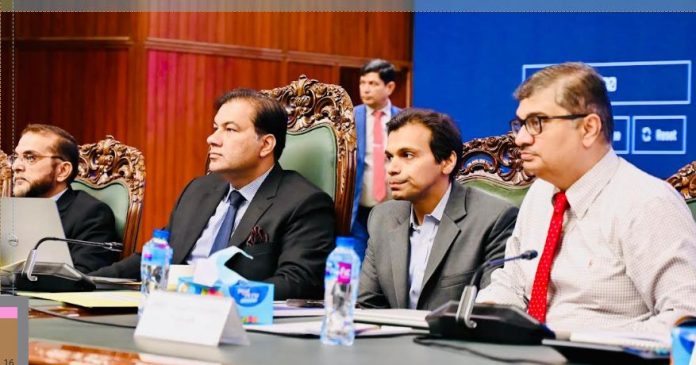
ISLAMABAD, JUL 16: Federal Information Minister Attaullah Tarar on Wednesday said that social media should be used to raise awareness against the patriarchal system, rather than for spreading misinformation or political propaganda.

Speaking at an event in Islamabad, Tarar addressed the PECA (Prevention of Electronic Crimes Act) amendments, stating: “The purpose of the PECA amendments and the establishment of a new national agency is to prevent crime. These new laws are not intended to suppress freedom of expression in any way.”

He added, “In the best democracies, there is a system of punishment and reward. The aim of this legislation is to make the digital world safer for women and other vulnerable groups.”

Tarar stressed that political parties must play a leading role in this process. “There is gender discrimination in our society. The patriarchal system continues to pose challenges for women,” he noted.

Highlighting the influence of digital platforms, he said, “Social media accounts related to fashion or entertainment attract millions of followers. Social issues must also be brought to the forefront under a new system. The need of the hour is to use social media for positive and constructive objectives.”

He observed that the number of social media users has grown significantly, adding, “All political parties are responsible for the irresponsible use of social media.”

Citing a report by the World Economic Forum, Tarar said: “The misuse of social media is one of the greatest threats of our time. The spread of fake news and propaganda poses serious risks. Traditional media still has certain rules and regulations, but these are lacking in the digital space.”

“Print media has transitioned into electronic media and now into digital media. The absence of clear rules for social and digital media has caused significant harm,” he added.

“Digital media has developed autonomously, leading to various challenges. The government has enacted legislation to regulate this space. When crimes moved into the digital realm, there were no proper regulations. Anyone can easily incite violence online,” he said.

“A system of checks and balances on social media is essential,” he added.

Separately, a delegation from the Pakistan Federal Union of Journalists (PFUJ), the Rawalpindi-Islamabad Union of Journalists (RIUJ), and parliamentary reporters met with Tarar.

During the meeting, Tarar pledged to ensure the dignity, freedom, and professional security of journalists at all levels. “We will provide full cooperation and protection to journalists in the performance of their duties,” he said.

He added, “The government considers independent journalism a pillar of social progress and remains committed to defending it.”

Also present at the meeting was Principal Information Officer Mubashir Hassan, among others.

Meanwhile, Tarar expressed concern over an incident involving RIUJ President Tariq Virk and vowed to resolve the issue.

Many dead as bus targeted in Kalat

Three dead, seven injured as passenger bus targeted in Balochistan's Kalat

Coach was en route from Karachi to Quetta when gunmen opened fire, say police

Bureau Report

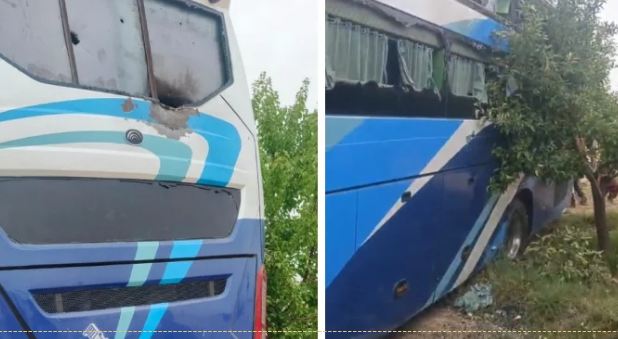
KALAT: At least three people were killed and seven others sustained injuries after unidentified assailants opened gunfire on a passenger coach travelling from Karachi to Quetta near a checkpost in Balochistan’s Kalat, police said on Wednesday.

The attack occured when the bus approached Nemargh Cross near Kalat district as the unidentified attackers first opened fire and then hurled hand grenades.

The vehicles that run on this route carry approximately 40 to 50 passengers. However, the exact number of passengers on board the targeted bus remains unknown.

Balochistan government spokesperson, Shahid Rind noted that security agencies, district authorities, and rescue teams reached the scene immediately. The wounded were transferred to the Qalat DHQ Hospital, where an emergency has been declared.Security forces cordoned off the area and launched a search operation to pursue the assailants, Rind said, adding that the attackers are still at large. “Initial reports suggest that the attackers were waiting to strike. They closed the street from both sides,” he added.  

Police officials added that the assailants were waiting on top of nearby mountains to attack the bus.

The attack came days after at least nine passengers travelling on two Punjab-bound coaches were abducted and killed by unidentified armed men in Sur-Dakai area, on the border between Balochistan’s Zhob and Loralai districts.

Assistant Commissioner Zhob, Naveed Alam, said the attackers opened fire on the abducted passengers after taking them away from the vehicles, adding that the bodies were being transported to Rakhni for dispatch to their native towns in Punjab.

Shahid Rind, the Balochistan government’s spokesperson, said that Fitna al Hindustan — a term used for terrorist organisations in Balo­chistan — had carried out the attacks.

Three dead, seven injured as passenger bus targeted in Balochistan’s Kalat

Three dead, seven injured as passenger bus targeted in Balochistan's Kalat

KALAT: At least three people were killed and seven others sustained injuries after unidentified assailants opened gunfire on a passenger coach travelling from Karachi to Quetta near a checkpost in Balochistan’s Kalat, police said on Wednesday.

SHO Kalat Habibullah told Geo News that the attack occurred as the coach approached a checkpoint in the area. The vehicles that run on this route carry approximately 40 to 50 passengers. However, the exact number of passengers on board the targeted bus remains unknown.

In a statement, the police said two of the injured passengers were in critical condition. The injured passengers were immediately transported to District Hospital Kalat for treatment.

When the bus reached Nemargh Cross, the unidentified attackers first opened fire and then hit the bus with hand grenades. Police and FC personnel have cordoned off the area, and security has been beefed up at the hospital as well.

Police officials added that the assailants were waiting on top of nearby mountains to attack the bus.

Speaking to Geo News, Balochistan government spokesperson, Shahid Rind noted that law enforcement personnel have begun a search operation. “Initial reports suggest that the attackers were waiting to strike. They closed the street from both sides,” he added.

The attack came days after at least nine passengers travelling on two Punjab-bound coaches were abducted and killed by unidentified armed men in Sur-Dakai area, on the border between Balochistan’s Zhob and Loralai districts.

Assistant Commissioner Zhob, Naveed Alam, said the attackers opened fire on the abducted passengers after taking them away from the vehicles, adding that the bodies were being transported to Rakhni for dispatch to their native towns in Punjab.

Shahid Rind, the Balochistan government’s spokesperson, said that Fitna al Hindustan — a term used for terrorist organisations in Balo­chistan — had carried out the attacks.

Balochistan Chief Minister Sarfaraz Bugti declared that the killers of innocent civilians were not worthy of any mercy. “Those who murder innocent people will be hunted to the last man,” the chief minister said.

Stay Connected

64FansLike
60FollowersFollow

Latest Reviews

Exchange Rates

USD - United States Dollar
EUR
1.17
GBP
1.35
AUD
0.72
CAD
0.73