Home Blog Page 535

DGSE to host Marka-e-Haq & Independence Day walk with special students

DGSE to host Marka-e-Haq & Independence Day walk with special students

ISLAMABAD, AUG 17 /DNA/ – The Directorate General of Special Education (DGSE), under the Ministry of Federal Education & Professional Training, is set to celebrate Marka-e-Haq and Independence Day with the participation of students with disabilities.

To mark the occasion, a Road Show/Walk will be organized on Monday, 18th August 2025 from 12:00 pm to 2:00 pm, starting from the National Library and Resource Centre, F-7 Markaz (behind Caltex Petrol Pump old Shell Pump) and culminating at Jinnah Super Market, F-7, Islamabad.

The event will be graced by Ms. Wajiha Qamar, Minister of State, Ministry of Federal Education & Professional Training, as the Chief Guest. Parliamentarians, officials from various ministries, NGOs, INGOs, and people from different walks of life are also expected to join the walk in solidarity.

The purpose of this Road Show/Walk is to celebrate Pakistan’s historical victory, pay tribute to the Armed Forces, and highlight the rights and achievements of persons with disabilities.

All media outlets (electronic & print) are cordially invited to cover this significant event and support the cause of inclusivity and empowerment for persons with disabilities.

Over 72% of telecom sites restored in flood-hit regions: PTA

Over 72% of telecom sites restored in flood-hit regions: PTA

ISLAMABAD, AUG 17: The Pakistan Telecommunication Authority (PTA) said on Sunday that more than 72% of the affected telecom sites have been restored.

According to details, the PTA and other concerned telecommunication services were working to restore the mobile phone networks in the flood-hit areas.

The PTA has made it clear that the all possible steps have been taken to ensure the restoration of the services in the remaining flood-stricken places.

“The mobile operations are providing free on-net voice calls to telecommunication users in the flood-hit areas,” the PTA stated.

The PTA maintained, “The mobile service users can have access to the emergency services and can stay in contact with their families despite zero balance.”

Palestine condemns Israel’s tax attack on Christian holy sites

Palestine condemns Israel’s tax attack on Christian holy sites

RAMALLAH, AUG 17 /DNA/ – The Ministry of Foreign Affairs and Expatriates strongly condemns the decision of the Israeli occupation authorities to freeze the bank accounts of the Orthodox Patriarchate in occupied Jerusalem and to impose exorbitant taxes on its properties, with the aim of undermining its ability to carry out its work in all fields. The Ministry considers this measure part of the occupation’s systematic targeting of Palestinian holy sites in general, and Christian holy sites, institutions, properties, and the Christian presence in Palestine in particular.

The Ministry calls upon the international community, and both the Christian and Islamic worlds to take serious action to protect the Christian presence in Palestine in all its forms, and to adopt effective measures to shield our people from the occupation’s genocide, displacement and annexation.

PM Shehbaz orders ministers to supervise relief operations after KP floods leave 314 dead, 156 injured

PM Shehbaz orders ministers to supervise relief operations after KP floods leave 314 dead, 156 injured

ISLAMABAD, AUG 17: Prime Minister Shehbaz Sharif on Sunday ordered federal ministers to supervise relief operations in Khyber Pakhtunkhwa after flash floods left 314 people dead and 156 injured, along with severe damage to infrastructure.

The KP government declared an emergency on Saturday as torrential rains ravaged homes, displaced families, and left a trail of destruction across Buner, Swat, Shangla, Mansehra, and beyond, with authorities warning that dozens of victims may still be trapped under debris.

According to state-run Radio Pakistan, additional relief goods are being dispatched to the flood-affected areas on the directives of PM Shehbaz, who is personally monitoring the relief operations of the National Disaster Management Authority in all flood-affected districts of KP.

“Teams of federal Ministers, on the instructions of the prime minister will participate in the relief operations in the flood-affected areas,” Radio Pakistan reported.

Federal Minister for Gilgit Baltistan and Kashmir Affairs and States and Frontier Regions, Amir Muqam will supervise the distribution of relief goods in districts Shangla and Buner.

Minister for Power Division Awais Leghari will look after activities in Buner, and Minister for Religious Affairs Sardar Yousaf will oversee operations in Mansehra. Special Assistant to the Prime Minister Mubarak Zeb will supervise relief distribution activities in Bajaur.

“Additional trucks carrying relief goods are being sent to the affected districts under the Prime Minister’s Relief Package,” Radio Pakistan reported. “The relief goods include ration, tents, and medicines, which are being district administrations.”

PM Shehbaz directed the NDMA chairman to stay in constant contact with the disaster management authorities of the provinces and Gilgit-Baltistan for better and coordinated relief efforts.

Earlier in the day, the KP PDMA released an update on the death and injury toll across the province, as well as damage to infrastructure and loss of cattle

Buner district alone has accounted for 209 deaths and 120 injuries, according to the report, with 36 dead and 21 injured in Shangla.

Mansehra recorded a total of 24 deaths and five injuries, with a similar toll of 21 deaths and five injuries in Bajaur.

According to the PDMA report, 16 men died in Swat while two were injured. Meanwhile in Lower Dir, five people died due to thunder strikes and roof collapse, with three people injured. Thunder strikes also killed three people in Battagram.

A total of 159 houses have been damaged — 62 of them fully — while 57 schools across KP have also been partially damaged.

According to initial details from the Buner Deputy Commissioner’s Office, machinery has been deployed to the affected areas. “However, due to continuous heavy rainfall, it is currently impossible to reopen the causeway at Gadezai.”

District officials and rescue teams have already been dispatched to the affected locations in the Gokand and Pir Baba areas, per the report, which also noted that rescue teams have recovered the dead bodies at Daggar Village.

In Swat, two women and several school students were safely rescued by local authorities.

“The situation remains critical in certain areas, and necessary response and relief operations are underway,” the PDMA report quoted a statement from the additional deputy commissioner’s office.

KP Rescue 1122 spokesperson Bilal Ahmed Faizi told AFP that the operation to rescue people trapped under debris is ongoing.

“There is still concern that dozens of people may be trapped under the rubble… the chances of those buried under the debris surviving are very slim,” Faizi said.

He added that around 2,000 rescue workers were engaged in recovering bodies from the debris and carrying out relief operations across nine districts, where rain was still hampering efforts.

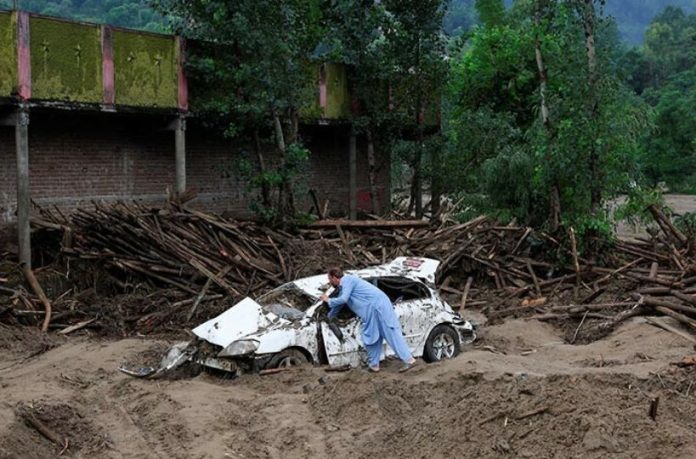
AFP journalists in Buner saw half-buried vehicles and belongings lying strewn in the sludge, with mud covering houses and shops. Flooded roads hampered the movement of rescue vehicles, as a few villagers worked to cut fallen trees to clear the way after the water receded.


Meanwhile, KP PDMA Director General Asfandyar Khattak told AFP that those missing in Buner “could be trapped under the rubble of their homes or swept away by floodwaters”.

He noted that in Shangla, dozens of people are also reported missing.

“There is no electricity or mobile signal in Buner, as power lines and mobile towers were damaged,” he added.

Over 850 rescued across Buner
More than 850 people have been rescued and shifted to safer places while 181 bodies have been recovered in Buner’s districts of Gaddizi, Bishoni, Malikpur, Balokhan and other nearby areas which were worst affected, according to an update from Buner Rescue 1122 issued today.

“Dozens of houses in different districts have been reduced to rubble; agricultural lands and infrastructure have been severely damaged, while reports of loss of life are also alarming,” the update said.

In Daggar, the capital of Buner, 30 people died in Gokand, Kot and other districts, while 202 people including women and children were shifted to safer places.

A total of 41 bodies were recovered from Chagharzai while 35 people were rescued in injured condition and taken to the Rural Health Centre Hospital Gulbandi.

Three bodies were also recovered from the Salmani area of Mandanr and shifted to the district headquarters hospital.

“Buner Rescue 1122 personnel are continuously engaged in search and rescue operations day and night in the affected areas,” the statement said.

“Rescue personnel and emergency vehicles from Swabi have also joined the operation, while special rescue teams from Peshawar are also participating in relief activities in the affected areas.”

Rescue teams and district officials are continuously present in the field and on high alert to provide timely assistance to the affected people, it added.

Punjab PDMA orders restriction of tourists to Murree
The Punjab PDMA has ordered that tourists be restricted from travelling to Murree and other “disaster-vulnerable areas in view of the ongoing surge in monsoon activities, particularly in mountainous regions.”

A letter in this regard was sent from the Punjab Board of Revenue to the secretary to the Government of Punjab, Tourism Department, the Rawalpindi Division Commissioner and the Murree Deputy Commissioner.

The government authority asked to restrict tourist entry to vulnerable and hazard-prone sites until the current monsoon spell subsides, as well as to coordinate with law enforcement agencies for restrictions under Section 144, wherever required.

The authority also asked to ensure wide public awareness through electronic, print and social media regarding safety advisories.

Meanwhile, the Lower Dir district administration, on the orders of the KP government, distributed compensation cheques to the heirs of the five people who died in a roof collapse incident due to rain in Maidan area’s Suri Pao village.

Salman Agha to lead Pakistan’s Asia Cup squad as Babar, Rizwan left out

Salman Agha to lead Pakistan’s Asia Cup squad as Babar, Rizwan left out

ISLAMABAD, AUG 17: Pakistan left out Babar Azam and Mohammad Rizwan from the T20 squad named on Sunday for the Asia Cup and a warm-up tri-series beginning this month against Afghanistan and the United Arab Emirates, according to a press release issued by the Pakistan Cricket Board.

Azam and Rizwan have been star performers in the shortest format in the past, but have not played since December, which head coach Mike Hesson put down to other players performing well while addressing a press conference.

“We know what a fine player Babar (Azam) is,” said Hesson.

“Babar has been asked to improve in certain areas, like taking on spin and in terms of his strike rate, and he is working hard on these things.

“The players we have are performing well and having a positive impact,” said Hesson.

Since Hesson took over as head coach in May, Pakistan have played three T20 series — winning 3-0 at home but losing 2-1 away to Bangladesh. They then beat the West Indies 2-1 in the United States.

“Our focus is to win the tri-series and the Asia Cup, and the aim is to peak from these pinnacle events,” said Hesson.

All-rounder Salman Agha will lead the side, which also sees the return of fast bowlers Mohammad Wasim and Salman Mirza.

Mirza took seven wickets in Bangladesh but was left out of the squad against the West Indies.

Opener Fakhar Zaman also returns after being injured for a one-day international series in the West Indies last week, which Pakistan lost 2-1.

The tri-series, which starts on August 29, and the Asia Cup from September 9 will both take place in the UAE.

Pakistan squad: Salman Agha (captain), Saim Ayub, Fakhar Zaman, Sahibzada Farhan, Hasan Nawaz, Salman Mirza, Mohammad Haris, Mohammad Nawaz, Shaheen Shah Afridi, Haris Rauf, Hasan Ali, Hussain Talat, Sufiyan Muqeem, Abrar Ahmed, Khushdil Shah, Faheem Ashraf, Mohammad Wasim.

Hajj 2026 applications can be submitted until Aug 18

Hajj 2026 applications can be submitted until Aug 18

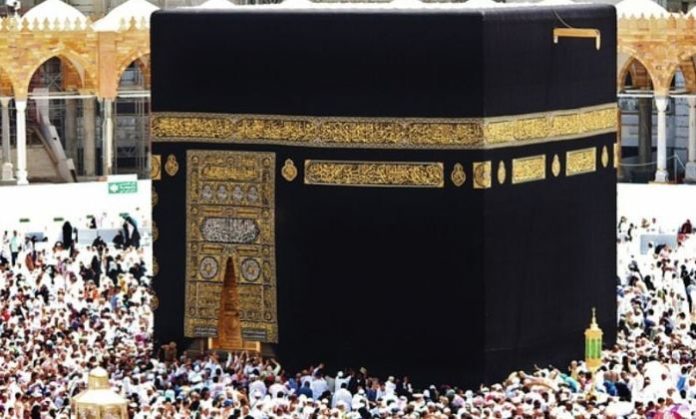
ISLAMABAD, AUG 17: The Ministry of Religious Affairs has extended the deadline for receiving Hajj applications by one day. According to a ministry spokesperson, designated banks will continue accepting applications on Monday, August 18.

The spokesperson said more than 110,000 applications have been received in the past 12 days, while 7,000 seats remain under the government Hajj scheme.

The extension is based on a “first come, first served” basis, and applications will be closed once the quota is filled, the ministry added.

According to a ministry spokesperson, designated banks will continue accepting applications on Monday, August 18.

The spokesperson said more than 110,000 applications have been received in the past 12 days, while 7,000 seats remain under the government Hajj scheme.

The extension is based on a “first come, first served” basis, and applications will be closed once the quota is filled, the ministry added.

Floods, terror, and the nation’s unending crisis

Floods, terror, and the nation’s unending crisis

Opinion

Ansar Mahmood Bhatti

August 15, 2025, will be remembered as yet another dark day in Pakistan’s troubled history. In the past 48 hours, devastating floods in Khyber Pakhtunkhwa (KP), Gilgit-Baltistan (GB), and parts of Azad Jammu and Kashmir (AJK) have claimed more than 200 lives. Entire villages have been washed away, roads destroyed, and families torn apart by nature’s fury. The tragedy comes barely a day after terrorists struck in KP on August 14 — a day meant for national pride and celebration — killing scores of innocent citizens.

What is there to celebrate when the country remains engulfed in crisis? What joy can be found in waving flags and singing anthems while our fellow countrymen drown, are buried under debris, or are killed by bullets? The reality is grim: amidst Independence Day parades, fireworks, and official speeches, Pakistan bleeds, mourns, and waits in vain for genuine change.

The latest floods have been described as among the worst in recent memory. Torrential rains over the past week swelled rivers beyond capacity. The Swat River, once again, became a symbol of devastation — a haunting reminder of past tragedies that we never truly learned from. Entire stretches of road have collapsed into rushing waters, bridges have been swept away, and communication lines in several areas have gone dead.

Villagers in upper KP recount harrowing scenes of loved ones being swept away in seconds. In GB, rescue operations have been severely hampered by landslides blocking access routes. In AJK, already fragile infrastructure has been completely overwhelmed, leaving thousands stranded. Relief is slow, rescue efforts are disorganized, and for many, help will come too late.

The Swat River tragedy few weeks ago should have been a turning point in Pakistan’s disaster preparedness. It wasn’t. Lessons were never learned; systems were never fixed. Instead, year after year, we witness the same script: heavy rains lead to floods, people die, the government announces relief packages, and then life moves on — until the next tragedy strikes.

We keep asking the same questions: When will we awaken from this national slumber? When will we shift from lip service to real, practical measures? When will we take the safety of ordinary citizens seriously, instead of treating disasters as mere seasonal inconveniences?

The National Disaster Management Authority (NDMA), created to coordinate disaster response, has once again failed to deliver. Each time tragedy strikes, the Prime Minister rushes to the NDMA headquarters, where officials present elaborate PowerPoint slides filled with charts, forecasts, and “strategies.” And that’s where it ends.

The irony is that crisis management in Pakistan was often more effective before the NDMA existed. Back then, response relied on swift, on-ground action by local administrations, armed forces, and volunteers. Today, bureaucracy and red tape slow everything down, while NDMA remains an organization that talks big but acts little.

As the floods claimed lives in the north, terrorism reared its head once again in KP. On August 14, when the rest of the country was busy celebrating Independence Day, terrorists targeted innocent citizens, killing many. This was not an isolated attack — it is part of a disturbing trend that has seen violence spike in the past year, particularly in border regions.

What does it say about our priorities when our cities are lit up with fireworks, yet rural communities live in fear of both nature’s wrath and man-made violence? The celebration rings hollow when the state fails in its most basic duty — to protect lives.

Adding to the sense of disconnect was the government’s decision to hand out awards in abundance during the Independence Day festivities. Many of these honors went not to the truly deserving, but to those who follow the “masters’ voices” — individuals celebrated for loyalty rather than merit. Meanwhile, countless genuine heroes, including those who risk their lives in floods and terror attacks, were ignored.

Yet, amidst the usual self-congratulatory atmosphere, there were a few brave voices who refused to accept their awards in protest of this injustice. Their stance deserves recognition and emulation — a small but powerful reminder that dignity and integrity still exist in this country.

Decades ago, American journalist Christina Lamb captured Pakistan’s political and social dysfunction in her book Waiting for Allah. Written in the 1990s, it painted a portrait of a nation caught between hope and despair, crippled by corruption, mismanagement, and short-sighted leadership. Sadly, her observations remain relevant today.

From disaster response to governance, from counterterrorism to the allocation of national honors, nothing fundamental has changed. We remain stuck in the same cycle of tragedy, outrage, empty promises, and eventual amnesia.

Lip service has become our default mode. Every time disaster strikes, we hear the same phrases: “We stand with the victims,” “Relief efforts are underway,” “An inquiry will be conducted.” These words have lost all meaning because they are never followed by sustained action.

Practical steps require political will, transparency, and long-term investment — qualities that have been in short supply. Flood defense infrastructure remains inadequate, urban planning ignores climate realities, and emergency services are underfunded. Terrorist networks continue to operate in certain regions because dismantling them would require systemic reforms that challenge entrenched interests.

It is the ordinary citizen — the farmer in Swat, the shopkeeper in Skardu, the teacher in Muzaffarabad — who pays the price for this chronic negligence. They lose homes, livelihoods, and loved ones. They watch as politicians fly in for photo opportunities, then fly out to resume business as usual. They know that the next disaster is not a matter of if, but when.

The events of August 14 and 15 should be a wake-up call — not just for the government, but for the entire nation. We cannot continue to treat disasters and terrorism as routine. We cannot allow incompetence and corruption to be normalized. We cannot afford to spend another decade “waiting for Allah” to solve problems that are within our power to address.

Real change requires more than speeches. It demands investment in infrastructure, honest governance, and a culture that rewards merit over sycophancy. It requires that we take the concerns of ordinary people seriously, whether they live in Karachi, Swat, or the remotest village in GB.

August is supposed to be a month of pride for Pakistan — a time to remember the sacrifices that built this nation. But pride without responsibility is meaningless. As we mourn the more than 200 lives lost in the floods and the victims of terrorism, we must confront the uncomfortable truth: our tragedies are not just acts of fate. They are the result of choices — choices to neglect, to delay, to favor loyalty over competence, to celebrate instead of act.

Until we change those choices, August will keep bringing us anniversaries not just of independence, but of grief. And history will keep repeating itself, one flood, one attack, one tragedy at a time.

NDMA warns of intensified monsoon spells; says relief, restoration efforts underway

NDMA warns of intensified monsoon spells; says relief, restoration efforts underway

ISLAMABAD, AUG 17 (DNA): Chairman National Disaster Management Authority (NDMA) Lieutenant General Inam Haider on Sunday warned that two to three additional monsoon spells are likely in the coming weeks, with rainfall intensity projected to surge 50 to 60 percent above previous years.

Addressing a media briefing on rain-related damages and flood response, the NDMA chief said this year’s monsoon spread has expanded significantly due to unusually high summer temperatures, which triggered atmospheric instability and heavier rainfall across multiple regions.

He attributed the heightened severity to climate change, which continues to intensify weather disruptions in vulnerable regions. Pakistan is witnessing severe repercussions, with widespread destruction reported in Buner, Bajaur and Battagram areas increasingly exposed to climate-driven hazards.

“The monsoon season is expected to persist until September 10,” he said.

Lieutenant General Haider said land connectivity has been severed with several settlements in Gilgit-Baltistan and Khyber Pakhtunkhwa due to flash floods and landslides. Search operations for missing persons are ongoing, while relief goods and food supplies are being dispatched to affected districts.

Restoration work is underway in areas where link roads have been damaged. NDMA remains in constant coordination with provincial governments to ensure timely assistance and effective response. More relief packages will be delivered on Monday to districts that have suffered the highest loss of life during recent monsoon-related disasters.

The NDMA chairman emphasized that all available resources will be mobilized to minimize potential flood-related losses. Vulnerable areas will be evacuated in advance to safeguard lives, while communication networks in cut-off regions will be restored on a priority basis through technical teams.

Following the monsoon season, NDMA will work closely with the Ministry of Communications and the Ministry of Housing to rehabilitate damaged infrastructure.

Lt Gen Inam Haider attributed the recent devastation in northern districts to climate change, warning that northern Punjab and northern Khyber Pakhtunkhwa are likely to experience more intense rainfall in the coming days. He assured that the NDMA, in coordination with relevant ministries, will sustain rehabilitation efforts and issue regular updates to help minimize future losses.

The restoration drive will prioritize reconnecting isolated regions and is expected to be completed before the onset of the next monsoon cycle.

Armed forces are assisting in ongoing relief and rescue operations. A detailed survey, in coordination with provincial governments, will be conducted to assess exact losses. Relief camps will be established if necessary to provide shelter and support to displaced communities.

Earlier, officials from the NDMA briefed the media on a comprehensive monsoon contingency plan, identifying regions most vulnerable to heavy rainfall and potential flooding. According to the briefing, northeastern areas—including Azad Jammu and Kashmir and central Khyber Pakhtunkhwa—along with southeastern districts such as Tharparkar, Sujawal, Tando Allah Yar, Tando Muhammad Khan, and Badin are likely to experience intensified monsoon activity.

The NDMA highlighted that three major weather systems are currently converging over Pakistan, which is expected to significantly amplify rainfall across the country

NDMA Technical Expert Dr. Tayyab Shah stated that the ongoing rainfall sequence is expected to continue until August 22, with further intensification likely. He added that another monsoon spell will begin after August 22, with three additional rainfall systems approaching the region.

He noted that a new rainfall sequence is approaching from the Bay of Bengal, while another system is advancing from Afghanistan’s Nangarhar and Kandahar regions.

NDMA General Manager Zahra Hassan stated that heavy rainfall is expected within the next 24 to 48 hours, warning that Tarbela Dam is currently at 98 percent capacity and may reach a critical level during this period. She further noted that water levels have risen by up to 15 feet at Katarian and Gwalmandi bridges along Nullah Leh.

A new rainfall sequence has commenced in areas along the Koh-e-Suleiman mountain range. Flood risks have escalated in Azad Jammu and Kashmir’s Neelum, Poonch, and Bagh districts. In Khyber Pakhtunkhwa, vulnerable areas include Peshawar, Chitral, Dir, and Charsadda, where flood threats remain particularly high.

Brigadier Kamran, Member Operations at NDMA, stated that preparations for the monsoon season began as early as February 2025, with preventive measures undertaken in coordination with provincial governments to minimize potential damage. However, he noted that the recent devastation in Buner and Bajaur was triggered by sudden cloudbursts.

According to Brigadier Kamran, 337 lives have been lost and 178 individuals injured over the past two days. He stated that the army and Frontier Corps are actively supporting provincial governments with resources for ongoing rescue operations. A second consignment of relief goods from the federal government is scheduled to be dispatched to Buner on Monday.

European leaders to join Zelensky for White House

European leaders to join Zelensky for White House

French President Emmanuel Macron, German Chancellor Friedrich Merz, and European Commission President Ursula von der Leyen are among those expected to join Zelensky for the discussions

DNA

Washington/Brussels, Aug 17 — A high-stakes round of diplomacy is set to unfold in Washington on Monday as Ukrainian President Volodymyr Zelensky arrives in the US capital for talks with President Donald Trump. A number of senior European leaders have confirmed their participation in the White House meeting, underscoring Europe’s push to be seen as central to any settlement of the Ukraine war.

French President Emmanuel Macron, German Chancellor Friedrich Merz, and European Commission President Ursula von der Leyen are among those expected to join Zelensky for the discussions. Their presence is widely interpreted as an effort to convince Trump that Europe remains indispensable to the peace deal he has repeatedly said he wants to secure.

According to the BBC’s James Waterhouse, European capitals are wary of being sidelined as Trump seeks to directly broker a deal with Moscow and Kyiv. By standing alongside Zelensky in Washington, leaders hope to remind the US president that any sustainable peace will require transatlantic coordination and European guarantees.

The White House talks will follow a Sunday conference call between France, Germany, the UK, Ukraine, and other allies to align positions ahead of the Washington meeting. Diplomats say the call will focus on both military realities on the ground and potential frameworks for a political settlement.

The flurry of diplomacy comes just days after a failed summit in Anchorage, Alaska, where Trump and Russian President Vladimir Putin met but failed to clinch an agreement. While Trump described the encounter as “progress,” Putin publicly stressed that it was “still too early” for a breakthrough.

Trump has made clear he is not interested in a temporary ceasefire, which he argues could collapse like previous efforts. Instead, he says the goal must be a permanent peace agreement that ends hostilities once and for all.

For Zelensky, the White House gathering represents an opportunity to shore up Western unity and ensure Ukraine’s voice is not drowned out in direct US-Russia negotiations. For Europe, it is a chance to demonstrate both solidarity with Kyiv and influence over the trajectory of the talks.

With expectations carefully managed after Alaska, Monday’s meeting in Washington may not deliver an immediate breakthrough. But it is likely to set the tone for what could be the most decisive phase yet in the search for an end to Europe’s bloodiest conflict since World War Two.

Independence Day Hockey Cup: Rising Stars White triumph over rising Stars Green

Independence Day Hockey Cup: Rising Stars White triumph over rising Stars Green
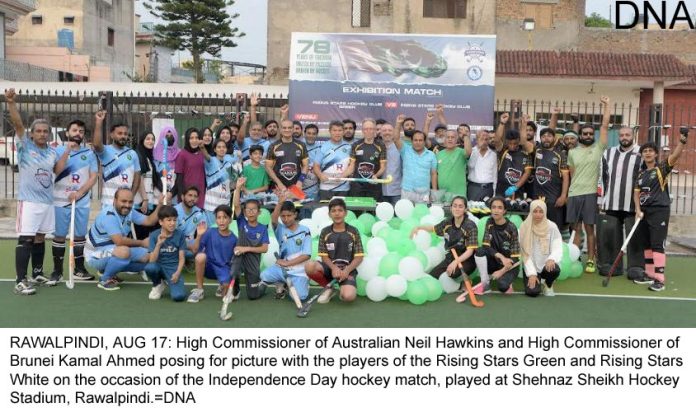
RAWALPINDI, AUG 17: High Commissioner of Australian Neil Hawkins and High Commissioner of Brunei Kamal Ahmed posing for picture with the players of the Rising Stars Green and Rising Stars White on the occasion of the Independence Day hockey match, played at Shehnaz Sheikh Hockey Stadium, Rawalpindi.=DNA

Saifullah Ansar

RAWALPINDI, AUG 17 /DNA/ – The Rising Stars Hockey Club organized an Independence Day Hockey match at the Shehnaz Sheikh Hockey Stadium Rawalpindi, marking Pakistan’s 78th Independence Day with a spirited display of sportsmanship, and international friendship. The much-anticipated exhibition match was contested between Rising Stars White and Rising Stars Green, with Rising Stars White emerging victorious by 3-1.

The event carried a special charm as it featured diplomats, young players, and budding female athletes on the same field. Neil Hawkins, High Commissioner of Australia to Pakistan, donned the Rising Stars Green jersey, while Kamal Ahmed, High Commissioner of Brunei Darussalam, represented Rising Stars White. Their participation not only energized the crowd but also highlighted the growing role of sports diplomacy in strengthening people-to-people ties.

The match began with fast-paced action from both sides, with Rising Stars Green pressing hard in the opening minutes. However, Rising Stars White quickly found their rhythm and took the lead midway through the first half. Despite a strong fightback from the Green side, including a penalty corner conversion, the White side proved too strong, scoring two more goals to seal the 3-1 victory.

A special feature of the Independence Day Cup was the participation of female players from the Rising Stars Girls Hockey Academy, who were given the opportunity to showcase their talent alongside senior players. Their involvement drew wide appreciation from the spectators, who applauded the club’s efforts in encouraging women’s participation in hockey.

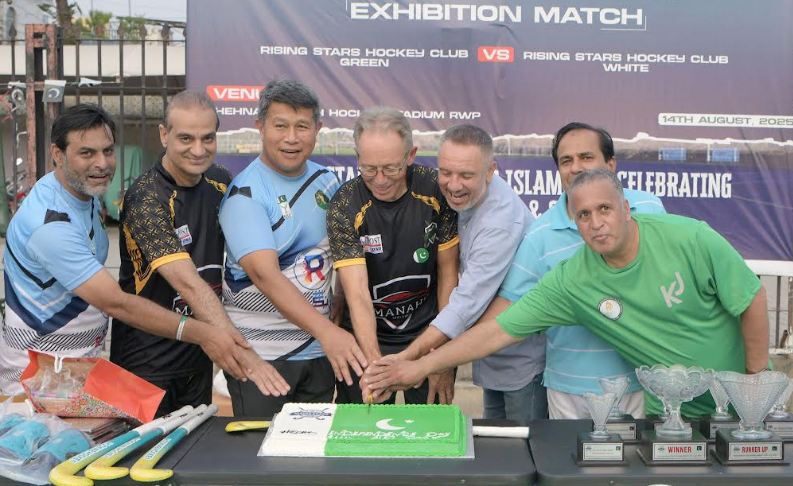
Following the match, both high commissioners and Deputy Head of Mission of the Romanian Embassy Eduard Preda, along with players of the two teams, gathered to cut a cake, symbolically marking the Independence Day celebrations. In their remarks, Neil Hawkins and Kamal Ahmed lauded the Rising Stars Hockey Club for organizing the event with such enthusiasm and inclusivity. They praised the management for creating a platform where youth, diplomats, and female players could come together in the spirit of sportsmanship.

 “This was more than just a match; it was an occasion to celebrate Pakistan’s independence, promote hockey, and build bridges of friendship,” said Kamal Ahmed. Neil Hawkins echoed similar sentiments, emphasizing that such initiatives reflect the true spirit of unity and celebration.

The Independence Day Hockey match concluded with cheers, photographs, and renewed commitment to promoting hockey at the grassroots level.=DNA

Stay Connected

64FansLike
60FollowersFollow

Latest Reviews

Exchange Rates

USD - United States Dollar
EUR
1.17
GBP
1.35
AUD
0.72
CAD
0.73