Home Blog Page 500

When China Becomes #1

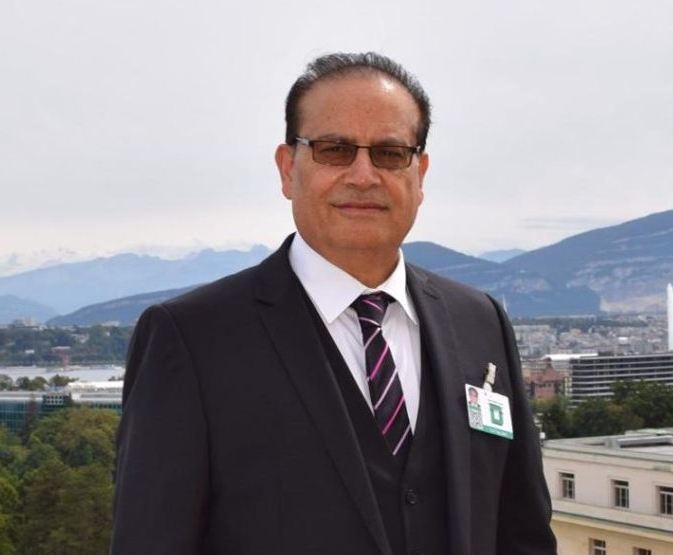
Qamar Bashir

By Qamar Bashir

The United States is without question a great country. Its people are hardworking, intelligent, innovative, creative, and generous. From breakthroughs in medicine to technological revolutions in Silicon Valley, America has shaped the modern world in ways unmatched by any other nation. It remains a land where people from every nationality, race, and background are welcomed with open arms and provided with the opportunity to realize their dreams. Millions of immigrants, including myself, have experienced this spirit of hospitality and freedom, and this openness has helped make America a beacon of hope and aspiration for the entire world.

Yet today, the global balance of power is shifting rapidly, and the next two decades may define humanity’s political, economic, and technological future. At the heart of this transformation lies China, a country whose breathtaking rise over the last thirty years is unmatched in modern history and whose trajectory now threatens to challenge America’s position as the world’s leading power.

It is within this context that economists, think tanks, and policy experts around the world have debated when — and whether — China will overtake the United States as the dominant global power. The Council on Foreign Relations and Citigroup estimate that China could surpass the United States by 2035, driven by rapid technological advances, growing influence in international trade, and the vast economic ecosystem built around its Belt and Road Initiative. A report by the Centre for Economics and Business Research (CEBR) places the crossing point around 2036 and predicts China may hold the top position for roughly two decades before the U.S. potentially regains its lead by 2057, underscoring that American decline is not inevitable if the right policies are adopted. Analysts at the RAND Corporation are more cautious, projecting that the tipping point may arrive only in the 2040s due to China’s aging population, rising debt, and slowing growth rates, but they warn that America’s relative decline accelerates if Washington fails to take decisive corrective measures. Meanwhile, The Guardian introduced the concept of “Peak China” in its 2025 economic report, suggesting that while China’s pace of expansion may eventually plateau, its technological leadership, military modernization, and deep integration with 154 countries give it an edge the United States cannot ignore. Despite differences in timelines, most credible institutions converge on one conclusion: the world is approaching a historic turning point where China could match or surpass American power, potentially redefining global leadership as early as the mid-2030s.

China’s leadership has spent decades investing heavily in its people, its industries, and its future. Millions of students were sent abroad with state support to acquire cutting-edge education and technical expertise, returning home to apply their skills to the country’s rapid technological advancement. Research centers and laboratories across the country are producing breakthroughs in artificial intelligence, quantum computing, electric vehicles, semiconductors, biotechnology, and space exploration. With consistent policy, centralized planning, and the ability to execute at extraordinary speed, China has achieved what no other country has attempted in modern times: it has built a knowledge-driven, innovation-focused economy at a scale the world has never seen before. Today, it competes directly with the United States in nearly every strategic sector, from energy to digital technology to defense.

This progress is matched by China’s deep global outreach through the Belt and Road Initiative, which now connects more than 154 nations through infrastructure, trade, and investment partnerships. By building ports, highways, railways, energy grids, and digital corridors across Asia, Africa, the Middle East, and Europe, China has positioned itself at the center of emerging economic systems and established influence across continents. In doing so, it offers developing countries access to resources and opportunities while simultaneously expanding its own markets and soft power. Unlike coercive alliances built on dependence, Beijing presents this as a model of shared prosperity — one where growth is mutual and partnerships create new possibilities for all. This resonates deeply with many nations, especially those historically marginalized in the global economic order.

In contrast, the United States stands at a crossroads. For decades, America has been the center of global power, but over time, its overreliance on financial dominance rather than industrial capability has weakened its foundations. Much of its manufacturing base has been outsourced to China, India, Taiwan, Vietnam, Bangladesh, and other nations, leaving the U.S. dependent on foreign supply chains for critical products, including advanced electronics, pharmaceuticals, and energy systems. America’s global influence has long relied on the dominance of the U.S. dollar as the world’s reserve currency, allowing it to print trillions without economic backing and finance its consumption and global strategy. Yet this advantage is eroding rapidly as BRICS nations, the Shanghai Cooperation Organization, and other blocs create new frameworks for trade that bypass the dollar entirely. As countries increasingly settle energy, technology, and agricultural trades in local currencies or the Chinese yuan, Washington’s ability to shape the world economy through financial leverage diminishes year after year.

Political polarization compounds these challenges. While China moves forward with a unified vision, the United States struggles to reconcile deep divisions between Democrats and Republicans, preventing the creation of long-term strategies needed to sustain global leadership. Powerful lobbying networks and foreign influence groups, such as AIPAC, steer U.S. policy to serve external interests rather than the nation’s strategic priorities. Meanwhile, traditional allies in Europe and Canada, as well as partners in Latin America, are pursuing greater independence from Washington, no longer willing to follow policies they increasingly view as contrary to their own interests. For many across the globe, America is still admired for its innovation, opportunity, and generosity, but there is growing frustration with its history of military interventions and regime-change policies that have destabilized nations from Iraq to Syria, from Libya to Afghanistan. If the United States wants to sustain its role as a respected leader, it must abandon strategies rooted in coercion and start building partnerships grounded in trust, friendship, and mutual respect.

Yet the United States is not destined to fall behind. It still holds immense strengths — from its culture of innovation and world-class universities to its entrepreneurial spirit and unparalleled capacity to attract global talent. America’s scientific leadership, vibrant democracy, and openness to diversity remain unmatched assets. But sustaining these advantages requires decisive action and renewed purpose.

To match China’s pace and reclaim long-term competitiveness, the U.S. must invest heavily in rebuilding its domestic manufacturing base, revitalizing its infrastructure, and restoring leadership in research and development. It must reform its education system to empower a new generation of engineers, scientists, and innovators, and it must foster unity in policymaking, setting aside partisanship for strategic national goals. Most critically, America must shift from a foreign policy based on dominance to one built on equal partnerships, cooperation, and mutual growth.

China’s rise represents a once-in-a-century transformation of the global order, and whether the coming decades lead to confrontation or collaboration will depend on choices made today. If Beijing sustains its momentum and continues integrating 154 nations into its economic vision, it could emerge as the defining power of the 21st century. But China also presents itself as a nation seeking harmony, offering development opportunities rather than pursuing domination, knowing that shared prosperity fuels its own progress. Meanwhile, the United States has the ability to remain a global leader, but only if it adapts to a rapidly changing world, invests in its people, strengthens its alliances, and treats all nations with dignity, fairness, and respect.

The world stands at the threshold of a profound transformation. America’s greatness lies in its creativity, diversity, and openness, qualities that have long inspired humanity. If it can harness these strengths, end destructive foreign interventions, and focus on building lasting partnerships based on trust and care, it can chart a new path where leadership is not imposed but earned. This is the moment for the United States to rediscover its founding ideals and become not just a superpower but a partner to the world. If it fails to do so, China’s relentless rise will reshape the global balance irreversibly, and the 21st century may well belong to Beijing. But if America chooses wisely, there is room for both nations to thrive, for a multipolar world rooted in cooperation rather than conflict, and for humanity to achieve shared prosperity.

By Qamar Bashir

Press Secretary to the President (Rtd)

Former Press Minister, Embassy of Pakistan to France

Former Press Attache to Malaysia

Former MD, SRBC | Macomb, Michigan, USA

Germany urges accelerated consultations on new EU climate target

Germany urges accelerated consultations on new EU climate target

BERLIN, Sep 8 (QNA/APP): German Environment Minister Carsten Schneider pressed for speeding up consultations on setting a new climate target for the European Union.

In press statements, Schneider said that anyone who obstructs the new European climate target for 2040 and delays the necessary decisions is acting against German interests and risks Germany taking a costly, private path.

The German minister explained that he expects to join forces within the federal government to work together to ensure a decision is issued in the next Environment Council.

EU environment ministers are scheduled to meet on September 18.

In early July, the European Commission presented a proposal to reduce carbon emissions by 90% by 2040 compared to 1990, with the possibility of offsetting part of this percentage through internationally recognized climate certificates.

The proposal requires the approval of EU member states and the European Parliament, but it has long faced opposition within many EU countries.

Last week, climate activists sent an open letter to the German chancellor that stressed to prevent the delay in climate protection and ensure that the meeting of environment ministers on September 18 results in the adoption of the EU’s 2040 climate target, in addition to the EU’s contribution to climate protection. They warned against anything else that would jeopardize international climate protection.

Private sector’s role crucial in future-proofing economy against climate change,  OICCI CEO

Private sector’s role crucial in future-proofing economy against climate change,  OICCI CEO

ISLAMABAD, Sep 8 (APP):CEO & Secretary General of the Overseas Investors Chambers of Commerce & Industry (OICCI) Muhammad Abdul Aleem on Monday urged all private sector entities to unite with the government in formulating comprehensive long-term strategies and ambitious green emission targets to confront the escalating challenges of climate change.

While in conversation with the local news channel, Muhammad Abdul Aleem also highlighted the devastating impact of climate change on agriculture, particularly the widespread crop damages caused by extreme weather events.

   “The agricultural sector, which is the backbone of our economy is facing unprecedented losses due to unpredictable weather patterns, floods, and droughts. We cannot afford to ignore these warning signs,” he said.

   CEO stressed the urgent need for early preventive measures to minimize damage in the coming seasons. “We must invest in better forecasting, irrigation systems, and flood management to safeguard crops and ensure food security.”

  He also called for a comprehensive overhaul of the agriculture-to-transportation network, which he described as crucial for reducing post-harvest losses.

     “Our agricultural produce is often wasted due to poor infrastructure, lack of storage, and inadequate transportation networks. It is essential that we streamline the entire supply chain from farm to market to ensure farmers get their produce to consumers in a timely and efficient manner,” Aleem explained.

In his call to the private sector, Aleem emphasized that businesses must be part of this solution. “The private sector has a critical role in building resilient agricultural systems and improving logistics.

   Collaboration with the government is key to establishing a robust infrastructure that supports both the agriculture sector and the broader economy,” he concluded.

Saudi Endo 2025 conference on diabetes, obesity updates concludes in Al-Khobar

Saudi Endo 2025 conference on diabetes, obesity updates concludes in Al-Khobar

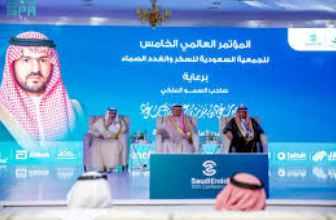
Al-Khobar, Sep 8 (SPA/APP):The fifth international conference on diabetes and obesity updates (Saudi Endo 2025), organized by the Saudi Diabetes and Endocrine Association, has concluded in Al-Khobar.

The event was held under the patronage of Deputy Governor of the Eastern Region Prince Saud bin Bandar bin Abdulaziz, featuring the participation of more than 60 doctors, consultants, and specialists from six Arab and foreign countries.

Discussing updates on diabetes and obesity, Saudi Endo 2025 culminated in seven key recommendations aimed at raising awareness, enhancing prevention and treatment, and improving individuals’ healthy lifestyles.

The recommendations emphasized boosting awareness and prevention efforts, intensifying early screening, and adopting the latest therapeutic technologies.

They also focused on continuous medical education and scientific research. They called for providing comprehensive patient care and supporting health policies that improve the quality of life and reduce the disease burden.

At least 19 killed in Nepal in ‘Gen Z’ protest over social media ban

At least 19 killed in Nepal in 'Gen Z' protest over social media ban

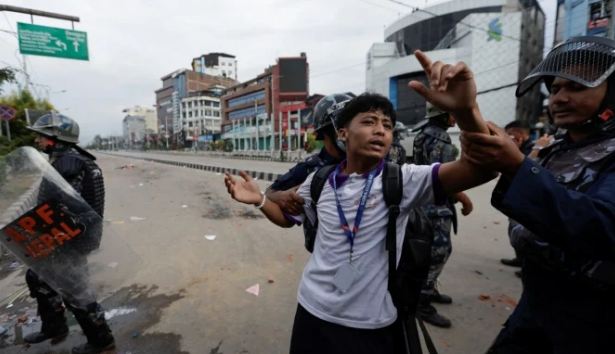
KATHMANDU: Unrest killed at least 19 people in Nepal on Monday, authorities said, as police in the capital fired tear gas and rubber bullets at protesters trying to storm parliament in anger at a social media shutdown and corruption.

Some of the main youth protesters forced their way into the parliament complex in Kathmandu by breaking through a barricade, a local official said, setting fire to an ambulance and hurling objects at lines of riot police guarding the legislature.

“The police have been firing indiscriminately,” one protester told the ANI news agency. “(They) fired bullets which missed me but hit a friend who was standing behind me. He was hit in the hand.”

More than 100 people, including 28 police personne,l were receiving medical treatment for their injuries, police officer Shekhar Khanal told Reuters. Protesters were ferrying the injured tthe o hospital on motorcycles.

Another two people were killed when protests in the eastern city of Itahari turned violent, police said.

Prime Minister KP Sharma Oli called an emergency cabinet meeting to discuss the unrest, which erupted after thousands of young people, including many wearing their school or college uniforms, took to the streets earlier on Monday.

Many carried flags and placards with slogans such as “Shut down corruption and not social media”, “Unban social media”, and “Youths against corruption”, as they marched through Kathmandu.

Organisers of the protests, which spread to other cities in the Himalayan country, have called them “demonstrations by Gen Z”. They say the protests reflect young people’s widespread frustration with government action to tackle corruption and boost economic opportunities.

“This is the protest by the new generation in Nepal,” another protester told ANI.

A government decision to block access to several social media platforms, including Facebook, last week has fuelled anger among the young. About 90% of Nepal’s 30 million people use the internet.

Officials said they imposed the ban because platforms had failed to register with authorities in a crackdown on misuse, including false social media accounts used to spread hate speech and fake news, and commit fraud.

Batons and rubber bullets
Police had orders to use water cannons, batons and rubber bullets to control the crowd and the army was deployed in the parliament area to bolster law enforcement officers, Muktiram Rijal, a spokesperson for the Kathmandu district office, told Reuters.

He said the curfew, which will remain in force until 10 p.m. local time, had been extended to Kathmandu’s Singha Durbar area, which includes the prime minister’s office and other government buildings.

Violence abated later in the evening although protesters remained in the area outside parliament.

Police said similar protests were also held in Biratnagar and Bharatpur in the southern plains and in Pokhara in western Nepal.

Many people in Nepal think corruption is rampant, and the Oli government has been criticised by opponents for failing to deliver on its promises to tackle graft or make progress to address longstanding economic issues.

Thousands of young Nepalis go abroad every year for work and education.

Rameshwore Khanal, a former finance secretary, said although job creation is not up to expectations, popular anger appears to stem more from unhappiness with government appointments and its inability to stamp out corruption.

Nepal’s social media shutdown comes as governments worldwide take steps to tighten oversight of social media and Big Tech due to growing concern about issues such as misinformation, data privacy, online harm and national security.

Critics say many of these measures risk stifling free expression, but regulators say stricter controls are needed to protect users and preserve social order.

Kazakh DPM Nurtleu arrives in Pakistan to ‘cement bilateral ties’

Kazakh DPM Nurtleu arrives in Pakistan to 'cement bilateral ties'

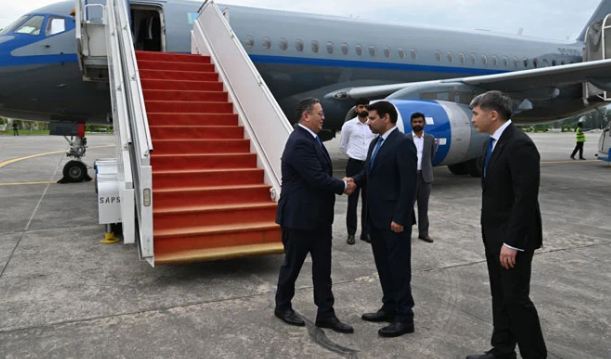
ISLAMABAD: Kazakhstan’s Deputy Prime Minister and Foreign Minister Murat Nurtleu on Monday arrived in Islamabad for a two-day official visit.

The Kazakh DPM was received at the airport by Additional Secretary West Asia Syed Ali Asad Gillani and other senior government officials, said the Foreign Office spokesperson.

The DPM was accompanied by a high-level 13-member delegation, including the minister of transport, FO spokesperson Shafqat Ali Khan said in an earlier press statement.

The Joint Working Groups meetings on Agriculture and IT will also be held on the sidelines of the visit.

During his stay, DPM Nurtleu will hold a tate-a-tete with Deputy Prime Minister and Foreign Minister Senator Ishaq Dar, followed by delegation-level talks.

Nurtleu is also expected to call on President Asif Ali Zardari and Prime Minister Shehbaz Sharif.

The discussions will provide an opportunity to review preparations for the upcoming Presidential visit and to deliberate comprehensively on the entire spectrum of Pak-Kazakh bilateral cooperation, with particular focus on trade and investment, agriculture, education, cultural and tourism exchanges, regional connectivity and logistics, and collaboration at multilateral fora.

“The visit of the Deputy Prime Minister and Foreign Minister of Kazakhstan will further cement the longstanding Pakistan-Kazakhstan ties and contribute to deepening bilateral engagements in diverse fields, for the benefit of the people of the two countries,” the FO spokesperson added.

French Government on the Brink

News Desk

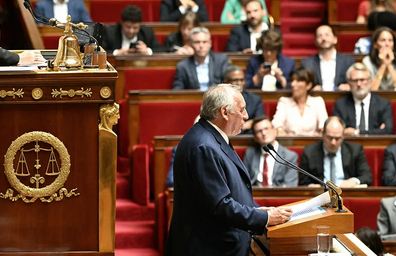
PARIS: The French government is teetering on the edge of collapse as Prime Minister François Bayrou struggles to secure enough support ahead of a crucial vote of confidence in parliament.

Addressing lawmakers, Bayrou described the situation as a “moment of truth,” urging MPs to put aside political divisions and agree on a roadmap to tackle the country’s mounting debt crisis. “France cannot afford paralysis,” he warned, stressing the need for unity at a time of deep financial uncertainty.

Despite a flurry of last-minute negotiations, parliamentary insiders say it appears increasingly unlikely that Bayrou has the numbers to survive the confidence vote. Opposition parties have already signaled their intent to vote against him, while fractures within his own centrist coalition have further weakened his position.

Our Paris correspondent notes that the outcome of the vote could trigger the collapse of Bayrou’s government and open the door to renewed political instability in France. If defeated, President Emmanuel Macron would be forced either to appoint a new prime minister capable of commanding a majority or dissolve parliament altogether, paving the way for snap elections.

The stakes are high: financial markets are watching closely as France struggles with ballooning public debt, rising borrowing costs, and widespread public frustration over austerity measures. A loss for Bayrou would mark the most severe political crisis of Macron’s second term.

Iran offers aid to Afghanistan

Iran offers aid to Afghanistan

TEHRAN,  SEP 08  (DNA) —  Interior Minister Eskandar Momeni has expressed condolences to Afghanistan over the deadly earthquake that struck the country last week and said Tehran was ready to provide assistance to those affected.In a Sunday message to his Afghan counterpart, Sirajuddin Haqqani, Momeni said Iran was prepared to extend “any cooperation and assistance” in the aftermath of the disaster.  

“The recent devastating earthquake in the friendly and brotherly country of Afghanistan, which unfortunately resulted in the death and injury of a number of its citizens, caused deep sorrow for me and the people of the Islamic Republic of Iran,” Momeni said.

He voiced confidence that Afghanistan’s government and people would overcome the tragedy, while reiterating Iran’s readiness to help.A 6.1 magnitude earthquake hit eastern Afghanistan last week, killing more than 622 people and injuring around 1,500, Afghan authorities said.— DNA

Commander UAE Naval forces meets Admiral Naveed Ashraf

Commander UAE Naval forces meets Admiral Naveed Ashraf

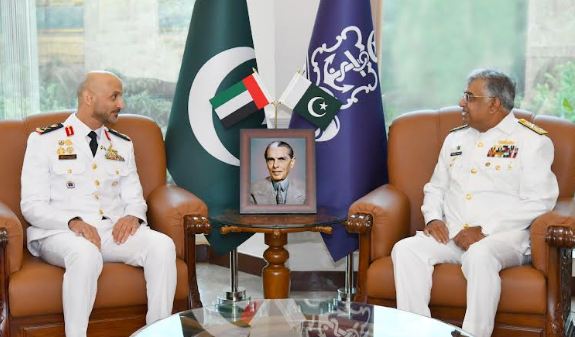
ISLAMABAD, SEPT 8 /DNA/ – Commander UAE Naval Forces, Major General Staff Humaid Mohammed Abdullah Alremeithi visited Naval Headquarters, Islamabad and called on Chief of the Naval Staff Admiral Naveed Ashraf. Upon arrival at the Naval Headquarters, Commander UAE Naval Forces was received by Chief of the Naval Staff. A smartly turned out contingent of Pakistan Navy presented him Guard of Honour. The visiting dignitary was then introduced to the Principal Staff Officers at NHQ.

During the meeting, professional matters, bilateral naval collaboration, various avenues of cooperation including training, exchange of visits and conduct of bilateral naval exercises between the two Navies were discussed . Admiral Naveed Ashraf highlighted Pakistan Navy’s commitment towards promoting maritime stability through Regional Maritime Security Patrols (RMSP). Moreover, Commander UAE Naval Forces acknowledged and appreciated Pakistan Navy’s efforts in ensuring maritime security and fostering regional and global maritime cooperation. A comprehensive brief was also given to the visiting dignitary.

Pakistan Navy and UAE Naval Forces share a long-standing and fraternal relationship. During the formative years of UAE Naval Forces, training facilities and technical advice rendered by Pakistan Navy, laid solid foundation for enduring bilateral ties. A number of senior officers of UAE Naval Forces also received their training from Pakistan Naval Academy.This visit will further strengthen the bilateral collaboration between the two Navies.

Bilawal appeals to PM Shehbaz to reconstruct houses

Bilawal appeals to PM Shehbaz to reconstruct houses

DNA

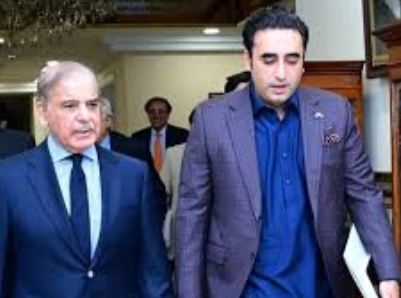
KARACHI: PPP Chairman Bilawal Bhutto-Zardari has appealed to Prime Minister Shehbaz Sharif to rebuild houses destroyed or damaged due to floods in south Punjab.

“The immediate help we’re asking for on an emergency basis right now from the federal government, and I’ve talked to the prime minister himself, we request the premier to immediately provide financial aid to those areas which have been affected by the floods through the Benazir Income Support Programme.”

Sindh Irrigation Minister Jam Khan Shoro said that a flow of 800,000 cusecs of water was moving towards Guddu Barrage from Chachran, but assured that all preparations to deal with a possible super flood had been completed.

Speaking to journalists, the minister said around 200,000 people in the katcha areas could be affected, while 70 relief camps and 40 boats had been arranged for the operation. He added that 30 schools and one health centre between Guddu and Sukkur had already been impacted.

Shoro said the first priority was to shift women and children to safe locations, while water released from Sukkur Barrage was being diverted towards Kotri and onwards to the sea. “InshaAllah, the flood surge will safely pass into the sea,” he remarked.

The minister clarified there was no option of breaching embankments in Sindh, adding that canal flows had not been stopped, and standard operating procedures were being followed to open gates when water levels rose.

The National Disaster Management Authority (NDMA) forecasted more rains in several districts of Punjab, including Gujranwala, Sialkot, Lahore, and Hafizabad, during 12 to 24 hours.

In a statement, it said Faisalabad, Chiniot, Sargodha, Multan, Layyah, Khanewal, and Dera Ghanzi Khan are also expected to receive more rain, while downpours have been predicted for Liaquatpur, Zahir Pir, and Rahim Yar Khan.

The NDMA also forecasted rain in Sindh for 24 hours.

The authority said rains may cause landslides and overflow of drains in low-lying areas. Punjab Education Minister Rana Sikandar Hayat has said that the recent floods have severely affected the education sector of Punjab, stating that over 2,000 schools in the province have been completely or partially damaged.

Hayat said that the Punjab government is trying to ensure that children’s education in flooded districts is not affected or interrupted.

The minister said that the restoration of educational institutions has been ensured by setting up tent schools in flood relief camps on the instructions of Punjab Chief Minister Maryam Nawaz Sharif.

“I have seen determination, courage and faith in the eyes of innocent children in tent schools set up in flood-affected areas,” Hayat was quoted as saying. “The confidence of these children has also increased our morale. If this confidence remains in the children, no one’s dream of education will remain unfulfilled.”

Stay Connected

64FansLike
60FollowersFollow

Latest Reviews

Exchange Rates

USD - United States Dollar
EUR
1.17
GBP
1.35
AUD
0.72
CAD
0.73