Home Blog Page 46

Takaichi Invents a China Crisis

Qamar Bashir

By Qamar Bashir

From the moment Sanae Takaichi stood in parliament and declared that a possible Chinese attack on Taiwan could be a “survival-threatening situation” for Japan, the tectonic plates of East Asian security shifted. Her words this November did more than stir diplomatic tempest: they signalled a decisive step away from Japan’s longstanding post-war pacifism and into a far more volatile era of militarised logic.

The phrase “survival-threatening situation” refers to the controversial 2015 security legislation under Shinzo Abe that permitted Japan’s Japan Self‑Defense Forces (JSDF) to act when Japan’s survival was directly endangered—even if Japan itself was not under attack. Takaichi, widely regarded as Abe’s political heir, now seeks to wrench that framework into a domain far riskier than its original intent.

In the parliamentary session on 7 November, Takaichi tied Taiwan explicitly into that formula: if China moved by warships or other force to bring Taiwan under its control, that would, in her view, meet the threshold for Japan’s intervention. Japan’s Security Council would thereby be triggered. Until then, Tokyo had maintained the diplomatic stance of “strategic ambiguity.” But instead of nuance, a red line was drawn.

Beijing’s response was immediate—and fierce. China’s foreign ministry called the remarks “crude interference” in its internal affairs, asked Japan to retract the comments or “bear all consequences,” and even issued a travel caution for Chinese citizens heading to Japan.  Meanwhile, the Japanese public is sharply divided: according to a recent poll by Kyodo News, 48.8 % said Japan should exercise collective self-defense in the event of a China–Taiwan conflict, while 44.2 % opposed such action. Notably, 60.4 % supported Takaichi’s drive to raise Japan’s defence spending to 2 % of GDP ahead of schedule.

The ripple effects extend far beyond Tokyo and Beijing. Already, the Senkaku Islands (known in China as the Diaoyu) are once again flashing as potential flash-points. On 16 November a Chinese Coast Guard formation sailed through the waters near the islands, citing a “rights enforcement patrol.” The timing was no accident: the patrol followed Takaichi’s remarks by days and underlines Beijing’s willingness to translate diplomatic anger into maritime pressure.

What is unfolding is a brave-yet-reckless recalibration of Japan’s role. On one hand, Takaichi is tackling the undeniable fact that Japan’s western flank now faces a giant neighbour gathering forces, asserting its claims, and threatening to change the status quo. Taiwan lies just 110 km from Japan’s Yonaguni island. A Chinese move across the Taiwan Strait would have direct implications for Japanese sea lines of communication and defence. On the other hand, by linking Japan’s survival to Taiwan’s fate, she is converting long-dormant capabilities into forward-leaning military logic—well beyond the classic self-defence posture.

It is true that under her leadership Japan is moving on several vectors immediately. Within weeks of taking office she has floated raising defence spending, relaxing arms an-export controls, and revisiting Japan’s long-sacrosanct “three non-nuclear principles.” The contours of Japan’s strategic transformation are visible: from self-defence to power projection.

There is, however, a danger of mis-calculation. The architecture of Japan–China relations is still underpinned by four political documents and the one-China policy. Takaichi’s invocation of Taiwan as an existential threat, in Beijing’s eyes, tears at those threads. The Xinhua commentary argued that this was not prudent defence policy but “militaristic adventurism” masquerading as legitimacy. “Plainly not a country with close ties to Japan,” the commentary said of Taiwan—and therefore not eligible under Japan’s survival threshold.

Domestically, Japanese society is wrestling with the new narrative. Many recall that when Japan permitted limited collective self-defence in 2015, public protest rose at the idea of rewriting Article 9 which renounces war. A decade later, the argument is no longer about whether Japan can defend itself—it is whether Japan should prepare to intervene aggressively alongside the U.S. or even independently in a Taiwan contingency. The traditional myth of “Japan as pacifist by default” is fading.

Globally, the United States is watching nervously. Washington values Tokyo as its most reliable ally in the Pacific, but historically the U.S. has maintained strategic ambiguity over Taiwan. Japan’s embedding of Taiwan into its own survival equation complicates that U.S. position—and may lead to Tokyo being the flash-point for U.S.–China escalation. Beijing certainly interprets it that way: “Japan is taking up the role of dragging the United States into confrontation,” the Xinhua commentary stated.

Should this drift continue, the region faces multiple fault-lines. First, Japan may formalise new policy that treats Taiwanese contingencies as threats to its own survival, with equal standing to attack on Japan’s home islands. Second, Japan may transform its Self-Defence Forces into an expeditionary capability suited for overseas intervention—not only in support of allies, but under Japan’s own mandate. Third, diplomatic and economic fallout with China would accelerate. Already tourism from China to Japan is threatened; trade ties and investment flows could follow.

Yet there remains an alternative route: a recalibration rather than escalation. Domestic push-back and regional concerns may force Tokyo to clarify its position and restrain from pushing the Taiwan threshold too far. The United States may pull Tokyo back into alignment on ambiguity. But whether that happens is uncertain—and delayed action risks slipping Japan into a once-avoided diplomacy of force.

The irony is sharp: Japan, whose devastation at Hiroshima and Nagasaki shaped a post-war constitution grounded in pacifism and relief by American defence guarantee, now appears poised to raise its military profile not simply for defence, but for intervention. The shadow of its prior militarism, which invaded — and colonised — other nations, looms large. The question Japan must answer is whether its patriotic defence is a shield or a spear.

In the end, Takaichi’s gambit is a crossing of the Rubicon. By pulling Taiwan inside her “survival-threatening situation” framework, she has torn away the last veil of ambiguity. Japan has claimed the right to act—not in defence of its own soil—but in defence of a regional ally whose fate it now says is its own. That claim may win some admiration in Tokyo; in Beijing it is seen as provocation. And in the wider region it raises a chilling possibility: that the next crisis will not be Taiwan’s alone—but Japan’s too.

If this moment is mishandled, we may witness not just a rhetorical shift, but a strategic pivot—and the region may find itself drawn into a wider conflict far sooner than anyone anticipated. Japan might believe it is merely upgrading its defences; in reality it could be lifting the stage curtain on a return to great-power warfare.

By Qamar Bashir

Press Secretary to the President (Rtd)

Former Press Minister, Embassy of Pakistan to France

Former Press Attaché to Malaysia

Former MD, SRBC | Macomb, Michigan, USA

ICT admin announces key transfers, new appointments

ICT admin announces key transfers, new appointments
ISLAMABAD, Nov 16 (APP/DNA):The Islamabad district administration has issued a new notification announcing several administrative transfers and appointments, including the posting of new assistant commissioners in Nilor, Shalimar, Potohar, and the Industrial Area.

The Islamabad Capital Territory (ICT) administration has reshuffled several officials as part of its latest administrative changes.

According to a notification issued by Director Administration Usman Ashraf, multiple officers have been reassigned to new positions across the district.

Under the new postings, Assistant Commissioner (AC) Nilore, Muhammad Ali, has been transferred and posted as AC Shalimar. The notification states that he will take charge of the new assignment immediately.

The administration has also appointed Ali Naeem as AC Potohar. He had been awaiting a posting, and his new assignment places him in charge of one of the district’s key subdivisions.

In another posting, Grade-17 officer Muhammad Haroon has been appointed as AC Industrial Area. His new role includes oversight of administrative matters in the city’s main commercial and industrial zone.

Meanwhile, a notification has been issued confirming the appointment of Saif-ul-Islam as the new AC Nilore. He will assume the position following Muhammad Ali’s transfer to Shalimar.

Officials said the transfers and new appointments aim to streamline administrative functions across Islamabad’s subdivisions and ensure continuity in field operations.

Shaheen Chowk Underpass nears completion as CDA Chairman reviews progress

Shaheen Chowk Underpass nears completion as CDA Chairman reviews progress
ISLAMABAD, Nov 16 (APP):The Shaheen Chowk Underpass project in Islamabad is progressing steadily, with 80% of the barrel wall work completed and Ramp One walls 60% finished, officials said during a site visit by Capital Development Authority (CDA) Chairman Muhammad Ali Randhawa on Sunday.

The project’s barrel girder work has been fully completed, while earthwork, roadwork, and construction of Ramp Two walls continue around the clock.

Chairman Randhawa, accompanied by Member Engineering Syed Nafasat Raza and other officers, expressed satisfaction with the pace of work.

He emphasized strict adherence to high-quality construction standards and directed attention to landscaping, digital boards, and LED lighting to enhance the underpass’s aesthetics.

“The Shaheen Chowk Underpass will be a key milestone in resolving traffic congestion in Islamabad,” Randhawa said. “It will provide signal-free travel for daily commuters and students in the area, improving mobility and connectivity.”

The chairman instructed the Project Director and Resident Engineers to maintain rigorous monitoring of all ongoing construction activities to ensure the project meets its timelines and quality benchmarks.

Luxury houses eye India, but barriers remain

Luxury houses eye India, but barriers remain

MUMBAI, Nov 16 (AFP/APP): The globe’s biggest luxury brands have dreamt of India’s vast consumer base for decades, but navigating the market has proven to be a complex task.

French retailer Galeries Lafayette is the latest to try its luck, opening its first Indian store on Sunday: a sprawling five-floor outlet in Mumbai, the country’s financial capital.

Its splashy foray into the market is getting a local boost from the fashion arm of the Aditya Birla Group, a major Indian conglomerate.

Luxury expert and Comite Colbert CEO Benedicte Epinay called the arrival of the French department store “an important step”.

India, with 1.4 billion people, offers what Epinay called “a promising market, but still a complicated one”.

Brands must not only overcome high customs duties, a cumbersome bureaucracy and infrastructure limitations, but must also compete with a robust domestic luxury market.

Galeries Lafayette’s Mumbai store of 8,900 square metres (105,000 square feet) has some 280 luxury and designer brands spread across it, according to figures from the French retailer on Sunday.

  Almost all of the brands are foreign, which industry professionals warn is a bold gamble given the rich local clothing culture.

   Galeries Lafayette’s international development director, Philippe Pedone, said at Sunday’s launch more local brands would be added.

   Mumbai resident Sonal Ahuja, 39, told AFP: “I think a lot of brands like Louis Vuitton and Gucci and Dior have been doing a pretty good job at sort of weaving Indian design into their products.”

                  “But at the end of the day, if you want to buy something to wear to a wedding, you will buy (from Indian fashion designers) Sabyasachi or Tarun Tahiliani. Why would you want to buy something foreign that is trying to be Indian?” she said.

                  – ‘Ticks all the boxes’ –

                  India’s luxury market is still relatively small, but expanding rapidly.

                  Valued at $11 billion in 2024, it is set to triple to $35 billion by 2030, said Estelle David, South  Asia  Director at Business France.

                  India’s economy creates tens of thousands of new millionaire households each year.

                  These consumers increasingly splurge on everything from Lamborghini cars to Louis Vuitton bags.

                  “When a luxury house looks at a new country, it considers the number of wealthy people and the rise of a middle class,” Epinay said. “India ticks all the boxes.”

                  The reality is more complex.

                  French luxury giants contacted by AFP declined to comment. Their silence, analysts suggest, reflects a lack of positive things to say about a market widely considered difficult.

                  “They have very little data to show they are making profits or generating a return on investment,” said Ashok Som, from France’s ESSEC Business School.

                  In the early 2000s, the biggest fashion houses eyed India as their next growth engine after China. But the market remains tiny a quarter of a century later, Epinay said.

                  According to Epinay, most brands have only one to three stores in India, compared with 100 to 400 in China.

                  In her view, the only real similarity between the two giants is “the size of their populations”. India lacks China’s “social, linguistic and territorial homogeneity”, Epinay said.

                  India still has limited numbers of premium malls, most of which do not match what customers find in the Middle East, Europe, the United States or China.

                  “India is not at the same stage of development, so it’s very difficult to compare,” Business France’s David said.

                  Galeries Lafayette executive chairman Nicolas Houze said the luxury giant plans to open a second store in Delhi by the end of the decade, with an initial revenue target of 20 million euros ($23 million).

UN, local groups launch ‘We Will Rebuild Gaza’ cleanup campaign

UN, local groups launch 'We Will Rebuild Gaza' cleanup campaign
UNITED NATIONS, Nov 16 (APP/DNA):A large-scale campaign under the slogan “We Will Rebuild Gaza” was launched on Saturday in Gaza City, with the participation of local organizations and United Nations agencies, in an effort to begin cleaning operations and removing mountains of debris left by the Israeli war in yje besieged enclave.

Dozens of participants — including UN officials, volunteers, and residents who recently returned from the south of the Strip — took part in the activities in the city centre, according to a UN report. One participant, a woman in a wheelchair, held up a sign reading “We Will Rebuild Gaza” to express her support for the campaign.

Amjad Al-Shawa, Director of the Palestinian NGO Network, said the initiative represents “a shared message to the world that the people of Gaza are capable of bringing life back to their city.”

He added that specialised engineering teams working on rubble management have begun seeking solutions to deal with more than 60 million tons of debris resulting from the destruction of homes and infrastructure, noting that “today’s volunteer campaign is only the beginning of a long process until Gaza returns more beautiful than it was.”

Alessandro Marakic, an official with the United Nations Development Programme (UNDP), said, “we are here with the local authorities, civil society organizations, and the Chamber of Commerce to start the cleaning operations. What we are witnessing today is people returning to their city and regaining part of their dignity by restoring order to the streets.”

He added that the programme carries out daily solid-waste collection and is currently preparing plans for the winter season to ensure proper management of water and wastewater.

The campaign included the deployment of machinery and trucks to clear debris from the streets, while dozens of workers and volunteers took part in removing waste and cleaning public areas, as part of broader efforts to restore life to the city after many months of war.

King Abdullah II watches joint military drills in Pakistan

King Abdullah II watches joint military drills in Pakistan

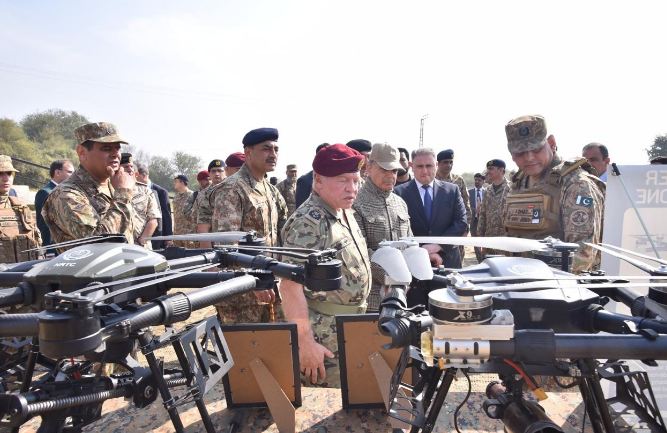
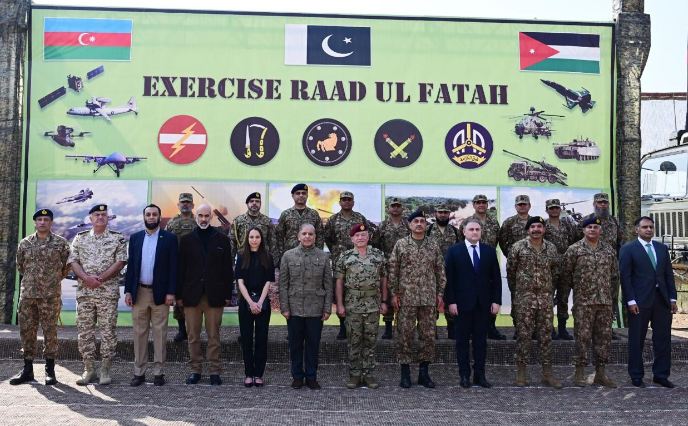
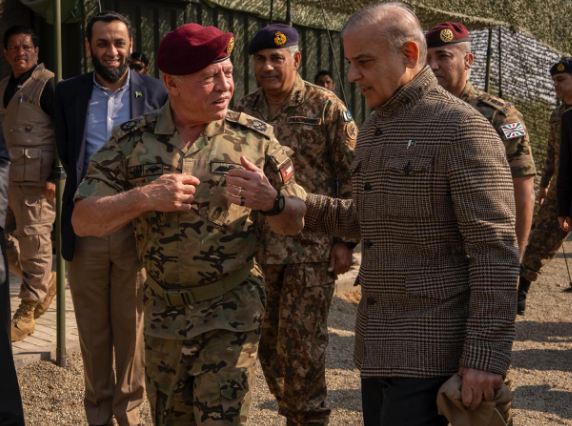
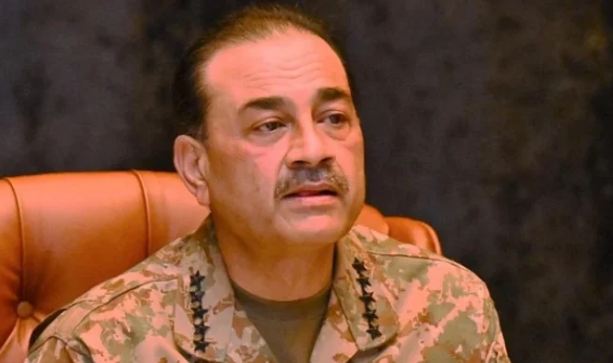
RAWALPINDI, NOV 16 /DNA/ – King Abdullah II ibn Al Hussein, King of the Hashemite Kingdom of Jordan and the Supreme Commander of the Jordan Armed Forces visited Global Industrial & Defence Solutions (GIDS) accompanied by Her Royal Highness Princess Salma bint Abdullah II ibn Al Hussein and delegation of Jordanian civil and military officials. Field Marshal Syed Asim Munir, NI (M), HJ, Chief of Army Staff (COAS) along with other senior officials received the royal guests at the venue.

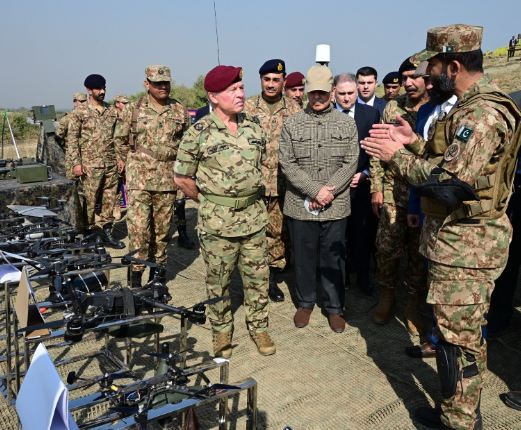
During the visit, His Majesty was given a comprehensive briefing on the structure, capabilities, and product portfolio of GIDS. The briefing showcased Pakistan’s progress in indigenous defence production, technological innovation, and potential avenues for bilateral defence cooperation between Pakistan and Jordan.

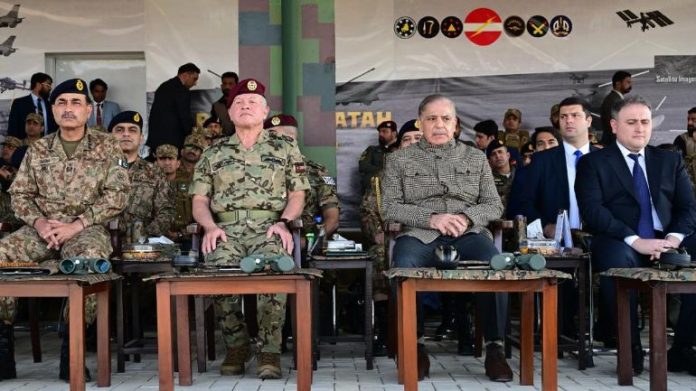
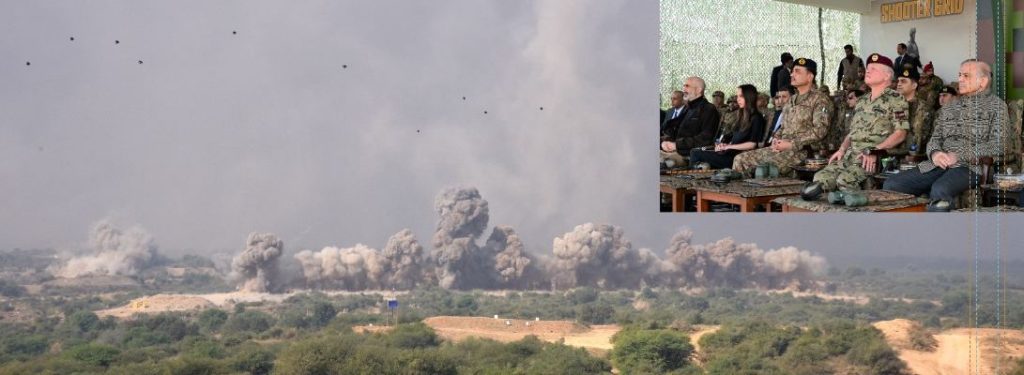
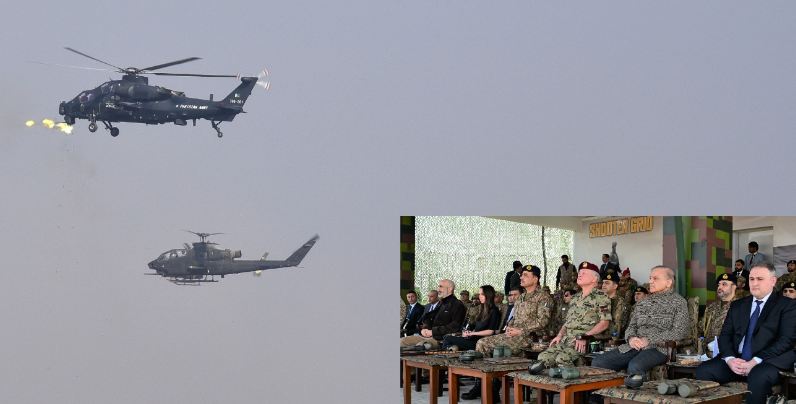
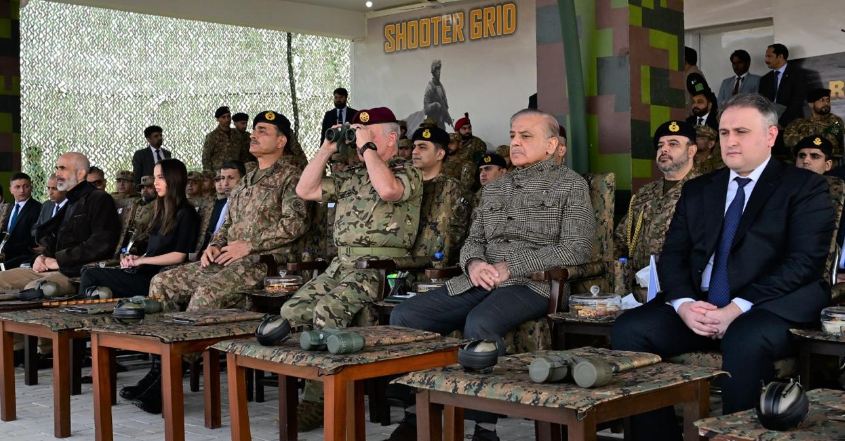
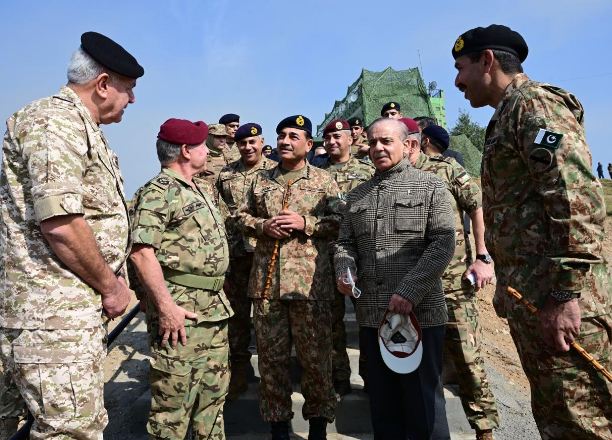
Later, His Majesty King Abdullah II visited the Tilla Field Firing Ranges. Prime Minister Muhammad Shehbaz Sharif also graced the occasion. His Excellency Mr Vugar Valeh oglu Mustafayev, Minister of Defence Industry of the Republic of Azerbaijan was also amongst the distinguished guests at the Firing Ranges.

His Majesty and distinguished guests witnessed a joint fire and manoeuvre exercise. The exercise demonstrated multi-domain operations, including conventional and air firepower, coordinated manoeuvres, spectrum warfare capabilities supported by multi-purpose drones employed in various configurations and roles.

King Abdullah II appreciated the high standards of training, professionalism, and operational capabilities and preparedness demonstrated by the participating troops and aircrews.

On the occasion, Prime Minister Muhammad Shehbaz Sharif expressed Pakistan’s deep respect and affection for His Majesty King Abdullah II and the people of Jordan, noting that the visit reflects the enduring friendship, mutual trust and a shared desire for peace and development.

During the visit, COAS underscored the strong defence partnership between Pakistan and the Hashmite Kingdom. The Field Marshal reiterated Pakistan’s commitment to further enhancing military-to-military cooperation with Jordan and jointly realising the mutual vision of a stable and peaceful region.

Earlier His Majesty conferred upon the COAS the Order of the Military Merit of First Degree, in recognition of his outstanding service and significant contributions to strengthening military cooperation between the Hashemite Kingdom of Jordan and Pakistan.

His Majesty King Abdullah II is on a two day visit to Pakistan which marks a significant milestone in reinforcing the historic bonds of fraternity and brotherhood between Pakistan and the Hashemite Kingdom of Jordan.

Field Marshal Munir vows ‘strong response’ to any future aggression

Field Marshal Munir vows 'strong response' to any future aggression

RAWALPINDI, NOV 16 – Chief of Army Staff (COAS) Field Marshal Syed Asim Munir on Sunday pledged a swift and strong response to any act of aggression against Pakistan.

He, while speaking to Daily Jang at a luncheon hosted for Jordan’s King Abdullah II ibn Al Hussein at the President’s House, raised his finger towards the sky, saying: “I did not lead Pakistan to victory, Allah did.”

“It is Allah’s special blessing that Pakistan’s enemy bit the dust in May. Pakistan’s Army is Allah’s Army, its soldiers fight in the name of Allah,” he added.

The May confrontation between the two neighbouring countries saw Pakistan downing seven Indian fighter jets, including three Rafale aircraft, after India’s unprovoked missile strikes on the night of May 5 and 6, which resulted in the martyrdom of several civilians and security personnel.

India’s strikes came after a terrorist attack on tourists in Indian Illegally Occupied Jammu and Kashmir’s Pahalgam area, which resulted in the killing of 28 men.

New Delhi, without providing any concrete evidence, said the attack was backed by Pakistan, which denies its involvement.

Pakistan then targeted over 20 Indian military sites across multiple regions in a large-scale retaliatory strike, named “Operation Bunyan-um-Marsoos”.

The war between the two nuclear-armed nations ended on May 10 with a ceasefire agreement brokered by the United States.

Shortly after the war, the federal government formally promoted COAS Munir to field marshal for his leadership during the conflict.

Meanwhile, the army chief reaffirmed Pakistan’s commitment to peace. He, however, said that the country would respond firmly to any aggression, similar to its response during the May conflict with India.

Field Marshal Munir, recalling verses from the Quran, said that Allah Almighty has promised believers that with faith they can defeat any enemy, regardless of its strength, adding that Pakistan demonstrated this in May.

As the participants of the meeting began congratulating the field marshal, he asked them to pray for Pakistan’s progress.

The army chief then reiterated his unwavering commitment to fulfil his duties “as commanded by Allah”.

Field Marshal Munir’s remarks came just days after the federal government confirmed that his tenure will restart following his new appointment as Chief of Defence Forces (CDF).

Speaking during a National Assembly session on November 13, Law Minister Azam Nazeer Tarar said that the CDF’s term would be five years from the date of his appointment.

The bill, passed by both the Senate and NA, to amend the Army Act mentioned that the COAS, concurrently the CDF under Article 243 of the Constitution, “the tenure under this section shall commence from the date of notification of the said office”.

King Abdullah of Jordan awarded top Pakistani honour

King Abdullah of Jordan conferred with Nishan-e-Pakistan

ISLAMABAD, NOV 16 /DNA/ – President Asif Ali Zardari received His Majesty King Abdullah II ibn Al-Hussein, King of the Hashemite Kingdom of Jordan, who is on a State visit to Pakistan, at Aiwan-e-Sadr here today.

His Majesty was accompanied by His Royal Highness Prince Ghazi bin Muhammad, Chief Advisor for Religious and Cultural Affairs and Personal Envoy; Mr Ayman Safadi, Deputy Prime Minister and Minister of Foreign Affairs and Expatriates and Major General Yousef Huneiti, Chairman of the Joint Chiefs of Staff.

First Lady Bibi Aseefa Bhutto Zardari; Chairman PPP, Bilawal Bhutto Zardari and Senator Sherry Rehman were present on the occasion.

The two leaders reaffirmed the longstanding and fraternal ties between Pakistan and Jordan and discussed the full range of bilateral relations. They noted the need to build on the strength of these relations and to encourage greater people-to-people contact between the two countries.

They also reviewed regional and international developments of mutual concern, with particular focus on peace, stability and security in the Middle East. Both sides underlined the importance of working together in multilateral forums and of promoting humanitarian and development cooperation.

On Palestine, the President and His Majesty noted the convergence of views and reiterated their shared principled position on post-war Gaza. They rejected any displacement of Palestinians and emphasised the need for a Two-State solution. They called for the establishment of an independent, sovereign, viable and contiguous State of Palestine on pre-June 1967 borders with Al-Quds Al-Sharif as its capital.

His Majesty King Abdullah II expressed pride in the deep-rooted ties between Jordan and Pakistan, reaffirming Jordan’s keenness to expand cooperation across various sectors.

Both leaders expressed confidence in the future direction of Pakistan-Jordan relations and agreed to maintain close coordination on bilateral, regional and global issues.

The meeting was also attended by Deputy Prime Minister and Foreign Minister Senator Mohammad Ishaq Dar; Federal Minister for Climate Change & Environmental Coordination, Senator Musadik Malik; Secretary, Ministry of Foreign Affairs as well as Ambassadors of Jordan in Pakistan and Pakistan in Jordan.

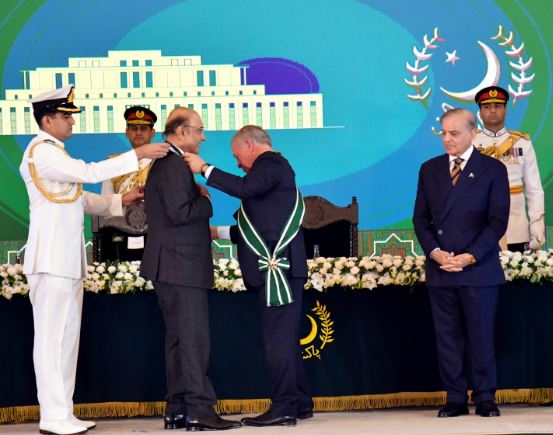
The meeting was followed by a special investiture ceremony in which President Asif Ali Zardari conferred Nishan-e-Pakistan on His Majesty the King of Jordan.

On this occasion, His Majesty the King also conferred on President Asif Ali Zardari the Wisam al-Nahdah al-Mursa‘ (Bejewelled Grand Cordon of Al Nahdah translated as Order of the Renaissance), which is awarded by the King to Heads of State and distinguished dignitaries.

The ceremony was also attended by Prime Minister, Muhammad Shehbaz Sharif; Chairman Senate, Syed Yousuf Raza Gilani; Field Marshal, Syed Asim Munir; Chief of the Air Staff, Air Chief Marshal Zaheer Ahmad Babar Sidhu; Chief of the Naval Staff, Admiral Naveed Ashraf, Cabinet ministers and members of the diplomatic corps.

Later, a state banquet was hosted in honour of the visiting dignitary at Aiwan-e-Sadr.

PRCS convenes global partnership meeting in Kuala Lumpur to expand humanitarian collaboration

PRCS convenes global partnership meeting in Kuala Lumpur to expand humanitarian collaboration

KUALA LUMPUR, NOV 16 /DNA/ – The Pakistan Red Crescent Society held a two-day Partnership Meeting in Kuala Lumpur, Malaysia, bringing together National Societies from across the world. Convened after nine years, the meeting focused on strengthening partnerships, enhancing institutional capacity, and improving humanitarian outreach in Pakistan. By gathering partners in one central location, PRCS aimed to deepen dialogue, mobilize collective resources, and advance cooperation in areas such as Climate Change, Health and Care, and support for Migration and Displacement.

The gathering brought together senior leaders including the President of the Iraqi Red Crescent Society Dr. Yaseen Ahmed Abbas, Regional Director of IFRC Asia Pacific Mr. Alexander Matheou, Head of IFRC Country Delegation in Pakistan Mr. Farid Abdulkadir, Head of ICRC in Pakistan Mr. Christoph Sutter, Head of Office German Red Cross in Pakistan Mr. Asif Aman Khan, Head of Norwegian Red Cross in Pakistan Dr. Ulugbek Khusenovich Aminov, and Head of Turkish Red Crescent in Pakistan Ms. Beyza Tuner. Delegations from the Canadian, Italian, Chinese, Singapore, British, Japanese, Qatari, Australian, and Malaysian Red Cross and Red Crescent Societies, along with corporate partners, also joined the discussions.

PRCS and its provincial branches will prioritize several areas to strengthen humanitarian work nationwide. These include system development to improve transparency and accountability, reinforcing PRCS’s auxiliary role through stronger coordination with government stakeholders, expanding the youth and volunteer network, and strengthening financial sustainability through local partnerships and diversified resource mobilization.

Participants were briefed on the PRCS Transformation Plan and Strategic Plan, highlighting ongoing efforts to improve systems and processes for more effective service delivery. Thematic sessions presented updates on Climate Change Adaptation, Migration and Displacement, and Health and Wellbeing. The second day centered on commitments from partner National Societies, moderated by Alexander Matheou.

Chairperson Mrs. Farzhana Naek welcomed participants and noted that the meeting marks a key step in PRCS’s transformation journey. She thanked partners for their support and expressed hope for stronger collaboration to better serve vulnerable communities.

Dr. Yaseen Ahmed Abbas praised PRCS for creating a platform that brings together partners to strengthen coordination and exchange ideas for a more resilient future. The Heads of Delegation from IFRC and ICRC, along with PRCS Secretary General Mr. Muhammad Abaid Ullah Khan, underscored the growing humanitarian needs in Pakistan and the importance of collective action.

The Chairperson also held sideline meetings with delegations from the Canadian Red Cross, German Red Cross, Red Cross Society of China, and Iraqi Red Crescent Society.

The meeting concluded with a shared resolve to strengthen partnerships and work together to address evolving humanitarian challenges in Pakistan.

PPP holds district meeting in Sanghar to mark 58th Foundation Day on Nov 30

PPP holds district meeting in Sanghar to mark 58th Foundation Day on Nov 30

SANGHAR, NOV 16 (APP/DNA): In line with directives issued by Pakistan Peoples Party (PPP) Chairman Bilawal Bhutto-Zardari to celebrate the party’s 58th Foundation Day at the district level, PPP Sanghar convened a key district meeting at the District Council Hall.

The meeting was presided over by District General Secretary Jahangir Junejo, while PPP Shaheed Benazirabad Division General Secretary Javed Nayab Laghari attended as the chief guest.

The session was attended by District Information Secretary Imran Dhamrah, Chairman District Council Sanghar Syed Riaz Hussain Shah Khurasani, Vice Chairman Nawab Jam Zaheer Ali Khan, Syed Sibtain Ali Shah, Ali Muhammad Khoso, Javed Shoro, Khadim Hussain Khaskheli, Abdul Sattar Khaskheli, Rashid Mughal, Raja Aftab Laghari, Zulfiqar Ali Zardari, Syed Khair Shah Jilani, Gul Muhammad Dahri, Rehana Chandio, Shehla Naushad Baloch, Abida Baloch, Khair-un-Nisa Panhwar and a large number of office-bearers and workers.

During the meeting, the party decided to hold a large public gathering on November 30 at the Gymkhana Ground, Sanghar, to commemorate the Foundation Day. To ensure maximum public mobilisation, special committees comprising taluka presidents, city and union council presidents, and district-wing representatives were formed, which will carry out an extensive public outreach campaign at the UC level.

The committees have also been tasked with conducting awareness campaigns regarding the Shaheed Benazir Bhutto Hari Card distribution programmes. Additionally, a separate committee headed by District Information Secretary Aijaz Zardari was established to oversee media coordination and information management for the event.

Addressing the meeting, Jahangir Junejo, Javed Nayab Laghari, Imran Dhamrah, Syed Riaz Shah Khurasani, Jam Zaheer Ali Khan, Aijaz Zardari, Khadim Hussain Khaskheli and other leaders said that “Shaheed Zulfikar Ali Bhutto rendered historic services for the nation by empowering the poor, labourers and marginalised communities, and by bringing politics out of elite circles and into the reach of the common man.”

They added that the fact that every political party today speaks about the rights of the poor is “a testament to the success of Bhutto’s ideology.”

Stay Connected

64FansLike
60FollowersFollow

Latest Reviews

Exchange Rates

USD - United States Dollar
EUR
1.17
GBP
1.34
AUD
0.67
CAD
0.73