Home Blog Page 457

When Conscience Walked Out

When Conscience Walked Out

by Muhammad Mohsin Iqbal

Cruelty is the darkest stain on the conscience of mankind. It has been condemned in every age, every nation, every faith, and every civilization. Yet, though condemnation is universal, silence often prevails, and silence in the face of cruelty becomes its greatest ally. Islam has enjoined upon its followers to resist oppression with courage.

The Qur’an commands: “And do not incline toward those who do wrong, lest you be touched by the Fire, and you would not have besides Allah any protectors; then you would not be helped” (Surah Hud, 11:113). To oppose tyranny is not an option but a sacred duty. The Prophet Muhammad (peace and blessings be upon him) reminded his followers: “Whoever of you sees something evil, let him change it with his hand; and if he is not able, then with his tongue; and if he is not able, then with his heart, and that is the weakest of faith.”

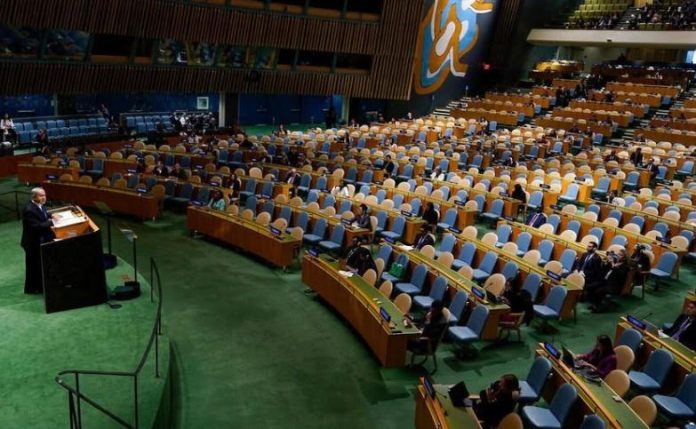
History is a river flowing with both the blood of victims and the resolve of those who defied cruelty. Some sufferings scar individuals, but others crush entire nations. And yet, even in the darkest hours, humanity has shown its ability to rise in protest, to remind the world that cruelty cannot be allowed to reign unchallenged. Such a reminder was given only two days ago in New York, the towering city of the United States, where the United Nations General Assembly convened.

As Israeli Prime Minister Netanyahu addressed the Assembly, seeking to cloak oppression in the language of politics, a rare moment unfolded. Representatives of conscience, unable to bear the weight of hypocrisy, rose from their seats and walked out. The silence of their absence was louder than the noise of his words. It was a gesture that pierced the walls of the Assembly and reached the heart of the world.

Nearly thirty to thirty-five nations took part in this silent yet thunderous protest. Most were members of the Organization of Islamic Cooperation (OIC), joined by countries outside the Muslim world who have long condemned the cruelty inflicted upon Gaza and the occupied West Bank. Their message was clear; they would not remain present to dignify words “divorced from reality,” words that ignored the bleeding wound of Palestine.

The list of these nations carried great weight. From the Arab heartlands—Saudi Arabia, Jordan, Egypt, Iraq, Kuwait, Qatar, and the United Arab Emirates—to the far horizons of Asia—Pakistan, Indonesia, Malaysia, Bangladesh, and Brunei. From North Africa—Morocco, Algeria, Tunisia, Libya, Mauritania, Djibouti, and Somalia—to the shores of South Africa and Namibia, and even Bolivia in Latin America. Lebanon, Syria, Yemen, and Afghanistan also stood in protest. That Bahrain and the UAE, both signatories to the Abraham Accords, chose to join the walkout made the act even more striking. Their message was unambiguous; normalization cannot mean endorsement of tyranny.

The protest was a direct response to Israel’s relentless expansion of illegal settlements, its suffocating siege of Gaza, and its contempt for international law. Netanyahu’s words were dismissed as hollow, as the blood of children in Gaza and the cries of mothers in Palestine testified more powerfully than any speech.

For too long, Gaza has been a place where the world’s conscience faltered. Its skies have been filled with fire, its streets with rubble, its nights with the screams of the wounded and the silence of the dead. Every stone in Gaza carries the memory of a child’s laughter extinguished, every wall torn down by bombs bears the trace of prayers interrupted. Yet even in its suffering, Gaza has become the lantern of truth, forcing the world to look into the mirror of its own humanity.

Now, after years of hesitation, a collective voice has stirred. The Prophet Muhammad (peace be upon him) said: “Help your brother, whether he is an oppressor or oppressed.” His companions asked, “O Messenger of Allah, we help the oppressed, but how do we help the oppressor?” He replied, “By restraining him from oppression.” Those who walked out of the Assembly sought to restrain an oppressor by denying him the legitimacy of their presence.

If the countries that staged this protest unite with resolve beyond symbolism, they have the power to change history. Allah has endowed them with wealth, resources, and influence. Should they stand together with steadfastness, others will rally beside them. The Qur’an promises: “Indeed, Allah commands you to render trusts to whom they are due and when you judge between people to judge with justice” (Surah An-Nisa, 4:58). The trust of our age is to defend the oppressed and to judge cruelty for what it is.

From Gaza to occupied Jammu and Kashmir, from Palestine’s blood-soaked soil to other corners of the world where oppression thrives, the oppressed wait for the dawn of justice. The walkout in New York may be but a beginning, a spark of unity in a fractured world. Yet, it is proof that the advocates of peace are growing in number and that the enemies of peace cannot forever hide behind power.

Cruelty is temporary; justice is eternal. The enemies of peace will one day be humiliated, their cruelty turned into their own disgrace. The cries of Gaza, the prayers of Palestine, the blood of martyrs—these will not be in vain. History has shown that no tyrant lasts forever, but every act of resistance, no matter how small, becomes a seed of victory.

Arch-rivals Pakistan, India set for high-stakes Asia Cup 2025 final in Dubai

Pakistan seek revenge against unbeaten India in Asia Cup final

DUBAI: The stage is set for the grandest showdown of Asian cricket as arch-rivals Pakistan and India face each other in the Asia Cup final for the very first time in the tournament’s history on Sunday.

This evening, the Dubai Sports City Stadium will be transformed into a cauldron of passion, pressure, and pride as the two most celebrated cricketing nations in the region battle for continental supremacy.

The stakes could not be higher, not only because of the glittering trophy at stake but also due to the political undertones and controversies that have marred the lead-up to the final.

The past two weeks have been a rollercoaster. India captain Suryakumar Yadav’s refusal to shake hands after a tense group-stage win and his political remarks at the prize distribution ceremony sparked uproar, drawing strong responses from Pakistan’s Haris Rauf and Sahibzada Farhan, whose gestures on the field fueled the fire.

While India have been in commanding form, winning both their Super Four matches convincingly, Pakistan clawed their way into the final with a nerve-jangling victory against Bangladesh, a result that has injected fresh belief and fire into their dressing room.

With Shaheen Shah Afridi rediscovering his rhythm, Haris Rauf’s pace threatening every batsman, and Salman Ali Agha’s leadership sparking renewed confidence, Pakistan suddenly look like a team capable of upsetting the odds.

Speaking at his pre-final press conference, Pakistan skipper Salman Ali Agha admitted the tension was palpable.

“When it comes to a title-decider, pressure is on both sides. You cannot say which team is better or has more chances. The team committing fewer mistakes will carry the day,” he said, urging his players to seize the moment. Salman emphasised that Pakistan have been saving their best for the ultimate clash.

“Now when we are this close to the title, we will put every ounce of effort into every department. Our batsmen have not shown their full potential yet, but this is the right time to regroup and rise to the occasion,” he added.

On the sensitive issue of Suryakumar Yadav’s conduct, Salman did not hold back.

“I have played cricket all my life. Even our elders say they have never seen captains refusing to shake hands. No matter how heated the contest, Pakistani and Indian captains always set an example in the past. This is against the spirit of the game.”

The Pakistan captain also dismissed the latest Indian media-driven controversy regarding the no-show for the traditional trophy photoshoot.

“That is up to them. We are here to play cricket and focus on the final. Whether they come or not, it changes nothing for us,” he asserted.

Statistically, Pakistan go in as underdogs. They have lost 12 of their 15 T20I encounters against India, a record that does not reflect the immense talent at their disposal. A victory would not only hand them the Asia Cup title but also serve as a symbolic redemption for years of heartbreak.

India, meanwhile, are facing fitness concerns. Abhishek Sharma and Hardik Pandya both limped off during the clash against Bangladesh, and though the team management has remained tight-lipped, their availability for the final remains doubtful. Without two of their key all-rounders, India’s balance could be disrupted at a crucial juncture.

Off the field, anticipation is at fever pitch. Organisers expect a near-capacity crowd for the final, the first of its kind in Dubai since the tournament began.

Tickets have been selling at a good speed, with fans from both nations flying in to witness what is being billed as one of the most significant Indo-Pak contests since the 2024 World Cup clash in New York.

Former players have also added fuel to the build-up. Legendary pacer Wasim Akram predicted a nail-biter:

“India may have the stronger record, but finals are about nerves. Pakistan’s bowling attack can dismantle any side on their day. If the batsmen hold their ground, I see them lifting the trophy.”

As the countdown to the 40 overs of destiny begins, the cricketing world is bracing for a contest where skill will meet nerves, and passion will meet history. One thing is certain on Sunday night, Dubai will not just host a cricket match; it will witness a spectacle for the ages.

Like Playing XIs:
Pakistan (likely): Sahibzada Farhan, Fakhar Zaman, Saim Ayub, Hussain Talat, Mohammad Nawaz, Salman Agha (Capt), Faheem Ashraf, Mohammad Haris (wk), Shaheen Shah Afridi, Haris Rauf, Abrar Ahmed

India (likely): Abhishek Sharma, Shubman Gill, Suryakumar Yadav (Capt), Tilak Varma, Sanju Samson (wk), Hardik Pandya, Shivam Dube, Axar Patel, Kuldeep Yadav, Varun Chakravarthy, Jasprit Bumrah.

BMP urges govt to emulate Nepal’s hydropower model to cut energy costs

BMP urges govt to emulate Nepal’s hydropower model to cut energy costs

Anjum Nisar notes Pakistan’s industrial power at 13.5 cents/kWh versus Nepal’s 6.4 and India’s 8.5–9 cents

ISLAMABAD, SEPT 28 /DNA/ – The Federation of Pakistan Chambers of Commerce and Industry’s Businessmen Panel (BMP) Chairman Mian Anjum Nisar has said Pakistan can no longer afford to lag behind its neighbours in tapping its natural resources for energy security and export earnings, urging the government to learn from Nepal’s recent success in turning hydropower into a regional export industry.

While addressing a delegation of trade and Industry here at PIAF office, he noted that Nepal had moved from chronic power shortages a decade ago to a surplus that now allows it to supply electricity to India and Bangladesh under long-term contracts at tariffs far lower than Pakistan’s domestic rates.

Mian Anjum Nisar pointed out that Nepal’s state-owned Nepal Electricity Authority signed a landmark agreement with Bangladesh earlier this year to export 40 megawatts of surplus power between June and November each year, routed through India’s transmission grid, at an agreed tariff of about 6.4 US cents per unit. This is in addition to more than 360 megawatts of electricity Nepal is already selling into India, with several other projects in the pipeline. “If a mountainous country with a much smaller economy can achieve this transformation, there is no reason Pakistan, with its vast untapped hydropower potential, cannot do the same,” he remarked.

According to Anjum Nisar, Pakistan currently generates roughly 59 per cent of its electricity from imported thermal fuels such as gas, RLNG, coal and oil, while hydropower contributes around 25 per cent and renewables just 5 to 7 per cent. This reliance on imported energy exposes the country to global fuel price volatility and pushes up tariffs for industry and households. Industrial users now pay on average about 13.5 US cents per kilowatt-hour, compared with Nepal’s export price of 6.4 cents and India’s average industrial tariff of about 8.5–9 cents. Even Bangladesh, despite being a power importer, is paying less per unit for some of its supply than Pakistan’s own manufacturers, he said. “We are effectively pricing our industries out of regional markets,” he warned.

He noted that while Pakistan’s hydropower plants, once built, can generate electricity at a low levelised cost — the tariff for major existing hydropower projects averages around 4 to 5 US cents per unit — the share of such projects remains too small because of slow dam construction, regulatory bottlenecks and delayed investment decisions. “The tragedy is that our cheapest energy source is also our most under-utilised. By accelerating projects like Diamer-Bhasha, Mohmand and Dasu, and by streamlining approvals for private sector hydropower, we could double the share of clean, low-cost electricity in less than a decade,” Nisar said.

He argued that Nepal’s model shows the benefits of focusing on indigenous resources, transparent pricing and regional interconnection. Not only has Nepal achieved energy security at home, but it has also begun to earn steady foreign exchange through power exports. Pakistan, he said, should design a policy framework that encourages similar cross-border electricity trade once its own surplus is achieved. “This would stabilise our power sector finances, reduce dependence on imported fuels and create a new export industry for Pakistan,” he said.

Anjum Nisar urged the government to adopt a multi-pronged approach: prioritising hydropower and renewable projects in public sector planning; offering tax breaks and concessional finance for private investors in green energy; tightening controls on theft and distribution losses; and revising the tariff structure to reward efficiency. He also called for a more proactive role by regulators in clearing pending hydropower projects and setting transparent wheeling and transmission rules so that private producers can supply power directly to industrial clusters at competitive rates.

He emphasised that energy policy should be treated as an integral part of industrial and trade policy. “High tariffs are one of the biggest reasons for our export stagnation. If we can lower the cost of electricity through indigenous generation, our textile, engineering and IT industries will regain competitiveness and create jobs,” he said. He added that cheaper, cleaner power would also help Pakistan meet international environmental standards, which are becoming prerequisites for market access in Europe, North America and the Gulf.

Nisar said the government should also look at regional examples of integration beyond South Asia. The European Union, Gulf Cooperation Council and ASEAN have all made cross-border electricity trade a pillar of their economic strategies, allowing countries to balance seasonal surpluses and deficits and attract investment into generation and transmission infrastructure. “Pakistan should not think only in terms of self-sufficiency but also in terms of becoming an energy hub for the region. This requires vision and urgency,” he said.

He concluded by saying that the present moment offers a rare opportunity to reset Pakistan’s energy trajectory. Global investors are increasingly interested in financing green and renewable projects, while technologies for hydropower, solar and wind are becoming cheaper. “If we take decisive action now, we can build an energy system that is affordable, sustainable and export-oriented within the next decade,” he said. “Nepal has shown it can be done. The only question is whether we have the political will to do it faster and at scale.”

ITP Facilitation Vans to serve citizens across Capital from Sept 29 to Oct 5

ITP Facilitation Vans to serve citizens across Capital from Sept 29 to Oct 5

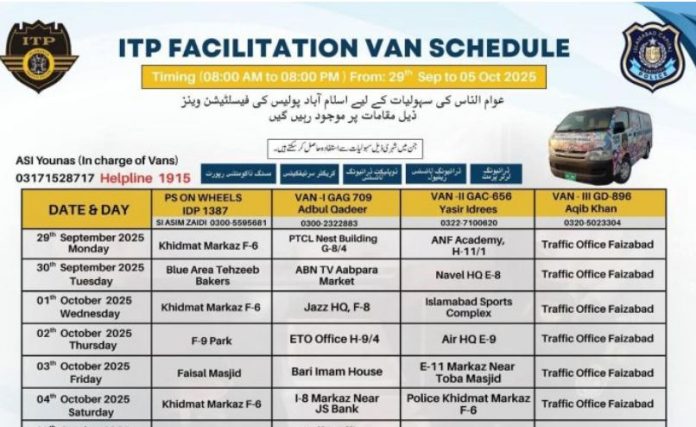
ISLAMABAD, Sep 28 (DNA): Islamabad Traffic Police (ITP) will deploy facilitation vans at different locations across the federal capital from September 29 to October 5, 2025, to provide citizens with easy access to licence-related services.

An official told APP on Sunday that the vans will remain operational daily from 8:00 a.m. to 8:00 p.m., offering licence renewal, duplicate licences, learner permits, and international driving permits.

On September 29 (Monday), vans will be stationed at Khidmat Markaz F-6, PTCL Nest Building G-8/4, ANF Academy H-11/1, while one van will remain at the Traffic Office Faizabad.

On September 30 (Tuesday), facilitation points will include Blue Area Tehzeeb Bakers, ABN TV Aabpara Market, and Navel HQ E-8, in addition to the permanent van at Faizabad.

On October 1 (Wednesday), citizens may avail services at Khidmat Markaz F-6, Jazz HQ F-8, and Islamabad Sports Complex, besides the Faizabad office.

On October 2 (Thursday), vans will be stationed at F-9 Park, ETO Office H-9/4, and Air HQ E-9, along with the Faizabad office.

On October 3 (Friday), services will be provided at Faisal Masjid, Bari Imam House, and E-11 Markaz near Toba Masjid, with the Faizabad van continuing operations.

On October 4 (Saturday), facilitation vans will be at Khidmat Markaz F-6, I-8 Markaz near JS Bank, and Police Khidmat Markaz F-6, along with the Faizabad office.

On October 5 (Sunday), citizens may visit Khidmat Markaz F-6, Traffic Office Faizabad, and Police Line H-11.

He said ASI Younas has been appointed as in-charge of the vans, supported by teams led by SI Asim Zaidi, Abdul Qadeer, Yasir Idrees, and Aqib Khan. Citizens may also contact the ITP helpline 1915 for further guidance.

The ITP reaffirmed that the facilitation vans would ensure convenient, citizen-friendly services at locations close to workplaces and residential areas./APP-rzr-mkz

Islamabad to vaccinate over 461,000 children in October polio drive

Islamabad to vaccinate over 461,000 children in October polio drive

ISLAMABAD, Sep 28 (DNA):Islamabad’s district administration has finalized plans for the upcoming anti-polio campaign, aiming to vaccinate 461,125 children across 80 union councils from October 13 to 19.

Officials said the week-long effort is part of the city’s goal to eliminate the virus once and for all.

A meeting chaired by Deputy Commissioner (DC) Islamabad reviewed the preparations for the October campaign. Senior officers from the district administration and health department attended the session. The officials received a briefing on the targets, past performance, and overall situation of polio in Pakistan.

According to the briefing, the campaign will focus on administering oral polio vaccines to children under the age of five in all 80 union councils of Islamabad. Field teams and health workers have been assigned to reach every household, with mobile units set up for areas where access is difficult.

Officials stressed that 461,125 children is the official target, and every effort will be made to ensure no child is missed. The campaign will also include door-to-door visits by vaccination teams and special counters at public places, schools, and health centers.

The meeting also reviewed the record of polio cases reported from 2016 to 2025. The data was compared with the situation in other provinces to assess Islamabad’s progress against the virus. Officials noted that while significant gains have been made, Pakistan remains one of the few countries where polio has not yet been eradicated.

The Deputy Commissioner underlined the need to address gaps identified during previous campaigns. The review showed that although most children were reached, challenges remain in ensuring consistent coverage in certain areas due to population movement, refusal cases, and logistical issues.

Performance of the most recent polio drive in Islamabad was also discussed. District health officials shared figures on how many children were vaccinated, the percentage of the target achieved, and feedback from monitoring teams.

The session highlighted that while coverage levels were high, there were still instances where children were missed. These were attributed mainly to family refusals, temporary absence of households, or technical problems faced by vaccination teams.

In this regard, the  Deputy Commissioner directed all concerned departments to ensure that every child in the capital must receive the vaccine during the October campaign. He emphasized that field teams must be monitored closely and gaps must be addressed promptly.

He also appealed to parents to cooperate fully with vaccination teams, stressing that their support is critical for success. “No child should remain unvaccinated,” he said, adding that even a single missed case can put others at risk.

Officials reiterated that continued campaigns are essential until polio is completely eliminated in Pakistan. They also stressed that efforts in the capital are closely linked with nationwide strategies, requiring coordination between federal and provincial health authorities.

The October campaign will deploy thousands of health workers, supervisors, and volunteers across the city. Awareness efforts will run in parallel to encourage parents to bring children forward and to counter misinformation about vaccines.

Islamabad’s district administration expressed confidence that the set target of over 461,000 children can be achieved through careful planning, monitoring, and community participation.

The meeting concluded with a call for joint efforts from all stakeholders to make the upcoming campaign a success and move closer to the goal of a polio-free Pakistan.

Army’s swift action saves children’s lives after Bajaur blast

Army’s swift action saves children’s lives after Bajaur blast

PESHAWAR, Sep 28 (DNA): In Bajaur’s Lagharai area the explosive material planted by Khawarij militants went off the other day, killing three innocent children and leaving five others critically injured.

However, the Pakistan Army immediately launched a rescue operation, airlifting the injured children to Peshawar via helicopter.

These critically injured children are now receiving treatment under the supervision of military doctors at CMH Peshawar. This timely action saved several precious young lives.

The children had been playing when they came into contact with the hidden explosives, which suddenly went off.

Police and other relevant authorities cordoned off the blast site and collected evidence. Security officials noted that this incident highlights how the Khawarij terrorists have trapped local communities in deadly networks of explosives.

In the past, similar incidents have taken place, including in the Tirah Valley, where stored explosives belonging to the militants detonated, killing several civilians and 14 terrorists.

This latest blast underscores the militants’ ruthless tactics of using civilian populations as shields, targeting children, homes, and even mosques without hesitation.

The Pakistan Army and security forces, with the cooperation of local residents, have reaffirmed their commitment to clearing Bajaur of explosives and eliminating the threat of Khawarij. Authorities expressed confidence that with public support, Bajaur will soon be freed from the militants’ deadly traps.

Guinea presidential vote set for December 28

Guinea presidential vote set for December 28

CONAKRY, SEPT 28 (AFP/APP/DNA): Guinea’s presidential election will be held on December 28, the presidency of the junta-ruled country announced in a decree read out on state television Saturday.

The announcement came a day after the Supreme Court confirmed the result of a referendum to approve a new constitution, paving the way for the elections.

Opposition parties had called on voters to boycott the referendum that was held September 21, accusing General Mamady Doumbouya of using it to stay in power.

But the Supreme Court rejected a request they filed Friday for its result to be annulled.

The signs suggest that Doumbouya will run for the presidency, despite an earlier promise that he would not.

Guinea, an impoverished nation in west Africa, has long been blighted by coups and violence from authoritarian regimes.

When the military toppled president Alpha Conde in 2021, it initially said it would return the country to civilian rule by 2024, before reneging on that commitment.

United Nations rights chief Volker Turk called on Thursday for the military regime to lift bans on opposition parties and media outlets.

He also criticised what he said was a broader assault on fundamental rights in Guinea since the coup, referring to a rise in arbitrary arrests and enforced disappearances.

Russian missile and drone barrage kills four in Kyiv

Russian missile and drone barrage kills four in Kyiv

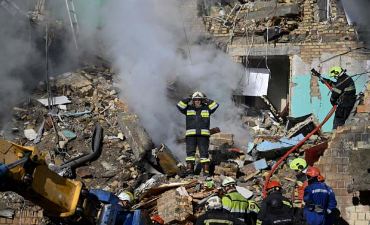
Kyiv, Sept 28 (AFP/APP/DNA):Ukraine said Sunday that Russia had pounded the country with hundreds of drones and missiles overnight for hours, killing at least four people in the capital alone.
                  Neighbouring Poland scrambled jets to secure its airspace in the wake of the barrage, after NATO accused Moscow of being behind a series of violations of the defence alliance’s airspace.
                  Diplomatic efforts to stop the war, now nearing its fourth year, have faltered, while Russia has vowed to press on with its offensive.
                  “Moscow wants to continue fighting and killing and deserves only the harshest pressure from the world,” Ukrainian President Volodymyr Zelensky said following the strikes, which lasted for 12 hours.
                  “The Kremlin benefits from continuing this war and terror as long as there are profits from energy sales,” he added, urging stronger measures against Russia from Kyiv’s allies.
                  The Ukrainian leader vowed his country would target Russia’s ability to fund the war and force Moscow to diplomacy.
                  He posted a video of residential buildings caught up in flames, with emergency services putting down fires and rescuing people from shattered buildings.
                  Besides the dead, which included a 12-year-old girl, more than 40 people were wounded in the Zaporizhzhia, Odesa, Sumy, Cherkasy and Mykolaiv regions, Ukrainian authorities said.    
                  More victims could be uncovered as rescuers went about their jobs, they warned.
                  Apart from residential buildings, a cardiology centre and a kindergarten were among the targets across the country, Ukraine’s foreign ministry said.  
                  Andriy Yermak, the head of Ukraine’s presidential office, accused Moscow of waging a “war against civilians”, urging greater action from Kyiv’s Western allies.
                  “There will be a response to these actions. But the West’s economic blows against Russia must also be stronger,” Yermak said.
                  Russia rained down 643 drones and missiles, including glide bombs, across eastern, central and southern Ukraine, Ukraine’s General Staff said.
                  The attacks came after Russia warned NATO against taking sterner action in response to alleged incursions into airspace covered by the military alliance.

Taliban govt welcomes Russia, China, Iran and Pakistan’s stance

Taliban govt welcomes Russia, China, Iran and Pakistan’s stance

Bagram Air Base served as the linchpin for US operations in the rugged country, where the long war against the Taliban and their Al Qaeda allies was fought with air strikes and resupply missions from the airfield

News Desk

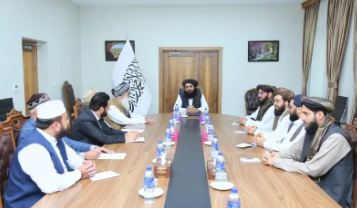
ISLAMABAD: The Afghan government has welcomed the position taken by Russia, China, Iran and Pakistan against the establishment of foreign military bases in Afghanistan, Taliban government deputy spokesperson Hamdullah Fitrat said on Saturday.

His statement, shared with journalists, came days after foreign ministers of the four countries held a meeting on the sidelines of the 80th United Nations General Assembly in New York. A joint statement was issued after the quadripartite consultation, which is being held since 2017 and is aimed at promoting reg­ional stability and coordinating efforts to counter terrorism, narcotics, and extremism emanating from Afghan territory.

The joint statement, also shared by Pakistan’s Foreign Office on X, said: “The four sides emphasised that the sovereignty, independence and territorial integrity of Afghanistan should be respected, firmly opposed the re-establishment of military bases in and around Afghanistan by the countries responsible for the current situation, which is not conducive to regional peace and security.”

While the joint statement did not refer to any specific country seeking bases in Afghanistan, it follows one by US President Donald Trump where he said Washington was trying to get Bagram air base in Afghanistan back.

Bagram Air Base served as the linchpin for US operations in the rugged country, where the long war against the Taliban and their Al Qaeda allies was fought with air strikes and resupply missions from the airfield. In July 2021, all US and Nato troops left Afghanistan’s biggest air base, signalling the complete withdrawal of foreign forces from the country after two decades of war.

After his initial statement about Bagram in the United Kingdom, Trump had threatened Afghanistan last with unspecified consequences if it refused to give the control of the Bagram air base to the US.

For their part, the Taliban government in Afghanistan rejected his demand.

Why Donald Trump is so kind towards Pakistan?

Why Donald Trump is so kind towards Pakistan?

Beyond trade, Pakistan’s geographic centrality remains indispensable to U.S. interests. Afghanistan, though no longer a primary U.S. military theater, still looms large in Washington’s strategic thinking

Centreline Report

The relationship between the United States and Pakistan has long been a rollercoaster of strategic necessity, punctuated by periods of deep mistrust. However, the tenure of President Donald Trump, particularly his second term, has seen a remarkable shift, with a conspicuous warming of ties that contrasts sharply with his earlier public criticisms. This pivot is not rooted in altruism, but in a series of calculated, transactional moves driven by geopolitical expediency, regional dynamics, and economic self-interest.

Trump’s “kindness” towards Islamabad, particularly evident in recent high-level meetings and favorable trade arrangements, is fundamentally a reflection of his transactional foreign policy approach. Washington has recently concluded a trade deal with Pakistan and shown keen interest in developing Pakistan’s mineral wealth and its claimed “massive oil reserves.” For an administration laser-focused on business, resource security, and energy diversification, the promise of new, significant, and potentially fast-tracked sources of energy and rare minerals is too attractive to ignore. Lower tariffs on Pakistani exports, compared with regional rivals like India, further sweeten the deal.

Beyond trade, Pakistan’s geographic centrality remains indispensable to U.S. interests. Afghanistan, though no longer a primary U.S. military theater, still looms large in Washington’s strategic thinking. A stable but pliable Afghanistan is essential for preventing the re-emergence of terrorist sanctuaries and for maintaining a regional foothold. Pakistan’s influence over Afghan factions, coupled with its ability to facilitate or obstruct U.S. access to the region, makes Islamabad a crucial partner.

By courting Pakistan, Trump ensures that Washington retains a back channel into Afghanistan—whether for counterterrorism cooperation, intelligence sharing, or as leverage against other actors like Russia and Iran who seek to fill the void left by America’s drawdown. In this sense, Trump’s pivot is both a hedge and an insurance policy, ensuring U.S. relevance in a volatile neighborhood.

Another layer in this recalibration is Iran. U.S. hostility toward Tehran has only intensified, with sanctions, diplomatic isolation, and military posturing forming the core of Washington’s approach. Pakistan’s proximity to Iran, coupled with its longstanding ties to the Gulf monarchies, makes it a potential partner in containing Iranian influence.

While Islamabad has historically walked a fine line between Riyadh and Tehran, Trump sees value in nudging Pakistan closer to the Saudi-led security framework. The recently signed Pakistan-Saudi Arabia Defence Agreement reinforces this dynamic, offering Washington indirect leverage over Gulf security through Islamabad’s growing role as a “net security provider” in the Muslim world.

In Trump’s calculus, a Pakistan aligned more closely with Riyadh weakens Tehran’s ability to expand influence westward and further isolates Iran diplomatically—a goal squarely in line with U.S. strategic aims.

Perhaps the most consequential backdrop to Trump’s pivot is China. Pakistan has been a cornerstone of Beijing’s Belt and Road Initiative through the China-Pakistan Economic Corridor (CPEC). For years, Washington dismissed Pakistan as firmly in China’s orbit. Yet Trump’s approach reveals a subtle recognition: engaging Pakistan does not mean dislodging it from China, but rather complicating Beijing’s monopoly over Pakistan’s loyalties.

By dangling trade incentives, resource investment, and political recognition, Trump hopes to create wedges that limit Beijing’s ability to use Pakistan as an uncontested strategic asset. Even modest successes—such as drawing Pakistan into U.S.-brokered economic initiatives or encouraging Islamabad to balance ties—would be counted in Washington as strategic wins against China’s unchecked influence in South Asia.

Beyond economics and geopolitics, the personal style of Trump—equal parts showmanship and transactional deal-making—has played a role. The Pakistani leadership has adeptly played to Trump’s ego, crediting him with brokering the 2025 ceasefire with India and even floating a Nobel Peace Prize nomination. Such symbolic gestures appeal to Trump’s desire for validation and legacy, making him more amenable to Islamabad’s overtures.

In essence, Donald Trump’s apparent kindness to Pakistan is less about unconditional support and more about a calculated strategy to secure a quick return on investment—whether in trade, energy, Afghanistan, or balancing regional rivals like Iran and China. It is a pragmatic, quid pro quo relationship, moving away from a traditional security-first framework to one driven by transactional economics and tactical alignments.

This explains not only the speed of the recent rapprochement but also its fragility. The historical baggage of mistrust remains, yet Trump’s pivot demonstrates how quickly old patterns can be reshaped when immediate gains align with broader U.S. strategic objectives.

Stay Connected

64FansLike
60FollowersFollow

Latest Reviews

Exchange Rates

USD - United States Dollar
EUR
1.14
GBP
1.34
AUD
0.69
CAD
0.71