Home Blog Page 456

EU pledges nearly $638M for Africa’s renewable energy transition

EU pledges nearly $638M for Africa’s renewable energy transition

ISTANBUL, Sep 29 (AA/APP):The European Union has pledged nearly €545 million (about $638 million) to support renewable energy projects across Africa, aiming to boost electricity access, strengthen regional power grids, and accelerate the continent’s transition to clean energy.

European Commission President Ursula von der Leyen announced the package via video message at the Global Citizen Festival, held alongside the UN General Assembly, the Commission said in a statement on Saturday.

“The choices Africa makes today are shaping the future of the entire world. A clean energy transition on the continent will create jobs, stability, growth, and the delivery of our global climate goals,” von der Leyen said.

The statement said Africa has vast renewable energy potential, but nearly 600 million people still lack electricity, and the continent’s clean energy transition will play a key role in development, regional stability, and climate progress.

The package will fund projects in the Ivory Coast, Cameroon, the Republic of Congo, Lesotho, Ghana, the Central African Republic, Madagascar, Mozambique, and Somalia.

Mashhood launches National Youth Employment Policy to boost jobs, green economy

Mashhood launches National Youth Employment Policy to boost jobs, green economy

LAHORE, Sep 29 (APP):Prime Minister’s Youth Programme (PMYP) Chairman Rana Mashhood Ahmad Khan said on Monday the government was opening new avenues of employment for youth both at home and abroad, with countries including Qatar, Saudi Arabia, the United States, Turkiye, and Belarus offering opportunities for Pakistani workers.

Unveiling the salient features of the National Youth Employment Policy (NYEP) at Aiwan-e-Iqbal, here on Monday, he announced a comprehensive package of measures, including overseas employment opportunities for up to 1.8 million Pakistani youth, establishment of employment exchanges in every district, registration of new businesses, and the launch of green jobs to productively engage young people. “The doors of opportunities have opened internationally, and we are preparing our youth to fully benefit from them,” he remarked.
Rana Mashhood said that despite the enormous challenges posed by recent floods, Pakistan had gained recognition at the international level, creating new prospects for collaboration in education, skills, and employment. He underlined that the policy, initiated under the leadership of Prime Minister Shehbaz Sharif during the PDM government, had now been further strengthened to ensure continuity and greater impact.
Highlighting the scope of the policy, he said it was designed for all segments of youth, whether enrolled in schools, colleges and universities, or those who are currently out of the education system. “Every young Pakistani must be given the chance to shape a dignified life,” he said, adding that women would be an integral part of employment programmes up to 2029.
He informed that a dedicated committee on technical education and IT, headed by the Prime Minister, meets every two months to review progress and expand initiatives to reduce unemployment. He said that along with providing overseas job opportunities, the policy would equip young people with essential language and professional skills.
Rana Mashhood announced that ten new businesses would be registered to encourage entrepreneurship and innovation. He added that youth involved in negative activities would also be rehabilitated and provided constructive opportunities under initiatives like green jobs. He said that employment exchanges were being established in every district to facilitate job seekers not only through online platforms but also through doorstep services.
The Chairman said that the National Youth Employment Policy is a landmark step to address unemployment, empower the young generation, and transform them into a driving force for Pakistan’s progress.

India overpowers Pakistan by 5 wickets to lift Asia Cup Trophy

India overpowers Pakistan by 5 wickets to lift Asia Cup Trophy

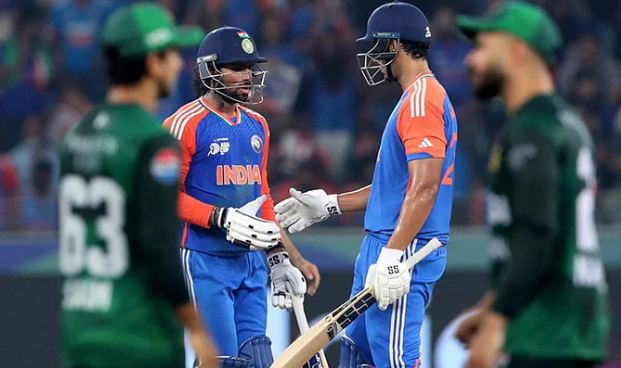
DUBAI: Middle-order batter Tilak Varma’s anchoring half-century helped India down Pakistan and win the ACC Men’s T20 Asia Cup 2025 here at the Dubai International Cricket Stadium on Sunday.

Set to chase a modest 147-run target, the reigning world champions had to do hard yards to eventually knock the winning runs in 19.4 overs after losing five wickets.

India got off to a dismal start to the pursuit as Faheem Ashraf and Shaheen Shah Afridi ran through their top-order, dismissing in-form Abhishek Sharma (five), skipper Suryakumar Yadav (one) and Shubman Gill (12) cheaply and reducing them to 20/3 in four overs.

Following the disastrous start, middle-order batters Varma and Sanju Samson launched an astounding recovery by putting together 57 runs off 50 deliveries until the latter was sent back by Abrar Ahmed in the 13th over.

The wicketkeeper batter mustered 24 off 21 deliveries with the help of two fours and a six.

Varma was then joined by all-rounder Shivam Dube in the middle, and the duo batted sensibly under pressure to add crucial 60 runs for the fifth wicket until Faheem struck again in the penultimate over, dismissing the latter, who made 33 off 22 with the help of two sixes and as many fours.

Tilak Varma, on the other hand, batted until the end and top-scored with an unbeaten 69 off 53 deliveries, studded with four sixes and three fours.

Faheem was the pick of the bowlers for Pakistan, taking three wickets for 29 runs in his four overs, while Abrar and Shaheen could pick up one apiece.

India captain Suryakumar Yadav’s decision to bowl first eventually proved beneficial as his team’s bowling unit made a strong comeback to bundle out Pakistan for 146 in 19.1 overs.

The Green Shirts got off to a commanding start to their innings as their opening pair of Sahibzada Farhan and Fakhar Zaman yielded a quickfire 84 runs inside the halfway mark.

Top-ranked T20I bowler Varun Chakravarthy eventually broke the crucial partnership in the 10th over by getting Pakistan’s mainstay Farhan caught at deep mid-wicket.

The right-handed opener remained the top-scorer for Pakistan with 57 off 38 deliveries, studded with five fours and three sixes.

Following his departure, out-of-form Saim Ayub joined Fakhar for a brief 29-run partnership until falling victim to Kuldeep Yadav in the 13th over, contributing 14 off 11 deliveries with the help of two boundaries.

His dismissal sparked a middle-order collapse which saw Pakistan lose six more wickets, including that of set batter Fakhar, in the span of 25 deliveries and consequently slipped to 134/8 in 17 overs.

Fakhar remained a notable run-getter for Pakistan with his 35-ball 46, comprising two sixes and as many fours.

Yadav was the standout bowler for India, taking four wickets for 30 runs in his four overs, while Axar Patel, Jasprit Bumrah and Chakravarthy chipped in with two each.

Sumud Flotilla To Gaza: Humanity at Sea

Qamar Bashir

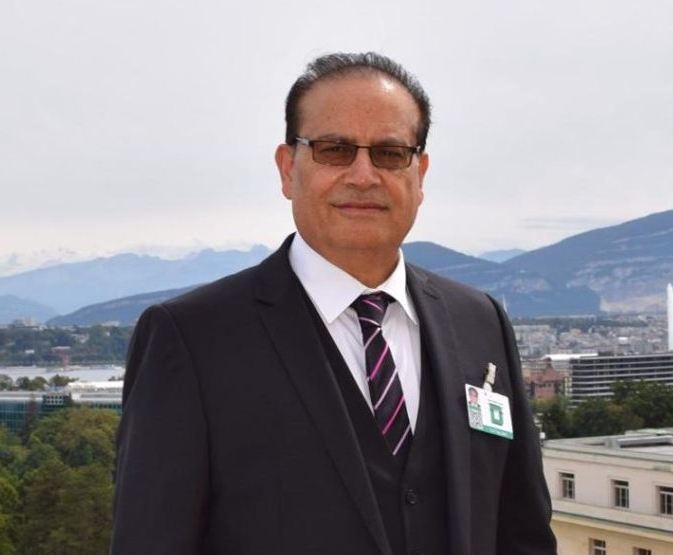
By Qamar Bashir

They said humanity would stand by while Gaza was starved. They said states would avert their eyes as children cried for bread and water. Yet when Muslim governments folded, when Western nations chose silence, and when the United Nations looked on powerless, civil society — that stubborn conscience of the world — took up the mantle. In this desperate week of insensitivity and inability, ordinary men and women filled the vacuum left by governments, setting sail with aid that should have been delivered through corridors of diplomacy and justice.

Thus emerged the Global Sumud Flotilla, a fleet of resolve as much as vessels, charting a dangerous course across the Mediterranean. Some fifty small ships and boats, crewed by activists, lawyers, journalists, parliamentarians, and volunteers from over forty countries, embarked on a mission larger than their holds. They carried roughly a hundred tons of food, medical supplies, and water, but above all they carried the moral weight of seven billion people whose red blood still insists that dignity and survival are not negotiable.

Israel had not expected such defiance from civil society. Used to intimidating states and dictating conditions, it now faced fragile ships bearing the courage of the people. Almost immediately, the flotilla was harassed. Off Greek waters, drones swooped low; explosions and stun devices rattled decks, activists claimed. In Tunisia, a fire consumed a key aid boat, which organizers blamed on a drone strike though authorities denied it. Mechanical breakdowns added to the peril — one vessel, the Family Boat, suffered catastrophic failure and lagged behind. Yet despite disruption and fear, the flotilla pressed forward. Their blood was red, their purpose unwavering, and no intimidation could deter them.

As the convoy pushed closer to Gaza, the unexpected happened: two European governments decided to stand visibly with it. Spain ordered a naval ship from Cartagena to monitor and assist the flotilla, declaring that the aid boats posed “no threat to Israel.” Italy, condemning the drone attacks as “intolerable,” dispatched a frigate to protect its nationals onboard and signaled its support for a humanitarian sea corridor. Their escorts are not overwhelming fleets, but their symbolism looms large. For the first time in years, EU states placed themselves — even cautiously — between Israel’s blockade and the conscience of the world.

Yet symbolism alone cannot carry the weight of a humanitarian crisis. Now is the moment for powerful states that still possess diplomatic and kinetic leverage — Turkey, Saudi Arabia, China, France, Germany, the United Kingdom, Pakistan and others — to move beyond statements and commit real protection and logistical support. If these nations deploy naval escorts, open safe corridors, offer port facilities, and use every lawful means at their disposal to protect civilian ships, the flotilla’s mission could be made safer and the principle of saving lives reinforced. Such collective resolve would signal that the world’s conscience is not merely rhetorical but backed by governments willing to defend humanitarian action.

Israel’s response has been unyielding. Foreign Minister Gideon Saar warned in stark terms that Gaza’s coastal waters are a “combat zone” and that no ship will be allowed to enter. Officials insist that if aid is genuine, it should be offloaded at Ashkelon port, under Israeli control, from where Israel promises to transfer it into Gaza. Yet the promise rings hollow: for months Israel has restricted and slowed aid to a trickle, starving civilians under siege. For the flotilla, docking at Ashkelon would betray the very principle of their voyage — delivering aid directly to the starving without Israel’s interference. The organizers have therefore refused.

Now the confrontation nears its climax. The flotilla lies a few hundred nautical miles from Gaza, with organizers estimating arrival within days. Israeli naval forces are reportedly mobilized to intercept them, echoing the bloody precedent of 2010 when a raid on the Mavi Marmara left activists dead and the world in uproar. The fear is palpable that history could repeat itself, that once more peaceful civilians will meet armed commandos in international waters.

But whether or not the ships succeed in reaching Gaza’s shore, the symbolic victory is already secured. This flotilla embodies the conscience abandoned by states. It represents the mothers in Europe, the students in Asia, the workers in Africa, the citizens of the United States — all who see starvation as an abomination and refuse to reduce Palestinian survival to a bargaining chip. By taking the risk states would not, the Global Sumud Flotilla has already pierced the blockade of indifference.

And yet the test is cruelly real. On one side, determined civilians sail with supplies of life. On the other, a powerful military insists they must be stopped. Between them lies not only the fate of cargo, but the very question of whether humanity still has meaning in the face of brute force. If Israel crushes the flotilla, it will deepen the stain already seared onto its name: the deliberate starvation of two million souls. If the flotilla prevails, it will write a chapter where people, not governments, rose to redeem humanity.

This is no longer about tonnage of aid. It is about moral freight. It is about whether law serves power or whether it can still protect the powerless. It is about whether the hunger of children can outweigh the pride of armies. And as the boats draw closer to Gaza, the world is forced into its own reckoning: stand with humanity, or stand aside as cruelty sails unhindered.

Let us hope, in these decisive hours, that the flotilla prevails. Let us hope that the dignity of human life triumphs over siege, that courage outweighs cruelty, and that the Mediterranean does not become yet another graveyard of hope. For in these boats, humanity itself is on board. And history will judge not only what becomes of them, but what becomes of us all.

By Qamar Bashir

Press Secretary to the President (Rtd)

Former Press Minister, Embassy of Pakistan to France

Former Press Attache to Malaysia

Former MD, SRBC | Macomb, Michigan, USA

Shama claims PM included her name in delegation

Shama claims PM included her name in delegation

News Desk

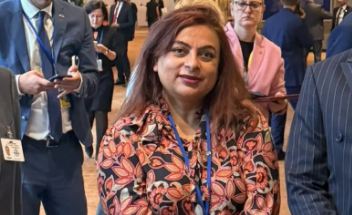
LONDON: The controversy surrounding the supposed inclusion of columnist and social media activist Shama Junejo in Pakistan’s delegation to the United Nations this week took a new turn on Sunday when she claimed that Prime Minister Shehbaz Sharif had included her among the delegates as an adviser.

The controversy had surfaced when photos from Defence Minister Khawaja Asif’s address at a UN Security Council session on artificial intelligence (AI) spread like wildfire on social media platform X, with users pointing to Junejo sitting in the background. Several of them also shared screenshots from her Twitter (now X) timeline from several years ago, expressing support for Israel — a position sharply at odds with Pakistan’s longstanding pro-Palestinian stance.

After social media furore, Asif said on X that only the Foreign Office could explain Junejo’s presence at the session. Later, the FO clarified that she had not been part of Pakistan’s accredited delegation.

Following that, Asif also spoke about the matter on Geo News programme ‘Naya Pakistan’. Asked whether he was “taken aback” by the FO’s statement, Asif emphatically said: “I was taken aback, rather I was a bit disturbed that such people could be with the delegation whom no one owns later.” He also denied Junejo having written PM Shehbaz’s speech for the 80th UN General Assembly session, further stating that as far as he knew, she did not have any official position, be it of an adviser or a special assistant.

China sends monsoon relief aid to flood-hit Pakistan

China sends monsoon relief aid to flood-hit Pakistan

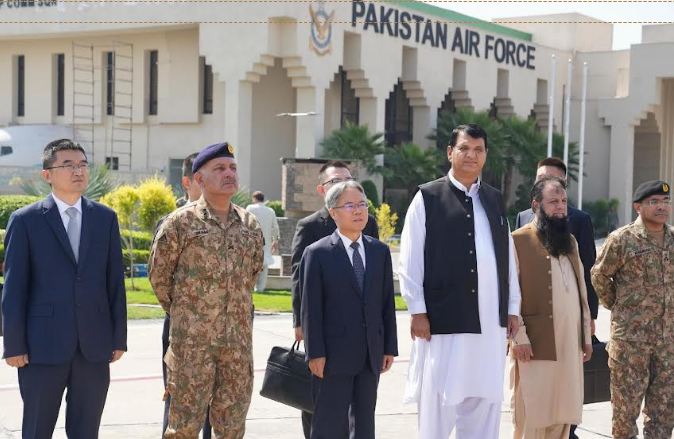
ISLAMABAD, SEPT 28 /DNA/ – The People’s Republic of China has once again reaffirmed its role as Pakistan’s steadfast friend by extending Monsoon Relief Assistance for the flood-affected people in Pakistan through NDMA. It will augment the NDMA’s relief support for flood affected areas in Punjab. Two Chinese relief flights carrying 300 tents and 9,000 blankets landed today at Nur Khan Air Base, Rawalpindi, to support families displaced by the recent floods. This gesture underscores China’s enduring solidarity with Pakistan in times of difficulty.

The reception ceremony was attended by Federal Minister Engr. Amir Muqam as Chief Guest, along with Chairman NDMA Lt Gen Inam Haider Malik, Chinese Ambassador to Pakistan, H.E. Mr. Jiang Zaidong and representatives of MOFA and NDMA.

Speaking on the occasion, the Federal Minister expressed deep gratitude to the Government and people of China for their prompt support, noting that the assistance will bring much needed relief to thousands of flood affected families. He emphasized that Pakistan, under the leadership of the Prime Minister and with NDMA at the forefront, is mobilizing all available resources to ensure swift relief and recovery efforts in the flood hit areas.

He added that China’s contribution is not only a humanitarian endeavor but also a reaffirmation of the everlasting Pakistan China friendship a bond described as higher than the Himalayas, deeper than the ocean, and stronger than steel.

The Minister reaffirmed the Government of Pakistan’s resolve, in coordination with NDMA and with the support of friendly countries like China, to overcome the challenges posed by the floods and ensure the rehabilitation of the affected population.

Attock journalists demanded to retrieve the occupied building of Attock Press Club 

Attock journalists demanded to retrieve the occupied building of Attock Press Club 

Qazi Shoaib Khan 

ATTOCK 28th sep,A well-attended meeting regarding the Attock Press Club building was held at a local hotel, in which journalists associated with national newspapers and news channels participated actively. Addressing the meeting, former General Secretary of Attock Press Club (Registered), Hafiz Shehzad Akhtar, said that the Press Club Restoration Committee, formed in the previous meeting by journalists, has been fulfilling its responsibilities effectively and has been in continuous contact with the administration.

He said that Deputy Commissioner Attock Rao Atif Raza, ADCG Aneel Saeed, Deputy Director Information Shehzad Niaz Khokhar, and AC Anza Abbasi have shown a highly positive approach and made serious efforts to resolve the longstanding issues of journalists, for which all journalists are grateful to them.

The participants said that a Press Club is the identity, dignity, and home of journalists, and its absence is not only a matter of concern for journalists but also a source of embarrassment for the administration. The journalists attending the meeting appreciated the efforts of the Attock administration and the performance of the Restoration Committee and suggested that the committee should continue to work with the administration in the future as well.

Hafiz Shehzad Akhtar said that it is hoped that a decision regarding the building will be announced in the next few days. He added that while differences do exist among journalists, they are only of a principled nature, whereas on the issues of the restoration of the building and transparent elections, all are united. With the decision about the building, an Election Committee will also be formed.

All journalists unanimously demanded that this time, the Press Club elections should be conducted under the supervision of the administration to ensure a transparent and fair process. The participants further said that the upcoming elections will be held strictly in accordance with the constitution and rules of the Press Club. Since the Press Club building has not been with journalists for the past thirteen years and the constitutional framework of the institution has also remained inactive, it is essential that elections be held under the supervision of the administration and that the building be handed over to the newly elected body.

India win toss, elect to bowl first against Pakistan in Asia Cup 2025 final

India win toss, elect to bowl first against Pakistan in Asia Cup 2025 final

DUBAI, SEPT 28: India have won the toss and opted to field first against arch-rivals Pakistan in the blockbuster ACC Men’s T20 Asia Cup 2025 final here at the Dubai International Cricket Stadium on Sunday.

Squads

Pakistan: Saim Ayub, Fakhar Zaman, Salman Ali Agha (c), Abrar Ahmed, Faheem Ashraf, Haris Rauf, Hasan Ali, Hasan Nawaz, Hussain Talat, Khushdil Shah, Mohammad Haris (WK), Mohammad Nawaz, Mohammad Wasim Jr., Sahibzada Farhan, Salman Mirza, Shaheen Shah Afridi and Sufiyan Muqeem.

India: Suryakumar Yadav (c), Shubman Gill (vc), Hardik Pandya, Arshdeep Singh, Abhishek Sharma, Tilak Varma, Shivam Dube , Axar Patel, Jitesh Sharma, Jasprit Bumrah, Varun Chakravarthy , Kuldeep Yadav, Harshit Rana, Rinku Singh and Sanju Samson.

Head-to-head

Traditional rivals Pakistan and India have come face-to-face 15 times in T20Is, with the Men in Blue dominating the head-to-head record with 12 victories, compared to the Green Shirts’ three.

The two teams also locked horns in the ongoing Asia Cup 2025, with the Men in Blue emerging victorious on both occasions.

Matches: 15
India: 12
Pakistan: 3

Form Guide

Pakistan and India enter the historic fixture with contrasting momentum as the 2016 champions are on an eight-match winning streak, while the Green Shirts have two defeats in their last five completed T20Is.

Notably, both of Pakistan’s defeats came against India in the prior stages of the ongoing eight-team tournament.

Pakistan: W, W, L, W, L (most recent first)
India: W, W, W, W, W

Pakistan Navy launches mangrove plantation campaign 2025

Pakistan Navy launches mangrove plantation campaign 2025

KARACHI, SEPT 28 /DNA/ – Pakistan Navy launched the Mangrove Plantation Campaign 2025 at Bin Qasim, Gharo. Commander Coast, Rear Admiral Faisal Amin, graced the occasion as the Chief Guest and planted a sapling.

The campaign has been launched in collaboration with the Forest Departments of Sindh and Balochistan and the International Union for Conservation of Nature (IUCN).

While addressing the ceremony, the chief guest underscored the critical role of mangroves in combating climate change, preserving biodiversity, and protecting coastal communities from erosion and natural disasters. He appreciated the collaboration of the Forest Departments of Sindh and Balochistan, as well as IUCN, with Pakistan Navy, and highlighted that the campaign aims to promote environmental awareness and strengthen coastal resilience.

The mangrove plantation campaign is part of Pakistan Navy’s environmental protection programme, under which the Navy has planted 8.7 million mangroves from Shah Bandar to Jiwani. These plantation drives have also created employment opportunities for the local populace.

Marine conservation and sustainable development are integral to Pakistan Navy’s environmental initiatives, and this campaign stands as a testament to the Navy’s unwavering commitment to preserving the country’s coastal environment for future generations.

Rising global Hindutva networks fueling Islamophobia and threatening peace: Seminar

Rising global Hindutva networks fueling Islamophobia and threatening peace: Seminar

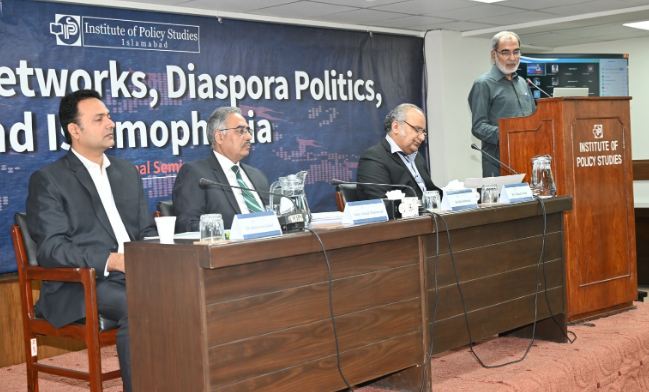
ISLAMABAD, SEPT 28 /DNA/ – The rising influence of Hindutva ideology and its expanding transnational networks are fueling diaspora-driven politics and a dangerous escalation in Islamophobia worldwide. This trend poses serious challenges to global peace, coexistence, and pluralism, highlighting the urgent need for academic, diplomatic, and policy-driven engagements to counter its divisive narratives.

This was deliberated at a seminar, “Hindutva: Networks, Diaspora Politics, and Islamophobia,” convened by the Institute of Policy Studies (IPS), Islamabad, which gathered scholars, policymakers, diplomats, and other stakeholders to explore one of today’s most pressing global ideological challenges. The seminar featured insightful discussions by Dr Mujeeb Afzal, associate professor Quaid-i-Azam University, Dr Khurram Iqbal, academic and policy analyst, Ambassador (r) Sohail Mahmood, director general Institute of Strategic Studies, Islamabad, and Khalid Rahman, chairman IPS.

In his opening remarks, Khalid Rahman noted that the Rashtriya Swayamsevak Sangh (RSS), which propagates and institutionalizes the ideology of Hindutva, marked its centenary on September 27. He highlighted the steady surge in mobilization of Hindutva organizations under the guise of cultural organizations, such as the RSS, not only within India but also across Indian diasporas, to advance the politics of hate.

He underlined the factors through which Hindutva reinforced itself within India, including organizational discipline, a robust grassroots network, political influence through the BJP, expansion in affiliate organizations, community service, shaping educational and cultural discourse, and, most of all, a favorable Islamophobic global environment. He emphasized that Hindutva weaponizes Islamophobia as a strategy in the West to further its own anti-Muslim agenda.

Dr Mujeeb Afzal unpacked the structural and political dimensions of Hindutva, asserting that it was more of a political phenomenon than a religious one. He examined its operational strategies within India and its outreach into global diasporas. He also underlined Hindutva’s construction of identity in opposition to Muslims and its global strategies and ideological links to promote Islamophobia.

Dr Khurram Iqbal expanded on the security and societal consequences of these developments, noting how Hindutva-driven narratives contribute to Islamophobic sentiments and discriminatory policies. He said that the Hindutva diaspora in the Global North funds Hindutva-led activities inside India and the dissemination of this divisive ideology globally.

He emphasized that the Hindutva diaspora in the West acts as a lobby group for the BJP and RSS. However, he noted that Hindutva may struggle to gain ground in Western societies, where racial identity often proves stronger than religious affiliation, and India’s assumed role as a ‘vishwaguru’ did not sit well with the host societies. He also drew parallels between the ideas of Akhand Bharat and Greater Israel, describing the recent Pakistan-Saudi defense pact as evidence of growing awareness of their potential dangers.

In his concluding remarks, Ambassador Sohail Mahmood warned of the dangers posed by Hindutva and its transnational networks for Muslim, especially Pakistani, diaspora communities. He stressed the need for sustained dialogue and global solidarity to counter Hindutva and Islamophobia, while noting that many Hindus themselves reject these extremist ideologies.

Emphasizing that pluralism, inclusivity, and justice are essential for peace and stability, he cautioned that Hindutva groups actively fuel Islamophobia, pointing to the current BJP/RSS support for Israeli genocide in Gaza as a dangerous convergence. He further observed that beyond India, Hindutva networks tie their agenda to global security narratives, portraying Pakistan as the alleged epicenter of terrorism.

The seminar drew attention not only to the ideological rise of Hindutva but also to its implications for the world, especially Indian Illegally Occupied Jammu and Kashmir, and the Muslim diaspora. The discussions consistently pointed toward the necessity for policy circles both within Pakistan and internationally to take cognizance of Hindutva’s expanding transnational dimensions. Treating Islamophobia as not merely a societal prejudice while framing Hindutva as a violent extremist ideology must be done in a way that the West understands, the discussants highlighted.

Stay Connected

64FansLike
60FollowersFollow

Latest Reviews

Exchange Rates

USD - United States Dollar
EUR
1.14
GBP
1.34
AUD
0.69
CAD
0.71