Home Blog Page 448

Japan’s first female PM, but Takaichi is not a feminist

Japan's first female PM, but Takaichi is not a feminist

TOKYO, OCT 5 (AFP/APP/DNA): Sanae Takaichi is poised to become Japan’s first female prime minister, but many of her positions are socially conservative in an often still deeply patriarchal nation.

Takaichi, whose hero is Margaret Thatcher, became head of the ruling Liberal Democratic Party on Saturday and will likely take office later this month.

She has promised to appoint a cabinet with “Nordic” levels of women, up from just two under outgoing premier Shigeru Ishiba.

Takaichi, 64, has also said she “hopes to raise awareness” about women’s health struggles and spoken candidly about her own experience with menopause.

Despite these gestures, her policy positions on gender place her on the right of an already conservative LDP.

She is against revising a 19th-century law requiring married couples to share the same surname, which overwhelmingly results in women taking their husbands’ names.

Takaichi also wants Japan’s imperial family to stick to its male-only succession rules, and is “fundamentally opposed” to same-sex marriage.

Yuki Tsuji, a professor specialising in politics and gender at Tokai University, said Takaichi “has no interest in women’s rights or gender equality policies”.

“Therefore, it is unlikely that any change will occur in this policy area compared to previous LDP administrations,” she told AFP.

Tsuji added the symbolic significance of having a woman as premier is “quite substantial”.

But the pressure will be high to achieve results, and if she fails “this could foster negative perceptions of woman prime ministers”, Tsuji said.

Yuka, a Tokyo office worker in her 50s, welcomed Takaichi’s win.

“We can proudly tell the world Japan will likely have a woman leader,” Yuka told AFP.

But she is sceptical that there will be much progress on gender issues under Takaichi.

Last year ex-cabin attendant Mitsuko Tottori became boss of Japan Airlines, but hers is a rare success story in the corporate world where hours are long and childcare options are often limited.

Women in Japan held 13.2 percent of management positions in 2021, the lowest among members of the Organisation for Economic Co-operation and Development.

Japan ranked 118 out of 148 in the World Economic Forum’s 2025 Global Gender Gap Report.

“There are many capable women but leadership roles tend to be taken by men in Japan,” Yuka said, giving only her first name.

    “Many women are forced to give up at the height of their careers because they have to take care of their children or ageing parents.”

                  – ‘Not that beautiful’ –

                  In politics too, women are underrepresented, accounting for only around 15 percent of lawmakers in the lower house of parliament.

                  One notable exception is the three-term Tokyo governor, Yuriko Koike, who has announced several women-friendly policies including free day care for preschool children.

                  Female MPs have highlighted the difficulties of juggling the duties of being a politician and a homemaker — not something that worries their male counterparts.

                  They also routinely face sexist jibes.

IoBM hosts HEC’s 5-day NCRC meeting on Computing & IT

IoBM hosts HEC's 5-day NCRC meeting on Computing & IT

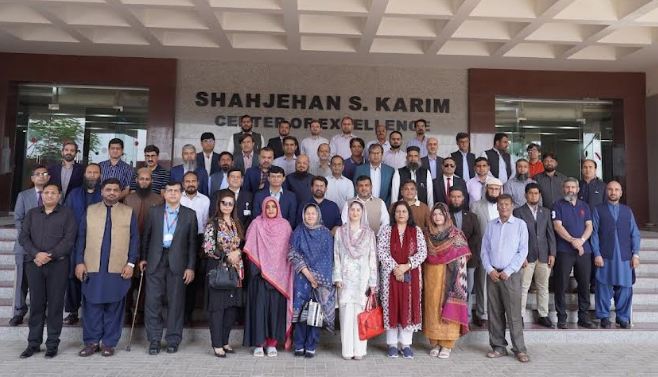
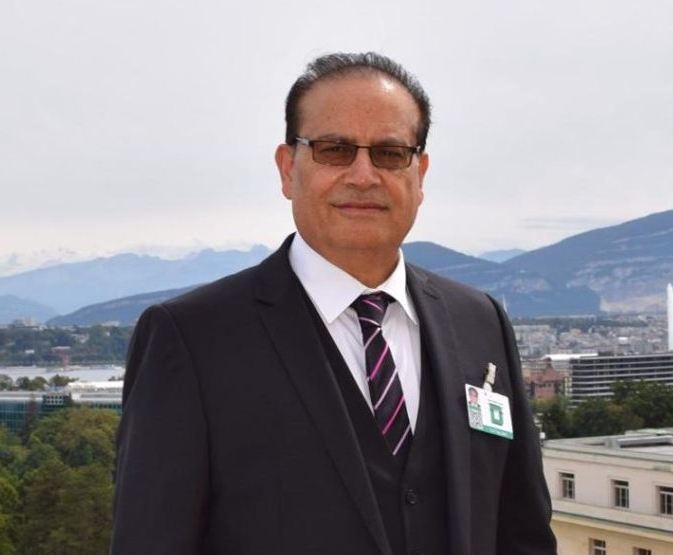
KARACHI, OCT 5 /DNA/ – The Institute of Business Management (IoBM) hosted the 5-day National Curriculum Revision Committee (NCRC) Meeting on Computing & IT, organized in collaboration with the Curriculum Division of the Higher Education Commission (HEC), Government of Pakistan, and the British Council. Held from September 30 to October 4, 2025, the event brought together academicians, industry experts, and policymakers to align Pakistan’s computing education with global standards. Representing IoBM were Prof. Dr. Tariq Rahim Soomro, Rector and Prof. Dr. Muhammad Abbas, Dean, College of Computer Science & Information Systems (CCSIS). The opening ceremony featured a welcome address by Prof. Dr. Tariq Rahim Soomro, followed by remarks from Dr. Amjad Hussain, Director General (Academics), HEC; and Mr. Abdul Hafeez Abbasi, EU TVET Technical Advisor, British Council.

During the meetings, the committee finalized the structure of computing programs, introduced AI, cybersecurity, and other IT specializations, and agreed on common core courses for BS Computing. It also reviewed industry-linked final year projects, certifications, electives, and soft skills. The committee approved the learning outcomes, degree requirements, and eligibility criteria for BS Computer Science programs. At the closing ceremony, held on the fifth and last day, the speakers highlighted the importance of digital skills, academia-industry collaborations, and preparing graduates for the future of work. In his closing remarks, Mr. Nasir Shah, Director General QAA, HEC, commended the participants for their dedication throughout the five-day session and for successfully finalizing the BS Computer Science curriculum. The event concluded with the presentation of the final revised curriculum and the distribution of souvenirs and certificates among the participants.

360 Views of Trump’s Peace Plan

Qamar Bashir

By Qamar Bashir

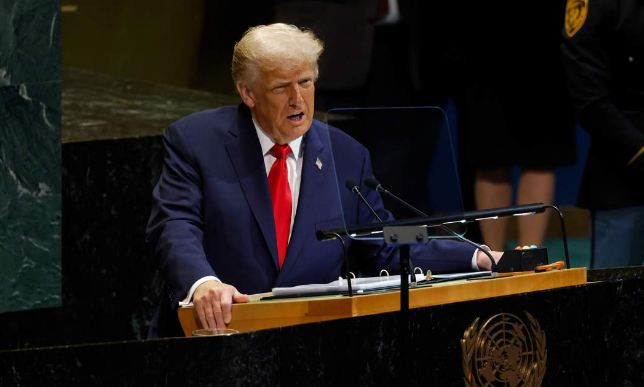
President Trump’s Gaza Peace Plan is simple in intention but complex in execution. It envisions a staged ceasefire tied to the release of all hostages, a phased Israeli withdrawal linked to verifiable benchmarks, the deployment of an international stabilization force, and governance reforms that transition Gaza toward a reconstituted Palestinian authority supported by technocrats. It concludes with a pathway—deliberately flexible in language—toward Palestinian self-determination and eventual statehood. For Hamas, the red lines are disarmament and exclusion from governance; for Israel, they are credible security guarantees and an avoidance of steps that appear to reward an armed adversary. Between these lines lies a narrow diplomatic corridor where progress must move swiftly or collapse under mistrust.

Hamas’s reaction is a tactical acceptance laced with strategic reservations. Its negotiators abroad signal readiness for a full hostage exchange and a willingness to cede administrative control to an interim Palestinian body, but they resist unconditional disarmament and permanent exclusion from politics. Inside Gaza, command structures are fractured; senior military cadres are depleted; field units operate semi-independently. Leaders willing to compromise must still gauge whether they can enforce any agreement among fighters radicalized by devastation and grief. Hence, the idea of surrendering heavy weapons to third-party custodians while retaining light arms as a “defensive dignity” measure—symbolically vital to Hamas but unacceptable to Israel without intrusive verification.

Israel’s stance is equally ambivalent. Strategically, the plan offers what Israel has long demanded: the return of hostages, demilitarization of Gaza, and an international mechanism to assume day-to-day responsibilities while blocking rearmament. Politically, however, it forces the ruling coalition to digest hard realities: staged withdrawals under international supervision, re-empowerment of a reformed Palestinian Authority, and text that implicitly gestures toward a future Palestinian state. For an Israeli leadership dominated by hard-liners, this feels like concessions under fire and risks coalition fracture. Hence, Jerusalem insists on strict benchmarks, real-time monitoring, and a conditional, performance-based path to statehood—not one dictated by dates.

Iran’s posture is obstructionist yet calculated. A low-intensity conflict serves its interest by keeping Israel and the U.S. occupied while Iran restores deterrence and influence. It will quietly encourage factions to brand disarmament as betrayal and redirect loyalty to splinter groups. Still, Tehran recognizes that a united Arab-Western front behind a ceasefire could shrink its diplomatic space. Expect it to question verification mechanisms and sovereignty provisions while retaining leverage through militant proxies capable of derailing peace at will.

Turkey, Qatar, and Egypt form the indispensable mediating triangle. Ankara frames Hamas’s partial acceptance as a “constructive step” and demands Israel halt military operations. Doha, central to past negotiations, supports the swap framework and advocates timelines that preserve face for both parties. Egypt, the gatekeeper of Rafah, emphasizes sequencing—ceasefire first, synchronized exchanges of hostages and prisoners, and gradual transfer of governance under Arab oversight. Their combined credibility will determine whether enforcement mechanisms succeed or unravel.

The Palestinian Authority welcomes the plan but insists that Gaza’s sovereignty lies with the State of Palestine, unified with the West Bank under one civil and security framework. Yet its legitimacy deficit is glaring. Reforms must be real—transparent appointments, credible policing, and efficient public services—to regain Gazan trust. Jordan and other Arab states condition their support on those very reforms and on tangible progress toward the two-state horizon.

Europe, the U.K., Canada, and other Western partners view the plan as the first viable diplomatic track in months. Their priorities converge: secure a ceasefire, free all hostages, restore humanitarian lifelines, and cautiously advance a two-state endgame. They will bankroll stabilization and reconstruction but only under strict oversight. France and Germany call it “the best chance for peace”; Spain and Ireland demand stronger civilian protections; EU institutions emphasize timelines and enforceable humanitarian guarantees.

Pakistan, Malaysia, and the wider Global South call the plan imperfect but necessary to end the siege and save lives. They urge a complete ceasefire, unrestricted aid access, and firm guarantees against annexation or forced displacement. Their support will be critical in lending legitimacy to any multinational peace force that must not appear Western-controlled.

Yet Trump’s plan, while pragmatic, misses a critical element: justice. Peace without accountability is fragile, and reconstruction funded by neutral donors ignores moral responsibility. It was Israel that unleashed overwhelming destruction—flattening neighborhoods, hospitals, schools, and mosques, killing thousands of civilians, and turning Gaza into ruins. Therefore, the financial and moral burden of rebuilding Gaza must not fall upon the Arab world or the international community, but squarely upon those who caused the devastation—Israel and its allies, principally the United States. They must finance reconstruction, compensate victims, and fund the restoration of homes, infrastructure, and livelihoods. Anything less would legitimize impunity and perpetuate the cycle of destruction.

Equally, Hamas cannot escape scrutiny for its October 7 attack that killed and abducted civilians. Justice must be even-handed: a transparent, international investigation under UN auspices should probe alleged war crimes, genocide, and ethnic cleansing by both Hamas and Israel. Those who ordered or executed attacks on civilians, destroyed civilian infrastructure, or used starvation and displacement as tools of war must face the law. Impunity—whether for militants or states—cannot coexist with lasting peace.

A just and sustainable settlement would thus require three compacts added to Trump’s architecture. First, a clarity compact—public, enforceable annexes specifying who verifies compliance, how violations are penalized, and when corrective mechanisms activate. Second, a sequencing compact—a 30-60-90 day ladder of actions tied to verifiable outcomes: immediate ceasefire and aid corridors; phased withdrawals; transfer of civil governance; and reconstruction monitored by auditors from neutral states. Third, a dignity compact—addressing not only arms but human dignity: mobility, jobs, municipal elections within a year, and a binding roadmap toward statehood linked to measurable governance performance.

To this must be added a justice compact—a moral and legal foundation ensuring accountability. An independent tribunal, perhaps modeled on the International Criminal Court but regionally backed, should document atrocities, assign blame, and impose reparations. This would transform peace from a political bargain into a moral restoration, proving that even in geopolitics, justice is not optional.

Arab and Western partners must move from mediation to stewardship—deploying peacekeepers, engineers, and funds not as charity, but as custodians of shared responsibility. Moreover, the reconstruction of Gaza must be sponsored and fully financed by Israel—the power that devastated those neighborhoods—and by any allies whose military or material support enabled that destruction. This is not punitive grandstanding; it is deterrence by consequence: any nation or actor that resorts to ethnic cleansing, mass starvation, or genocidal tactics must know it will bear the full financial, legal and moral costs of rebuilding, reparations, and accountability.

The alternative is a replay of history: more funerals, deeper resentment, and another generation growing amid rubble. Flexibility on process is not weakness; it is maturity. If disarmament becomes verifiable, withdrawal becomes milestone-driven, governance becomes transparent, and accountability becomes universal, then the guns can fall silent, Gaza can rebuild, and the Middle East can finally begin to heal.

By Qamar Bashir

Press Secretary to the President (Rtd)

Former Press Minister, Embassy of Pakistan to France

Former Press Attache to Malaysia

Former MD, SRBC | Macomb, Michigan, USA

HECP invites students to apply for fully funded scholarship

HECP invites students to apply for fully funded scholarship

LAHORE, Oct 04 (APP/DNA):The Higher Education Commission of Pakistan (HECP) has invited applications from bright and deserving students for its fully funded study programme.

The HEC sources told APP that the programme has been introduced for students who are unable to continue their education due to financial constraints, for which the Government of Pakistan will provide all the funding.
The scholarship will be provided to students of HEC-approved educational institutions. Students studying in undergraduate degree programmes will be eligible for the scholarship.
All educational expenses including monthly fees and books will be included in the scholarship.

Palestine announces urgent Int’l meeting to halt Israeli aggression

Palestine announces urgent Int'l meeting to halt Israeli aggression

RAMALLAH, OCT 4 /DNA/ – The Global Coalition for the Implementation of the New York Declaration is preparing to hold a high-level meeting in an international capital to finalize a comprehensive plan addressing the ongoing crisis in the Occupied Palestinian Territory, Dr. Omar Awadallah, the Palestinian Deputy Minister of Foreign Affairs for Political Affairs, confirmed today.

The urgent session will focus on a multi-faceted implementation plan with key objectives, including:

Ending the Israeli Genocide: Securing an immediate and permanent cessation of the military offensive and acts of genocide against the Palestinian people.

Halting Settlement Activity: Demanding a complete and verifiable end to all Israeli settlement construction and expansion in the West Bank and East Jerusalem, which are illegal under international law.

Initiating Reconstruction and Recovery: Launching a major international initiative for the massive task of reconstructing the Gaza Strip and addressing the profound humanitarian needs of its population.

Dr. Awadallah emphasized the critical nature of the upcoming meeting, stating, “This Coalition represents a significant international consensus on the need for immediate action. We are moving beyond statements and into the phase of concrete implementation. The plan on the table is robust and addresses the root causes of the conflict: the ongoing occupation, violence, and the systemic denial of Palestinian rights.”

“The priority is to stop the genocide, end the illegal settlement enterprise that sabotages the prospect of a viable Palestinian state, and begin the process of healing and rebuilding for our people in Gaza, who have endured unimaginable suffering,” he added.

The exact date and location of the meeting are being finalized and will be announced by the Coalition Secretariat in the coming days. The meeting is expected to bring together foreign ministers, senior diplomats, and representatives from key international organizations who are signatories to the New York Declaration.

Laptops distributed to top Matric and Intermediate students

Laptops distributed to top Matric and Intermediate students

RAWALPINDI, OCT 04 (APP/DNA): A laptop distribution ceremony for top-performing Matric and Intermediate first annual 2025 students was held at Board of Intermediate and Secondary Education (BISE) Rawalpindi under the vision of Punjab Chief Minister Maryam Nawaz Sharif.

The ceremony was presided over by Chairman of the Board of Education Muhammad Adnan Khan and was attended by Controller of Examinations Tanveer Asghar Awan, Board Secretary Amjad Iqbal Khattak, as well as a large number of students, parents, teachers, and board officials.

Addressing the gathering, Chairman Muhammad Adnan Khan praised Chief Minister Maryam Nawaz’s vision for empowering students through modern educational resources.

“This initiative is a testament to the Chief Minister’s commitment to provide advanced facilities to students in a short span of time,” he said, crediting her for the laptop distribution program.

He highlighted the joy and gratitude expressed by the students, noting that their hard work had been duly rewarded.

Khan advised students to stay dedicated and honest in their pursuits, emphasizing that success has no shortcuts.

“Whether enrolled in pre-engineering, pre-medical, or general science, stay focused and committed to education to bring pride to the institution and the country,” he urged.

Board Secretary Amjad Iqbal Khattak also spoke, congratulating the position holders.

The ceremony concluded with Chairman Khan distributing laptops to the top students and extending best wishes for their academic and professional journeys.

‘Hamas must move quickly, or else all bets will be off,’ says Trump

‘Hamas must move quickly, or else all bets will be off,’ says Trump

WASHINGTON, OCT 4: Donald Trump’s son-in-law and a senior envoy were heading to Egypt on Saturday to finalise hostage release details, as the US president warned he would “not tolerate delay” by Hamas in implementing a peace deal with Israel.

A White House official confirmed that Jared Kushner and Trump’s Middle East envoy Steve Witkoff are traveling to the region to address the finalisation of details on the release of hostages and to discuss the deal pushed by the US president to bring an end to the conflict between Israel and Hamas.

The Palestinian militant group on Friday reacted positively to a peace plan to end two years of war, saying it was ready to release all hostages and discuss details on the peace plan.  Trump in turn called on Israel to “immediately” halt its bombings of the war-ravaged territory.

Then on Saturday he suggested the shelling had stopped – even as Israel said its troops were still operating in Gaza and the enclave’s civil defense agency said Israel carried out dozens of “violent” air strikes on Gaza City overnight.

“I appreciate that Israel has temporarily stopped the bombing in order to give the Hostage release and Peace Deal a chance to be completed,” Trump posted on his Truth Social platform.

“Hamas must move quickly, or else all bets will be off. I will not tolerate delay, which many think will happen, or any outcome where Gaza poses a threat again,” he added. “Let’s get this done, FAST. Everyone will be treated fairly!”

Trump’s proposal calls for a halt to hostilities, the release of hostages within 72 hours, a gradual Israeli withdrawal from Gaza and Hamas’s disarmament.

PM Shehbaz to embark on three-day visit to Malaysia tomorrow

PM Shehbaz to embark on three-day visit to Malaysia tomorrow

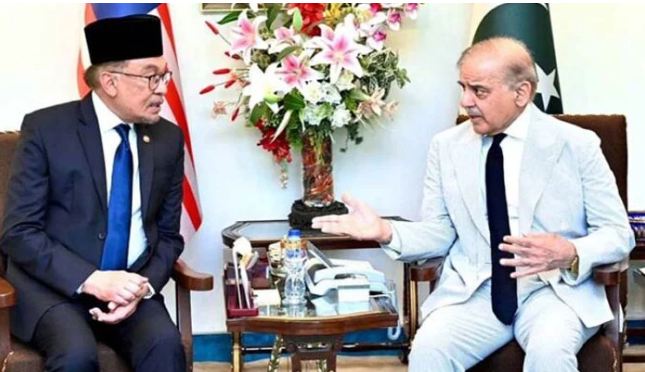
ISLAMABAD, OCT 4 – Prime Minister Shehbaz Sharif will be undertaking a three-day official visit to Malaysia from October 5 at the invitation of Malaysian counterpart Anwar Ibrahim.

During the visit, PM Shehbaz is scheduled to hold bilateral talks with his Malaysian counterpart and will discuss key regional and global developments, read a statement issued by the Foreign Office.

The two leaders will also deliberate on enhancing bilateral cooperation in trade to explore opportunities for further cooperation in trade, IT, telecom, Halal industry, investment, education, energy, infrastructure, digital economy, and people-to-people ties, read the statement.

FO Spokesperson Shafqat Ali Khan said that both the leaders are expected to witness the signing of agreements and MoUs for cooperation in several existing and new sectors.

The visit underscores Pakistan’s continued commitment to strengthen ties with Malaysia, he added.

It also reaffirms the importance both countries place on working together to promote peace, stability, trade and investment and sustainable development.

The Pakistani side looks forward to mutually beneficial engagements in Malaysia, building on the solid foundations of friendship and cooperation that exist between our two nations.

A high-level delegation comprising Deputy Prime Minister and Foreign Minister Ishaq Dar, federal ministers and senior government officials is also accompanying the prime minister, read the statement.

The visit reflects strong and enduring strategic partnership between Pakistan and Malaysia, rooted in mutual respect, shared interests, and close cooperation across a wide range of sectors.

Pakistan Navy lifts CNS Hockey Trophy 2025

Pakistan Navy lifts CNS Hockey Trophy 2025

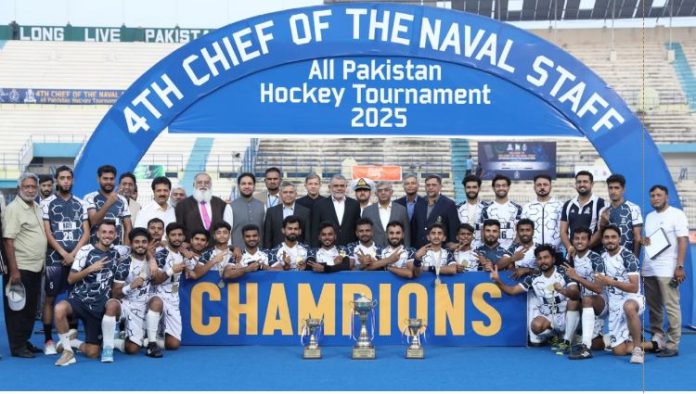
LAHORE, OCT 4 /DNA/ – The 4th Chief of the Naval Staff All Pakistan Hockey Tournament 2025 concluded today with a spectacular closing ceremony at the National Hockey Stadium in Lahore. The ten-day event, which ran from September 25 to October 4, saw Pakistan Navy emerge as the champions after a thrilling final match against Mari Energies.

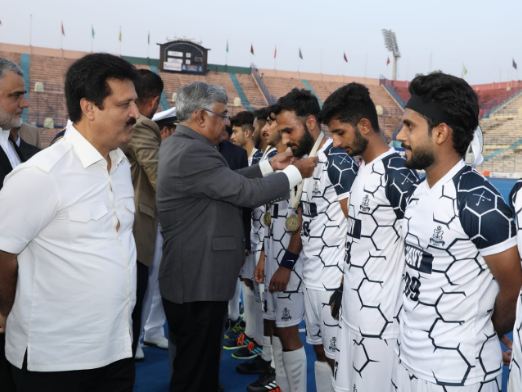
The Chief of the Naval Staff, Admiral Naveed Ashraf, presided over the closing ceremony as the Chief Guest. He commended all the participating teams for their sportsmanship and competitive spirit. Admiral Ashraf presented the championship trophy to the Pakistan Navy team and awarded medals to the runners-up, Mari Energies, and the third-place winners, Pakistan Air Force.

In his address, the Naval Chief praised the successful organization of the tournament, extending his appreciation to the Commander Central Punjab, Punjab Sports Board, Pakistan Hockey Federation, various sponsors, and the media for their vital support. He expressed hope that such events would rekindle public passion for hockey, the national sport, and emphasized the need for further collaborative efforts from both public and private institutions to ensure its revival.

The ceremony also recognized outstanding individual performances. Zakariya Hayat from Pakistan Navy was awarded the title of Best Player of the Tournament. Ahmed Nadeem from Mari Energies was honored as the Top Scorer, while his teammate, Abdullah Ishtiaq, was named the Best Goalkeeper.

The tournament featured eight top teams from across the nation: Pakistan Army, Pakistan Navy, Pakistan Air Force, Mari Energies, Rangers, Police, Port Qasim, and National Bank of Pakistan. The primary objective of the event was to promote and revitalize the game of hockey, which has faced challenges over the past two decades.

The final match and closing ceremony were attended by a large number of senior civilian and military officials, former Olympians, students, and members of the public, who all witnessed a successful celebration of national sportsmanship.

PM Shehbaz says Hamas response to Trump’s peace plan opens path to Gaza ceasefire

PM Shehbaz says Hamas response to Trump's peace plan opens path to Gaza ceasefire

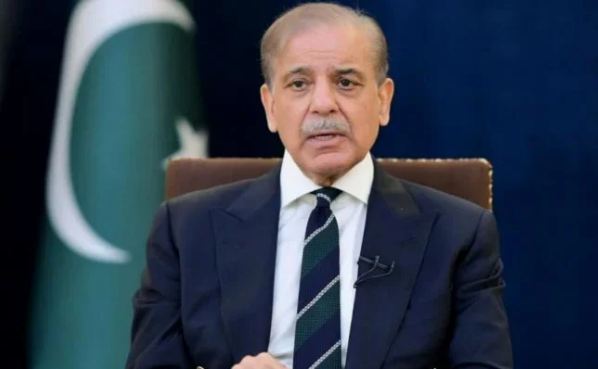
ISLAMABAD, OCT 4 – Hailing Hamas’s response to the Trump-brokered Gaza peace plan, Prime Minister Shehbaz Sharif said on Saturday that the statement issued by the Palestinian group opened a potential path to a ceasefire, urging the international community to seize the opportunity to end the war.

In a post on X, the prime minister reaffirmed Pakistan’s commitment to supporting lasting peace and stability in Palestine, saying that diplomatic progress must now translate into relief for the people of Gaza.

The statement comes after Hamas announced that it had accepted parts of US president’s proposal aimed at ending the nearly two-year conflict and securing the release of all remaining hostages from the October 7, 2023 attack.

The prime minister expressed gratitude to President Trump, as well as the leaderships of Qatar, Saudi Arabia, Turkiye, Egypt, the United Arab Emirates, Jordan, and Indonesia, for their efforts during the United Nations General Assembly (UNGA) sidelines meetings.

The premier said: “Alhamdolillah, we are closer to a ceasefire than we have been since this genocide was launched on the Palestinian people. Pakistan has always stood by the Palestinian people and shall always do so.”

“The statement issued by Hamas creates a window for a ceasefire and ensuring peace that we must not allow to close again,” he said, adding that Pakistan would continue to work with all brotherly nations and partners to [ensure] everlasting peace in Palestine”.

Separately, the Foreign Office (FO) in a statement also welcomed the Palestinian group’s response.

“This offers an important opportunity to secure an immediate ceasefire, end the bloodshed of innocent Palestinians in Gaza, release of hostages and Palestinian prisoners, ensure unhindered humanitarian assistance, and pave the way for a credible political process toward lasting peace. Israel must immediately cease attacks.”

“Pakistan will continue to contribute constructively and meaningfully to this process,” it said.

Hamas’s response was also hailed by global leaders and ally, Palestinian Islamic Jihad.

“Hamas’ (reaction) to Trump’s plan represents the position of the Palestinian resistance factions, and the Islamic Jihad participated responsibly in the consultations that led to this decision,” it said in a statement.

The group’s approval of the plan could help facilitate the release of hostages held by both groups in Gaza.

Israeli Prime Minister Benjamin Netanyahu’s office said early on Saturday that Israel was preparing for an “immediate implementation” of the first stage of Trump’s Gaza plan for the release of Israeli hostages following Hamas’ response.

Palestinians in the besieged enclave reportedly expressed happiness and hope for the two-year war to end after US President Donald Trump called for a halt to the bombing, but Israel continued to pound Gaza.

Israeli fire killed at least seven people across Gaza Strip since the development, local authorities said. One strike killed four people in a house in Gaza City while another killed two others in Khan Younis in the south, medical workers and local authorities said.

Since the start of war in October 2023, Israel has killed at least 66,288 people and wounded 169,165 since October 2023. Thousands more are believed to be buried under the rubble. A total of 1,139 people were killed in Israel during the October 7, 2023, attacks and about 200 were taken captive.

— Additional input from Reuters

Stay Connected

64FansLike
60FollowersFollow

Latest Reviews

Exchange Rates

USD - United States Dollar
EUR
1.14
GBP
1.34
AUD
0.69
CAD
0.70