Home Blog Page 440

Azerbaijan, Pakistan chambers meet to boost bilateral trade ties

Azerbaijan, Pakistan chambers meet to boost bilateral trade ties

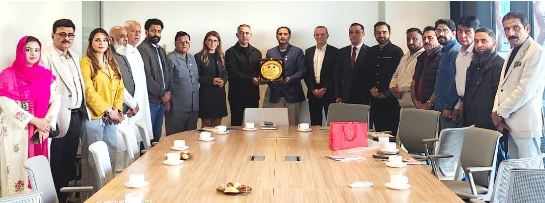
BAKU, OCT 10 /DNA/ – The delegation of the Azerbaijan-Pakistan Joint Chamber of Commerce and Industry met with the management of Azerbaijan’s largest retail business group, BRAVO, in Baku and visited the company’s main store.

The delegation was led by Chamber President Waqar Bakhtawari, who held detailed discussions on the growing business opportunities between Pakistan and Azerbaijan. He particularly briefed the BRAVO management on key Pakistani products such as rice, Himalayan salt, mangoes, citrus fruits, and textiles.

BRAVO Directors Zaur Daryav, Garakhan Shirinli, and Vajisi Ben expressed deep interest in Pakistani products and agreed to enhance trade relations between the two countries. It was mutually decided that if BRAVO requires any products from Pakistan or wishes to strengthen business cooperation, the company will directly coordinate through the Azerbaijan-Pakistan Joint Chamber of Commerce.

 Similarly, if the Chamber requires any information or assistance regarding the Azerbaijani market, it will remain in contact with BRAVO to ensure more effective bilateral collaboration.

During the meeting, Waqar Bakhtawari  said that there are vast opportunities for trade between Pakistan and Azerbaijan. We aim to build strong connections between major business entities of both countries to further expand bilateral trade. Pakistani products are globally recognized for their quality, and there is growing demand for them in Azerbaijan.

BRAVO Group representatives expressed their willingness to expand business relations with Pakistan, noting potential cooperation in sectors such as agricultural products, salt, and textiles.It was also agreed to continue mutual cooperation to establish direct business relations between Pakistan’s leading retail group D. Watson and BRAVO, in order to promote imports, exports, and trade development between the two friendly nations.

The Azerbaijan-Pakistan Joint Chamber of Commerce delegation included Chairman Zafar Bakhtawari , Abid Bakhtawari, Haris Bakhtawari, Yousaf Rajput, Asad Aziz, Malik Shabir Awan, Awais Satti, Nasir Ali Raki, Mohsin Khalid Malik, Rohail Anwar Butt, Umar Khayyam Abbasi, Shumaila Siddiqui, Malik Abdul Aziz, Fatima Hassan, and other distinguished members.

Outgoing Ethiopian ambassador pays farewell call on PM Shehbaz

Outgoing Ethiopian ambassador pays farewell call on PM Shehbaz

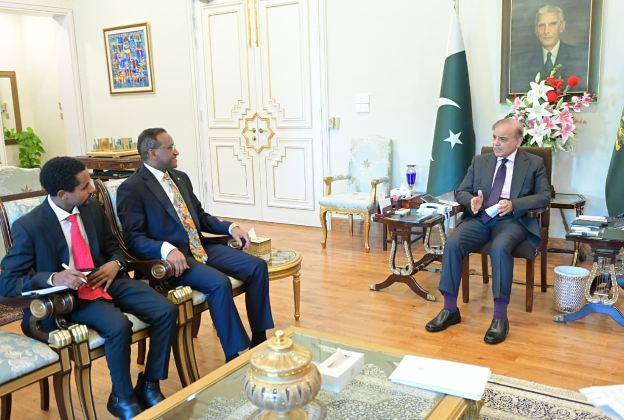
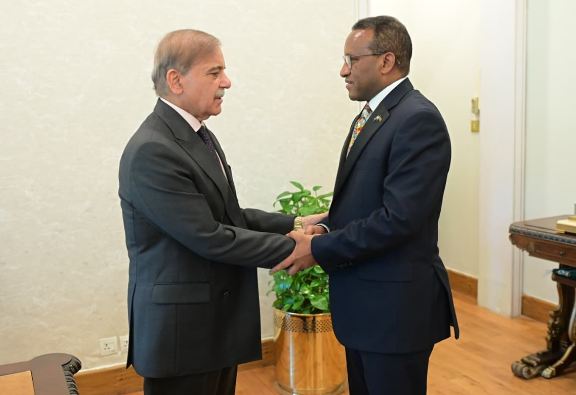
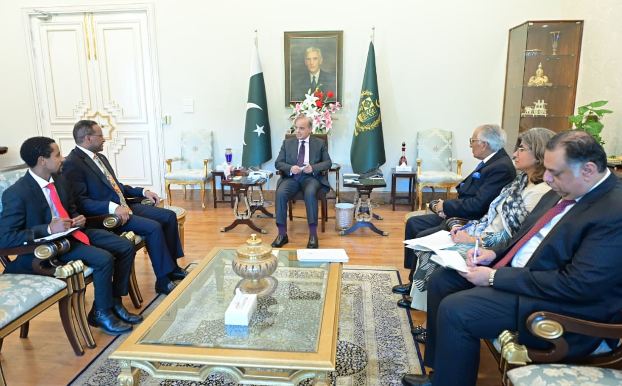
ISLAMABAD, OCT 10 /DNA/ – Ambassador Dr. Jemal Beker Abdula, the outgoing Ambassador of the Federal Democratic Republic of Ethiopia to Pakistan, paid a farewell call on Prime Minister Muhammad Shehbaz Sharif this afternoon.

The Prime Minister congratulated the Ambassador on the successful completion of his tenure in Pakistan and thanked him for his contribution towards the strengthening of Pakistan-Ethiopia relations.

The Prime Minister appreciated the Ambassador’s efforts for achieving significant milestones during his tenure, including the conclusion of the Bilateral Trade Agreement, the resumption of direct flights between Karachi and Addis Ababa.

Highlighting Ethiopia’s important role in Africa, the Prime Minister reaffirmed Pakistan’s commitment to expand mutually beneficial cooperation with Ethiopia, particularly in trade, investment, agriculture and technical capacity building.

The Ethiopian Ambassador thanked the Prime Minister for receiving him for a farewell call and expressed his heartfelt gratitude for the support and friendship that was extended to him throughout his tenure in Pakistan, by the people and the Government of Pakistan.

The Prime Minister also conveyed his warm regards for the Ethiopian leadership and expressed his desire to enhance high-level interaction between the two countries.

Atta Tarar appreciates outgoing Ethiopian Envoy for his remarkable diplomatic services

Atta Tarar appreciates outgoing Ethiopian Envoy for his remarkable diplomatic services

Saifullah Ansar / DNA

ISLAMABAD, OCT 10: Federal Minister for Information and Broadcasting Attaullah Tarar on Friday visited the Ethiopian Embassy Islamabad to bid a farewell to outgoing Ethiopian Ambassador to Pakistan Dr. Jemal Beker Abdula.

The Federal Minister appreciated the Ambassador for his remarkable role and services for strengthening the bilateral relations of Ethiopia and Pakistan to the greater heights.

Ambassador Dr. Jemal Beker said Ethiopia attached great importance to its diplomatic relations with the Islamic Republic of Pakistan which has been playing an important role at the international level.

He expressed gratitude to the Government and people of Pakistan for extending immense support to him during his tenure in strengthening bilateral and multilateral cooperation between the two countries in diverse areas including peace and security, climate resilience, aviation, trade, investment, tourism and culture.

The Ambassador said he was proud of connecting the two nations by diligently working on three main areas including connectivity, economic diplomacy and climate resilience in Pakistan.

The Ambassador said the Ethiopian Airlines is serving as an instrument of the Look Africa and Engage Africa policies of the Islamic Republic of Pakistan under which the 5th Pakistan-Africa Trade Development Conference and Single Country Exhibition is taking place in Addis Ababa, Ethiopia next week. 

He recalled the esteemed presence of the Federal Minister at the celebrations of the Ethiopian New Year in Islamabad that demonstrated the growing bilateral relations based on mutual understanding and respect.

The Federal Minister lauded the great transformation and progress achieved by Ethiopia under the leadership of Ethiopian Prime Minister Dr. Abiy Ahmed.

The Minister called the Ambassador a true “Friend of Pakistan” who has built bridges between the two nations and rendered great services not only to Ethiopia but also to Pakistan by bringing the two nations closer together.

He announced that the National Television of Pakistan will document his diplomatic services and air it on PTV in recognition of his remarkable services to both countries.

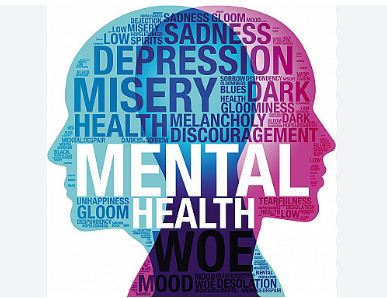
Over 30 million in Pakistan need mental health support

Over 30 million in Pakistan need mental health support

ISLAMABAD, Oct 10 (APP/DNA): On World Mental Health Day, Psychiatrist Friday underscored the critical need to make mental health care accessible during disasters and to eliminate stigma, pointing out that over 30 million Pakistanis need support.

Renowned psychiatrist Dr. Syeda Dure Shahwar Hamza, while speaking to a local news channel emphasized the urgent need to break the taboo surrounding mental health particularly among the youth.

She also pointed out that nearly 1 billion people worldwide suffer from mental health conditions, with both women and men equally affected.

However, she emphasized that men often hide their struggles due to social stigma, which can lead to worsening conditions and in some cases, push individuals toward suicide.

She highlighted that despite growing awareness, many young people still struggle in silence due to societal stigma, lack of access to care, and inadequate support systems, especially during times of crisis.

This year’s theme, “Access to mental health services in catastrophes and emergencies,” serves as a reminder that mental well-being must be prioritized alongside physical health during disasters, she added.

Dr. Shahwar Hamza called for coordinated awareness campaigns, school-based mental health programs and community-level interventions to ensure that mental health support is both available and accessible to young people.

She stressed that without urgent action, the ongoing neglect of youth mental health could have long-term consequences on their future and society at large.

“If we want to safeguard the next generation, we must normalize seeking help and create safe, stigma-free spaces for open conversations,” she added.

She further said that October 10 is globally recognized as World Mental Health Day by the World Federation for Mental Health and the World Health Organization (WHO) to raise awareness of mental health issues around the world and to mobilize efforts to support those affected worldwide.

The expert concluded by emphasizing the importance of continued global commitment to mental health care, reducing stigma, and ensuring access to support for everyone affected.

Abu Dhabi Govt to participate at GITEX Global 2025

Abu Dhabi Govt to participate at GITEX Global 2025
ABU DHABI, Oct 10 (WAM/APP/DNA):The Department of Government Enablement (DGE) will lead Abu Dhabi Government’s showcase at GITEX, taking place from 13-17 October at the Dubai World Trade Centre, under the theme 'AI-Native by Design, Community-Driven by Purpose."

This marks the 14th year of participation by Abu Dhabi Government, reinforcing the emirate’s commitment to becoming the world’s first AI-native government as part of the Abu Dhabi Government Digital Strategy 2025-2027.

DGE will coordinate contributions from more than 30 government and academic institutions to deliver an immersive, engaging experience for every visitor.

At this year’s Abu Dhabi Government Pavilion, 55 projects will highlight the real-world benefits AI is already delivering to millions across the emirate. Highlights will include TAMM 4.0, the latest version of the cross-government super app; Smart Investigator and AI Supervisor by Abu Dhabi Police; and Smart Hotel Check-In by the Department of Culture and Tourism (DCT), which uses facial recognition technology to enable effortless hotel check-in experiences.

Ahmed Tamim Hisham Al Kuttab, Chairman of DGE, said: “In Abu Dhabi, we are designing every public service around people’s needs. This is central to how we are embracing an AI-native mindset from the ground up. AI-Native by Design, Community-Driven by Purpose means reimagining a government to be more intuitive, personal, and responsive. By working together within a unified government ecosystem, we are shaping a digital future where innovation serves a clear purpose: empowering communities and building a government ready for tomorrow.”

Many of the projects will be shown in public for the first time. Visitors will also be able to adopt six different VR personas to explore how each is impacting every community in Abu Dhabi, including students, business owners, working parents, international tourists and investors, and government employees.

Other project highlights include the Personal AI Recruitment Companion, which streamlines the entire hiring process across government; QMobility’s AI-powered parking pilot which allows drivers to park without barriers, tickets, or manual payments; Rayah, by the Department of Education and Knowledge, a mobile app that helps parents track their children’s grades, attendance, milestones and activities; and Sahatna’s health services which will be among one of four new TAMM Spaces unveiled.

Dr Mohamed Al Askar, Director General of TAMM, said: “TAMM’s journey over the past year has been nothing short of remarkable. Since the last GITEX, TAMM has grown to more than 1,100 services, a milestone made possible by more than 90 public and private sector partners working together as one. TAMM stands as a testament to what cross-government partnership can achieve, delivering AI-powered services that are more intuitive than ever. This latest version takes that vision further, being smarter, more seamless, and our most ambitious yet.”

Abu Dhabi Government will set out the next phase of its journey toward an AI-native government, anchored by more than 80 strategic partnerships with global technology partners advancing the emirate’s digital ecosystem.

Wesam Lootah, Director General at DGE, said: “To date, we have assessed almost 400 AI-powered solutions across Abu Dhabi Government and have now deployed more than 100 of the most impactful, paving the way toward our 2027 vision of becoming the world’s first AI native government. These initiatives go beyond efficiency – empowering our public sector workforce to solve complex challenges, anticipate needs, and create greater value for society.”

Abu Dhabi Government’s participation at GITEX 2025 underscores the emirate’s commitment to becoming the world’s first AI-native government. By showcasing breakthrough projects, unveiling next-generation services, and deepening global partnerships, Abu Dhabi is demonstrating how AI-driven innovation can create a government that is smarter, more human, and future-ready, setting new benchmarks for digital excellence worldwide.

IRSA releases 86,600 cusecs water

IRSA releases 86,600 cusecs water

ISLAMABAD, Oct 10 (APP/DNA): Indus River System Authority (IRSA) on Friday released 86,600 cusecs of water from various rim stations with inflow of 91,100 cusecs.

According to the data released by IRSA, Tarbela Dam has already attained its maximum conservation level of 1550.00 feet, which was 148.00 feet higher than the dead level of 1402.00 feet. Water inflow and outflow in the dam were recorded as 37,300 cusecs and 36,900 cusecs, respectively.

River Jhelum at Mangla Dam has also attained its maximum conservation level of 1242 feet, which was 192 feet higher than its dead level of 1,050 feet. The inflow and outflow of water was recorded as 11,600 cusecs and 6,900 cusecs respectively.

The release of water at Kalabagh, Taunsa, Guddu and Sukkur was recorded as 64,100, 71,600, 78,600, and 36,700 cusecs, respectively. Similarly, from River Kabul, a total of 10,200 cusecs of water was released at Nowshera, and 22,700 cusecs were released from River Chenab at Marala.

Pakistan deepens regional engagement, strengthens Malaysia ties: FO Spox

Pakistan deepens regional engagement, strengthens Malaysia ties: FO Spox

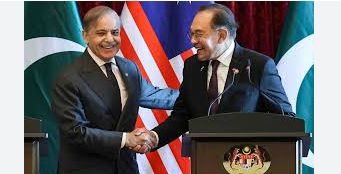
ISLAMABAD, Oct 10 (DNA): Foreign Office Spokesperson Ambassador Shafqat Ali Khan on Friday said Pakistan continued its proactive diplomatic outreach during the past week, marked by Prime Minister Muhammad Shehbaz Sharif’s successful visit to Malaysia and a series of high-level engagements aimed at promoting peace, trade, and regional cooperation.

The Foreign Office Spokesperson made these remarks at his weekly media briefing here at the Foreign Office.

Ambassador Khan said that at the invitation of Prime Minister Dato’ Seri Anwar Ibrahim, Prime Minister Shehbaz Sharif undertook an official visit to Malaysia from October 5 to 7, 2025, accompanied by Deputy Prime Minister and Foreign Minister Senator Mohammad Ishaq Dar, federal ministers, and senior officials.

Upon arrival in Kuala Lumpur, the Prime Minister was warmly received by his Malaysian counterpart, followed by an official welcome ceremony at Perdana Putra. The two leaders held extensive bilateral talks on October 6, covering trade and investment, defense, education, climate cooperation, and tourism.

“The visit marked an important milestone in Pakistan–Malaysia relations,” Ambassador Khan noted, adding that Prime Minister Shehbaz Sharif welcomed Malaysia’s decision to import halal meat worth 200 million US dollars from Pakistan, which he described as a “landmark step in expanding the halal trade partnership.”

During the visit, both leaders also launched the Urdu translation of Prime Minister Anwar Ibrahim’s book “Script for a Better Malaysia”, reflecting shared values of sustainability, inclusivity, and compassion.

Ambassador Khan said that the two sides also exchanged views on major regional and global developments, including the situations in the Middle East and South Asia. In their joint statement, both leaders reaffirmed the importance of regular high-level exchanges and agreed to reconvene the Pakistan–Malaysia Joint Commission at the foreign ministers’ level soon.

The Spokesperson highlighted that the leaders expressed satisfaction with ongoing defense collaboration under the Joint Committee on Defense Cooperation established in 1997 and agreed to enhance cooperation in defense science, technology, and industry.

Both leaders strongly condemned the ongoing genocide in Gaza and reiterated unwavering support for the Palestinian people’s right to self-determination and for the establishment of an independent and contiguous Palestinian state based on pre-1967 borders with Al-Quds Al-Sharif as its capital.

Prime Minister Shehbaz Sharif also addressed the Pakistan–Malaysia Business and Investment Conference in Kuala Lumpur, inviting Malaysian investors to explore opportunities in Pakistan’s growing market and business-friendly environment. Several agreements were signed in various sectors to boost cooperation.

During the visit, Prime Minister Shehbaz Sharif was also conferred with an honorary Doctorate in Leadership and Governance by Her Majesty Tunku Azizah Aminah Maimunah Iskandariah, Queen of the State of Pahang, in recognition of his leadership and governance vision.

Ambassador Khan said the visit reaffirmed Pakistan’s commitment to strengthening relations with Malaysia and working together to promote peace, prosperity, and sustainable development.

Reviewing other developments, the FO Spokesperson informed that Deputy Prime Minister and Foreign Minister Ishaq Dar addressed the National Assembly on October 3, apprising members of Pakistan’s engagement during the 80th session of the UN General Assembly. Senator Dar reiterated Pakistan’s principled position on Palestine and condemned the Israeli interception of the Global Sumud Flotilla* carrying humanitarian aid to Gaza, terming it a violation of international law.

The Spokesperson said Pakistan had ensured the safety of former Senator Mushtaq, one of the activists aboard the flotilla, through diplomatic efforts that led to his safe return following detention by Israeli forces.

Ambassador Khan further stated that the Deputy Prime Minister and Foreign Minister held telephonic conversations with his Saudi and Egyptian counterparts on October 4, discussing efforts for a ceasefire in Gaza and the broader peace process in the Middle East. Pakistan welcomed the announcement of a ceasefire, appreciating the efforts of President Donald Trump and the leaders of Qatar, Egypt, and Turkey for facilitating the agreement.

He added that Senator Dar also spoke with the Iranian Foreign Minister on October 1, reaffirming Pakistan–Iran cooperation in promoting peace and stability.

Highlighting other regional engagements, Ambassador Khan said the sixth session of Pakistan–Tajikistan Bilateral Political Consultations was held in Dushanbe on September 29–30, covering trade, energy, defense, and connectivity, including progress on CASA-1000.

He also noted that a high-level Saudi business delegation led by Prince Mansour bin Muhammad Al-Saud visited Islamabad on October 7 and met with the Pakistani leadership to explore avenues for enhanced trade and investment under the Saudi–Pakistan Joint Business Council framework.

“These engagements reflect Pakistan’s continued commitment to strengthening partnerships, promoting peace and stability, and fostering economic growth across the region,” Ambassador Shafqat Ali Khan concluded.

UK opens door to tougher regulation of Google search

UK opens door to tougher regulation of Google search

LONDON, OCT 10 (AFP/APP): Britain’s competition watchdog on Friday paved the way for tougher regulation to tackle Google’s dominance in online search, under new targeted measures focused on technology giants.

The Competition and Markets Authority said it has designated Google with “strategic market status” (SMS), subjecting it to special requirements, in a final decision following a nine-month investigation.

“We have found that Google maintains a strategic position in the search and search advertising sector,” Will Hayter, executive director for digital markets at the CMA, said in a statement.

A similar tech competition law from the European Union, the Digital Markets Act (DMA), carries the potential for hefty financial penalties.

The CMA plans to launch a consultation this year to determine the rules to impose on the US tech giant.

Google warned the UK against “unduly onerous regulations” and urged it to learn from “negative results seen in other jurisdictions”, referencing the EU’s DMA.

“Many of the ideas for interventions that have been raised in this process would inhibit UK innovation and growth,” said Oliver Bethell, Google’s senior director for competition.

‘Status quo won’t work anymore’

DG ISPR hints at governance failure in KP

Lt Gen Chaudhry briefs media on key security-related matters; blames Imran Khan (without naming him) and his party for unrest in the KP province; The general highlighted that at least 917 terrorists were killed in over 1,000 intelligence-based operations in 2025 so far

Shamim Shahid

PESHAWAR: Director-General (DG) Inter-Services Public Relations (ISPR) Lieutenant General Ahmed Sharif Chaudhry is addressing a press conference at Corps Headquarters in Peshawar.

“In 2014 after the incident of Army public school tragedy, the government of the that time and the military began rooting out the menace of terrorism from Khyber Pakhtunkhwa,” said the DG ISPR.

Later on, the ISPR chief said that terrorists and their facilitators were given space in KP under the “well thought out plot”.

The governance and public welfare were deliberately affected, Lt Gen Chaudhry said.

Lt Gen Chaudhry noted that while the surge in terrorism has been witnessed during recent years, the swift and decisive response of the Pakistan Army, intelligence, and law enforcement agencies is evident to all.

The general highlighted that at least 917 terrorists were killed in over 1,000 intelligence-based operations in 2025 so far, adding that 132 civilians and 311 Pakistan Army soldiers were among 516 martyred during the period.

Speaking on the repatriation of Afghan refugees, the military’s spokesperson said that Pakistan has hosted “Afghan brothers” for decades, but now the state decided to send them back.

“Unfortunately, politics is being done on this issue, and a narrative is being created around it.”

“A fake and fabricated narrative is being built against the ongoing operations against terrorism and martyrs of Pakistan Army and police are being ridiculed,” he noted, while describing it as a “nexus between political and criminal elements”.

“A person or group that is facilitating Fitna al-Khawarij has three choices — one is to hand over these terrorists to the state, second is to join hands with state institutions in anti-terror operations.”

“If both of these options do not work, then they [the facilitators] should be ready for action by the state,” he added.

“This status quo will not work anymore.”

Responding to a question on the purported airstrikes in Afghanistan’s Kabul, the DG ISPR neither admitted or rejected targeting Tehreek-e-Taliban Pakistan (TTP) chief Noor Wali Mehsud.

“We are doing and we will continue to do whatever is necessary for the protection our civilians’ lives and properties as well as territorial integrity of Pakistan,” he replied.

High-Stakes Games in the Middle East

Qamar Bashir

By Qamar Bashir

The Middle East has long been the epicenter of conflict, betrayal, shifting alliances, and global maneuvering. Yet the most recent chapter has revealed not just another tragic confrontation, but a sophisticated, high-intensity, high-stake game where every move was calculated to achieve both destruction and survival. The sequence began with Hamas’s surprise attack on Israel—an operation described by some analysts as clumsy and poorly coordinated, yet one that, paradoxically, many claim was abetted by Israel itself to trigger a wider conflict. What followed was a brutal escalation that saw Gaza reduced to rubble, its people starved, slaughtered, and collectively punished under what international observers called nothing less than genocide.

The early days of the war set the stage for Israel’s long-held expansionist ambition: to annex Gaza, the West Bank, and potentially extend its dominance into the broader Middle East. With the United States’ unconditional backing, Israel unleashed a campaign that turned Gaza into what one doctor called a “slaughterhouse,” where children, women, doctors, and civilians were killed daily in horrifying numbers. This genocidal spectacle shocked the world and forced international powers to take sides.

China and Russia limited their involvement largely to issuing statements, avoiding direct entanglement. The real surprise came from Europe. Under immense public pressure, European governments pivoted dramatically. Citizens poured into the streets demanding sanctions against Israel, recognition of Palestine as a state, and an end to the occupation. Governments responded by canceling military, civilian, and economic agreements with Israel, withdrawing investments, and promising support for a two-state solution. This groundswell of European public opinion became a turning point. For decades, Israel had enjoyed near-total impunity in Western capitals, but this time the moral force of public condemnation began to erode even the most entrenched political loyalties. One decisive moment came when a prominent European leader flew to Israel, not to offer support, but to confront its leadership, creating diplomatic shockwaves and forcing new pressure on Tel Aviv.

Equally astonishing was the role of the Muslim world. Long criticized for division and inaction, the Muslim ummah displayed unprecedented cohesion. Iran, while vilified as a sponsor of Hamas, proved its influence by supporting Palestinian resistance and deterring Israel and the United States from full-scale regional escalation. The collective strength of Muslim nations, particularly through economic and diplomatic channels, became a bargaining chip powerful enough to push the United States toward reconsidering its position.

Amid this turmoil, President Donald Trump played what many now describe as one of the most intelligent and strategic diplomatic games of his career. Historically, U.S. presidents have been tethered to Israel’s narrative, often adopting regime-change agendas across the Middle East at Israel’s urging. Netanyahu, for example, loudly advocated regime change in Iran, Syria, Iraq, and Libya. But Trump deviated sharply from this script. He refused to endorse Netanyahu’s ambition to annex Gaza and the West Bank, despite widespread support for the idea within Israel’s parliament and public opinion. He rejected calls for regime change in Iran, signaling that Washington would no longer be manipulated into destabilizing yet another regional power. For Israel, this was an unprecedented betrayal. For the world, it was a signal that America might finally be pulling back from decades of Middle Eastern entanglements.

Trump’s stance marked a turning point. It reflected not only his desire to assert American independence from Israeli influence but also his recognition that the United States could not afford endless wars while its economy and political institutions were under strain. His 21-point peace plan became the centerpiece of this recalibration—a plan that sought not only to stop the carnage in Gaza but also to end centuries of conflict by pushing for a viable two-state solution. When Trump unveiled the plan, many dismissed it as fragile, unrealistic, and destined to fail. Yet, against all odds, it gained momentum. The plan’s strength lay not in forcing capitulation but in balancing interests. It acknowledged Hamas as a legitimate political actor—something Israel had long resisted—and compelled Israel to sit at the same negotiation table as its sworn enemy.

In an unprecedented development, Hamas and Israel accepted the first phase of the plan. This meant an agreement to a ceasefire, humanitarian access to Gaza, and recognition of Palestine’s right to statehood in principle. The agreement is expected to be formally signed in Egypt, with Trump himself likely attending the ceremony. This moment is remarkable not only for its symbolic power but also for its practical implications. For the first time in decades, Israel was forced to concede to negotiations that recognized Palestinians as equal stakeholders. Trump’s ability to leverage European sanctions, Muslim unity, and American political will into one cohesive push was a rare alignment of global forces.

The immediate outcome of the plan is the cessation of the most brutal phase of the Gaza war. Yet its long-term implications are far more significant. If implemented fully, it could establish a two-state solution with Palestine gaining international recognition and sovereignty, force Israel to halt annexation and ethnic cleansing policies, rebalance U.S. foreign policy away from blind loyalty to Israel, strengthen European political autonomy, and reinforce Muslim nations’ influence as collective economic and diplomatic actors in global politics.

Nevertheless, challenges remain. Israel’s political establishment continues to resist, with Netanyahu lobbying fiercely to derail the plan and push the United States back into alignment with Israel’s hardline agenda. Doubts persist about Hamas’s ability to transform from an armed resistance group into a reliable political entity. Skeptics also question Trump’s capacity to maintain momentum given domestic pressures and the fragility of international alliances. Yet despite these uncertainties, the peace plan represents a monumental shift. It demonstrates that even in a region as complex and conflict-ridden as the Middle East, diplomacy, economic leverage, and public opinion can achieve what decades of war could not.

Credit for this breakthrough belongs to multiple actors. Trump’s strategic deviations from Israel’s traditional influence were decisive. Europe’s citizens, by refusing to remain silent in the face of genocide, forced their governments into action. Muslim nations, particularly Iran, used their strength to tilt the balance. International institutions such as the UN and the International Court of Justice provided moral legitimacy by condemning Israel’s actions and upholding Palestinian rights. Even Pakistan’s diplomats, often overlooked, played a vital role in mobilizing the Muslim world and countering Israeli-American propaganda at the United Nations. Conversely, China and Russia, despite their global stature, remained largely on the sidelines—issuing statements but contributing little. Their absence highlights a critical lesson: in this conflict, words without action mean little.

The Middle East has endured millennia of bloodshed, with the Israeli-Palestinian conflict at its modern heart. Yet the alignment of international outrage, Muslim unity, European pressure, and Trump’s uncharacteristically disciplined diplomacy has produced a fragile but real chance for peace. The 21-point plan is not merely a blueprint for ending one war; it is a test of whether humanity can finally prioritize justice and coexistence over expansion and annihilation. If the plan succeeds, it will not only be remembered as Trump’s greatest diplomatic achievement but also as the moment when the world finally forced Israel and Palestine to imagine peace. If it fails, it will join the long list of shattered hopes in the Middle East. For now, however, the world stands at a rare crossroads—one where the slaughter has paused, the diplomacy has begun, and the possibility of justice has flickered into view.

By Qamar Bashir

Press Secretary to the President (Rtd)

Former Press Minister, Embassy of Pakistan to France

Former Press Attaché to Malaysia

Former MD, SRBC | Macomb, Michigan, USA

Stay Connected

64FansLike
60FollowersFollow

Latest Reviews

Exchange Rates

USD - United States Dollar
EUR
1.14
GBP
1.34
AUD
0.69
CAD
0.70