In addition to revoking parts of the 18th Amendment, the government is also considering amendments to Article 243 of the Constitution, which deals with the command and control of the armed forces
Ansar Mahmood Bhatti
ISLAMABAD, NOV 4: The government is reportedly preparing to introduce the 27th Constitutional Amendment, a move that has already begun to stir political debate and speculation across the country. According to well-placed sources, the proposed amendment seeks sweeping changes to the existing constitutional framework — including a rollback of key provisions of the 18th Amendment, which devolved significant powers to the provinces.
If enacted, the 27th Amendment would effectively bring crucial departments such as health and population welfare back under the control of the federal government, reversing one of the hallmark features of Pakistan’s decentralization process introduced in 2010. The proposed shift is being seen by many as a centralization of authority at a time when the federation is struggling with governance and fiscal coordination issues.
In addition to revoking parts of the 18th Amendment, the government is also considering amendments to Article 243 of the Constitution, which deals with the command and control of the armed forces. Sources suggest that the move aims to provide legal cover for the potential appointment of a Field Marshal, a development that could have profound implications for Pakistan’s civil-military balance.
Moreover, the powers of the judiciary may also be curtailed under the new constitutional scheme. Reports indicate that the government intends to establish a full-fledged Constitutional Court, separate from the existing Supreme Court structure. A similar concept was floated earlier under the 26th Amendment, which created a constitutional bench, but it failed to achieve its intended objectives.
Critics argue that the new amendment is less about reform and more about consolidating power. “One thing is clear — this amendment has nothing to do with the welfare of the people of Pakistan. It’s purely a power game, an exercise in dominance,” a senior political analyst remarked.
The Pakistan Peoples Party (PPP), which was the chief architect of the 18th Amendment, has strongly opposed the proposed changes. Party leaders fear that undoing provincial autonomy will undermine the federal structure of the state. However, political insiders suggest that despite its initial resistance, the PPP may ultimately strike a deal if it receives certain political concessions.
As deliberations continue behind closed doors, the 27th Amendment appears set to reshape Pakistan’s political and constitutional landscape once again — though not necessarily in favor of the common citizen.
Another leading political party the PTI has also decided to oppose the amendment. The PTI leadership made it clear that any attempt to cut powers of the judiciary or to harm the spirit of the constitution shall be resisted.
ISLAMABAD, NOV 4: /DNA/ – The Institute of Strategic Studies Islamabad (ISSI) organized a Roundtable Discussion on “Pakistan and South Asia: Towards Progress, Partnership & Peace” with a visiting U.S. delegation headed by Mr. Imran Shaukat, Founder and Chairman, JOBS Group. Other distinguished members included: Skip Waskin, Chief Executive Officer, International Solutions; Anthony Renzulli, Associate Partner, Albright Stonebridge Group; Jon Danilowicz, Editor, South Asia Perspectives; Maureen Shauket, Chief Operating Officer, URC; Elizabeth Threlkeld, Senior Fellow and Director, South Asia Program, Stimson Center; and Michael Kugelman, former Director, South Asia Institute, Wilson Center. The RT brought together former diplomats, practitioners, and South Asia experts from both the U.S. and Pakistan for an in-depth exchange on pathways to regional progress, partnership, and peace in South Asia.
In his remarks, Director General ISSI Ambassador Sohail Mahmood set the tone for the discussion by underlining the timeliness and significance of the discourse on the theme. He noted that while South Asia possesses immense potential for economic development and regional integration, its progress continues to be constrained by structural inequalities, political divisions, and a persistent trust deficit. Drawing parallels with ASEAN’s cooperative approach, Ambassador Sohail Mahmood emphasized that a similar “habit of dialogue and culture of cooperation” is essential for South Asia to achieve shared prosperity. He highlighted Pakistan’s readiness to promote inclusive development and regional connectivity as part of a broader vision for peace and stability in the region.
Mr. Imran Shoukat expressed gratitude to ISSI for facilitating a constructive policy dialogue and emphasized the importance of engaging Pakistan’s youth and private sector in regional initiatives to drive innovation and growth. He noted that Pakistan’s future lies in fostering self-reliance, expanding cultural and business linkages, and adopting regional models of cooperation inspired by ASEAN’s spirit of collaboration.
The delegation members and participants from Pakistan shared valuable perspectives on regional cooperation, connectivity, and human capital development. They appreciated ISSI’s initiative in providing a platform for informed dialogue on South Asia’s evolving regional architecture and underscored the importance of sustained engagement to address shared challenges and explore new avenues for cooperation.
Earlier, in his introductory remarks, Dr. Talat Shabbir, Director, China-Pakistan Study Centre (CPSC), ISSI, welcomed the participants and highlighted the need to reimagine regional development and cooperation in South Asia.
In his concluding remarks, Ambassador Khalid Mahmood, Chairman, Board of Governors, ISSI, appreciated the thoughtful inputs shared by participants and reaffirmed the Institute’s commitment to fostering constructive regional discourse and partnerships that advance peace and prosperity in South Asia.
The Roundtable concluded with a shared understanding that South Asia’s stability and progress depend on renewed cooperation, inclusive policies, and a collective will to transform challenges into opportunities for peace and development.
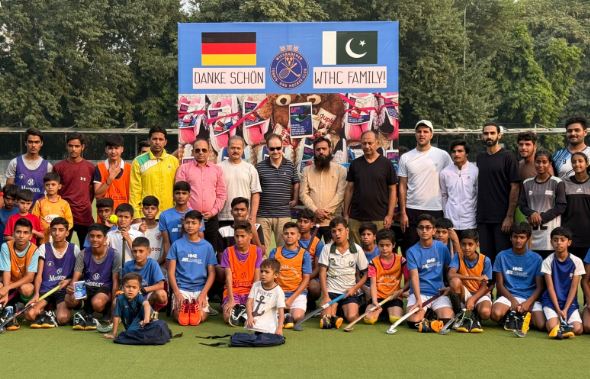
LAHORE, NOV 4: /DNA/ – The German Embassy in Pakistan’s Cultural Attaché, Jan Gerald, paid a visit to the Khawaja Junaid Hockey Academy in Lahore, where he distributed shoes among young players. The ceremony took place at the National Hockey Stadium’s turf, with Jan Gerald as the chief guest. During the event, he handed out shoes and chocolates to the boys and girls, and also presented school bags to two students.
The academy’s patron-in-chief, international hockey player Ajmal Khan Lodhi, along with vice-chairman Muhammad Yousaf Anjum, Abdul Samad, Habib Azhar, and coach Mahebullah, praised the German Embassy and the German club WTHC for their cooperation and support.
Jan Gerald expressed his pleasure in meeting the talented children at the academy, highlighting the valued relations between Pakistan and Germany in hockey. He stated, “The donation of shoes by the German club is an example of goodwill and will strengthen our relations.” He added that hockey in Pakistan can improve only if efforts are made at the grassroots level, wishing Pakistan a return to its former glory in the sport.
Ajmal Khan Lodhi thanked Jan Gerald and presented him with a souvenir.
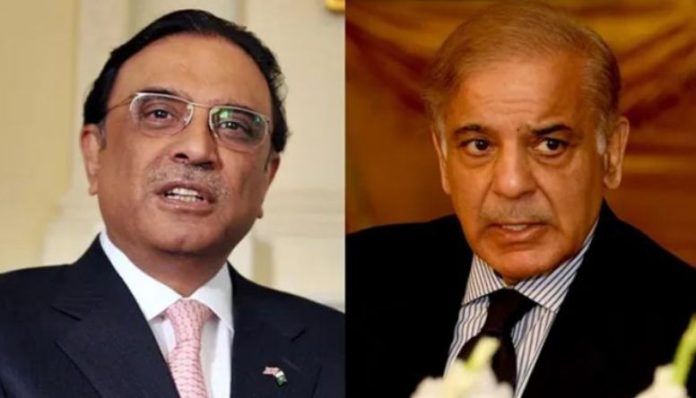
ISLAMABAD, NOV 4 (APP/DNA): President Asif Ali Zardari and Prime Minister Shehbaz Sharif on Tuesday paid tribute to the security forces for carrying out a successful intelligence-based operation in Kalat district of Balochistan.
The president and prime minister, in their separately issued statements, praised the forces for killing four India-backed terrorists, calling it a great achievement for national security.
He said that the entire nation stood with the security forces and remained committed to the complete eradication of the scourge of terrorism.
Appreciating the resolve and steadfastness of the security forces and law enforcement agencies, the president, who is currently on an official visit to Qatar, said that the continuation of Operation “Azm-e-Istehkam” against anti-state elements was indispensable for national security.
Similarly, Prime Minister Shehbaz said that Pakistan would continue the war against terrorism until its complete eradication from the country, reiterating that entire nation stood in support of the armed forces with an unwavering resolve to protect the homeland.
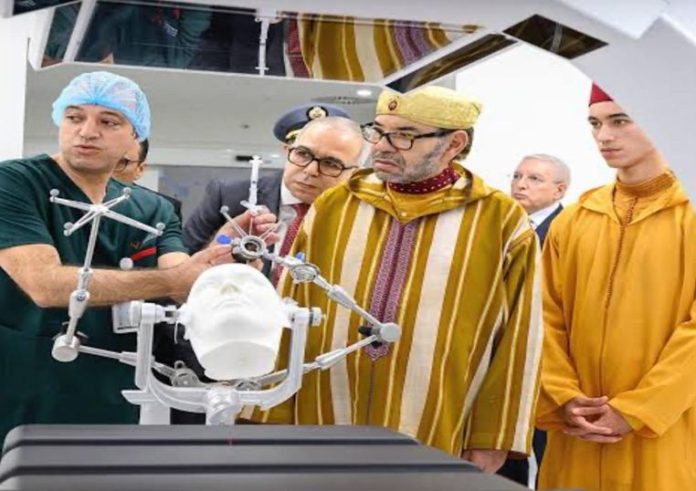
RABAT, NOV 4 /DNA/ – The King Mohammed VI, accompanied by the Prince Moulay El Hassan, inaugurated on Monday “the Mohammed VI International University Hospital Complex of Rabat“, an internationally renowned facility offering cutting-edge nationwide services for all, along with a high level training in healthcare professions. On the same day, the Sovereign has issued His High Instructions to put into service “the Mohammed VI University Hospital Center of Agadir“, considered a landmark medical pole poised to make a great stride in healthcare services and doctor training in the Souss-Massa region.
A true emblem of a new-era modern and smart sanitary infrastructure, “the Mohammed VI International University Hospital Complex of Rabat”, established by the Mohammed VI Foundation and Sciences and Health, embodies the Utmost Care and Vision of HM the King. It also reflects the ambition aimed at providing all citizens with equitable access to next-generation healthcare services, with a hospital facility that integrates the most advanced medical innovations built against a university facility of reference and research. It also attests to the key role attached by the Sovereign to human resources training in this vital sector, as well as His determination to grant them high-quality training, in line with the scientific and technological developments as regards treatment, prevention, management and healthcare governance, in accordance with international standards.
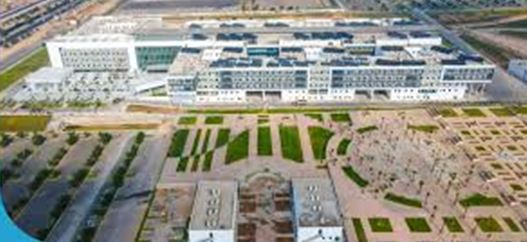
Spanning a 280,000 m² surface area, the Complex encompasses two complementary facilities: The Mohammed VI International University Hospital of Rabat (190,000 m²) in addition to the Mohammed VI University of Science and Health (90,000 m²).
A patient-centered next-generation facility:
With an initial capacity hosting 600 beds, extensible to 1000, “the Mohammed VI University Hospital-Rabat” englobes more than 30 medical surgical and medical technical poles of excellence, covering specialties such as robotic surgery, neurosurgery, interventional cardiology, oncology, radiotherapy, as well as cutting-edge imaging.This hospital counts, among others, more than 24 ultramodern operating rooms, including 19 concentrated within an integrated operating unit, with a global 3,400 m² area, including hybrid and robotic rooms, as well as 143 intensive care beds, including 30 neonatal incubators. The facility is equipped with state-of-the-art technology, including PET-MRI, a first in Morocco and Africa, combined with PET-SCAN for high-precision diagnosis. It is also equipped with 3T Omega MRI, the Ethos Hypersight radiotherapy system, a robotic hospital pharmacy, and a simulation center.
Among the innovative services, it is worth mentioning the burn unit and the hyperbaric and hypobaric oxygen therapy service -the only service of this kind in Morocco intended for advanced medical treatments and physiological research. In addition, the Complex has the first laboratory platform fully automated in Africa, covering all stages of chemical analysis, immunology and hematology, from preanalysis, analysis and postanalysis. It has the only anatomical pathology digitalized lab in Morocco, offering traceability and high precision diagnosis.
Patient-focused, “the Mohammed VI International University Hospital-Rabat” proposes integrated and customized care paths, ensuring comfort, security and quality. The facility is also considered a privileged learning platform for the Mohammed VI University of Sciences and Health students, enabling them an immersive experience in clinical and top-tier technology environments. A genuine academic pole of excellence, “the Mohammed VI University of Sciences and Health-Rabat” is due to contribute to strengthening one of the strategic pillars of the healthcare system’s reform, namely the human capital.
The university has 15 lecture halls with a total capacity of 4,000 seats, 72 classrooms, and 217 rooms for practical and supervised work. With a capacity of up to 8,000 students, this educational facility has several faculties and schools: Mohammed VI Faculty of Medicine – Rabat, Mohammed VI Faculty of Dentistry, Mohammed VI Faculty of Pharmacy, Mohammed VI School of Veterinary Medicine, Mohammed VI Higher School of Health Sciences, Mohammed VI Faculty of Nursing Sciences and Health Professions. An international medical simulation center complements this system, providing students with hands-on training in an environment that simulates real-life professional conditions.
Committed to a sustainability approach, “the Mohammed VI International University Hospital Complex of Rabat” is certified HQE (High Quality Environmental standard) at the “Exceptional” level. It is equipped with 8,800 m² of photovoltaic panels, covering more than 10% of its energy needs and reducing its carbon emissions by 40%.
Agadir Mohammed VI CHU, genuine symbol of modernity:
As for “the Mohammed VI University Hospital Center of Agadir”, which will be opened to citizens in accordance with the High Royal Instructions, it was built on a 30-hectare site (127,000 m² indoors), located near the Faculty of Medicine and Pharmacy. With an investment of around MAD 3.1 billion, the new “Mohammed VI University Hospital of Agadir”, with a total capacity of 867 beds, includes several poles (mother-and-child, medical-surgical, radiology, cardiology, etc.), a central operating block (19 rooms), additional rooms for emergencies ( 5 rooms) and for burn victims, a laboratory, a central pharmacy, and an integrated training and simulation system.
A true symbol of modernity, Agadir CHU is the first facility in Africa to integrate surgical robot “Revo I”, allowing minimally invasive interventions with micrometric precision, high definition 3D vision and providing unprecedented operational comfort for surgeons and patients. With two cardiac catheterization rooms and intensive care units equipped with multi-parameter monitors, the cardiology pole of the new CHU ensures the full care of patients with coronary illnesses and heart arrhythmia. The equipment, which complies with international standards, enables angioplasty, electrophysiology exploration, and high-resolution intravascular imaging to be performed.
Similarly, to guarantee patient safety and quality of care, “the Mohammed VI University Hospital of Agadir” is equipped with a full sterilization Center (washer-disinfectors, saturated steam autoclaves, and automated packaging areas ensuring the traceability of instruments), as well as a central pharmacy with a medication dispensing robot, guaranteeing secure preparation and automated delivery to hospital departments, a first in the region.
As a next-generation reference hospital, this project, which will benefit around 3 million people, will contribute to the development of hospital infrastructure in the Souss-Massa region and to strengthening healthcare services, bringing them closer to citizens who will no longer need to travel to other cities for complex surgeries or certain difficult pathologies. These two large hospital facilities will generate thousands of direct and indirect jobs, contributing to economic and social development at both regional and national levels.
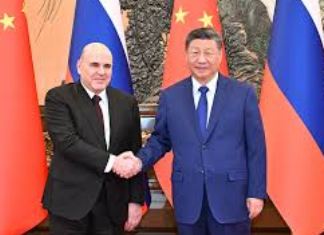
BEIJING, NOV 4 (APP/DNA): Chinese President Xi Jinping met with Russian Prime Minister Mikhail Mishustin on Tuesday in Beijing, calling for enhanced cooperation on multiple fronts and better synergy of development strategies.
Xi said that since the beginning of this year, China and Russia have steadfastly navigated a turbulent external environment with great composure, aiming for higher-level and higher-quality development goals.
He added that maintaining, consolidating and advancing bilateral relations is a strategic choice for both sides.
Noting that new blueprints for bilateral ties were charted during his meetings with Russian President Vladimir Putin this year, Xi said the two countries should maintain close coordination, fully implement the important common understandings reached by the two leaders, and work to expand the pie of cooperation with an eye on the fundamental interests of the two countries and their peoples, so as to contribute more to world peace and development, CGTN reported.
Both sides should steadily expand mutual investment and carry out cooperation in traditional fields such as energy, connectivity and agriculture, Xi said, adding that they should also cooperate in areas such as artificial intelligence, digital economy and green development so as to create new cooperation growth points.
Noting that the Fourth Plenary Session of the 20th Communist Party of China Central Committee, which concluded last month, adopted recommendations for formulating the plan for national economic and social development in the next five years, Xi said China will unswervingly promote high-quality development and high-level opening up, which will bring opportunities for China-Russia cooperation and people of both sides.
Mishustin conveyed President Putin’s warm greetings and best wishes to President Xi.
The Russian prime minister applauded the successful convening of the Fourth Plenary Session of the 20th CPC Central Committee, and said he believes China will achieve the goals set forth in the 15th Five-Year Plan.
He said the two heads of state set strategic guidance for bilateral ties in this year’s meetings and consolidated the comprehensive strategic partnership of coordination between the two countries.
Mishustin added that Russia is willing to work with China to implement the important consensus reached by the two leaders, deepen cooperation in areas such as trade, science and technology, energy, agriculture and the digital economy, strengthen people-to-people exchanges, and enhance multilateral coordination and cooperation.
ISLAMABAD, Nov 04 (APP/DNA): Federal Minister for Climate Change and Environmental Coordination, Senator Dr Musadik Malik, on Tuesday warned that the world is moving towards a dangerous new order marked by the “weaponisation of water” and growing injustice in global climate politics.
Speaking at the Sustainable Development Policy Institute’s (SDPI) 28th Sustainable Development Conference at the Allama Iqbal Open University in Islamabad, Dr Malik said the collapse of multilateral cooperation was pushing the world into an era of conflict and competition.
“Multilateralism is dying,” he told delegates. “It’s landing its way to bilateralism, and now mostly to unilateralism. The new politics of the world is not moving towards cooperation. You are going to see more wars, more conflict, and more weaponisation.”
The minister warned that lower riparian countries — those located downstream on shared rivers — faced growing risks as powerful upstream nations sought control over water flows.
“Water is becoming the next weapon,” he said. “Once the precedent is set for upper riparian countries to control water, what will come next — the weaponisation of wind?”
Dr Malik also criticised what he described as hypocrisy in global climate finance, accusing major polluters of benefiting the most from green funding.
He said that 40% of the world’s carbon emissions were produced by just two countries, while ten nations accounted for 75% — yet the same ten received around 85% of global green financing.
“Countries like Pakistan and Bangladesh emit less than one percent of global emissions,” he said. “The countries that consume the environment don’t pay the price.
They should be charged for the oxygen they consume and the carbon dioxide and methane they emit. This is not justice — it’s the industrial policy of big carbon emitters.”
Recalling Pakistan’s 2022 floods, which killed up to 2,000 people and displaced more than eight million, Dr Malik said the disaster underscored the human cost of climate change. Economic losses were estimated between $32bn and $40bn — about 15–18% of the country’s GDP.
He added that Pakistan ranked 167th out of 180 nations in progress towards the UN’s Sustainable Development Goals, saying the country must “find sustainability in an era of global disorder.”
“This conference is not about the past — it’s about the future,” he said. “We must speak the truth and stand up for climate justice.”
The SDPI’s annual Sustainable Development Conference brings together international experts, academics and policymakers to discuss the challenges of achieving sustainable growth amid climate and geopolitical instability.
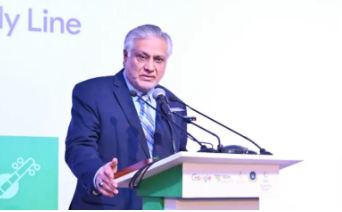
ISLAMABAD, Nov 4 (APP/DNA): Deputy Prime Minister and Foreign Minister Senator Ishaq Dar on Tuesday calling the launch of first Chromebook assembly line a “defining moment” for Pakistan’s digital transformation, said that the Government of Pakistan was taking concrete steps towards realizing the vision of a digital nation.
The deputy prime minister, addressing the event titled “Building the Digital Future, Together” marking the launch of first Chromebook assembly line, said that localizing the initiative would make access to digital tools more affordable and inclusive, particularly in the education sector.
“From the launch of Pakistan’s first Chromebook assembly line to Google’s announcement of establishing a local presence in Pakistan and to the agreement between the Government of Pakistan and Google to upskill our youth, this is a defining moment for our country’s digital transformation,” he said addressing the event attended by federal ministers, IT experts and representatives of tech giant Google.
He viewed that the initiative held great economic significance marking an industrial milestone laying the foundation for jobs, supply chain development, and future technology exports.
Dar said that the step would bring Google closer to Pakistan’s developers, startups, and entrepreneurs, enabling direct collaboration, capacity building, and great access to global platforms.
“Let me assure you, the management of Google, you won’t regret setting up all this in Pakistan… You will be very happy to be here… And in the years to come, you’ll find many multinational and others partners coming here. Pakistan is moving fairly fast to achieve the position in the comity of nations, which it was originally destined,” he stated.
He said that under the MoU, Google and Pakistan would collaborate to provide AI skills training for 100,000 developers nationwide.
Deputy Prime Minister Dar assured that the incumbent government was committed to creating an environment suitable for technology investment, collaboration, and establishment of a sustainable local presence.
For this, he said the government had established Special Investment Facilitation Council (SIFC) to facilitate establishing the businesses in the least possible time.
“Our policies aim to make Pakistan a regional hub for technology development, backed by a regulatory framework that supports innovations, ensures transparency, and encourages investment.”
Addressing the concerns of high fiscal tax rates, the deputy prime minister said the government was pursuing an agenda to establish a reasonable, affordable and comparable tax structure.
Coming to the country’s economic outlook, he said that government was striving to regain and make sure that Pakistan was all set to enter the global G20 club as soon as possible.
He also told the gathering that while Pakistan has total debt and liabilities of $130 billion, it was blessed with mines and minerals, with stones, with hydrocarbons worth around $6 trillion to $10 trillion.
“You can imagine $130 billion debt and liabilities would be peanut. So we are on that road. We are working on very fast track.”
The deputy prime minister, who returned from Istanbul after attending Coordination Meeting of Arab-Islamic Foreign Ministers, said that last month, Gaza peace agreement signed in the presence of President Trump by eight countries. Now the efforts are underway to implement that peace agreement, he added.
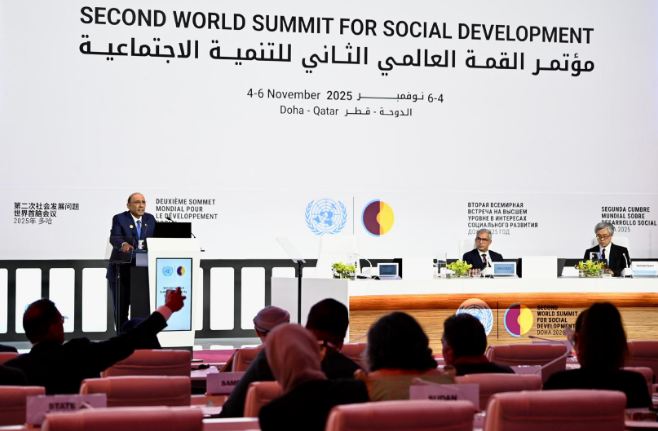
ISLAMABAD, NOV 4: President Asif Ali Zardari on Tuesday called for comprehensive global financial reforms, including debt relief and equitable taxation, to enable developing countries to pursue social justice and sustainable development.
Addressing the Second World Summit for Social Development, he said existing international financial structures place disproportionate burdens on poorer nations, limiting their ability to invest in people-centric progress.
He reaffirmed Pakistan’s commitment to social justice, inclusive development, and global solidarity, emphasising the need to eradicate poverty, promote decent work, and ensure equality and human rights for all.
The president expressed full support for the Doha Political Declaration, highlighting that the country’s vision for inclusiveness and sustainable development aligns with the spirit of the Doha Declaration. “Pakistan remains steadfast in placing people at the centre of policy”, he added.
Showcasing Pakistan’s progress, he cited the Benazir Income Support Programme (BISP), which has empowered over nine million families through income assistance, healthcare, and education. The initiative, he said, “is recognised globally as one of the best social protection models.”
He reaffirmed Pakistan’s commitment to the Sustainable Development Goals (SDGs), pledging to raise literacy to 90% and ensure every child attends school within five years.
The president also mentioned initiatives such as the National Youth Internship Programme and green and resilient housing projects, which aim to empower youth and strengthen climate resilience through nature-based solutions like mangrove restoration.
President Zardari also expressed grave concern over the “weaponisation of water” and violations of the Indus Waters Treaty, calling them a “serious threat” to the livelihoods of 240 million Pakistanis.
He also condemned the genocide, apartheid, and mass starvation in Palestine, calling for a just and lasting peace. He reiterated Pakistan’s unwavering support for the people of Kashmir, linking both struggles as two sides of the same coin in the pursuit of justice and self-determination.
“Development must begin and end with the betterment of people,” Zardari said, adding: “We must rise above all differences to embark on a path of compassion and progress for all.”
ISLAMABAD, NOV 4 /DNA/ – As the global community gears up for COP30, Pakistan faces an urgent need to strengthen governance, institutional readiness, and local resilience, and clarify access mechanisms to effectively benefit from the Fund for Responding to Loss and Damage (FRLD). While the fund presents a critical opportunity for Pakistan, persistent gaps in governance, capacity, accreditation, and project preparedness continue to impede timely access.
Building climate resilience demands integrated planning, a better understanding of financing processes, bankable projects, and locally driven approaches. Without these, Pakistan risks remaining on the margins of emerging global climate finance flows, designed to compensate developing nations for climate-induced losses.
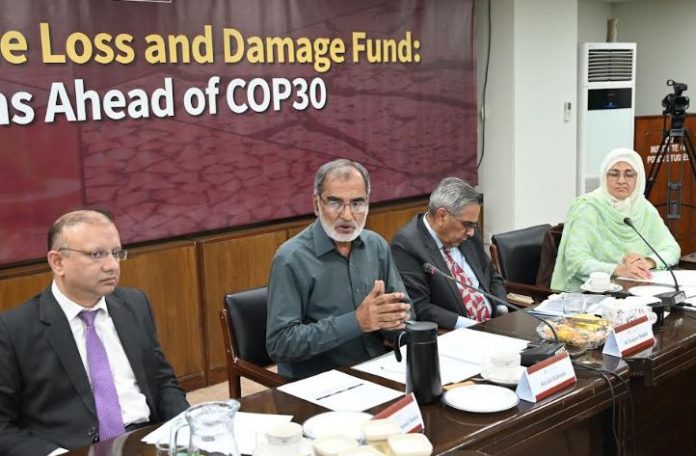
Climate experts stressed this during a roundtable titled ‘Operationalizing the Loss and Damage Fund: Expectations Ahead of COP30,’ held at the Institute of Policy Studies (IPS), Islamabad.
The event was addressed by Khalid Rahman, chairman IPS, AliTauqeer Shaikh, senior climate expert and FRLD board member, Afia Malik, senior energy economist, Muhammad Hammad Bashir, climate finance expert, Dr Saira Qaiser, director policy, Pakistan Academy of Science, Talha Tufail, research officer, Institute of Regional Studies, Dr Irfan Yousaf, climate expert and consultant, World Bank, and HamidSarfaraz, climate expert.
Speaking on the evolving global framework of the Loss and Damage Fund, Ali Tauqeer explained that loss and damage financing is distinct from mitigation and adaptation efforts, as it compensates developing countries for the costs of building resilience. He informed that direct budget support under the fund has been confirmed but remains non-operational, pending adoption of the risk management framework.
Tauqeer further pointed out that procedural obstructions are slowing direct access to the fund, and until national accreditation is achieved, countries will have to rely on multilateral entities for access. He emphasized that projects must demonstrate country ownership, measurable results, and complementarity with national systems, with 50 percent allocation for least developed countries and geographic balance as guiding principles.
Furthermore, Afia Malik highlighted that extreme weather events are already imposing heavy costs on Pakistan’s energy infrastructure. She pointed out that power distribution companies have not upgraded their systems to make them climate-resilient, emphasizing the need for climate risk assessments in procurement processes and least-cost planning that accounts for resilience.
Discussing Pakistan’s expectations from COP30, Hammad Bashir underlined that a limited understanding of international climate finance mechanisms hampers access to available resources. He stressed the importance of developing bankable projects and bridging the gap between available finance and local needs. He outlined the “Four As” critical to effective engagement with the Loss and Damage Fund: accessibility, additionality, adequacy, andaccountability, each necessary to ensure transparent, sufficient, and equitable climate finance.
Dr Saira Qaiser noted that funding criteria must be clearly communicated, as many stakeholders in Pakistan remain unaware of how to develop viable project proposals. She also emphasized the need to safeguard funds from exchange rate fluctuations and called for a holistic national strategy to build resilience. She further underscored that climate education should be strengthened to equip the next generation with the knowledge to navigate emerging climate finance mechanisms.
Talha Tufail emphasized the need for robust attribution studies that scientifically link emissions and their resulting impacts. Such evidence, he said, would strengthen Pakistan’s case when submitting projects to international climate funds.
Arguing about Pakistan’s vulnerability to climate change, Dr Irfan Yousaf pointed out that the challenge lies in the lack of preparedness. He noted that gaps in education, mindset, and institutional readiness hinder effective responses to climate extremes. Instead of relying solely on external funds, he urged a stronger focus on building local resilience through understanding national vulnerabilities and capacities.
Endorsing this, Hamid Sarfaraz observed that the accredited entities under the FRLD are the same ones that struggled to deliver under the Green Climate Fund. He lamented that current access remains dominated by multilateral agencies such as the ADB and the World Bank. He argued that this approach limits local benefits and reiterated the need to prioritize indigenous resilience-building efforts.
In his concluding remarks, Khalid Rahman underscored that Pakistan’s effective engagement with the Loss and Damage Fund depends on proactive preparation, good governance, and institutional strengthening. He emphasized the importance of designing a coherent national strategy that bridges policy, technical, and financial dimensions to build sustainable climate resilience.