Home Blog Page 383

IPS gathering hails Waqar Khan’s intellectual, spiritual contributions

IPS gathering hails Waqar Khan's intellectual, spiritual contributions

ISLAMABAD, NOV 17 /DNA/ – Dr Waqar Masood Khan was remembered as a figure of unwavering integrity, intellectual depth, and faith-driven service, an economist and public official whose moral strength and clarity of thought guided national policymaking for decades.

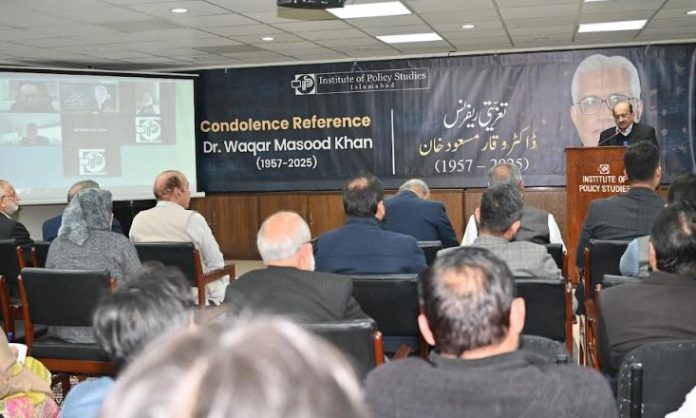
His colleagues, peers, and family members reflected on a life marked by humility, wisdom, and national commitment during a condolence reference held at the Institute of Policy Studies (IPS), Islamabad.
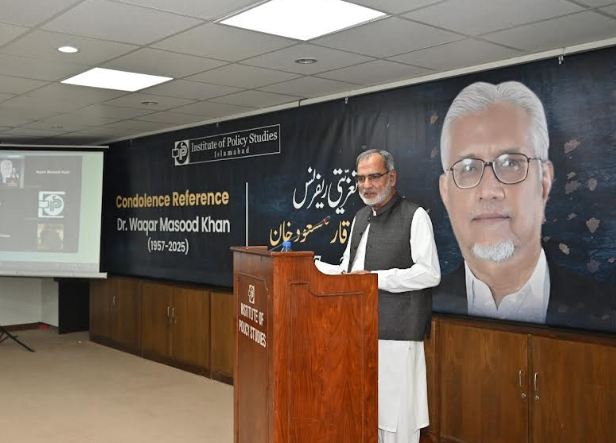
The reflections were shared by Khalid Rahman, chairman, IPS, Amb (r) Syed Abrar Hussain, vice chairman, IPS, Prof Dr Atiquzzafar Khan, former dean, Faculty of Social Sciences & Humanities, Riphah International University, Dr Syed Tahir Hijazi, former federal secretary, and member IPS National Advisory Council (NAC), Dr Tahir Mansoori, former DG, Shariah Academy, IIUI, Syed Irtiqa Ahmed Zaidi, a retired civil servant, Wahaj us Siraj, CEO Nayatel and member IPS BoG, Dr Ashfaque Hassan Khan, principal, School of Humanities and Social Sciences, NUST, Noman Ishtiaq, consultant UNDP, Prof Dr Mukhtar Ahmed, former chairman, HEC, and member IPS NAC, Bakhtiar Ahmad, former member, FBR, Dr Ijaz Shafi Gilani, founder Gallup Pakistan, Mirza Hamid Hassan, former federal secretary, water and power, and member IPS NAC, and Dr Habib ur Rehman Asim, chairperson, Iqbal Chair at Bahria University and member Quran House. His sons, Mehmood Masood Khan and Abdul Rahman Masood Khan, and his daughter, Rafiya Hameedah, also shared their memories and reflections.

The gathering served as a heartfelt tribute to a man widely respected for his integrity, intellect, and lifelong commitment to Pakistan’s economic and intellectual development.

The event highlighted what made Dr Waqar an extraordinary figure in public service. A distinguished economist, policymaker, and scholar, he served as Pakistan’s longest-serving secretary of finance and was known across governments for his principled, objective, and nationally driven approach. He stood above group interests and personal gain, earning deep trust across different administrations.

His life, however, extended far beyond policy leadership. As a founding member of the Quran House, he maintained a profound intellectual and spiritual bond with the Qur’an, remembered by many as a man whose humility, reflection, and sincerity were shaped by a deep attachment to faith.

His association with IPS began in the 1980s, a period when IPS was shaping its identity as a forum for critical ideas. His insight played a valuable role in developing IPS’s early work on the State of the Economy in Pakistan, a theme that still informs policy discourse. After his retirement, he continued to contribute to important debates, such as Hindutva, offering a perspective on emerging ideological issues and supporting discussions that encouraged scholarly engagement. During his two tenures on the IPS’s National Advisory Council (2002-2007 and 2019-2025), he was regarded as a thoughtful advisor whose analytical clarity and research guidance enriched institutional thinking.

Speakers collectively remembered him as a man who balanced brilliance with humility, an individual committed to learning, teaching, and serving. Many reflected on his spiritual devotion, including his dedication to memorizing the Qur’an later in life and his passion for imparting Qur’anic teachings to young people. Others recalled his early love for literature and poetry, his commitment to ethical governance, and his professionalism throughout his public service journey.

Across all tributes, the recurring sentiment was clear that Dr Waqar Masood Khan leaves behind not only impactful policies and scholarship but a legacy defined by moral clarity, intellectual sincerity, and faith-driven service, a legacy that will continue to inspire generations to come.

Pak Navy offers golden opportunities for youth to join as officers

SUKKUR, Nov 17 (APP/DNA): The Pakistan Navy Recruitment and Selection Center Sukkur on Monday has announced the Short Service Commission (SSC) Course 2026-A and M-Cadet Scheme (11th Batch) for young men and women from Sukkur Division.

The registration deadline is November 23, 2025, for various specializations, including Mechanical, Electrical, Electronics, IT, Management Sciences, Law, and more.

Eligible candidates must be between 18 and 26 years old as of July 1, 2026. Interested candidates can visit www.joinpaknavy.gov.pk for online registration and contact the Pakistan Navy Recruitment and Selection Center Sukkur for further guidance.

J-35A, J-10CE fighter jets among top Chinese aviation products displayed at Dubai Airshow

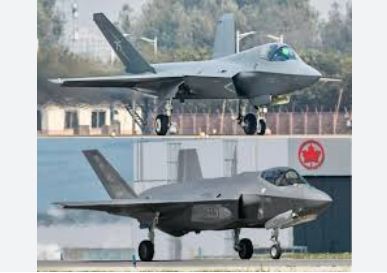
BEIJING, NOV 17 (APP/DNA): A Chinese exhibiting delegation reportedly brought some of the country’s top aviation products, including the J-35A stealth fighter jet and the J-10CE fighter jet, to the Dubai Airshow 2025, which kicked off in Dubai, the UAE on Monday.

An aviation expert said the Chinese aviation product lineup is one of the best in recent years, offering the Middle Eastern market new and attractive options.

According to a report by the military channel of China Central Television (CCTV), a model of a J-10CE fighter jet carrying PL series air-to-air missiles attracted particular attention at the exhibiting booth of China National Aero-Technology Import & Export Corporation (CATIC).

Other items featured at the CATIC booth included the J-35A stealth fighter jet, the Y-20 large transport aircraft, the L-15A training aircraft that is in service with the UAE air force, Wing Loong series drones and AR series drones.

A full-scale model of the Wing Loong-X drone is displayed at the outdoors static display area of the airshow, marking the first-ever static display of the Wing Loong-X at an airshow abroad.

For the first time, Aero Engine Corporation of China (AECC) is bringing its products to the Dubai Airshow, marking the most comprehensive, content-rich, and largest overseas exhibition of China’s domestically produced aero engines to date, featuring 19 different engine models across five exhibition zones, CCTV reported, noting that AECC has tailored its display to meet market demands in the Middle East and Africa by presenting corresponding products.

AECC products on display include the Taihang series high-thrust turbofan engines that have been equipped by multiple types of advanced warplanes, as well as the KP16-3D engine, which is a type of 3D-printed minimalist turbo jet engine with only 20 kilograms but can provide a 160 kilogram-level thrust, making it suitable for drones, according to the report.

Wang Ya’nan, chief editor of Aerospace Knowledge magazine, told the Global Times on Monday that Chinese aviation firms have brought one of the best lineups in recent years overseas, featuring not only fourth and fifth generation fighter jets, but also drones and other platforms, making it an all-dimensional display of China’s top aviation products.

These Chinese products could provide countries in the Middle East new options in their defense procurement. With the changing regional security environment and the test of time, Chinese weapons and equipment are proving their reliability, potentially attracting more users in the region, according to Wang.

Another Chinese element of the Dubai Airshow is the flight performance by Al Fursan aerobatic team of the UAE air force. Ahead of the official opening of the air show, the UAE aerobatic team conducted adaptive formation training using L-15 aircraft developed by China, carrying out multiple aerobatic maneuvers, including forming a huge heart in the sky.

Aircraft used for flight performances usually have special requirements in terms of reliability, handling and maneuverability, Wang said, noting that the UAE aerobatic team’s choice of using China’s L-15 aircraft as their performance jets is a manifestation of recognition of Chinese equipment.

Criminals use E-Commerce to hide drug trafficking: UNODC

Criminals use E-Commerce to hide drug trafficking: UNODC

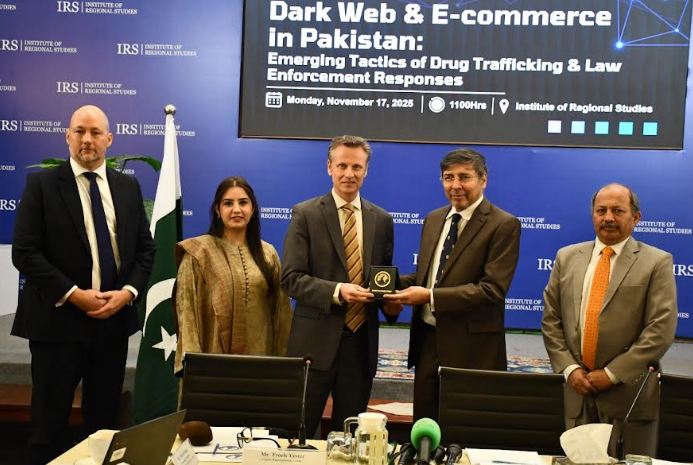
ISLAMABAD, NOV 17 /DNA/ – The Institute of Regional Studies (IRS) held a special session on “Dark Web and E-Commerce in Pakistan: Emerging Tactics of Drug Trafficking and Law Enforcement Responses,” organized by the IRS Cyber Security Program led by Ms. Alina Fayaz. The discussion brought together diplomats, government representatives, and international experts to examine rapidly evolving digital threats.

Ambassador Jauhar Saleem, President IRS, opened the session by noting that while online platforms offer significant opportunities, their ease of access also exposes young people to criminal activities, including the online purchase and sale of drugs. He stressed the urgent need to strengthen state capacities, train cyber domain specialists, and upgrade investigative agencies such as the FIA. He also underlined the importance of inter-agency collaboration and knowledge-sharing to counter increasingly sophisticated digital drug-trafficking techniques.

Troels Vester, UNODC Country Representative, highlighted the Dark Web’s growing role as a sophisticated enabler of cybercrime, providing anonymity for a widening range of illicit activities. He noted that messaging applications are being misused for drug distribution and that criminal networks are adopting e-commerce–style operating models, making trafficking more organized and harder for authorities to detect. He warned that Pakistan’s online drug markets are expanding rapidly, with sellers using encrypted channels and digital payments to evade law enforcement. These developments, he emphasized, demand a coordinated, technology-driven, and well-resourced response.

Oliver Gadney, Programme Coordinator GPML at UNODC Headquarters, shared insights into technological tools, investigative methodologies, and global best practices for countering dark-net-based crime. He highlighted growing challenges in tracing online trafficking networks and stressed the need for strong inter-agency cooperation, including efforts to disrupt the financial foundations of such criminal enterprises. He further noted that law enforcement must continually adapt to fast-evolving digital ecosystems while maintaining compassion toward individuals struggling with drug use.

Amb. Mansoor Khan, former Chair of the UN Commission on Narcotic Drugs (CND), pointed out that Afghanistan and Pakistan remain among the largest producers and transit routes for opiates fueling regional drug flows. He warned that educational institutions are increasingly vulnerable, with students becoming major targets for distribution networks. Citing alarming figures, he noted that nearly 70% of Pakistan’s drug users are under 30, driven by stress, peer pressure, and accessibility. He added that despite the ANF’s dedicated efforts, sophisticated digital networks and established maritime, land, and air routes continue to enable trafficking.

Concluding the session, Amb.  Saleem stressed that a holistic approach—combining stronger border controls, enhanced monitoring mechanisms, promoting awareness and coordinated institutional responses is essential to effectively counter emerging digital and transnational drug-trafficking threats.

FCC: It’s time to get down to business

FCC: It’s time to get down to business

Editorial

Ansar M Bhatti

With the establishment of the Constitutional Court (FCC), Pakistan has entered a new phase of judicial evolution. The political leadership proudly calls it a major reform designed to ease the burden on the Supreme Court and ensure swift adjudication of constitutional matters. But now that the court is operational, the real test begins: will justice finally be delivered, or will it merely be repackaged under a new title? For decades, Pakistan has suffered from an overburdened judiciary, chronic delays, and widespread violations of human rights. Tens of thousands of constitutional petitions remain pending. Citizens continue to suffer humiliating experiences in lower courts where cases drag on for years and where, in many instances, justice has to be “purchased” rather than secured. With the FCC now functional, the nation expects more than ceremonial inaugurations and official fanfare. It expects real results.

The state of Pakistan’s lower judiciary remains a matter of deep concern. Litigants often queue outside courtrooms for years, spending their life savings to prove what should have been resolved within months. Court staff, lawyers, and at times even judges become part of an environment where influence, money, and political connections can alter the course of justice. This is not merely judicial weakness; it is judicial paralysis. The establishment of the FCC offers an opportunity to begin cleaning up this system, but the responsibility does not rest on one institution alone. Reforms in civil and criminal procedures, digitization of case management, transparent monitoring systems, and strict accountability of judicial officers are urgently needed. Unless the lower judiciary is repaired and strengthened, no top-tier court—regardless of its mandate—can deliver justice at the grassroots level.

One of the most pressing issues surrounding the newly formed Constitutional Court is the perception of its independence. Questions began to arise even before its first significant judgment. Critics argue that the selection of judges appears to follow a familiar pattern appointments of like-minded individuals who may be inclined toward predictable outcomes. Whether or not these concerns are justified, the danger lies in the perception itself. For the highest constitutional court in the country, even a hint of partiality undermines credibility. If the public believes that judgments are influenced by political will, institutional pressure, or internal alignment, the FCC’s verdicts will inevitably lose their moral authority. Justice, after all, must not only be done; it must be seen to be done. The government and the Judicial Commission must ensure that the FCC reflects diversity in legal thought. Future appointments should include judges known for their independence, courage, and integrity ,those who command respect across the political spectrum.

Ironically, the political parties now expressing reservations about the FCC are the very architects of the system. They drafted and supported the amendment, voted on it in Parliament, defended it in public, and called it a historic milestone. If they are genuinely committed to constitutionalism, they must also be prepared to accept the decisions of the very court they helped create even when the axe falls on them. Selective acceptance of judicial verdicts has long damaged Pakistan’s institutional stability, where parties praise courts when decisions favor them and condemn the same courts when judgments go against their interests. This cycle of hypocrisy must end.

While political leaders spent days debating the 27th Amendment and restructuring the judicial hierarchy, they remained largely silent on Pakistan’s biggest menace: corruption. If the nation is to progress, corruption must be confronted with iron resolve. Politicians frequently cite the example of China, where corrupt officials face severe penalties, even the death penalty. Yet, when it comes to Pakistan, no political party has dared to introduce similar tough legislation. If our leaders truly desire a corruption-free Pakistan, why not propose harsher punishments for plunderers of national wealth? Why not push for an amendment suggesting capital punishment for those who rob billions from the exchequer? The silence in this regard is both striking and revealing.

Another deeply troubling issue is the deteriorating law-and-order situation, which continues to scare away foreign investors. Diplomats in Islamabad share candid feedback: their investors ask two straightforward questions about Pakistan whether the judiciary is independent and whether the investment environment is secure. When diplomats describe the actual situation on the ground, including political interference, delays in legal processes, corruption, and insecurity, the response from investors is almost always the same: they decline to come. No constitutional amendment, economic conference, or investment package can yield meaningful results unless Pakistan provides predictability, stability, and transparent dispute resolution. If investors cannot trust the courts, they cannot trust the country and without investor confidence, economic revival remains a distant dream.

The creation of the Constitutional Court gives Pakistan an opportunity to redefine justice. But institutions alone cannot transform a system deeply mired in corruption, manipulation, and inefficiency. Real change requires independent judges at every level, transparency in appointments, digitization of procedures, strict accountability for corrupt judicial officers, and long-overdue reforms that protect citizens and investors alike. Legislation against corruption must move beyond rhetoric and become a national priority. The FCC will be judged not by its architecture, composition, or inaugurations, but by the fairness, quality, and speed of its decisions.

Pakistan now stands at a critical crossroads. The Constitutional Court can become a catalyst for genuine judicial reform or it can become yet another institution overshadowed by suspicion and political manipulation. The choice, ultimately, belongs to the nation and its leaders.

Takaichi Invents a China Crisis

Qamar Bashir

By Qamar Bashir

From the moment Sanae Takaichi stood in parliament and declared that a possible Chinese attack on Taiwan could be a “survival-threatening situation” for Japan, the tectonic plates of East Asian security shifted. Her words this November did more than stir diplomatic tempest: they signalled a decisive step away from Japan’s longstanding post-war pacifism and into a far more volatile era of militarised logic.

The phrase “survival-threatening situation” refers to the controversial 2015 security legislation under Shinzo Abe that permitted Japan’s Japan Self‑Defense Forces (JSDF) to act when Japan’s survival was directly endangered—even if Japan itself was not under attack. Takaichi, widely regarded as Abe’s political heir, now seeks to wrench that framework into a domain far riskier than its original intent.

In the parliamentary session on 7 November, Takaichi tied Taiwan explicitly into that formula: if China moved by warships or other force to bring Taiwan under its control, that would, in her view, meet the threshold for Japan’s intervention. Japan’s Security Council would thereby be triggered. Until then, Tokyo had maintained the diplomatic stance of “strategic ambiguity.” But instead of nuance, a red line was drawn.

Beijing’s response was immediate—and fierce. China’s foreign ministry called the remarks “crude interference” in its internal affairs, asked Japan to retract the comments or “bear all consequences,” and even issued a travel caution for Chinese citizens heading to Japan.  Meanwhile, the Japanese public is sharply divided: according to a recent poll by Kyodo News, 48.8 % said Japan should exercise collective self-defense in the event of a China–Taiwan conflict, while 44.2 % opposed such action. Notably, 60.4 % supported Takaichi’s drive to raise Japan’s defence spending to 2 % of GDP ahead of schedule.

The ripple effects extend far beyond Tokyo and Beijing. Already, the Senkaku Islands (known in China as the Diaoyu) are once again flashing as potential flash-points. On 16 November a Chinese Coast Guard formation sailed through the waters near the islands, citing a “rights enforcement patrol.” The timing was no accident: the patrol followed Takaichi’s remarks by days and underlines Beijing’s willingness to translate diplomatic anger into maritime pressure.

What is unfolding is a brave-yet-reckless recalibration of Japan’s role. On one hand, Takaichi is tackling the undeniable fact that Japan’s western flank now faces a giant neighbour gathering forces, asserting its claims, and threatening to change the status quo. Taiwan lies just 110 km from Japan’s Yonaguni island. A Chinese move across the Taiwan Strait would have direct implications for Japanese sea lines of communication and defence. On the other hand, by linking Japan’s survival to Taiwan’s fate, she is converting long-dormant capabilities into forward-leaning military logic—well beyond the classic self-defence posture.

It is true that under her leadership Japan is moving on several vectors immediately. Within weeks of taking office she has floated raising defence spending, relaxing arms an-export controls, and revisiting Japan’s long-sacrosanct “three non-nuclear principles.” The contours of Japan’s strategic transformation are visible: from self-defence to power projection.

There is, however, a danger of mis-calculation. The architecture of Japan–China relations is still underpinned by four political documents and the one-China policy. Takaichi’s invocation of Taiwan as an existential threat, in Beijing’s eyes, tears at those threads. The Xinhua commentary argued that this was not prudent defence policy but “militaristic adventurism” masquerading as legitimacy. “Plainly not a country with close ties to Japan,” the commentary said of Taiwan—and therefore not eligible under Japan’s survival threshold.

Domestically, Japanese society is wrestling with the new narrative. Many recall that when Japan permitted limited collective self-defence in 2015, public protest rose at the idea of rewriting Article 9 which renounces war. A decade later, the argument is no longer about whether Japan can defend itself—it is whether Japan should prepare to intervene aggressively alongside the U.S. or even independently in a Taiwan contingency. The traditional myth of “Japan as pacifist by default” is fading.

Globally, the United States is watching nervously. Washington values Tokyo as its most reliable ally in the Pacific, but historically the U.S. has maintained strategic ambiguity over Taiwan. Japan’s embedding of Taiwan into its own survival equation complicates that U.S. position—and may lead to Tokyo being the flash-point for U.S.–China escalation. Beijing certainly interprets it that way: “Japan is taking up the role of dragging the United States into confrontation,” the Xinhua commentary stated.

Should this drift continue, the region faces multiple fault-lines. First, Japan may formalise new policy that treats Taiwanese contingencies as threats to its own survival, with equal standing to attack on Japan’s home islands. Second, Japan may transform its Self-Defence Forces into an expeditionary capability suited for overseas intervention—not only in support of allies, but under Japan’s own mandate. Third, diplomatic and economic fallout with China would accelerate. Already tourism from China to Japan is threatened; trade ties and investment flows could follow.

Yet there remains an alternative route: a recalibration rather than escalation. Domestic push-back and regional concerns may force Tokyo to clarify its position and restrain from pushing the Taiwan threshold too far. The United States may pull Tokyo back into alignment on ambiguity. But whether that happens is uncertain—and delayed action risks slipping Japan into a once-avoided diplomacy of force.

The irony is sharp: Japan, whose devastation at Hiroshima and Nagasaki shaped a post-war constitution grounded in pacifism and relief by American defence guarantee, now appears poised to raise its military profile not simply for defence, but for intervention. The shadow of its prior militarism, which invaded — and colonised — other nations, looms large. The question Japan must answer is whether its patriotic defence is a shield or a spear.

In the end, Takaichi’s gambit is a crossing of the Rubicon. By pulling Taiwan inside her “survival-threatening situation” framework, she has torn away the last veil of ambiguity. Japan has claimed the right to act—not in defence of its own soil—but in defence of a regional ally whose fate it now says is its own. That claim may win some admiration in Tokyo; in Beijing it is seen as provocation. And in the wider region it raises a chilling possibility: that the next crisis will not be Taiwan’s alone—but Japan’s too.

If this moment is mishandled, we may witness not just a rhetorical shift, but a strategic pivot—and the region may find itself drawn into a wider conflict far sooner than anyone anticipated. Japan might believe it is merely upgrading its defences; in reality it could be lifting the stage curtain on a return to great-power warfare.

By Qamar Bashir

Press Secretary to the President (Rtd)

Former Press Minister, Embassy of Pakistan to France

Former Press Attaché to Malaysia

Former MD, SRBC | Macomb, Michigan, USA

ICT admin announces key transfers, new appointments

ICT admin announces key transfers, new appointments
ISLAMABAD, Nov 16 (APP/DNA):The Islamabad district administration has issued a new notification announcing several administrative transfers and appointments, including the posting of new assistant commissioners in Nilor, Shalimar, Potohar, and the Industrial Area.

The Islamabad Capital Territory (ICT) administration has reshuffled several officials as part of its latest administrative changes.

According to a notification issued by Director Administration Usman Ashraf, multiple officers have been reassigned to new positions across the district.

Under the new postings, Assistant Commissioner (AC) Nilore, Muhammad Ali, has been transferred and posted as AC Shalimar. The notification states that he will take charge of the new assignment immediately.

The administration has also appointed Ali Naeem as AC Potohar. He had been awaiting a posting, and his new assignment places him in charge of one of the district’s key subdivisions.

In another posting, Grade-17 officer Muhammad Haroon has been appointed as AC Industrial Area. His new role includes oversight of administrative matters in the city’s main commercial and industrial zone.

Meanwhile, a notification has been issued confirming the appointment of Saif-ul-Islam as the new AC Nilore. He will assume the position following Muhammad Ali’s transfer to Shalimar.

Officials said the transfers and new appointments aim to streamline administrative functions across Islamabad’s subdivisions and ensure continuity in field operations.

Shaheen Chowk Underpass nears completion as CDA Chairman reviews progress

Shaheen Chowk Underpass nears completion as CDA Chairman reviews progress
ISLAMABAD, Nov 16 (APP):The Shaheen Chowk Underpass project in Islamabad is progressing steadily, with 80% of the barrel wall work completed and Ramp One walls 60% finished, officials said during a site visit by Capital Development Authority (CDA) Chairman Muhammad Ali Randhawa on Sunday.

The project’s barrel girder work has been fully completed, while earthwork, roadwork, and construction of Ramp Two walls continue around the clock.

Chairman Randhawa, accompanied by Member Engineering Syed Nafasat Raza and other officers, expressed satisfaction with the pace of work.

He emphasized strict adherence to high-quality construction standards and directed attention to landscaping, digital boards, and LED lighting to enhance the underpass’s aesthetics.

“The Shaheen Chowk Underpass will be a key milestone in resolving traffic congestion in Islamabad,” Randhawa said. “It will provide signal-free travel for daily commuters and students in the area, improving mobility and connectivity.”

The chairman instructed the Project Director and Resident Engineers to maintain rigorous monitoring of all ongoing construction activities to ensure the project meets its timelines and quality benchmarks.

Luxury houses eye India, but barriers remain

Luxury houses eye India, but barriers remain

MUMBAI, Nov 16 (AFP/APP): The globe’s biggest luxury brands have dreamt of India’s vast consumer base for decades, but navigating the market has proven to be a complex task.

French retailer Galeries Lafayette is the latest to try its luck, opening its first Indian store on Sunday: a sprawling five-floor outlet in Mumbai, the country’s financial capital.

Its splashy foray into the market is getting a local boost from the fashion arm of the Aditya Birla Group, a major Indian conglomerate.

Luxury expert and Comite Colbert CEO Benedicte Epinay called the arrival of the French department store “an important step”.

India, with 1.4 billion people, offers what Epinay called “a promising market, but still a complicated one”.

Brands must not only overcome high customs duties, a cumbersome bureaucracy and infrastructure limitations, but must also compete with a robust domestic luxury market.

Galeries Lafayette’s Mumbai store of 8,900 square metres (105,000 square feet) has some 280 luxury and designer brands spread across it, according to figures from the French retailer on Sunday.

  Almost all of the brands are foreign, which industry professionals warn is a bold gamble given the rich local clothing culture.

   Galeries Lafayette’s international development director, Philippe Pedone, said at Sunday’s launch more local brands would be added.

   Mumbai resident Sonal Ahuja, 39, told AFP: “I think a lot of brands like Louis Vuitton and Gucci and Dior have been doing a pretty good job at sort of weaving Indian design into their products.”

                  “But at the end of the day, if you want to buy something to wear to a wedding, you will buy (from Indian fashion designers) Sabyasachi or Tarun Tahiliani. Why would you want to buy something foreign that is trying to be Indian?” she said.

                  – ‘Ticks all the boxes’ –

                  India’s luxury market is still relatively small, but expanding rapidly.

                  Valued at $11 billion in 2024, it is set to triple to $35 billion by 2030, said Estelle David, South  Asia  Director at Business France.

                  India’s economy creates tens of thousands of new millionaire households each year.

                  These consumers increasingly splurge on everything from Lamborghini cars to Louis Vuitton bags.

                  “When a luxury house looks at a new country, it considers the number of wealthy people and the rise of a middle class,” Epinay said. “India ticks all the boxes.”

                  The reality is more complex.

                  French luxury giants contacted by AFP declined to comment. Their silence, analysts suggest, reflects a lack of positive things to say about a market widely considered difficult.

                  “They have very little data to show they are making profits or generating a return on investment,” said Ashok Som, from France’s ESSEC Business School.

                  In the early 2000s, the biggest fashion houses eyed India as their next growth engine after China. But the market remains tiny a quarter of a century later, Epinay said.

                  According to Epinay, most brands have only one to three stores in India, compared with 100 to 400 in China.

                  In her view, the only real similarity between the two giants is “the size of their populations”. India lacks China’s “social, linguistic and territorial homogeneity”, Epinay said.

                  India still has limited numbers of premium malls, most of which do not match what customers find in the Middle East, Europe, the United States or China.

                  “India is not at the same stage of development, so it’s very difficult to compare,” Business France’s David said.

                  Galeries Lafayette executive chairman Nicolas Houze said the luxury giant plans to open a second store in Delhi by the end of the decade, with an initial revenue target of 20 million euros ($23 million).

UN, local groups launch ‘We Will Rebuild Gaza’ cleanup campaign

UN, local groups launch 'We Will Rebuild Gaza' cleanup campaign
UNITED NATIONS, Nov 16 (APP/DNA):A large-scale campaign under the slogan “We Will Rebuild Gaza” was launched on Saturday in Gaza City, with the participation of local organizations and United Nations agencies, in an effort to begin cleaning operations and removing mountains of debris left by the Israeli war in yje besieged enclave.

Dozens of participants — including UN officials, volunteers, and residents who recently returned from the south of the Strip — took part in the activities in the city centre, according to a UN report. One participant, a woman in a wheelchair, held up a sign reading “We Will Rebuild Gaza” to express her support for the campaign.

Amjad Al-Shawa, Director of the Palestinian NGO Network, said the initiative represents “a shared message to the world that the people of Gaza are capable of bringing life back to their city.”

He added that specialised engineering teams working on rubble management have begun seeking solutions to deal with more than 60 million tons of debris resulting from the destruction of homes and infrastructure, noting that “today’s volunteer campaign is only the beginning of a long process until Gaza returns more beautiful than it was.”

Alessandro Marakic, an official with the United Nations Development Programme (UNDP), said, “we are here with the local authorities, civil society organizations, and the Chamber of Commerce to start the cleaning operations. What we are witnessing today is people returning to their city and regaining part of their dignity by restoring order to the streets.”

He added that the programme carries out daily solid-waste collection and is currently preparing plans for the winter season to ensure proper management of water and wastewater.

The campaign included the deployment of machinery and trucks to clear debris from the streets, while dozens of workers and volunteers took part in removing waste and cleaning public areas, as part of broader efforts to restore life to the city after many months of war.

Stay Connected

64FansLike
60FollowersFollow

Latest Reviews

Exchange Rates

USD - United States Dollar
EUR
1.14
GBP
1.34
AUD
0.69
CAD
0.71