Home Blog Page 382

FCC: it’s time to get down to business

BY Ansar M Bhatti

With the establishment of the Constitutional Court (FCC), Pakistan has entered a new phase of judicial evolution. The political leadership proudly calls it a major reform designed to ease the burden on the Supreme Court and ensure swift adjudication of constitutional matters. But now that the court is operational, the real test begins: will justice finally be delivered, or will it merely be repackaged under a new title? For decades, Pakistan has suffered from an overburdened judiciary, chronic delays, and widespread violations of human rights. Tens of thousands of constitutional petitions remain pending. Citizens continue to suffer humiliating experiences in lower courts where cases drag on for years and where, in many instances, justice has to be “purchased” rather than secured. With the FCC now functional, the nation expects more than ceremonial inaugurations and official fanfare. It expects real results.

The state of Pakistan’s lower judiciary remains a matter of deep concern. Litigants often queue outside courtrooms for years, spending their life savings to prove what should have been resolved within months. Court staff, lawyers, and at times even judges become part of an environment where influence, money, and political connections can alter the course of justice. This is not merely judicial weakness; it is judicial paralysis. The establishment of the FCC offers an opportunity to begin cleaning up this system, but the responsibility does not rest on one institution alone. Reforms in civil and criminal procedures, digitization of case management, transparent monitoring systems, and strict accountability of judicial officers are urgently needed. Unless the lower judiciary is repaired and strengthened, no top-tier court—regardless of its mandate—can deliver justice at the grassroots level.

One of the most pressing issues surrounding the newly formed Constitutional Court is the perception of its independence. Questions began to arise even before its first significant judgment. Critics argue that the selection of judges appears to follow a familiar pattern appointments of like-minded individuals who may be inclined toward predictable outcomes. Whether or not these concerns are justified, the danger lies in the perception itself. For the highest constitutional court in the country, even a hint of partiality undermines credibility. If the public believes that judgments are influenced by political will, institutional pressure, or internal alignment, the FCC’s verdicts will inevitably lose their moral authority. Justice, after all, must not only be done; it must be seen to be done. The government and the Judicial Commission must ensure that the FCC reflects diversity in legal thought. Future appointments should include judges known for their independence, courage, and integrity ,those who command respect across the political spectrum.

Ironically, the political parties now expressing reservations about the FCC are the very architects of the system. They drafted and supported the amendment, voted on it in Parliament, defended it in public, and called it a historic milestone. If they are genuinely committed to constitutionalism, they must also be prepared to accept the decisions of the very court they helped create even when the axe falls on them. Selective acceptance of judicial verdicts has long damaged Pakistan’s institutional stability, where parties praise courts when decisions favor them and condemn the same courts when judgments go against their interests. This cycle of hypocrisy must end.

While political leaders spent days debating the 27th Amendment and restructuring the judicial hierarchy, they remained largely silent on Pakistan’s biggest menace: corruption. If the nation is to progress, corruption must be confronted with iron resolve. Politicians frequently cite the example of China, where corrupt officials face severe penalties, even the death penalty. Yet, when it comes to Pakistan, no political party has dared to introduce similar tough legislation. If our leaders truly desire a corruption-free Pakistan, why not propose harsher punishments for plunderers of national wealth? Why not push for an amendment suggesting capital punishment for those who rob billions from the exchequer? The silence in this regard is both striking and revealing.

Another deeply troubling issue is the deteriorating law-and-order situation, which continues to scare away foreign investors. Diplomats in Islamabad share candid feedback: their investors ask two straightforward questions about Pakistan whether the judiciary is independent and whether the investment environment is secure. When diplomats describe the actual situation on the ground, including political interference, delays in legal processes, corruption, and insecurity, the response from investors is almost always the same: they decline to come. No constitutional amendment, economic conference, or investment package can yield meaningful results unless Pakistan provides predictability, stability, and transparent dispute resolution. If investors cannot trust the courts, they cannot trust the country and without investor confidence, economic revival remains a distant dream.

The creation of the Constitutional Court gives Pakistan an opportunity to redefine justice. But institutions alone cannot transform a system deeply mired in corruption, manipulation, and inefficiency. Real change requires independent judges at every level, transparency in appointments, digitization of procedures, strict accountability for corrupt judicial officers, and long-overdue reforms that protect citizens and investors alike. Legislation against corruption must move beyond rhetoric and become a national priority. The FCC will be judged not by its architecture, composition, or inaugurations, but by the fairness, quality, and speed of its decisions.

Pakistan now stands at a critical crossroads. The Constitutional Court can become a catalyst for genuine judicial reform or it can become yet another institution overshadowed by suspicion and political manipulation. The choice, ultimately, belongs to the nation and its leaders.
PM Shehbaz vows Centre-provinces cooperation to modernise Pakistan Railways

PM Shehbaz vows Centre-provinces cooperation to modernise Pakistan Railways

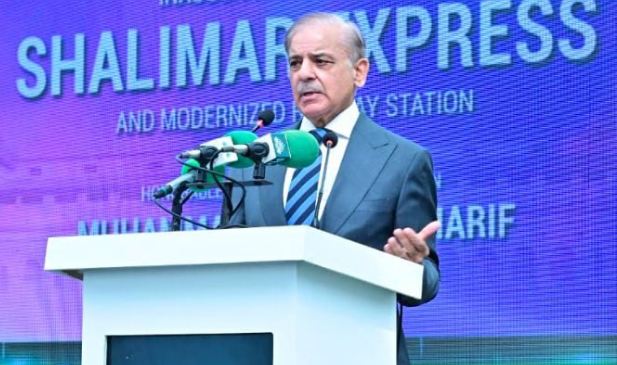
ISLAMABAD, NOV 17: Prime Minister Shehbaz Sharif said on Monday that the digitisation and modernisation of the Pakistan Railways and the provision of state-of-the-art facilities would play a key role in strengthening the national economy.

The prime minister expressed these views while addressing the inauguration ceremony of the new Shalimar Express and the newly upgraded waiting rooms and CIP lounges at Karachi Cantt Railway Station.

Sindh Chief Minister Syed Murad Ali Shah, Federal Minister for Railways Muhammad Hanif Abbasi, Federal Minister for Information and Broadcasting Attaullah Tarar, and other dignitaries were present on the occasion.

The prime minister said that soon after assuming office, Abbasi worked diligently to modernise the railway system. After revamping Lahore Railway Station, Karachi Cantt Station has also been upgraded with contemporary facilities.

He said that all railway stations in the province would be modernised in coordination with the Sindh government to ensure better travel facilities for the passengers.

He said like Sindh and Punjab, such coordination with the governments of Khyber Pakhtunkhwa and Balochistan should be evolved, which would ultimate make the Pakistan Railways the best transport system of this region.

PM Shehbaz said the railways freight system is also being organised, while the federal and Sindh governments have a partnership to provide transportation for Thar coal, with both governments investing 50% each in the project.

He assured that all required funds would be released in this regard so that the set targets of the projects could be achieved.

The premier said the Shalimar Express running between Karachi and Lahore has been converted into a new, upgraded train. He described Karachi as not only the economic hub but also “the heart of Pakistan”.

He reiterated that cooperation with the provincial governments of Punjab, Sindh, KP, and Balochistan would continue to ensure modernisation across the railway network and help stabilise the economy.

The prime minister praised Abbasi’s leadership, calling him the “hero of today’s ceremony”, and congratulated him for transforming the outdated railway system.

He said the federal government would work with all provinces to extend the railway network to Central Asia, specifically highlighting the Uzbekistan-Afghanistan-Pakistan railway line project.

He also emphasised reviving the Islamabad–Tehran-Istanbul rail route, which would boost our economy to the heights.

The prime minister noted that Abbasi has initiated discussions with the Asian Development Bank (ADB) for a $2 billion loan to further upgrade Pakistan Railways’ line from Karachi to Rohri, and that it would ultimately be connected to the Reko Diq project.

Responding to CM Shah’s request to include the KCR project in the China-Pakistan Economic Corridor (CPEC), the prime minister assured full cooperation, calling it a vital initiative.

He said he had flagged the KCR project at every international forum and we would jointly revive it as this project was inevitable for the people of Karachi. He hoped this project would soon become a reality.

The prime minister said that 54 railway stations have already been modernised, and once all stations — big or small — are upgraded, he would recommend a presidential award for the railways minister.

Earlier, Minister Abbasi said that under the prime minister’s guidance, significant improvements were achieved in just eight months, including the modernisation of Karachi Cantt Station and the renewal of the Shalimar Express.

He added that Rs1 billion is being spent on upgrading Rohri Station, while work is also underway at Karachi City Station.

The prime minister said that 14 trains are being outsourced under government policy, and railway hospitals and schools are also being given to private administration, while ensuring full protection for railway employees. Work on the ML-1 project is also progressing, he added.

The Sindh chief minister reaffirmed full cooperation from the provincial government for the improvement of the railways.

Earlier, the prime minister inaugurated the new Shalimar Express at Karachi Cantt Station by cutting the ribbon and unveiling the plaque, as well as inspecting the modernisation and digitisation works.

He visited the upgraded waiting area, CIP lounge, state-of-the-art dining hall and computerised ticketing system, accompanied by federal ministers, senior railway officials, and the Railways IG.

The ceremony was also attended by foreign diplomats and parliament members, senior officers from the federal as well as provincial governments.

‘Fully prepared’: Indian Army chief says May conflict was ‘a trailer’ in new warning to Pakistan

‘Fully prepared’: Indian Army chief says May conflict was ‘a trailer’ in new warning to Pakistan

New Delhi, NOV 17: Indian army chief General Upendra Dwivedi on Monday issued a pointed warning to Pakistan, comparing the brief May conflict to a “trailer” rather than a full-length film.

The Indian army chief’s remarks come a week after an explosion near the Red Fort in New Delhi on November 10, leaving 12 people dead in the first such explosion in the Indian capital since 2011.

Delivering a speech at a defence conference in New Delhi, Gen Dwivedi said, “I’d like to say that the movie hasn’t even started — only a trailer was shown, and, after the trailer, it was over within 88 hours.“

“So, we’re fully prepared for the future, and if Pakistan gives us such an opportunity, we’d like to provide them with a thorough education on how a responsible nation should behave with its neighbours.“

The conflict between the two countries in May was sparked by an attack on tourists in India-occupied Kashmir, which New Delhi, without evidence, linked to Pakistan. Islamabad strongly denied responsibility while calling for a neutral investigation.

New Delhi then launched deadly air strikes in Punjab and Azad Kashmir on May 7. After tit-for-tat strikes on each other’s airbases during the four-day escalation, it took American intervention on May 10 for both sides to finally reach a ceasefire.

Delhi blast suspect presented in court
Indian anti-terrorism investigators presented a suspect linked to the bombing in court, one of two men accused of involvement in the suicide attack. Officials have not disclosed any details on the motives or organisational backing of the alleged attackers, both of whom they claim came from India-occupied Kashmir.

India’s National Investiagtion Agency (NIA) alleged that Amir Rashid Ali “conspired with the alleged suicide bomber, Umarun Nabi, to unleash the terror attack” last Monday.

It remains unclear whether Nabi is included in the tally.

Security personnel escort the suspect from a police vehicle at the Patiala House Court, a day after his arrest, in New Delhi, India on November 17. — AFP
An AFP photographer saw Ali being taken under heavy guard from a police truck to a New Delhi court to face charges. Indian media reported that the court had ordered that he be held in custody for 10 days by the NIA.

Nabi was a medical professor at a university in Haryana state, just outside the capital, while Ali had allegedly travelled to Delhi to “facilitate the purchase of the car which was eventually used as a vehicle-borne improvised explosive device (IED)”, according to the NIA.

India has provided no further information on the alleged motives or network behind the two suspects.

Another suspect apprehended: NIA
Later on Monday, the NIA said in a statement that it “arrested another key associate of the terrorist involved in the blast” in Delhi.

According to the statement, the suspect was arrested from Srinagar in India-occupied Kashmir by an NIA team, with the agency stating that he “allegedly provided technical support for carrying out terror attacks by modifying drones and attempting to make rockets ahead of the deadly car bomb blast which killed 10 persons and left 32 persons injured”.

“The accused, a resident of Qazigund in Anantnag district of [India-occupied Kashmir], was an active co-conspirator behind the attack and had worked closely with the terrorist, Umarun Nabi, to plan the terror carnage,” the statement read.

“NIA continues to explore various angles to unravel the conspiracy behind the bombing,” it added. “Several teams of the anti-terror agency are pursuing multiple leads and are conducting searches across states to identify every person involved in the terror attack.”

The Indian government has since branded the Delhi car blast a terrorist attack, with Indian Prime Minister Narendra Modi vowing not to spare anyone involved in the “conspiracy” the day after the blast. Yesterday, the NIA said the blast was a “suicide bombing”.

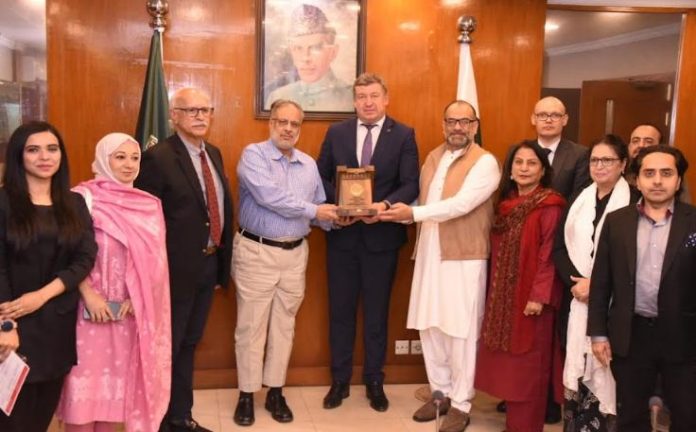
EU Ambassador to Pakistan Raimundas Karoblis Visits FPCCI

EU Ambassador to Pakistan Raimundas Karoblis Visits FPCCI

KARACHI, 17 NOV (DNA) — Mr. Atif Ikram Sheikh, President FPCCI; President ECO-CCI and VP CACCI, has apprised that the Ambassador of the European Union to Pakistan, H.E. Mr. Raimundas Karoblis, accompanied by senior officials, visited the Federation of Pakistan Chambers of Commerce & Industry (FPCCI) and held extensive discussions with the business leadership on further strengthening Pakistan-EU economic relations.

Mr. Atif Ikram Sheikh informed that Pakistan and the European Union, celebrating over 60 years of strong diplomatic and economic ties, are hosting the first high-profile European Union-Pakistan Business Forum (EU-PKBF) on 28–29 April 2026 in Islamabad.

Mr. Atif Ikram Sheikh highlighted that this landmark event, supported by the EU, its member states, and the Government of Pakistan, aims to facilitate high-level dialogue, empower partnerships and unlock opportunities for businesses in both regions. The event is expected to be opened by the Prime Minister of Pakistan, Mian Muhammad Shehbaz Sharif.

Mr. Atif Ikram Shaikh has said in his message that the EU remains one of Pakistan’s most important trading partners and the continued validity of GSP Plus status has been instrumental in boosting our exports. We are grateful to the EU for its support and look forward to working closely to meet all 27 international conventions for the next cycle.

FPCCI is fully committed to facilitating European investors and joint ventures in diverse sectors including renewable energy, IT, textiles value-addition, agriculture processing and logistics.

H.E. Mr. Raimundas Karoblis, Ambassador of the EU in Pakistan, appreciated the pivotal role played by FPCCI as the apex body of trade and industry in Pakistan and underlined the EU’s commitment to further deepen economic ties. Pakistan is a very important partner for the European Union.

We highly value the constructive engagement with FPCCI and the Pakistani private sector. The EU will continue supporting Pakistan’s sustainable economic growth, particularly through the GSP Plus scheme, social & environmental initiatives and enhanced people-to-people contacts.

Mr. Asif Inam, VP FPCCI, said that today’s visit reflects the strong trust and mutual confidence between Pakistan’s private sector and the European Union. We have assured the Ambassador of the business community’s complete support in enhancing bilateral trade volume, which has already crossed €12 billion, and in attracting more FDI from EU member states.

FPCCI will act as a bridge to resolve any issues faced by European companies operating in Pakistan. Mr. Zubair Baweja, Head of FPCCI’s Pak-EU Desk, stressed that this engagement underscores the vital role of the Pak-EU Desk in fostering direct business linkages.

We are eager to collaborate with Ambassador Karoblis on targeted initiatives to leverage GSP Plus opportunities, promote sustainable supply chains, and facilitate market access for Pakistani exporters in key EU sectors like green technologies and value-added manufacturing. — DNA

Ambassador Galey hails arts council’s role in global harmony

Ambassador Galey hails arts council's role in global harmony

KARACHI, NOV 17 /DNA/ – The Ambassador of France to Pakistan, Nicolas Galey visits the Arts Council of Pakistan Karachi, along with His Wife, Camelia Galey and Consul General of France, H.E. Alexis Chahtahtinsky, Director of the Alliance française de Karachi, Mr Emmanuel Bruerec, Chairman Alhamra Lahore Arts Council, and Mr Razi Ahmed. A detailed discussion was also held regarding the World Culture Festival.

President ACP Mohammad Ahmed Shah warmly welcomed the French delegation and gave them a tour of various sections of the Arts Council, where cultural activities were in full swing.

During His Visit, Ambassador Nicolas Galey said that the display of global cultures and diverse artistic programs at the World Culture Festival is playing an important role in connecting cultures worldwide. The Arts Council of Pakistan Karachi is playing a vital role in connecting cultures from around the world.  Appreciating the French Mural Artist Chifumi, he said that at the World Culture Festival, French mural artist Chifumi is transforming the Arts Council’s wall with beautiful cultural colors.

This mural stands as a symbol of the friendship and cultural harmony between Pakistan and France, and is a matter of great pride. He further said the efforts of the Arts Council of Pakistan Karachi are commendable. Karachi’s cultural exchange is acting as a bridge, bringing global cultures closer together. He praised the Arts Council for organizing such meaningful events.

He also noted that the participation of a large number of national and international artists is helping highlight Pakistan’s cultural identity on the global stage. On this occasion, President Mohammad Ahmed Shah presented bouquets to the French Ambassador, his wife Camelia Galey, and other distinguished guests.

Bangladesh demands India extradite convicted ex-PM Hasina

Bangladesh demands India extradite convicted ex-PM Hasina

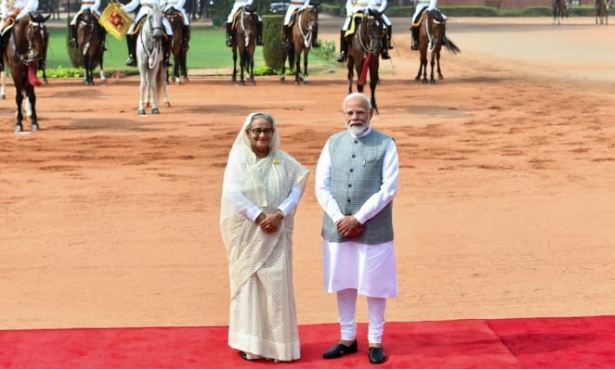
DHAKA, NOV 17: Bangladesh on Monday demanded India extradite ousted former prime minister Sheikh Hasina, hours after she was sentenced to hang for crimes against humanity.

On Monday a court in Dhaka sentenced Hasina as well as former interior minister Asaduzzaman Khan Kamal to death in absentia, after being found guilty of crimes against humanity over a deadly crackdown against last year’s student-led uprising.

The former minister’s whereabouts are not known, but Bangladesh says he is also in India.

“We urge the government of India to immediately extradite the two convicts to the Bangladeshi authorities,” Dhaka’s foreign ministry said in a statement, saying it was “an obligatory responsibility for India”.

Bangladesh warned that “granting asylum to these convicts… would be extremely unfriendly and an affront to justice.”

India’s foreign ministry said that it had “noted the verdict” of Hasina.

“India remains committed to the best interests of the people of Bangladesh, including in peace, democracy, inclusion and stability,” the ministry said in a statement that does not directly address the issue of potential extradition.

Hasina’s 15-year tenure saw widespread human rights abuses, including the mass detention and extrajudicial killings of her political opponents.

Bangladesh last year said it would request an Interpol red notice for Hasina, but there was no record on the global police body alert law enforcement list.

Bangladesh’s interim leader Muhammad Yunus welcomed the verdict.

“The awarding of death sentences to Sheikh Hasina and Asaduzzaman Khan Kamal in the crimes against humanity case is a historic verdict,” the Nobel Peace Prize winner said in a statement.

He called for calm and warned against any “attempt to violate public order”, urging “everyone to refrain from any indisciplined acts”.

Hasina’s son and adviser, Sajeeb Wazed, told Reuters on the eve of the verdict that they would not appeal unless a democratically elected government took office with the Awami League’s participation.

During the trial, prosecutors told the court that they had uncovered evidence of her direct command to use lethal force to suppress a student-led uprising in July and August 2024.

According to a United Nations report, up to 1,400 people may have been killed during the protests between July 15 and August 5, 2024, with thousands more injured — most of them by gunfire from security forces

Hasina was represented by a state-appointed defence counsel who told the court that the charges against her were baseless and pleaded for her acquittal.

Ahead of the verdict, Hasina dismissed the accusations and the fairness of the Tribunal proceedings, asserting a guilty verdict was “a foregone conclusion.”

Bangladesh has been tense ahead of the verdict, with at least 30 crude bomb explosions and 26 vehicles torched across the country over the past few days. There have been no casualties, however.

‘Politically motivated’

Hasina, 78, who has remained in India since she was overthrown in August 2024, challenged the legitimacy of the Tribunal in an email interview with Reuters last month.

“These proceedings are a politically motivated charade,” she said. “They have been brought by kangaroo courts, with guilty verdicts a foregone conclusion. They are presided over by an unelected government which consists of my political opponents.”

She also said she was denied adequate notice of the hearings and any meaningful opportunity to mount a defence, adding that she was not personally involved in the use of lethal force or other alleged crimes.

The Muslim-majority South Asian country of 170 million people has been governed by an interim administration headed by Nobel Peace laureate Muhammad Yunus since Hasina fled. Although the country has been largely peaceful since, political stability is yet to return.

In the Reuters interview, Hasina warned of growing anger among supporters of the Awami League and said that millions of party loyalists would boycott the parliamentary elections in February.

On Monday, security remained tight across Dhaka and other major cities, with paramilitary forces deployed around key government buildings and the tribunal complex.

Authorities said they were prepared for any trouble after the verdict.

Raja Faisal Rathore becomes new AJK PM as assembly ousts Chaudhry Anwarul Haq

Raja Faisal Rathore becomes new AJK PM as assembly ousts Chaudhry Anwarul Haq

MUZAFFARABAD, NOV 17: The Azad Jammu and Kashmir (AJK) on Monday voted to remove Prime Minister Chaudhry Anwarul Haq from his post, replacing him with Pakistan Peoples Party’s (PPP) Raja Faisal Rathore.

PPP’s candidate for the premier’s slot, Rathore, received 36 votes, with two against.

Overall, Rathore is the 16th AJK PM and the fourth of the current assembly. Those who have served in the top post during the incumbent assembly’s tenure, apart from Haq, include Abdul Qayyum Khan and Sardar Tanveer Ilyas Khan.

Assembly Speaker Chaudhry Latif Akbar presided over Monday’s session, attended by lawmakers of the PPP, PML-N, and Pakistan Tehreek-e-Insaf, including Leader of the Opposition, Khawaja Farooq Ahmad.

Strict security measures were put in place at the Assembly Secretariat, Ministers’ Block, and Prime Minister’s Secretariat.

Speaking on the floor of the assembly, PM Haq said that no single individual could be held solely responsible for the “destruction of the constitution and administrative system,” noting that members of his cabinet also share responsibility for governance outcomes.

Haq said he was placing his remarks on record, expressing gratitude to the assembly that “gave him political life.”

He said that no formula for the division of Kashmir could succeed under his leadership and described signing off on ending reserved seats for refugees as “political death.”

The political system could only survive, he said, if the region’s borders are protected. “Without Pakistan’s armed forces, nothing will remain.”

On recent political developments, Haq said that he would have supported Rathore for the prime minister’s post had the elections been held.

“I was once asked to dissolve the assembly by February 15 this year, but I refused to do so,” he added.

The PPP had moved to consolidate its government in the autonomous region shortly after President Asif Ali Zardari revealed the political strategy last month.

The party bolstered its strength in the Legislative Assembly when 10 Pakistan Tehreek-e-Insaf lawmakers joined the PPP on October 26 during a meeting with President Zardari’s sister, Faryal Talpur, at Zardari House in Islamabad.

Among those who joined the PPP were Muhammad Hussain, Chaudhry Yasir, Chaudhry Muhammad Akhlaq, Chaudhry Arshad, Chaudhry Muhammad Rasheed, Zafar Iqbal Malik, Faheem Akhtar Rabbani, Abdul Majid Khan, Muhammad Akbar Ibrahim, and Asim Sharif Butt.

Later, the PML-N also tendered its support for the no-confidence motion, but decided against joining the government’s fold.

Ambassador of Lebanon visits RCCI

Ambassador of Lebanon visits RCCI

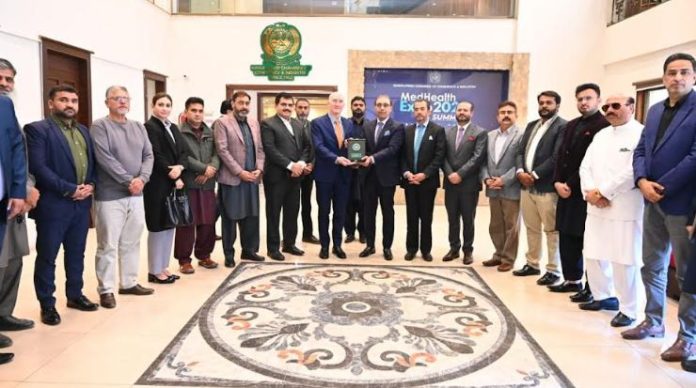
ISLAMABAD, NOV 17 /DNA/ – The Ambassador of Lebanon to Pakistan, Abdulaziz Issa, paid an official visit to the Rawalpindi Chamber of Commerce and Industry (RCCI), where he held a detailed meeting with RCCI President Usman Shaukat. Senior Vice President Khalid Farooq Qazi, Vice President Fahad Barlas, and members of the Executive Committee were also present.

During the meeting, both sides explored avenues to strengthen bilateral economic cooperation, with a particular focus on enhancing trade, promoting tourism, and boosting business-to-business linkages.

Key areas of discussion including, Diversification of bilateral trade, leveraging Pakistan’s strengths in textiles, rice, and pharmaceuticals,  and opportunities in Lebanon’s agricultural products and tourism services, Promotion of medical and religious tourism between the two countries and Exchange of trade delegations to explore new market opportunities and Visa facilitation to support business and people-to-people connections.

Ambassador Issa noted that Pakistan and Lebanon hold significant potential for expanding bilateral trade and emphasized the need to formalize cooperation through existing frameworks such as the Joint Economic Commission. Both sides also recognized IT, renewable energy, and export-led manufacturing as promising sectors for future collaboration.

RCCI President Usman Shaukat expressed appreciation for the Ambassador’s visit and reaffirmed RCCI’s commitment to fostering stronger ties with Lebanon’s business community.

Envoys of four countries present credentials to President

Envoys of four countries present credentials to President

Saifullah Ansar

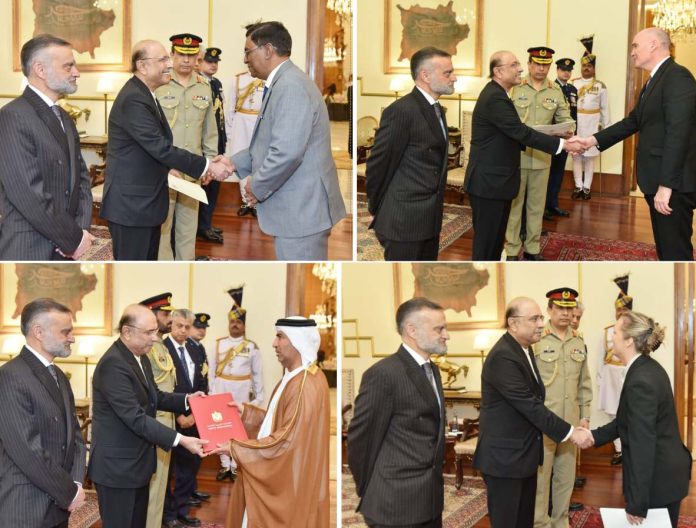
ISLAMABAD, NOV 17 /DNA/ – Four newly designated envoys presented their credentials to President Asif Ali Zardari at a ceremony held today at Aiwan-e-Sadr.

Those who presented their credentials included Mr. Tim Kane, High Commissioner-designate of Australia; Mr. Munsoo Kurrimbaccus, High Commissioner-designate of Mauritius; Mrs. Maja Mortensen, Ambassador-designate of Denmark and Mr. Salem Mohammed Salem Al Bawab Al Zaabi, Ambassador-designate of the United Arab Emirates.

Upon arrival at the Presidency, the envoys were presented Guard of Honour by a smartly turned-out contingent of the Pakistan Armed Forces.

The President congratulated them on their appointment and expressed confidence that their tenures would further strengthen Pakistan’s bilateral relations with the four countries.

While talking to the High Commissioner-designate of Australia, President highlighted Pakistan’s friendly relations with the country, emphasising enhanced trade and investment cooperation, agriculture and particularly in the education sector with a sizeable community of Pakistani students in Australia. He noted the importance of people-to-people linkages, with a shared passion for sports and appreciated the role of the Pakistani diaspora in Australia in promoting goodwill between the two nations.

During his meeting with the High Commissioner-designate of Mauritius, the President termed the long-standing bonds of friendship, underpinned by deep cultural affinity and shared Commonwealth heritage, as pivotal. The President underscored the importance of further strengthening bilateral ties, especially in trade, investment, agriculture, defence cooperation and interparliamentary linkages.

In his interaction with the Ambassador-designate of Denmark, the President discussed the fraternal relations with Denmark and appreciated the close coordination between the two countries at the UN Security Council. He underscored the potential for enhanced cooperation in trade, agriculture, dairy products, technology and infrastructure development. He appreciated Denmark’s support for Pakistan’s green transition and climate resilience agenda.

In his conversation with the Ambassador-designate of the United Arab Emirates, the President reaffirmed Pakistan’s solidarity with the Government and people of the United Arab Emirates, with Pakistan being the first country to recognize the UAE in 1971. He said the historic ties anchored in common faith, mutual trust and shared aspirations for regional peace and prosperity are the hall marks of this fraternal relationship. President Zardari emphasised the need to enhance bilateral trade, security and defence cooperation and underscored the role played by the Pakistani diaspora as a bridge between the two states.

The President extended his best wishes to all four envoys for a productive tenure, expressing hope that their efforts would lead to stronger bilateral and multilateral partnerships for mutual benefit and prosperity.

ATC issues arrest warrants of CDA chief, commissioner Islamabad

ATC issues arrest warrants of CDA chief, commissioner Islamabad

RAWALPINDI, NOV 17 /DNA/ – During the hearing of the case related to the November protest registered at Sadiqabad Police Station in the Anti-Terrorism Court (ATC) Rawalpindi, the court took stern action against the continuous absence of accused Aleema Khanum by reissuing non-bailable warrants against her for the second time. The court also summoned Aleema Khanum’s property records from the Punjab Board of Revenue.

According to the details, the report, which has been submitted in the court here on Monday, revealed that 338 kanals (42 acres approx) of land is registered in Aleema Khanum’s name across four districts. Additionally, directives were issued to freeze her 15 more bank accounts.

Three accused appeared in person and seven through their pleaders, while the prosecution witnesses and team were fully present in the court during the case hearing presided by ATC Judge Amjad Shah.

The court summoned details of Alima Khanum’s properties to take further action against her, so that if the absence continues, she can be declared a proclaimed offender and her properties can be confiscated.

According to the Board of Revenue report, the properties registered in Aleema Khanum’s name include 51 kanals and 16 marlas in Bhakkar, 1 kanal and 4 marlas in Lahore, and 1 kanal and 1 marla (Mauza Nurpur Kamboh, Tehsil Lahore Cantonment), 64 kanals and 14 marlas in Mauza Sultan, Tehsil Raiwind, 217 kanals and 5 marlas in Mianwali, and 4 kanals and 13 marlas in Sheikhupura.

The court issued directives to freeze 7 more accounts of her in Allied Bank Limited and 15 accounts of United Bank Limited under financial measures, making the total to 37 frozen accounts.

The absence of the reply by the CDA Chairman and the Commissioner Islamabad, even after a reminder issued first and then a contempt of court notice, was reported to the court. With no response from both sides’ representatives, the court issued non-bailable warrants against them and directed the IG Islamabad to execute them immediately.

Moreover, one surety related to vehicles appeared in the court, while non-bailable warrants have been reissued against the two other sureties who have not yet been arrested.

The court adjourned the hearing until November 20.

Stay Connected

64FansLike
60FollowersFollow

Latest Reviews

Exchange Rates

USD - United States Dollar
EUR
1.14
GBP
1.34
AUD
0.69
CAD
0.71