Home Blog Page 38

BOI showcases one-window business facilitation centre at ICCI awareness session

BOI showcases one-window business facilitation centre at ICCI awareness session

Government committed to facilitating investors through One-Window Services: Additional Secretary BOI

Business Facilitation Centre to Enhance Investors’ Confidence, Ease of Doing Business: Acting President ICCI

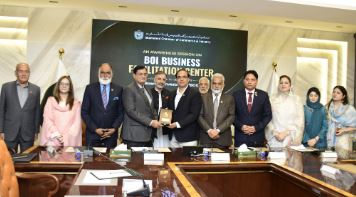
ISLAMABAD, JUL 15 /DNA/ – The Islamabad Chamber of Commerce and Industry (ICCI), in collaboration with the Board of Investment (BOI), organized an awareness session on the Business Facilitation Centre (BFC), established by the BOI in Islamabad, to familiarize the business community with the government’s flagship one-window initiative designed to simplify investment procedures, improve inter-agency coordination and enhance Pakistan’s ease of doing business.

Addressing the session as the chief guest, Additional Secretary and Executive Director General, Board of Investment, Zulfiqar Ali, described the Business Facilitation Centre as a landmark initiative aimed at creating a more investor-friendly business environment in Pakistan. He said the Centre has been designed to provide investors and entrepreneurs with seamless access to a broad range of government services through a single platform, eliminating the need to approach multiple departments separately.

He said the BFC offers comprehensive facilitation in company registration, business incorporation, investment approvals, licensing, regulatory compliance, documentation, tax guidance and coordination with relevant government agencies. By integrating these services under one roof, he noted, the Centre would reduce procedural delays, enhance transparency, improve institutional coordination and strengthen investor confidence.

Zulfiqar Ali reaffirmed the Board of Investment’s commitment to providing an efficient and responsive facilitation mechanism for both domestic and foreign investors. He urged the business community to fully utilize the Business Facilitation Centre and its digital platform to expedite business operations and capitalize on emerging investment opportunities in Pakistan.

Earlier, welcoming the distinguished guests and participants, Acting President ICCI Tahir Ayub said the private sector requires efficient, transparent and accessible public services to remain competitive in today’s rapidly evolving business environment. He observed that initiatives such as the Business Facilitation Centre are not merely administrative reforms but strategic interventions that will help transform Pakistan into a more competitive and investment-friendly economy.

He expressed confidence that the Business Facilitation Centre would play a pivotal role in improving Pakistan’s ease of doing business, attracting greater domestic and foreign investment and strengthening the country’s economic competitiveness.

A comprehensive technical presentation was delivered by   Sabih-ul-Hussain Warsi, Manager, Business Facilitation Centre, Board of Investment, who  gave a detailed briefing  about the BFC as well as the milestones achieved by the initiative.

In his  vote of thanks, ICCI Vice President Irfan  Chaudhry reaffirmed ICCI’s commitment to strengthening collaboration with government institutions to promote investor facilitation, improve the ease of doing business and foster sustainable economic growth.

Among those present were Ms. Aasiya Jahangir Khan, former Provincial Minister, entrepreneur and women rights champion; Ms. Hina Razzaq, Assistant Registrar, Securities and Exchange Commission of Pakistan (SECP); Ms. Sama Gul of the Federal Board of Revenue (FBR); ICCI Executive Members Imran Minhas, Waseem Chaudhry and Zulqurnain Abbasi; former Senior Vice President Khalid Chaudhry; senior members Ms. Sadaf Asim and Ms. Rabiha Raheel;  Kashif Qureshi, Chairman, and Ms. Muqaddas Chaudhry, Vice Chairperson, ICCI Standing Committee on Social Mobilization and Communication, along with a large number of entrepreneurs, industrialists and members of the business community.

CDA Chairman calls for global collaboration to strengthen Islamabad’s green future

CDA Chairman calls for global collaboration to strengthen Islamabad’s green future

ISLAMABAD, Jul 15: Chairman of the Capital Development Authority (CDA), Lt. (Retd.) Sohail Ashraf reaffirmed the Authority’s commitment to making Islamabad greener, more environmentally sustainable and aesthetically vibrant through collaborative initiatives with national and international partners.

Speaking at a tree plantation event organised by The Turkish Cooperation and Coordination Agency (TIKA) at the Ankara Park for leaving a lasting green legacy, the CDA chairman said Islamabad’s identity has always been closely associated with its lush greenery and natural beauty, emphasizing that environmental preservation remains at the heart of the capital’s development strategy.

“I think this forum is beautiful, and Islamabad is beautiful. Whenever you visit Islamabad, the fundamental focus is on greenery,” he said, adding that the city’s green landscape significantly contributes to its unique character and quality of life.

Lt. (Retd.) Sohail Ashraf described the tree plantation campaign as an important milestone in promoting environmental sustainability, noting that it was the first Green Initiative event he had attended since assuming his responsibilities.

CDA Chairman calls for global collaboration to strengthen Islamabad’s green future

Highlighting the importance of international cooperation, he said the CDA was actively engaging with several friendly countries to advance green development initiatives. He said discussions were underway with Azerbaijan and Uzbekistan on cooperation in environmental protection, urban greening and sustainable development.

The CDA chairman said collaborative efforts with international partners would help introduce innovative approaches to environmental conservation while supporting the capital’s long-term development goals.

He stressed that the Authority was working collectively with stakeholders to implement new initiatives in a bid to enhance Islamabad’s green infrastructure and environmental resilience.

Expressing appreciation to Turkish Ambassador, Dr. Irfan Neziroglu, Lt. (Retd.) Sohail Ashraf described the event as an encouraging beginning and said it represented “the first step in the right direction” towards achieving a cleaner, greener and more beautiful federal capital.

CDA Chairman calls for global collaboration to strengthen Islamabad’s green future

He reaffirmed the CDA’s resolve to continue expanding tree plantation drives and other environmentally sustainable initiatives to preserve Islamabad’s natural heritage for future generations while strengthening its status as one of the region’s most scenic and environmentally friendly capitals.

Minister of State for Climate Change and Environmental Coordination, Dr. Shezra Mansab Ali Khan said the tree plantation drive reflected the shared commitment of Pakistan and Türkiye to environmental protection and sustainable development.

She said trees are indispensable for human life, wildlife, and the environment as they provide habitats for countless species, improve air quality, stabilize the soil, and play a vital role in mitigating the impacts of climate change.

Highlighting Pakistan’s climate vulnerability, the minister noted that despite being among the world’s low greenhouse gas emitters, the country remains one of the worst affected by climate change. She said Pakistan has witnessed devastating flash floods and other climate-induced disasters in recent years, emphasizing that expanding the country’s green cover is one of the most effective measures to enhance climate resilience.

Dr. Shezra said trees planted across plains provide shade, shelter, and carbon absorption, while those planted in mountainous regions help prevent soil erosion, reduce the risk of landslides, conserve water resources, and strengthen ecological balance. “Every tree we plant today is an investment in a safer, greener, and more sustainable future,” she remarked.

Expressing confidence in the ongoing greening initiatives in the federal capital, she said the ceremony marked only the beginning of a broader environmental campaign and voiced optimism that, under the leadership of CDA Chairman Sohail Ashraf, Islamabad would become an even greener, cleaner, and more beautiful city.

The minister also reaffirmed Pakistan’s unwavering solidarity with the Republic of Turkiye, stating that the two brotherly countries have consistently stood by each other during times of need. She thanked the people and Government of Türkiye, as well as President Recep Tayyip Erdogan, for their enduring friendship and support, and called for further strengthening bilateral cooperation in environmental protection and other areas of mutual interest.

Ambassador of Turkiye to Pakistan Irfan Neziroglu paid tribute to the martyrs of the failed July 15, 2016 coup attempt, expressing gratitude to Pakistan for its steadfast support and reaffirming the enduring brotherly ties between the two nations.

Addressing a commemorative ceremony marking the anniversary of Turkiye’s Democracy and National Unity Day, the ambassador recalled that on July 15, 2016, the Fethullah Terrorist Organization (FETO) attempted to overthrow Turkiye’s democratically elected government, constitutional order, democracy and the will of the Turkish people.

He said the terrorist group targeted and bombed key state institutions, including the headquarters of the National Intelligence Organization (MIT), police headquarters and stations, military facilities, the Turkish Radio and Television Corporation (TRT), satellite communication facilities and, most notably, the Grand National Assembly of Turkiye.

The ambassador shared his personal experience of being inside the Turkish Parliament during the attack, saying he was in the plenary hall alongside members of parliament, journalists and citizens who had gathered to defend democracy when a bomb struck the parliament building. “By the grace of Allah, the explosion occurred around 30 metres away from the plenary hall, and we survived,” he said.

Recalling the sacrifices made that night, Ambassador Neziroglu said more than 250 people embraced martyrdom, while over 2,000 civilians were injured defending democracy. He said President Recep Tayyip Erdogan’s call for citizens to take to the streets was answered by millions of people who courageously resisted the coup plotters and ensured the failure of the attempted takeover.

The ambassador said the ceremony was held to honour the martyrs who sacrificed their lives for democracy and freedom.

Highlighting the longstanding friendship between Turkiye and Pakistan, he said Pakistan had stood by Turkiye not only during the failed coup attempt but also throughout history, including during Türkiye’s War of Independence.

He said Pakistan officially designated FETO as a terrorist organisation in 2018, describing it as another demonstration of the deep trust and solidarity between the two brotherly nations. “Pakistan has always been very special to us and will always remain special. We are grateful to Pakistan. We love this country and its people,” he said.

Concluding his address, Ambassador Neziroglu reaffirmed the enduring bond between Turkiye and Pakistan. “We stood together in the past, we stand together today, and, God willing, we will continue to stand together in the future. You will never walk alone,” he said.

TIKA Islamabad Coordinator Saliha Tuna said the memorial forest established at Ankara Park under the project would serve not only as a lasting tribute to the martyrs of July 15, but also as a tangible symbol of the strong brotherhood between Türkiye and Pakistan and their shared commitment to environmental sustainability.

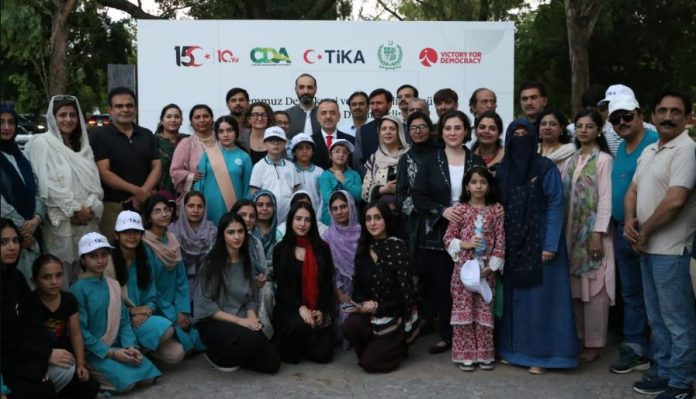
The TIKA commemorated the martyrs of July 15 Democracy and National Unity Day through a tree-planting ceremony at Ankara Park. As part of the project, a total of 500 saplings were planted, with approximately 100 saplings planted together with participants during the event.

The ceremony was organized in cooperation with Pakistan’s Ministry of Climate Change and Environmental Coordination and the Capital Development Authority (CDA). Around 200 participants attended the event, including the Minister of State for Climate Change and Environmental Coordination, Dr. Shehzra Mansab Ali Khan; the Ambassador of the Republic of Turkiye to Pakistan, Dr. Irfan Neziroglu; CDA Chairman Lt. (Retd.) Sohail Ashraf; as well as representatives of public institutions, universities, civil society organizations, humanitarian organizations, students, and members of the Turkish community in Pakistan.

The programme commenced with the recitation of the Holy Quran in memory of the July 15 martyrs. Following the speeches, participants planted saplings together and posed for a commemorative group photograph. The programme concluded with the serving of traditional Turkish doner and ayran.

KP govt to develop 12 polo grounds in Chitral

KP govt to develop 12 polo grounds in Chitral

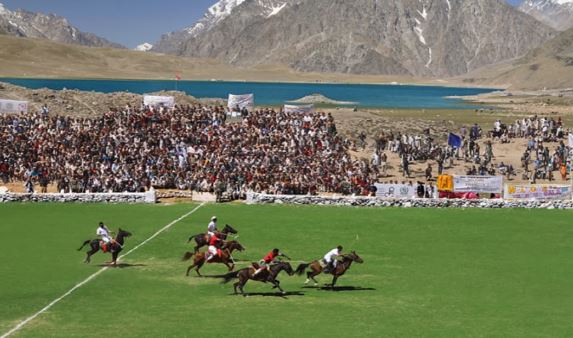
ISLAMABAD, Jul 15: The Khyber Pakhtunkhwa government has approved a Rs2 billion tourism and cultural heritage project for the development and maintenance of 12 polo grounds in Upper and Lower Chitral, including the historic Shandur Polo Ground.

According to an official document available with Wealth Pakistan, the project has been designed to preserve and promote polo as one of the most important cultural and heritage traditions of Chitral. The scheme also aims to strengthen sports-based tourism and create income opportunities for local communities.

The Shandur Polo Festival is one of the key tourism events of the region. It is organised at Shandur Top in coordination with Chitral Scouts, the district administration, the police, and the Gilgit-Baltistan government.

The festival generates millions of rupees for the communities of Upper and Lower Chitral through tourism-related activities, including transport, accommodation, food services, temporary stalls, and local trade.

Chitral’s polo culture is deeply connected with the region’s identity. Unlike formal club polo, the traditional version played in Chitral is faster, more physical, and closely linked with local festivals and community gatherings.

The document also lists several promotional festivals for the region, including the Shandur Polo Festival, the Pre-Shandur Polo Tournament, the Qaqhlasht Festival, the Broghil Festival, the Khut Festival, the Chilam Joshi Festival, the Uchal Summer Festival and the Choimus Winter Festival.

The polo grounds project is the largest individual tourism-related scheme mentioned in the document for Chitral. Other projects include tourist rest areas, picnic spots, camping pod villages, and road schemes.

The development of 12 polo grounds could help Chitral turn its traditional sport into a stronger tourism product, benefiting local players, transporters, hoteliers, shopkeepers and small businesses.

Besides the polo grounds project, the document outlines several other tourism development initiatives for Chitral. These include the establishment of a Tourist Facilitation and Rest Area at Booni in Upper Chitral, development of tourist picnic spots at Garam Chashma in Lower Chitral and Sorlaspur in Upper Chitral, as well as camping pod villages at Bumburait, Sorlaspur and Yarkhun Lasht to improve visitor facilities and encourage tourism.

The document also includes road infrastructure projects, including the construction of a 17.1-kilometre road at a cost of Rs1.783 billion, while the Ayun-Bumburait and Zainey Pass roads have been recommended for inclusion in upcoming Annual Development Programme (ADP) schemes. In addition, a Rs300 million “Mezban” (Host) Tourism Programme has been initiated in Upper and Lower Chitral, Upper Dir, Lower Dir and Mansehra to support home-stay facilities through interest-free loans ranging from Rs1 million to Rs3 million.

Operation Shaban: Security forces eliminate three more Khwarij terrorists

Operation Shaban: Security forces eliminate three more Khwarij terrorists

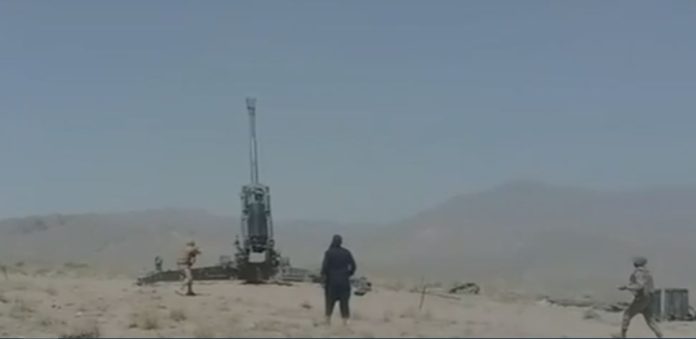
QUETTA, Jul 15: Security forces killed three more Khwarij terrorists as the Pakistan Army, Frontier Corps (FC), and Balochistan Police continue the joint Operation Shaban.

Security sources said that the total number of terrorists killed during Operation Shaban has risen to 88. They said the terrorists were being targeted through coordinated air and ground operations.

They said the security forces were carrying out effective operations against terrorists belonging to Fitna al Khwarij in the area.

As a result of the sustained offensive, the terrorists have suffered heavy losses, the sources added.

Since July 5, security forces have killed a total of 126 terrorists during Operation Shaban and other intelligence-based operations (IBOs), the security sources said. The sources said Operation Shaban would continue across Balochistan until the last terrorist would be eliminated.

PM Shehbaz directs FBR to provide all possible facilities to business community

PM Shehbaz directs FBR to provide all possible facilities to business community

ISLAMABAD, JUL 15: Prime Minister Shehbaz Sharif on Wednesday hailed the business community as “the backbone of the national economy” and said that they should be provided with every possible facility to enhance production and boost exports.

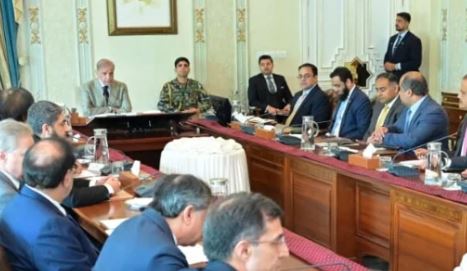
Chairing a meeting to review the affairs of the Federal Board of Revenue (FBR), the prime minister directed the Board to work closely with the business community and resolve their legitimate concerns on a priority basis.


He also instructed senior FBR officials to visit Karachi during the first week of every month to maintain direct engagement with the business community and ensure the prompt resolution of their issues.

He expressed his confidence that Pakistan’s economy is on the path to stability, and the current year will be marked by economic growth and the expansion of business activities.

He said companies that comply with tax laws would be officially recognised and encouraged in appreciation of their contribution.

The prime minister emphasised that the government’s objective was to promote ease of doing business, encourage investment and exports, and make the tax system more transparent and simpler to strengthen the confidence of the business community.

The meeting was also briefed on the performance of the FBR and the implementation of ongoing reforms.

It was informed in the meeting that production monitoring systems had been installed in the sugar, cement, tobacco, tiles, and fertiliser industries.

The installation of production monitoring systems in the textile and beverages industries is currently underway.

During the past year, production monitoring in the sugar industry resulted in the collection of an additional Rs42 billion in taxes, the meeting was told.

In the cement industry, production monitoring led to the collection of an additional Rs 38 billion in tax revenue over the past year.

Similarly, the meeting was further informed that in the beverages industry, production monitoring generated an additional Rs15 billion in tax revenue during the past year.

The meeting was attended by Minister for Law and Justice Azam Nazeer Tarar, Minister for Economic Affairs Ahad Khan Cheema, Minister for Finance and Revenue Muhammad Aurangzeb, Minister for Information and Broadcasting Attaullah Tarar, Minister for Information Technology and Telecommunication Shaza Fatima Khawaja, Minister of State for Finance and Railways Bilal Azhar Kayani, Special Assistant to the Prime Minister Haroon Akhtar, Governor of the State Bank of Pakistan Jameel Ahmad, and other senior government officials.

Files relating to India’s largest nuclear power plant Kudankulam exposed in data breach

Files relating to India's largest nuclear power plant Kudankulam exposed in data breach

NEW DELHI: Ransomware group World Leaks has posted on the dark web a huge cache of files related to India’s largest nuclear plant, including purported blueprints of parts of its facilities and supplier details — information it labelled as coming from Reliance Group.

The Kudankulam Nuclear Power Plant, located in the southern state of Tamil Nadu, is the largest of India’s seven nuclear plants and central to Prime Minister Narendra Modi’s ambitious plans to expand the country’s atomic energy capacity.


Indian businessman Anil Ambani’s Reliance Group, one of the plant’s contractors, told Reuters in a statement that there had been a “partial breach” of its data on a server hosted by third-party Indian data centre service provider Yotta, and that the government has been informed about the incident.

Reliance did not disclose what data had been breached.

The data breach could pose a “serious” risk to the safety of the plant, says Nickolas Roth, a senior director at the Nuclear Threat Initiative, which advises governments and benchmarks countries’ preparedness on nuclear security.

The breach also underscores how hacks have become more common in India, where many companies are ill-equipped to deal with such threats.

Reuters reviewed the documents, which were dated from 2016 to mid-2025, but could not verify their authenticity. In addition to some blueprints and supplier details, they purportedly show meeting and inspection records, equipment reviews and insurance policies.

The 19,000 files appeared to be the most sensitive of a total 858,000 Reliance files on the World Leaks website.

One of the conglomerate’s subsidiaries, Reliance Infrastructure, won a contract in 2018 to design and build infrastructure for the plant’s Unit 3 and Unit 4. Both units, still under construction, are due to be operational by 2027 and are slated to provide a combined 2,000 megawatts of capacity.

World Leaks, a well-known ransomware group that has previously targeted Nike and India’s Tata Group, did not respond to Reuters queries on the Reliance data breach. The group typically posts stolen corporate data on its website after companies decline to pay the ransom demanded. Its website can only be accessed with a specialised browser.

In June, World Leaks told Reuters it had sought $1.5 million in ransom for Tata Group files that contained confidential component designs of clients Apple and Tesla, adding that it posted the data after Tata “ignored” its demand.

Suspicious activity on server in May
The Nuclear Power Corporation of India, which commissions and operates the country’s nuclear power plants, has been communicating with Reliance about the breach and India’s main cybersecurity agency — the Indian Computer Emergency Response Team (CERT-In) — is looking into the incident, according to a source familiar with the matter. The source declined to be identified due to the sensitivity of the issue.

Nuclear Power Corporation Chairman Rajesh Veeraraghavan, CERT-In and the government’s main press office did not respond to repeated requests for comment.

Yotta said in a statement it had noted suspicious activity on May 29 on a server it hosts that belongs to Reliance Infrastructure.

It said the activity was immediately terminated and that the suspected ransomware execution was prevented, but Reliance Infrastructure informed it at the end of June that there had been claims of a data breach made by “external threat actors.”

Yotta said it has not been able to verify the claims of the “threat actor”, but added that it has shared its detailed technical investigation with Reliance Infrastructure and supports an ongoing investigation.

India’s Department of Atomic Energy declined to comment, while Modi’s office did not respond to Reuters queries.

Blueprints and insurance policies
The documents posted on World Leaks do not appear to relate to the nuclear reactors’ core systems, which are supplied by Russia’s state-owned Rosatom.

They did contain purported blueprints for the ventilation and cooling systems used in Unit 3 and Unit 4, as well as what appeared to be the complete floor layout of a “common control room”.

The files also included what appeared to be vendor proposals, a list of approved suppliers, and a record of a 2024 meeting about a joint inspection by the Nuclear Power Corporation and Reliance, with photos of equipment.

Another document purports to show that Reliance Infrastructure and the Nuclear Power Corporation had taken out an insurance policy that would entitle them to $112 million if either Unit 3 or Unit 4 were to suffer an act of terrorism.

The files, in the hands of bad actors, could in theory be exploited to map the plant’s support systems, identify its suppliers and pinpoint weaknesses in its security chain, according to researchers.

They could “show an adversary not just who has access to the project but which systems that access reaches,” said Nuclear Threat Initiative’s Roth.

India ranks third among a list of countries suffering the most data breaches, with 28.9 million accounts compromised last year, lagging only the United States and France, according to cybersecurity company Surfshark.

A report last year by the Data Security Council of India and cybersecurity firm Seqrite said that of 204 organisations surveyed across India, some 73% were “unaware if they have ever been attacked” while 57% lack cyber hygiene practices.

It is also the second time that the Kudankulam plant has been linked to a cyber incident, with malware tied to a North Korean hacker group found on the plant’s administrative network in 2019.

At the time, the Nuclear Power Corporation said the matter was investigated immediately and plant systems were not affected.

Three arrested in young doctor’s robbery-murder case, say Karachi police

Three arrested in young doctor's robbery-murder case, say Karachi police

KARACHI, JUL 15: Police have arrested three suspects allegedly involved in the fatal shooting of a young doctor during a robbery near Teen Talwar in Karachi’s Clifton area, South Deputy Inspector General Asad Raza said on Wednesday.

Speaking at a press conference, the police official said that the suspects were arrested from the jurisdiction of the Defence police station.


The 28-year-old doctor was killed during a robbery resistance outside a private bank near Teen Talwar in Karachi on Monday.

DIG Raza said that the three suspects arrived on two motorcycles to carry out the robbery, adding that the police obtained details of the incident within 24 hours and completed the arrests over the following 36 hours.

The South DIG said the suspects were already present when Dr Akash reached the bank. He said that one of the accused allegedly conducted reconnaissance before the robbery and passed information to his accomplices.

He noted that the police collected and reviewed more than 100 CCTV recordings during the investigation. He said the suspects used two motorcycles and a car during the crime.

The DIG South added that police had also recovered a portion of the stolen cash from the suspects.

Separately speaking on Geo News programme “Geo Pakistan”, Sindh Inspector General of Police (IGP) Javed Alam Odho said that two more suspects had been identified and would be arrested soon.

The IGP said that CCTV footage had played a key role in the investigation of the Dr Akash murder case.

Speaking on the Safe City project, Odho said that the first phase of the project had been completed successfully, with around 1,150 cameras installed, while the second phase was about 90% complete.

Highlighting what he called the “improvements” in the security situation, Odho said Karachi recorded 37 terrorism incidents last year, compared with only seven so far this year.

Odho also said crime had declined in Karachi’s Defence area following the installation of CCTV cameras.

He said street crime in Sindh had dropped by 11.8% during the first six months of the year.

Spain advances to World Cup final with 2-0 win over France

Spain advances to World Cup final with 2-0 win over France

ARLINGTON, Texas: Mikel Oyarzabal scored from the penalty spot after a heady play by teenager Lamine Yamal, Pedro Porro added another goal and Spain advanced to its first World Cup final since winning in 2010 with a 2-0 victory over France on Tuesday.

A day after his 19th birthday, Yamal was denied a goal on a close offside call that came soon after Porro’s give-and-go with Dani Olmo in the 58th minute had put Spain up 2-0. But it was Yamal’s smart play against a veteran defender that put Spain in the lead.

Spain will face either defending champion Argentina or England on Sunday in East Rutherford, New Jersey. They face each other on Wednesday in Atlanta.

Kylian Mbappé and France, FIFA’s top-ranked team, were trying to become only the third team to reach three consecutive World Cup finals. They instead will play in the third-place game in Miami Gardens, Florida, on Saturday, the day before the final at MetLife Stadium across the river from New York City.

This win on soccer’s biggest stage marked the third summer in a row that Spain beat France in a tournament semifinal match. Yamal scored in a 2-1 win in the 2024 European Championship semifinals just days before his 17th birthday, and La Roja won 5-4 in Nations League play last year.

After a quarterfinal win over Belgium last Friday, Yamal said he believed France should fear Spain. Those words certainly proved true.

Oyarzabal’s penalty kick in the 22nd minute came after Yamal drew a foul when kicked by defender Lucas Digne.

After a poor first touch with his head, Digne was trying to clear the ball when Yamal raced in from behind to challenge in the penalty area. The ball hit off the elbow of the leaping teen before he was kicked by Digne, playing in his 63rd game for France only six days before his 33rd birthday.

Oyarzabal’s fifth goal of this year’s World Cup marked the first time either team has trailed in their seven games in this tournament. It was his 30th goal in 60 international games for Spain.

Pakistan urged to pursue balanced foreign policy amid geopolitical shifts

Pakistan urged to pursue balanced foreign policy amid geopolitical shifts

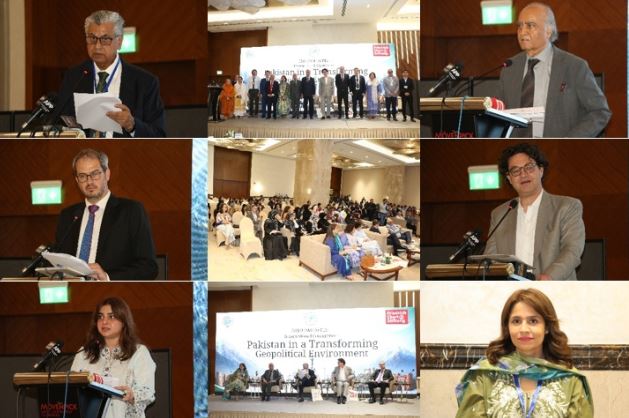
ISLAMABAD, JUL 15 /DNA/ – The Centre for Afghanistan, Middle East and Africa (CAMEA) at the Institute of Strategic Studies Islamabad (ISSI), in collaboration with the Friedrich Ebert Stiftung (FES), Pakistan office, hosted a one-day International Conference, titled ‘Pakistan in a Transforming Geopolitical Environment.’

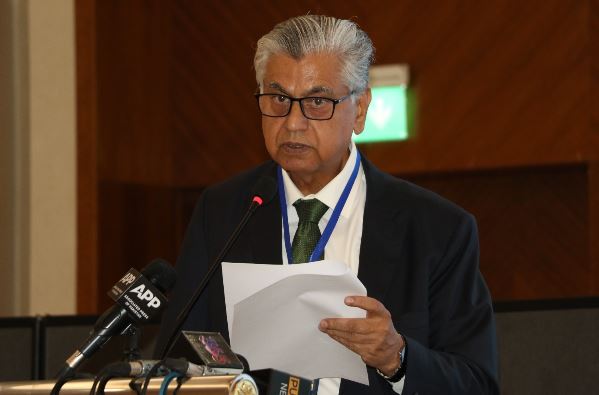
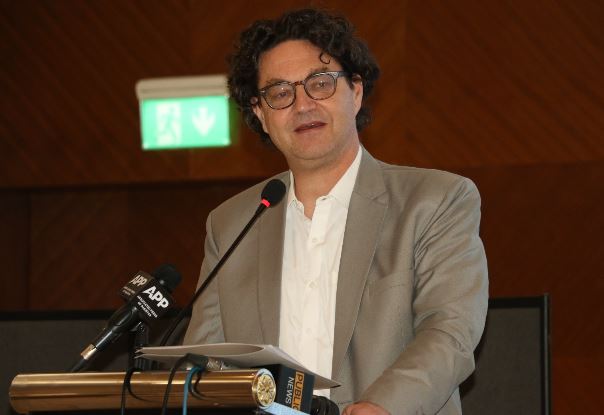
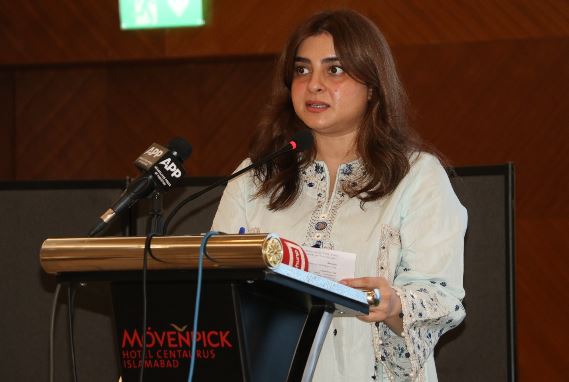
Mr. Murtaza Solangi, Spokesperson for the President of Pakistan, was the Chief Guest at the inaugural session. Speakers included Dr. Amina Khan, Director CAMEA; Ambassador Khalid Mahmood, Chairman, BOG ISSI; Mr. Felix Kolbitz, Country Director, FES Pakistan; and Mr. Arno Kirchhof, Charge d’Affaires, Embassy of the Federal Republic of Germany, Islamabad.

Pakistan urged to pursue balanced foreign policy amid geopolitical shifts

Ambassador Khalid Mahmood, while giving his welcome remarks, stated that Pakistan finds itself in a regional and global environment that is changing rapidly, with strategic competition intensifying, regional alignments shifting, with conflicts producing wider political and economic consequences.  He said that the line between traditional and non-traditional security challenges is becoming increasingly blurred. He further opined that, for Pakistan, these developments are not abstract as they directly affect our security, economy, diplomacy and regional outlook. Pakistan’s location gives it strategic importance, but it also places a responsibility to pursue a balanced, thoughtful and forward-looking foreign policy. Pakistan’s approach has consistently been based on dialogue, peaceful coexistence, respect for sovereignty, regional stability, economic cooperation and connectivity.

Pakistan urged to pursue balanced foreign policy amid geopolitical shifts

Dr. Amina Khan, in her introductory remarks, said that the annual CAMEA–FES Conference continues to promote deeper dialogue and understanding of shared challenges and the evolving regional dynamics. She was of the view that Pakistan is located in what has been constantly called a ‘tough neighbourhood.’ The region continues to confront a complex interplay of traditional and non-traditional security challenges, further compounded by geopolitical rivalries, great-power competition, and protracted conflicts. However, at the same time, the region possesses enormous potential for connectivity, economic integration, and shared prosperity. At a time of profound geopolitical transformation, sustained dialogue and regional cooperation remain indispensable for building trust, advancing connectivity, and promoting lasting peace and shared prosperity, she concluded.

Mr. Murtaza Solangi, while speaking at the occasion, said that this conference is very timely and important as it brings together experts from across the world at a very consequential moment. He went on to say that we live in a transformative arena where we see a transition from a unipolar to multipolar order. The order created after the second world War is collapsing and the big global powers are creating their own spheres of interest. Pakistan today is also at the intersection of several transitions; unsettled Pakistan Afghanistan relations and a fast moving global order. These are the most consequential years for Pakistan. Last year’s India Pakistan war, continued conflict between the United States and Iran all affect Pakistan. Pakistan maintains good ties with the GCC, with China and also the US. Pakistan has tried to reposition itself and has tried to bring peace to a volatile region. Pakistan seeks a peaceful and stable relationship with Afghanistan and has historically stood with the Afghan people. Pakistan would not like to see Afghanistan become a global sanctuary for terrorism. Pakistan welcomes China’s, Turkiye’s and Qatar’s mediation with regard to its relationship with Afghanistan. Pakistan is also interested in trans-regional connectivity. Pakistan’s defense pact with Saudi Arabia is part of our broader agenda of improving relationships with the GCC and Pakistan has a very sound relationship with Iran. Security has become transformative and we face numerous challenges like pandemics, natural disasters and other challenges. He concluded by saying that Pakistan’s foreign policy rests on strategic balance with regional neighbour’s and proactive diplomacy.

Pakistan urged to pursue balanced foreign policy amid geopolitical shifts

Mr. Arno Kirchhof presented European Union as an example to express optimism regarding the functionality and sustainability of the ‘rule-based world order’, despite persistent challenges. He identified several key areas in which Pakistan could establish and strengthen its partnership with Germany and other European countries. He stressed the need to further enhance trade, investment, and human resource exchange between Pakistan and Germany.

In his remarks, Mr. Felix Kolbitz applauded Pakistan’s recent global diplomatic maneuvering in the region and beyond as remarkable. With successfully brokering a peace deal between Iran and the United States as well as concluding a defense agreement with Saudi Arabia, Pakistan has emerged as a net security provider for the region. Indicating Pakistan’s unique geography, he identified several key challenges facing Pakistan such as water and climate security and transnational terrorism.  He stressed that these were shared challenges that require collective strategy and shared response by the global community.

Conference’s schedule includes three separate working sessions on: Afghanistan, Central Asia and the Future of Regional Stability, Pakistan and the Middle East in a Transforming Geopolitical Environment and Non-Traditional Security Challenges Across a Changing Regional Landscape.

PIDE calls for Middle East Recovery Mission to boost exports

PIDE calls for Middle East Recovery Mission to boost exports

New policy viewpoint urges the government to activate existing institutions, certify workers, support Pakistani firms and capture a share of the Gulf’s trillion-dollar project pipeline

ISLAMABAD, JUL 15: /DNA/ – The Pakistan Institute of Development Economics (PIDE) has called for the immediate launch of a Middle East Recovery Mission to help Pakistan move beyond exporting workers and begin exporting contracts, services, goods and firm-level expertise.

In its latest Policy Viewpoint, “Capturing the Middle East Recovery: From Labour Export to Contract Export,” authored by Dr Nasir Iqbal, Professor of Economics and Registrar, PIDE, the Institute argues that Pakistan’s relationship with the Gulf remains economically important but structurally weak. While the country benefits from remittances, energy supplies, deposits and diplomatic goodwill, it captures only a limited share of the commercial value generated through construction, logistics, engineering, healthcare, information technology and regional reconstruction.

“We send workers; others get projects. We provide manpower; others provide systems.”

The report estimates that the Gulf’s project and reconstruction landscape represents a market exceeding US$1.5 trillion this decade, including Saudi Vision 2030 projects and reconstruction requirements in Syria, Gaza and Lebanon. Pakistan, however, continues to earn mainly through workers’ wages rather than through project margins, specialist subcontracts, supply chains and professional services.

Despite strong labour and remittance flows, Pakistan exported only US$3.79 billion worth of goods to GCC countries in FY2025, compared with imports of approximately US$17.9 billion. The study also notes that more than 762,000 Pakistani workers went abroad in 2025, but around 61 per cent were classified as unskilled, limiting their wages, bargaining power and long-term economic contribution.

According to Dr Nasir Iqbal, Pakistan’s challenge is not the absence of comparative advantage but the country’s inability to convert its workers, firms, products and strategic relationships into organised, certified and bankable commercial offerings.

The proposed Mission would operate through five permanent desks within the Special Investment Facilitation Council, using institutions that already exist rather than creating another authority or administrative structure. These desks would focus on labour and skills certification, exports and supply chains, investment and contracts, defence-industrial cooperation and migrant protection.

Under the proposed model, Pakistani workers would be certified, registered, insured and linked with formal banking channels before deployment. Exporters would receive support in areas such as construction materials, food, pharmaceuticals, surgical goods and other products required by Gulf markets. Pakistani firms operating in construction, logistics, healthcare, information technology and facilities management would be prepared for subcontracts, joint ventures and project partnerships.

The framework also seeks to convert Pakistan’s strategic relationships into financed export orders, maintenance agreements, training arrangements and joint manufacturing opportunities, while strengthening legal assistance, emergency insurance, wage recovery and rapid-response mechanisms for overseas workers.

The study recommends that each desk should have a clearly designated institutional owner, measurable responsibilities and a publicly monitored 90-day implementation schedule. It argues that transparency and accountability must remain central to the Mission so that workers, exporters and firms can track progress and institutional delays can be identified.

PIDE’s indicative estimates suggest that the Mission could generate US$2–4 billion in additional, debt-free external inflows annually by Year Three, with the potential to exceed US$5 billion by Year Five. These gains could come from higher remittances through skilled employment, stronger exports of goods, contract revenues and defence-industrial cooperation. The study presents these figures as transparent policy targets rather than guaranteed forecasts and recommends that they be verified before being used in budgeting or official projections.

The policy viewpoint further proposes the introduction of a Gulf Worker ID, linked with NADRA, formal banking, insurance and skills certification. The system would help protect workers, support formal remittance channels and improve the government’s ability to respond during emergencies, deportations or evacuations.

It also recommends a diaspora-focused Pakistan Development Bond to channel part of migrant savings into productive infrastructure and long-term investment rather than unproductive assets.

PIDE emphasises that the initiative is not separate from the government’s existing economic agenda. Instead, it offers a practical mechanism for advancing the exports, digital economy, infrastructure, employment and equity objectives of Uraan Pakistan.

The report urges the Prime Minister to designate SIFC as the nerve centre of the Middle East Recovery Mission, approve the proposed 90-day implementation framework and ensure that all economic gains flow through transparent and audited contracts to Pakistani workers and private firms.

The study concludes that Pakistan must stop viewing the Middle East merely as a destination for workers and begin treating it as a strategic market for Pakistani businesses, services, products and institutional capabilities.

“Pakistan does not need another strategy, council or consultant. It needs an operating model that converts relationships into contracts, skills into higher incomes and remittances into productive investment.”

Stay Connected

64FansLike
60FollowersFollow

Latest Reviews

Exchange Rates

USD - United States Dollar
EUR
1.15
GBP
1.34
AUD
0.70
CAD
0.71