Home Blog Page 362

Pakistan, Canada discuss streamlining GM canola trade

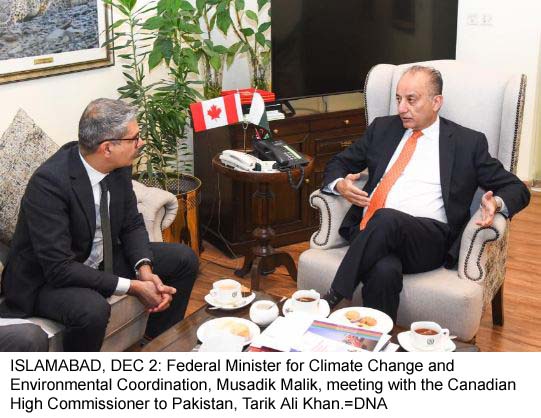
ISLAMABAD, DEC 2: Federal Minister for Climate Change and Environmental Coordination, Musadik Malik, meeting with the Canadian High Commissioner to Pakistan, Tarik Ali Khan.=DNA

ISLAMABAD, DEC 02 (APP/DNA): Pakistan and Canada on Tuesday discussed ways to streamline the trade framework for genetically modified (GM) canola, with both sides agreeing to improve regulatory clarity and strengthen bilateral cooperation.

Federal Minister for Climate Change and Environmental Coordination Dr Musadik Malik met Canadian High Commissioner Tarik Ali Khan in Islamabad. Secretary Climate Change Aisha Moriani was also present.

The meeting focused on challenges linked to existing Harmonized System (HS) codes and the need for greater efficiency in procedures governing GM canola trade.

Dr Malik said the government was committed to reducing procedural delays and ensuring that any policy amendments aimed to facilitate importers and exporters.

He added that the Ministry was upgrading its digital dashboard to enhance transparency and ease of doing business.

The minister noted that institutional capacity-building remained a priority to better manage technical and regulatory requirements for climate-linked trade, agricultural commodities and biosafety issues.

The Canadian high commissioner appreciated the Ministry’s efforts to improve regulatory mechanisms and reiterated Canada’s commitment to expanding cooperation in the agriculture and food sectors.

Both sides agreed to maintain close coordination to promote sustainable and mutually beneficial trade practices.

USA Has Normalised Collective Punishment 

Qamar Bashir

By Qamar Bashir

From the dawn of human civilization, long before Judaism, Christianity, Islam, or Buddhism emerged to reshape the moral foundations of society, humanity lived under a brutal and irrational law: when one person committed a crime, entire tribes, cities, and nations were punished. The crime of an individual became the burden of thousands. A conflict between two men could trigger decades of warfare. A single act of adultery could unleash generational blood feuds. Ancient history is filled with examples of wars ignited by the wrongdoing of a few but fought by tens of thousands who had no connection to the original offense. Around 1200 BCE, the legendary Trojan War erupted because of the actions of one couple—Paris and Helen—but ended with the deaths of an estimated 40,000 to 100,000 warriors and the destruction of Troy. In 490 BCE, the entire city of Miletus was destroyed by the Persian Empire in retaliation for the Ionian Revolt, though only a handful of rebels had participated in the initial uprising. In 586 BCE, the kingdom of Judah was crushed and Jerusalem destroyed because King Zedekiah rebelled against Babylon; tens of thousands were exiled for the decision of one ruler. These ancient precedents reveal an era dominated by collective vengeance rather than individual responsibility.

When Judaism arrived, the moral code began to shift. The Torah introduced the revolutionary principle that “the children shall not be put to death for the sins of the father,” establishing that punishment must be confined to the perpetrators. Christianity later reinforced this concept through the teachings of Jesus, emphasizing forgiveness and individual accountability. Islam, too, declared unequivocally in the Quran that “no soul shall bear the burden of another,” and that punishment must be proportionate and directed only toward the guilty. These religions attempted to end the age-old normalization of collective punishment. Yet despite these divine instructions, humanity repeatedly drifted back into the primitive instinct of retaliating against entire populations instead of targeting the individuals responsible for the crime.

Modern history, too, is littered with catastrophic examples of collective punishment. When one person or one small group acted, nations responded with wars that killed millions. During World War I, the assassination of a single man—Archduke Franz Ferdinand—on June 28, 1914, by a 19-year-old Serbian nationalist, led to a conflict that killed over 20 million people. In World War II, the rise of a few extremist leaders drove humanity into the deadliest war in history, killing an estimated 70–85 million people between 1939 and 1945. In 1937, after one Chinese soldier went missing near the Marco Polo Bridge, Japan launched a full invasion that resulted in the deaths of 300,000 civilians in Nanjing alone. Again and again, the scope of punishment far exceeded the scope of the crime.

The twenty-first century has unfortunately normalized collective punishment in new and devastating forms. After the 9/11 attacks of September 11, 2001—committed by 19 individuals—America understandably pursued all those who plotted, supported, facilitated, or financed the attack. Justice against the perpetrators was necessary and morally justified. But the response soon expanded far beyond those responsible. The invasion of Afghanistan in October 2001 resulted in more than 170,000 Afghan civilian deaths over two decades. In March 2003, Iraq was invaded even though Iraq had no involvement in 9/11; the war killed between 300,000 to 600,000 Iraqis and displaced millions. Libya was bombed in 2011, leaving 30,000 dead. Syria’s civil war, ignited by a small protest in 2011, eventually claimed over 500,000 lives and displaced more than 12 million people—half of the population. These tragedies illustrate a dark truth: the punishment for the crime of a few was extended to entire nations.

In the most recent and heartbreaking episode, the October 7, 2023 Hamas attack on Israel killed around 1,200 Israelis and took approximately 250 hostages—a horrific and indefensible act that demanded justice. Yet the response unleashed upon the civilians of Gaza escalated into one of the deadliest campaigns of the 21st century. By late 2025, more than 70,000 Palestinians had been killed, 75 percent of the population displaced, nearly all hospitals destroyed, food and medicine blocked, and children left freezing under plastic sheets in harsh winter rain. Families buried under rubble, newborn babies dying without incubators, entire neighborhoods turned to dust—this was not justice against the perpetrators but a sweeping punishment against an entire population for the crimes of a few.

The world watched collective punishment become normalized once again. Instead of targeting militants, the response treated every man, woman, and child in Gaza as equally punishable, an approach that contradicts not only international law but the core moral principles of Judaism, Christianity, Islam, and every civilized system of justice ever established.

And now, in November 2025, America risks repeating this ancient mistake within its own borders. After a lone gunman killed one National Guard soldier and severely wounded another, the United States had every right and duty to pursue the killer and anyone who supported or facilitated him. The safety of American soldiers and citizens must always come first, and no one can dispute that justice must be delivered swiftly and firmly. But instead of targeting the perpetrator and his network, sweeping executive orders were issued that affected millions of immigrants who had no connection whatsoever to the crime. Immigration processing was halted. Asylum cases were frozen. Green card holders and legal permanent residents—people who have committed no crime, who work hard, pay taxes, raise families, and contribute to America’s GDP—were suddenly labeled suspicious, stereotyped as criminals, and threatened with deportation.

Collective punishment once again overshadowed common sense. American immigrants, who statistically commit fewer crimes than native-born citizens, found themselves trapped under suspicion because of the actions of one man. These families fled economic collapse, persecution, and violence in their home countries; now they face being thrown back into the very instability they escaped. Their dreams, their years of sacrifice, their contributions to the U.S. economy have been jeopardized by an act they neither supported nor participated in.

The logic is simple and eternal: punish the guilty, not the innocent. Every major religion, every moral code, and every civilized legal system supports this principle. Collective punishment is not justice—it is a return to the darkest chapters of human history. It destroys trust, divides societies, and creates new cycles of hatred.

The United States is a great nation with strong institutions and a history of self-correction. It has the capacity to distinguish between a criminal and an entire community. It can choose a path guided by law, reason, and fairness rather than anger. As President Trump often says, his movement is a movement of “common sense.” But common sense does not support punishing millions for the crime of one. Common sense teaches us to hold the perpetrator accountable, not innocent families. Common sense demands proportionality, fairness, and justice—not blanket retaliation.

The question now is whether America, and indeed the world, will learn from history. Will we continue to repeat the ancient mistakes of punishing nations for the crimes of individuals, or will we finally embrace the moral clarity that has been taught to us for thousands of years? The answer will determine whether humanity advances toward justice—or falls backward into its brutal past.

By Qamar Bashir

Press Secretary to the President (Rtd)

Former Press Minister, Embassy of Pakistan to France

Former Press Attaché to Malaysia

Former MD, SRBC | Macomb, Michigan, USA

KP Governor inaugurates Islamic Financial Lounge at NUML Campus

KP Governor inaugurates Islamic Financial Lounge at NUML Campus

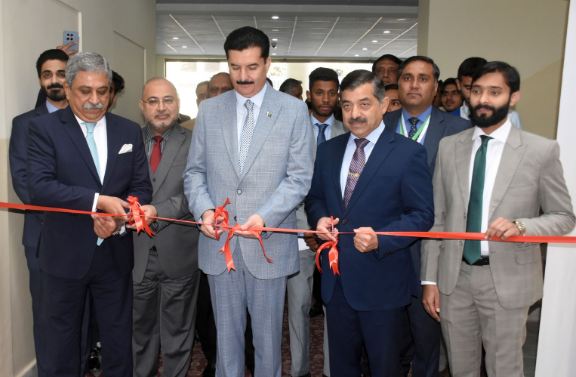
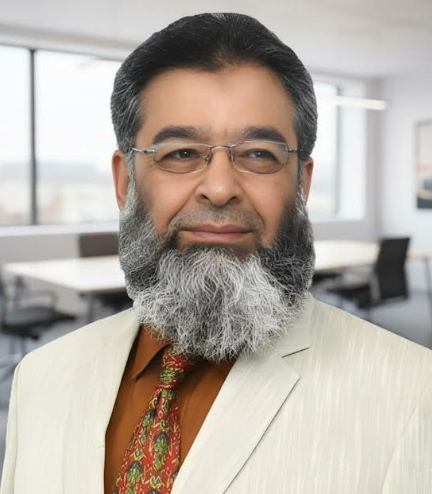
ISLAMABAD, DEC 2 /DNA/ – ZLK Islamic Financial Services, Pakistan’s first and premier Shariah-compliant brokerage firm licensed by the Securities and Exchange Commission of Pakistan (SECP), has officially launched the “NUML Equity Lounge” at the National University of Modern Languages (NUML). The inauguration ceremony was graced by Mr. Faisal Karim Kundi, Governor of Khyber Pakhtunkhwa; Major General Shahid Kiyani (R), Rector NUML; and Mr. Zahid Latif Khan, Chairman, ZLK Islamic Financial Services, who collectively inaugurated the equity lounge.

Developed in collaboration with the Department of Accounting & Finance, NUML, powered by ZLK Islamic Financial Services, the NUML Equity Lounge is a landmark initiative aimed at advancing financial literacy and fostering deeper student engagement with Pakistan’s capital markets. The facility provides access to real-time market data, analytical tools, research materials, and Shariah-compliant investment guidance, bridging the gap between academic theory and practical financial application.

During the ceremony, dignitaries emphasized the importance of equipping youth with the knowledge and skills needed to participate responsibly in Pakistan’s stock market. They highlighted how initiatives like the NUML Equity Lounge play a crucial role in empowering students to understand ethical investing, risk management, and the dynamics of modern financial markets.

Mr. Zahid Latif Khan, Chairman – ZLK Islamic Financial Services emphasized that while Pakistan’s stock market presents strong long-term potential, the lack of financial literacy has historically limited youth engagement. This initiative aims to empower students with the knowledge and confidence to participate responsibly in the capital markets while adhering to Islamic financial principles.

Located at Ibn-e-Rushd Block, NUML, the lounge provides easy access for students, including QR-enabled account opening support and direct interaction with financial professionals. The facility stands as a symbol of ZLK Islamic’s commitment to nurturing the next generation of financially aware and ethically responsible investors.

ZLK Islamic Financial Services continues to lead the way in shaping Pakistan’s financial landscape by promoting Shariah-compliant investing, enhancing financial literacy, and strengthening the connection between academic institutions and capital markets.

Turkish energy minister meets army chief at GHQ

Turkish energy minister meets army chief at GHQ

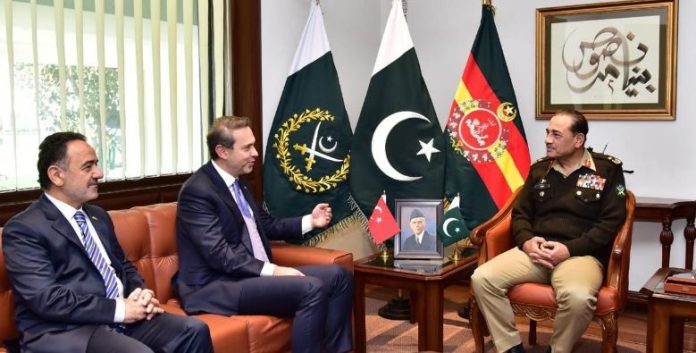
RAWALPINDI, DEC 2 /DNA/ – Alparslan Bayraktar, Minister of Energy and Natural Resources of the Republic of Turkiye, called on Field Marshal Syed Asim Munir, NI (M), HJ, Chief of Army Staff (COAS), at General Headquarters (GHQ) today.

During the meeting, matters of mutual interest were discussed, with a particular focus on expanding Pak–Turkiye cooperation in the energy sector, strengthening bilateral ties, and exploring avenues for strategic collaboration. Both sides reaffirmed their commitment to enhancing partnership in areas of shared objectives and regional stability.

The COAS highlighted the deep-rooted and historic brotherly relations between Pakistan and Turkiye, expressing appreciation for Turkiye’s steadfast support to Pakistan at various international forums. Minister Bayraktar conveyed Turkiye’s desire to deepen cooperation across the energy domain and acknowledged Pakistan’s efforts toward regional peace, stability, and sustainable development.

Pakistan Hockey team departs for pro league’s first phase in Argentina

Pakistan Hockey team departs for pro league's first phase in Argentina

ISLAMABAD, DEC 2 /DNA/ – The Pakistan national hockey team is set to depart for Santiago, Argentina tonight to compete in the opening phase of the Pro League 2025. The first leg of the tournament will be held from December 9 to 14, where Pakistan will face off against Argentina and the Netherlands in a series of matches.

The Pakistan Hockey Federation (PHF) confirmed the squad following approval from its President, Mir Tariq Hussain Bugti. The announcement was made by Secretary General Olympian Rana Majid Ali Khan, who unveiled the list of players and team officials for the crucial away fixtures.

Team Management
The management includes:

  • Team Manager: Olympian Anjum Saeed
  • Head Coach: Olympian Tahir Zaman
  • Assistant Coaches: Olympian Muhammad Usman Sheikh and Olympian Zeeshan Ashraf
  • Video Analyst: Muhammad Nadeem Khan Lodhi
  • Physiotherapist: Muhammad Aslam

Squad
The 20-member squad, led by captain Imad Shakeel Butt, features a blend of experienced and emerging talent. The full list of players is as follows:

  1. Imad Shakeel Butt (Captain)
  2. Abdullah Ishtiaq Khan
  3. Muneeb-ur-Rehman
  4. Muhammad Sufyan Khan
  5. Muhammad Abdullah
  6. Hamaduddin Anjum
  7. Abdul Manan
  8. Moeen Shakeel
  9. Zakirya Hayat
  10. Arshad Liaquat
  11. Ghazanfar Ali
  12. Rana Abdul Waheed
  13. Afraz
  14. Abdul Hanan Shahid
  15. Abdul Rahman
  16. Rana Muhammad Waleed
  17. Ahmed Nadeem
  18. Arbaz Ahmed
  19. Muhammad Emad
  20. Abu Bakr Mahmood

Tournament Schedule
The Pro League’s first phase in Santiago marks the beginning of Pakistan’s campaign in the 2025 season. The team will aim to start strongly against two of the world’s top hockey nations, Argentina and the Netherlands, as they build momentum for upcoming fixtures.

The PHF expressed confidence in the selected squad and management, hoping for a positive performance that will boost Pakistan’s ranking and morale in international hockey.

Fans across the country are eagerly awaiting the team’s performance, with matches scheduled to be broadcast live. The team’s departure tonight signals the start of what promises to be an exciting chapter for Pakistan hockey.

Governor’s Rule in Pakistan: A Political-Theoretical Assessment

Governor’s Rule in Pakistan: A Political-Theoretical Assessment

by Muhammad Mohsin Iqbal

Once again, Pakistan finds itself amid speculation over the possible imposition of Governor’s Rule—this time in Khyber Pakhtunkhwa. Names of potential governors are buzzing around drawing rooms and newsrooms, and the debate resurfaces with its usual urgency; when does the Constitution actually warrant putting a province under direct federal control, and what does that move say about the deeper flaws in our political system? Since 1947, every province of Pakistan has experienced Governor’s Rule at least once, and each episode has carried deep political, administrative, and constitutional implications.

The Constitutional basis for such an intervention lies in Article 234 of the Constitution of Pakistan. It empowers the President, acting on the advice of the federal government, to authorise the Governor to assume the executive authority of the province when the provincial machinery can no longer function in accordance with the Constitution. While the article itself is clear and procedural, the circumstances that trigger its invocation are invariably political, often controversial, and occasionally reflective of deeper tensions between centre and province, party and opposition, or law and disorder.

Sindh, unlike popular perception, has witnessed direct Governor’s Rule on only three occasions. The first was in the early post-independence years when Governor Mian Aminuddin took charge from 1951 to 1953 following the dismissal of Chief Minister Muhammad Ayub Khuhro and the dissolution of the assembly amid instability and corruption allegations. The second came in 1988 under Lt. Gen. (Retd.) Rahimuddin Khan, when severe ethnic violence in Karachi and Hyderabad compelled the dismissal of the provincial government. The third instance occurred in 1998 after the assassination of Hakim Muhammad Saeed, when Lt. Gen. (Retd.) Moinuddin Haider assumed control. By that point reportedly, tensions between the MQM and PML-N had already put a strain on governance, showing just how easily coalition arrangements could crack under pressure.

Balochistan’s experience has been similarly turbulent. Governor’s Rule was first imposed in 1973 under Mir Ghous Bakhsh Bizenjo after the dismissal of the Ataullah Mengal’s government amid accusations of separatist tendencies and breakdown of law and order. It returned in 1975 under Mir Ahmed Yar Khan Baloch and again in 1977 under the same governor, overlapping with political upheaval at the national level. Later, from 1999 to 2002, Syed Muhammad Fazal Agha administered the province under the extended military rule following General Musharraf’s coup. The most recent intervention, under Nawab Zulfiqar Ali Magsi in 2013, came after escalating sectarian violence and the paralysis of the provincial setup. According to political observers, each example reflects not only administrative shortcomings but also the Center’s inability or disinterest in discussing political grievances through democratic channels.

Punjab, the largest and politically most consequential province, has faced Governor’s Rule three times. The first imposition in 1949 came when Premier Liaquat Ali Khan, upon learning that Chief Minister Iftikhar Mamdot had exaggerated his legislative majority, advised the Governor General to remove him. Sir Francis Mudie, and later Abdul Rab Nishtar, administered the province for nearly two years, revealing how fragile the early institutions of parliamentary democracy were. The second intervention came in 1999 after General Musharraf’s military takeover, which cut short Chief Minister Shahbaz Sharif’s tenure and placed Punjab under successive governors(Lt. General (R) Muhammad Safdarand Lt. General(R) Khalid Maqbool) until 2002. The third instance unfolded in 2009 when President Asif Ali Zardari suspended the provincial executive following the Supreme Court’s disqualification of Nawaz Sharif and Shahbaz Sharif. Although the assembly remained intact, full executive authority was vested in Governor Salman Taseer until political compromise restored the PML-N government.

Khyber Pakhtunkhwa—formerly NWFP—has also witnessed three spells of Governor’s Rule. The first, in 1975 under Major General (R) Syed Ghawas, came amid political turbulence during Prime Minister Zulfikar Ali Bhutto’s tenure. The second, in 1994 under Major General (R) Khurshid Ali Khan, corresponded with rising factional clashes and administrative breakdown. The third arrived after the 1999 coup, when Lt. Gen. Muhammad Shafiq (R)and later Lt. Gen.(R) Iftikhar Hussain Shah oversaw the province until 2002. According to the historians, each intervention stemmed from a combination of deteriorating law and order, fragile political alliances, and the centre’s predisposition to assert control during moments of provincial instability.

A review of these episodes reveals a sobering reality; Governor’s Rule in Pakistan has rarely been a purely constitutional measure devoid of political overtones. Rather, it has often emerged as a tool of political recalibration—sometimes justified by genuine administrative crises, at other times employed to settle scores, suspend rivals, or reset power dynamics. It reflects both the vulnerabilities of provincial institutions and the centralising impulses inherent in our federal framework.

The lesson of history is clear; Governor’s Rule may provide temporary administrative relief, but it cannot build stable provincial governance. That requires stronger political parties, greater respect for constitutional boundaries, empowered local institutions, and an ethos of democratic patience. Unless Pakistan internalises these principles, the cycle of intervention and instability will continue to shadow its provincial politics.

Finally, the real test of a federation is not how often it centralises power, but how effectively it protects provincial autonomy while ensuring constitutional order. Pakistan’s journey with Governor’s Rule is a reminder that the Constitution offers remedies, but it is political wisdom that decides whether those remedies heal or further wound the system.

JCP meeting elevates Justice Miangul to permanent SC judge

JCP meeting elevates Justice Miangul to permanent SC judge

Presided over by Chief Justice of Pakistan (CJP) Yahya Afridi, the JCP held its first meeting following the passage of the 27th Constitutional Amendment and the establishment of the Federal Constitutional Court (FCC).

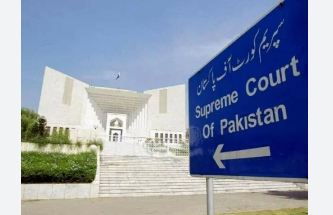
ISLAMABAD, DEC 2 /DNA/ – The Judicial Commission of Pakistan (JCP), which is responsible for appointing judges to the superior judiciary, on Tuesday elevated Justice Miangul Hassan Aurangzeb to a permanent judge of the Supreme Court (SC).

Presided over by Chief Justice of Pakistan (CJP) Yahya Afridi, the JCP held its first meeting following the passage of the 27th Constitutional Amendment and the establishment of the Federal Constitutional Court (FCC).

The JCP had appointed Justice Aurangzeb as an ad hoc judge of the apex court in February after elevating him from the Islamabad High Court (IHC),

The forum also approved the elevations of Justice Zafara Ahmed Rajput as the chief justice of the Sindh High Court, and Justice Kamran Mullahkhail as the chief justice of the Balochistan High Court.

During the meeting, held at the conference room of the SC building, the JCP had considered the appointment of the SHC chief justice from among the three senior-most judges of the high court.

Those considered for the office included Justice Rajput, Justice Muhammad Iqbal Kalohoro and Justice Mahmood A. Khan.

Similarly, the JCP had also considered the appointment of the BHC chief justice from among the three senior-most judges of the high court. Those considered for the office included Justice Mullahkhail, Justice Iqbal Ahmed Kasi and Justice Shaukat Ali Rakhshani.

With the establishment of the FCC, where four judges from the SC — Justices Aminuddin Khan, Syed Hasan Azhar Rizvi, Aamer Farooq and Ali Baqar Najafi — have been appointed, as well as the resignation of Justices Syed Mansoor Ali Shah and Athar Minallah, the total strength of the SC has reduced to 18 judges from 24.

The JCP meeting was also attended by FCC Chief Justice Aminuddin Khan, Justice Munib Akhtar, Justice Syed Hasan Azhar Rizvi, Justice Aamer Farooq, Attorney General for Pakistan Mansoor Usman Awan, Law Minister Azam Nazeer Tarar, Pakistan Bar Council representative Ahsan Bhoon, Senator Farooq Hamid Naek, Senator Syed Ali Zafar, and MNAs Sheikh Aftab Ahmad and Gohar Ali Khan.

After the passage of the 27th Constitutional Amendment, changes were made to key constitutional and statutory judicial bodies.

Following these changes, SC’s Justice Jamal Khan Mandokhail was included in the Supreme Judicial Council (SJC) and the Practice and Procedure Committee, while the FCC’s Justice Farooq was made a member of the JCP.

Among the three statutory bodies, the SJC is the top forum for judicial accountability that probes allegations of misconduct against judges, the Practice and Procedure Committee forms benches and fixes cases, and the JCP is responsible for appointing judges to the superior judiciary.

PM extends warm felicitations to UAE on National Day

PM extends warm felicitations to UAE on National Day

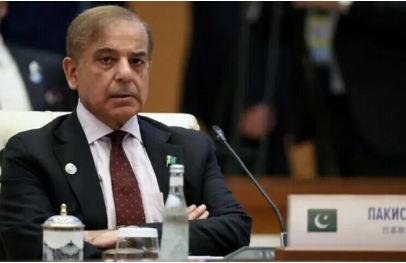
ISLAMABAD, DEC 2 /DNA/ – Prime Minister Muhammad Shehbaz Sharif on Tuesday extended heartfelt felicitations to the leadership and people of the United Arab Emirates on the occasion of their National Day.

The prime minister, in a message posted on his X timeline, said, “On behalf of the people and Government of Pakistan, I extend my heartfelt felicitations to the leadership and brotherly people of the United Arab Emirates on the joyous occasion of their National Day.”

He said that Pakistan deeply valued its historic and time-tested partnership with the UAE – a relationship built on mutual respect, shared aspirations, and an unbreakable bond between our peoples.

The prime minister said that the vibrant Pakistani community in the UAE remained a proud bridge between the two nations, contributing to the UAE’s remarkable success story.

He said that under the visionary leadership of the UAE President Sheikh Mohamed bin Zayed Al Nahyan, the UAE continued to inspire the world with its remarkable progress, innovation and global leadership.

“We remain committed to further strengthening our multifaceted cooperation and elevating our partnership for a brighter, more prosperous future for our two nations.

Long live Pakistan–UAE friendship,” he commented.

Pakistan Navy hosts MARSEW-8 to promote national maritime security awareness

Pakistan Navy hosts MARSEW-8 to promote national maritime security awareness

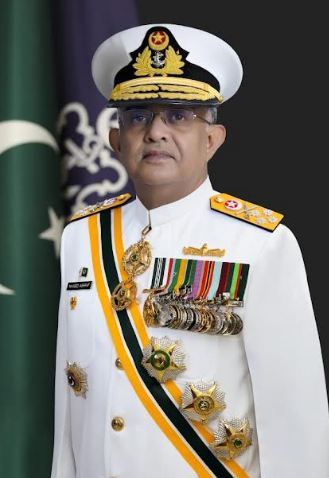
ISLAMABAD, DEC 1 /DNA/ – It is a matter of great satisfaction for me to witness the evolution of Maritime Security Workshop (MARSEW) which has matured into a signature event of Pakistan Navy in fostering maritime awareness and generating informed debate on Pakistan’s maritime security dictates. MARSEW is aimed at sensitizing maritime stakeholders and decision makers to support suitable policy formulation at the national level. The participants include Govt. officials and representatives from the military, business community, academia, entrepreneurs and the media. Such diversity is pivotal in developing a shared understanding of Pakistan’s maritime challenges and opportunities. I, therefore, extend a warm welcome to all the esteemed participants of MARSEW-8 which is hosted by Pakistan Navy War College at Lahore.

Understanding oceans, allied resources and Blue Economy are critical to global geopolitics and economic security of nations around the globe. Sitting astride the most important Sea Line of Communication in the Indian Ocean Region (IOR), Pakistan holds tremendous maritime importance and relevance. With our huge, though largely untapped maritime potential, Pakistan’s economic future is intrinsically linked to the sea which serves as mankind’s last reservoir for sustenance.

Pakistan’s Blue Economy potential, currently contributing only to a fraction of GDP, has the capacity to add tens of billions of dollars; if tapped effectively. Hence, drawing dividends from our maritime domain is not merely a national choice but a compelling need, and requires a whole-of-nation-approach. The ongoing developments in IOR have direct bearing on Pakistan’s maritime security. To navigate this shifting landscape, Pakistan needs to pursue a comprehensive maritime strategy that balances security and prosperity; duly enabled by a secure maritime environment.

It is my firm belief that this Workshop will afford vibrant exchange of ideas between the esteemed participants and their diverse perspective will help engender innovative solutions. I am also confident that the novel ideas presented in the workshop will enable us to chart a fresh course in reinforcing our maritime security, unlocking the Blue Economy potential and contributing to a prosperous and secure maritime future for Pakistan.

I wish MARSEW-8 participants an insightful interaction and a pleasant stay with their host, Pakistan Navy War College. May you have, Fair Winds and Following Seas.

Section 144 imposed in Rawalpindi and Islamabad

Section 144 imposed in Rawalpindi and Islamabad

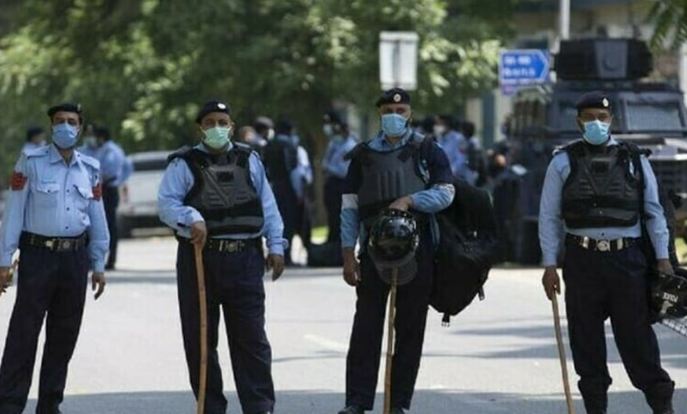
ISLAMABAD, DEC 1 – The district administrations of Rawalpindi and Islamabad have imposed Section 144, banning all gatherings, rallies, processions, and sit-ins from December 1 to 3.

The Deputy Commissioner of Rawalpindi issued a notification implementing Section 144 after a meeting of the District Intelligence Committee. The restrictions aim to prevent any disturbance and ensure public safety.

Similarly, the federal capital has also come under Section 144. The district administration emphasized that no protests, rallies, or processions are permitted during this period.

Law to act immediately against violations

Authorities warned that any illegal activity will trigger immediate legal action. Citizens have been urged not to participate in any unauthorized gatherings or actions that could disturb public order.

Section 144 will remain in force from December 1 to 3 in both Rawalpindi and Islamabad. The administration stressed full compliance to maintain peace and security.

Stay Connected

64FansLike
60FollowersFollow

Latest Reviews

Exchange Rates

USD - United States Dollar
EUR
1.14
GBP
1.34
AUD
0.70
CAD
0.71