Home Blog Page 346

NUML, Russian Embassy Advance Strategic Partnership in Language Education & Cultural Cooperation

NUML, Russian Embassy Advance Strategic Partnership in Language Education & Cultural Cooperation

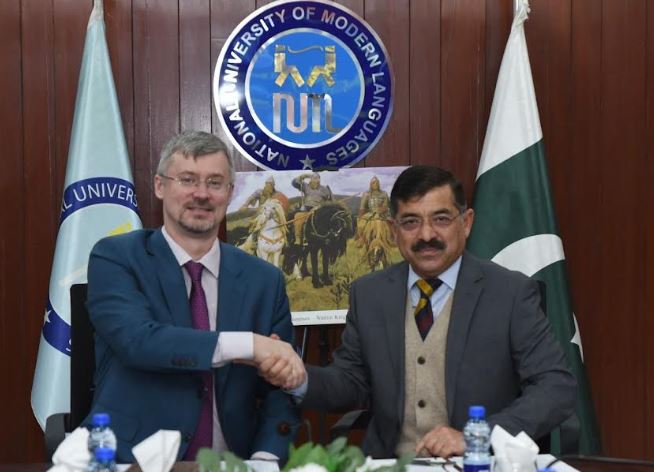
ISLAMABAD, DEC 15 /DNA/ – Russian Ambassador Albert Khorev visited the National University of Modern Languages (NUML) today and called on Rector NUML, Maj Gen (R) Shahid Mahmood Kayani, HI (M). The meeting marked a significant step toward strengthening long-term and short-term collaboration in Russian language education, academic exchange, and cultural promotion.

During the discussion, both sides explored an ambitious long-term vision to introduce the Russian language from early schooling up to Class XII. Under this initiative, qualified Russian teachers, supported by the Russian Federation, would teach in Pakistan to build strong linguistic foundations and deepen cultural understanding among students.

In the short term, the focus remained on enhancing Russian language education for students of Classes XI and XII. This initiative aims to prepare Pakistani students for higher education opportunities in Russia, including scholarships, academic placements, and smooth admission pathways.

The Rector emphasized NUML’s strong commitment to promoting the Russian language and culture, noting that with its extensive student body and specialized expertise in foreign languages, NUML is fully equipped to expand Russian language teaching, provided that qualified Russian instructors are made available. He added that students could complete undergraduate studies in Pakistan and later pursue advanced degrees in Russia, ensuring a secure and well-guided academic transition.

Following the meeting, both sides signed an Act of Acceptance of books and printed materials. This gesture reaffirmed the enduring partnership between the Russian Embassy and NUML, reflecting a shared commitment to cultural dialogue and academic cooperation between the Russian Federation and the Islamic Republic of Pakistan. Under the agreement, the Embassy formally transferred, and NUML accepted, a collection of books and printed resources.

Pakistan to host key ECO-CCI meetings in Karachi next January

Pakistan to host key ECO-CCI meetings in Karachi next January

KARACHI, DEC 15 /DNA/ – Atif Ikram Sheikh, President FPCCI; President ECO-CCI and VP CACCI, has apprised that The Federation of Pakistan Chambers of Commerce & Industry (FPCCI) has announced that it will host the 30th Executive Committee Meeting and the 20th General Assembly Meeting of the ECO Chamber of Commerce & Industry (ECO-CCI) on 22 January 2026 at the FPCCI Head Office in Karachi on the sidelines of 2nd Sustainable Tourism Forum (STF) to be jointly organized by FPCCI and Islamic Chamber of Commerce, Industry and Development (ICCD) during January 21-22.

Mr. Atif Ikram Sheikh stated that these ECO-CCI events carry immense strategic importance for the region – as they will help strengthen economic cooperation; expand intra-ECO trade; promote investments; foster business linkages and revitalize the institutional role of ECO-CCI as a key platform for vis-à-vis regional economic integration.

FPCCI Chief further disclosed that invitations have already been extended to all ECO Member Chambers – and, FPCCI expects participation from Presidents, senior officials, B2B delegations and sectorial experts from multiple ECO countries.

Mr. Atif Ikram Sheikh added that the Sustainable Tourism Forum will also provide a significant platform to highlight the tourism potential of ECO countries; enhance regional cooperation in aviation and hospitality sectors; promote investment opportunities in tourism sector of Pakistan and encourage collaborative initiatives for sustainable and responsible tourism development across the region.

FPCCI maintained that hosting these events in Karachi will further strengthen Pakistan’s leadership role in regional economic diplomacy; expand B2B connectivity and reinforce the country’s commitment to deeper economic and trade partnerships within the ECO framework.

Romanian Embassy to host Christmas Carols Concert in Islamabad

Romanian Embassy to host Christmas Carols Concert in Islamabad

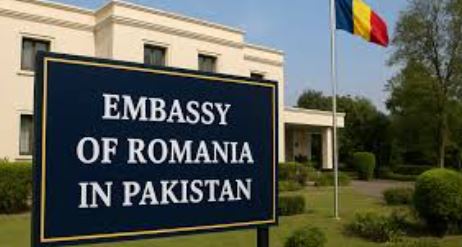
ISLAMABAD, DEC 15 /DNA/ – The Embassy of Romania has announced a special Christmas carols concert to celebrate the festive season, inviting guests and their spouses to an evening of music and celebration in the spirit of Christmas.

The concert will feature renowned Romanian soprano Georgiana Costea-Glugă, accompanied by pianist Sheeza Maqsood, who will present a festive programme of traditional Christmas carols. The event will be held at St. Thomas Church, Islamabad, and will showcase a selection of cherished Christmas melodies from Romania and around the world.

Guests will enjoy a rich and diverse repertoire, including popular Romanian carols such as “Moș Crăciun cu plete dalbe” and “O, ce veste minunată”, alongside internationally loved classics like “Silent Night”. The performance aims to create a warm and uplifting atmosphere, reflecting the true spirit of the holiday season and promoting cultural harmony.

The Embassy has emphasized that the invitation is strictly personal and valid only for invited guests and their spouses. For security reasons, entry will be granted exclusively to those who have received an official invitation and have confirmed their attendance in advance. Guests are required to RSVP by December 15.

The Embassy of Romania expressed its pleasure in hosting this special cultural event and looks forward to welcoming guests to an evening of music, celebration, and festive joy.

36 Gold, 29 Silver Medals Awarded at BU Convocation

36 Gold, 29 Silver Medals Awarded at BU Convocation

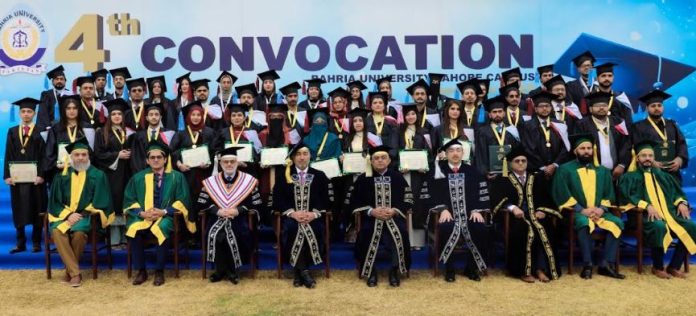
LAHORE, DEC 15 /DNA/ – Bahria University Lahore Campus held its 4th Convocation. Chief of the Naval Staff and Pro-Chancellor of Bahria University, Admiral Naveed Ashraf graced the occasion as Chief Guest and conferred degrees upon graduates.

Addressing the ceremony, Admiral Naveed Ashraf praised Bahria University’s dedication to academic excellence, innovation and character-building. He commended the graduates for their hard work, discipline and perseverance and congratulated their families.

A total of 564 graduates from the Departments of Computer Science, Management Sciences and Professional Psychology were awarded PhD, MS and BS degrees. In recognition of exceptional academic achievement, 36 gold medals and 29 silver medals were presented to high-performing students.

The ceremony was attended by graduating students, their proud families, senior officials, faculty members and distinguished guests from academia.

Winter health tips for children

Winter health tips for children

With the onset of winter, children’s health becomes a major concern for parents. The sudden drop in temperature, cold winds, and rapidly changing weather after summer often lead to colds, coughs, fever, and respiratory problems in children.

Young children, in particular, whose immune systems are still developing, are especially vulnerable to seasonal illnesses.

Health experts say that the most effective way to prevent winter illnesses is timely precautions and small adjustments in daily routines. By following a few basic measures, parents can keep their children safe from most seasonal ailments.

Warm clothing:

It is essential to keep a child’s head, chest, and feet covered during winter, as a significant amount of body heat is lost through the head. Woolen caps, socks, and light yet warm clothing are ideal choices. However, overly heavy clothing can make a child uncomfortable, causing sweating and potentially harming their health.

Avoid cold water and low-quality foods:

Bathing children with cold water or letting them wash their hands and face with it in winter can cause illnesses. Similarly, low-quality candies and chocolates can irritate the throat and chest. It is better to give children lukewarm water and simple homemade meals.

Pneumonia: A serious concern:

Doctors warn that pneumonia can be a dangerous illness in children. Rapid breathing, chest pulling inward, fever, and extreme weakness are its key symptoms. In such cases, it is crucial to seek professional medical help immediately instead of relying on home remedies. Vaccination against pneumonia is also highly important.

Fever care:
Giving antibiotics to a child with fever without medical advice can be harmful. During fever, dress children in light clothing, check their temperature regularly, and include nourishing foods like broth or soup in their diet. Consult a doctor if the fever persists.

Home remedies for colds, flu, and coughs:
Mild winter illnesses like colds and sore throat can often be managed with traditional remedies:

Ginger and honey tea
Warm milk with dates or dried apricots
Tea made with dry ginger and jaggery
Fresh carrot or seasonal fruit juice
These remedies help boost immunity and relieve mild symptoms.

Massage and sunlight:
A gentle massage with mustard or olive oil followed by a few minutes in the sun can provide warmth to the body and help prevent colds.

Digestive health:
Experts note a strong link between respiratory illnesses and constipation. Maintaining proper digestion is essential. Light use of raisins, dried figs, or psyllium (ispaghol) can be beneficial.

Caring for children during winter may be challenging but is far from impossible. With proper attention, warm clothing, nutritious food, and time-tested home remedies, parents can protect their children from seasonal illnesses. Remember, prevention is always better than cure.

IMF assured of Rs5 carbon levy on petrol, diesel

IMF assured of Rs5 carbon levy on petrol, diesel

ISLAMABAD, DEC 15 – Pakistan has formally assured the International Monetary Fund (IMF) that it will implement a comprehensive 13-point reform agenda under climate financing, linking development spending, energy use, and disaster preparedness to climate resilience.

According to official documents, Pakistan has committed to implementing a 13-point reform framework under the IMF’s $1.3 billion Resilience and Sustainability Facility (RSF) program. The reforms set clear targets to be achieved by 2027, focusing on climate resilience, energy efficiency, and financial stability.

The Ministry of Finance has confirmed that these measures will apply across the federation and provinces.

Disaster risk financing to be strengthened
Pakistan has assured the IMF that it will strengthen disaster risk financing mechanisms to better deal with natural disasters. Improved financial planning will be introduced at both federal and provincial levels to manage climate-related emergencies.

The goal is to reduce fiscal shocks caused by floods, droughts, and other climate-driven disasters.

Under the new framework, climate impact assessment will be mandatory for all major development projects. Any project costing more than Rs7.5 billion will require a formal climate impact review before approval.

This condition will apply to all future development initiatives to ensure climate resilience is built into public spending.

Climate costs in infrastructure projects
According to the document, at least 30% of total expenditure in infrastructure projects will be allocated to climate-related measures. This includes adaptation, mitigation, and resilience-building components.

The move aims to ensure infrastructure can withstand climate shocks while reducing long-term environmental risks.

The Finance Ministry has confirmed that a climate budgeting system will be implemented at both federal and provincial levels. A climate budget report will be issued every year to track spending and progress.

This system is designed to improve transparency and accountability in climate-related financial planning.

Carbon levy on fuel included in reforms
As part of the IMF conditions, Pakistan has agreed to impose an additional carbon levy of Rs5 per liter on petrol and diesel. The measure is intended to discourage fossil fuel use and generate revenue for climate initiatives.

The levy forms a key component of Pakistan’s climate financing strategy.

To promote clean transport, the government will provide subsidies for electric vehicles, according to the Ministry of Finance. Under the plan, 30% of new vehicles will be electric by 2030.

In addition, 50% of motorcycles are targeted to shift to electric by 2030, significantly reducing emissions from the transport sector.

Electricity subsidies to be restricted
Pakistan has assured the IMF that electricity subsidies will be limited to deserving consumers only. A decision has been taken to end electricity subsidies for wealthy consumers.

The government has also committed to reducing line losses and electricity theft, which continue to strain the power sector.

Energy labeling will be made mandatory for refrigerators, fans, LED lights, motors, and air conditioners. The sale of energy-efficient appliances will be actively promoted by June 2027, according to the Ministry of Finance.

These measures aim to lower energy consumption and reduce pressure on the national grid.

Water pricing, irrigation reforms planned
The government plans to collect service charges for effective water use in Sindh, Khyber Pakhtunkhwa, and Balochistan. Revenue from irrigation systems in provinces will be increased under the reform plan.

A new system for adjusting water rates will be introduced in Sindh and Punjab, improving sustainability and financial recovery in the water sector.

Under the agreement, a review of climate-related financial risks will be made mandatory for banks. Pakistan will also introduce green finance instruments and a green taxonomy to guide sustainable investments.

These steps aim to align the financial sector with climate resilience goals.

For all I know, she could be dead, says son of Myanmar’s Suu Kyi

For all I know, she could be dead, says son of Myanmar's Suu Kyi

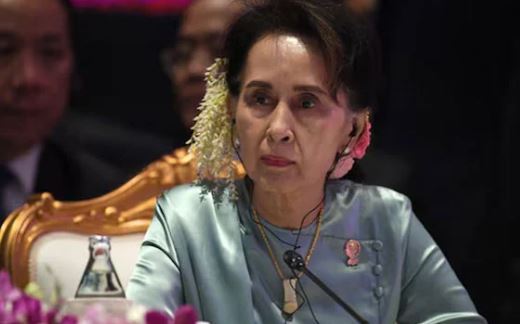
With her health failing and an information vacuum around Myanmar’s detained former leader Aung San Suu Kyi, her son worries that he may not even know if she passed away.

Kim Aris told Reuters he has not heard from his 80-year-old mother in years, and has received only sporadic, secondhand details about her heart, bone and gum problems since a 2021 military coup that deposed her government.

And while he rejects attempts by Myanmar’s junta to hold elections later this month, dismissed by many foreign governments as a sham aimed at legitimising military rule, he says it could provide an opening to ease his mother’s plight.

“She’s got ongoing health issues. Nobody has seen her in over two years. She hasn’t been allowed contact with her legal team, never mind her family,” he said in an interview in Tokyo. “For all I know, she could be dead already.”

“I imagine (Myanmar junta leader) Min Aung Hlaing has his own agenda when it comes to my mother. If he does want to use her to try and appease the general population before or after the elections by either releasing her or moving her to house arrest, then at least that would be something,” he added.

A Myanmar junta spokesman did not respond to calls seeking comment.

Myanmar’s military has a history of releasing prisoners to mark holidays or important events.

Nobel Peace Laureate Suu Kyi was freed in 2010 days after an election, ending a previous long period of detention largely spent at her colonial-style family home on Yangon’s Inya Lake.

She went on to become Myanmar’s de-facto leader after elections in 2015, the first openly contested vote in a quarter century, though her international image was later tarnished by accusations of genocide committed against her country’s Muslim Rohingya minority.

‘Small window of opportunity’
Myanmar has been in turmoil since the 2021 coup, which triggered an armed rebellion that has captured swathes of territory across the country.

Kim Aris, the son of Aung San Suu Kyi, takes part in a protest rally organised by Myanmar people residing in Japan denouncing an upcoming election led by the military junta and demanding the immediate release of Myanmars detained former leader Aung San Suu Kyi and all political prisoners, outside Myanmars embassy in Tokyo, Japan, December 14, 2025. — Reuters
Kim Aris, the son of Aung San Suu Kyi, takes part in a protest rally organised by Myanmar people residing in Japan denouncing an upcoming election led by the military junta and demanding the immediate release of Myanmar’s detained former leader Aung San Suu Kyi and all political prisoners, outside Myanmar’s embassy in Tokyo, Japan, December 14, 2025. — Reuters
Suu Kyi is serving a 27-year sentence for offences including incitement, corruption and election fraud, all of which she denies.

Aris said he believes she is being held in the capital Naypyitaw, and in the last letter he received from his mother two years ago she complained about the extreme temperatures in her cell during the summer and winter months.

With conflicts erupting all over the world, Aris worries that people are forgetting about Myanmar.

He is trying to capitalise on the upcoming elections — the first since the coup which are set to be held in phases from December 28 — to get foreign governments like Japan to exert more pressure on the junta and call for his mother’s release.

“Because of the upcoming elections that the military are trying to stage, which we all know are completely unfair, and so far from being free that it would be laughable if it wasn’t so lamentable, I need to use this small window of opportunity,” he said.

“In the past, when my mother was held in higher regard by the international community, then it was much harder for people to ignore what’s happening in Burma. But since her position was undermined through the crisis in Rakhine, that’s no longer the case,” he added, using the country’s former name.

Aris, a British national who kept a low profile until a few years ago, maintains his mother was “not complicit” in what the United Nations called a genocidal campaign by the military against the Rohingya in Rakhine state in 2016-17.

While she was de-facto leader, Myanmar’s constitution limited Suu Kyi’s power over the military. She admitted that war crimes may have been committed at an international tribunal in The Hague in 2020 but denied genocide.

During his trip to Japan, Aris said he met with various Japanese politicians and government officials to press them to take a stronger stand against the junta and reject the elections.

Asked what his mother would think of his efforts, he said: “I think she’d be incredibly sad that I’ve had to do this. She’s always wanted me to not have to get involved. But I don’t really have a choice at the moment. I am her son after all. And if I’m not doing it, I can’t expect anybody else to do it.”

Off-field differences add to Pakistan hockey’s on-field misery

Sources within the federation revealed that Tahir Zaman was unhappy with the PHF’s decision to appoint Anjum Saeed as the team manager. The relationship between the head coach and the manager reportedly remained strained throughout the tour, with frequent disagreements particularly over team selection and operational matters

Ansar M Bhatti

ISLAMABAD: Pakistan’s poor performance in the FIH Pro League matches played in Argentina has once again exposed the deep-rooted problems plaguing the country’s hockey system. While the team failed to register a single victory, the outcome was largely expected given Pakistan’s low world ranking and limited exposure at the highest level of international hockey.

Ranked 14th in the world, Pakistan entered the Pro League not through direct qualification but after New Zealand declined participation. Against elite, well-prepared teams, Pakistan’s task was always going to be difficult. However, beyond technical gaps and lack of depth, internal issues within the Pakistan Hockey Federation (PHF) further compounded the team’s struggles and negatively affected player morale.

One of the major controversies during the tour was the premature return of head coach Tahir Zaman to Pakistan midway through the competition. His departure triggered unnecessary speculation and confusion within hockey circles. Officially, Tahir Zaman cited his daughter’s wedding, scheduled for December 20 and planned well in advance, as the reason for his return. However, insiders suggest that the situation was far more complex.

Sources within the federation revealed that Tahir Zaman was unhappy with the PHF’s decision to appoint Anjum Saeed as the team manager. The relationship between the head coach and the manager reportedly remained strained throughout the tour, with frequent disagreements particularly over team selection and operational matters. These repeated clashes eventually culminated in Tahir Zaman’s decision to leave the team, further destabilizing an already fragile setup.

Such internal grouping and lack of unity at the top have long been cited as key reasons behind Pakistan hockey’s consistent decline. Players, already under pressure due to tough opposition and limited resources, were further demoralized by off-field disputes. In modern international hockey, where preparation, planning, and cohesion are critical, such instability inevitably reflects in on-field performances.

From a purely technical standpoint, Pakistan struggled across departments during the Argentina fixtures, but the most alarming weakness was in goalkeeping. The goalkeeping unit was badly exposed, with no keeper demonstrating consistency or composure at a world-class level. In contemporary hockey, goalkeepers are the backbone of a team, often deciding matches through crucial saves. Weak goalkeeping not only results in goals conceded but also undermines the confidence of defenders and midfielders, affecting the overall team structure.

Pakistan now faces an urgent need to identify, groom, and invest in quality goalkeepers capable of competing at the international level. Without addressing this critical position, progress will remain limited regardless of improvements elsewhere.

Despite the dismal results, it would be unfair to label the players as incapable. The current squad is largely underdone compared to other Pro League teams, lacking regular high-intensity international exposure. Playing against the world’s best, even in defeat, provides invaluable experience something Pakistan hockey has been deprived of for years.

While Pakistan may continue to struggle in the remaining Pro League matches and may not secure victories, participation itself holds long-term value. Exposure to top-level competition can help players develop confidence, tactical awareness, and mental toughness. Such experiences, if supported by stability and proper planning, can eventually translate into improved performances.

However, exposure alone is not enough. Without resolving administrative conflicts, ensuring professional management, and establishing a unified vision, Pakistan hockey will continue to underperform. The Pro League campaign should serve as a wake-up call for the PHF: structural reform, merit-based decisions, and harmony between officials and coaches are as important as talent development.

Pakistan hockey’s revival will not come overnight. But acknowledging internal failures, investing in key positions like goalkeeping, and creating a stable, professional environment are essential first steps toward reclaiming lost glory.

From Gaza to Bondi Beach: How Israel’s War Fuels Global Rage

Qamar Bashir

Qamar Bashir
Press Secretary to the President (Rtd)
Former Press Minister, Embassy of Pakistan to France
Former Press Attaché to Malaysia
Former MD, SRBC | Macomb, Michigan, USA

On December 14, 2025, Australia was jolted out of its sense of safety. At Bondi Beach in Sydney, a space synonymous with openness, community, and peaceful coexistence, gunmen opened fire on members of the Jewish community gathered to celebrate Hanukkah. Eleven people were killed and many more injured. Families, children, and elders—people with no role in war, policy, or geopolitics—were turned into victims of terror.

The attack was immediately and rightly condemned by Australia and the world. There can be no ambiguity: the killing of civilians anywhere is criminal, immoral, and indefensible. No grievance, no ideology, no historical wound justifies such an act. The Jewish community in Australia, like Jewish communities everywhere, deserves safety, dignity, and protection.

Yet condemnation alone does not prevent recurrence. If the world wishes to stop such horrors from repeating, it must confront a harder truth: violence does not arise in isolation. It is shaped, amplified, and redirected by global political behavior—especially when power is exercised without accountability.

The Bondi Beach massacre occurred in a world already saturated with unresolved wars, mass civilian suffering, and a growing perception that international law is applied selectively. This perception—whether ignored or dismissed by those in power—has consequences. When pain is denied in one place, it does not disappear. It travels. It mutates. And it eventually erupts where the innocent live.

The Hamas attack of October 7, 2023, which killed Israeli civilians and took hostages, was universally condemned. That condemnation was justified. What followed, however, shattered moral balance. Israel’s military response in Gaza resulted in the deaths of tens of thousands of Palestinian civilians, the destruction of homes, hospitals, schools, and the deliberate deprivation of food, water, and medical aid. International legal institutions and humanitarian organizations warned that collective punishment and starvation had become tools of war.

This matters not to excuse terrorism or antisemitism—both are crimes—but to understand how unchecked state violence creates global insecurity. When a state presents itself as above scrutiny, when it dismisses civilian deaths as necessary or inevitable, it sends a message to the world that human life is conditional. That message does not stay confined to Gaza. It seeps into streets, minds, and communities across continents.

The Jewish community worldwide has increasingly been placed in an impossible position. Jews in Australia, Europe, or North America do not command armies, blockade borders, or authorize bombardments. Yet they increasingly find themselves vulnerable to backlash generated by actions taken by a government thousands of miles away. This conflation is unjust, dangerous, and morally wrong—but it is fueled by the refusal of powerful leaders to acknowledge the global consequences of their conduct.

This refusal was starkly illustrated in the aftermath of the Bondi Beach killings. Instead of engaging in self-reflection or acknowledging how Israel’s actions in Gaza have heightened global tensions and endangered Jewish communities abroad, Israeli Prime Minister Benjamin Netanyahu publicly criticized the Australian government, accusing it of failing to provide adequate security to the Jewish community.

In doing so, Netanyahu acted not as a statesman grappling with consequences, but as if he were a ruler passing judgment on sovereign nations—assigning blame outward while absolving himself entirely. There was no acknowledgment that the relentless violence in Gaza, the images of starving children, and the dismissal of international law have contributed to an environment in which rage is exported globally. There was no recognition that leadership carries responsibility not only for battlefield outcomes, but for the safety of one’s people everywhere.

By placing the burden solely on Australia’s security apparatus, Netanyahu effectively treated the Bondi Beach massacre as an isolated policing failure—rather than as a symptom of a wider moral and political breakdown. This posture is not only arrogant; it is dangerous. It ignores the simple reality that actions taken in the Middle East now reverberate instantly across the world.

A similar warning emerged just one day earlier, on December 13, 2025, in Palmyra, Syria. A lone suspected Islamic State gunman attacked a convoy of U.S. and Syrian partner forces during a key leader engagement. The assault killed two U.S. Army soldiers and a civilian interpreter, and wounded three others. Partner forces killed the attacker at the scene. President Donald Trump vowed serious retaliation.

That attack, like Bondi Beach, underscored the same truth: wars fought far from home do not remain distant. They return—sometimes as direct attacks, sometimes as unpredictable consequences. Soldiers, interpreters, and civilians pay the price for conflicts whose political roots remain unresolved.

This reality struck even closer to home in Washington, D.C., where a lone Afghan gunman killed one U.S. soldier and critically wounded another. His act was criminal and indefensible. But it was also a reminder that decades of war leave behind trauma and grievance that do not end with troop withdrawals. When conflicts are managed through force rather than resolution, the aftershocks linger in human lives.

Today, the same pattern threatens to repeat itself in the Western Hemisphere. Tensions between the United States and Venezuela, and increasingly involving Colombia, are escalating. Once again, familiar language is resurfacing—delegitimization, sanctions, pressure, and whispers of regime change. The narrative being constructed against Venezuela echoes the one once built against Iraq: moral urgency, existential threat, inevitability of action.

We know how that story ended. Iraq was destabilized. Libya collapsed. Syria fractured. The Middle East was turned upside down. Millions were displaced. Extremism flourished. And the consequences spilled into Europe, North America, and beyond.

Venezuela may be weaker than the United States militarily, but modern conflict teaches a clear lesson: retaliation does not strike power centers; it strikes soft targets. It does not reach presidents; it reaches soldiers, worshippers, commuters, and children. Innocent Americans—both civilians and service members—become exposed to the revenge of those whose loved ones were killed far away.

This is not justification. It is historical reality. Violence creates memory. Memory creates resentment. Resentment seeks release—often against those least responsible.

The tragedies at Bondi Beach, in Palmyra, in Washington, and the looming risks in Venezuela and Colombia all point to the same conclusion: when leaders refuse accountability, insecurity becomes global. No border, no ocean, no alliance can contain the consequences.

The only alternative is restraint, diplomacy, and genuine multilateral engagement. Institutions like the United Nations exist to prevent this chain reaction—to replace unilateral force with collective responsibility. They are imperfect, but bypassing them guarantees repetition of failure.

If humanity continues to normalize collective punishment, regime-change wars, and selective morality, the violence will keep returning—again and again—against people who never chose these conflicts. Peace is not a moral luxury. It is a strategic necessity.

Only by choosing introspection over arrogance, law over impunity, and dialogue over domination can the world hope to prevent the next Bondi Beach—and the next innocent life lost to a war they never owned.

Qamar Bashir
Press Secretary to the President (Rtd)
Former Press Minister, Embassy of Pakistan to France
Former Press Attaché to Malaysia
Former MD, SRBC | Macomb, Michigan, USA
RCCI Pindi Food Fest 4th Edition draws massive public interest

RCCI Pindi Food Fest 4th Edition draws massive public interest

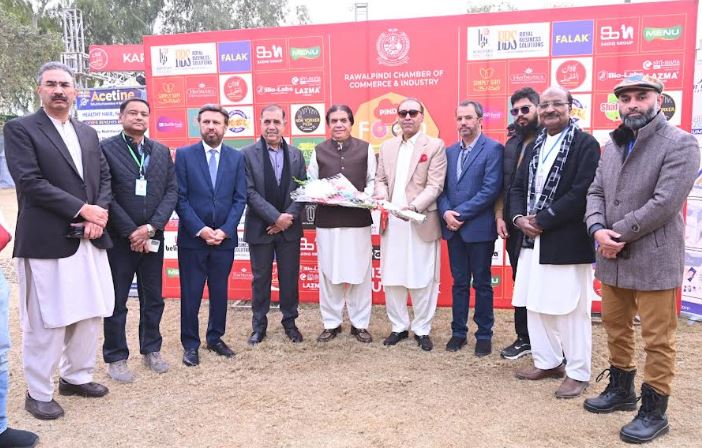
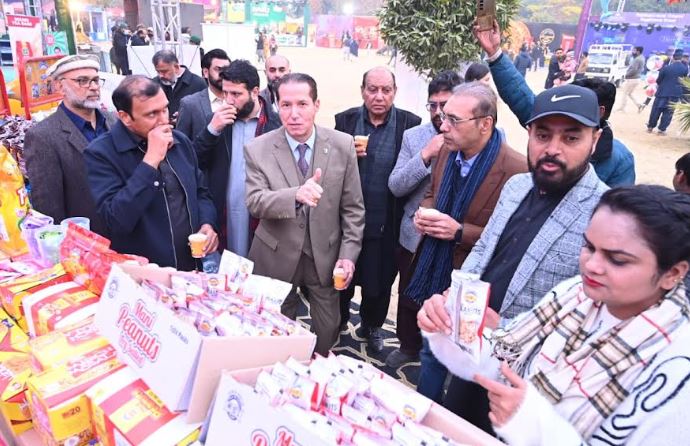
RAWALPINDI, DEC 14: /DNA/ – The Rawalpindi Chamber of Commerce and Industry (RCCI) organized the three-day Pindi Food Fest – 4th Edition at Ayub Park, which attracted a large number of families and food enthusiasts from Rawalpindi and Islamabad. The annual festival aims to celebrate Pakistan’s rich traditional and regional cuisines, introduce innovative food concepts, and provide valuable networking and branding opportunities for SMEs, startups, and women entrepreneurs, particularly in the food sector. 

Federal Minister for Railways Hanif Abbasi, Ambassador of Algeria Brahim Romani, Station Commander Rawalpindi Cantonment Brigadier Ali Anjum Syed, along with representatives of various trade associations and other distinguished guests, visited the festival and appreciated RCCI’s initiative. 

Speaking on the occasion, Federal Minister Hanif Abbasi lauded RCCI for its proactive role in addressing the issues of the business community while also promoting cultural, social, and recreational activities for the public. He congratulated RCCI President Usman Shaukat, his cabinet members, and the entire organizing team on the successful arrangement of the food festival. 

He said that RCCI deserves appreciation for organizing positive, constructive, and people-friendly activities such as the annual food festival. Such events, he added, play a vital role in projecting Pakistan’s soft image at national and international levels. He noted that the presence of foreign diplomats at the festival would help convey a positive impression of Pakistan abroad.

 The minister further emphasized that it is wrong to associate Pakistan solely with terrorism, adding that the world must also be introduced to the country’s culture, traditions, hospitality, and positive societal values.

 RCCI President Usman Shaukat, while highlighting the core objectives of the festival, emphasized the promotion of local culinary heritage and the empowerment of women-led food businesses.

“More than 100 food stalls are participating in the festival, showcasing a wide variety of flavors and cuisines. This initiative provides women entrepreneurs with a platform to launch and grow their brands while building meaningful connections within the industry,” he said.

 He added that the festival also serves as a source of inspiration for aspiring women entrepreneurs. “Our goal is to create opportunities and motivate women who have yet to begin their entrepreneurial journey,” he remarked. This year, over 15 stalls have been allocated exclusively for women, particularly those running home-based food ventures.

Stay Connected

64FansLike
60FollowersFollow

Latest Reviews

Exchange Rates

USD - United States Dollar
EUR
1.14
GBP
1.34
AUD
0.70
CAD
0.71