Home Blog Page 3444

Pakistani student hails China’s poverty alleviation campaign

YUNNAN, China, May 20 / DNA /  = : “To help the needy by whatever means is a great accomplishment,” said Talha Elahi, a Pakistani student who spent his 2019 winter holiday to observe China’s poverty alleviation campaign in a small village named Sabazi in Yunnan Province, China.

According to a report published by China Economic Net (CEN),  a few months ago Talha was an average Pakistani student studying in Sichuan Normal University. He attends classes, plays basketball, friends others, travels around, with not much difference from his schoolmates.

But earlier this year when he returned to school from Sabazi Village, he came to understand things about China’s poverty alleviation – a must-win battle for the Chinese government – as quoted by him, “two months that I’ll never forget”.

blue-and-yellow-parrot-on-wooden-stick-3327116

Talha has been in China for further study since 2016. Living in Chengdu, one of the most important financial, commercial, cultural and transportation centers of western China, he is quite familiar with urban life, so he made a decision to experience rural life in China’s developing Yunnan Province, and more importantly, to see how the Chinese government help its people who yearns for a better life.

Sabazi Village, with a population of 1,171, is located in Songping Town, Yongsheng County of Yunnan Province. By the end of 2019, residents here have got access to water, electricity, roads and street lights.

The village is an impoverished one in dire need of being lifted out of poverty; its economy, in common with other villages nearby, is dominated by crop and plant cultivation, with purchasers mainly from Yongsheng County.
The village is quite distant from Chengdu that it took Talha four and a half hours to get there. Led by the poverty alleviation group, he got chances to see how they find out information and facts about the deserving people and come up with a list of definite targets to hit for.

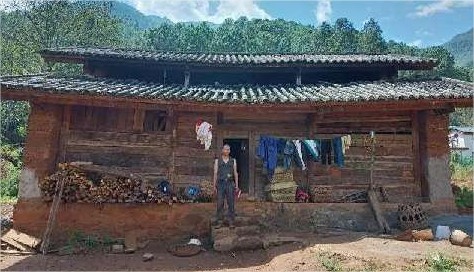
Stepping into a 89-year-old granny’s house, they were shocked by her living conditions. It is unbearable to stay in her woolen house with chilly winter coming, and what is worse, the roof would leak when it rained. To Talha’s surprise, the old lady offered to cook her only hen for him out of kindness.

“I did cry, ” Talha told CEN, “they are so needy but still, they are nice. I was deeply moved by her goodwill.” Touched by the granny’s move, he gave her all his money in the pocket. People might be poor for different reasons, but one’s kindness will never lie, and that is the reason why we are ready to help them, Talha added.
According to CEN, 2020 is set to be the year China eradicates poverty in the country and becomes a “moderately prosperous society in all respects.” En route to delivering the target of eradicating poverty in rural areas and eliminating regional poverty, China still has 52 counties, 2,707 villages and 5.51 million people who need to be lifted out of poverty.

To ensure a smooth implementation of poverty alleviation, China has taken several measures. According to China’s State Council Leading Group Office of Poverty Alleviation and Development, the government had built schools, houses, hospitals in poverty-stricken areas; on top of that, people now have access to education, training programme and job opportunities.

Azerbaijan Piano artists show rare solidarity by singing Dil Dil Pakistan

Ansar M Bhatti

ISLAMABAD: Relations between Pakistan and Azerbaijan are getting deeper and deeper with the each passing day. The hallmark of these relations is growing interest on both sides to give these ties versatile dimensions.

Cultural cooperation happens to be the cornerstone of these splendid relations. Maintaining cultural connections even during the difficult times of corona pandemic is a clear manifestation of earnest desire especially on the part of the Azerbaijan to protect and preserve these relations.

The Azerbaijan embassy spearheaded by Ambassador Ali Alizada has been instrumental in promotion of bilateral links in all fields. Just recently the Ambassador took an initiative of promoting Pakistani national songs in Azerbaijan with a view to further strengthening friendship and brotherly bonds.

In this connection a wonder family of Azerbaijan, well known for their singing skills performed Pakistani national song Dil Dil Pakistan on Piano.

The performance of Ms. Turan and her family indeed presented a mesmerizing performance and won hearts and minds of Pakistani people.

Ambassador of Azerbaijan to Pakistan Ali Alizada in his Tweet said that the wonderful joint performance of the popular Pakistani song “Dil Dil Pakistan” by Ms.Turan Manafzadeh and her parents ‪Maestro Islam Manafov, the honored artist of Azerbaijan and Mrs. Shukufa Manafova in solidarity with brotherly country Pakistan fighting coronavirus pandemic.

He further said that Ms.Turan is the honored artist of Azerbaijan, composer and one of the few women conductors of the world.

Full story in tomorrow’s daily Islamabad Post

CPEC pioneers battle coronavirus in Thar Desert

ISLAMABAD, May 20, / DNA /  : The Chinese company, China Railway 19 Bureau Group Mining Investment stated that it has provided necessary infection prevention and control material to its staff at its coal-mining project  (Thar-block II) in Tharparkar, Sindh, says a report published by Gwadar Pro on Wednesday.

It was noted that during COVID-19 pandemic, Pakistan stands one of the worst-hit countries in South Asia. Ensuring workers’ health and safety is a top priority for each China-Pakistan Economic Corridor (CPEC) project.

To safeguard staff’s health and eliminate their anxiety, the Company had taken immediate action to contact local suppliers in Karachi to formulate supply plan.

According to the report, medical materials such as disposable medical masks, protective coveralls, safety protective goggles and disinfectant have been sent to the project.

It may be mentioned here that till now over 800 local villagers have got jobs in this coal mining project. Due to the effective and timely pandemic prevention measures, all the workers’ health is well protected, and the project runs normal at present.

As Pakistan’s first large-scale open-pit coal mine, this project is an important part of Thar integrated coal mine and power project under CPEC.

The coal resources have been used to generate electricity with a capacity of 660 MW since March 25, 2019 to alleviate Pakistan’s power shortage, the report added.DNA

=========

German Court Orders Spy Agency to curb foreign intelligence gathering

The foreign intelligence service violated the constitution by spying on internet data from foreigners abroad, Germany’s top court ruled Tuesday in a victory for overseas journalists who brought the case

DNA

BERLIN—Germany’s foreign-intelligence agency, which is banned from spying on Germans, now faces strict limits on its overseas activities after the country’s constitutional court decided that the protections against arbitrary surveillance Germans enjoy applied to everyone world-wide.

The foreign intelligence service violated the constitution by spying on internet data from foreigners abroad, Germany’s top court ruled Tuesday in a victory for overseas journalists who brought the case.

The BND agency’s surveillance violates “the fundamental right to privacy of telecommunications” and freedom of the press, judges at the Constitutional Court in Karlsruhe said in their verdict.

But given the “great importance” of foreign surveillance to German security, the court gave the BND until the end of 2021 to change its practices to comply with the law.

The ruling marked the first time the  Constitutional Court clearly stated that the BND must respect fundamental rights accorded by the constitution even when operating abroad.

German intelligence services are already not allowed to monitor the internet traffic of Germans in such a vast way.

The case was brought by journalists and civil society groups who were outraged after the BND was granted sweeping new powers to carry out “strategic telecommunications surveillance” under amended legislation in 2016.

This allowed the BND to tap into internet traffic from non-Germans abroad, often through monitoring the use of keywords, phone numbers or email addresses, and to share this information with other secret services.

One of the plaintiffs, Reporters Without Borders, argued that this allowed the agency to spy on journalists “almost without restrictions”.

“The big victory is that German authorities cannot get out of their constitutional obligations by going abroad and working there,” said Nora Markard from the GFF Society for Civil Rights, another of the co-plaintiffs.

European Film Festival launched online showcasing European movie culture

DNA

Islamabad, 20 May 2020: The European Union has launched the European Film Festival for a worldwide audience, including Pakistan. Unlike previous years when the festival included screenings, panel discussions and workshops in several Pakistani cities, it takes place this year online. The audience will be able to watch, free of charge, a selection of films until June 18th.

The Ambassador of the European Union to Pakistan, Androulla Kaminara explained: “We initially hoped to screen a wide range of films in cinemas, universities and cultural centers across the country. This was to showcase the diversity of European cinema, but more importantly to engage with a Pakistani audience to discuss the stories behind the films and how these stories relate to their lives. Due to Covid19, we had to move the festival online. But we hope it will be a teaser that trigger curiosity for more. Because we hope to organize a real festival again, when the public health situation allows doing so safely.”

The festival promotes European films that reflect the diverse cultures, languages and societies within, but also outside of Europe. The films centre around artificial borders and preconceptions that separate us despite the fundamental human traits that unite us. This topic remains more relevant than ever during the Corona Virus, which has destroyed and disrupted many lives, but it has also sparked global solidarity and cooperation across borders.

The selection includes a Finnish-Bulgarian biographical documentary about coping with childhood traumas, a tragic comedy about a dog not respecting borders, a family drama about a young boy feeling ashamed of his younger brother with down syndrome, an Austrian documentary exploring what the footprint of humans will be once we are gone, and a documentary about the conspiracy theories surrounding the death of the former UN Secretary-General Dag Hammarskjöld. In addition, short films focus, among other topics, on climate change and its impact on lives across the globe – a topic highly relevant for Pakistan, one of the worst effected countries.

The fight against the pandemic requires concerted multilateral efforts: SCO

The SCO countries have demonstrated a high level of solidarity in the fight against the pandemic, said Secretary-General of SCO

DNA

Beijing, May 13. The member states of the Shanghai Cooperation Organization (SCO) have demonstrated solidarity and mutual support in the fight against the coronavirus pandemic, said the SCO Secretary-General Vladimir Norov on Wednesday.

In his opening remarks, at the video-conferencing of the SCO Council of Foreign Ministers, V.Norov expressed his gratitude to the Russian Federation on the initiative to convene the meeting, in its capacity as current chair of the SCO.

“The SCO member states, guided by the principles of the ‘Shanghai Spirit’, have shown a high level of solidarity and mutual support in combating the Coronavirus epidemic”, said Norov.Considering China’s experience, the Secretary-Generalfurther added that the Chinese side received timely information about the impending threat and took appropriate preventive measures accordingly.

V. Norov noted the importance of increasing the efficiency of the organization’s mechanisms for rapid response to new outbreaks of infectious diseases, as well as the need for SCO’s effective interactionthe World Health Organization (WHO) and other relevant international institutions.

Referring to a draft regulation “on the Coordinating Council for Joint Counteraction to Epidemic Threats”, developed by the SCO Secretariat, would help develop and implement comprehensive early measures to prevent and reduce the negative impact of epidemic diseases, added the Secretary-General.

Overcome the consequences

Besides the issues of overcoming social and economic impacts of the pandemic, the SCO Secretary-General called for strengthening cooperation in the field of food security, and proposed development of an Action Plan in this regard.

Stressing the importance of wide application of digital technologies in public administration and business leading business enterprises;he expressed concern over the growing cyber security challenges related to Internet fraud and hacker attacks on government and financial institutions and proposed measures to be incorporated in the “Action Plan for Implementation of the SCO Concept of Cooperation in Digitalization and ICT”.

Afghan problem

Since the epidemic has suspended many SCO mechanisms involved in the process of harmonizing documents for consideration by SCO leaders,the Secretary-General proposed further enhancing the role of the mechanism of permanent representatives of the SCO Member States to the SCO Secretariat.

Regardless of the pandemic, the member countries of SCO continued to provide comprehensive assistance for a peaceful settlement in Afghanistan, he noted the growing importance of the organization in promoting the solution of the Afghan problem within the SCO-Afghanistan Contact Group mechanism.

About SCO

The SCO currently comprises of eight Member States (India, Kazakhstan, Kyrgyzstan, China, Pakistan, Russia, Tajikistan, and Uzbekistan), four Observer States (Afghanistan, Belarus, Iran, and Mongolia) and six “Dialogue Partners” (Armenia, Azerbaijan, Cambodia, Nepal, Turkey, and Sri Lanka. The Secretariat of SCO is the primary executive body of the organization – headquartered in Beijing, China.

Humanitarian space of the SCO is connected with the names of the greatest thinkers

Vladimir Norov

On 21 May, the world celebrates World Cultural Diversity Day for Dialogue and Development, launched by UNESCO in 2001. In 2002, the UN General Assembly proclaimed a resolution on World Cultural Diversity Day for dialogue and development.

This year marks this momentous day for the 19th time. This holiday date has taken on special significance in promoting and preserving culture, intercultural dialogue, and sustainable development. The events on this day aim to promote the importance and value of cultural diversity and the rich civilizational heritage of mankind.

It is quite symbolic that in the year of UNESCO’s adoption of the Universal Declaration on Cultural Diversity in 2001, the SCO was established, one of the most important activities of which is cultural and humanitarian cooperation. Recognizing the need to strengthen the potential of culture, our Organization makes a significant contribution every year to support cultural diversity through prosperity, sustainable development, and global peaceful coexistence.

Today, the SCO unites 18 states, the number of which reaches more than 44% of the world’s population. The SCO family, which includes various peoples, with its original culture, is a colorful palette of ethnic groups, nations, religions, and civilizations, ready for further rapprochement and fruitful cultural and humanitarian cooperation.

Speaking of this cooperation, it is important to keep in mind that the peoples of the “SCO family” are united by several objective factors that form a solid basis for the successful development of mutually beneficial relations. We are connected by many historical, cultural points of contact, common cultural heritage, common traditions, the similarity of languages and cultures, ethnocultural proximity, good-neighborly relations, and much more.

The humanitarian space of the SCO is connected with the names of the greatest thinkers and scientists who have made an invaluable contribution to world culture.

In the Ancient and Middle Ages, the geographical area of Eurasia was one of the most developed in the world. Thanks to the Great Silk Road, one of the most advanced models of economic development has been developed in the region, and the most advanced cultural policy has been created. Revenues from the operation of the Great Silk Road allowed the countries of the region to invest in cultural construction.

Today, every ninth UNESCO World Heritage Site, listed in the World Heritage Fund, is located in the SCO space.

Currently, in the SCO states, along with the important work to preserve the historical cultural heritage, active activities are being carried out to revive the past intensive cultural contacts between the peoples of the region, on the model of humanitarian communications of the Great Silk Road, to promote the popularization of the traditions and customs of the peoples living in the SCO space. One of the main missions in the SCO’s activities is consistently and purposefully implemented – strengthening mutual understanding between peoples, cognition and convergence of their cultures and civilizations.

The basis for building such multifaceted cooperation is the SCO Charter, a fundamental document that defines the main areas of cultural and humanitarian cooperation of our Organization. Practical work on this area of cooperation is entrusted to the Meeting of Ministers of Culture of SCO Member States, a coordinating and advisory mechanism for cooperation, the functioning of which is in line with the provisions of the SCO Charter and other documents adopted within the Organization.

The results of practical cooperation are reflected in the documents adopted at the annual SCO summits. At the summit of Heads of Statein 2007 in Bishkek, the Agreement on Cultural Cooperation was signed, and at the summit of Heads of Government in 2016in Tashkent, further outlines of improving multifaceted cooperation within the SCO, including in the field of cultural and humanitarian cooperation, were identified.

United by the “Shanghai spirit”, SCO Member States, based on the principles of mutual respect and equal dialogue, from year to year intensify practical work in the fields of culture, education, science and technology, health, sports, tourism, and youth contacts. These aspects of cooperation will continue to be an essential part of the Organization’s activities and will continue to serve the goals of cultural construction in the SCO space.

The SCO’s expanding cultural and humanitarian cooperation from year to year contributes to the further deepening of interstate cultural dialogue, in order to bring the SCO countries and peoples closer together. A striking example of this is the comprehensive SCO-our Common Home program, which includes the days of SCO culture, the cycle of piano concerts “Nine Magic Notes”, the annual “SCO Marathons” and the “Eight Wonders of the SCO” project aimed at creating a single tourist space.

The world community is now facing serious challenges related to a sudden attack called COVID-19. The consequences of the pandemic for further favourable world development are unpredictable and may cause dramatic changes in the modern world order. All this further actualizes the value of a single human civilization with the diversity of its forms of existence, the self-identification of the peoples and ethnicities of the world and their responsibility for its future.

We need to raise our many voices in defence of the importance of a day of cultural diversity in the name of dialogue and development. This is the best response and moral support in the fight against humanity’s most dangerous enemies, including the COVID-19 pandemic.

I am convinced that, based on the rich cultural traditions of our peoples, we will be able to overcome all difficulties and trials together and in close cooperation.

The writer is the SCO Secretary General

Japanese envoy expresses condolences over loss of Pak Army Soldiers’ lives in Quetta

ISLAMABAD, MAY 19 (DNA) – Matsuda Kuninori, Ambassador of Japan to Pakistan has expressed his profound grief and sincere condolences over the loss of precious lives of the Frontier Corps soldiers in two separate attacks in Balochistan on May 18.

“I was deeply shocked and would like to express my condolences and sympathies to all the bereaved families.

Terrorism cannot be justified for any reason. In close cooperation with Pakistan and the international community, Japan is determined to resolutely stand up against terrorism” said Ambassador MATSUDA on Tuesday.=DNA

===============

Pak-China relations-new heights

By: Syed Ali Nawaz Gilani

21st May 2020 will be 69th Anniversary day of establishment of diplomatic ties between the two countries in May 1951, China and Pakistan have developed an exemplary all-season friendship which was based on equality, brotherhood and overall cooperation. In the past 69 years, the two countries have carried out multi-dimensional cooperation in varied fields. Despite unstable international situation, the China-Pakistan friendship remained strong and vibrant. Recent past years specially last after the two high level state visits from China in 2013 & 2015, have witnessed a frequent exchange of visits between the leadership of the two countries which further promoted cooperation.

Chinese President Xi Jinping said on terms special friendship between Pakistan and China was choice of the history as it had deep roots in the hearts of people of the two countries.“We want to see a united and strong Pakistan with stability and prosperity,” he said during a meeting with President Dr Arif Alvi here at the Great Hall of People. President Xi said no matter how international landscape might change, China would always stand firmly by Pakistan. “China will stay committed to our ironclad friendship and will expand our strategic cooperation.”President Xi said China backed Pakistan in stepping up its constructive role in regional and international affairs. He said when China was fighting against the outbreak, the Pakistani government and people did their level best to make donations to China to which he expressed heartfelt thanks.President Arif Alvi said he was visiting China to show solidarity with the people and the leadership of China while they were successfully fighting the Covid-19 outbreak.He said China had shown to the world its ability to deal with the challenge and set an example for other countries, which were facing the corona virus outbreak.

In the early years of establishment of the Sino-Pakistan diplomatic relations, Pakistan remained inactive as it was an ally of the West. The period between 1957 and 1969 witnessed an important phase in the history of the Sino-Pakistan relations. During this period, historical changes took place in bilateral relations, which changed the lukewarm attitude of Pakistan. This gesture opened a new chapter in the relationship and in the 1970s; steady developments were made to strengthen friendly cooperation between the two governments and their people. Since 1990, drastic changes have taken place on the international horizon; however, China and Pakistan has further developed.

The success & strengthening of these relationship also remembered the important role started from His Excellency Mr. Han Nian Long first Chinese Ambassador

who served from 1951-54 till to Widely respected & friendly Ambassador Yao Jing who assumed the office in November 2017 likewise Pakistan first Ambassador H. E. Maj. Gen. Nawabzada Agha Muhammad Raza from 1951 to 1954 till our present Ambassador Naghmana Hashmi Sahiba who took the office in 2019 while She also served as DCM in China from 2003-2007,  She is doing a great to further strengthen these relationship & explore more avenues which is really need of the houre.

The Sino-Pakistan both  plays a central role in Asia’s geopolitics, from India’s rise to the prospects for a post-American Afghanistan, from the threat of nuclear terrorism to the continent’s new map of mines, ports and pipelines. China is Pakistan’s great economic hope and its most trusted military partner. Pakistan lies at the heart of China’s geostrategic ambitions, from its take-off as a global naval power to its grand plans for a new silk road connecting the energy fields of the Middle East and the markets of Europe to the mega-cities of East Asia.

China and Pakistan have witnessed steady growth in mutual investments in recent years. In the last few years, China invested more than USD……. billion in Pakistan. A large number of Chinese companies are presently working in Pakistan in different sectors. Chinese goods are very much in demand in the Pakistani markets. Their experience of growth in trade is positive due to convenient trade flows and openness measures. China has become one of the top five import sources of Pakistan. Bilateral trade had reached around USD……. billion in 20`18 and is on the rise. The balance, however, is in favour of China due to lesser exports by Pakistan.

Tensions between the US and Pakistan over the presence of Osama bin Laden in Pakistan, and a speedy US withdrawal from Afghanistan are likely to reinforce Sino-Pak ties. China is the only country that has taken a supportive stand for Pakistan after the Bin Laden operation.

The Soviet invasion of Afghanistan in 1979 opened a new chapter of consultation and collaboration between China and Pakistan. The two countries were in total agreement that the Soviet military presence in Afghanistan posed a great threat to the security of the entire region and prepared to co-ordinate their policies to face the challenge. Support to Pakistan’s security was the major feature of China’s Afghan policy because they wanted to honour their often repeated commitments. Regarding recent developments in Afghanistan, China and Pakistan have a close understanding of each other’s point of view.

Page 3

In the recent past, a 100-member youth delegation of Pakistan visited China for a week long visit. Chinese Government also regularly inviting youth & young people from various walks of life from Pakistan to visit China as a response, the Pakistani government also invited  Chinese youths to Pakistan. Being launched in 2007, the youth exchange program is aimed at increasing mutual understanding between the people of the two countries.

There are many opportunities of collaboration between the two countries in the realm of higher education. The largest number of students of Pakistan are now studying in Pakistan. There is close cooperation between the Universities of China and Pakistan. High level delegations are reciprocally exchange visits. Recently A seminar on, “Pakistan and China Relations” was organized by China Study Centre University of Peshawar in  July 2019. A delegation from China Embassy Islamabad under the leadership of Ms Bao Zhang, Director General Political & Media Affairs participated in the seminar.

Ms Bao Zhang while speaking said that China and Pakistan relations are higher than mountains, deeper than oceans and sweeter than honey. Pakistan and China are iron brothers. Pakistan and China relations became stronger when President Xi Jinping visited Pakistan in 2015. Pakistan supported China on many global and regional issues and appreciated the completion of early harvest projects of CPEC and optimistically underlined that the second phase of CPEC will boost industrialization in Pakistan. She also highlighted the important role of the business community in the economic development of the country. Ms Bao said that China has helped Pakistan to overcome its energy problem and recently it has also helped Pakistan in addressing the problem of forex reserves. Prof Dr Zahid Anwar, Director, China Study Centre, University of Peshawar said that came into existence, recently with the support of China Embassy Islamabad.  The China Study Centre (CSC) endeavours to enrich understanding between China and Pakistan through research, learning, institutional linkages, and people to people contacts.

This is high time to properly utilize the services of various groups of Friends of China in Pakistan. In order to increase awareness for this friendly relationship among the youth of both countries, the vital role played by Pakistan-China Friendship Association, Listeners of Urdu Services from China Radio and the Urdu Department of Peking University must be appreciated for their result oriented efforts and to use these informal channels for further awareness.

As a part of 70th Anniversary of Founding of the People’s Republic of China last year 2019, the Pakistan-China Friendship Association – Khyber Chapter  & Radio China Listener’s Club (a group of listeners of Urdu Service from CRI) organized many specially focused events to highlight the importance of the occasion,

Page 4

The Chinese Ambassador Yao Jing along with Mr. Chen Xian-Director Pakistan CRI  donated books to the Central Libray UoP in  on behalf of the CRI. The book donation has led to the establishment of a Chinese Corner.. On daily basis hundreds of student come and take benefit from these books and get to know about the time tested relations that both the countries enjoy. The love of Amb. Yao Jing  for this great alma mater of North of Pakistan is evident from the fact that he has visited several times to this institution since he has taken charge of the  office. Ambassador visited the Institute of Peace & Conflict Studies and had a fruitful interaction with research students and galaxy of experts on Afghan affairs to share views on the  afghan peace process and regional integration.

The Mass Media’s dynamic role Strengthening the Pak-China Relations & further understanding amoung the peoples of both countries can not be over looked and with each passing day their role become more and more vital like Urdu Service from China Radio International since August 1955 and recently successfully launching of FM 98-Dosti Channel with the cooperation of Radio Pakistan First in Islamabad, later Lahore & Karachi successfully improving the nobale cause of this examplery relations and as mentioned by Director CRI & FM-98 Dosti Mr. Chen with Urdu name Shaheen, proudly mentioned that FM-98 Dosti networks day by day increase across the country shows height of people to people heart to heart relationship. Director Urdu Service Section, China Radio International (CRI) Madam Zhao Qiao (Mahvesh –Urdu name) while speaking termed mass media a key player in widely spreading the message of BRI and CPEC’s. Ms Zhao Qiao said, Media significantly contributed in highlighting benefits of BRI and CPEC to regional countries and clearing the misconceptions about the vision. Mass Media informed people that through BRI’s economic cooperation and communication skills, Chinese leaders are determined to share their fruits of prosperity with regional countries. Director CRI Pakistan, Chen Xiang apprised that via FM 98 Dosti Radio Channel in Islamabad, Lahore, and Karachi and Beijing’s Urdu Service in China have built a liaison to interact with the local community. Like wise print media and official news agencies of both Pakistan & China are doing great and updating their peoples about latest specially in recent past in  COVID 19 all of them play their role in the best interest of masses which great appreciated. Recently, the government of China had also established China Media Group (CMG) headed by senior leader Mr.  Shen Haixiong as First President of CMG, to provide in time and accurate information to the masses across the world. China Media Group would comprise the CCTV, China National Radio and China Radio International.

There is a lot of potential for trade between Pakistan and China. In the present geo-political and geo-strategic dynamics, Pakistan and China need each other more than ever. The economic ties between China and Pakistan need to be strengthened on a war footing and beyond rhetoric. We need to identify areas of priority, where mutual growth can take effect efficiently.

For example, China can practically guide Pakistan in increasing its economic growth rates just as it has doubled its GDP in a record 10 years, while it took USA almost 50 years, to achieve the same growth rate. It can provide technical assistance to Pakistan in policy and planning.

Furthermore, there should be a free and facilitated exchange of business persons between the two countries. Pakistani companies should be encouraged to develop joint ventures with multinational Chinese countries, which would help penetrate the Chinese market as well as the global market. These joint ventures will also help in transfer of technology, management skills and improve innovation in products and services.

China has vast and valuable experience in development of its agricultural sector. Pakistan can achieve monumental strides in development of its agricultural sector by following successful Chinese methodologies. Another very important area for cooperation from China is the education sector. Pakistan has a very high section of its population in the 15-24 age category, and the overall literacy rates are not very encouraging. China and Pakistan can form ‘sister universities’ for the promotion of education and research. China can offer some seats in its universities for deserving students and Pakistan can facilitate Chinese students likewise.

Finally, China’s influence as a growing economic power, can wield substantive support to Pakistan in the decisions of the international financial institutions. Such support can go a long way in helping Pakistan fight its way out of its financial distress, and in getting the desired foreign investment.

(The writer a Media Consultant, the President of Radio China Listener’s Club & Secretary-General Pakistan-China Friendship Association Khyber-Pakhtunkhwa.  President, Radio China Listener’s Club. His email is  syeed.gilani@gmail.com)

Stay Connected

64FansLike
60FollowersFollow

Latest Reviews

Exchange Rates

USD - United States Dollar
EUR
1.17
GBP
1.35
AUD
0.71
CAD
0.72