Home Blog Page 3392

Pakistan witnesses record 136 coronavirus deaths in past 24 hours

DNA

ISLAMABAD JUNE 19 : The countrywide tally of coronavirus cases has jumped to 165,062 after 4,944 new infections were detected in Pakistan over the past 24 hours while 136 more people succumbed to the deadly disease.

According to data released by the National Command and Operation Center (NCOC), 61,678 cases have been detected in Punjab so far, 62,269 in Sindh, 20,182 in Khyber Pakhtunkhwa, 8,998 in Balochistan, 9,941 in Islamabad, 769 in Azad Jammu and Kashmir and 1,225 in Gilgit Baltistan,

With 136 more Covid-19 related fatalities recorded over the past 24 hours, the number of people dying from the disease in the country has soared to 3,229. A total of 4,944 new cases were detected when 28,042 tests were conducted during this period. The number of people defeating the deadly virus has reached 61,383. So far, 1,011,106
tests have been conducted across the country.

Global coronavirus cases

The number of coronavirus infection cases across the world has surpassed over eight point five million while the pandemic has so far claimed more than 455,000 lives.

The United States tops with over two point two million cases and more than 120,000 deaths.

Brazil with over 983,000 cases and more than 47,000 deaths is the second badly hit by the virus.

Over four point five million patients have so far recovered from the disease across the world.

Indonesian Embassy, PBC discuss COVID-19 impacts  


DNA

ISLAMABAD: Though, COVID 19 continues to play havoc with human lives and global economies, nevertheless, simultaneously the damage control efforts are also in full swing to minimize the devastating socio-economic impacts of the pandemic. To contain and fight off the financial downturn the friendly nations through consultations are identifying ways for mutual cooperation for the enhanced sustainable economic activities between them.

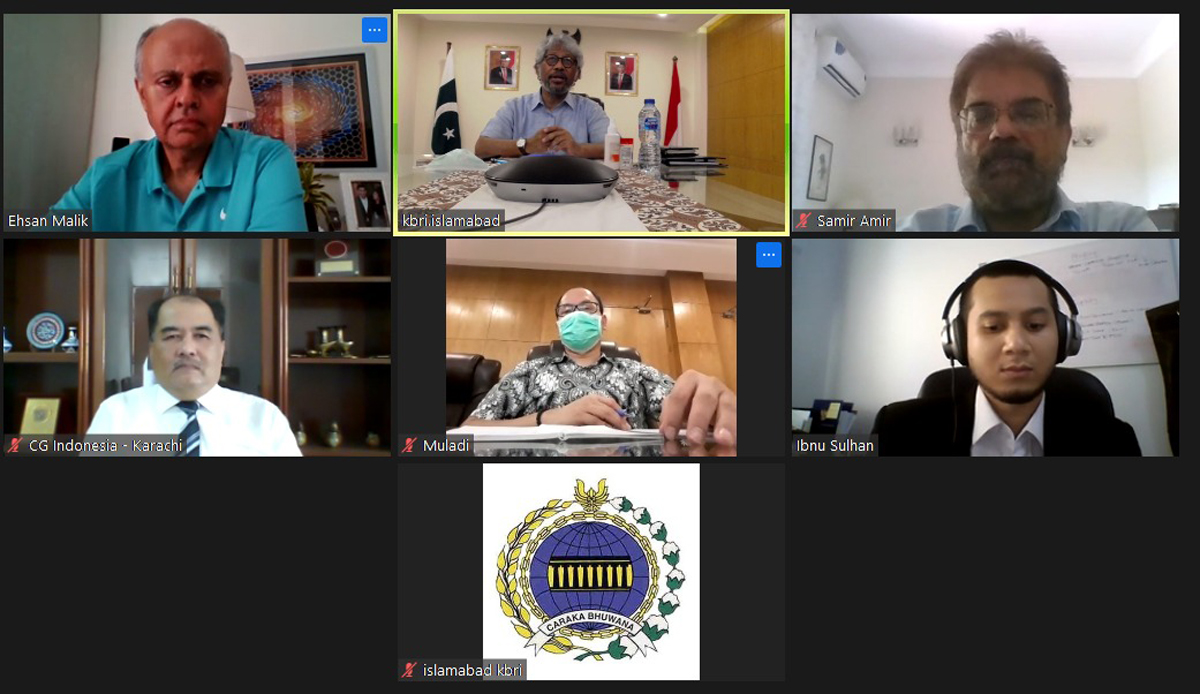
With the same spirit, the Indonesian Embassy in Islamabad organized a virtual meeting with the Pakistan Business Council (PBC) which is headquartered in the Pakistani economic hub of Karachi. It represents country’s leading Corporate and Business Groups and as an advocacy forum work to improve the general business environment of the country. Through its research projects, it also provides valuable input to the Government of Pakistan for bilateral agreements such as the Preferential Trade Agreement (PTA) and the Free Trade Agreement (FTA) between Pakistan and other countries.

The Indonesian Ambassador Iwan S. Amri and the Indonesian Consul General in Karachi Totok Prianamto attended the virtual meeting. The Indonesian Embassy has always worked closely with PBC and this time the meeting was aimed at discussing and evaluating the bilateral economic and trade situation arising out of the COVID 19 pandemic.

Speaking on the occasion, Indonesian Ambassador Iwan Suyudhie Amri highlighted the current issues concerning the bilateral economic cooperation between the countries and stressed on the significance of fostering the sustainable bilateral trade relations. “Indonesia and Pakistan must work together for the sustainable trade relations between them,” Ambassador Iwan Amri observed.

The Envoy believed that the concerted communication and consultations with the PBC and other stakeholders in Pakistan will certainly build greater confidence and improve environment for the both countries to uplift business, economic and other aspects of the bilateral ties.

“We would like to encourage and elevate bilateral trade and overall economic cooperation between the two countries that was sustainable, equitable and mutually beneficial corresponding to their respective supply &demand potential,” remarked Ambassador Iwan Amri.

Pakistan Business Council’s CEO Ehsan Ali Malik, in his remarks, reciprocated Ambassador’s views and highly commended the Indonesian Embassy in Islamabad and the Indonesian Consulate General in Karachi for their timely initiative and being persistent towards optimization of cooperation with Pakistan in various potential spheres.

42b45537-6bcc-4239-9ada-0a649a8841f5

Ehsan Ali Malik said that with the realization of the China Pakistan Economic Corridor (CPEC) strategic project the economic outlook in Pakistan was way more dynamic. He expressed his confidence that CPEC projects offered Indonesia a great opportunity to increase its economic cooperation and investment in Pakistan.

Ambassador Iwan Amri noted with pleasure that Indonesia’s trade relations with Pakistan have been on upward trajectory. The total trade value between Indonesia and Pakistan in 2019 reached USD 2.3 billion with surplus of USD 1.6 billion favoring Indonesia. While shedding some light on the research carried out by the Embassy, the Ambassador hoped that the PBC could play its vital role towards making Pakistan the hub of Indonesia’s palm oil business to Central Asia and the Middle East.

The successful implementation of the Indonesia-Pakistan Preferential Trade Agreement (PTA) in 2013 opened the door for the Indonesia’s superior and competitive products in the Pakistani market such as palm oil and its derivatives, viscos rayon materials, coal, polyester, paper, rubber, motor vehicle parts, tractor accessories, clove, broom, brush, vein chloride and others products.

Following the establishment of concrete trade cooperation within the PTA framework, currently the two countries were moving towards the Free Trade Agreement (FTA) within the framework of the Trade in Goods Agreement (TIGA).

On the occasion, PBC’s CEO, Ehsan Ali Malik lauded the Indonesian Government’s policies that created an investment friendly climate in the country and have been very successful in attracting foreign investors. “We would like to learn from Indonesia’s success story in encouraging the relocation of multinationals and other large companies for instance from the US and Japan to Indonesia.

Tourism sector, people to people contacts and removing non-tariff barriers for bilateral trade were among other issues that also came under discussion at the meeting.

The successful two-hour long wide-ranging virtual meeting concluded with the Indonesian Embassy in Islamabad and the Pakistan Business Council agreeing to continue to work together by means of mutual consultations and sharing of the information about existing and emerging economic opportunities and potential business cooperation that can be focused and capitalized by Indonesia and Pakistan,” concluded Ambassador Iwan Amri.

___

Indian envoy summoned over LoC violations

ISLAMABAD (DNA) -Indian Charge d’Affaires Gaurav Ahluwalia was summoned on Thursday by Director General (South Asia & SAARC) Zahid Hafeez Chaudhri, to register Pakistan’s strong protest over the ceasefire violations by the Indian occupation forces along the Line of Control (LoC) on 17 June 2020, resulting in shahadats of four innocent civilians and serious injuries to one.

Due to indiscriminate and unprovoked firing by the Indian occupation forces in Bagsar and NikialSectors of the LoC;27 year old Razeem s/o Saleem;25 year old Tehzeeb s/o Saleem; 13 year old Ali Maroof s/o Muhammad Maroof, residents of Ratta Jabbar village in Nikial Sector, and 60 year old Rasheeda Bibi w/o Muhammad Hussain, resident of Lewana Khaiter village in Bagsar Sector, embraced shahadat. Also, 61 year old Muhammad Hussain s/o Fateh Ali,resident of Lewana Khaiter village sustained serious injuries.

The Indian occupation forces along the LoC and the Working Boundary (WB) have been continuously targeting civilian populated areas with artillery fire, heavy-caliber mortars and automatic weapons. This year, India has committed 1410 ceasefire violations to date, resulting in 12 shahadats and serious injuries to 102 innocent civilians.

Condemning the targeting of innocent civilians by the Indian occupation forces, the DG (SA & SAARC) underscored that such senseless acts, in clear violation of the 2003 Ceasefire Understanding and complete disregard for international human rights law and international norms, further vitiate the already tense atmosphere.

 He added that by raising tensions along the LoC and the WB, India cannot divert attention from the worsening human rights situation in the Indian Occupied Jammu and Kashmir (IOJ&K).The Indian government must realize that its irresponsible policies and unilateral actions are increasingly imperiling peace and security in the region. India must act responsibly in the interest of regional peace and stability.

Azerbaijan through the prism of BRI

Yunis Sharifli

At a time when U.S. influence in the South Caucasus is declining and the European Union is not fully engaged in the region, the People’s Republic of China (PRC) has emerged as a strategically important new player in the South Caucasus, which has the potential to enhance Azerbaijan’s capacity as a regional transit hub. In particular, the Belt and Road Initiative (BRI), announced by the President of PRC Xi Jinping in 2013 in Nur-Sultan (formerly known as Astana), Kazakhstan, has aroused interest in Azerbaijan from its very beginning.

During the visit of the Azerbaijani President Ilham Aliyev to China in 2015, the two countries signed a memorandum of understanding on joint promotion of the Silk Road Economic Belt”. Since regaining its independence, Azerbaijan has been seeking to invest in infrastructure projects to take advantage of its favorable geographical position. The availability and operation of the already built infrastructure has further increased the strategic importance of Azerbaijan for the PRC. The Baku-Tbilisi-Kars Railway (BTK) and the Baku International Sea Trade Port (BSTP) play a crucial role in the plans of both Azerbaijan and China.

On October 30, 2017, Azerbaijan and Georgia, along with Turkey, officially launched the 826-kilometer Baku-Tbilisi-Kars railway. On July 24, 2019, it for the first time delivered cargo from Turkey to Georgia. The BTK has a capacity of 5 million tons of cargo per year and offers a viable alternative to other railway routes on the East-West corridor. In addition to the BTK, the “construction of the New Baku International Sea Trade Port Complex” began in the Alat settlement, 70 km south of Baku, according to a decree signed by the President of Azerbaijan on March 18, 2007. The first phase of the port has already been completed. At the initial stage, the port’s loading capacity is expected to be up to 15 million tons. Upon completion of the second phase, the loading capacity will increase to 25 million tons. The BSTP is located at the intersection of the East-West and North-South corridors, as well as key highways and railways of Azerbaijan. The adoption of the law on the establishment of the Alat Free Economic Zone increases the importance of the port and attracts the attention of both regional and non-regional countries.

Azerbaijan is located within the Middle Corridor of the Silk Road Economic Belt. Covering 4,256 km of railways and 508 km of sea routes, this corridor stretches from the Chinese-Kazakh border to Azerbaijan (via the Caspian Sea), Georgia and Turkey. The location of both the BTK and the BSTP in the central corridor turns Azerbaijan into a key country in terms of realizing and reaching full potential of the BRI.

The Middle Corridor is shorter and more cost-effective than other alternatives. Goods shipped from China by sea take 36 days to reach Europe, while shipping along the Trans-Siberian route takes 20 days. The Middle Corridor, however, offers a timespan of 12 days for the Chinese goods to reach the same destination. In addition to being economically attractive, the Middle Corridor is also more politically viable for China, as the countries along this corridor are more secure, both geographically and due to stable relations with other countries. In addition, the corridor allows China to diversify its exports, reduce its dependence on Russia, a major player in the Northern Corridor, and safely ship its products to Europe without using the Southern Corridor through U.S.-sanctioned Iran.

From Azerbaijan’s point of view, the Middle Corridor strengthens the country’s position as a regional transit center and contributes to the further deepening of the Azerbaijan-Georgia-Turkey strategic triangle. Baku’s decisive role in this corridor increases Azerbaijan’s strategic importance not only for China, but also for European and regional countries. A greater role in the East-West corridor increases the country’s attractiveness along the North-South corridor and encourages countries in the neighborhood, especially Iran and Russia, to deepen cooperation with Azerbaijan. Moreover, the Middle Corridor may help Azerbaijan to diversify the national economy and reduce dependence on oil. The development of the Azerbaijani-Chinese relations may also attract more Chinese investment and increase the region`s potential to become a transport hub by developing the business environment and making it an integral part of the country’s international supply network. Politically, China’s growing influence in the region could help balance Russia and increase Azerbaijan’s maneuverability in the political arena and develop relations with international organizations in which China has a leading role (e.g.: Asian Infrastructure Investment Bank).

With the outbreak of the COVID-19 in China and its rapid spread to other regions, international trade has stagnated. During the pandemic, air and sea routes lost their functionality as a result of restrictive measures of many countries to prevent the spread of the virus. The closure of air and maritime routes due to the pandemic is having a serious impact on multiple industries. Experts predict that many European ports are going to be running only at 20-30% of their capacity in the coming months. At this time, elevated air shipping prices and longer transit times in both air and ocean freight means that the railways connecting Europe and China, remain the only reliable means of transportation for companies.

On April 19, a 940-meter freight train (the longest to have ever operated on the BTK) carrying 82 containers was sent from Turkey to Uzbekistan via Azerbaijan, Kazakhstan and Turkmenistan along the Middle Corridor. During the pandemic, a container transfer system was installed at the Canbaz station on the Turkish side of the Turkey-Georgia border to increase the capacity of the railway line to 3,500 tons due to the growing demand for freight on the BTK railway. The increase of the BTK`s freight capacity and the growing demand for freight along this route may further increase the strategic importance of Azerbaijan within the BRI framework. This situation can continue in the post-pandemic period and increase Azerbaijan’s geopolitical and geostrategic value for China. This is also a promising perspective for Azerbaijan against the backdrop of the sharp drop in oil prices and the pandemic-related burden on the national economy.

The Middle Corridor seems to dispose of an enormous potential to become the safest and shortest trade route between Europe and Asia, with Azerbaijan playing a key role in this initiative. Given the rapid development of the Azerbaijani-Chinese relations since 2015, the sharp drop in oil prices and the growing pressure on the Azerbaijani economy due to the pandemic, as well as the increasing strategic importance of railways, Azerbaijani-Chinese relations may receive a further impetus. Chinese investment in Azerbaijan would also be necessary for reviving the post-pandemic economy and more active participation of Azerbaijan in the BRI. Moreover, the deepening of relations can contribute to the development of Azerbaijan as a regional transport hub, as well as China’s diversification of export routes, reduction of transport costs and delivery of goods to Europe along the shortest route.

Yunis Sharifli is an intern at Topchubashov Center, Baku-based think tank. He studies at the Azerbaijan State University of Economics, Faculty of Turkish World Economics, majoring in International Relations. His areas of expertise cover Central Asia and Caucasus in China`s foreign policy, as well as Belt and Road Initiative.

FM Qureshi briefs Russian counterpart about Kashmir

ANSAR BHATTI

ISLAMABAD : Foreign Minister Makhdoom Shah Mahmood Qureshi during a telephonic conversation with Russian Foreign Minister Sergey Lavrov, briefed him about latest situation in the occupied Kashmir.

Matters of mutual interest, including the Covid-19 pandemic, cooperation at the multilateral fora, prospects of enhanced bilateral cooperation, and regional issues were discussed. Foreign Minister Qureshi underlined that Pakistan considered Russia an important partner and desired to forge a long-term and multi-dimensional partnership with Russia.

Foreign Minister Qureshi offered condolences on the loss of precious lives in Russia due to the COVID-19 pandemic. The two Foreign Ministers exchanged views about the socio-economic ramifications about the pandemic. Foreign Minister Lavrov expressed solidarity with Pakistan in its efforts to combat the outbreak.

The Foreign Minister apprised his Russian counterpart of Prime Minister Imran Khan’s call for “Global Initiative on Debt Relief” for developing countries. He stated that coordinated and comprehensive actions were essential to create fiscal space needed by the developing world to deal with the socio-economic impacts of Covid-19. The Russian Foreign Minister expressed support for debt relief initiative and assured to play a positive role.

In context of IOJ&K, Foreign Minister Qureshi shared deep concern over the continuing double lockdown as well as the intensification of military crackdown by Indian occupation forces and attempts to change the demographic structure of the occupied territory. The Foreign Minister underlined the importance of urgent steps to address the grave situation.

The two Foreign Ministers also discussed the situation in Afghanistan in the context of the recent positive developments. Foreign Minister Qureshi reaffirmed Pakistan’s support for an Afghan-led and Afghan-owned peace process and underlined Pakistan’s positive contribution to the U.S.-Taliban peace agreement.

He stressed the importance of inclusive intra-Afghan negotiations as the only way to build durable peace and security in the country. The two Foreign Ministers agreed on maintaining close consultations as part of regional efforts to support the Afghan peace process.

The two Foreign Ministers agreed to remain in close contact to take forward the important bilateral agenda and close cooperation in the regional context.

Vote on Africa’s Security Council seat goes to runoff

Kenya and Djibouti will compete in a runoff vote on Thursday to become Africa’s next representative on the Security Council after an inconclusive first round of voting.

The United Nations General Assembly voted on Wednesday on who will occupy the non-permanent seats on the council for the next two years.

The vote for Africa’s third seat was pushed after neither Kenya nor Djibouti managed to achieve the required two-thirds majority required to win.

Kenya received 113 votes against Djibouti, which got 78.

The winner will join Niger and Tunisia currently representing the African continent.

Kenya was nominated by African Union (AU) member states to replace South Africa for the seat that will fall vacant in January 2021, but Djibouti demanded a review of the decision and refused to withdraw its candidacy.

French-speaking Djibouti and English-speaking Kenya are both highlighting their roles to seek peace in the Horn of Africa region, the AFP news agency reports.

India, Mexico, Norway and Ireland were chosen as non-permanent members, while Canada lost out again.

PCB chairman rules out holding of ICC events during ongoing year

DNA

LAHORE, JUNE 18 :  Pakistan Cricket Board (PCB) Chairman Ehsan Mani is of the view that during the current year no International Cricket Council event can take place due to ongoing situation of coronavirus pandemic all over the world.

There are chances that next year when situation becomes conducive ICC will take place, he said this while addressing an online video conference here.

“Although New Zealand and Australia have almost controlled Covid19 yet their cricket boards are very careful and they are not ready take any risk in this regard. So seeing all this, one can easily say that there is hardly any chance of any ICC event to be conducted this year. Only next year, we can expect any ICC event.”

“The main danger of holding the ICC event this year is that if any player gets affected by the Coronavirus, it will create a lot of difficulties for the organizers. For such a big decision, the ICC hopefully will take all the stakeholders in confidence first and then decide about the fate of the mega event (World Cup). In next three to four weeks, the ICC can take final decision on it. If the World Cup doesn’t take place, it won’t bring a big loss to the PCB.”

The PCB chairman said that he is not interested in taking over the slot of ICC President. “Last time, when I left the ICC presidentship, I had decided to quit cricket completely but on the request of Prime Minister Imran Khan, I returned to Pakistan cricket again. Some of the ICC members are trying to convince me to join the ICC again, but this is not on my agenda. I just want to serve Pakistan cricket in the befitting manner.”

“I keep on meeting the PM, as he very openly talks about cricket and the board. I told the Prime Minister Imran Khan in my very first meeting as PCB chief that there is a dire need to make laws against match fixing so that corrupt elements must be dealt with a iron hand and sent behind the bars. To eliminate corruption from cricket, the PCB has already sent the draft to the government and hopefully that it will be duly approved to eliminate the fixing from cricket.”

Ehsan Mani added that in his meeting with the PM, he also discussed the domestic cricket and the ways so that it may prove fruitful for Pakistan cricket at national and international level. “I have thoroughly discussed with the Prime Minister Imran Khan about domestic cricket and the hurdles being faced by the PCB in this regard. I am hopeful that after taking some drastic steps, the problems of domestic cricket will be resolved and it will improve gradually and will start producing results.”

“It is true that departmental cricket plays very significant role in Pakistan cricket but it’s not a durable model and no big cricket-playing nation has such a model in their domestic cricket. When the PCB took some bold decision for bringing betterment in Pakistan cricket, those, who were misusing their powers, they brought their cases to the courts. They are speaking against the PCB just to enjoy their vested interests.”

The PCB Chief said that if the situation doesn’t improve till December, the PCB has to take some very important decisions in this regard. “The decision of playing remaining matches of the Pakistan Super League will be taken in December seeing the situation of the country. If it doesn’t improve till December, then we will sit and ponder over how to conduct the remaining matches of the PSL-5.”

He said that it is also difficult to hold domestic cricket matches in time in the country. “It seems that the situation will further worsen instead of getting improved. So it is also possible that domestic cricket may be delayed due to this Coronavirus pandemic.”

The PCB chairman said that the purpose of Asia Cup is to collect capital for the Asian countries. “If Asia Cup doesn’t take place, it will be a great loss for Nepal, Qatar and Bahrain. In South Asia, Sri Lanka has much better situation to host cricket events. They (Sri Lanka) are hopeful of resuming cricket activities in September this year after getting rid of Coronoavirus pandemic. Pakistan has decided to host its events in Sri Lanka in order to bring betterment in Asia cricket.”

IHC judge tests positive for coronavirus

ISLAMABAD, JUN 18 : An Islamabad High Court (IHC) judge, Justice Lubna Saleem Pervaiz has tested positive for the novel coronavirus.

Official sources at the high court confirmed the news saying the IHC judge took a coronavirus test after her secretary was diagnosed as positive for the infection last week.

Last month, Islamabad High Court (IHC) Chief Justice Athar Minallah had tested negative for the novel coronavirus. He took a COVID-19 test after his secretary Asad Khokhar was diagnosed with the deadly virus.

It merits mentioning here that the IHC was also closed after an employee tested positive for the infection last month. The high court building was vacated and disinfectant spray was conducted. Later, a limited number of staffers were directed to come to the court to avert the spread of Covid-19.

Earlier, on June 8, Chief Justice of Pakistan (CJP) Justice Gulzar Ahmed had tested negative for COVID-19. This was the second time the chief justice had got himself tested for the coronavirus.

Pakistan’s coronavirus deaths top 3,000

The countrywide tally of coronavirus (COVID-19) cases has jumped to 160,118 after 5,358 new infections were detected in the country over the past 24 hours while 118 more people succumbed to the deadly disease.

So far, 60,138 cases have been detected in Punjab, 59,983 in Sindh, 19,613 in Khyber Pakhtunkhwa, 8,794 in Balochistan, 9,637 in Islamabad, 740 in Azad Jammu and Kashmir and 1,213 in Gilgit Baltistan, according to data released by the National Command and Operation Center (NCOC).

With 118 more Covid-19 related fatalities recorded over the past 24 hours, the number of people dying from the disease in the country has soared to 3,093. A total of 5,358 new cases were detected when 31,500 tests were conducted during this period. The number of people defeating the deadly virus has reached 59,215. So far, 982,012 tests have been conducted across the country.

Earlier, Special Assistant to Prime Minister (SAPM) on National Health Services Dr. Zafar Mirza had said there is no effective treatment for the novel coronavirus in the world so far.

He said recent research shows that one third of severely affected patients can survive by using medicine, Dexamethasone. He, however, added this medicine can only be used for critical patients and urged the people not to use it without doctor’s advice.

The special assistant urged the people to follow SOPs to contain the spread of coronavirus.

Stay Connected

64FansLike
60FollowersFollow

Latest Reviews

Exchange Rates

USD - United States Dollar
EUR
1.15
GBP
1.32
AUD
0.69
CAD
0.72