Home Blog Page 337

Palestinian GDP remains 24% below pre-war level, data shows

Palestinian GDP remains 24% below pre-war level, data shows

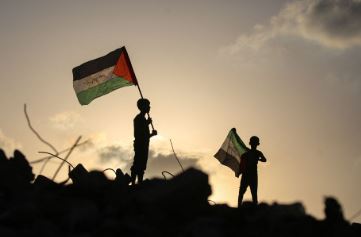
RAMALLAH, DEC 21 /DNA/ – The Palestinian economy remains in a deep, protracted recession, with its productive capacity severely damaged by the ongoing conflict, according to a joint economic report released today. The Palestinian Central Bureau of Statistics (PCBS) and the Palestine Monetary Authority (PMA) stated that while Gross Domestic Product (GDP) showed a statistical increase of 4% in 2025 compared to 2024, it marks a catastrophic collapse of 24% from pre-war 2023 levels.

The data, which excludes parts of Jerusalem annexed by Israel in 1967 and is measured at constant prices, quantifies the staggering cumulative damage to the economic foundations of the West Bank and Gaza Strip since the escalation of hostilities. The report attributes the severe decline to the “deterioration of productive capacity and the persistence of bottlenecks in economic activities” caused by the Israeli military aggression.

The 4% uptick in 2025 does not signal a recovery but rather underscores the depth of the preceding collapse and the economy’s struggle to function amidst continued constraints. The joint publication frames the current GDP level as indicative of a prolonged recession, with the economy trapped well below its pre-conflict output.

This annual report represents the ongoing collaborative effort between the PCBS and PMA to document the economic landscape. It also includes forecasts for 2026, which are anticipated to detail the significant challenges ahead for reconstruction and recovery, contingent on the political and security situation.

The findings present a stark numerical illustration of the war’s economic toll, highlighting the immense challenge of rebuilding shattered infrastructure, commerce, and livelihoods in the Palestinian territories.

During 2025, GDP recorded a sharp decline in Gaza Strip, reaching 84% compared to 2023, while it declined by 13% in the West Bank during the same period. Even though GDP in the West Bank recorded a slight increase of 4.4% in 2025 compared to 2024, GDP in Gaza Strip continued to contract, where if further declined  by 8.7% during the same period.

The growth rate recorded in 2025 is mainly attributed to a relative improvement in some productive sectors and the partial return of commercial activity compared to 2024. However, the level of GDP in Palestine remains far below its pre-Israeli aggression levels, confirming that the Palestinian economy has not yet regained its productive capacity and that the road to recovery remains fragile and constrained by the repercussions of the Israeli aggression and the ongoing restrictions.

A complete collapse of all economic activities in Gaza Strip during 2025 compared to 2023, along with a sharp decline in economic activities in the West Bank, despite their increase compared to 2024.

The Palestinian economy is considered a service economy, where 60% of the Palestinian economy is services, while the productive sectors that support economic growth constitute only about 19% of the total economy. This indicates that the Palestinian economy is changeable, and is significantly impacted by the challenges.

During 2025, most economic activities in Palestine declined compared to 2023, as the construction activity recorded the highest decline, reaching 41% (29% in the West Bank, and 99% in Gaza Strip) to reach USD 296 million, followed by the industrial activity with a decline of 25%  (21% in the West Bank, and 94% in Gaza Strip) to reach USD 1,155 million, then the services activity declined by 25% (12% in the West Bank, and 82% in Gaza Strip) to reach USD 6,794 million, and agriculture activity with a decline of 18% (stable in the West Bank, and 92% in Gaza Strip) to reach USD 686 million.

In 2025, most economic activities showed marginal increases that do not indicate the beginning of recovery of the Palestinian economy’s sectors compared to 2024. Most of economic activities remain about one-third below their pre-Israeli aggression levels.

A decline in the trade volume from and to Palestine in 2025 compared with 2023

The volume of trade exchange between Palestine and the outside world witnessed a 12% decline. The value of imports fell by 17%, totaling USD 7,881 million in 2025 compared to 2023. Additionally, Palestinian imports make up more than three times the value of  Palestinian exports. However, the value of exports of goods and services from Palestine increased by 5%, reaching USD 2,856 million, where this rise is attributed to the fact that most Palestinian exports come from the West Bank, which recorded a relative increase during the same period. In a sense, this reflects a steady deficit in the Palestinian balance of trade. Exports and imports increased by 18% and 20% in 2025, respectively, compared to 2024, while they remain below their pre-Israeli-aggression levels. It is important to note that the largest share of trade exchange with the outside world in Gaza Strip was recorded in 2003, at 29% of total Palestinian trade. However, this percentage has since declined to less than 4% during Israeli occupation aggression, due to the near-total disruption of supply chains into and out of Gaza Strip. This disruption led to a health and food crisis, with basic commodities, medicines, health supplies, and food provided at minimal levels, not exceeding 4% of the necessary quantities required in the Gaza Strip.

The Unemployment Rates in Gaza Strip Exceed 77% in 2025

The Palestinian labor market continues to face difficult challenges in light of the ongoing economic and social impacts of the Israeli aggression on Gaza Strip. Despite the slight improvement in unemployment and labor force participation indicators during 2025, the figures still reflect a state of recession and a sharp disparity between the West Bank and Gaza Strip.

About half of the labor force in Palestine was disrupted, where the unemployment rate reached 46% in 2025 (28% in the West Bank and 78% in Gaza Strip). This reflects the high unemployment rates in the West Bank and Gaza Strip, despite the slight changes in these rates, where the total number of unemployed individuals reached more than 650 thousand.

Despite this difficult reality, labor force participation rate increased in 2025 to 43.7%, partly due to individuals attempts to engage in any form of work or seek alternative livelihood opportunities after the Israeli aggression. The participation rate reached 43% in the West Bank, while it reached 38% in Gaza Strip, where such percentages are below the pre-Israeli aggression levels recorded in 2023.

Poverty and Living Standards

Prior to the Israeli occupation’s aggression against the Gaza Strip, poverty rates there exceeded 63%, with the poverty line in Palestine set at approximately NIS 2,717 and the extreme poverty line at about NIS 2,170. Recently, due to the ongoing Israeli aggression against the Gaza Strip, the concept of poverty has been surpassed, and we are now confronting different levels of famine and food insecurity. Consequently, total consumption has dropped in 2025 by 24% (12% in the West Bank and 81% in Gaza Strip) compared with 2023, reflecting a direct impact on the standard of living in Palestine. In other words, the majority of individuals in Gaza Strip are now suffering from severe levels of food insecurity.

Unprecedented Increase in Prices Levels

At the level of prices in Palestine during 2025, prices increased by about 11% compared to 2024, due to the sharp rise of prices in Gaza Strip of around 22%, despite their slight decline in the West Bank of about 0.13%. The near-total blockade on Gaza Strip continued, leading to a severe shortage of goods entering to Gaza Strip, in addition to the regional situation that affected Palestine.

 “Prospects of the Palestinian Economy for 2026: A slight increase within a challenging economic reality”

The Palestinian Monetary Authority and the Palestinian Central Bureau of Statistics have issued two reports on the economic forecasts for 2026, which are available on their websites. The two reports address forecasts of the key macroeconomic indicators of the Palestinian economy during 2026, based on a set of factors and assumptions incorporated into the baseline scenario. The impacts of these factors are expected to be reflected in the performance of various sectors, particularly the real sector, the financial sector, and the external sector.

The baseline assumptions underlying the baseline scenario for 2026 indicate the continuation of the current economic and political conditions without any fundamental changes. This scenario assumes the persistence of strict restrictions on the movement of individuals and goods and on crossings, alongside continued limitations on economic activity in Gaza Strip due to the widespread destruction of the productive base. Economic activity is expected to remain confined to a narrow scope linked to humanitarian assistance and relief operations. This scenario also assumes that a large share of Palestinian workers will continue to be unable to access the labor market inside Israel, negatively affecting income levels and domestic demand.

At the level of public finance, the scenario assumes continued pressure on the Palestinian government’s public budget, in light of the irregular transfer of clearance revenues and the persistence of Israeli deductions, alongside a decline in domestic revenues due to weak economic activity. This scenario also assumes that levels of external grants and aid will remain at their current low levels. In the external sector, performance is expected to remain affected by Israeli restrictions and obstacles imposed on the movement of individuals and goods and on crossings.

In light of these assumptions, forecasts estimate that the Palestinian economy will record growth ranging between 4.1% and 4.5% in 2026. This growth reflects the continuation of the gradual recovery path that began after the sharp contraction recorded in 2024, without indicating a broad-based recovery or a genuine restoration of productive capacity. The growth is attributed mainly to a limited improvement in the components of aggregate demand, particularly final consumption, supported by the continued flow of humanitarian aid and private transfers, in addition to a partial positive contribution from investment spending.

Given that the environment in which the Palestinian economy operates entails a high degree of risk and uncertainty, these forecasts incorporate an analysis of potential risks with varying probabilities (an optimistic scenario and a pessimistic scenario). If these risks materialize, they are expected to have positive or negative repercussions on economic performance in the short term.
Erdogan attends commissioning of Pakistani navy ship built in Turkey

Erdogan attends commissioning of Pakistani navy ship built in Turkey

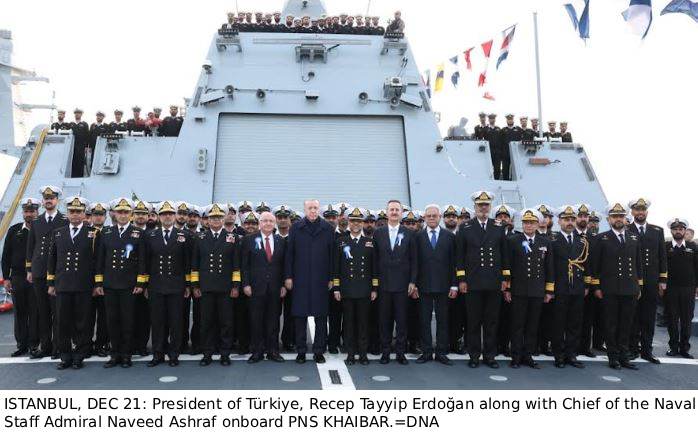
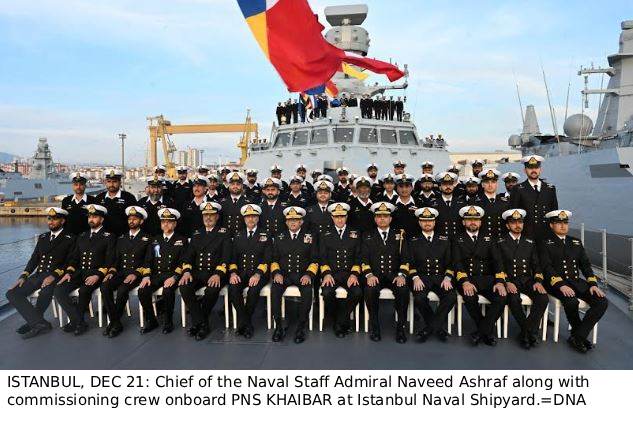
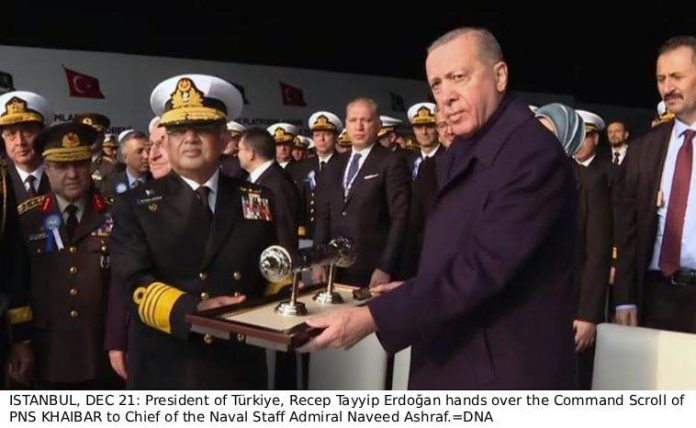
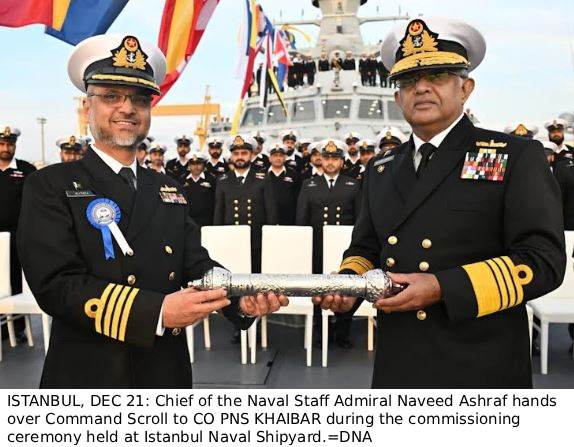
ISLAMABAD, DEC 21 /DNA/ – The commissioning ceremony of 2nd Pakistan Navy MILGEM class ship PNS KHAIBAR was held at Istanbul Naval Shipyard, Türkiye. The President of Republic of Türkiye, Recep Tayyip Erdoğan, graced the occasion as Chief Guest. Chief of the Naval Staff Admiral Naveed Ashraf also attended the ceremony.

While addressing on the occasion, President  Recep Tayyip Erdoğan termed the brotherly relations between Pakistan-Türkiye as exemplary.  The President further emphasized the need for enhanced mutual collaboration in the field of defence production in future as well.

Speaking on the occasion, Chief of the Naval Staff Admiral Naveed Ashraf acknowledged the commitment of M/s ASFAT, Istanbul Naval Shipyard and the OEMs (Original Equipment Manufacturer) involved in planning, design and construction of PN MILGEM ships. Naval Chief also appreciated the deepening defence partnership between Pakistan and Türkiye. He highlighted that bilateral engagements between Pakistan Navy and Turkish Naval Forces not only contribute immensely towards strengthening Pakistan-Türkiye defence collaboration but also reflect our enduring and deepening partnership.

Following the ceremony, Turkish President visited the ship, where he was presented Guard of Honour and interacted with ship’s crew. During the visit Turkish President and Chief of the Naval Staff Admiral Naveed Ashraf exchanged views on maritime security in the region and discussed avenues for future PN-TNF joint initiatives. 

PN MILGEM ships are the most technologically advanced surface platforms. These vessels are equipped with latest Command and Control Systems integrated with  modern weapons and advanced sensors.

The contract for construction of 4 MILGEM class ships for Pakistan was signed between Ministry of Defence Production, Pakistan and M/s ASFAT, Türkiye in 2018, wherein two Ships planned to be constructed at Türkiye and remaining two ships in Pakistan. Commissioning of PNS KHAIBAR marks the completion of construction of both Ships at Türkiye.

Israel’s security cabinet approves 19 new settlements in West Bank

Israel's security cabinet approves 19 new settlements in West Bank

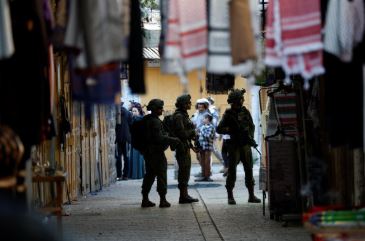
JERUSALEM, DEC 21: Israel’s security cabinet approved the establishment of 19 new settlements in the occupied West Bank, a move the country’s far-right finance minister said on Sunday was aimed at preventing the establishment of a Palestinian state.

The decision brings the total number of settlements approved over the past three years to 69, according to a statement from the office of Finance Minister Bezalel Smotrich.

The latest approvals come days after the United Nations said the expansion of Israeli settlements in the West Bank — all of which are considered illegal under international law — had reached its highest level since at least 2017.

“The proposal by Finance Minister Bezalel Smotrich and Defence Minister Israel Katz to declare and formalise 19 new settlements in Judea and Samaria has been approved by the cabinet,” the statement said, without specifying when the decision was taken.

Smotrich is a vocal proponent of settlement expansion and a settler himself. “On the ground, we are blocking the establishment of a Palestinian terror state,” he said in the statement.

                  “We will continue to develop, build, and settle the land of our ancestral heritage, with faith in the justice of our path.”

                  UN Secretary-General Antonio Guterres has recently condemned what he described as Israel’s “relentless” expansion of settlements in the occupied territory.

                  It “continues to fuel tensions, impede access by Palestinians to their land and threaten the viability of a fully independent, democratic, contiguous and sovereign Palestinian State”, he said earlier this month.

                  Since the start of the war in Gaza, calls for the establishment of a Palestinian state have proliferated, with several European countries, Canada and Australia recently moving to formally recognise such a state, drawing rebukes from Israel.

                  – ‘Sharp increase’ –

                  A UN report said the expansion of settlements was at its highest point since 2017, when the United Nations began tracking such data.

                  “These figures represent a sharp increase compared to previous years,” Guterres said, noting an average of 12,815 housing units were added annually between 2017 and 2022.

                  “These developments are further entrenching the unlawful Israeli occupation and violating international law and undermining the right of the Palestinian people to self-determination.”

                  Excluding east Jerusalem, which was occupied and annexed by Israel in 1967, more than 500,000 Israelis live in the West Bank, along with about three million Palestinian residents.

                  Smotrich’s office said the 19 newly approved settlements are located in what it described as “highly strategic” areas, adding that two of them — Ganim and Kadim in the northern West Bank — would be re-established after being dismantled two decades ago.

                  Five of the 19 settlements already existed but had not previously been granted legal status under Israeli law, the statement said.

                  While all Israeli settlements in the Palestinian territory are considered illegal under international law, some wildcat outposts are also illegal in the eyes of the Israeli government.

                  Many of these, however, are later legalised by Israeli authorities, fuelling fears about the possible annexation of the territory.

                  US President Donald Trump has warned Israel about annexing the West Bank.

                  “Israel would lose all of its support from the United States if that happened,” Trump said in a recent interview to Time magazine.

                  Israel has occupied the West Bank since 1967, and violence there has soared since the Gaza war erupted in October 2023 following Hamas’s attack on Israel.

                  Israeli troops or settlers have killed at least 1,027 Palestinians in the West Bank — both militants and civilians — since the start of the fighting in Gaza, according to an AFP tally based on Palestinian health ministry figures.

                  At least 44 Israelis have been killed in the West Bank in Palestinian attacks or Israeli military operations during the same period, according to Israeli data.

Pakistan’s winning moment as Green Shirts clinch U19 Asia Cup title

Pakistan's winning moment as Green Shirts clinch U19 Asia Cup title

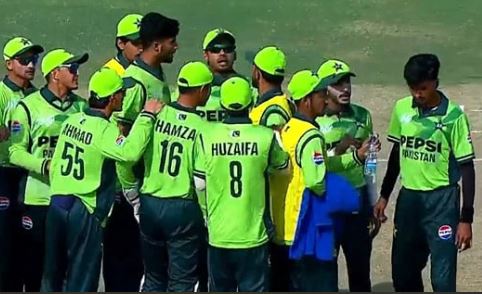
DUBAI, DEC 21: Scenes of jubilation erupted at the ICC Academy in Dubai as Pakistan thumped India in the Men’s U19 Asia Cup final on Sunday. The Green Shirts sealed a commanding 191-run victory in the final after bowling out their arch-rivals for 156 runs.

As Ali Raza dismissed Deepesh Devendran, India’s last batter to fall, jubilant Pakistani players and support staff stormed the field, waving national flags.

Among the support staff was former Pakistan captain Sarfaraz Ahmed, who serves as the national U19 team’s mentor.

Pakistan lifted the Men’s U19 Asia Cup title courtesy of their brilliant batting, followed by a stellar bowling performance.

The game saw Pakistan set a daunting 348-run target for India, who could score 156 runs before getting bowled out in 26.2 overs.

Raza was the standout bowler for Pakistan, taking four wickets for 42 runs in his 6.2 overs, while Abdul Subhan, Mohammad Sayyam, and Huzaifa Ahsan chipped in with two each.

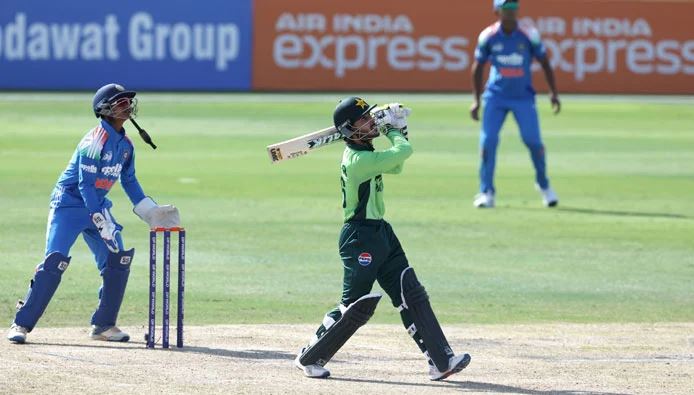
Batting first, Sameer Minhas’s monumental 172-run knock helped Pakistan post 347/8 in their 50 overs.

The Green Shirts got off to a decent start to their innings as their opening pair of Minhas and Hamza Zahoor (18) put together 31 runs before the latter fell victim to Henil Patel in the fourth over.

Following the early setback, Usman Khan joined Minhas in the middle, and the duo led Pakistan into a commanding position by knitting a brisk 92-run partnership for the second wicket off just 79 deliveries.

The platform-setting stand culminated in the 17th over when Khilan Patel got Usman Khan caught at long-on. The left-handed batter made a vital contribution with a 45-ball 35, featuring three fours and a six.

Minhas was then involved in another crucial partnership for Pakistan, a blistering 137-run stand for the third wicket with Ahmed Hussain, who made 56 off 73 deliveries, laced with three fours and a six.

The right-handed opener then shared a 42-run partnership with captain Farhan Yousaf until eventually being dismissed by Deepesh Devendran on the penultimate delivery of the 43rd over.

He remained the top-scorer for Pakistan with 172 off 113 deliveries, studded with 17 fours and nine sixes.

His dismissal sparked a collapse which saw Pakistan lose four more wickets, including that of captain Yousaf (19) in quick succession, and consequently brought the total down to 327-8 in 46.4 overs.

Following the slump, Mohammad Sayyam and Niqab Shafiq added valuable runs at the backend, playing unbeaten cameos of 13 and 12, respectively.

For India, Deepesh Devendran led the way with three wickets but was expensive as he conceded 83 runs in his 10 overs, followed by Henil Patel and Khilan Patel with two each, while Kanishk Chouhan could bag one.

Pakistan needs a Charter of Politics: Azam Nazeer Tarar

Pakistan needs a Charter of Politics: Azam Nazeer Tarar

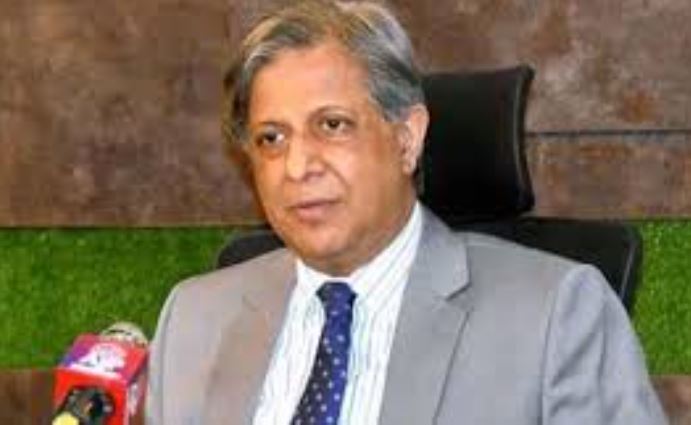
LAHORE, DEC 21 (APP/DNA): Federal Law Minister Azam Nazeer Tarar on Sunday stressed that Pakistan urgently needs a “charter of politics” to ensure political maturity, stability and national progress.

He was addressing a seminar held at Aiwan-e-Iqbal on the 53rd martyrdom anniversary of Khawaja Muhammad Rafique Shaheed.

The law minister said the proposed charter was not for any individual or political party, but solely for the beloved homeland. He remarked that those who had played with the fate of the country were no longer hidden from the public.

The minister emphasized the need to adopt a positive attitude towards criticism, promote tolerance, and listen to political opponents.

He said such events highlight the personality and sacrifices of great leaders, adding that Pakistani politics has produced many illustrious names, with Khawaja Muhammad Rafique Shaheed shining as a bright star among them.

Paying tribute, he said Khawaja Rafique Shaheed always raised his voice for truth and followed a path rooted in love for the homeland, politics, and the common citizen. “He left this world like a brave man,” he added, noting that politics is a continuous process that demands wisdom and patience.

The minister observed that Pakistan had witnessed extremism in politics and said it was the responsibility of politicians to address issues with prudence. He warned that extremism and violence should not be allowed to chart their own course in political affairs.

Stressing the present challenges, Azam Nazeer Tarar said Pakistan today needs dialogue, political stability and economic stability. “Without these, progress is not possible,” he said, adding that Khawaja Rafique Shaheed sacrificed his blood in the struggle to eliminate fascism from the country.

Terrorists backed by Afghan Taliban harm civilians, children: CDF Asim Munir

Terrorists backed by Afghan Taliban harm civilians, children: CDF Asim Munir

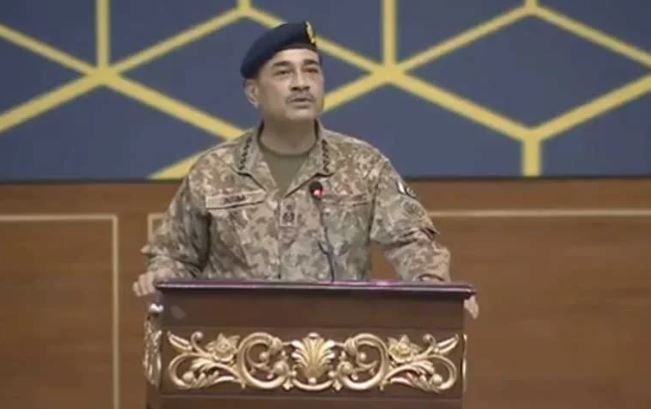
RAWALPINDI, DEC 21: Chief of Defence Forces (CDF) Field Marshal Asim Munir said terrorism backed by the Afghan Taliban is targeting innocent civilians and children.

Addressing the National Ulema and Mashaikh Conference, Field Marshal Syed Asim Munir said he witnessed divine help during Operation Bunyan-um-Marsoos. He said no authority except the state can issue an order or fatwa for jihad in any Islamic state.

He said nations that abandon the scholarly and intellectual legacy of their forebears, and the power of the pen, fall into decline. Field Marshal Asim Munir said Allah granted Pakistan the honour of being the guardians of the holy sanctuaries among Islamic countries. He said there is a deep connection and resemblance between the State of Madinah and the State of Pakistan.

The CDF said both the State of Madinah and the State of Pakistan were founded on the Kalima Tayyaba during the blessed month of Ramadan.

He said this resemblance exists because the Lord of the universe destined one to be the custodians of the sanctuaries and the other to be their protectors.

The Field Marshal said 70 per cent of the formations of Fitna al-Khawarij operating from Afghanistan consist of Afghans.

He said Afghanistan must choose between Fitna al-Khawarij and Pakistan. The Field Marshal added that terrorism backed by the Afghan Taliban is targeting innocent civilians and children.

It is pertinent to note that the conference was held in Islamabad on December 10. Religious scholars and mashaikh from all schools of thought across the country attended the conference.

President Zardari seeks deeper economic ties with Iraq

President Zardari seeks deeper economic ties with Iraq

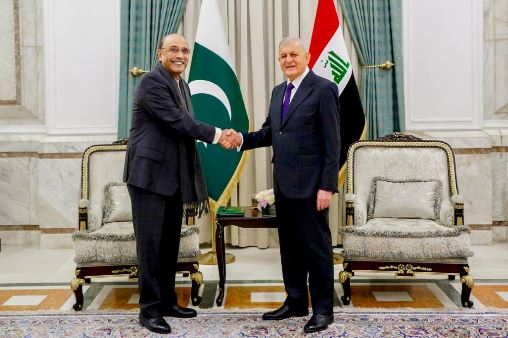
BAGHDAD, DEC 21 /DNA/ – President Asif Ali Zardari met Dr. Abdul Latif Jamal Rashid, President of the Republic of Iraq at Baghdad Palace today.

Upon arrival at the Palace, President Asif Ali Zardari was accorded a guard of honour. An official welcoming ceremony was held, followed by a one-on-one meeting between the two Presidents and delegation-level talks. President Rashid also hosted a lunch in honour of President Asif Ali Zardari and his accompanying delegation.

The President expressed his appreciation for the warm welcome extended by the Iraqi leadership and people, and described Baghdad as a historic city symbolising civilisation and resilience.

President Zardari congratulated the Iraqi leadership and people on the successful conduct of the parliamentary elections and expressed best wishes for the smooth formation of the new government. He reaffirmed Pakistan’s firm support for Iraq’s sovereignty, territorial integrity and national unity, and reiterated Pakistan’s commitment to Iraq’s stability, prosperity and democratic progress.

Both leaders reviewed the state of bilateral relations and expressed satisfaction over the positive momentum generated by recent high-level exchanges, including the 9th session of the Pakistan-Iraq Joint Ministerial Commission and parliamentary interactions.

The President noted that current levels of bilateral trade do not reflect the true potential of Pakistan-Iraq economic, cultural and security relations. He highlighted opportunities for expanding trade, investment, agriculture and defence production sectors besides information technology, construction, pharmaceuticals and related industries. He also underscored the importance of business-to-business engagement, reciprocal business delegations and the establishment of direct banking channels to facilitate trade and commercial activity.

President Zardari reiterated Pakistan’s willingness to support Iraq’s reconstruction and development efforts through the provision of skilled and semi-skilled manpower under the existing Memorandum of Understanding on manpower transmission. He also highlighted Pakistan’s capacity in medical services, financial expertise and digital governance, and expressed readiness to share technical experience, including in secure data management, to support institutional capacity-building in Iraq.

The President also requested for improved facilitation for Pakistani pilgrims visiting Iraq and expressed hope for early finalisation and implementation of the proposed Memorandum of Understanding on Zaireen Management, aimed at ensuring orderly travel and addressing longstanding issues related to religious visits. The President also expressed his firm resolve to work with Iraqi government to stop illegal entry and overstay of those Pakistanis who violate Iraqi law.

Both Presidents expressed their resolve to fight extremism, terrorism and narco trade and enhance bilateral cooperation.

The two leaders reaffirmed their commitment to further deepening bilateral cooperation across political, economic and social domains, and agreed to maintain close coordination at regional and multilateral fora, including the United Nations and the OIC, on issues of mutual interest.
Iraqi President appreciated Pakistan’s role in uniting Islamic Ummah and the historical support to the people of Palestine.

Senator Sherry Rehman; Senator Saleem Mandviwala; Sardar Saleem Haider Khan, Governor Punjab; Mr. Sharjeel Inam Memon, Sr Provincial Minister Govt of Sindh; Syed Nasir Hussain Shah, Provincial Minister of Sindh; Syed Nayyer Hussain Bukhari, Ex-Chairman Senate and Pakistan’s Ambassador to Iraq, accompanied the President.

Sameer’s ton leads Pakistan to massive total against India in U19 Asia Cup final

Sameer's ton leads Pakistan to massive total against India in U19 Asia Cup final

DUBAI: In-form opener Sameer Minhas’s monumental century-plus knock, coupled with Ahmed Hussain’s half-century, powered Pakistan to a commendable total against fierce rivals India in the blockbuster ACC Men’s U19 Asia Cup 2025 final here at the ICC Academy on Sunday.

India captain Ayush Mhatre’s decision to field first backfired as Pakistan piled up 347/8 in their 50 overs, courtesy of Minhas.

The Green Shirts got off to a decent start to their innings as their opening pair of Minhas and Hamza Zahoor (18) put together 31 runs before the latter fell victim to Henil Patel in the fourth over.

Following the early setback, Usman Khan joined Minhas in the middle, and the duo led Pakistan into a commanding position by knitting a brisk 92-run partnership for the second wicket off just 79 deliveries.

The platform-setting stand culminated in the 17th over when Khilan Patel got Usman Khan caught at long-on. The left-handed batter made a vital contribution with a 45-ball 35, featuring three fours and a six.

Minhas was then involved in another crucial partnership for Pakistan, a blistering 137-run stand for the third wicket with Ahmed Hussain, who made 56 off 73 deliveries, laced with three fours and a six.

The right-handed opener then shared a 42-run partnership with captain Farhan Yousaf until eventually being dismissed by Deepesh Devendran on the penultimate delivery of the 43rd over.

He remained the top-scorer for Pakistan with 172 off 113 deliveries, studded with 17 fours and nine sixes.

His dismissal sparked a collapse which saw Pakistan lose four more wickets, including that of captain Yousaf (19) in quick succession, and consequently brought the total down to 327/8 in 46.4 overs.

Following the slump, Mohammad Sayyam and Niqab Shafiq added valuable runs at the backend, playing unbeaten cameos of 13 and 12, respectively.

For India, Deepesh Devendran led the way with three wickets but was expensive as he conceded 83 runs in his 10 overs, followed by Henil Patel and Khilan Patel with two each, while Kanishk Chouhan could bag one.

U19 Asia Cup final: Pacers put Pakistan on top in 348-run defence against India

U19 Asia Cup final: Pacers put Pakistan on top in 348-run defence against India

DUBAI, DEC 21: Pakistan’s pace trio of Ali Raza, Mohammad Sayyam and Abdul Subhan ran through India’s top order and reduced the arch-rivals to 69/5 in 11 overs while defending a massive 348-run target in the ACC Men’s U19 Asia Cup 2025 final, underway here at the ICC Academy on Sunday.

Put into bat first, in-form opener Sameer Minhas produced a towering 172, backed by a half-century from Ahmed Hussain, leading Pakistan to 347/8 in their 50 overs.

India captain Ayush Mhatre chose to field after winning the toss, but Pakistan capitalised, piling on the runs through Minhas’ big-hitting knock.

The Green Shirts got off to a decent start to their innings as their opening pair of Minhas and Hamza Zahoor (18) put together 31 runs before the latter fell victim to Henil Patel in the fourth over.

Following the early setback, Usman Khan joined Minhas in the middle, and the duo led Pakistan into a commanding position by knitting a brisk 92-run partnership for the second wicket off just 79 deliveries.

The platform-setting stand culminated in the 17th over when Khilan Patel got Usman Khan caught at long-on. The left-handed batter made a vital contribution with a 45-ball 35, featuring three fours and a six.

Minhas was then involved in another crucial partnership for Pakistan, a blistering 137-run stand for the third wicket with Ahmed Hussain, who made 56 off 73 deliveries, laced with three fours and a six.

The right-handed opener then shared a 42-run partnership with captain Farhan Yousaf until eventually being dismissed by Deepesh Devendran on the penultimate delivery of the 43rd over.

He remained the top-scorer for Pakistan with 172 off 113 deliveries, studded with 17 fours and nine sixes.

His dismissal sparked a collapse which saw Pakistan lose four more wickets, including that of captain Yousaf (19) in quick succession, and consequently brought the total down to 327/8 in 46.4 overs.

Following the slump, Mohammad Sayyam and Niqab Shafiq added valuable runs at the backend, playing unbeaten cameos of 13 and 12, respectively.

For India, Deepesh Devendran led the way with three wickets but was expensive as he conceded 83 runs in his 10 overs, followed by Henil Patel and Khilan Patel with two each, while Kanishk Chouhan could bag one.

There was no handshake at the toss between the two captains, and a handshake also did not take place during the pre-match trophy photo opportunity.

Separately, reports said Pakistan Cricket Board (PCB) Chairman Mohsin Naqvi is scheduled to attend the final and the closing ceremony in Dubai.

Sources added that Naqvi, who is also the Asian Cricket Council (ACC) president, will watch the match live at the venue and attend the ceremony where the winning team will lift the trophy.

Playing XIs
Pakistan: Sameer Minhas, Usman Khan, Ahmed Hussain, Farhan Yousaf (c), Hamza Zahoor (wk), Huzaifa Ahsan, Niqab Shafiq, Mohammad Shayan, Ali Raza, Abdul Subhan, Mohammad Sayyam

India: Ayush Mhatre (c), V Suryavanshi, Aaron George, VM Malhotra, Vedant Trivedi, AA Kundu (wk), Kanishk Chouhan, Khilan Patel, Henil Patel, D Deepesh, KK Singh

Fauji Fertiliser quits PIA bid as three groups remain in race

Fauji Fertiliser quits PIA bid as three groups remain in race

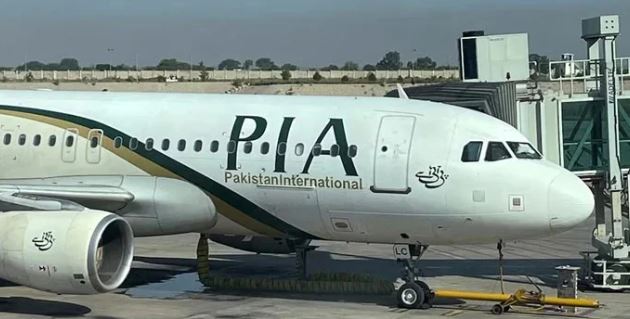
ISLAMABAD: Fauji Fertiliser Company Ltd, earlier viewed as a leading contender for a 75% stake in Pakistan International Airlines, has formally withdrawn from the privatisation bidding and notified the Privatisation Commission, even as sealed bids are due on December 23, The News reported.

The move came on Saturday, the last day for depositing earnest money. Three other prequalified bidders submitted the required amount and are set to file sealed bids, while Fauji Fertiliser did not, a senior Privatisation Commission official told The News.

Officials said the company’s decision to stay out of the bidding means it can later join any winning consortium, noting that if it had submitted a bid, rules would have prevented it from teaming up with the successful bidder afterwards.

Earlier, the Privatisation Commission Board had prequalified four bidders: Fauji Fertiliser Company Ltd; Airblue (Pvt) Ltd; a consortium led by Lucky Cement with Hub Power Holdings, Kohat Cement and Metro Ventures; and a consortium led by Arif Habib Corporation with Fatima Fertiliser, City Schools and Lake City Holdings. On November 7, AKD Group Holdings (Pvt) Ltd was added to the Arif Habib-led consortium.

Under the privatisation plan, bids will be invited for a 75% stake in PIA. The winning bidder must decide whether to buy the remaining 25% stake, for which the government has offered a 90-day option period.

The bidding process will begin with sealed bids. The Privatisation Commission Board will first approve the reserve price, followed by approval from the Cabinet Committee on Privatisation. Bids will then be opened publicly in the presence of the media. If bids exceed the reserve price, open bidding will follow. If bids fall below it, the highest bidder will be given the first right to match the price.

Of the amount paid for the 75% stake, 92.5% will be invested in PIA, while 7.5% will go to the government. The remaining 25% stake retained by the government is considered valuable, and bidders will have the option to acquire it later or leave it with the state.

Officials said the structure was designed to accommodate bidders interested in either 75% or full ownership. Those who do not participate in the bidding cannot later join the winning consortium, a restriction that no longer applies to Fauji Fertiliser now that it has formally withdrawn.

Under the payment terms, the winning bidder must pay two-thirds of the bid amount within 90 days, while the remaining one-third can be paid within 12 months.

The government has assured 12 months of job security for PIA employees. Pension liabilities, medical benefits and other post-retirement perks will be handled by the holding company, while current salaries and benefits will be paid by the new owners.

PIA currently have rights to 78 destinations and holds about 170 landing slots worldwide. Officials said the airline urgently needs fresh investment and professional management to turn around its operations.

Stay Connected

64FansLike
60FollowersFollow

Latest Reviews

Exchange Rates

USD - United States Dollar
EUR
1.14
GBP
1.34
AUD
0.70
CAD
0.71