
Home Blog Page 3325

July 15: Turkish people thwarted coup attempt to save democracy

Ambassador of Turkey Ihsan Mustafa Yurdakul says Turkey will never forget Pakistani support during difficult times: DC Hamza Shafqaat recognizes valiant struggle of Turkish people

Asnar M Bhatti

ISLAMABAD: – Ambassador of Turkey Ihsan Mustafa Yurdakul has said on 15 July one of the most treacherous attempts was made on the people of Turkey with a view to making the Turkish people slaves, but the brave Turkish people valiantly thwarted that attempt.

Ostensibly, the Turkish people had to pay a price also. And what was that price; the price was bombing of the presidential palace; bombing of the Turkish national assembly and bombing of police headquarters; intelligence headquarters and Special Forces headquarters. But at the end of the day will the people prevailed and the move was vehemently rejected.

The ambassador expressed these views during a ceremony held in connection with commemoration ceremony for Democracy and National Unity Day, held at the Turkish embassy.
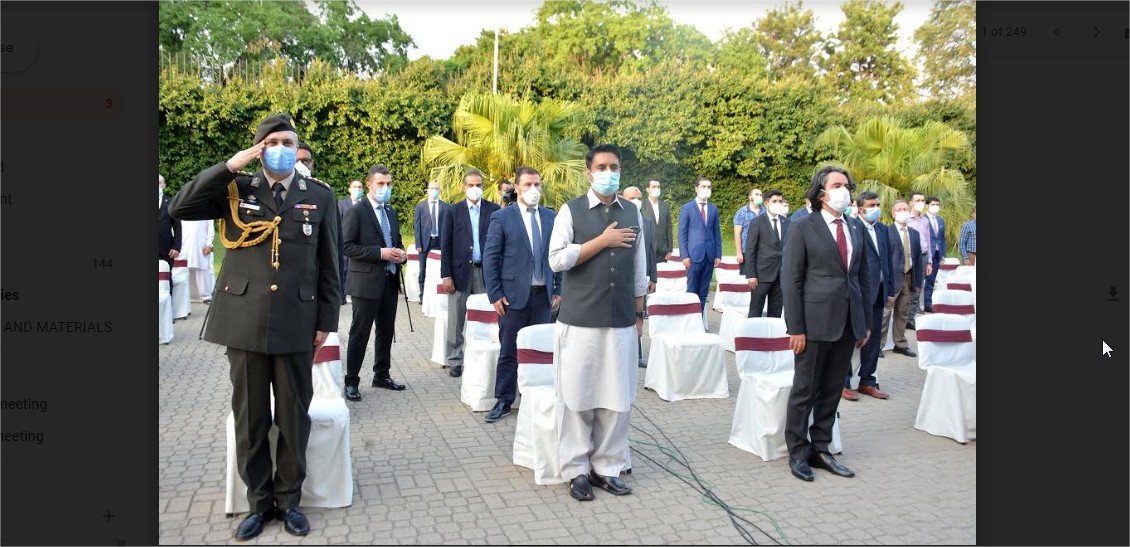
00

It was first diplomatic gathering, albeit a selective one, after four months span because of COVID 19.

The Ambassador further said, 15th of July coup attempt was planned by the FETO leadership and carried out by members of the organization, whom infiltrated into our army by disobeying the chain of command of the armed forces.

“We have never before witnessed such savagery and treachery in our history as the one exhibited by the perpetrators of this coup attempt: our Parliament Building, the Presidential complex, the building of the National Intelligence Organization (MIT), buildings of the Turkish National Police, the Headquarters of the Police Special Operations Department located in Ankara were bombed by rogue pilots”.

While giving an account of what happened on July 15 the ambassador said Tanks were driven to the streets to mow down innocent civilians, while helicopters and jets dropped bombs from the air and shot everyone in sight. That night, two hundred and fifty one citizens were killed and more than two thousand people were injured.

He said, by brainwashing young minds at schools founded under the disguise of so-called training activities, they indoctrinated a large group of radical followers, who carried out the instructions of the organization’s leadership unquestioningly and violated all legal and moral norms.

Ambassador said in the past three years, the fight against FETO both inside and outside Turkey has constituted one of the main priorities of our State. Within Turkey, our efforts are being conducted under three pillars:  a) Firstly, on the basis of the rule of law, the perpetrators of the 15th of July coup attempt have been brought to justice.  b) FETO’s organizational structure within governmental institutions has been unveiled; administrative and judicial procedures have been initiated against its members and hence the “parallel state structure” has been brought down.

Ambassador Ihsan Mustafa thanked people of Pakistan and Pakistani governments for standing shoulder to shoulder with the people of Turkey by extending whole hearted support. He said the FETO organization also made inroads into Pakistani society by establishing schools.

The ambassador also lauded role of the District Administration led by Deputy Commissioner Hamza Sahfqaat, which moved immediately and closed down all such schools in one single day.

The ambassador thanked the government of Pakistan and people of Pakistan who outright rejected ideology of the terrorist organization and put a ban on all these schools when the Turkish government requested for that.

Ambassador Mustafa further said this the moment which has been entrenched deep into our hearts, which I cannot express in words.

Hamza Shafqaat the Deputy Commissioner also spoke on the occasion and paid glowing tributes to Turkish people who bravely thwarted coup attempt. He said Turkish people live in the hearts of Pakistani people.

The DC assured that people of Pakistan would always stand side by side with its Turkish brothers and sisters whenever there is a need for that.

A pictorial exhibition was also arranged on the sidelines of the ceremony highlighting valiant struggle of brave Turkish people who rejected the coup and saved the democratically elected government of Republic of Turkey.

Pakistan on way to success through digital economy, education: President

DNA

ISLAMABAD, Jul 15: President Dr Arif Alvi on Wednesday said Pakistan had immense potential in the field of digital economy and digital education and stressed the importance of fast data communication modes to explore vast opportunities in such areas.

“Pakistan has high prospects in making strides in digital economy, digital education and digital finance and is heading in right direction to cope with the challenges during current pandemic,” the President said in his address at the contract signing of high-speed mobile broadband projects in Muzaffargarh and Rajanpur districts, here at the Aiwan-e-Sadr.

President Alvi said the future highway to success was all about information gathering based upon

internet and making it accessible for people.  He mentioned that the new life pattern during the coronavirus pandemic demanded digitalized systems in areas particularly trade, commerce, education and health.

He lauded the Ministry of Education for adopting new modes of teaching through television to address the challenges faced by students residing in towns with either low-speed internet or with no access. The President said Pakistan was proud to launch its first public-sector Virtual University in 2004, offering education at relatively low rates as compared to physically

attending institutions that had several other overheads.

The President said e-commerce and e-trade could prove a stimulus towards expansion of economy due to fast financial transactions. He said State Bank of Pakistan was working to launch digital payment system across the country in October, expressing confidence that the step would boost business across the board, including of small companies

Also, he said, software being top of the value-addition chain could prove as effective marketing tool for products and mentioned the country’s 30 percent improvement in software development scenario.  President Alvi said access to information through digitalization would also provide a platform for women to help them thrive, thus ensuring their empowerment.

He said digital information could also eliminate ‘elite capture’ of resources and quoted the book ‘Capital and Ideology’ by French economist Thomas Piketty who defined education and health as two top areas of such notorious culture. He said Pakistan through reforms was resisting the elite capture, however India on the contrary, was reported with high inequality during 2014 to 2018, as mentioned by the French economist with full supporting data.

The President stressed proper Right-of-Way policies for the broadband and mobile companies to

effectively sort out matters related to installation of signal towers at people’s land. President Alvi said internet could be best used for improving skilled economy and mentioned that as Pakistan required one million nurses in health sector, online training courses could be a great option instead of brick and mortar education.

Federal Minister for Information Technology and Telecommunication Syed Amin ul Haque said the government was committed to promote the country’s technological capacity to develop and produce a globally competitive IT sector and industry. He said provision of 3G and 4G service to the far-flung areas of Balochistan, Khyber Pukhtunkhwa and Gilgit Baltistan would also be ensure in near future.

He said in line with the vision of Digital Pakistan, the Ministry of IT and Telecom through Universal Service Fund was running diverse projects, which were playing an important role in the socio-economic benefit of people.

Speaking on the occasion, Irfan Wahab Khan, CEO Telenor Pakistan said, “We are committed to empowering the country with enhanced connectivity that creates a positive impact through reducing inequalities and uplifting millions of lives. Today, we are one step closer to bridging the digital gap by providing 2 million people of Muzaffargarh and Rajanpur with the fastest mobile broadband services. Our core purpose at Telenor Pakistan is to empower societies and create opportunities for every Pakistani, especially those living in underserved areas.”

CEO Universal Service Fund Haaris Mehmood Chaudhry and CEO Telenor Pakistan Irfan Wahab in their speeches also highlighted salient features of the project.

Sherry Rehman questions the Federal Government’s Incompetence

DNA

Islamabad, July 15, 2020: Parliamentary leader of the PPP in the Senate, Senator Sherry Rehman in her Senate speech said, “Kashmir’s issue has become more important than ever especially now when Modi’s Nazi government is inflicting new atrocities against the Kashmiris after August 5, 2020. But it is shocking that Pakistan did not oppose India’s non-permanent seat in the United Nations Security Council? Pakistan should have started lobbying a year ago. Even then we were all discussing what all we could do to help Kashmir and warned the federal government that this is the time to change our policy but no heed was paid to us. The government should have taken a stand for Kashmir by opposing India’s seat”.

Commenting on the new domicile rule in India, Senator Rehman said that, “Under the Nazi government of Modi, the new domicile law allows Indian citizens who have lived in Jammu and Kashmir for 15 years to claim a “domicile certificate” for residency benefits. Up to 25,000 people have been granted domicile certificates raising fears of the beginning of demographic change in Kashmir. There is Nazi government there and here we have the Niazi government which did not even oppose India’s seat”.

 “Does this house not agree that India has gone far ahead of any conventions, laws, moral obligation as a nation? Of course, it has. So, why were we doing regular, conventional diplomacy when this house has repeatedly requested and advised this government in our collective best interests and in the best interests of Kashmir to not do that?”, questioned the Senator.

“You had a year in which you could have tried your utmost best. You had support of many others like Turkey and Malaysia. No extra teams were required, the people there were enough but still you did not oppose India’s seat. When Kashmir is the cornerstone of your foreign policy then why did you not lobby for one year to make sure this is not what it is or give some assurance that if this seat goes there will be no blockage on Kashmir in the UNSC. There’s already a blockage but there will be no further blockage in all the committees where Kashmir issues will be raised, including the human rights,” she added.

“We need to act now.  India has done away with the conventional diplomacy, international laws and moral obligations. So, it is our responsibility to have acted out of the box, even diplomatically and there’s no rocket science in it. We all want the same thing then why is the Federal government so chilled out”, the Senator added.

Rehman said, “The Prime Minister did not call one meeting on Kashmir which he attended. Is his ego more important than Kashmir? What message are we sending across to Kashmir?  Previous governments are being continuously blamed but what has this Nazi government done? There is no disagreement when it comes to Kashmir. We are all on the same page when it comes to this issue and will stand together to protect Kashmir”.

Talking about the Federal government’s incompetency, she said, “The clash has only been from the Federal government’s side. They have destabilized the Parliamentary system and have not been on consensus with the opposition on matters of national security. It is alarming that they started an abusive campaign against Chairman PPP, Bilawal Bhutto Zardari.

“The federal government continuously blames the previous governments for shortcomings but what have they actually achieved in these two years? It is the history’s most corrupt government. Despite the historical dip in the international oil prices, why have domestic oil prices been increased by twenty-five rupees? We must create a commission to investigate this alarming development,”she added.

Highlighting the Naya Pakistan Housing Scam, she said, “30 billion rupees subsidy has been given this scam initiative. While, big construction companies have been given amnesty. These are the kinds of tabdeelis the nation is witnessing. Without even any charges, Mir Shakil ur Rehman is in detention since more than 125 days. There is no press freedom because of this government’s draconian censorship policies. They are giving their cronies amnesty while muzzling democratic voices”.

Parliamentary leader of the PPP in the Senate, Senator Sherry Rehman concluded by saying, The PTI government has made numerous promises but what have they actually achieved? Nothing. Our healthcare system is collapsing, tourism sector is in shambles, the national airlines has been deliberately crashed. If this was the tabdeeli promised to us, then please save us from it”.

New measures at a new stage in the fight against the epidemic

DNA 

Each state has its own conditions, mentality, social environment, economy and, accordingly, the ability to combat the epidemic. Some countries were able to overcome the epidemic relatively quickly, while some are still in crisis. COVID-19 has had a different impact on the development of countries and their plans. Kazakhstan, like all countries of the world, is going through its difficult period and does not hide its challenges and individual problems.

As in all countries of the world, the national healthcare system of the Republic of Kazakhstan is undergoing a severe test, both citizens and doctors, who are on the front line of the fight, are becoming ill. Just like in the whole world, there are human losses in Kazakhstan. All this naturally impacts the morale of the population, which, it must be acknowledged, previously did not completely trust the information about the new coronavirus.

Doctors, hospitals, public infrastructure, a medicine distribution system, and everything else are now operating to their limits and are under tremendous pressure. The population began to justly criticize a number of issues through the media and social networks. Within the framework of the concept of the “listening state”, the Government of the Republic of Kazakhstan has taken prompt measures in response to the requests of the Kazakhstani society.

In addition to the epidemic, Kazakhstan has confronted panic, provoked by an overload of various information and a wave of incorrect assessments in foreign mass media. This led to a certain misunderstanding of the real situation in Kazakhstan. Thus, the so-called infodemia around the coronavirus, which the WHO warned about earlier this year, jumped the gun and exaggerated the risks in the minds of the population.

So what is the real situation? Currently, more than 61,000 cases have been recorded in the country, of which 375 have been fatal. According to the classification of the American Johns Hopkins University, Kazakhstan occupies the 31st position in the world in terms of the prevalence rate of the illness (https://coronavirus.jhu.edu/map.html). In these conditions, Kazakhstan is adapting to the changes in the epidemiological situation.

First. On July 10, at an expanded meeting of the Government, the President of the Republic of Kazakhstan, Kassym-Jomart Tokayev, summed up the results of the work carried out to counter the epidemic and set out new tasks. In his statement, the Head of State directly answered all the resonant questions that concern the Kazakhstani society, and set the Government clear tasks for the new period of battle with COVID-19. The President publicly criticized the mistakes and shortcomings in the work of a number of central government bodies and local authorities in the regions of Kazakhstan.

The head of state put an end to the discussions and doubts regarding the statistics on the increase of incidence of the disease. He noted that all statistics in Kazakhstan are absolutely transparent, and variousdisinformation is aimed at destabilizing the situation. Such a public discussion of all pressing issues and urgent problems in the implementation of measures to combat the epidemic indicates the openness of the state and transparency of the state’s response to the epidemiological challenge.

Second. At a new stage in the fight against the epidemic, the Government of the Republic of Kazakhstan has replaced the senior management in the healthcare system. A new experienced Head of the Ministry of Health has been appointed, and the state body has been given broader powers for interagency coordination in the field of combating the epidemic. The new leadership of the Ministry of Health has changed the methodology for counting the patients infected with coronavirus, which led to an increase in their number, and an uncertain perception of the epidemiological situation due to different statistics.

The new management at the Ministry is currently preparing an updated protocol for the treatment of coronavirus, taking into account the outbreak of pneumonia caused by the coronavirus infection.In addition, the new management in the Ministry is preparing a package of measures to protect the population from COVID-19, which is based on the effective experience of states that have already managed the epidemic and which have good medical potential. For example, currently a group of several dozen doctors from Russia is working in the country, who are sharing their experience in treating coronavirus with Kazakh colleagues.

Third. In response to public criticism of disruptions in the supply of medical drugs and equipment, President Tokayev instructed to change the leadership of two organizations responsible for the distribution of medicines and public access to medical services. In particular, there has been a change of leadership in the Compulsory Health Insurance Fund, which must provide the population with equal access to health services. The leadership of SK Pharmacia, a state organization that distributes medicines in all regions of the country, has also changed. The new leadership has the task of ensuring an uninterrupted supply of necessary medicines.

President Tokayev ha also set the task of creating the necessary reserve of medicines and medical devices. It is planned to additionally purchase more than 4,000 ventilators in case of the worst case scenario of the development of coronavirus. More than 3,000 units will be purchased from domestic manufacturers. According to the Ministry of Industry and Infrastructure Development of Kazakhstan, starting in August, industrial production of ventilators will be established, and the first batch of 595 units will go to healthcare organizations.

Fourth. The country is preparing a package of measures to stimulate the national economy in a downturn in business activity. The Government and the National Bank are developing an action plan to support sectors of the economy and the population in the event of a likely worsening of the situation. To increase the efficiency of the budget revenues, tax preferences and benefits will be analysed. In order to create a stable environment for attracting direct investments, necessary amendments to the legislation will be introduced to the Parliament of Kazakhstan to ensure stability in maintaining conditions for strategic investors.

Fifth. For the period of July 5-19, there are a number of restrictions in the country due to quarantine measures. On 14 July, it was decided that the quarantine period in Kazakhstan will be extended for another two weeks until August 2. The state will provide financial assistance for food products to certain categories of the population, as well as make social payments in case of temporary loss of income.

Overall, the first stage of the global pandemic in March-May, under the conditions of a complete lockdown, passed generally unnoticed and without noticeable losses in Kazakhstan. Seemingly, that period consolidated the perception of Kazakhstan as a country where the risk of COVID-19 is minimal.

During the second post-quarantine stage, when it is necessary to deal with the epidemic and rebuild the economy, it has become much more difficult to cope: the epidemic in the country is reaching its peak. When comparing this period with previous months, there is to some extent a perception that a complete crisis is taking place in Kazakhstan.

In fact, from the point of view of the global situation, the current situation in Kazakhstan is in some ways better and in some ways worse than in other states. In addition, according to the World Health Organization, the epidemiological situation in the world is now getting worse.

However, there is no single recipe in the world for how to respond to COVID-19 without loss. Each state is coping with the epidemic based on its capabilities. The task of countering the epidemic in Kazakhstan is being successively addressed. Today, the state is working on mistakes, adapting to new trends and building a new strategy for its actions to protect the population.

Oil tanker association to discontinue supply in Pakistan Thursday

The Oil Tankers and Contractors Association has announced that it will discontinue supply across the country Thursday to protest an increase in income, provincial service and toll taxes.

“There is no business and they have increased the tax,” association’s president Abidullah Afridi said. “If the problems are not resolved, then we will observe a strike on July 16.”

Afridi said their sector worked 24 hours and continued oil supply across the country during the coronavirus pandemic.

He threatened that they would go on an indefinite strike if the government didn’t withdraw the hike taxes.

PM Khan says Diamer-Bhasha dam won’t impact Pakistan’s climate

Prime Minister Imran Khan believes that the functioning of the Diamer-Bhasha dam will not have any adverse effects on the climatic conditions of Pakistan.

“We won’t have to import fuel for this project nor will its construction affect our climate,” the PM said while addressing a public gathering in Chilas, Gilgit-Baltistan, after visiting the site of the Diamer-Bhasha dam.

The PM was accompanied by Federal Water and Power Minister Faisal Vawda, Army Chief General Qamar Javed Bajwa and ISI DG Lieutenant General Faiz Hameed.

The government aims to build the dam near the Nanga Parbat peak. It will stand 272 metres above the Indus River, being one of the highest dams in the world, if made.

Former chief justice Mian Saqib Nisar was one of the prominent personalities to have highlighted the importance of the dam. He and PM Khan found it the sole solution to the country’s water scarcity issue.

The premier believes that the destiny of the people of Gilgit-Baltistan will change for the better once the dam begins creating job opportunities for them.

He said the project will not add to the global warming problems of Pakistan, but environmentalists believe otherwise.

Speaking to The Third Pole, Gilgit-Baltistan Environmental Protection Agency Director Shehzad Shigri said the creation of the reservoir will have a devastating impact on the climate in the region.

“Around 0.1 billion cubic metres of water will evaporate every year from the reservoir [if the dam is constructed]. This may change the climate and weather patterns in the region,” Shigri said.

He believes the dam will divide communities on both sides of the Indus River and displace 50,000 residents.

Aisha Khan, the chief executive of the Civil Society Collation for Climate Change, also holds a similar views about the dam.

She feels that rising temperatures will accelerate the melting of Himalayan glaciers and a significant amount of water will be drained in the next 30 years.

The expert said the solution doesn’t lie in new dams, but in improved water management and cropping patterns.

Quarterly Security Report Q2, April-June, 2020

Casualties from Violence in Pakistan

A total of 185 casualties were recorded during second quarter in 2020 (139 fatalities and 46 injuries). Khyber Pukhtunkhwa (KP) had the highest number of casualties followed by Sindh, Balochistan, Punjab, and Islamabad. There were no violence-related casualties reported from Gilgit Baltistan (GB) and Azad Jammu and Kashmir (AJK). Despite continued military operations, the former Federally Administered Tribal Areas (FATA) regions of KP continue to be militancy hot spots (table 01).

Table 1: Casualties from violence by region – Q2, 2020
RegionFatalitiesInjuriesTotal
Khyber Pukhtunkhwa (KP) – including FATA8325108
Sindh26228
Balochistan21425
Punjab61218
Islamabad Capital Territory (ICT)336
Grand Total13946185

Compared to the last quarter’s figures, KP and Sindh appeared to be the only two provinces where fatalities from violence went up while the remaining provinces showed a significant decline (table 02).

Table 2: Fatalities from violence by region – Q1 2020 vs. Q2 2020
RegionQ1 2020Q2 2020% Change
Khyber Pukhtunkhwa (KP) – including FATA748312.2%
Sindh926188.9%
Balochistan4021-47.5%
Punjab146-57.1%
Islamabad Capital Territory (ICT)330.0%
Total140139-0.7%

June was the only month when the fatalities from violence showed a marked uptick, the other two months, April and May, showed moderate decline in violence throughout the country (table 03).

Table 3: Comparative data on fatalities by month  – Q1 vs. Q2 2020
MonthQ1 2020Q2 2020% Change
January 2020 vs. April 20205344-17.0%
February 2020 vs. May 20205451-5.6%
March 2020 vs. June 2020334433.3%
Total140139-0.7%

For the first time since the inception of this report in 2012, Quetta district experienced zero violence-related fatalities. North Waziristan, Karachi, Bolan, Makran, Bahawalpur, Buner, and Ghotki districts showed a significant increase in the number of fatalities from violence (table 04).

Table 4: Fatalities by district – Q1 2020 vs. Q2 2020
Districts/Agency/RegionQ1 2020Q2 2020
N. Waziristan2147
Karachi818
Bajaur98
Bolan07
Lakki Marwat67
Makran06
Panjgur35
Bahawalpur04
Peshawar64
Buner03
Ghotki03
Islamabad33
Kohat33
Mohmand03
Sukkur02
Swat02
Kurram02
Badin01
Bannu21
Batkhela01
Chakwal01
Dukki01
Jacobabad01
Kalat01
Kandhkot01
Mastung01
Rawalpindi71
S. Waziristan01
Tank101
Quetta300
Attock10
Charsadda10
D.I. Khan50
Dir30
Gujranwala10
Harnai10
Harnai/Naseerabad30
Kech20
Lahore10
Mehrabpur10
Muree20
Nushki10
Orakzai20
Sargodha20
Shangla10
Swabi30
Swat20
Grand Total140139

No suicide attack was reported during this quarter while encounters and ground operations carried out by security officials left a large number of outlaws dead. Gun violence, armed attacks, and lethal explosions caused the largest number of fatalities (table 05).

Table 5: Comparative fatality data on violence/counter violence – Q1 2020 vs.  Q2 2020
Method of ViolenceQ1 2020 Q2 2020 
Gun violence (including target killings)2631
Ground operation/clashes2940
IEDs, Landmines, Hand Grenade Attacks, Other Explosions3030
Encounter with Law Enforcement Agencies (including suspected)3522
Armed attacks411
Dead body found55
Others10
Suicide attacks100
 Total140139

Like previous quarter, the fatalities of militants, insurgents, and criminals went up during the second quarter as well reflecting effective measures taken by the security forces. A sharp rise in the number of security personnel’s fatalities pointed to a retaliatory strategy of the outlaws – a situation further corroborated by the significant decline in the number of civilian fatalities during this quarter (table 06).

Table 6: Fatalities by type of victims –  Q1 2020 vs. Q2 2020
Militants/Criminals/InsurgentsQ1 2020Q2 2020
Militants3941
Insurgents311
Criminals116
Total Militant/Criminal/Insurgent5358
Percentage of total fatalities37.9%41.7%
Government and Security OfficialsQ1 2020Q2 2020
Security officials2443
Government officials11
Total Government/Security Official2544
Percentage of total fatalities17.9%31.7%
CiviliansQ1 2020Q2 2020
Civilians5732
Politicians03
Media personnel21
Religious party/persons21
Foreigner10
Total Civilians6237
Percentage of total fatalities44.3%26.6%
Overall Total140139

Multiple insurgent groups from Balochistan and Sindh once again became active in the country and claimed responsibilities for several terror attacks that left 17 persons dead. Balochistan Liberation Army (BLA) claimed two attacks: one IED blast in Makran, Balochistan wherein an army major and five soldiers of the Frontier Corps lost their lives, and a daring attack at the Pakistan Stock Exchange in Karachi on 30 June 2020 leaving a policeman, three guards, and four insurgents dead.

An eight-year-old boy was killed and his father was seriously injured when their motorcycle hit a landmine planted by militants in Dasht-i-Goran area of Kalat District in Balochistan. Baloch Liberation Tiger (BLT) claimed responsibility for this explosion.

Two rangers and a civilian lost their lives in a bomb explosion at a meat shop near Ghotki Railway station on 19 June 2020. The same day, a civilian was killed when a hand grenade hurled near a paramilitary rangers mobile in Liaquatabad. One rangers official was injured in Larkana when a cracker was hurled at a security checkpoint. These three attacks were claimed by Sindh Revolutionary Army (SRA).

The militant group Hizb-ul-Ahrar (HuA), an off-shoot of the Tehreek-e-Taliban Pakistan (TTP), claimed responsibility for the killing of two policemen in the night of 26 May 2020 in the Chowrangi No. 26 area of Turnol in Islamabad (table 07).

 Table 7: Fatalities claimed by militant outfits – Q1 2020 vs. Q1 2020
ClaimantsQ1, 2020Q2, 2020
Balochistan Liberation Army (BLA)014
Tehrik-e-Taliban Pakistan (TTP) – Hizbul Ahrar (HUA)22
Sindh Revolutionary Army (SRA)02
Baloch Liberation Tigers (BLT)s01
Baloch Raji Ajoi Sangar (BRAS)30
TTP – HUA/Daish150
Total2019

Although no militant groups like TTP or Daish (Islamic State) claimed their responsibility for any violence during this quarter, there were eleven fatalities of militants that were reported to have affiliation with TTP (7) and Daish (4). The insurgent groups like BLA and Balochistan Liberation Front (BLF) also lost their activists in counter-violence operations carried out by the security forces. Among the security officials, the Pakistan army had the highest number of fatalities compared to other security forces. A large number of unidentified civilians were the victims of violence in addition to four missing persons who were found dead; two of them belonged to Jeay Sindh Qaumi Mahaz (JSQM), one was of Muttahida Qaumi Movement (MQM) – London, while one was unidentified (table 08).

Table 8: Affiliation of victims – Q2 2020
Affiliation of victims  Fatalities
Militants/Criminals/Insurgents
Militants – Unknown30
Tehrik-e-Taliban Pakistan (TTP)7
Balochistan Liberation Army (BLA)4
Balochistan Liberation Front (BLF)4
Daish (Islamic State)4
Hazaro Kharoos Gang2
Government and Security Officials
Army25
Police8
Frontier Corps6
Rangers2
Post Office1
Civilians
Unknown/Missing33
Tribal people5
Jeay Sindh Qaumi Mahaz (JSQM)2
Shia community2
Daily Koshish Newspaper1
Jamiat Ulema-e-Islam – Fazl (JUIF)1
Pashtoon Tahafuz Movement (PTM)1
Muttahida Qaumi Movement (MQM)1
Total139

Sectarian Violence

Two persons lost their lives in Kurrum Agency of Khyber Pukhtunkhwa because of an explosion near an Imambargah in Lower Kurram’s Shoorki on 6 May 2020. No other regions of the country encountered sectarian violence during this quarter. Both victims were Shia, making them the only group targeted this quarter (table 09).

Table 9: Fatalities from sectarian violence – Q2 2020
ProvinceFatalitiesInjuriesTotal
Khyber Pukhtunkhwa (KP) – including FATA212

Ms Rahat Kaunain assumes charge as CCP Chairperson

DNA

ISLAMABAD, 15 JULY: The newly appointed Chairperson of the Competition Commission of Pakistan (CCP), Ms. Rahat Kaunain Hassan, has assumed the charge of her office after the Federal Government issued a notification of her appointment as the Member and Chairperson of CCP for a three year term.

Ms. Hassan studied Law at King’s College London and also possesses an L.L.M. degree. She has over 25 years of experience including over 8 years in public service. For the last 7 years she has been in private practice, as Senior Partner of Islamabad based law firm. She was also Member of the Audit Oversight Board, Independent Director/ Chairperson Pakistan LNG Limited and has held independent directorships including on the boards of Pakistan Stock Exchange and various other listed companies.

Ms. Hassan served as one of the founding Members of CCP from 2007 to 2010, and as its Chairperson from 2010 to 2013. She has authored, co-authored most of the seminal Orders passed by CCP, including those that resulted in breaking the most pernicious of cartels. During her term, the CCP witnessed peak enforcement against cartel and other anticompetitive practices taking the amount of penalty imposed from PKR 7 billion to over PKR 26 billion. She was instrumental in the establishment of the Office of Fair Trading within CCP and has authored numerous position papers, guidelines, policy notes on important issues of competition law and policy. Earlier, she has also served as General Counsel/Executive Director at the Securities and Exchange Commission of Pakistan (SECP) in 2001.

Under her leadership CCP was twice nominated/short listed amongst top 5 agencies for GCR Enforcement ‘Agency of the year Award’ out of 42 agencies in the region of Asia Pacific Middle East and Africa, by the Global Competition Review. Peer Review by UNCTAD was also accepted at her request in 2012 and CCP was quoted “as an example of institution building” in its report.

Ms. Hassan was recognized as one of 100 successful women in anti-trust globally Global Competition Review in 2013. She has the honor of being nominated/recommended for Sitara-e-Imtiaz for her work, both by her predecessor and her successor at CCP.

Zambian president denies funding Rwanda rebels

Zambia’s President Edgar Lungu has denied accusations that he was bankrolling a Rwandan rebel group whose spokesman is facing trial for attacks in Rwanda in 2018 that left scores dead.

The former spokesman, Callixte Nsabimana, told a Rwandan high court on Monday that President Lungu had promised his National Liberation Front (FLN) some $1m (£796,000) to help topple the Rwandan government.

He said President Lungu had made a down payment of $150,000 to support of rebel attacks.

But President Lungu’s spokesman said the allegations were false and should be treated “with the contempt they deserve”.

“The peoples of Zambia and Rwanda continue to enjoy strong and fraternal relations founded on mutual respect,” presidential spokesman Isaac Chipampe said in a statement on Tuesday.

Mr Nsabimana is facing 17 charges.

They include the formation of an illegal militia group, taking part in terrorist activities, killing, kidnapping and denying and undermining the 1994 genocide.

Mr Nsabimana has denied some of the charges, including being a leader of the rebel group.

South African minister tests positive for Covid-19

South Africa’s Minister of Mineral Resources and Energy, Gwede Mantashe, and his wife have tested positive for Covid-19.

The couple were in isolation and the minister would continue to work from home, a statement from the cabinet said.

This was Mr Mantashe’s third round of tests since the outbreak of the coronavirus pandemic.

“The minister has directed all members of his private office in government to also test,” the statement said.

South Africa has confirmed about 287,000 coronavirus cases, according to the World Health Organization, the highest on the continent.

Stay Connected

64FansLike
60FollowersFollow

Latest Reviews

Exchange Rates

USD - United States Dollar
EUR
1.17
GBP
1.35
AUD
0.71
CAD
0.72




