Home Blog Page 3318

Waqar Younis’ tips helped me to take fifer in practice match: Sohail Khan

Derby : Fast bowler Sohail Khan has revealed that bowling coach Waqar Younis’ tips on late swing helped him to take a five-wicket haul.

The 36-year-old Sohail, who was playing for Babar Azam’s Team White, picked 5-50 in the first innings against Azhar Ali’s Team Green.

Before the practice match, Sohail had a conversation with Waqar on the art of late swing. Sohail shared how the presence of the Waqar in the coaching staff helped him ahead of a four-day match.

“The conditions in England are swing conducive so every fast bowler gets the ball to move. I asked Waqar bhaito teach me how to swing the ball late. It took him only two minutes to explain it to me. It is because of his tips that I took five wickets in the first innings,” Sohail said in an interview released by the Pakistan Cricket Board (PCB).

“A few days back I was struggling with something while bowling, I thought of reaching out to him and even before I spoke to him about it, he said he knew what I wanted to talk to him about and he explained it to me in a minute,” he added.

Sohail is happy to make a comeback in the national team after almost 3.5 years. “Definitely, it is an honor for me to return to the side. I had taken two fifers here against England in 2016 and now in the practice match I have started off with five wickets so I am feeling very good,” he maintained.

It must be noted that Pakistan will play second intra-squad practice match from July 24-27 ahead of the first Test against England in Manchester, starting from August 5.

Matiullah Jan says grateful to those who made quick return possible

ISLAMABAD : Journalist Matiullah Jan, who went missing in Islamabad on Tuesday and returned home after nearly 12 hours, has thanked the national and international journalist community, politicians, judiciary and others for their ‘quick response’ which led to his safe return.

“I am back home safe and sound. God has been kind to me and my family. I am grateful to friends, national and int. journalist community, political parties, social media and rights activists, lawyers bodies, the judiciary for their quick response which made it possible,” Jan wrote in a Twitter post on Wednesday.

Jan, who was abducted on Tuesday afternoon from outside his wife’s school, returned home after being missing for about 12 hours.

The journalist was supposed to appear before the Supreme Court this week concerning a contempt of court case based on an allegedly contemptuous tweet by him.

Jan was dropped off at about 11pm on Kohat Road near Fateh Jung.

The correspondent quoted Jan as saying that he had been kept blindfolded and driven around for quite some time. He was then taken to an unknown location. Later, he was handed over to his brother.

Jan’s abduction has prompted uproar on social media with both the national and international journalist community, political parties and human rights organisations demanding the government ensure the “safe recovery” of the journalist.

Govt’s responsibility to safely recover Jan: Shibli
After news of his abduction had surfaced, Information Minister Shibli Faraz had said that it was the government’s responsibility to safely recover Jan.

Faraz, while addressing a press conference, had said that he spoke to interior minister Brig (retd) Ijaz Shah about the incident and that “it is confirmed that [Jan] has been kidnapped”.

“It is the government’s responsibility to ensure his safe recovery and it will fulfil this responsibility,” he had said.

Shah said he had no information regarding the disappearance of Jan.

Rights organisations voice concern
Following the incident, the International Press Institute (IPI) had issued a statement, expressing outrage at the incident.

“We fear that Mutiullah Jan’s life is in danger, and immediate steps must be taken to locate him and ensure his release from his apparent kidnappers”, IPI Deputy Director Scott Griffen said. “Given the history of violence against journalists in Pakistan, the authorities cannot delay in seeking to protect Jan’s safety.”

Amnesty International South Asia had also expressed concern about the “fate and wellbeing” of Jan.

“We are extremely concerned for the fate and wellbeing of@matiullahjan919. He has been the subject of physical attacks and harassment for his journalism. The authorities must establish his whereabouts immediately. #ReleaseMatiullah,” tweeted the human rights organisation.

Pakistan’s recoveries from COVID-19 top 210,400

ISLAMABAD: The country reported 1,332 coronavirus cases and 38 deaths over the past 24 hours, taking the national tally of infections to 267,428 and fatalities to 5,677.

1,332 new cases were detected after 18,331 tests were conducted in the previous 24 hours, according to the National Command and Operation Centre.

51,283 COVID-19 patients are undergoing treatment while 210,468 patients have recuperated from the disease. 17,76,882 tests have been conducted across the country so far.114,104 cases have been detected in Sindh so far, 90,816 in Punjab, 32,523 in Khyber Pakhtunkhwa, 11,469 in Balochistan, 14,701 in Islamabad, 1,878 Gilgit-Baltistan and 1,937 in Azad Kashmir.

18,331 corona tests were carried out during this period.

Global coronavirus cases

The overall number of global COVID-19 cases has increased to over 14.6 million while the deaths have topped to more than 6,09,000.

The total number of cases stood at 1,46,55,405 while the fatalities rose to 6,09,198.

The US accounted for the world’s highest number of infections and fatalities at 38,25,153 and 1,40,957, respectively. Brazil came in second place with 2,118,646 infections and 80,120 deaths.

In terms of cases, India ranks third (11,55,191) and is followed by Russia (7,76,212), South Africa (3,73,628), Peru (3,53,590), Mexico (3,49,396), Chile (3,30,930), the UK (2,96,944), Iran (2,76,202), Pakistan (2,65,083), Spain (2,64,836), Saudi Arabia (2,53,349), Italy (2,44,624), Turkey (2,20,572), France (2,14,023), Bangladesh (2,07,453), Colombia (2,04,005), Germany (2,03,325), Argentina (1,30,774), Canada (1,12,936) and Qatar (1,07,037).

RCCI virtual int’l trade forum on July 22

RAWALPINDI, JUL 21 (DNA) – The Virtual International Trade Forum, organized by the Rawalpindi Chamber of Commerce and Industry (RCCI) will be held on July 22.  The purpose of the trade forum is to make the business community aware of trade and export opportunities in African markets.

Giving details, Chamber President Saboor Malik said that this forum is the continuity of the Africa Trade Forum organized by RCCI last year.

The virtual forum will be attended by commercial and trade consular from Pakistan and abroad, officials of the Ministry of Commerce and CEOs of the companies. The trade forum will be inaugurated by PM advisor on Commerc  Razzaq Dawood.

He said that Pakistan would have to find new markets to boost exports. Africa is a continent of more than fifty countries. Pakistan’s trade volume with African countries is only close to 3 billion dollars, which could be doubled in the next three years. He said that an increase in trade in food, textile and pharmaceutical sectors could be made possible. He said that in order to increase Pakistani exports to African countries, new trade avenues would have to be explored.DNA

==============

18th Amendment: Impact on Governance in Pakistan

Any and all constitutional amendments should be debated through a broad-based consensual, deliberative political process.

DNA

ISLAMABAD: The Islamabad Policy Research Institute organized a special webinar on “18th Amendment: Impact on Governance in Pakistan” here in the capital.Speakers included Mr Ahmed Bilal Mehboob, President and Secretary General Board of Directors, Pakistan Institute of Legislative Development and Transparency (PILDAT); and Dr Nadeem ulHaque, Vice Chancellor, Pakistan Institute of Development Economics (PIDE).

In his Opening Remarks, Acting President IPRI, Brig. (Retd.) RaashidWaliJanjua highlighted that following thetenth anniversary of the 18th Constitutional Amendment, serious soul-searching is required to see what it has failed to achieve, whether there are lessons to be learned to modify it and remove bottlenecks to improve its implementation and make changes. He outlined that the 18th Amendment was unanimously adopted by the Parliament after 2 years of deliberations. It sought to enhance the federal character of the Constitution, but there were certain issues regarding the capacity and readiness of the provinces that are still hanging fire, and need proper debate. He remarked that the most important aspect of 18th Amendment was restructuring of the National Finance Commission (NFC) Award under which the provincial share in fiscal resources is 57.5 per cent. Under Article 160(3A), share of the provinces in each NFC Award cannot be less than the share given in the previous award, so the critics claim that the transfer of a large part of fiscal resources to the provinces limits the financial space of the federal government, putting constraints on its ability to undertake debt servicing, amongst others. The capacity issue of provinces and their readiness to shoulder the responsibilities devolved to them also remains a question. He hoped that the webinar would address important questions like how will the capacity issues of the provinces to handle education and health be addressed; what can be the role and status of local governments; would the center be as effective to address the issues of law and order and other security- related issues and development-oriented responsibilities of the federation under the 18th Amendment as devised.

Discussing post-18th Amendment fiscal space issues faced by federal government and possible solutions, Dr Nadeem ulHaque stressed the need for exhaustive research and debate before any policy is proposed in the National Assembly. ‘A white paper should be circulated a year before any policy is set in motion’, he said. He shared that the case of the 18th Amendment has begotten a frenzy of speculations and conspiracy theories pitting the opposition against the government; and stressed that the 18th Amendment is a political issue rather than an economic one. Dr Haque pointed out the NFC award happened hastily, and has thus far, not been representative nor offers any clarity on what needs to be done, by whom and how. ‘Policy decisions taken in a vacuum have serious consequences’, he warned. He also stressed that the 18th Amendment calls for a smaller federal structure but despite that the size and number of federal ministries/agencies/departments continues to increase albeit under different nomenclature. At the same time, he explained that the provinces too have been jealously guarding their turf and not focusing on strengthening local governance, an important part of the Amendment. Albeit, a decade into its passage, terms of the 18th Amendment are yet to be implemented in letter and spirit, he lamented.

Discussing the post-18th Amendment governance challenges and possible solutions, Mr Ahmed Bilal Mehboobfirst provided a historical overview and background of the issue.He stated that since health, education and labour are not part of the Concurrent List,serious issues of coordination have arisen. Sharing the Terms of Reference of the Council of Common Interests (CCI), he opined that despite not being 100% functional, the CCI has become ‘a state within a state’ making decision-taking complex and time-consuming. Issues like the annual census is one case in point. He also remarked that unlike the Indian Constitution, the 18th Amendment does not provide a detailed framework for the functioning of local governments such as length of term, number and functions of tiers, direct or indirect election. ‘Local governments are imperative for effective governance under Article 140-A, but have been left to the mercy of the provinces, as shockingly 3 of them are without local government,’ he remarked. He also pointed towards the federal government’s desperation to wriggle out of locked National Finance Commission provisions under Article 160 (3A). MrMehboob was of the view that since Provincial Assemblies lack the will, capacityand power to deal with additional legislative challenges, civil services need to be prepared for greater responsibility through the 18th Amendment. Talking about possible solutions, MrMehboob said that ‘talk of amending the 18th Amendment is not only absurd, it is provocative and counterproductive since sub-national zones have struggled and worked hard for it, and have strong emotional bonds to the 18th Amendment.’ Perseverance, patience and continuous dialogue is required to develop consensus. He also added that while change through a judicial verdict is an option, it would be unwise to solve a political issue through judicial means. ‘Dissent should be accepted as a norm and there must be a realization that open and civilized discourse on the 18th Amendment (which is part and parcel of the Constitution) should not be deemed as anti-province, or anti-Centre nor unpatriotic as long as the end goal is to make Pakistan astrong country with effective governance mechanisms.

In the interactive Question/Answer session, speakers agreed that implementation of the 18th Amendment has been met with resistance from central bureaucracies that stand to lose political influence if power is devolved effectively from provincial governments to local governments. However, such a challenge might still be an afterthought as local governments are a long way from exercising the level of autonomy guaranteed to them in the Amendment.

EU to provide Rs. 3.6 billion

Shujaat Hamza

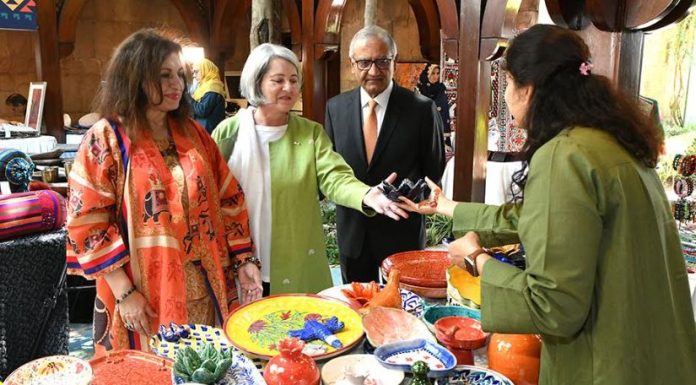
ISLAMABAD: The European Union will provide 3.6 billion rupees for Rule of Law support to Pakistan. An agreement to this effect was signed by Secretary Ministry of Economic Affairs Noor Ahmed and EU Chargé d’ Affaires Anne Marchal in Islamabad on Tuesday.

The grant assistance will be utilized in Khyber Pakhtunkhwa and Balochistan.

The Rule of Law Programme will be implemented over a period of five.

This programme will also provide technical assistance and capacity building to key government institutions in the security sector and the judiciary at federal and provincial level.

Under this programme, the police and judiciary will be supported in becoming more efficient, accessible for all, and faster in terms of procedures.

The programme will also help citizens to better understand legal matters, their rights and the functioning of the legal system.

Speaking on the occasion, Anne Marchal said this programme aims to provide equal access to justice for all, which is a key policy of the European Union. DNA

=============

233rd Corps Commanders’ Conference held at GHQ

DNA

RAWALPINDI, JUL 21 – 233rd Corps Commanders’ Conference, presided by Chief of Army Staff (COAS) General Qamar Javed Bajwa was held today at GHQ.

Forum reviewed operational readiness and evolving threat spectrum in context of external and internal security of the country. COAS complimented efforts put in by all formations to maintain high level of combat readiness particularly in the wake of evolving regional security situation.

Taking special note of continued atrocities in Indian Occupied Jammu & Kashmir as illegal actions of August 5, 2019 complete  one year next month, forum paid tribute to brave Kashmiris for their legitimate struggle for freedom.

COAS especially lauded efforts in aid of civil administration in fight against COVID -19 and LOCUST.  Stressing the need to exercise maximum care with respect to Eid Ul Azha and Muharram to maintain the gains  achieved  in countering the pandemic, forum also appreciated efforts of Doctors, Healthcare workers, Paramedics across the country.

COAS expressed complete satisfaction with overall  operational readiness of Army as the forum reiterated resolve to thwart any threat to Pakistan’s security.

Suburban Housing Initiatives

Hamid Asghar Khan

Covid -19 has compelled increased reliance on Skype, Zoom and other online platforms. Many feel that these mediums, while useful, are an inadequate substitute for actual meetings. Thus, upon receiving an invitation to meet with the Moroccan Minister for Housing, Land Management & Urban Affairs Mme. Nouzha Bouchareb in person, I leapt at the opportunity.

Economies everywhere are struggling with the adverse impact of the pandemic, and Morocco, like Pakistan, views the housing and construction sectors as key to stimulating economic resurgence. A helpful series of incentives and concessions have been unveiled to kickstart housing and construction in both countries.

The Kingdom has successfully focused on equitable regional development. Instead of one or two major cities, well thought out efforts have been made to improve infrastructure, housing, business, educational and recreational facilities in all  regions. This has enabled showcasing of the diverse landscape, promoting tourism  attracting over a million tourists a month, contributing 10% to the national economy.

Madame Minister herself is an expert in sustainable development. She dilated upon the “Cities without slums” initiative geared to providing affordable housing for the less fortunate. It is now universally acknowledged that a key goal of modern town planning is to cap the size of large cities to limit urban sprawl. Major challenges  are increased traffic, pollution, vanishing green areas, waste management, unaffordable property values and scarce water resources. All of these impact on quality of life, health and mental wellbeing.

Megapolis such as New York and Karachi were badly affected by Covid-19. The staggering density of thousands of souls living per square mile, crammed into highly urbanized areas was no doubt a factor. Conversely, the impact of Covid-19 has been far more temperate in rural and open areas.

 Consequently, an increasing desire of moving to rural areas for a healthier and more relaxed lifestyle, surrounded by the purity and delights of nature is emerging. There are reports of increased interest in suburban and rural living options away from, but within commuting distance of large cities.

Sydney, Australia presents an interesting model that our Housing Authority may wish to study. The city center, known as the central business district -CBD- witnesses a huge influx in the morning, only to empty out with amazing speed in the evening as over half a million people takes buses, trains, boats, and cars and to return to their comfortable homes in the suburbs after a day’s work.

 Less than 15% live within the down town city area itself, the vast majority undertake a comfortable commute to the suburbs between 20 minutes to an hour away from the CBD for quality living.

Australia, like Morocco, keeps sustainable development and environmental preservation as key goals. Thus large expanses of green belts and forested areas are maintained between self-contained small villages along train and bus lines, providing eminently manageable living clusters with adequate breathing and living space. Clinics, schools, shopping areas and other essential amenities in local living clusters preclude the need for daily travel to the city.

Our Districts in Pakistan are the optimum platform for enabling development of new living clusters.  A move away from from Karachi, Lahore and Pindi-Islamabad has to be incentivized, with district governments identifying and making available suitable state land for the construction of housing, hospitals, schools, clinics, colleges, petrol pumps and markets.

The capacity to innovate is going to be a key factor in the success of our construction and housing initiatives. Karachi suffers from extraordinary challenges of waste management, water supply, traffic, storm drainage and electricity. Similar challenges are fast emerging in Lahore and Pindi-Islamabad where land cost also puts affordable housing beyond the reach of many.

The Government has done well in recent years to enhance rural connectivity by constructing a network of highways and interchanges. Consideration must be given to develop new self-contained towns in accessible rural areas, half an hour or so from major cities.

The construction of secondary and tertiary access roads in rural areas can greatly enable freeing up hitherto blocked land. Suburban clusters in districts if planned and developed as a strategy can easily address the 9 million housing unit shortage that Pakistan currently faces.This will prevent further overburdening of already overcrowded metropolis’ and will contribute to wider, broad based development of hitherto neglected areas.

Extension of public transport is essential to enable commuting. The extraordinary differential in raw land price, say between Islamabad, and the mostly uninhabited acres adjacent M2 up to Kallarkahar may be considered. If a new town were announced in this area, a shuttle train service connecting it to Islamabad could be financed through the booking of land alone. This could be a signature project for the government, generating jobs, economic activity and much goodwill in a high visibility, easily accessible area.

Thought can also be given to having themes for proposed new clusters, such as conceiving an Education Town, Health Town or Tech Town. District Government’s  can identify state land  for such initiatives on public private partnership basis.

Development may also be centered around pre-existing points of attraction to promote tourism and leisure activities. With the proper infrastructure Taxila could become a mecca for Budhists. We have already witnessed the attraction of the Kartarpur complex, and the many scenic lakes of Chakwal can afford tremendous leisure opportunities, as can other historic forts, temples and monuments scattered across the Potohar.

Banks are already making mortgages more easily available, but it would be beneficial to update the legal regime and enact easy repossession laws to secure  loans being extended. Further incentives for the installation of solar energy grids, water harvesting, use of local finishing items, and environment friendly construction materials would help economic revival.

 The state through robust regulatory oversight must  ensure adequate parking, solid waste, sanitation, sewerage systems, and sufficient green areas for leisure are incorporated in projects.

A key bottleneck is access to land record. Functionaries such as patwaris, being custodians of land record must remain available at state provided offices to cater for public needs. Much work has been done to computerize records, but further effort is required to ensure transparency and efficiency at the lower end of the revenue spectrum.

Procedures for planning permissions also need simplification. Special enabling provisions for districts to develop satellite towns would be attractive not only for local dwellers, but also for workers returning from abroad, now accustomed to more modern housing facilities.

The new Housing Authority must secure inputs from the institutes of Architects and Town Planners as well as environmental experts. A careful study of the successful and sustainable development model adopted by many countries including Morocco would be beneficial. A dash of flair and imagination would come in handy as we proceed with creating attractive new living options outside of existing overcrowded cities.

We have a rich tradition in architecture. Our own Sir Ganga Ram, the famous civil engineer born in Punjab, left us with iconic architectural splendors such as Aitchison College, Lahore GPO and Lahore Museum among many others that he so ably designed and built. Heritage preservation must invariably form an integral part of the national development agenda.

It is for the new housing Authority to seize upon the mandate, incentives and facilities provided by the government, to reflect and plan on the basis of international best practices, and usher in a vibrant new era of excellence in suburban development.

The author is a Diplomat serving as Ambassador of Pakistan to the Kingdom of Morocco

SCO a reliable platform for forming a polycentric world order: Norov

DNA

Vladimir Norov, Secretary-General, Shanghai Cooperation Organization (SCO) Secretariat, Beijing, China gives an exclusive interview to CGSS; says Belt and Road project to ensure peace and prosperity.

ISLAMABAD:  Vladimir Norov, Secretary-General, Shanghai Cooperation Organization (SCO) Secretariat, Beijing, China gave an exclusive interview to CGSS. It was for the first time that he gave an interview especially for Pakistan’s audienceafter being appointed as Secretary General SCO. CGSS has the distinct honor of conducting this interview. The interview was conducted by Lt Col Khalid Taimur Akram (Retd), Executive Director, CGSS.

The interview was focused to discuss Shanghai Cooperation Organization as a viable forum for enhanced mutual development and Trans regional integration.

In a question asked regarding the development of SCO since Vladimir Norov took office he mentioned that, since assuming office in January 2019, he, along with his colleagues, has been taking steps for the implementation of the SCO’s basic documents and the important agreements concluded by the Heads of State of the member countries.  He also commented that the Pakistani side in the SCO exercises and activities aimed at maintaining stability in the Organization’s area of responsibility. It has become global and diversified, as well as became possible to establish close ties with the relevant UN structures and with other international organizations, for example, ASEAN and the OSCE and the Paris Pact Initiative. Moreover, he expressed to continue and deepen SCO’s cooperation with our Pakistani counterparts. In general, in the last year and a half of this year, the work has been directed effectively on the development of practical areas of cooperation, especially in trade, economic, transport & logistics, infrastructure, scientific & technological, innovation and information & communication spheres, including the development of small and medium-sized businesses.

On discussing the role of SCO in uniting the member states on a single platform to discuss current common security challenges, in particular, unconventional security threats, His Excellency, Vladimir Norov stated that SCO has demonstrated to the world an effective mechanism of cooperation, in which there is no place for closed “exclusive” clubs and dividing lines, and multilateralism and cooperation are seen as the only way to protect themselves from global threats and ensure stable development and well-being for all.  It is no coincidence that we use the term “SCO family”, which applies not only to member states but also to our observers and dialogue partners.

When asked about the strategy to strike a balance between the trends of globalization and regionalization in today’s world for expansion, SCO Secretary General highlighted that according to preliminary estimates, the total GDP of the SCO member countries over the past year amounted to 22.5 % of the global figure (18.4 trillion us dollars). This figure is expected to reach 35-40% of the world’s runway by 2030. The SCO acts as a reliable platform for fruitful cooperation in the interests of forming a polycentric world order.

While discussing the new potential areas that should be included in the SCO’s scope for future work, Vladimir Norov stated that, the SCO strives to go in the same rhythm with new trends in the world. Determining the strategy, prospects, and priorities for the development of multidisciplinary cooperation is the prerogative of the Council of Heads of SCO union. Information and communication technologies have great potential not only in the economy and trade but also in providing the population with accessible and high-quality health services. Distance learning should also be one of the promising areas of cooperation within the SCO. The online learning format provides a wide range of opportunities and perspectives for changing and improving educational systems for which a critical situation creates a forced environment.

Highlighting the active involvement of Shanghai Cooperation Organization in the One Belt One Road initiative, the Secretary General of SCO stressed that the SCO countries cannot stay away from the large-scale economic initiative unfolding in the region.The main routes of the Silk Road Economic Belt lead from China through Central Asia, Russia to Europe, as well as from China through Central and West Asia to the Persian Gulf and the Mediterranean Sea. Ensuring the long-term sustainable development of countries and regions along the Belt and Road objectively necessitates increased transport and communication interconnectivity and interconnected infrastructures, which is particularly important in overcoming the effects of the COVID-19 pandemic.

Regarding the global challenge of dealing with COVID-19 and role of international cooperation including SCO, His Excellency Vladimir Norov stated that, the SCO advocates effective engagement with WHO, other international organizations and associations in the fight against coronavirus infection. Meetings of Health Ministers and Heads of Services responsible for the health and epidemiological well-being of countries will be held in the near future. The SCO intends to fully implement the existing mechanisms, actively continue consultations on the topic on the fight against coronavirus, and jointly take decisive measures to maintain security and stability, as well as restore economic activity.

Discussing the problems occurring in the functioning of SCO and how can they be addressed by SCO member states, the Secretary of SCO highlighted that the main security challenge for the Organization is the continued fight against international terrorism and extremism, and the illicit trafficking of drugs and weapons, ensuring regional peace, and promoting the work of the UN and other sought-after international organizations. He emphasized that the SCO’s international credibility has improved significantly in recent years, cementing its status as a leading multilateral structure in the region and the world.

In his message for youth, he stated that we are now focusing more attention towards the youth of our nations including Pakistan. We have organized their visits to various companies in Beijing, China including Ali Baba. Due to digitalization and information technology, the opportunities for the youth have increased. The Pakistani students that are studying in China are showing active results which we highly appreciate. Pakistan youth organization became the part of Council of Youth of SCO which can be mutually beneficial.

He thanked Col Khalid Taimur Akram (Retd), Executive Director, Center for Global & Strategic Studies (CGSS), Islamabad for organizing the interview and mentioned that the SCO Secretariat is always ready to share regular news and information with the Pakistani mass media on the important activities of the SCO.

Stay Connected

64FansLike
60FollowersFollow

Latest Reviews

Exchange Rates

USD - United States Dollar
EUR
1.17
GBP
1.35
AUD
0.71
CAD
0.72