Home Blog Page 331

Christmas, Islam, and the Lost Message of Peace

Qamar Bashir

Qamar Bashir

Christmas is one of the most cherished moments in the global calendar, marking the birth of Jesus Christ — one of the greatest prophets in human history. According to Christian belief, he was born in Bethlehem, a humble town in the West Bank that today remains under Israeli occupation. From that land emerged a message that still echoes across centuries: love your neighbor, seek truth, forgive freely, and show mercy even in hardship.

For Muslims, Jesus — Isa ibn Maryam (peace be upon him) — is not only respected but deeply revered. The Qur’an dedicates an entire chapter to his miraculous birth and to the purity and piety of his mother, Mary. Islam affirms that Mary conceived Jesus by the will of God, without a biological father, and that the infant Jesus spoke in her defense — a miracle highlighting divine power and mercy.

Islam teaches that God sent many prophets — Abraham, Moses, Jesus, and finally Muhammad (peace be upon them all) — as guides for humanity. Belief in all of them is a core Islamic principle. The foundational faith includes belief in all prophets, revealed scriptures, angels, the Day of Judgment, and God’s decree. This reflects Islam’s spiritual inclusiveness: a Muslim cannot reject Jesus or Moses and still claim faith. The Qur’an presents Jesus as a noble prophet who healed the sick, defended the weak, and called people to righteousness.

Christians and Muslims share deep respect for his moral example. Islamic tradition also teaches that Jesus will return near the end of time as a sign of God’s justice. That belief strengthens the spiritual connection between the two faiths rather than weakening it.

Across much of the Muslim world, Christmas is acknowledged with warmth and respect. In Malaysia, Indonesia, the Gulf states, and elsewhere, public spaces display Christmas decorations, and citizens of different faiths greet one another sincerely. That spirit of coexistence reflects the higher purpose of religion: to bring people closer to God and to one another.

Yet the world today stands painfully distant from the teachings of Jesus. The message of humility has been overshadowed by arrogance; compassion has been replaced with dominance; and the defense of the weak has too often yielded to the pursuit of wealth, territory, and power.

From Europe to the Middle East to Africa, wars continue to scar humanity. The conflict between Russia and Ukraine has dragged on with staggering human cost — soldiers and civilians alike suffering displacement, injury, and death while entire cities are destroyed and generations traumatized.

In Gaza and the broader Israeli-Palestinian conflict, tens of thousands of civilians have been killed or wounded, and families live under unimaginable loss and fear. The civil war in Sudan has unleashed famine, displacement, and brutality on a massive scale.

Tensions between Armenia and Azerbaijan over Nagorno-Karabakh have uprooted communities and shattered lives. Border friction between Thailand and Cambodia periodically flares, affecting vulnerable border populations. And the Caribbean region is witnessing rising confrontation involving Venezuela and the United States — another reminder of how competition over resources and power can spiral toward conflict.

Looming over all of this is the dangerous and often-overlooked nuclear risk in South Asia. India and Pakistan — both nuclear-armed neighbors — have fought multiple wars and experienced repeated crises. Any future conflict between them, if it were ever to escalate to nuclear exchange, could kill millions in minutes and devastate the region for generations. It is a sobering reminder that war today carries consequences far beyond the battlefield — consequences that threaten the survival of entire nations.

Behind many of these conflicts lie the same driving forces: greed, the hunger for dominance, the thirst for hegemony, disrespect for international law, and a chilling indifference to human suffering. Power becomes a prize rather than a responsibility. Neighbors become enemies rather than fellow human beings. War, sanctions, and blockades punish ordinary people — the poor, the elderly, and especially children — while the powerful speak in cold language about strategy and national interest.

This reality stands in total contradiction to what Jesus taught. His message condemned arrogance. He challenged the tyranny of wealth over conscience. He uplifted the marginalized, called for humility, and insisted that the moral worth of a society is measured by how it treats the weakest among it.

Christmas should therefore be more than a seasonal ritual. It should be a moment of moral awakening. A time when Christians and Muslims — who together make up over half of humanity — reflect on their shared spiritual foundation: belief in one God, devotion to truth, compassion, justice, humility, and service to others.

Today, the sacred books that once guided civilizations often sit unread on shelves, gathering dust while nations prepare for war instead of peace. Christmas is the time to wipe away that dust — literally and symbolically — and return to the message inside: love your neighbor, protect the innocent, feed the hungry, forgive the offender, and speak truth to power.

If even a fraction of that message were followed, wars would not be waged for land, oil, minerals, or geopolitical advantage. The enormous resources consumed by conflict could instead lift millions out of poverty, build schools and hospitals, and restore dignity to forgotten communities. True greatness lies not in the size of a nation’s military, but in the depth of its compassion and the justice of its actions. This is the heart of the matter: Faith without justice is empty, worship without mercy is incomplete and peace without humility is impossible.

When humanity rediscovers this shared spiritual core — not as slogan, but as living practice — peace will no longer remain a distant ideal. It will become a real and achievable way of life. And perhaps then, Christmas will not simply mark the birth of a prophet. It will mark the rebirth of the values he taught — compassion over cruelty, humility over arrogance, and peace over war — lighting a path forward for all humanity.
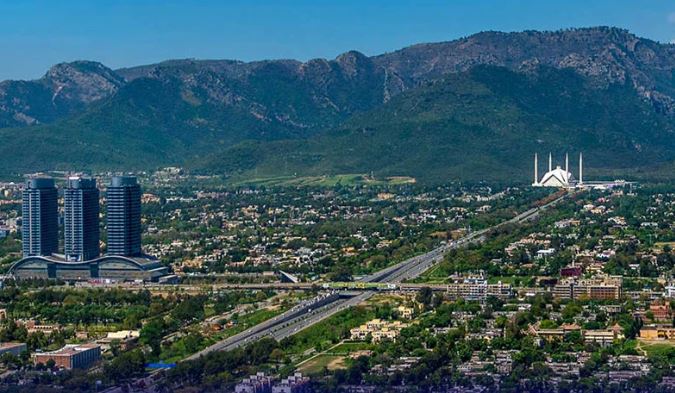
No holiday for federal institutions on Dec 26: Cabinet Division

No holiday for federal institutions on Dec 26: Cabinet Division

ISLAMABAD, DEC 24: Despite a local holiday in the federal capital, all federal institutions will remain open on December 26 (Friday).

A spokesperson for the Cabinet Division said there will be no holiday in federal institutions on December 26. The day will be a normal working day for the federal government and all federal offices.

It is pertinent to note that the district administration has declared a local holiday within the limits of Islamabad on Friday, December 26, 2025. A formal notification has been issued with the approval of the District Magistrate, Islamabad.

According to the notification, all government offices within the revenue limits of Islamabad will remain closed on December 26. However, institutions providing essential services are exempt from the holiday. These included the Metropolitan Corporation Islamabad, Capital Development Authority, ICT Administration, Islamabad Police, Islamabad Electric Supply Company (Iesco), Sui Northern Gas Pipelines, and hospitals.

Govt decides to place additional Rs1.67bn burden on Hajj pilgrims

ISLAMABAD, DEC 24: The Ministry of Religious Affairs has decided to place an additional financial burden of Rs1.67 billion on prospective Hajj pilgrims.

According to details surfaced on Wednesday, under the government scheme, pilgrims will be required to make extra payments towards airfare. Under the scheme, pilgrims will collectively pay an additional Rs1.67 billion in air travel charges. The ministry’s agreements with four airlines have resulted in further financial pressure on Hajj pilgrims.

The sources pertaining to the development said that under the government scheme each pilgrim will pay an additional Rs14,000 in airfare this year. According to the agreements with the airlines, the return air ticket will cost Rs238,000. During the previous Hajj, the airfare charged was Rs224,000 per person.

Under the agreements, travel services for government scheme pilgrims will be provided by PIA, Saudi Airlines, and two private airlines. Under the government Hajj scheme, 119,210 pilgrims will perform Hajj this year.

PTI rejects PM Shehbaz’s renewed offer for talks

PTI rejects PM Shehbaz’s renewed offer for talks

ISLAMABAD, DEC 24: The Pakistan Tehreek-e-Insaf (PTI) has rejected Prime Minister Shehbaz Sharif’s renewed offer for holding the negotiations. PTI spokesperson Sheikh Waqas Akram said the party would not take part in any form of dialogue with the government, terming the prime minister’s offer as ‘contradictory’. He said that if the prime minister could not facilitate a meeting between PTI founder Imran Khan and Sohail Afridi, there was no basis for talks. He added that Imran Khan has delegated the authority for negotiations to Mahmood Khan Achakzai and Raja Nasir Abbas.

It is pertinent to note that, while speaking at a federal cabinet meeting a day earlier, PM Shehbaz said the government remained committed to its principled stance of peaceful dialogue with all political parties for national development, prosperity and political harmony. He said he had personally extended offers of dialogue to all political parties on several occasions, and that any attempt to undermine law and order under the pretext of political dialogue would not be allowed to succeed.

Meanwhile, following the Prime Minister’s offer of talks to PTI, the National Dialogue Committee has also become active. A committee comprising Fawad Chaudhry, Imran Ismail and Mahmood Molvi welcomed the prime minister’s offer.

The committee has written to the prime minister, requesting the release on parole of PTI leaders currently detained in Kot Lakhpat Jail. The letter said that without confidence-building measures, the process of negotiations could not be successful or sustainable.

Pakistan, Oman navies sign information sharing deal to boost security

Pakistan, Oman navies sign information sharing deal to boost security

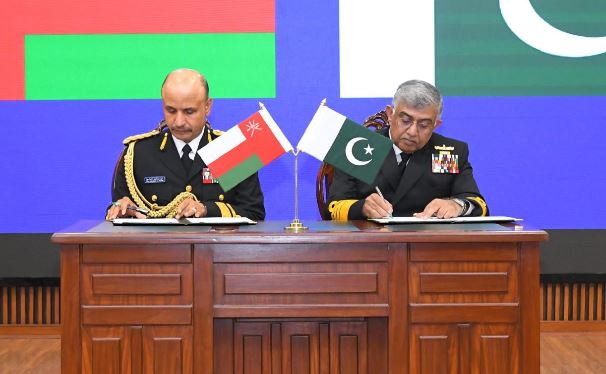
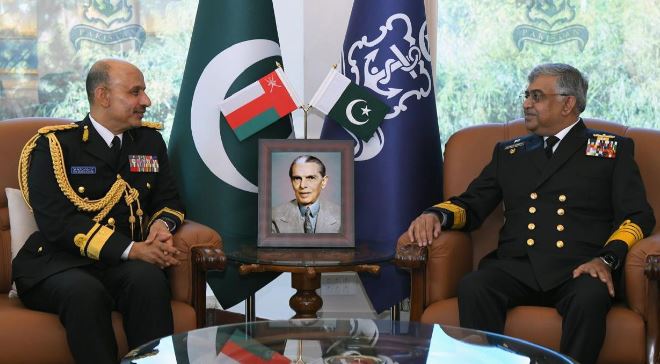
RAWALPINDI, DEC 24 /DNA/ – Commander of the Royal Navy of Oman, Rear Admiral Saif Bin Nasser Bin Mohsin Al Rahbi called on Admiral Naveed Ashraf, NI, NI (M), T Bt, Chief of the Naval Staff, at Naval Headquarters, Islamabad.

During the meeting, matters of mutual interest, regional maritime security and bilateral naval cooperation were discussed. The visiting dignitary lauded the professionalism of Pakistan Navy and acknowledged its continued contributions towards ensuring maritime security and stability in the region.

Later, Chief of the Naval Staff and Commander Royal Navy of Oman signed a Memorandum of Understanding (MoU) related to sharing of white shipping information in a ceremony held at Naval Headquarters. The MoU is aimed at establishing guidelines and procedures for information sharing in order to enhance mutual awareness of white shipping.

Pakistan and Oman enjoy geographical proximity sharing common maritime boundaries. The bilateral relations between brotherly countries cover wide ranging scope including economic cooperation, people to people contacts and strong defence ties. Both navies have deep professional relations which are manifested through PN and RNO ELSTS (Expert Level Staff Talks), training, bilateral exercises and participation in multilateral exercises.

PCB receives 12 bids for two new PSL teams

PCB receives 12 bids for two new PSL teams

LAHORE: The Pakistan Cricket Board (PCB) has received 12 bids for the two new Pakistan Super League (PSL) franchises, within the stipulated deadline, the cricket board announced on Wednesday.

The PCB, in a statement, said it received an “exceptional and encouraging response” to the tender issued for the sale of two new PSL teams as 12 parties formally submitted their bids.

The cricket board shared that investors from the United States of America (USA), Australia, Canada, the United Arab Emirates (UAE) and Pakistan expressed their interest in acquiring the franchises up for sale, depicting the marquee league’s global popularity and commercial appeal.

The PCB further announced that the “results” of the initial phase of the bidding process will be announced on December 27, which will determine the parties technically qualified to purchase the two new teams through an open auction, set to be held on January 8.

“The results of this phase of the bidding process will be announced on 27 December. In the next stage, technically qualified bidders will be given the opportunity to purchase the two new teams through an open competition bidding process,” the statement continued.

“This stage will be held on 8 January at the Islamabad Convention Centre. The Pakistan Cricket Board is committed to completing this process in a transparent and competitive manner in line with international standards, to ensure the continued expansion and growth of the Pakistan Super League.”

It is pertinent to mention that the PSL, which began in 2016 with five franchises and later expanded to six sides in 2018, is set for further expansion with the addition of two new teams from its upcoming 11th edition, set to be played next year.

With the upcoming additions, the PSL will undergo its first major restructuring in seven years, bringing the total number of franchises to eight.

Tarar calls for establishing Fact Check Forum to tackle fake news on CPEC

Tarar calls for establishing Fact Check Forum to tackle fake news on CPEC

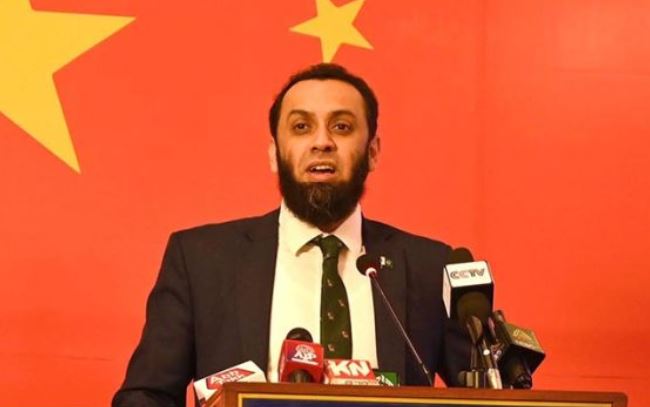
ISLAMABAD, Dec 24: Minister for Information and Broadcasting Attaullah Tarar on Wednesday called for the establishment of a Fact Check Forum at the China-Pakistan Institute to counter fake news and propaganda targeting the China-Pakistan Economic Corridor (CPEC).

Speaking as chief guest at the forum, hosted by the Embassy of the People’s Republic of China and jointly organized by the Pakistan-China Institute and China Economic Net, the Information Minister stressed that establishing a fact-check forum has become essential to counter misinformation surrounding CPEC.

Tarar urged the China-Pakistan Institute to take the lead in establishing the platform. He emphasized that the initiative would be instrumental in ensuring credible information and safeguarding the narrative of the CPEC.

The minister described Pakistan-China friendship as historic and exemplary, noting that strong and effective ties exist between the two nations across all levels.

The minister said the Pakistan-China Institute should play a role in combating fake news. He highlighted the deep-rooted heritage and cultural ties between the two nations, noting that rivers flowing from China symbolize peace, love, prosperity, and a shared future. Tarar added that Pakistan’s friendship with China is time-tested and enduring.

He noted that combating misinformation remained one of the biggest challenges, adding that his ministry’s responsibility was to inform the world about the true essence of the China-Pakistan Economic Corridor (CPEC) and to further promote harmony.

The first phase of the corridor is widely regarded as a historic turning point for Pakistan, he said.

Tarar underscored that Pakistan and China are ‘iron brothers,’ a bond the nation takes pride in. He emphasized that the friendship between the two countries is time-tested and enduring, with cultural ties continuing to deepen.

The “iron brothers” launched the China-Pakistan Economic Corridor (CPEC) in 2015, ushering in a cultural transformation alongside economic progress. The initiative has fostered greater people-to-people connectivity, with young Chinese learning Urdu and Pakistanis embracing the Chinese language, breaking traditional barriers of communication.

He noted that both sides take pride in their exemplary, trust-based friendship, adding that the term ‘iron brothers’ is reserved exclusively for describing Pakistan-China relations.

CPEC has not only built roads and infrastructure but also strengthened harmony and laid the foundation for an enduring bridge of friendship between the two nations.

The minister said the China-Pakistan Economic Corridor (CPEC) has created significant opportunities for the country’s youth. He urged stakeholders to promote positivity around the project, emphasizing its role in shaping a brighter future.

Upon taking office, the minister said he established Pakistan’s first media digital communication department and the launch of initiatives including the Digital Pakistan channel, aimed at effectively projecting the country’s stance on the global stage.

He recalled that during the conflict with India, a wave of misinformation was spread, with exaggerated claims including the destruction of Lahore and Multan ports. Tarar commended Pakistani media for its positive role in countering such false narratives.

Highlighting CPEC as a success story, he pointed to milestones such as the inauguration of Gwadar Airport and emphasized the project’s benefits in empowering the business community and strengthening Pakistan’s economic sector.

The minister described CPEC as a game-changing project, highlighting it as a major connectivity initiative linking multiple countries. He noted that CPEC 2.0 represents a key milestone in driving Pakistan’s economic growth, with several development projects already launched under the framewok.

The minister noted that Pakistan and China will celebrate the 75th anniversary of their friendship next year. He emphasized the importance of exchanges between journalists and media influencers, calling for stronger media cooperation and a shift toward digital collaboration.

He highlighted Prime Minister Shehbaz Sharif’s recent visit to China, saying the bilateral friendship is reaching new heights. Reflecting on his own childhood, he remembered witnessing the steady growth of ties between the two nations.

RCCI hosts Ambassador Oumer Oba for business talks

RCCI hosts Ambassador Oumer Oba for business talks

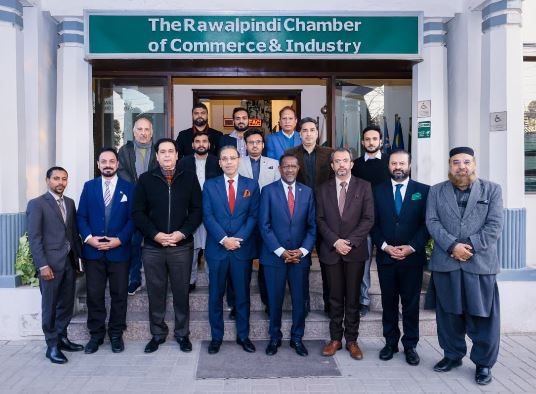
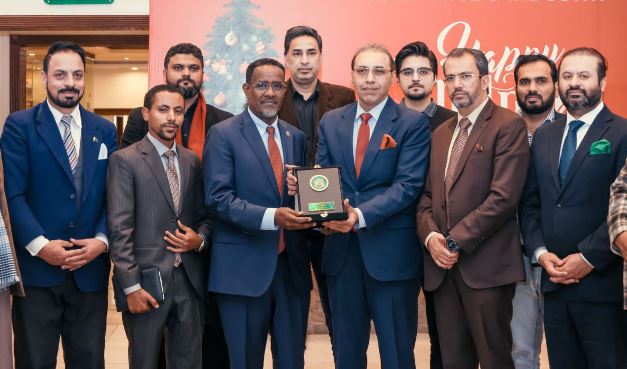
RAWALPINDI, DEC 24 /DNA/ – Oumer Hussein Oba, Ambassador-designate of the Federal Democratic Republic of Ethiopia (FDRE) to the Islamic Republic of Pakistan, paid a maiden visit to the Rawalpindi Chamber of Commerce and Industry (RCCI) on Wednesday to discuss bilateral cooperation, and highlight extraordinary investment opportunities within Ethiopia’s flourishing economic sectors.

​The meeting covered a broad range of issues, including trade, investment, institutional linkages, and future collaborations. Both sides discussed mechanisms for seamless cooperation to further strengthen bilateral relations between the two nations.

​Addressing the business gathering representing various economic sectors of Pakistan, the Ambassador briefed them on the homegrown economic reforms undertaken by the Ethiopian government. These reforms have created massive business opportunities in five primary sectors including agriculture and agro-processing, manufacturing, mining, tourism, and ICT, he added. 

​The Ambassador also urged the business community to participate in the high-level “Invest in Ethiopia” forum, scheduled for March 26–27, 2026 in Addis Ababa, Ethiopia. The event is expected to bring together over 700 international investors, policymakers, and development partners from across the globe.

He assured the RCCI that the Ethiopian Embassy in Islamabad would provide full support to Pakistani businesses looking to explore the untapped potential of bilateral economic relations.

​H.E. Usman Shaukat, President of the RCCI, welcomed the Ambassador and highlighted the growing cooperation between the Embassy and the Chamber. He emphasized that people-to-people relations are the key drivers of economic diplomacy, requiring a concentrated focus from both sides to bring the two nations closer.

​The President further highlighted the immense potential for trade and investment, praising the economic development achieved by Ethiopia under the leadership of Prime Minister H.E. Dr. Abiy Ahmed.

​Senior Vice President Mr. Khalid Farooq Qazi, Vice President Mr. Fahad Barlas, and Former President Mr. Raja Amer also spoke regarding the future of Ethiopia-Pakistan relations. The discussion concluded with a Q&A session and a cake-cutting ceremony organized by the RCCI to celebrate Christmas.

Field Marshal Syed Asim Munir vows decisive action against Indian-sponsored terrorism

Field Marshal Syed Asim Munir vows decisive action against Indian-sponsored terrorism

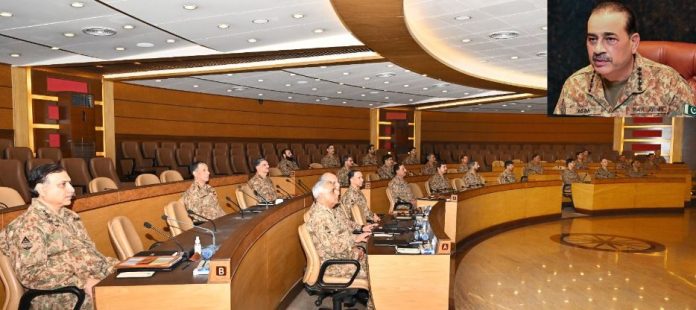
RAWALPINDI, DEC 24 /DNA/ – Field Marshal Syed Asim Munir, NI (M), HJ, COAS & CDF, presided over the 273rd Corps Commanders’ Conference (CCC) held at General Headquarters (GHQ), Rawalpindi.

The Forum offered Fateha for the Shuhada of the Armed Forces, Law Enforcement Agencies, and innocent civilians who laid down their lives in recent terrorist incidents, while defending the motherland against foreign-sponsored terrorism.

The COAS & CDF paid rich tribute to the unwavering courage, professionalism, and sacrifices of the Pakistan Armed Forces, and appreciated their resolute conduct in sustained, intelligence-based counter-terrorism operations across the country in recent months. He highlighted that owing to combined efforts of the Government, military and steadfast support of the people of Pakistan, our country is steadily and surely leaping towards stability, greater opportunities and respect.

The Forum undertook a comprehensive review of prevailing internal and external security environment, with particular emphasis on evolving threats and operational preparedness. The participants reaffirmed that all terrorists under the tutelage of Indian sponsors, along with their facilitators and abettors, would be dealt with decisively and without exception.

The Forum categorically rejected the nexus between terrorism, crime, and vested political interests. It resolved that no malicious interest, political or otherwise, aimed at undermining national unity, security and stability would be tolerated, nor would anyone be allowed to create divisions between the Armed Forces and the people of Pakistan.

The Forum appreciated Balochistan Special Development Initiatives, directed towards local empowerment and social engagements to address challenges of terrorism related to governance. The participants noted the need for similar public-centric initiatives elsewhere also in line with National Action Plan to ensure enduring peace and stability.

The Forum underscored Pakistan’s steadfast commitment to the legitimate struggle of the Kashmiri people for their right to self-determination, and reaffirmed Pakistan’s principled position on the Palestine issue, calling for an immediate and permanent ceasefire, unhindered humanitarian access to Gaza, and a credible pathway to Palestinian statehood.

In his concluding remarks, the COAS & CDF directed Commanders to maintain the highest standards of operational readiness, discipline, training, physical fitness, technological innovations and battlefield adaptability. He expressed full confidence in Pakistan Army’s capability to effectively counter complete spectrum of threats, ranging from conventional and sub-conventional to hybrid and asymmetric challenges, while steadfastly safeguarding national sovereignty and territorial integrity.

FPCCI calls for renegotiation of trade deals to aid exporters

FPCCI calls for renegotiation of trade deals to aid exporters

KARACHI, DEC 24: /DNA/ – Saquib Fayyaz Magoon, Acting President of the Federation of Pakistan Chambers of Commerce and Industry (FPCCI), has called upon the Government of Pakistan to conduct a comprehensive review of all existing Free Trade Agreements (FTAs) in order to curtail trade deficit – extending benefits of those agreements to Pakistani exporters as well. We need to negotiate and activate the pending FTAs on the same lines to avoid any further disadvantageous positions in future, he added.

It is pertinent to note that Rana Tanveer Hussain, Federal Minister for National Food Security & Research, has consulted FPCCI in detail over the recent decline in food exports of Pakistan. The minister informed the apex body that his initiative is based on Prime Minister of Pakistan’s advice to take the business on board.

Rana Tanveer Hussain acknowledged that there are genuine and valid concerns of the business, industry and trade community of Pakistan – which need to be addressed to reverse the decline in exports. He assured FPCCI that the government will seek diligent consultative process with them in taxation, industrial, sectorial and export promotion initiatives.

Rana Tanveer Hussain stated that the Ministry of National Food Security & Research and its subsidiary institutions are rigorously and tirelessly working to provide best quality seeds in ample quantities in a timely fashion. He also committed that he will bring federal secretaries of the relevant ministries in his next visit to the FPCCI.

Mr. Saquib Fayyaz Magoon, Acting President FPCCI, identified that there are three major areas of concern vis-à-vis declining food and agro-based exports; namely, the need to renegotiate FTAs with major trading partners, provision of top quality seeds for major crops and facilitation to agriculture industry and their exporters in meeting compliance standards of various industries and regions.

Mr. Saquib Fayyaz Magoon maintained that a joint meeting of Federal Minister of National Food Security; Federal Minister of Commerce and FPCCI is essential for result-oriented, data-driven and holistic dialogue on the issues pertaining to agricultural production, supply chain and exports issues.

Mr. Saquib Fayyaz Magoon underscored that the foundation of a robust export economy lies in the quality of its primary produce. The Federation demanded the immediate implementation of the national seed supply to ensure high-yield varieites through the introduction of climate-resilient varieties along with investment in R&D and increased collaboration between the private sector and research institutes to end dependence on imported seeds.

Mr. Aman Paracha, VP FPCCI, speaking during the high-level consultative session, highlighted that Pakistan’s current trade agreements require urgent renegotiation to address growing trade deficits and to provide a more level playing field for local industries and the agricultural sector for economic equity.

Aman Paracha emphasized that while FTAs are intended to enhance market access, several existing agreements have resulted in an influx of imports without a reciprocal growth in Pakistani exports. “We need a ‘Trade-First’ diplomacy approach,” stated Aman Paracha. “Existing FTAs must be reviewed to include more value-added agro-based products and to remove non-tariff barriers that currently hinder our penetration into export markets.”

Mr. Tariq Jadoon, VP FPCCI, stressed upon the need for an urgent focus on export compliance in lieu of the increasing global requirements for traceability and food safety. Pakistan’s agricultural exports face significant risks, if compliance standards are not modernized, he added.

“Compliance is no longer optional; it is a prerequisite for survival in the global value chain,” said Mr. Tariq Jadoon. The Federation urged the government to accelerate the technical support to exporters to meet Sanitary and Phytosanitary (SPS) standards; particularly for the EU, UK, and Gulf markets.

FPCCI concluded by recommending the establishment of a joint public-private task force to oversee the standardization of export-oriented crops. By combining better seed technology with rigorous international compliance, Pakistan can potentially double its agro-based exports within the next five years.

Stay Connected

64FansLike
60FollowersFollow

Latest Reviews

Exchange Rates

USD - United States Dollar
EUR
1.14
GBP
1.34
AUD
0.70
CAD
0.71