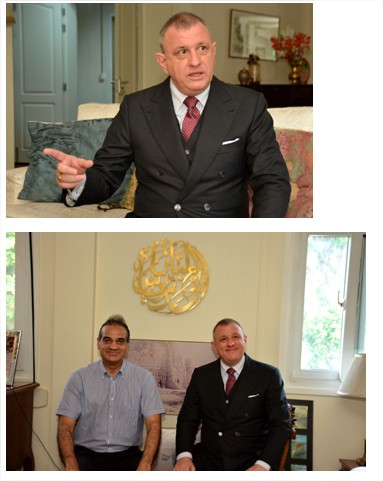
ISLAMABAD, JUL 29 – Patchamuthu Illangovan, the outgoing Country Director of World Bank in Pakistan paid a farewell call on Prime Minister Imran Khan at Islamabad.
Minister for Economic Affairs Makhdoom Khusro Bakhtiar and senior officials were present.
Mr. Illangovan thanked the Prime Minister for his support during his stay in Pakistan. He recognized Pakistan’s efforts towards stabilization of economy and overall reform process including response to Covid-19 pandemic.
The Prime Minister appreciated the partnership with World Bank and wished the out-going World Bank Country Director success for his next assignment.
KARACHI: The Sindh government on Wednesday released Rs463 million funds to counter emergency situations after heavy rainfall lashed different parts of Karachi during the recent monsoon spells.
The funds were released on the orders of Sindh Chief Minister Syed Murad Ali Shah.
According to details, Rs200 million funds had been released by the provincial government for the Solid Waste Emergency and Efficiency Project (SWEEP) on July 26.
The spokesperson said the funds have been utilized for rain emergency purposes and cleaning of Karachi’s stormwater drains. While giving details of funds, CM Murad, in a statement, said that the Sindh government on July 2 had released Rs229 million funds to divisional commissioners.
“Out of total Rs229 million funds, Rs30 million were given to Karachi Commissioner for rain emergency measures,” said Murad.
“The Sindh government had released Rs four million for District East, Karachi, Sadi Town and Mehran Drain as rains had badly affected these areas last year.”
Murad Ali Shah said that he has directed the local government department to prepare a detailed plan, highlighting low-lying areas, encroachments clogging drains (nullahs) in Karachi.
“I need a solid mechanism for saving low-lying areas where rainwater has flooded the houses,” he added.
It is pertinent to inform that Karachi has been marred with civic issues, the conditions worsened amid the recent spell of rains leading to clogged drains and several areas of the metropolis flooded with rainwater mixed with sewage.
Heavy rainfall flooded Orangi Town, Surjani Town, Clifton, Gadap Town, Garden Town, Federal B Area, Jamshed Road and the old city areas on Sunday causing power outages in several areas of the city.
The US government has summoned Zimbabwe’s ambassador to explain comments made about its envoy by the country’s ruling party.
A spokesperson of Zimbabwe’s ruling party, Zanu-PF, had on Monday accused the US of sponsoring anti-government protests in the country and called the US ambassador Brian Nichols a “thug”.
The Assistant Secretary for the State Department’s Bureau of African Affairs Tibor Nagy termed the comments as “deeply offensive”, adding that the Zimbabwe envoy had been summoned to explain.
The chairman of US Senate Foreign Relations Committee Jim Risch tweeted that Zimbabwe was using “name calling, deflection and misinformation to justify their current economic and political crisis”.
Ambassador Nichols has had several run-ins with the Zimbabwean government.
Zimbabwe’s foreign affairs minister in November 2019 threatened to expel the ambassador accusing him of “behaving and conducting himself like an opposition member”.
The country has been protesting against US sanctions and the embassy has been on the receiving end.
ISTANBUL: The Turkish Parliament on Wednesday passed a controversial new law regulating social media to comply with any demands by the government to block or remove content.
Under the new law, social media giants such as Facebook and Twitter have to ensure they have local representatives in Turkey and to comply with court orders over the removal of certain content or face heavy fines.
The legislation targets social networks with more than a million unique visits every day and says servers with Turkish users’ data must be stored locally.
If companies refuse to comply, they will face fines and restriction of bandwidth making the platform unusable.
The bill was submitted by the ruling AKP and its nationalist partner the MHP, which have a majority in the parliament, and passed after debates beginning on Tuesday and lasting into Wednesday.
After the night-long debate, the parliament went into summer recess till October.
‘Dark era’
Human rights groups and the opposition are worried over what they call the erosion of freedom of expression in Turkey, with thousands of people subject to criminal proceedings for “insulting” President Recep Tayyip Erdogan on social media.
They argue that increased control of social media will also limit Turkish access to independent or critical information in a country where the news media is in the hands of government-friendly businessmen or controlled by the state.
“Why now?” asked Yaman Akdeniz, professor at Istanbul´s Bilgi University and also a cyber rights expert.
“While print and broadcast media platforms are already under government control, social media networks are relatively free. Social media has become one of the few spaces for free and effective expression in Turkey.
Human Rights Watch expressed concerns that the law would enable the government to control social media, to get content removed at will and to arbitrarily target individual users.
“Social media is a lifeline for many people who use it to access news, so this law signals a new dark era of online censorship,” said Tom Porteous, deputy program director at Human Rights Watch in a statement before the legislation passed.
The legislation has aroused deep concerns for many Internet users in Turkey who mobilised online in recent weeks using the hashtag “don’t touch my social media”.
‘No obstacle’
Ibrahim Kalin, Erdogan’s spokesman, brushed off fears the law would hamper free speech.
“There is no obstacle to social media users freely expressing their opinion.
“Here is the rule: whatever is a crime in real world is also a crime in cyber world … there must be a limit to criticism.”
Erdogan vowed to tighten government control over social media earlier this month after he said “dark-hearted” users insulted Finance Minister Berat Albayrak and his wife Esra, the president’s daughter, following the birth of their fourth child.
And last month, the Turkish leader met with a spate of negative comments during a video-conference with young people.
The Turkish presidency then turned off comments but there were 388,000 clicks on the “thumbs down” button, compared with 114,000 on the “thumbs up” button.
Erdogan is not a fan of social media despite a large following on different platforms, including Twitter.
He once compared the media platforms to a “murderer’s knife” and previously promised to “eradicate” Twitter.
His government previously blocked Twitter and YouTube in 2014 after audio recordings were posted implicating the president, then prime minister, and his inner circle in an alleged corruption scandal.
Erdogan’s aversion of social media also dates back to anti-government protests in 2013, which were often mobilised by Twitter and Facebook posts.
A Turkish court in January lifted a ban on the online encyclopaedia Wikipedia after almost three years.
According to Twitter’s latest “transparency report” for the first half of 2019, Turkey ranked number one for seeking content removal with more than 6,000 requests.
ISLAMABAD: The International Court of Justice (Review and Reconsideration) Ordinance, 2020, in relation to Indian spy Kulbhushan Jadhav’s appeal against sentence will be presented in the Senate on Wednesday for approval.
Federal Law Minister Farogh Naseem will present the ordinance in the upper House of the parliament.
The session will commence at 4pm today.
Earlier, the bill was presented before the National Assembly, where a heated debate took place between the government and opposition benches on the subject.
The opposition claimed that the government is trying to give concession to the convicted Indian spy same as the National Reconciliation Ordinance or NRO.
Govt approaches IHC to appoint lawyer for Jadhav
The government on July 22 had approached the Islamabad High Court to appoint a legal representative for the Indian spy.
The move was made in the light of the International Court of Justice’s July 17, 2019 decision, following which the International Court of Justice (Review and Reconsideration) Ordinance, 2020 was enacted to implement the court’s verdict.
The federation, through the defense secretary and the Judge Advocate General (JAG) branch of General Headquarters (GHQ), has been made a party in the petition filed by the Ministry of Law and Justice.
According to the petition, Jadhav refused to file a petition against his sentence.
The Indian spy cannot appoint a lawyer in Pakistan without India’s assistance, while New Delhi is also reluctant to avail the facility under the ordinance, the petition said.
The government, in the petition, has asked the court to appoint a legal representative for Jadhav so that Pakistan can fulfil its responsibility to see to the implementation of the ICJ’s decision.
On July 17, Pakistan had offered Jadhav consular access for a third time, after the second opportunity was not fully availed.
Jadhav and ICJ verdict
Commander Jadhav — an Indian Navy officer working for Indian covert agency Research and Analysis Wing (RAW) — was arrested on March 3, 2016, from Balochistan after he entered Pakistan from Iran.
On 10th April, 2017, Jadhav was tried in a military court, which sentenced him to death for espionage and subversive activities. On May 18, 2017, the ICJ ordered Pakistan to halt the execution of Jadhav until a final decision was made in the proceedings.
On July 17, the court rejected India’s appeal for Jadhav’s release and asked Pakistan to suspend the execution. It ruled that Pakistan will have to review the entire process of trial and conviction of Jadhav and provide India with consular access. Over the past few days, Pakistan granted consular access to India thrice.
ISLAMABAD : An Accountability Court on Wednesday deferred indictment of former president Asif Ali Zardari and his sister Faryal Talpur in money laundering and Pink Residency references.
The court put off proceedings of indictment in NAB references till August 07 due to absence of former president’s counsel Farooque H. Naik.
It is to be mentioned here that the court had earlier fixed July 29 for indictment of Asif Ali Zardari and his sister Faryal Talpur in money laundering and Pink Residency references.
An assistance counsel appeared on behalf of Naik and sought a date of hearing after August 05. He informed the court that Farooque Naik could not appear in court due to the Senate session in Muzaffarabad scheduled on August 05. The court also approved a petition of Asif Ali Zardari and Faryal Talpur seeking exemption from appearing in the case proceedings.
Judge Azam Khan of the accountability court said that the accused have to appear in court regularly after indictment and opening of the trial.
He adjourned hearing of the case till August 07.
Zardari, his sister Faryal Talpur and other accused face charges of graft in money laundering in Pink Residency and other references filed by the National Accountability Bureau (NAB).
ISLAMABAD: The country reported as many as 1063 new coronavirus cases and 27 deaths over the past 24 hours, taking the national tally of cases to 276,288 and fatalities to 5,892.
According to the National Command and Operation Centre, 1063 new cases were detected after 21256 tests were conducted in the previous 24 hours.
25,513 COVID-19 patients are undergoing treatment while 244,883 patients have recuperated from the disease. 1,931,102 tests have been conducted across the country so far.Sindh remains the worst-hit province by the pandemic in terms of cases followed by Punjab, Khyber Pakhtunkhwa and Islamabad.
119,398 cases have been detected in Sindh so far, 92,452 in Punjab, 33,724 in Khyber Pakhtunkhwa, 11,654 in Balochistan, 14,963 in Islamabad, 2,055 in Azad Jammu and Kashmir and 2,042 in Gilgit Baltistan.
COVID-19 pandemic is ‘one big wave’
The World Health Organization on Tuesday warned against complacency about new coronavirus transmission in the northern hemisphere summer, saying that this virus did not behave like influenza that tended to follow seasonal trends.
WHO officials have been at pains to avoid describing a resurgence of COVID-19 cases like those in Hong Kong as “waves” as this suggests the virus is behaving in ways beyond human control, when in fact concerted action can slow its spread.
Margaret Harris repeated that message in a virtual briefing in Geneva. “We are in the first wave. It’s going to be one big wave. It’s going to go up and down a bit. The best thing is to flatten it and turn it into just something lapping at your feet,” she said.
Pointing to high case numbers at the height of the U.S. summer, she urged vigilance in applying measures and warned against mass gatherings.
ISLAMABAD : In another honour for the Pakistan Red Crescent Society (PRCS), Secretary General Khalid bin Majeed has been nominated as Co-Chairman of the Red Cross Red Crescent Global Committee for Covid-19 Vaccination, Advocacy, Fundraising and Resource Mobilization.
The coveted post has been bestowed upon Secretary General Khalid bin Majeed keeping in view his professional excellence, innovative approach, dedication towards the humanitarian cause and meritorious contribution to the ongoing fight against Covid-19, which has been acknowledged and appreciated even at the international level. The nomination has been made from among National Red Cross and Red Crescent Societies of 194 countries who are member of the International Federation of Red Cross and Red Crescent Societies.
As the global spread of Covid-19 continues to accelerate, in addition to the direct effects, the pandemic has triggered secondary effects that are threatening life-saving immunization services around the world. A report released by the WHO, UNICEF, and Gavi, the Vaccine Alliance, indicates that the disruption of immunization activities has put more than 80 million children under one at risk of vaccine-preventable diseases (VPDs), including polio, measles and rubella. Several models predict that the secondary impact of the pandemic can result in more lives lost from VPDs than from Covid-19.
The Red Cross Red Crescent Movement along with the United Nations has called for unity to scale up efforts to develop, test, and scale-up production of safe, effective, quality, affordable diagnostics, therapeutics, medicines and vaccines. Specifically, the governments, the private sector, international organizations and civil society have been urged to unite towards ‘a people’s vaccine’.
In the context of Covid-19, the RCRC Movement aims at supporting all phases of vaccine roll out and from development to deployment, and an equitable and affordable access of future Covid-19 vaccines.
The working group has been mandated to undertake a number of key activities to support the preparation and fair and equitable deployment of Covid-19 vaccine. Some of the key functioning areas include community engagement and risk communications to address vaccine hesitancy, assessment of bottlenecks to access and utilization of services, global advocacy and coordination support, resource mobilization and partnership engagement and collecting and sharing the best practices.
Ambassador of Italy Andreas Ferrarese talks to Daily Islamabad Post; says he wants to enhance Italian cultural presence; appreciates Pakistan’s role in regional as well as Afghan peace.
EXCLUSIVE
Ansar M Bhatti
ISLAMABAD: Ambassador of Italy to Pakistan Andreas Ferrarese has said Italy is a country whose extremely open economy is based on international trade, on extraordinary circulation of foreign passengers and merchandizes, on international tourism. That is the reason why it was one of the first countries to be affected. Italians had to hinder such a great challenge without the point of reference of previous experiences in the last 100 years.
The Italian ambassador made these remarks in an exclusive interview with daily Islamabad Post. His detailed interview shall be published in CENTRELINE magazine.
To a question about Italian govt steps to reduce impact of virus, the ambassador said, the Government acted from the beginning by adopting difficult and resolute decisions in full transparency. The main one was a general lockdown and unprecedented limitation of movements. The population has shown a great sense of responsibility and resilience. Many Italians live in small apartments. Life was very hard for them during months. There was an extraordinary effort by scientist, researchers, and a commitment by physicians and hospital staff which I would not hesitate to define heroic. We constantly shared our experience with all international partners. We received from Pakistan great solidarity and concrete support in the hardest moment.
Regarding bilateral ties the ambassador said, it is a matter of satisfaction that both our countries enjoy great unanimity of views on several issues of global importance. I would want to further deepen this understanding and cooperation at political level. We have, historically, an excellent collaboration within the United Nations. Even in this period of COVID we could have important political contacts, through a phone call between Prime Minister Imran Khan and his Italian counterpart, Prime Minister Giuseppe Conte, and a phone call between Foreign Minister Shah Mehmood Qureshi and Italian Foreign Minister Luigi Di Maio.
Over past few years, trade between the two countries has seen a constant rise, thanks to the efforts of business communities on both sides, reaching a total amount of 1,5 Billion Euro in 2019. However, there is still a lot of room for improvement. One of my goals during my posting in Islamabad is to enhance Italian cultural presence in Pakistan through various mediums.
I have to improve the consular services for more than 1 Million Pakistani citizens who have – nowadays – a relative living in Italy, since my Country, after Brexit, is currently hosting the biggest community of Pakistanis in the European Union.
Ambassador Andreas Ferrarese said Pakistan is a relevant player globally and not only in this Region, with whom we fruitfully collaborate in the main international fora, especially in United Nations. We praise and support the role of Pakistan and its action of facilitation in order to contribute to bring peace and normalization in Afghanistan, which would greatly contribute to a stabilization and prosperity of this geo-political area.
He said being one of his first interviews; he would take some longer to introduce himself. Pakistan he said was his sixth diplomatic assignment abroad and the second as Ambassador of Italy. “My father is a Professor of History with a passion for archeology and my mother a Professor of Financial Economy. I took something from both of them, but at the end prevailed to the seductions of an academic life the desire to serve my Country in public Administration. I graduated in Arabic language and literature, then had a first quality training in political sciences, economy and law at the University of Padua, and through a stage in Ecole Nationale d’Administration – ENA, thus in Paris”.
He said once he passed the selection for the diplomatic service, age 26, one of the hardest in Italy, in the Ministry I opted for starting my work in economic affairs, being assigned in Office for economic relations with Asia. In that occasion he worked a lot with Pakistani counterparts, with excellent results. “I remember that Pakistani Ambassador in Rome at that time, a great gentleman, often invited me for great lunches and dinners despite being a young Diplomat. He made me love your country’.
‘My first posting abroad was, age 28, as n.2 in the Italian Embassy in the Philippines. I faced relevant problems connected to migration and security (kidnapping of Italians), but had great satisfactions promoting Italian busyness and great increasing of political collaboration. I reinforced a lot the role of Italy in Asian Development Bank. First posting, for a Diplomat, is like first love’.
I than moved, age 33, to Tel Aviv as press Counsellor and coordinator for consular affairs. A difficult period but very useful for my professional formation, in a very challenging media and security environment.
I served then, age 36, in Crisis Unit of Ministry of Foreign Affairs, as Deputy Director. In that position I contributed to manage huge crises such as Tsunami in 2004, 4 evacuations from war scenarios, 96 hostage takings, epidemiologic crises, and many others. A great experience with a very high personal sacrifice. I reinforced a great passion for technology. When I finished my service there the Crisis Unit was considered one of the most efficient in the world. I was invited by Department of State in US to share our experience, the ambassador added.
Further dilating on his career he said, “I was then, age 39, Deputy Ambassador to Lebanon, in a period in which Italy played a major role for stabilization of that Country, since UNIFIL II Mission was thus leaded by an Italian Commander who still enjoys a great reputation in the Middle East Region’.
‘I then served, age 43, as Deputy Ambassador in Brazil where I coordinated the Embassy and one of the widest consular networks in the world: 6 major Consulates and about 100 Honorary Consuls. We had 400.000 persons in line to obtain Italian citizenship. Italian investments amounted 18 billion Euros, regarding – to mention some samples – 25% of Brazilian cars, and 68 millions of cellphone lines’.
I was then appointed, age 45, Ambassador to Kosovo, in a very important moment of the dialogue with Serbia, crucial for the stability of the Balkans a strategic region for Europe and Italy.
At the age of 48, I was assigned in the office of the Prime Minister, in charge of strategic analysis and some international rapports.
After a period of direct collaboration with the Foreign Secretary in the Ministry of Foreign Affairs, I was appointed on 4 October 2019, age 51, Ambassador to the Islamic Republic of Pakistan, where I arrived of February 10 2020, and presented Letter of Credence on June 11th 2020.
Full text of the interview shall be published in the CENTRELINE magazine. The interview is also available at www.dailyisbpost.com.pk / www.dnanews.com.pk and www.centreline.com.pk.