Home Blog Page 33

PM Shehbaz says economy out of woods, terms all indicators ‘wonderful’

PM Shehbaz says economy out of woods, terms all indicators 'wonderful'

ISLAMABAD: Prime Minister Shehbaz Sharif on Saturday launched the National Regulatory Reforms, saying Pakistan had come out of severe economic difficulties due to the untiring efforts of the incumbent government and its economic team, with key economic indicators showing strong improvement.

Addressing the launch ceremony, he called the regulatory reforms a “quantum jump,” saying the framework would facilitate business, industry, agriculture, and foreign direct investment from Europe, the Far East, and the Middle East, while also reducing wastage of time and resources that had fueled corruption and nepotism.

He commended federal and provincial teams for working in coordination and thanked the British government and International Development UK for their support, describing the UK as a long-standing partner in Pakistan’s progress.

He also said Pakistan enjoyed strong relations with the United States and looked forward to further cooperation.

The prime minister recalled that when the government assumed office, the country was on the verge of financial default, inflation was soaring, the policy rate was crippling, and business activity was in turmoil, making both local and foreign investment nearly impossible.

He said the government, despite facing daunting challenges, did not lose hope and steered the country out of economic woes through teamwork, planning, and persistent efforts over the past one and a half years. Stressing the need for continued hard work, he said the focus was now on moving forward and accelerating economic growth.

The prime minister also referred to International Monetary Fund (IMF) approval of a $1.2 billion tranche for Pakistan, and noted that excessive rules, regulations, and procedures had previously inflicted serious damage on the business environment.

He said the government was working to attract foreign investment in sectors of mutual benefit, including agriculture, information technology, and mines and minerals. Highlighting Pakistan’s youth bulge, he said vocational training with international certification was being offered to enable young people to secure productive employment at home and abroad.

Speaking on the occasion, Prime Minister’s Special Assistant Haroon Akhtar said the reforms marked a shift from a regulatory state to a developmental state, forming part of a broader transformation based on tariff rationalisation, regulatory modernisation, and export-led industrial revival.

UK Minister of State for International Development Baroness Jenny Chapman termed the reforms a positive achievement, highlighting Pakistan’s entrepreneurial potential, natural resources, and role in global trade, and noted growing trade and investment links between the two countries.

Pakistan Army clinch top spot in 35th National Games final rankings

Pakistan Army clinch top spot in 35th National Games final rankings

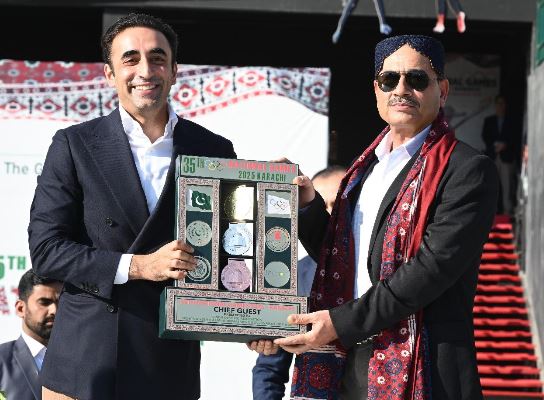
KARACHI, DEC 13: Pakistan Army secured the top position in the medal table of the 35th National Games on Saturday, showcasing strong performance across both individual and team events.

The 35th National Games concluded with a closing ceremony in Karachi, with Pakistan Army emerging as the highest medal-winning contingent.

Chief of Defence Forces (CDF) and Chief of Army Staff (COAS) Field Marshal Asim Munir attended as the chief guest, alongside PPP Chairman Bilawal Bhutto-Zardari.

According to the final medal standings shared by the Pakistan Olympic Association (POA), Pakistan Army reigned supreme with a total of 353 medals, including 200 gold medals, 97 silver, and 56 bronze medals.

The Water and Power Development Authority (Wapds) finished second with 85 gold medals, 73 silver, and 74 bronze, while Pakistan Navy remained third with 36 top honours, 39 silver, and 35 bronze.

Punjab was the most successful province in the games, concluding the week-long event with 16 gold medals, followed by Sindh with 11, Khyber Pakhtunkhwa with five, while Balochistan could claim four.

Capital territory Islamabad finished 11th with two gold medals, five silver and 11 bronze.

Azad and Jammu Kashmir (AJK) and Gilgit Baltistan remained the only participating teams which could not win a single medal and only managed seven bronze, and thus finished in the last two positions in the standings.

On the occasion, Bilawal presented CDF Field Marshal Munir with a Sindhi cap and ajrak.

During his address at the ceremony, Bilawal emphasised the broader significance of the National Games, saying: “These National Games were not merely a competition of speed, strength or skill; they were a celebration of Pakistan itself.

“From Gilgit Baltistan to Gwadar, from Khyber to Karachi, from Lahore to Larkana, every athlete who competed here carried the colours of their province but stood united under one flag,” he added.

He expressed pride that Sindh had hosted the prestigious sporting event.

“To our athletes, you are the pride of Pakistan. Whether you return home with medals or memories, you return as ambassadors; ambassadors of discipline, perseverance and national unity.

“You have shown us what Pakistan’s youth can achieve when given the opportunity and encouragement,” Bilawal noted.

He highlighted the values sport instills, saying: “Sport teaches us teamwork, courage, respect for rules and resilience in the face of challenge. These are not just sporting values, they are national values.”

Reflecting on the May conflict with India, the PPP chairman praised the armed forces’ performance, stating that the army, airforce and navy exhibited professionalism, coordination, and strength.

“Pakistan emerged victorious with its sovereignty defended and its honour upheld. This victory was not only a military victory, it was a national one. It reflected the unity of our people, the discipline of our forces and the unbreakable bond between the nation and those who stand guard over it,” he said.

He concluded by wishing that the spirit of the Games would have a lasting impact: “As these National Games conclude, may the friendships formed here endure, may the lessons learnt here guide us and may the unity displayed here continue to define our federation.”

The 35th National Games featured 14 teams, comprising departments and provinces, including hosts Sindh, Punjab, Khyber Pakhtunkhwa, Balochistan, Islamabad, Azad Jammu and Kashmir and Gilgit Baltistan, alongside Pakistan Army, Pakistan Air Force, Pakistan Navy, Wapda, Pakistan Police and Higher Education Commission (HEC).

Police detain organiser of Messi visit after Indian fans rip up seats

Police detain organiser of Messi visit after Indian fans rip up seats

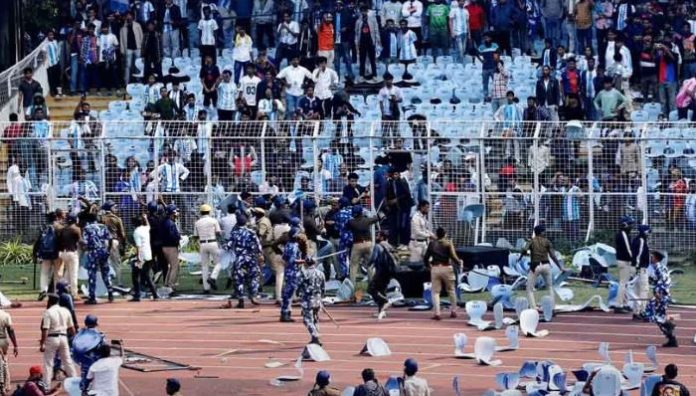
KOLKATA, DEC 13: Lionel Messi’s tour of India kicked off chaotically on Saturday as fans threw objects, ripped up seats and invaded the pitch at Kolkata’s Salt Lake stadium after the Argentine soccer great made only a brief appearance at a ticketed event.

Satadru Dutta, the event’s chief organiser, has been detained by police, said Rajeev Kumar, director general of West Bengal police.

Messi was scheduled for a 45-minute visit to the stadium, but his appearance lasted just 20 minutes. Tickets for the event were priced from around 3,500 rupees ($38.65) – more than half of average weekly income in India – but one fan said he had paid $130.

Fans in the Salt Lake stadium in the capital of the Eastern state of West Bengal threw ripped-up seats and other objects onto the field, while several people climbed a fence around the field and hurled objects.

“I can’t believe there was so much mismanagement,” said Eddie Lal Hmangaihzuala, who had travelled nearly 1,500km from Mizoram over two days to attend the event.

“Messi left quickly, I think he felt unsafe. I hardly got a glimpse of him,” he told Reuters.

The organisers of the tour did not immediately respond to a request for a comment.

“We’ve already detained the main organiser,” Rajeev Kumar told reporters. “We’re taking action so that this mismanagement does not go unpunished.

“He has already pledged in writing that tickets sold for the event should be refunded,” he added.

Chief minister apologises, orders probe
Messi is in India as part of a tour during which he is scheduled to attend concerts, youth football clinics and a padel tournament, and to launch charitable initiatives at events in Kolkata, Hyderabad, Mumbai and New Delhi.

The chief minister of West Bengal, Mamata Banerjee, apologised to Messi and ordered a probe into the incident.

“I am deeply disturbed and shocked by the mismanagement witnessed today at Salt Lake stadium,” Banerjee, who was on her way to the event when chaos broke out, posted on X.

“I sincerely apologise to Lionel Messi, as well as to all sports lovers and his fans, for the unfortunate incident,” she said.

She said she was constituting a committee to conduct a detailed enquiry into the incident, assign responsibility, and recommend measures to prevent such occurrences in the future.

West Bengal, Kerala and Goa states have long had large soccer followings in otherwise cricket-crazed India.

Multiple incidents of fan riots have taken place at Salt Lake stadium, including during a Kolkata derby match between East Bengal and Mohun Bagan in 2012 which was abandoned after a brick thrown from the stands hit a player, seriously injuring him.

Argentine soccer great Diego Maradona twice visited Kolkata, and in 2017 unveiled a statue there of himself holding the World Cup in the presence of thousands of fans.

Messi, who captained Argentina for the first time in a friendly match at the Salt Lake stadium in a 1-0 win over Venezuela in 2011, virtually unveiled a 70-foot statue of himself in Kolkata earlier on Saturday.

Chasing snowfall: Winter forecast draws tourists to northern KP

Chasing snowfall: Winter forecast draws tourists to northern KP
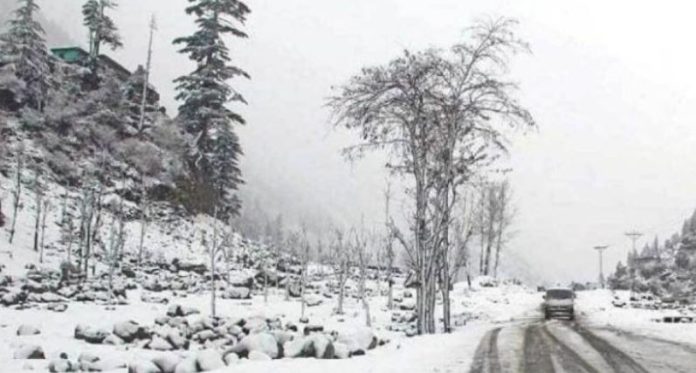
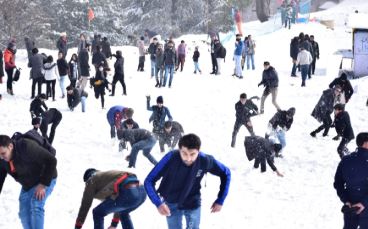
MALAM JABBA, Dec 13 (APP):Northern Khyber Pakhtunkhwa has transformed into a winter wonderland as the season’s first snowfall, forecast by the Pakistan Meteorological Department, has drawn a large number of tourists to the region, eager to experience snow-covered landscapes, trout fish and adventure sports.

As temperatures dipped over the weekend, families, snowfall enthusiasts, foodies and adventure seekers flocked to popular hills destinations including Malam Jabba, Kalam, Swat, Chitral, Upper Dir and Nathiagali.

The cold weather with chances of snowfall turned lush green mountains into breathtaking white vistas amid mesmerizing aromas of trout fish.

Renowned tourist spots such as Nathiagali, Ayubia, Kaghan, Naran, Kalam, Malam Jabba, Kumrat and Bamborat offered ideal settings for family recreation and winter photography, while the towering Hindu Kush, Karakoram and Himalayan ranges upstream added to the region’s dramatic charm with their snow-clad peaks.

While destinations like Kalam, Malam Jabba and Nathiagali are known for family-friendly tourism, areas such as Naran, Kaghan and Ayubia cater to thrill-seekers with activities including chairlift rides, skiing and snowboarding. These attractions continue to draw adventure lovers from across the country.

For those in search of a more immersive winter experience, valleys such as Hunza, Skardu, Naltar, Chitral and Swat provide pristine snowfall, panoramic mountain views and opportunities for snow sports. Swat, often called the “Switzerland of Pakistan,” has emerged as a leading winter tourism and skiing destination in the country.

“I came to Malam Jabba with friends after hearing the Met Office forecast for snowfalls,” said Engr Khushal Khan, a resident of Lower Dir. “Malam Jabba and Kalam receive some of the heaviest snowfall in Pakistan.”

He advised tourists to carry extra warm clothing and added that enjoying Swat’s famous trout fish makes the winter trip even more memorable.

Malam Jabba is regarded as a snowfall paradise, receiving an average of nearly ten feet of snow annually, which is ideal conditions for skiing. Its skiing history dates back to 1962, when the first competition was held there. The area gained international recognition after the establishment of a formal ski resort in 1988 and today offers world-class skiing and snowboarding facilities.

The skiing season typically runs from December to March, attracting thousands of visitors. The resort’s chairlift—one of the longest in Pakistan offers panoramic views of snow-blanketed mountains.

Beyond winter sports, Swat’s appeal is enhanced by its rich cultural heritage, including remnants of the ancient Gandhara civilization.

Adventure activities such as river rafting and fishing, particularly for the famed Swat trout, add to the valley’s charm. Nearby valleys such as Kalam, Mankial and Falaksair provide equally stunning backdrops for winter recreation.

“I love snowfall and wanted to experience Swat’s winter charm before returning to the UAE for work,” said Waqar Khan, a transporter from Nowshera.

“Travelling to nearby peaks on snowy tracks is an unforgettable thrill. Brown trout and skiing make Swat truly priceless.”

However, tourists urged authorities to ensure better maintenance of roads during the December-March period, as snowfall often disrupts travel routes. They said that poor road conditions sometimes dampen the experience and can pose safety risks.

Visitors also called for improved infrastructure, regulated hotel charges and enhanced facilities, saying these measures could help Swat emerge as the winter tourism capital of Pakistan.

Former ambassador Manzoor-ul-Haq, who recently visited the valley, said Swat’s unique blend of snowfall, natural beauty and trout fish is rarely found elsewhere in the world.

“I have travelled widely, but Swat’s snow-covered peaks, archaeological heritage and scenic beauty are exceptional,” he said, highlighting sites such as Falaksair, Elum and the Saidu Sharif Museum as major attractions for both adventure and history enthusiasts.

Recognizing winter tourism as a key source of revenue, the Khyber Pakhtunkhwa Tourism Department is working on several initiatives to fully harness its potential.

“Winter galas and skiing events are being planned this season,” said a spokesperson for the Culture and Tourism Authority.

To reduce congestion at major resorts, new tourist destinations including Sola Tanar, Puchar and Jargo Valley are being developed.

The government is also focusing on environmental preservation through the establishment of camping pods, road improvements and construction of the Mankyal–Bada Sarai road to improve access to snowbound areas.

Plans are also underway for jeep tracks, tourist facilitation centers and an Integrated Tourism Zone with modern amenities at Mankyal under the KITE project. A dedicated tourism police force has been deployed across Swat, Naran and Kaghan to assist visitors and ensure their safety.

Meanwhile, the KP government and the Italian Archaeological Mission have marked 70 years of partnership in Swat, a collaboration that began in 1955 under the patronage of the Wali of Swat. The partnership continues with the launch of the ‘Khyber Path’ project, funded by the Italian government, aimed at excavating and conserving archaeological sites while training local staff.

As winter sets in fully, northern Pakistan once again captivates visitors with its snow-covered landscapes, adventure sports and rich cultural heritage—making it a must-visit destination for snowfall lovers across the country.

HEC launches nationwide quality review of MS/MPhil & PhD Programmes

HEC launches nationwide quality review of MS/MPhil & PhD Programmes

ISLAMABAD, DEC 13 /DNA/ – The Higher Education Commission (HEC) of Pakistan has initiated a comprehensive quality review of graduate programmes, particularly MS/MPhil and PhD degrees, offered by Higher Education Institutions (HEIs) across the country.

The decision follows concerns during a comprehensive presentation by the Quality Assurance Agency to the Executive Director HEC regarding academic rigour and implementation standards of graduate education, especially in cases where PhD programmes are being conducted in part-time formats without meeting essential quality benchmarks.

Despite the introduction of the highly flexible Graduate Education Policy (GEP-2023) and HEC’s extensive outreach sessions including orientation, and capacity-building workshops, conducted both physically and online, serious gaps remain in the quality, supervision, governance, and delivery of graduate programmes in several institutions.

Taking strong notice of these concerns, Prof. Dr. Zia-Ul-Haq, Executive Director HEC, has mandated an immediate, sector-wide evaluation of graduate programmes in line with the Programme Review for Enhancement and Effectiveness (PREE) standards under the Pakistan Precepts Standards and Guidelines (PSG).

Letters have already been issued to the selected HEIs as part of the first phase of this review. Dedicated HEC teams will begin the evaluation process soon, focusing on Governance and Management of Graduate Programmes; Supervision Quality; Research Integrity and Ethics; Student Support and Grievance Redressal; Research Quality and Culture; Programme Infrastructure, Learning and Assessment; and Outreach and Professional Integration.

HEC reiterates its commitment to ensuring that graduate education in Pakistan meets national and international standards of excellence. The Commission encourages all HEIs to fully cooperate with the upcoming review and to take proactive steps to strengthen their programmes in the best interest of students, research productivity, and the country’s higher education ecosystem.

HEC, British Council expand partnership for scholarships, research grants

HEC, British Council expand partnership for scholarships, research grants

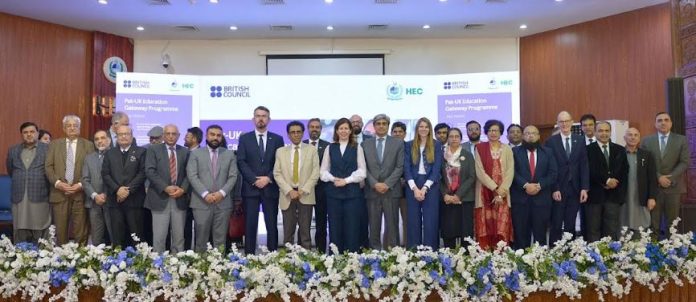
ISLAMABAD, DEC 13 /DNA/ – The Higher Education Commission (HEC) and British Council have launched the £10 million second phase of Pak-UK Education Gateway partnership. The Gateway will help the UK’s world class institutions work with their Pakistani counterparts on shared challenges from climate change to mobility and growth.

A launch ceremony was organised at the HEC Secretariat, which also celebrated the achievements of Phase-I of Pak-UK Education Gateway partnership.

Phase-II will open up numerous opportunities, and further strengthen the bilateral collaborative relationship. It will result in increased funding for scholarships, research grants and exchange between universities in both countries to work on shared challenges like climate change. A Start Up Challenge Fund will be set up to support Pakistan-UK collaborations in pursuing opportunities for growth, finding new markets and commercial success.

The partnership will also lead to development of high performing leadership in Pakistan’s education system with the governance to support it. This means a strong emphasis on inclusion, including access on campuses for people with disabilities, the role of women in senior leadership positions, quality assurance and standards setting, ensuring that more young people enjoy access to higher education. The collaborative programme is also aimed at paving the way for the growth of Transnational Education and a commitment to Mutual Recognition of Qualifications.

Speaking at the occasion, Federal Minister for Education and Professional Training, Dr. Khalid Maqbool Siddiqui said that Pak-UK Education Gateway has produced tangible results. He commended the efforts of HEC and British Council in fostering this bilateral partnership. The Minister said that the Government is committed to promoting higher education in the country through dedicated measures including development of collaborations and partnerships, and equipping country’s youth with education and skills. “Education is the bridge that connects people, cultures, and futures,” he emphasized.

Acting Chairperson HEC, Mr. Nadeem Mahbub said that Pak-UK Education Gateway is more than a mere programme, functioning instead as a system-to-system partnership. He shared background of the HEC-British Council partnership and shed light on the achievements marked under the Gateway initiative. The Chairperson expressed gratitude to all the stakeholders including the UK and Pakistani Governments, the higher education sectors, and the HEC and British Council teams for programme’s success. He noted that the programme has touched countless lives and continues to benefit the people.

British High Commissioner Jane Marriott said, “Education is the building block of growth and prosperity. Our work on education in Pakistan supports people throughout their lives: from helping reform education policy at the school level, to our strong partnership in higher education. This next phase builds on our already strong relationship, and will unlock opportunities to help both our higher education sectors thrive”.

In his welcome address, Executive Director HEC Dr. Zia Ul Haq highlighted the significance of Pak-UK Education Gateway in further strengthening the longstanding partnership. He said the Gateway has proved to be a flagship collaboration in key areas such as leadership development, quality assurance, distance learning, international mobility, and transnational education, etc.

Phase-I of Pak-UK Education Gateway, launched in 2018, supported the development of 165 partnerships between institutions in both countries, 2,000 joint research papers and £5 million that was awarded in research grants. Due to the work done in Phase-I – the Gateway has already become a cornerstone of international collaboration, driving innovation and research excellence.

UK Development Minister meets PM Shehbaz

UK Development Minister meets PM Shehbaz

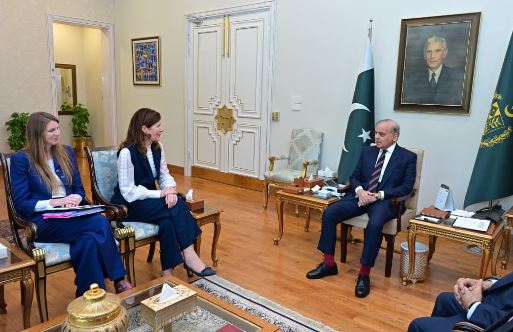
ISLAMABAD, DEC 13 /DNA/ – The Right Honourable Baroness Jenny Chapman, UK’s Minister of State for International Development and Africa, called on Prime Minister Muhammad Shehbaz Sharif in Islamabad today.

Baroness Chapman is currently on an official visit to Pakistan.
The Prime Minister and Baroness Chapman exchanged views on matters of mutual interest, including development cooperation, climate resilience, economic engagement and broader regional issues.

Both sides reaffirmed their shared commitment to further deepening cooperation in these key areas.

The Prime Minister underscored that Pakistan and the United Kingdom enjoy a longstanding relationship rooted in shared history, strong institutional linkages and mutual respect. He also highlighted the dynamic role of the British Pakistani diaspora, which continues to serve as a vital bridge between the two countries.

The Prime Minister welcomed the visit as an important opportunity to advance bilateral dialogue and expressed confidence that it would contribute to strengthening the partnership between Pakistan and the United Kingdom.

Field Marshal Munir lauds troops’ morale, mission-oriented training

Field Marshal Munir lauds troops' morale, mission-oriented training

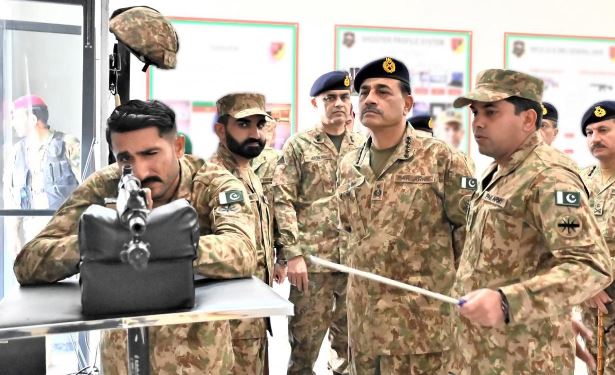
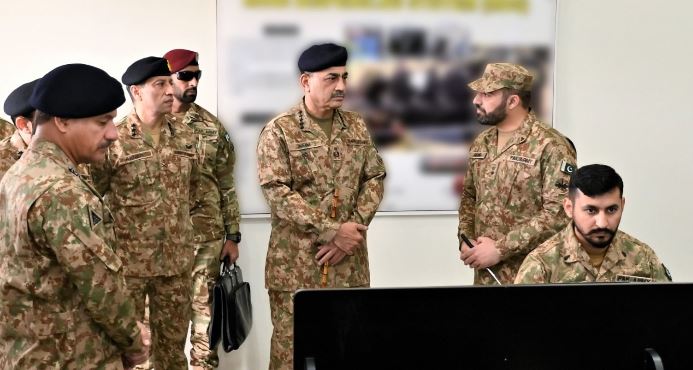
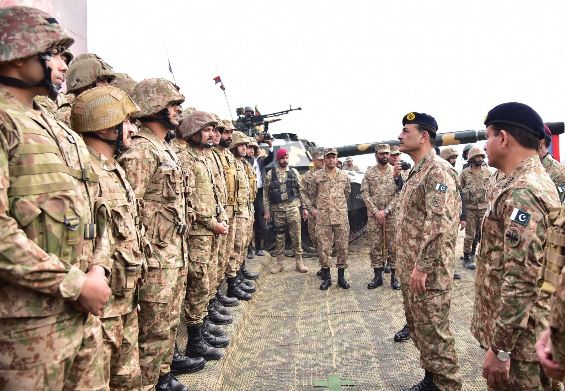
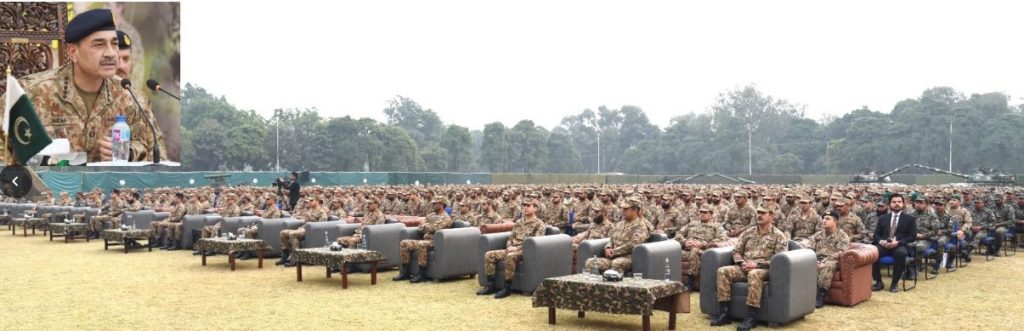
RAWALPINDI, DEC 13 /DNA/ – Field Marshal Syed Asim Munir, NI (M), HJ, COAS & CDF, visited Gujranwala and Sialkot Garrisons. Upon arrival, he was briefed on the formation’s operational readiness and key initiatives for strengthening combat preparedness.

The Field Marshal witnessed field training exercise and advanced simulator training facility, lauding the formation’s high professional standards and overall state of readiness. Emphasizing the significance of technological adaptability, he noted that modern warfare demands agility, precision, situational awareness and swift decision-making.

While interacting with officers and soldiers, the COAS & CDF lauded their high morale and steadfast commitment to national security while underscoring the importance of rigorous and mission-oriented training. He emphasized that Pakistan Army remains fully focused on both internal and external challenges, including hostile hybrid campaigns, extremist ideologies, and divisive elements seeking to undermine national stability.

Earlier on his arrival at Gujranwala, the COAS & CDF was received by Corps Commander Gujranwala.

When Law Wears a Uniform

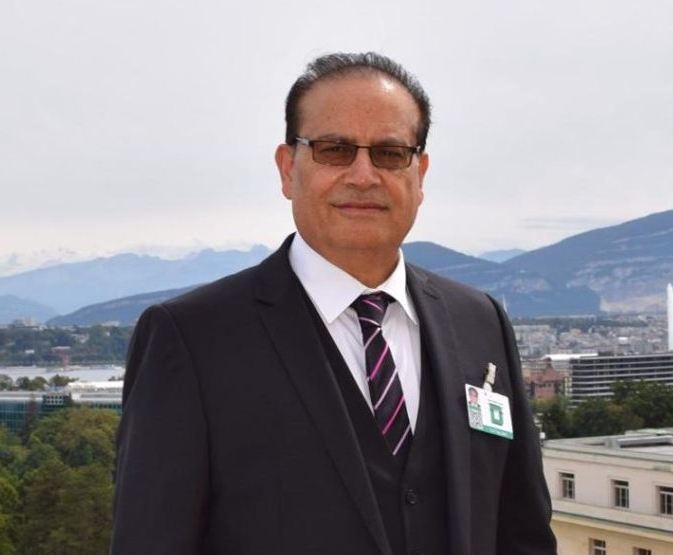
Qamar Bashir

Qamar Bashir

A state does not collapse the moment tanks roll into the capital or a general announces the suspension of the constitution. History shows that the most enduring and damaging forms of authoritarianism often emerge quietly, through legal amendments, institutional rearrangements, and the gradual subordination of civilian authority to military command. Pakistan today stands at precisely such a juncture. Without a formal declaration of martial law, the country exhibits nearly every substantive characteristic by which political scientists, constitutional scholars, and international legal bodies define military rule. The façade of civilian governance remains, but the substance of power has decisively shifted.

At the heart of this transformation is the structural reconfiguration of the state itself. Across established democracies, civil–military relations rest on a clear and universally accepted principle: the military serves under civilian supremacy, operates within defined constitutional limits, and remains institutionally subordinate to elected authority. Whether in the United States, the United Kingdom, France, or even semi-authoritarian systems, military chiefs hold fixed tenures, retire on schedule, and answer to civilian defense ministers and legislatures. There exists no precedent in functioning constitutional governance for a serving army chief, paid from the civilian treasury, to hold office indefinitely or for life.

Yet Pakistan has moved dangerously close to precisely this anomaly. Through constitutional amendments passed under conditions widely perceived as coercive, the tenure of the army chief has been repeatedly extended, while public discourse has been deliberately conditioned to normalize permanence in a role that, by its nature, must be temporary. When asked about retirement, the response is not institutional humility but visible irritation, coupled with claims of higher national missions that render accountability irrelevant. In comparative constitutional terms, this is not stability; it is personalization of power.

Even more striking is the concentration of military command itself. In established systems, the separation of services—army, navy, and air force—is not a matter of tradition alone, but a safeguard against absolute control. Joint coordination exists, but supremacy does not. No single uniformed officer simultaneously dominates all branches without civilian oversight. Such consolidation is historically associated not with national defense, but with military autocracy. Pakistan’s recent constitutional restructuring, which elevates one office above all armed services, represents not administrative efficiency but a profound distortion of command balance, extending martial dominance even within the military itself.

This internal militarization has been matched by an external economic takeover. Across the world, armed forces may execute infrastructure projects during emergencies or provide logistical support for development, but they do not own, manage, or monopolize the national economy. Pakistan’s experience diverges sharply from this norm. Military-controlled entities now dominate infrastructure development, often without competitive bidding, while strategic sectors such as agriculture, logistics, and industrial development—particularly under the second phase of the China–Pakistan Economic Corridor—have been effectively absorbed into a corporatized military ecosystem.

International development models recognize Special Economic Zones as civilian-led instruments for industrial growth, foreign investment, and employment generation. Their capture by military institutions transforms them from engines of inclusive development into closed systems of rent extraction. This shift does not merely distort markets; it entrenches a new political economy in which economic power reinforces coercive authority, and civilian institutions are hollowed out from within.

Equally consequential is the erosion of judicial independence. A functioning judiciary is not defined by the existence of courts, but by their capacity to restrain power. Where judges operate under intimidation, where constitutional amendments are insulated from challenge, and where prolonged detentions persist without due process, the rule of law becomes performative rather than real. International legal doctrine is unequivocal: when courts can no longer check the executive or the military, constitutional order has collapsed in substance, regardless of its textual survival.

Parliament, too, has been reduced to form. Comparative legislative studies demonstrate that assemblies lose legitimacy when they cease to deliberate freely and instead function as instruments for retroactive legal cover. When amendments are passed not through consensus but under duress, law itself becomes a weapon rather than a restraint. In such conditions, elections do not restore democracy; they merely legitimize its absence.

Control over media completes the architecture of undeclared martial rule. Authoritarian systems rarely silence all voices; instead, they curate narratives, elevate loyal platforms, and delegitimize dissent by branding it treasonous. The role of the military spokesperson in Pakistan has evolved from institutional communication to overt political arbitration, publicly condemning one political force while sanctifying another. This is not information management; it is narrative command.

Taken together, these developments satisfy every internationally recognized criterion of martial law as defined in political theory and comparative governance. Civilian supremacy has been replaced by military dominance. Economic control has shifted from elected institutions to uniformed management. Judicial independence has been neutralized. Parliamentary authority has been subordinated. Media freedom has been constrained. Political opposition has been criminalized. The absence of a formal proclamation does not negate these realities; it merely disguises them.

History offers a sobering warning. States that normalize indefinite military rule do not achieve stability; they accumulate fragility. Institutions decay, merit collapses, economic confidence erodes, and society internalizes fear as a governing principle. Even the armed forces suffer, as blocked promotion pathways and personalized command undermine professionalism and morale. What begins as control ends as corrosion.

Pakistan today stands not at the edge of a constitutional crisis, but deep within one. The question is no longer whether martial law exists, but whether the nation can reclaim civilian sovereignty before irreversible damage is done. Democracies are not destroyed in a single night; they are dismantled piece by piece, until law itself wears a uniform and authority answers to no one.

And history is unambiguous on one final point: no state can endure indefinitely when the gun replaces the constitution as the final arbiter of power.

Qamar Bashir
Press Secretary to the President (Rtd)
Former Press Minister, Embassy of Pakistan to France
Former Press Attaché to Malaysia
Former MD, SRBC | Macomb, Michigan, USA

APNS condemns govt’s ad ban on Dawn News, Media Group

APNS condemns govt's ad ban on Dawn News, Media Group

KARACHI, DEC 13 /DNA/ – The All Pakistan Newspapers Society in a statement has expressed its concern on the decision of the federal and provincial governments to stop government advertisements to Dawn News and other media outlets of Dawn Media Group.

The APNS stated that for last 13 months Daily Dawn was suffering from curtailment of govt advertising but now the news channel and FM radio owned by Dawn Media has also been subjected to denial of government advertising,which is not only unjust but also attack on freedom of expression. The APNS observed that this action has been taken to force the media group to change its editorial policy.

The APNS is of the considered opinion that the government advertisements are paid through public exchequer hence should not be used as tool to strangle the dissenting voices.

The APNS expresses its solidarity with Dawn Media Group in this hour of financial stifling and urges upon the federal and provincial governments to review their unconstitutional decision and restore government advertising to Dawn Media Group

Stay Connected

64FansLike
60FollowersFollow

Latest Reviews

Exchange Rates

USD - United States Dollar
EUR
1.17
GBP
1.34
AUD
0.67
CAD
0.73