BEIJING, Sept. 30 – Lahore to Karachi Motorway Section III: Lahore-Abdul Hakeem (M-3) project in Pakistan was taken as an example for international green supply chain management at the 2nd Belt and Road Green Development Forum for Infrastructure Supply Chain held in Beijing.
Song Rongjun, Chief Executive of China Railway 20 Bureau Group Corporation (International) shared the project at the forum, Gwadar Pro reported on Wednesday.
Addressing the symposium, Song Rongjun said the M-3 project implemented the administrative system of unified leadership, level-to-level management and different levels assuming different responsibilities.
During the tendering process, the selection of domestic suppliers was all selected from the list of qualified suppliers of CR20G, and the qualifications of foreign suppliers had been examined by methods such as recommendations by local partners, market surveys, and supply performance checks.
In terms of purchase, the project adhered to the concept of environmental protection and resource conservation.
The mechanical equipment and materials applied to the project met or exceeded the local environmental protection requirements. Additionally, new materials, new equipment, and new processes employed in the construction of the project had been also promoted in Pakistan.
The Lahore-Abdul Hakeem Motorway (M-3) project was jointly constructed by CR20G and ZKB, the latter being Pakistan’s second-largest construction company. In particular, ZKB was mainly in charge of 40% of the project site construction.
When commenting on cooperation with ZKB, Song Rongjun said that the project jointly contracted by Chinese and Pakistani enterprises can give full play to the comparative advantages of the two countries. Chinese enterprises can transfer management experience and construction technologies to the Pakistani side.
Meanwhile, Pakistani enterprises can assure manpower and material support for the project. Besides, materials such as steel, cement, stones and sand, asphalt, heavy oil, and diesel required by the project were all purchased locally, which reduced the logistics cost and drove forward the development of local relevant industries.
Regarding the environmental protection of the project, Song Rongjun told China Economic Net that CR20G had completed 70% of the designed greening within the scope of its responsibility, and the remaining work would be finished within two months after this year’s rainy season.
By that time, more than 150,000 trees and 1.4 million square meters of grass will be planted, symbolizing the practical implementation of the initiative of “Clean and Green Pakistan” proposed by Prime Minister Imran Khan.
It is learned that since the commencement of the Lahore-Abdul Hakeem Motorway project, more than 2,000 local skilled workers have been trained, more than 7,000 local workers have been engaged in the construction, and the number of Chinese management personnel is less than 500, which accounts for the lowest proportion among all the overseas projects of CR20G.
Statistics show that 92 kilometers of asphalt pavement roads were built for areas along the motorway with funds raised during the construction of the Lahore-Abdul Hakeem Motorway.
Desks and chairs were donated to local schools, and more than 30 kilometers of village roads were built, which substantially improved the local infrastructure and enhanced the living standards of residents. Barracks in the work areas including various facilities will be completely handed over to the local government upon the completion of the project.
SUKKUR : Lauding the smart lockdown policy of Prime Minister Imran Khan to contain coronavirus spread, Governor Sindh Imran Ismail on Wednesday said that the world is following the smart lockdown policy of PM Khan.
Talking to media in Sukkur, Governor Sindh Imran Ismail said PM was ridiculed when he introduced a smart lockdown policy to counter coronavirus spread, but today, the world is appreciating and following it.
He said that number of COVID-19 cases in Pakistan has declined but not completely eliminated from the country, the threat is still there.”Insha Allah second wave of coronavirus will not come in Pakistan.”Replying to a query, Imran Ismail said that he is unaware of the imposition of governor rule in Sindh and added that Prime Minister Imran Khan has never discussed this matter with him.
The governor ruling out any political change in the country said that PTI government will complete its 5-year constitutional term.
Earlier in the day, as many as 747 new cases of the coronavirus surfaced in Pakistan during the previous 24 hours, pushing the number of infections in the country to 312,263.
ISLAMABAD : The Pakistan Tehreek-e-Insaf government on Wednesday decided to keep the price of petrol at its existing rate for the month of for next 15 days.
Federal government has also decided to increase price of high speed diesel by Rs2.4 per liter.
Earlier, OGRA, in its summary to the petroleum division, has suggested a reduction in the prices of petroleum products for the first 15 days of October.
It is pertinent to mention that the government had also maintained petroleum prices of August for the month of September 2020.
Islamabad : Former Pakistan cricket captain and swashbuckling all-rounder, Shahid Afridi, said Tuesday he had been misquoted in a recent interview where it was said that he had blamed Head Coach Misbah-ul-Haq for the 2011 World Cup semi-final loss to India.
Afridi shared a screenshot of the interview, stating that he had been ‘misquoted’ and that every batsman in the team could not sustain the pressure of the match.
“Unfortunately I have been misquoted in this interview. The 2011 defeat was due to batting failure of the team. The batsmen including myself didn’t sustain pressure of the chase. No blame on any individual!” he tweeted.
Arab News had quoted Afridi as saying: “Many people speak about Misbah that he played a slow inning,” Afridi said in an interview last week. “First, it’s the nature of Misbah, this is his game. He takes enough time [to settle]. He strives to take the game to the end. But this situation required [from him] to get the scoreboard going”.
During the interview, the former cricket captain had also praised the late Bob Woolmer as a good coach. “He [Woolmer] won’t do politics … He knew the strengths of each player, he knew about the weaknesses so when a player wouldn’t perform, he won’t call him names but support him, he would back him,” Afridi had been quoted in the interview as saying.
Madrid : Real Madrid coach Zinedine Zidane has no interest in bringing in any more players before the transfer window closes next week, he said on Tuesday.
Madrid still looked like a work in progress in Saturday’s scrappy 3-2 win over Real Betis after drawing their first game of the season 0-0 at Real Sociedad, but the Frenchman does not believe adding to his squad is the answer.
“We already have a lot of players, why would we want to add any more?,” Zidane told a news conference ahead of Wednesday’s home game against Real Valladolid.
“It is already very difficult to pick a team, because all the players are very good, so why add more. The market is open until Oct. 5 but I’m very happy with what I have. This squad is mine and for me they are the best.”
Zidane will be without Germany midfielder Toni Kroos against Valladolid and Sunday’s trip to Levante, but he said Eden Hazard was getting closer to returning to action.
There have been questions about Hazard’s weight, but Zidane dismissed any suggestions the Belgian forward had an unprofessional attitude, putting his lack of impact at Real following his 100 million-euro move last year down to two ankle injuries.
“I don’t think he’s unprofessional, he’s just had a very big problem which has been bothering him for a long time. What we want is for him to not feel any discomfort again, so we need to wait,” he added.
“It’s a long season and he wants to be back on the pitch with his team mates so he can play well and help us out.
“He’s getting very close, he’s training regularly with us and getting into shape and getting ready to come back.”
Due to renovation work on their Santiago Bernabeu stadium, Madrid are continuing to play home matches at their training ground, where they won all six matches at the end of last season.
Pakistan can only become a developed nation when women are encouraged to take part in economic activities and their skills properly utilized for the greater cause of national development: MPs
Mahnoor Ansar
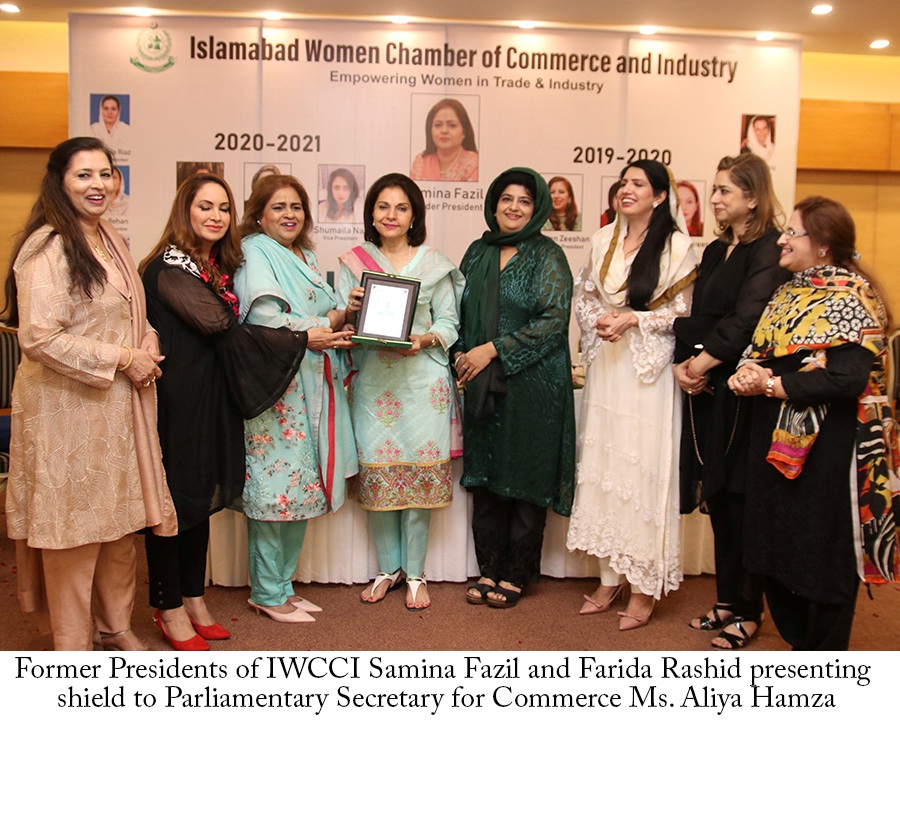
ISLAMABAD: Noted woman entrepreneur Neelofar Khan has been elected as President of the Islamabad Women’s Chamber of Commerce and Industry (IWCCI).
Rozina Lahooti has been elected as Senior Vice President, Shumaila Naz has been elected as Vice President at 11th Annual General Meeting.
The meeting was attended by a large number of businesswomen, former office-bearers and the newly-elected executive committee.
Chief Guest Parliamentary Secretary for Commerce, Industries and Production Ms Aliya Hamza, Senator Seemi Ezdi and MNA Dr Nausheen Hamid also participated in the event and took an oath from the newly-elected office-bearers.
Speaking on the occasion, Ms Aliya Hamza, Seemi Ezdi and Dr Nausheen Hamid, founder president IWCCI Samina Fazil, Farida Rashid and others said that entrepreneurship is one of the best ways to empower women and the government is trying its best to provide maximum support to businesswoman.
They said that Pakistan can only become a developed nation when women are encouraged to take part in economic activities and their skills properly utilized for the greater cause of national development.
The speakers lauded the women empowerment initiatives by the government and stressed that more should be done for social and economic development of women which will benefit the entire population of the country.
The women leaders said that they will try to increase economic opportunities for women through different capacity building initiatives, while safeguarding their rights and uplifting their status in the society.
Samina Fazil paid tributes to the outgoing office-bearers of IWCCI and lauded their services and asked the newly-elected officials to try best to serve the women.
She said that gender equality is the key to progress as the majority of our population comprises of women but they are discouraged in some places.
The newly-elected office-bearers said that government departments and private sector institutions can play a positive role in strengthening women’s economic capacities which can guarantee accelerated social and economic growth of Pakistan.
President Xi further mentioned that, spanning thousands of miles and years, the ancient silk routes embody the spirit of peace and cooperation, openness and inclusiveness, mutual learning and mutual benefit
Syed Ali Nawaz Gilani
1stOctober 2020, the 71st Foundation Day of People’s Republic of China, like national or foundations days of all other nations around globe, is of paramount significant. However, the Chinese President, Xi Jinping adds more value and significance to this already valuable and significant occasion for the Chinese people and its well-wishersthroughout the world. Since 2012, President, Xi Jinping hasinitiated various mega projects, including Belt and Road Initiative for collective prosperity of the wider community of the global village.
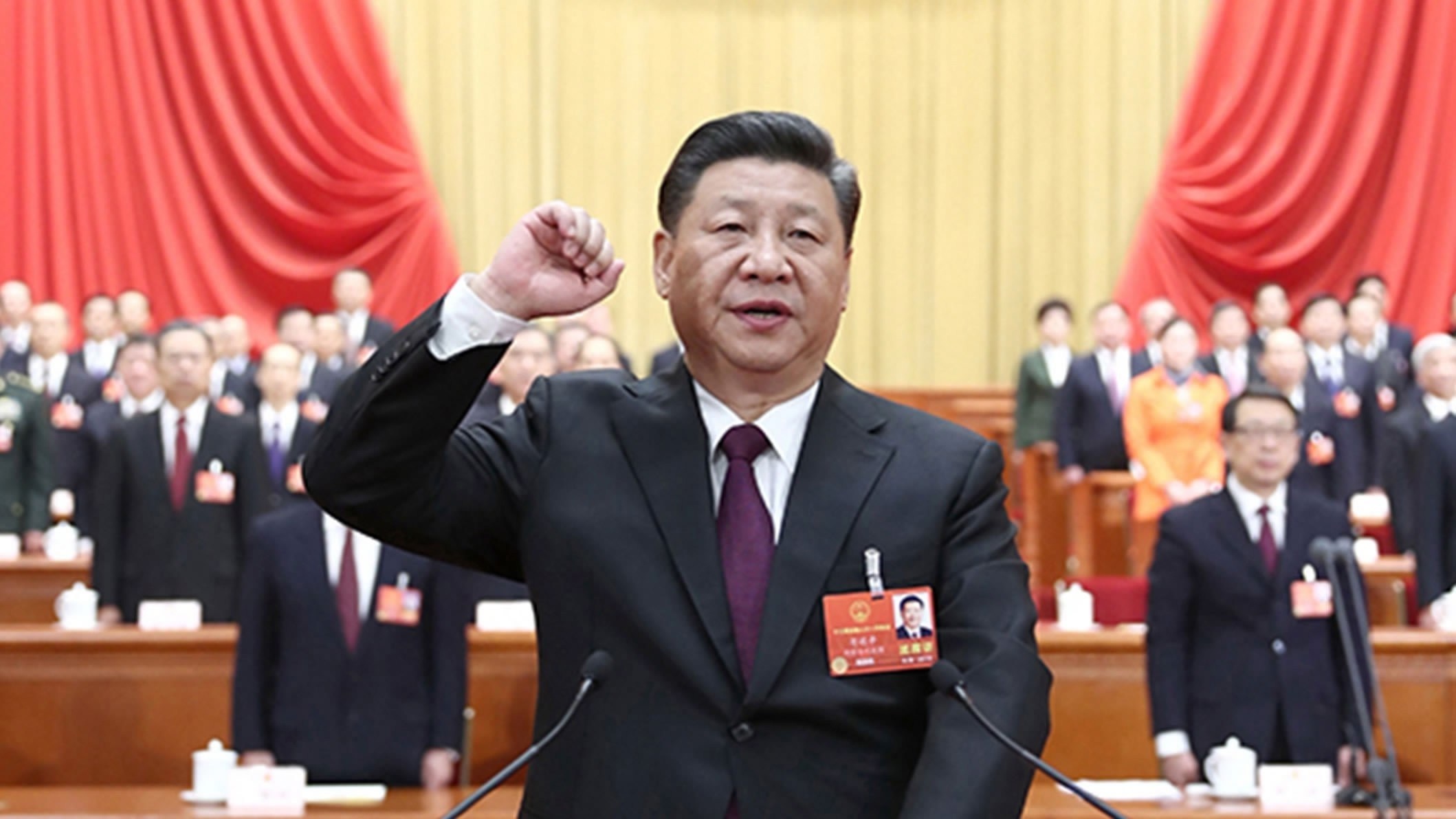
Owing to his achievements, his recent address to the united Nations General Assembly is worthwhile. Xi Jinping does not wish to engage in the new cold war, told United Nations General Assembly,“China is the largest developing country in the world, a country that is committed to peaceful, open, cooperative and common development”.He expressed that China did not has any intention of fighting either cold or hot wars with any of the countries of this world. The President, being focused at the peace of the global village largely, vowed for peaceful existence of world countries, sharing businesses.
This statement that came from the Chinese President is immensely importantas it is indicative of China’s preferences with regard to world development in general and the President’s intentions in particular. His sublime speechhighlights that how the President, Xi Jinping intends to support and favour multilateralism and safeguards international system with the United Nations at its core. He also mentioned that the world would never return to isolation and no one can sever the ties between countries.
Ever since 2012, the hon’ble President, Xi Jinping has taken steps that amicably highlight his visionary zeal of developing the world. From BRI to every single step that he has taken for the strengthening of shared community values and its prosperity, China has played its leading role not only in small regions but larger world avenues.As China claimed its strength during the last year landmark celebrations of its 70th Founding Day, proved it by facing and fighting global challenge of the COVID-19 pandemic in a spic and span manner.
This COVID-19 affected China firstly and thenit attacked entire world, but the world community, later on,learned a lot from Chinese experience as how tohandle this fatal virus. The credit for this, however, goers to the Chinese leadership &its determined nation for their resilience, perseverance and citizenship. It is, in actual, China who taught to the world as how to face any pandemic. Thus, China becomesa role model for other nations for which we must crown under President Xi and his dedicated nation driven by his hardworking team. Chinese President, Xi Jinping warned the assembled leaders and their nations of the “clash of civilizations” as the coronavirus pandemic ravages the world, while addressing the United Nations General Assembly. President mentioned that theworld must “oppose politicization and stigmatization” over COVID-19, urging global leaders to embrace the “concept of a bigger family … and avoid falling into the trap of a clash of civilizations.”
President Xi makes this clear to the world leaders that the China had no desire for “hegemony, expansion or sphere of influence” and further mentioned that “China has no intention to enter a Cold War with any country” he said, insisting China is instead a bulwark of international systems such as the World Trade Organization and a willing partner in the face of diplomatic spats.
“We insist on dialogue to bridge differences and negotiation to resolve disputes,” Xi added.
These most recent statements show that the Chinese President Xi’s mindset that China and its leadership always prefer to work for peaceful coexistence of the world community and strictly implement anon-interference policy: avoiding any indulgenceinaffairs of other and preferring to aolve every conflict on a table through a talk. Surprisingly, the China’s picture portrayed by the US is quite different from what China in real is and it nonetheless torn face of the US. It explicitly expresses that how the US wants to paint her own choiceof colours in the picture which are not real.
While, addressing the UN, President Xi Jinping recalled that Seventy-five years ago where China made historic contributions to winning the World Anti-Fascist War and supported the founding of the United Nations. He said, “the history of development of human society is a history of our struggles against all challenges and difficulties and our victories over them. At present, the world is battling the COVID-19 pandemic as it goes through profound changes never seen in a century. Yet, peace and development remain the underlying trend of the times, and people everywhere crave even more strongly for peace, development and win-win cooperation. COVID-19 will not be the last crisis to confront humanity, so we must join hands and be prepared to meet even more global challenges”. President Xi Jinping few years ago while speaking at BRI international summit mentioned, “Over 2,000 years ago, our ancestors, trekking across vast steppes and deserts, opened the transcontinental passage connecting Asia, Europe and Africa, known today as the Silk Road. Our ancestors, navigating rough seas, created sea routes linking the East with the West, namely, the maritime Silk Road. These ancient silk routes opened windows of friendly engagement among nations, adding a splendid chapter to the history of human progress. The thousand-year-old “gilt bronze silkworm” displayed at China’s Shaanxi History Museum and the Belitung shipwreck discovered in Indonesia bear witness to this exciting period of history.
President Xi further mentioned that, spanning thousands of miles and years, the ancient silk routes embody the spirit of peace and cooperation, openness and inclusiveness, mutual learning and mutual benefit. The Silk Road spirit has become a great heritage of human civilization.
— Peace and cooperation.
— Openness and inclusiveness.
— Mutual learning.
— Mutual benefit.
History is our best teacher. The glory of the ancient silk routes shows that geographical distance is not insurmountable. If we take the first courageous step towards each other, we can embark on a path leading to friendship, shared development, peace, harmony and a better future.
From the historical perspective, humankind has reached an age of great progress, great transformation and profound changes. In this increasingly multi-polar, economically globalized, digitized and culturally diversified world, the trend toward peace and development becomes stronger, and reform and innovation are gaining momentum. Never have we seen such close interdependence among countries as today, such fervent desire of people for a better life, and never have we had so many means to prevail over difficulties.
No doubt since start 2020, the 1.4 billion Chinese, undaunted by the strike of COVID-19, and with the Chinese leadership & people united as one, have made all-out efforts to control the virus and speedily restore life and economy to normalcy. Chinese Nation confidence to achieve our goals within the set time frame, that is, to finish the building of a moderately prosperous society in all respects, lift out of poverty all rural residents living below the current poverty line, and meet ten years ahead of schedule the poverty eradication target set out in the 2030 Agenda for Sustainable Development. China is the largest developing country in the world, a country that is committed to peaceful, open, cooperative and common development. We will never seek hegemony, expansion, or sphere of influence. We have no intention to fight either a Cold War or a hot war with any country. We will continue to narrow differences and resolve disputes with others through dialogue and negotiation. We do not seek to develop only ourselves or engage in a zero-sum game. We will not pursue development behind closed doors. Rather, we aim to foster, over time, a new development paradigm with domestic circulation as the mainstay and domestic and international circulations reinforcing each other. This will create more space for China’s economic development and add impetus to global economic recovery and growth.
Now, world community referred China due to landmark initiatives and steps taken by President Xi Jinping’s China to further engraving its vital role in global stage. Apart from other challenges, China also faced internationally baseless propaganda through out 2020, but during all these times, China continued to work with the same speeding pace andproved to remain dedicated and devoted to overcome these crises in health sector and even economic sectors through all available means which shows that President Xi Jinping’s China is now more young and energetic and will continue to work as a builder of global peace, a contributor to global development and a defender of international order.
(This writer is senior Media Consultant and could be contacted at [email protected])
The technology industry of the world has grown by leaps and bounds during the last couple of decades. We have now entered the digital age where almost all processes are being dealt online. If in the late 1990s when the world was introduced to the Internet, then in 2010 we are using the same Internet with unimaginable speeds to complete tasks. What began as a search engine as Google in the 1990s, is now a multinational technology company that specializes in Internet-related services and products, which include online advertising technologies, a search engine, cloud computing, software, and hardware. When talking about the tech industry of the world, we do mention five of its biggest companies. They are Apple, Google (Alphabet), Facebook, Amazon, and, Microsoft. Their combined market capitalization is estimated to be more than $4 trillion. It is indeed unbelievable to see that these five companies that were mere dreams many decades ago are now a global phenomenon. These companies have been offering services to a global audience and have a strong online presence. With the advent of digital media, customers are just a click away from interacting with the customer support of these companies. Moreover, these companies have remained true to their niche, genre, and business objectives. What they were offering in the 1990s, they have evolved in the same domain. They have used innovation and market research to offer such services that fulfill the needs of individual customers and corporations. Moreover, with technology as the mainstay of these companies, they have been utilizing artificial intelligence (AI) to bring new products into their portfolio. These companies have also focused on identifying a problem and offer solutions as products and services to resolve such challenges. Indeed, their market worth and relationship with customers will only grow in the coming times.
With regard to its primary role—Peaceful World— the United Nations faces a multitude of challenges. In the absence of any meaningful effort to mitigate these challenges, the UN has incrementally been in a nose-dive posture with regard to its credibility, as an honest peace broker, and effectiveness in term of its ability to implement its resolutions. Unless a meaningful strategy is adopted to mitigate the impact of these challenges, the role of the UN is likely to keep shifting from substance to nuance.
Prime Minister Imran Khan, highlighted the importance of the 75th anniversary of the UN. “This is also a time for us to reflect whether as the United Nations, we have been able to realize the promise we made collectively to our peoples,” he asked. Amid multifaceted threats to the foundations of the world order, the only way forward is through cooperation and not confrontation, he said.
He informed the General Assembly of “smart lockdowns” employed by Pakistan in its fight against Covid-19. “We have not only managed to control the virus, stabilize our economy, but most importantly, we have been able to protect the poorest segment of our society from the worst fallouts of the lockdown,” he said, adding that in spite of the success, Pakistan is not out of the woods yet, like all other countries in the world.
Reiterating the threats posed by climate change, Imran Khan called on world leaders to ensure that all commitments made in the Paris Agreement on Climate Change are fulfilled.
He voiced deep concern over rising religious hatred, increased nationalism and worsening global tensions, factors that have accentuated ‘Islamophobia’, resulting in attacks against Muslims in many countries. He stressed that “wilful provocations” and “incitements to hate” must be universally outlawed, calling on the General Assembly to declare an “International Day to Combat Islamophobia.”
He referred to India’s State-sponsored Islamophobia, pointing out that mosques have been destroyed, and at that Muslims have been killed and are at risk of losing their nationality due to discriminatory laws, noting that other religions are also at risk of being marginalized in India.
He underlined that for durable peace in the South Asian region, the Jammu and Kashmir dispute needs to be resolved, on the basis of international legitimacy. “The Security Council must prevent a disastrous conflict and secure the implementation of its own resolutions as it did in the case of East Timor,” he said, calling on the body to take “appropriate enforcement actions.”
Referring to the Intra-Afghan negotiations, he said that early return of Afghan refugees, sheltering in Pakistan, must be part of the political solution. Prime Minister called upon the UN SG to take the lead in preventing global conflicts. To that end, he urged the convening summit-level meetings to address regional hot-spots and resolve outstanding disputes.
Four of the five,veto- power wielding permanent members of the UN SC, spoke in the opening session. Donald Trump, Xi Jinping and Vladimir Putin presented their widely divergent views of the world. Emmanuel Macron berated both the US and China for the diplomatic impasse at the UN. Boris Johnson, representing the fifth member of the permanent five, was given a speaking slot near the end of the general debate, a harsh measure of the UK’s declining influence. Seeing the divergence, the UN’s 75th General Assembly was worse than the world’s worst Zoom meeting. Reservoir of hope was running low.
Leaders of the world’s two largest economies, China and the US, laid out their competing visions as relations between the two plunged to their worst level in decades as the coronavirus tensions are aggravating their trade and technology disputes. President Trump used the occasion to attack China’s handling of the Covid-19 pandemic, saying that Beijing must be held accountable for having “unleashed this plague onto the world”. By contrast, President Xi Jinping struck a conciliatory tone, calling for enhanced cooperation over the pandemic and stressing that China had no intention of fighting “either a Cold War or a Hot War with any country”. Trump, facing a November re-election with his country dealing with the world’s highest death toll from the contagion, accused Beijing of allowing people to leave China in the early stages of the outbreak to infect the world while shutting down domestic travel. In an implicit rebuke to Trump, President Xi called for a global response to the coronavirus and giving a leading role to the World Health Organisation (WHO). “Facing the virus, we should enhance solidarity and get through this together,” he added.There is wide spread Muslim perception of victimhood at the hands of UN dominant West on various counts, and rightly so. There have been recurrent failures to deliver a fair deal to Muslims, examples are: Kashmir, Palestine and Cyprus conflicts. Muslims also feel that when non-Muslims are likely to be the beneficiaries of a conflictual settlement with Muslims, Western countries and their affiliate institutions manage a quick settlement, examples are: East Timor, Ireland, Sudan etc. On the other hand when Muslims are likely to be beneficiary of conflict settlement with a non-Muslim faction, conflict is assigned to cold storage and there is a never ending foot dragging. And whenever there is a solution, due benefit to Muslim faction is marred by creating conflictual political structures; example, post conflict Bosnian political arrangement. This has generated a perpetual sense of insecurity and injustice amongst the Muslim States and the Muslim people viz a viz the UN.
Summary statement by Mr. Antonio Guterres, the UN Secretary General about the matters of which the Security Council is seized, was issued on January 2, 2020; all 69 agenda items were identified “as matters of which Security Council was currently seized,” including “The India-Pakistan Question.” Some of these conflicts are almost as old as the UN itself. Most glaring are Kashmir and Palestine conflicts which have caused numerous wars.
Now more and more countries look towards other fora for settling interstate matters. Power is, slowly but continuously, shifting away from under the feed of the UN.
UNSG aptly used the event of his inaugural addressed to sound a Clarion call: “Today, we face our own 1945 moment,” António Guterres, said as he opened the annual UNGA debate. Guterres meant the historical reference as a call to action inspired by the generation who had survived the second world war and sought to build a new world. Year 1945 was also the starting point of the cold war, and he warned about a new standoff, with the rapidly escalating US-China rivalry taking the world in “a very dangerous direction”. “Our world cannot afford a future where the two largest economies split the globe in a great fracture – each with its own trade and financial rules and internet and artificial intelligence capacities,” Guterres added. Any one listening?
ISLAMABAD : The country’s anti-graft body on Tuesday confirmed that an inquiry is underway against the JUI-F chief Maulana Fazlur Rehman over his assets which the authorities believe are disproportionate to his known sources of income.
In a statement, the National Accountability Bureau (NAB) said Fazlur Rehman could be summoned to get his view on ongoing inquiry against him.
However, it did not give any date for his summoning and said he could be summoned by the NAB’s Khyber Pakhtunkhwa office as per law to give an explanation in this regard.
The NAB KP was holding an inquiry against the JUI-F chief over alleged assets beyond known sources of income, read the statement.
The development is a significant one as it comes a few days after multiple opposition parties hosted an All Parties Conference (APC) where they criticised the government and called on Prime Minister Imran Khan to step down.
Opposition parties announced a new alliance named Pakistan Democratic Movement (PDM) would be formed under which the parties would unite to oust the incumbent government.
Besides holding an inquiry against Fazlur Rehman, the NAB was also conducting an investigation against his younger brother Ziaur Rehman for alleged assets beyond known sources of income and misuse of power by making illegal appointments.
Last week, the anti-corruption watchdog also arrested an associate of the JUI-F supremo for possessing illegal assets.
Former divisional forest officer (DFO) Musa Khan Baloch, was taken into custody by the NAB officials and presented before an accountability court in a case pertaining to assets beyond means and misue of official funds.
Musa Khan Baloch is also a member of Jamiat Ulema-i-Islam’s central council.